
When an auditor expresses an adverse opinion, the opinion paragraph should include
A. the principal effects of the departure from generally accepted accounting principles.
B. a direct reference to a separate paragraph disclosing the basis for the opinion.
C. the substantive reasons for the financial statements being misleading.
D. a description of the uncertainty or scope limitation that prevents an unqualified
opinion.
When the auditor is unable to determine the amounts associated with the illegal acts of
entity personnel because of an inability to obtain adequate evidence, the auditor should
issue a(n)
A. ‘subject to” qualified opinion.
B. disclaimer of opinion.
C. adverse opinion.
D. unqualified opinion with a separate explanatory/emphasis-of-matter paragraph.
The party responsible for assumptions identified in the preparation of prospective
financial statements is usually
A. a third-party lending institution.
B. the entity’s management.

C. the reporting accountant.
D. the entity’s independent auditor.
To test for unsupported entries in the ledger, the direction of audit testing should start
from the
A. Ledger entries.
B. Journal entries.
C. Externally generated documents.
D. Original source documents.
In an examination of prospective financial statements, which of the following would
not require a departure from the standard examination report?
A. Scope limitation.
B. Unreasonable assumptions.
C. Departure from AICPA presentation guidelines.
D. All of the other items listed would require a departure from the standard examination
report.

Which of the following procedures would not be used to obtain an understanding of the
entity and its environment?
A. Observe entity operations.
B. Reperform entity processes.
C. Verify proper valuation of inventory subject to technological obsolescence.
D. Review prior year’s audit documentation.
In providing PrimePlus services, a CPA is likely to perform all of the following
functions except:
A. Observe and report on the quality of care provided to older individuals.
B. Directly receive income and pay bills and provide an accounting for these
transactions.
C. Directly evaluate the quality of health care services provided by physicians and other
medical caregivers.
D. Perform assurance-related procedures by inspecting logs or other evidence to
support that contracted services have been provided.

Match the test of controls described below to the appropriate assertion it is used to test:
1)Review of cash receipts journal for unusual items
2)Recompute financial information on a sample of sales invoices
3)Compare the dates on the sales invoices with the dates of the relevant shipping
documents
4)Test a sample of cash receipts transactions for proper cash discounts
5)Test a sample of sales invoices for the presence of authorized customer order and
shipping document
6)Observe the endorsement of checks
a) Completeness
b) Occurrence
c) Authorization
d) Classification
e) Accuracy
f) Cutoff
The report of a CPA on a review of the financial statements of a nonpublic entity should
not include a statement that
A. all information included in the financial statements is the representation of the
entity’s management.
B. the review was performed in accordance with generally accepted auditing standards.
C. the CPA is not aware of any material modifications that should be made to the
financial statements in order for them to be in conformity with generally accepted
accounting principles.

D. a review consists principally of inquiries of company personnel and analytical
procedures applied to financial data.
The risk assessment component of internal control refers to
A. The auditor’s assessment of control risk.
B. The auditor’s assessment of client risk.
C. The entity’s identification and analysis of risks relevant to achievement of its
objectives.
D. The entity’s monitoring of the potential for material misstatements.
Which of the following statements is correct concerning statistical sampling in
compliance testing?
A. The population size has little or no effect on determining sample size except for very
small populations.
B. The expected population deviation rate has little or no effect on determining sample
size except for very small populations.
C. As the population size doubles, the sample size also should double.
D. For a given tolerable deviation rate, a larger sample size should be selected as the
expected population deviation rate decreases.

An auditor who discovers that a client’s employees paid small bribes to municipal
officials most likely would withdraw from the engagement if
A. The payments violated the client’s policies regarding the prevention of illegal acts.
B. The client receives financial assistance from a federal government agency.
C. Documentation that is necessary to prove that the bribes were paid does not exist.
D. Management fails to take the appropriate remedial action.
Auditing is defined as a ‘systematic process of objectively obtaining and evaluating
evidence regarding assertions…” What is meant by ‘systematic process”?
A. All audits involve obtaining the same evidence.
B. All audits involve evaluating evidence in the same manner.
C. There should be a well-planned approach for obtaining and evaluating evidence.
D. All assertions are equally important for all audits.

In order to efficiently establish the correctness of the accounts payable cutoff, an
auditor will be most likely to
A. coordinate cutoff tests with physical inventory observation.
B. compare cutoff reports with purchase orders.
C. compare vendors’ invoices with vendors’ statements.
D. coordinate mailing of confirmations with cutoff tests.
Which of the following controls would an entity most likely use in safeguarding against
the loss of marketable securities?
A. An independent trust company that has no direct contact with the employees who
have recordkeeping responsibilities has possession of the securities.
B. The internal auditor verifies the marketable securities in the entity’s safe each year on
the balance sheet date.
C. The independent auditor traces all purchases and sales of marketable securities
through the subsidiary ledgers to the general ledger.
D. A designated member of the board of directors controls the securities in a bank
safe-deposit box.
Which of the following is not true?
A. The auditor should not communicate with management until the audit of internal
control over financial reporting is finished.

B. Written communication between the auditor and management about internal control
over financial reporting should include the definitions of control deficiencies,
significant deficiencies, and material weaknesses.
C. The auditor should not include in the audit report that no significant deficiencies
were noted during an audit of internal control over financial reporting.
D. If fraud is discovered, the auditor must report it to the appropriate level of
management.
During the first phase of an audit, a CPA most likely would
A. Identify specific internal control activities that are likely to prevent fraud.
B. Evaluate the reasonableness of the company’s accounting estimates.
C. Evaluate the integrity of management.
D. Inquire of the company’s attorney as to whether any unrecorded claims are probable
or asserted.
Which of the following procedures would an auditor most likely perform in searching
for unrecorded payables?
A. Reconcile receiving reports with related cash payments made just prior to year-end.
B. Contrast the ratio of accounts payable to purchases with the prior year’s ratio.
C. Vouch a sample of creditor balances to supporting invoices, receiving reports and

purchase orders.
D. Compare cash payments occurring after the balance sheet date with the accounts
payable trial balance.
Of the following, which is the least persuasive type of audit evidence?
A. Documents mailed by outsiders to the auditor.
B. Correspondence between the auditor and third party vendors.
C. Copies of company sales invoices inspected by the auditor.
D. Computations made by the auditor.
An “in-charge” auditor typically holds the rank of
A. Associate.
B. Senior.
C. Manager.
D. Partner.

Possible misstatements related to the occurrence assertion for payroll transactions
include all of the following except:
A. payments to fictitious employees.
B. payments to terminated employees.
C. payments to valid employees who have not worked.
D. payments to valid employees at a rate in excess of the authorized amount.
Prospective financial statements may be prepared for
A. only general use.
B. only limited use.
C. only internal use.
D. general, limited and internal use.
Which is not a key segregation of duties for the revenue process? Different parties
should
A. prepare shipping orders and prepare bills of lading.

B. perform the credit and billing functions.
C. perform the shipping and billing functions.
D. receive cash and adjust accounts receivable.
Complex accounting issues for property, plant, and equipment include all of the
following except
A. lease accounting.
B. testing goodwill for impairment.
C. capitalized interest.
D. self-constructed assets.
Which of the following statements regarding the PCAOB is incorrect?
A. It is a public-sector, nonprofit corporation.
B. It is overseen by the SEC.
C. It sets standards for public company audits.
D. It has delegated all of its standard-setting authority to the AICPA.

Immediately upon receipt of cash, a responsible employee should
A. record the amount in the cash receipts journal.
B. prepare a listing of remittances.
C. update the subsidiary accounts receivable records.
D. prepare a deposit slip in triplicate.
In evaluating internal control, the auditor is basically concerned that the system
provides reasonable assurance that
A. Operational efficiency has been achieved in accordance with management plans.
B. Errors and fraud have been prevented, or detected and corrected.
C. Controls have not been circumvented by collusion.
D. Management cannot override the system.
Auditors will need to perform more substantive tests than normal to obtain sufficient

appropriate evidence that a financial instrument is fairly stated if which of the following
conditions exist?
A. Management is objective and transparent in their assumptions.
B. Management’s key assumptions are subject to volatility.
C. The entity’s portfolio is composed of only stocks issued by Fortune 100 firms traded
in an active market.
D. The entity does not have control weaknesses in its valuation processes.
The use of the ratio projection is most effective when
A. the dollar amount of the misstatement is expected to relate to the dollar amount of
items tested.
B. a small number of differences exist in the population.
C. estimating populations whose records consist of quantities but not book values.
D. large understatement differences exist in the population.
Which set of assertions is tested when, during completion of the audit, the audit partner
conducts a final review of the format of the entity’s balance sheet?
A. Assertions about classes of transactions and events.
B. Assertions about account balances at the period end.

C. Assertions about presentation and disclosure.
D. None of these.
During an engagement to review the financial statements of a nonpublic entity, an
accountant becomes aware of a material departure from GAAP. If the accountant
decides to modify the standard review report because management will not revise the
financial statements, the accountant should
A. express negative assurance on the accounting principles that do not conform with
GAAP.
B. disclose the departure from GAAP in a separate paragraph of the report.
C. issue an adverse or an “except for” qualified opinion, depending on materiality.
D. express positive assurance on the accounting principles that conform with GAAP.
Which of the following would be considered a change that affects consistency?
A. Change in accounting estimate.
B. Change in accounting principle.
C. Change in classification and reclassification.
D. All of the other options are correct.

Upon receipt of customers’ checks in the mailroom, a responsible employee should
prepare a listing of remittances that is forwarded to the cashier. A copy of the listing
should be sent to the
A. internal auditor to investigate the listing for unusual transactions.
B. treasurer to compare the listing with the monthly bank statement.
C. accounts receivable bookkeeper to update the subsidiary accounts receivable records.
D. entity’s bank to compare the listing with the cashier’s deposit slip.
When an auditor tests an entity’s cost accounting system, the auditor’s tests are
primarily designed to determine that
A. quantities on hand have been computed based on acceptable cost accounting
techniques that reasonably approximate actual quantities on hand.
B. physical inventories are in substantial agreement with book inventories.
C. the system is in accordance with generally accepted accounting principles and is
functioning as planned.
D. costs have been properly assigned to work in process, finished goods, and cost of
goods sold.

Snow, CPA, was engaged by Master Co., a privately-held company, to examine and
report on management’s written assertion about the effectiveness of Master’s internal
control over financial reporting. Snow’s report should state that
A. because of inherent limitations of any internal controls, errors or fraud may occur
and not be detected.
B. management’s assertion is based on criteria established by the American Institute of
Certified Public Accountants.
C. the results of Snow’s tests will form the basis for Snow’s opinion on the fairness of
Master’s financial statements in conformity with GAAP.
D. the purpose of the engagement is to enable Snow to plan an audit and determine the
nature, timing, and extent of tests to be performed.
For each of the following, state whether it is a test of details of account balances or a
test of details of disclosures. Then note for which assertion the test provides evidence.
1) Inspect loan agreements under which an entity’s inventories are pledged.
2) Review inventory compilation for proper classification among raw materials, work in
process, and finished goods.
3) Observe the count of physical inventory.
4) Trace test counts and tag control information to the inventory compilation.
5) Inquire of management about issues related to LIFO liquidations.
6) Review book-to-physical adjustments for possible misstatements.
The first step in auditing petty cash is to gain an understanding of the entity’s controls
over petty cash. Describe some important controls an entity should have over its petty
cash fund.
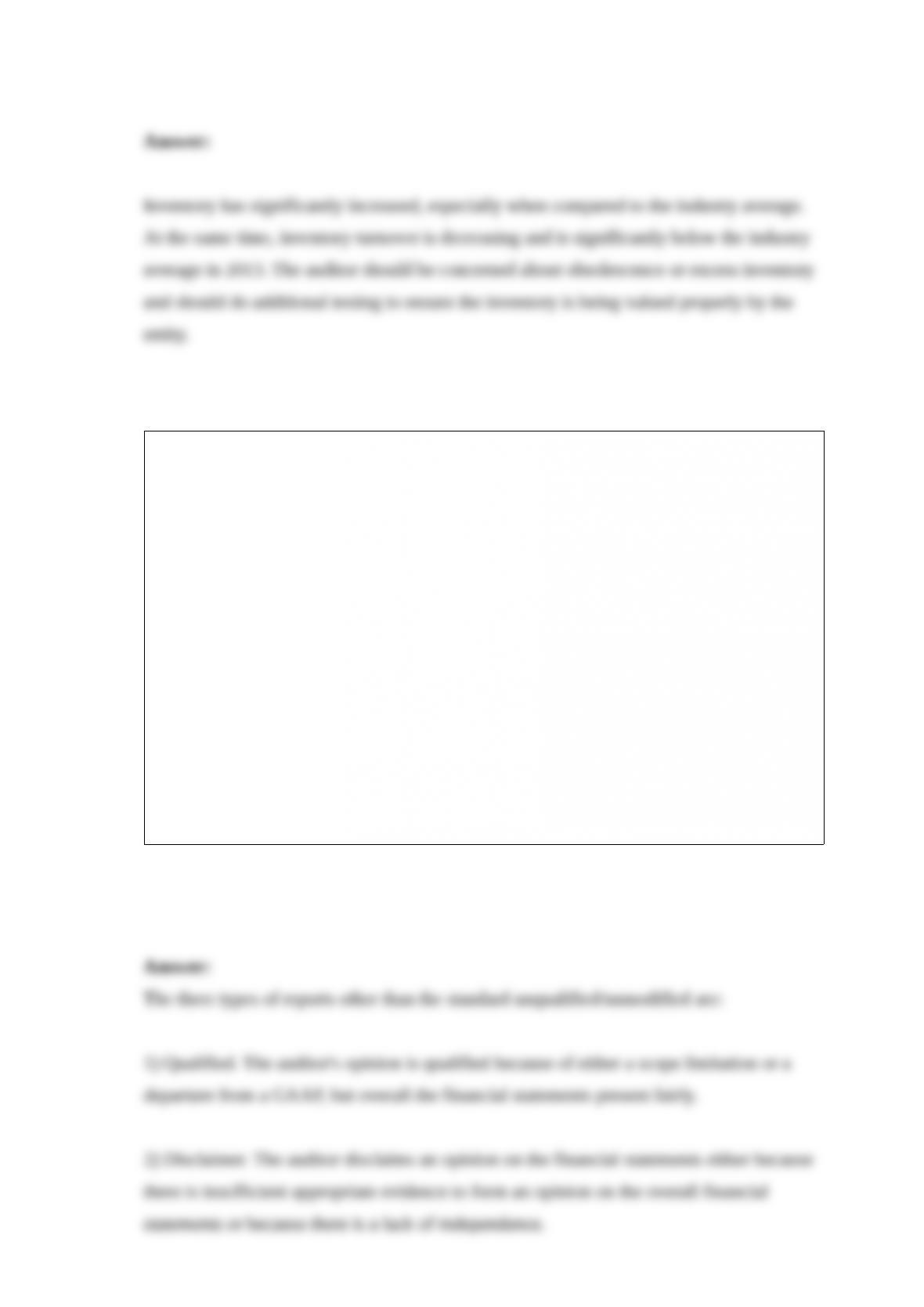
Below is information relating to the inventory management of Quick Sell. Using
analytical procedures, identify any concerns you have about misstatements in the
financial statements.
Discuss the conditions that prohibit the auditor from issuing an unqualified/unmodified
opinion and the types of reports that the auditor may issue for a financial statement
audit.
There are three circumstances that may require a departure from an
unqualified/unmodified audit report:
1) Scope limitation. A scope limitation results from an inability to collect sufficient
appropriate evidence, such as when management prevents the auditor from conducting
an audit procedure considered necessary.
2) Departure from GAAP. The financial statements are affected by a departure from
GAAP.
3) Lack of auditor independence. The auditor must comply with the second general
standard and the Code of Professional Conduct in order to issue an
unqualified/unmodified opinion.
Identify the three major types of transactions that occur in stockholders’ equity.
Identify the special purpose framework used in each of the following situations.
1) A real estate company reports to its partners on the basis used to complete the income
tax return.
2) A company has its financial statements prepared on a price-level adjusted basis as
required by its lender.
3) An insurance company reports in compliance with the rules of a state insurance
commission.
4) A partnership reports on revenues received and expenses paid.
What modifications must be made to the standard auditor’s report for these situations?
Why must an auditor assess materiality?
You are performing an audit on North South Natural Gas (NSNG). Alana, an NSNG
employee, has responsibility for reconciling bank statements with the entity’s cash
accounts. You determine, however, that Alana has never been taught how to reconcile
statements. In effect, the statements have not been properly reconciled for two years.
How would you judge the significance of this control deficiency? How would you
classify this deficiency?
For an auditor, how are management assertions useful?
Briefly describe the Sarbanes-Oxley Act of 2002. Be sure to mention (1) who passed
the Act, (2) its primary objectives, (3) major aspects of the Act, (4) the parties that it
affects, and (5) its relationship to the SEC rules.
The auditor can often obtain sufficient appropriate evidence in the audit of a tax
provision without the use of a specialist. However, several situations may indicate a
need for the auditor to involve a tax specialist. Identify three of these situations.
Discuss the steps used by an auditor to evaluate an entity’s ability to continue as a going
concern.
Trumpeter Corporation is a small publicly traded company that specializes in the
restoration and sale of fine musical instruments. The audit committee is made up of a
CEO from a technology company, a college accounting professor, and a local marketing
executive. All are sufficiently independent from management. Members of the audit
committee meet three times a year. Each time they meet, a different member, who
chooses the topics to discuss, leads the meeting. The audit committee then sends the
minutes of its meetings to the entity’s CFO. Solely from this information, what are your
conclusions about this audit committee’s role within the control environment?
Listed below are six assertions regarding the financial presentations made in the
revenue process. For each, give an example of how an auditor could use one of the
types of documents contained in the revenue process to test the assertion.
Occurrence
Completeness
Authorization
Accuracy
Cutoff
Classification
Sally Thompson’s company, Sally’s Shoes, is a successful shoe retail business with one
store. Sally would like to expand to two locations, but the bank has asked for an
independent audit before it will provide financing. Sally hires her brother-in-law,
George Thompson, to perform the audit. George has experience in auditing non-profit
organizations and he decides to perform the audit the same way as his other audits.
After completing all the steps of the audit process, George issues an unqualified opinion
indicating that he is certain that the company’s financial statements contain no
misstatements. Comment on any potential problems with George’s audit of Sally’s
Shoes.