1) After conducting a market research study, Stewart Manufacturing decided to produce
a new interior door to complement its exterior door line. It is estimated that the new
interior door can be sold at a target price of $120. The annual target sales volume for
interior doors is 20,000. Stewart has a 20% expected return on sales target.
What is the target cost for each interior door?
A) $96
B) $116
C) $120
D) $90
2) Cost-volume-profit analysis assumes all of the following EXCEPT:
A) all costs are purely variable or fixed
B) units manufactured equal units sold
C) total variable costs remain the same over the relevant range
D) total fixed costs remain the same over the relevant range
3) At Deutschland Electronics, product lines are charged for call center overhead costs
based on sales revenue. Last year’s summary of call center operations revealed the
following:
Surveillance ProductsSpecialty Products
Number of calls for information1,0004,000
Average call length for information 3 minutes8 minutes
Number of calls for warranties3001,200
Average call length for warranties7 minutes15 minutes
Sales revenue$8,000,000$5,000,000
Deutschland Electronics currently allocates call center overhead costs using a rate of
0.5% of sales revenue.
a. Compute the amount of call center overhead costs allocated to each product line
under the current system.
b. Assume Deutschland decides to use the average call length for information to assign
last year’s overhead costs. Does this allocation method seem more appropriate than
percentage of sales? Why or why not?
c. Assume Deutschland decides to use the numbers of calls of both types to assign last
year’s overhead costs of $65,000. Compute the amount of call center overhead costs
assigned to each product line under this revised ABC system.
d. Deutschland Electronics assigns bonuses based on departmental profits. How might
the Specialty Products manager try to obtain higher profits for next year if overhead
costs are assigned based on the average call length for information?
e. Discuss the barriers for implementing ABC for this call center.
4) Problems may arise when developing a Balanced Scorecard for all of the following
reasons EXCEPT:
A) poor organizational process for development and implementation of the Balanced
Scorecard
B) too few scorecard measures
C) senior executives share the strategy and Scorecard with middle managers and
employees on the front line
D) none of the above
5) Target costing was pioneered:
A) in Detroit in the 1990s
B) in Japan in the 1960s
C) in Japan in the 1980s
D) in Silicon Valley in the 1980s
6) The sales plan and inventory plan is compared to available productive capacity levels
and ________ is determined.
A) an aggregate plan
B) a new sales plan
C) a materials purchasing plan
D) an administrative and discretionary spending plan
7) ________ summarizes expenditures for advertising and research and development.
A) The labor hiring and training plan
B) The production plan
C) The administrative and discretionary spending plan
D) The aggregate plan
8) Marketing, selling, distribution, and administrative expenses:
A) can be traced through causal relationships to products
B) are independent of volume and product mix
C) are usually incurred through a single distribution channel
D) do not work well with activity based costing
9) The monitoring phase of the process of control in MACS focuses on:
A) research and development, design, manufacturing, marketing, and service
B) comparing the planned level to current performance to identify discrepancies
C) measuring the current level of performance
D) selecting measures to determine how well objectives are met
10) Different products consume different proportions of overhead costs because of
differences in all of the following EXCEPT:
A) sales prices
B) customers’ customization specifications
C) setup times
D) product design
11) Which of the following is NOT a role of budgeting in organizations?
A) performance evaluation
B) historical financial statements
C) allocation of resources
D) motivation of employees
12) Which of the following is an essential element of employee empowerment?
A) allowing employees to participate in decision making
B) ensuring employees understand the information they are generating
C) ensuring employees understand the information they are using
D) All of the above
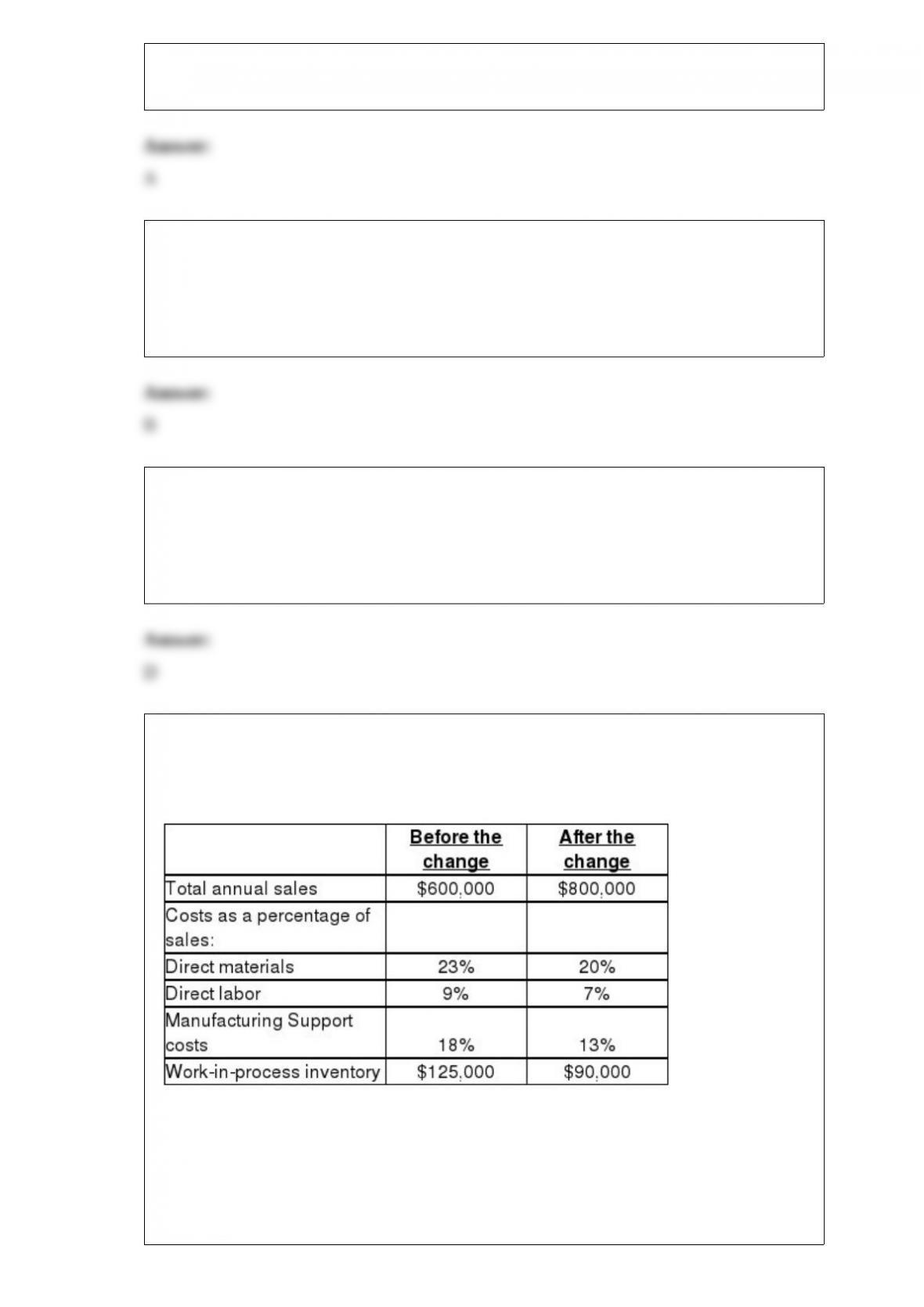
13) Umberger Manufacturing, Inc., is considering reorganizing its plant into
manufacturing cells. The following estimates have been prepared to evaluate the
benefits from the reorganization:
Inventory carrying costs are estimated to be 10% per year.
As a result of the layout reorganization, reduced levels of work-in-process inventory are
projected to decrease inventory carrying costs annually by:
A) $12,500
B) $ 9,000
C) $ 6,000
D) $ 3,500
14) Activity-based costing (ABC) can eliminate cost distortions because ABC:
A) develops cost drivers that directly link the activities performed to the products
manufactured
B) establishes multiple cost pools
C) employs capacity-related cost drivers
D) recognizes interactions between different departments in assigning overhead costs
15) The introduction of a new management accounting system is MOST likely to
motivate UNWANTED employee behavior when it is used for:
A) evaluation
B) planning
C) decision making
D) coordinating individual efforts
16) A local unit is evaluated as a profit center but the corporate office controls many
facets of the operation. If local-unit performance is poor, it may reflect:
A) poor corporate decisions
B) poor local decisions
C) conditions that no one can control
D) All of the above are correct
17) For 2011, Steve’s Plastics Manufacturing uses a normal job order costing system.
The accounting records contain the following information:
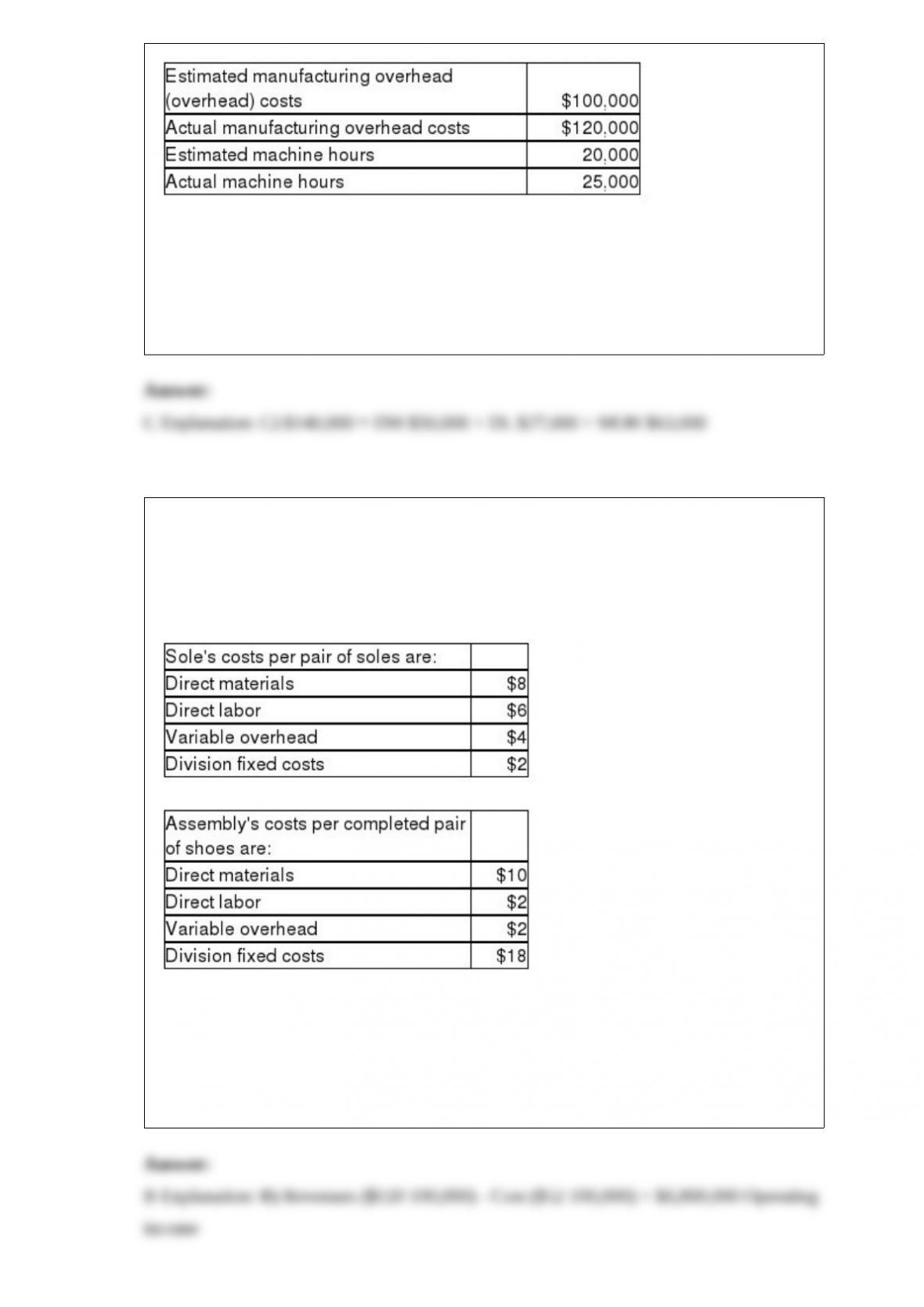
The only cost driver is machine hours.
Estimated total product costs for this special order equal:
A) $77,000
B) $97,000
C) $140,000
D) $175,000
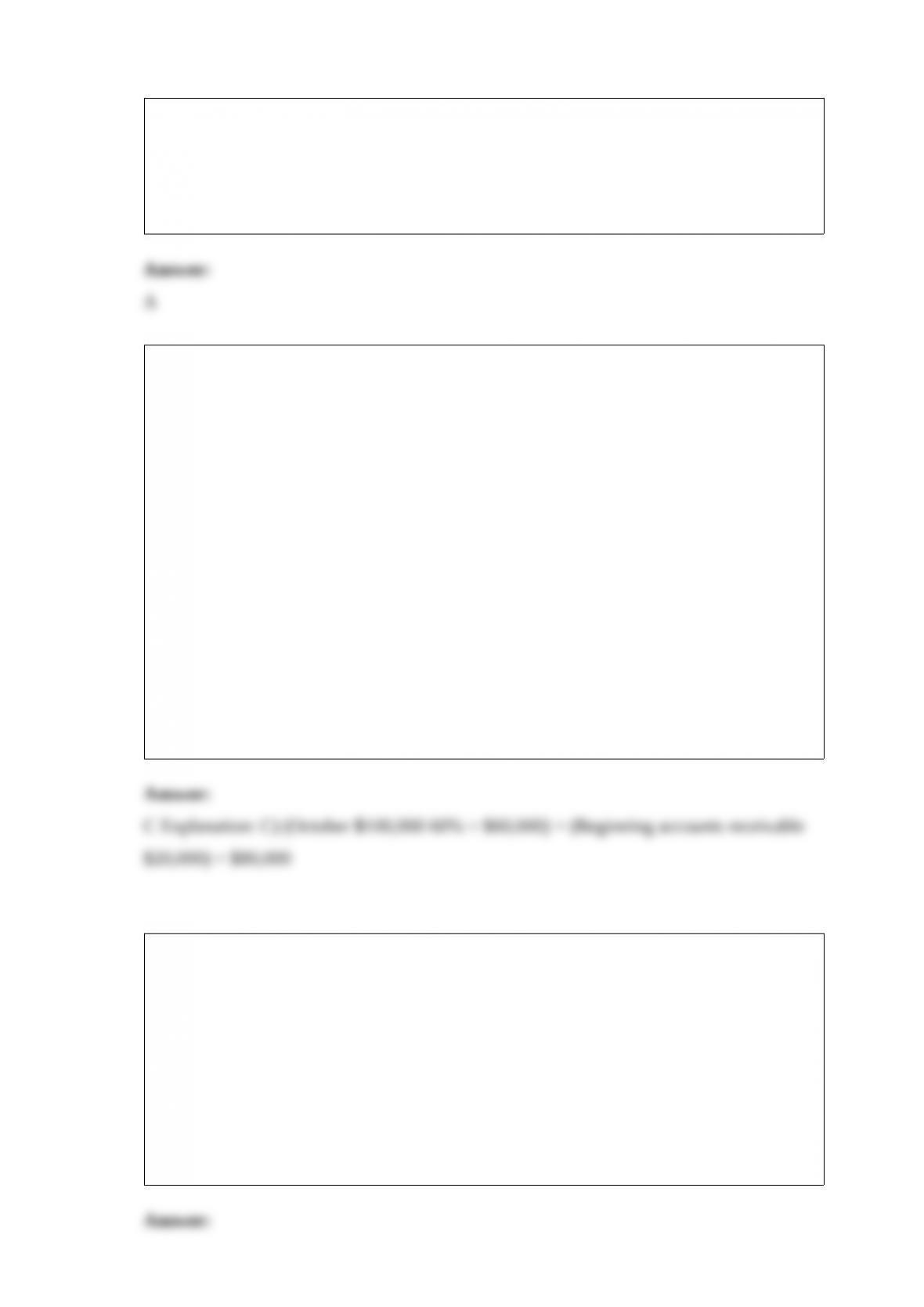
18) The Jordan Company manufacturers only one type of shoe and has two divisions,
the Sole Division and the Assembly Division. The Sole Division manufactures soles
and then ‘sells” them to the Assembly Division, which completes the shoes and sells
them to retailers. The market price for the Assembly Division to purchase a pair of soles
is $40. Fixed costs are per pair at 100,000 units.
If the Assembly Division sells 100,000 pairs of shoes at a price of $120 a pair to
customers, what is the operating income of both divisions together?
A) $8,800,000
B) $6,800,000
C) $6,000,000
D) indeterminable
19) Operating budgets and financial budgets:
A) combined form the master budget
B) are prepared before the master budget
C) are prepared after the master budget
D) have nothing to do with the master budget
20) The following information pertains to the October operating budget for Flockhart
Corporation.
Budgeted sales for October $100,000 and November $200,000.
Collections for sales are 60% in the month of sale and 40% the next month.
Gross margin is 30% of sales.
Administrative costs are $10,000 each month.
Beginning accounts receivable (October 1) $20,000.
Beginning inventory (October 1) $14,000.
Beginning accounts payable (October 1) $60,000. (All from inventory purchases.)
Purchases are paid in full the following month.
Desired ending inventory is 20% of next month’s cost of goods sold (COGS).
No loans are outstanding on October 1
For October, budgeted cash collections are:
A) $20,000
B) $60,000
C) $80,000
D) None of the above is correct
21) Schiff Company produces seven products. PQ-6 costs $240.00 per unit under their
traditional cost system using one cost driver. An analysis of the activities and their costs
revealed that three cost drivers would be used under the new ABC system. The new cost
of PQ-6 was determined to be $190.00 per unit.
The total amount of overhead costs assigned to product PQ-6 using the traditional cost
method is ________ the total amount assigned using ABC.
A) more than
B) less than
C) identical to
D) approximately the same
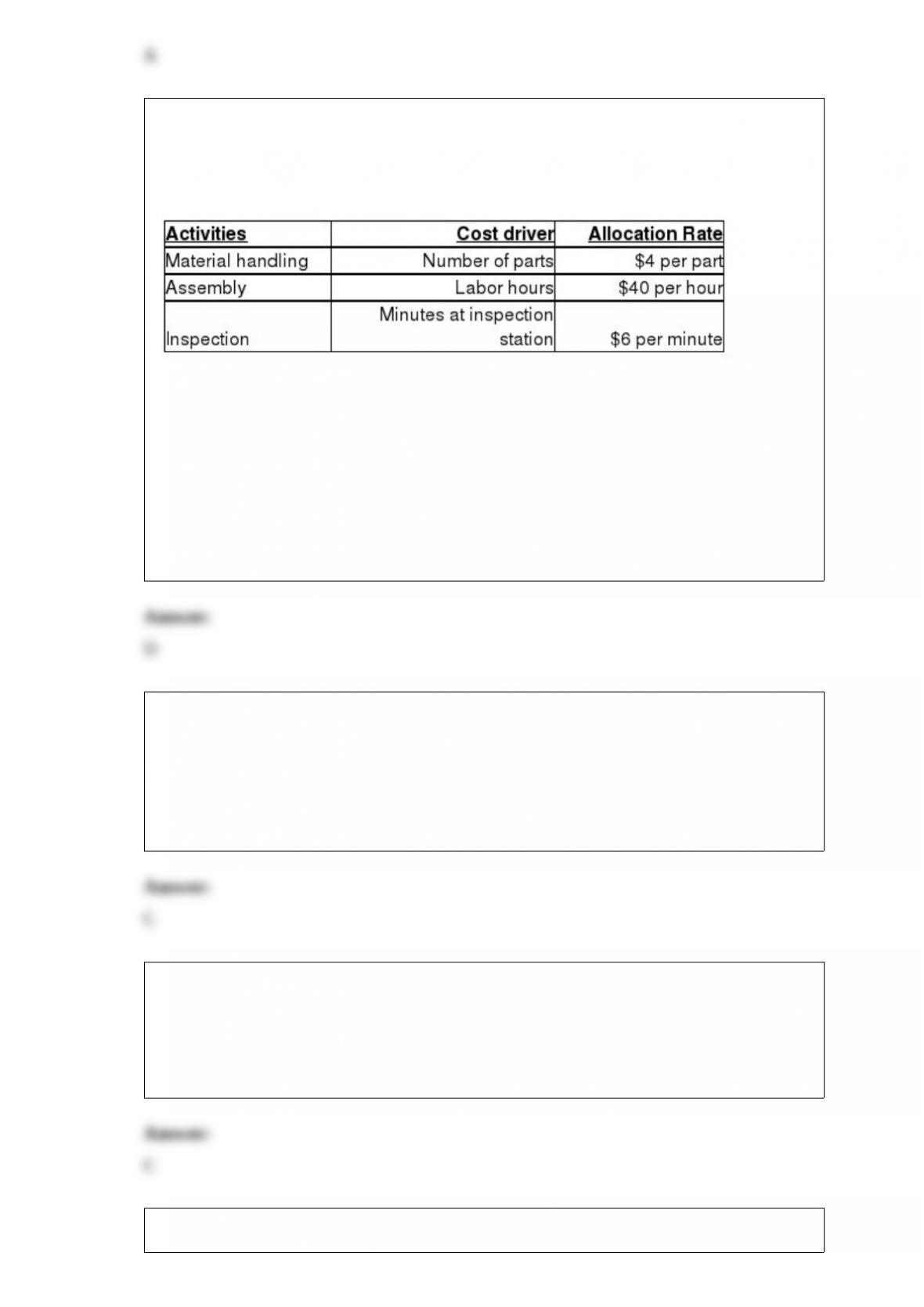
22) Merrill, Inc. manufactures remote controls. Currently the company uses a
plant-wide rate for allocating manufacturing overhead costs. The plant manager
believes it is time to refine the method of cost allocation and has the accounting
department identify the primary production activities and their cost drivers:
The current traditional cost method allocates overhead costs based on direct labor hours
using a rate of $400 per labor hour.
What are the manufacturing overhead costs per remote control assuming the traditional
cost method is used and a batch of 500 remote controls are produced? The batch
requires 1,000 parts, 10 direct labor hours, and 15 minutes of inspection time.
A) $4,000.00 per remote control
B) $0.50 per remote control
C) $4.00 per remote control
D) $8.00 per remote control
23) Persuading customers to use a greater score of the company’s products and services
is an example of:
A) process improvements
B) activity based pricing
C) managing relationships
D) the pricing waterfall
24) Managers of service departments need all of the following information EXCEPT:
A) efficiency data on work performance
B) quality data on work performance
C) profitability data of the whole company
D) profitability data of the service department
25) Power Cycle Manufacturing, Inc., is considering reorganizing its plant into
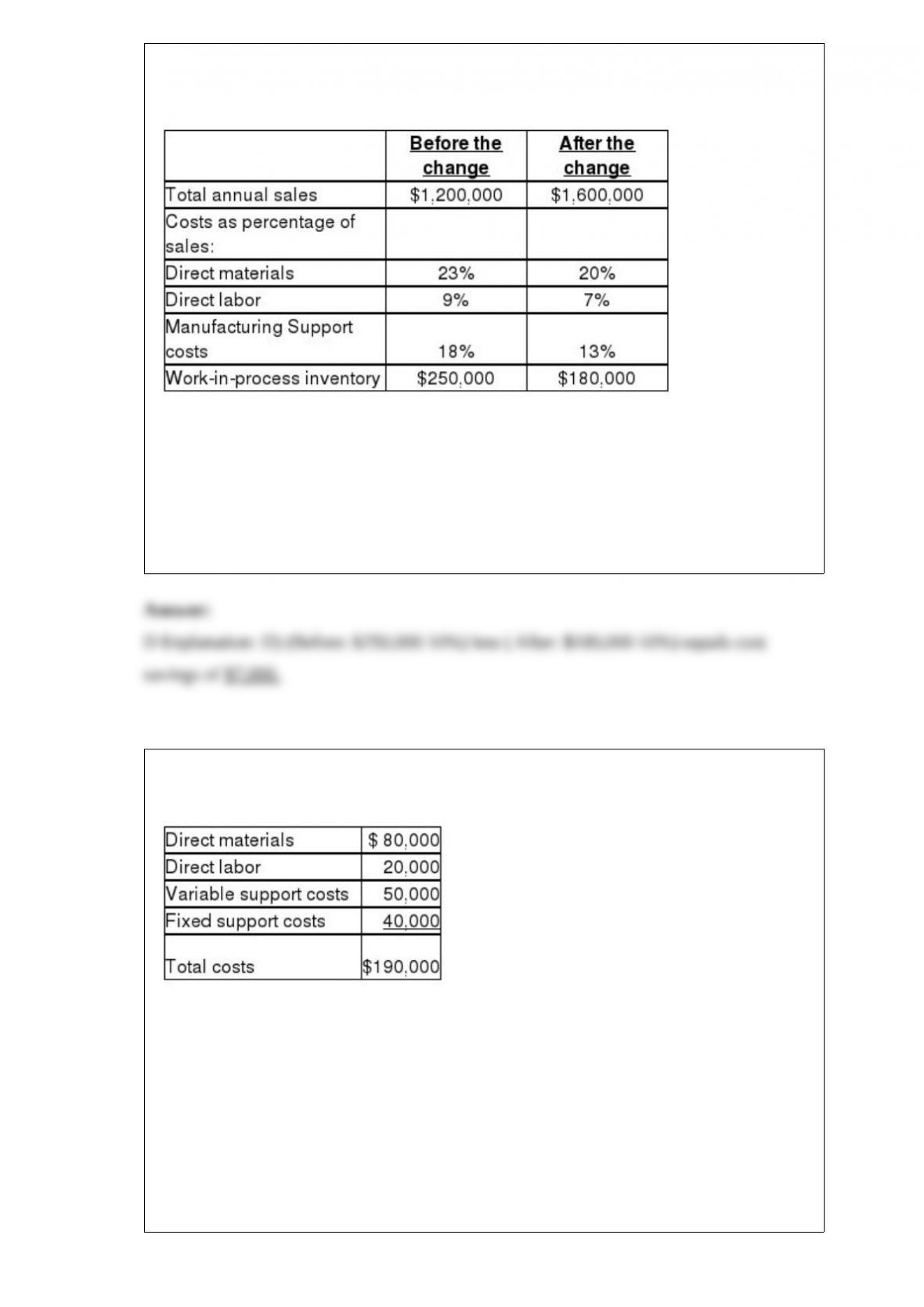
manufacturing cells. The following estimates have been prepared to evaluate the
benefits from the reorganization:
Inventory carrying costs are estimated to be 10% per year.
As a result of the layout reorganization, reduced levels of work-in-process inventory are
projected to decrease inventory carrying costs annually by:
A) $25,000
B) $ 18,000
C) $ 12,000
D) $ 7,000
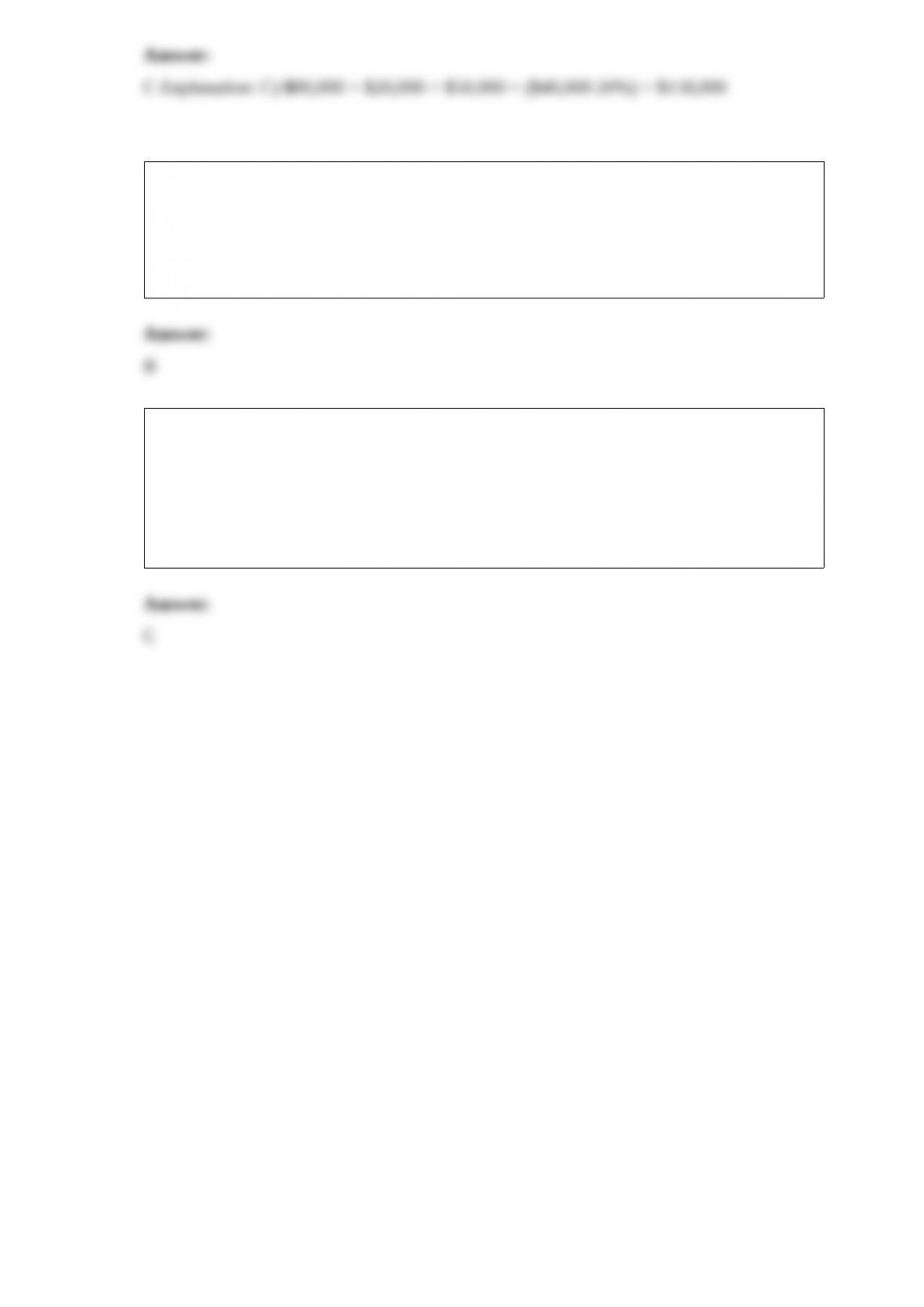
26) Fair Engineering Company manufactures part QE767 used in several of its engine
models. Monthly production costs for 10,000 units are as follows:
It is estimated that 20% of the fixed support costs assigned to part QE767 will no longer
be incurred if the company purchases the part from the outside supplier. Fair
Engineering Company has the option of purchasing the part from an outside supplier at
$16 per unit.
If Fair Engineering Company accepts the offer from the outside supplier, the monthly
avoidable costs (costs that will no longer be incurred) total:
A) $ 32,000
B) $ 82,000
C) $ 158,000
D) $190,000
27) A cost that depends on the amount of resource that is used is referred to as a
A) fixed cost
B) variable cost
C) direct cost
D) indirect cost
28) In a management accounting and control system design, behavioral expectations are
BEST incorporated by:
A) using a mix of short-term and quantitative performance measures
B) developing a task-related control system
C) including the organization’s code of conduct
D) monitoring behavior with time and motion studies