
1) The general fund of Gillette levied property taxes of $400,000 on November 1,
20X8. However, the property taxes are not collectible until May and August of 20X9.
Assume Gillette reports on the calendar year. On Gillette’s general fund balance sheet at
December 31, 20X8, the property taxes levied on November 1 should:
A.be reported as an asset and as a decrease in unassigned fund balance
B.be reported as an asset and as an increase in unassigned fund balance
C.be reported as an asset and as a reservation of fund balance
D.be reported as an asset and as a deferred revenue
2) On January 1, 20X6, Nichols Corporation issued 10-year bonds at par to unrelated
parties. The bonds have a 10% stated rate, face value of $300,000, and pay interest
every June 30 and December 31. On December 31, 20X9, Harn Corporation purchased
all of Nichols’ bonds in the open market at a $6,000 discount. Harn is Nichols’ 80
percent owned subsidiary. Harn uses the effective interest method of amortization. The
consolidated income statement for the year 20X9 should report with respect to the
bonds:
I. interest expense of $30,000.
II. an extraordinary gain of $6,000.
A.I
B.II
C.Either I or II
D.Neither I nor II
3) A voluntary health and welfare organization reports pledges receivable on its
statement of financial position at the present value of the future cash collections. How is
the increase in the present value of the pledges receivable, which is due to the passage
of time, reported on the voluntary health and welfare organization’s statement of
activities?
A.As interest income-temporarily restricted
B.As an increase in pledges receivable-temporarily restricted
C.As an increase in contributions-temporarily restricted
D.As an increase in deferred revenue-temporarily restricted
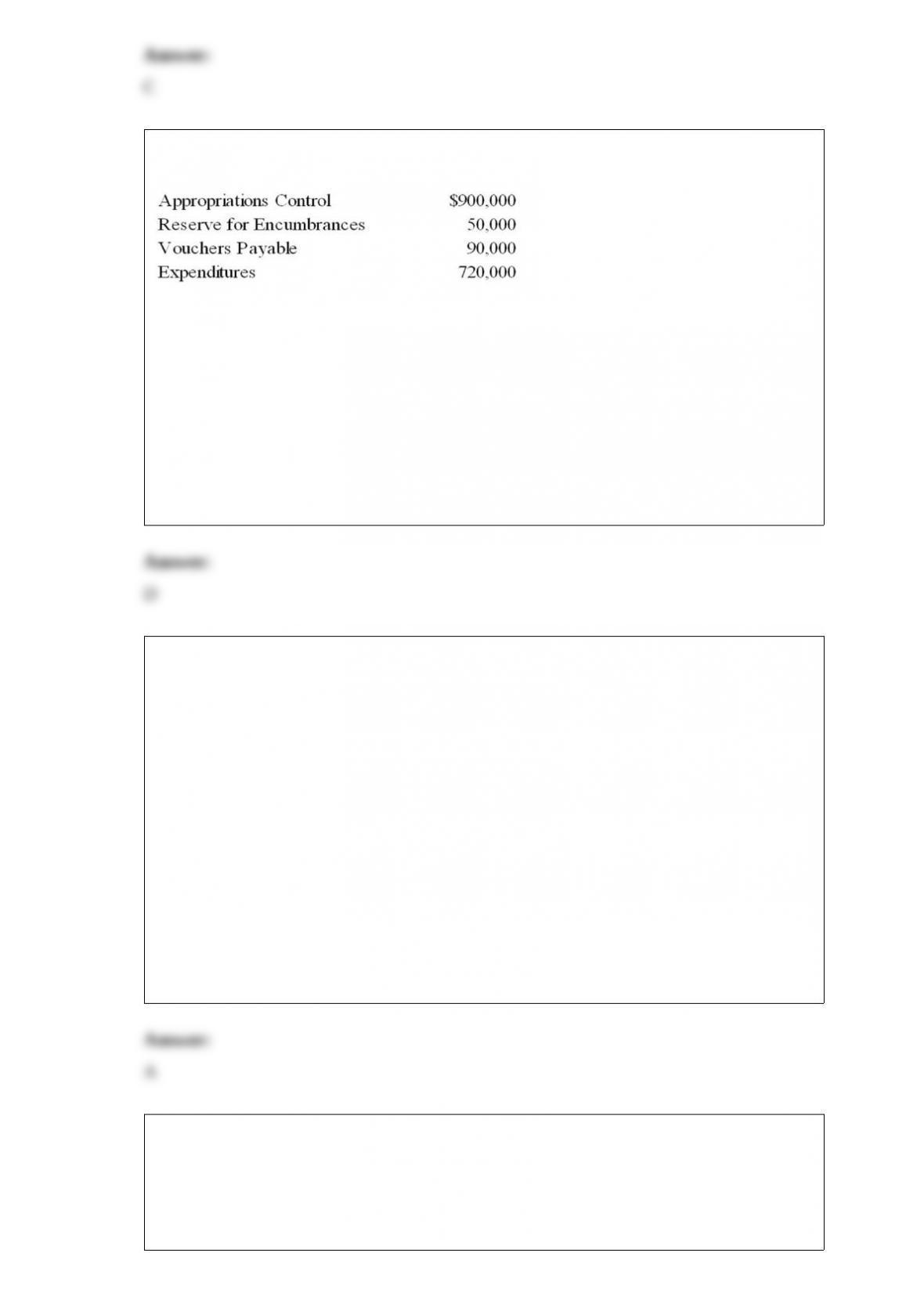
4) The general ledger of Broadway contains the following selected account balances:
Broadway wants to order additional goods and services before the fiscal year end. What
is the unencumbered balance of the budget that may be expended by Broadway?
A.$850,000
B.$760,000
C.$180,000
D.$130,000
5) ABC Corporation owns 75 percent of XYZ Company’s voting shares. During 20X8,
ABC produced 50,000 chairs at a cost of $79 each and sold 35,000 chairs to XYZ for
$90 each. XYZ sold 18,000 of the chairs to unaffiliated companies for $117 each prior
to December 31, 20X8, and sold the remainder in early 20X9 to unaffiliated companies
for $130 each. Both companies use perpetual inventory systems.
Based on the information given above, what amount of cost of goods sold did ABC
record in 20X8?
A.$2,765,000
B.$1,620,000
C.$1,422,000
D.$2,963,000
6) Note: This is a Kaplan CPA Review Question
Financing for the renovation of Fir City’s municipal park, begun and completed during
20X4, came from the following sources:
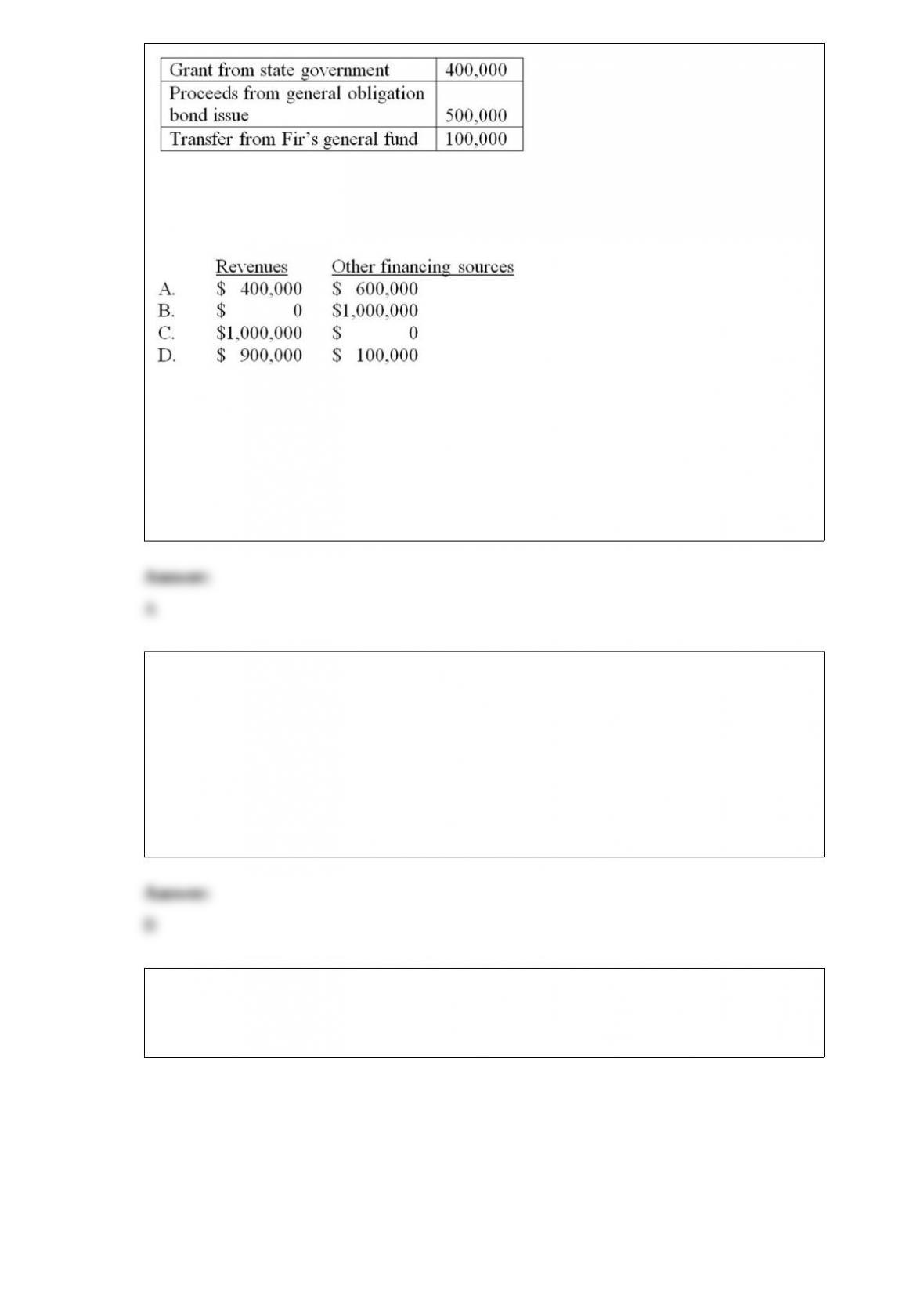
In its 20X4 capital projects fund operating statement, Fir should report these amounts
as:
A.Option A
B.Option B
C.Option C
D.Option D
7) The payment to general unsecured creditors is often termed:
A.a “preference payment.”
B.a “dividend.”
C.a “write-off.”
D.a “bonus.”
8) The Town of Baker reported the following items on the June 30, 20X9, balance sheet
of its general fund:
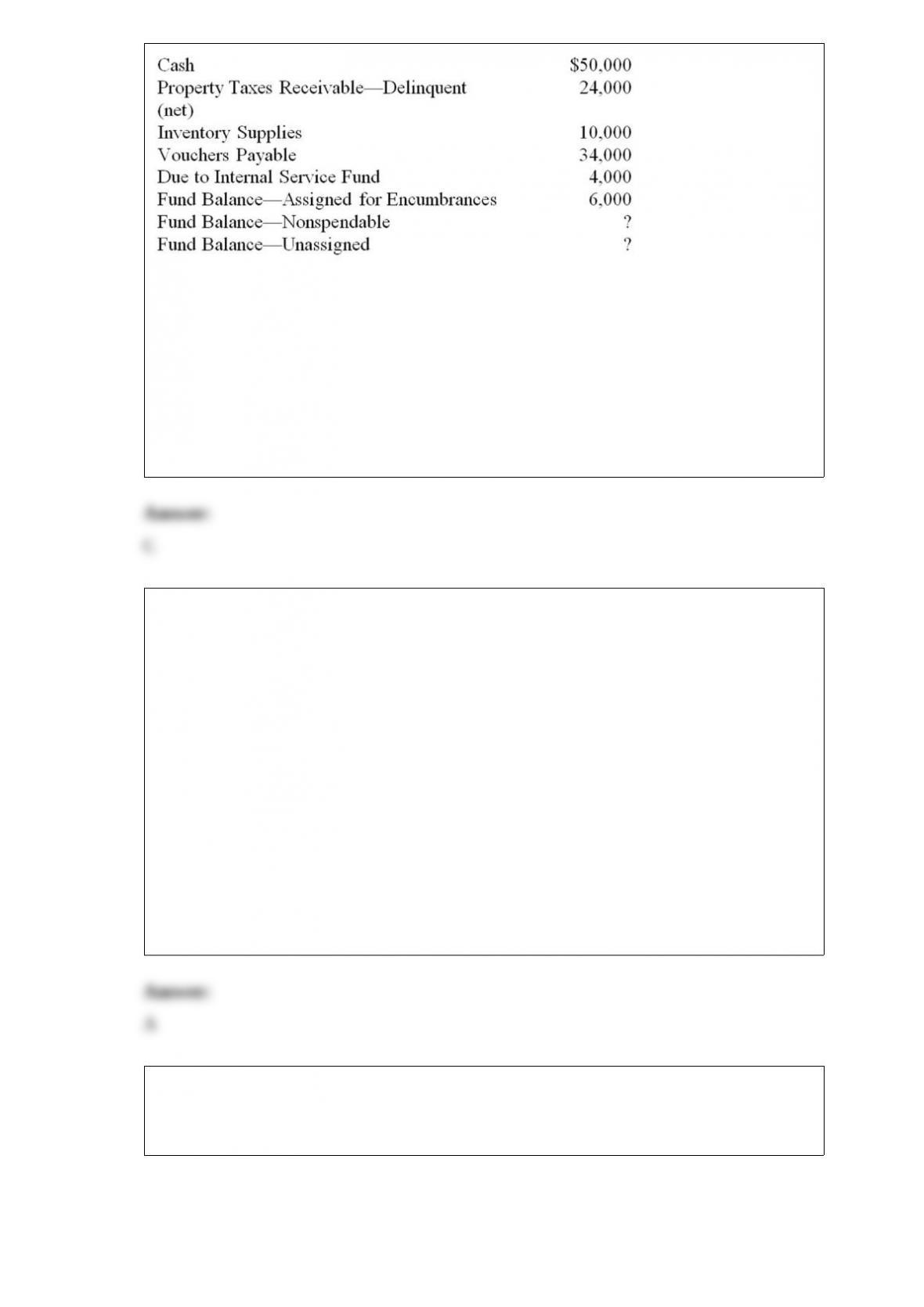
At June 30, 20X9, what amount should be reported for Fund BalanceUnassigned?
A.$46,000
B.$40,000
C.$30,000
D.$16,000
9) During the fiscal year ended June 30, 20X9, Global Charities, a voluntary health and
welfare organization, received unrestricted cash contributions of $500,000 and
temporarily restricted cash contributions of $300,000. All of the temporarily restricted
contributions were restricted by the donors for equipment acquisitions. During the year
ended June 30, 20X9, equipment costing $250,000 was acquired with the restricted
contributions. As a result of these two contributions, Global Charities’ statement of cash
flows, prepared for the year ended June 30, 20X9, would report an increase in net cash
provided by operating activities of:
A.$500,000
B.$800,000
C.$750,000
D.$550,000
10) Golden Path, a labor union, had the following receipts and expenses for the year
ended December 31, 20X8:
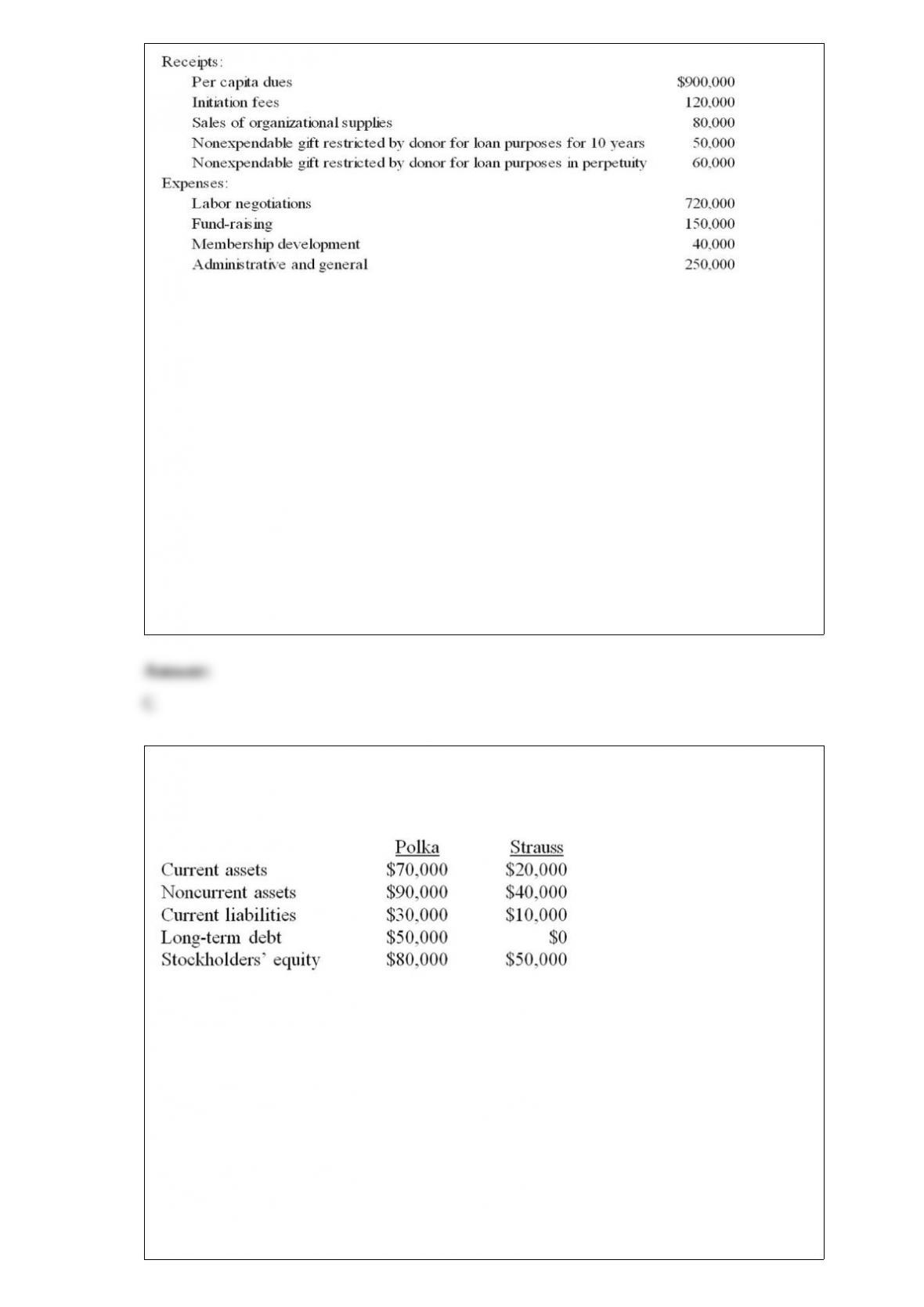
The union’s constitution provides that 12 percent of the per capita dues be designated
for the strike insurance fund to be distributed for strike relief at the discretion of the
union’s executive board.
Based on the information provided, in Golden Path’s statement of activities for the year
ended December 31, 20X8, what amount should be reported under the classification of
supporting services?
A.$150,000
B.$720,000
C.$440,000
D.$290,000
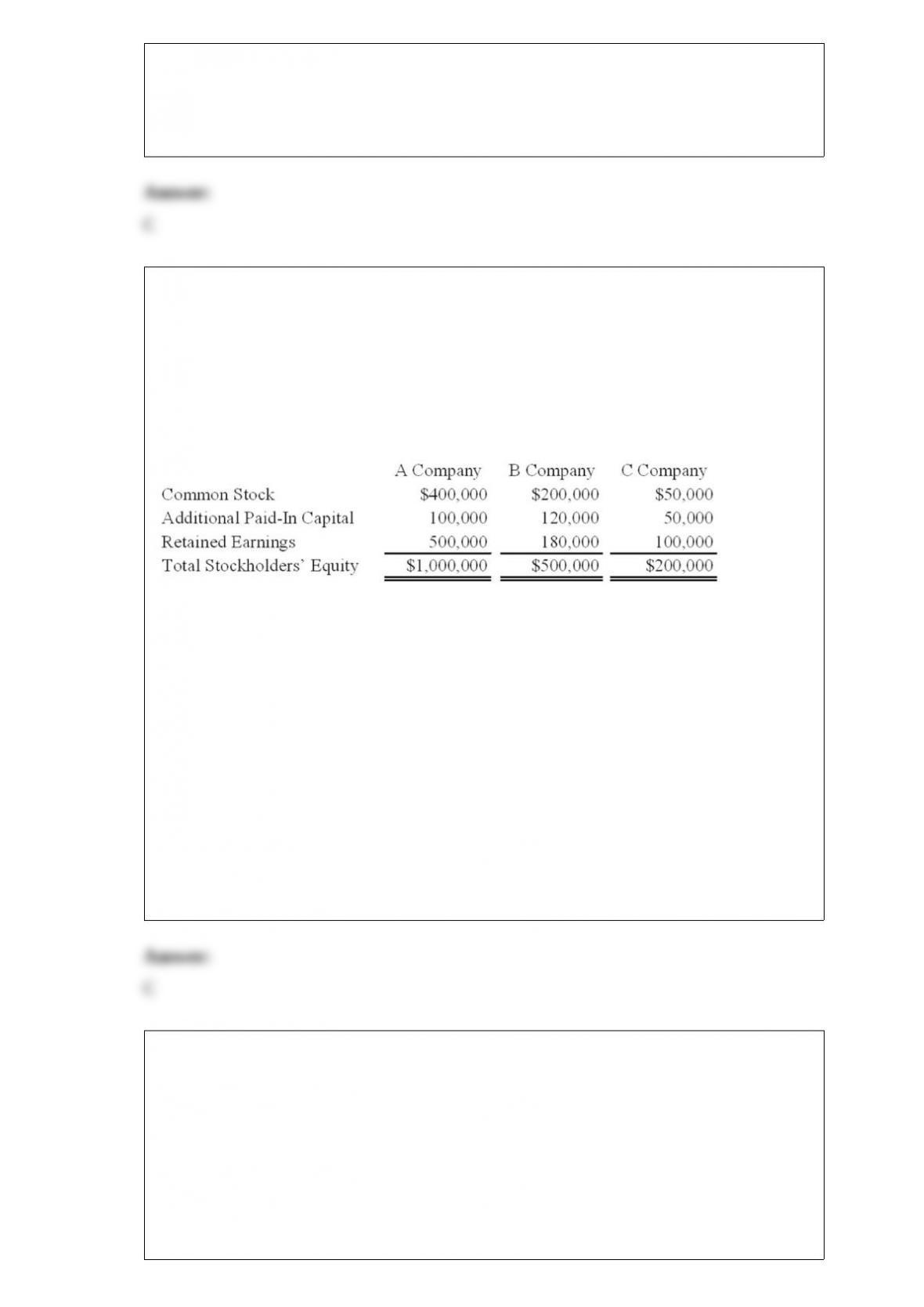
11) On January 1, 20X6, Polka Co. (Polka) and Strauss Co. (Strauss) had condensed
balance sheets as follows:
On January 2, 20X6, Polka borrowed $90,000 and used the proceeds to acquire 90% of
the outstanding common shares of Strauss. This debt is payable in ten equal annual
principal and accrued interest payments beginning December 30, 20X6. On the
acquisition date, the fair value of Strauss was $100,000, and the excess cost of the
investment over Strauss’s carrying amount of acquired net assets should be allocated
60% to inventory and 40% to goodwill.
Stockholders’ equity on the January 2, 20X6, consolidated balance sheet should be:
A.$85,000
B.$80,000
C.$90,000
D.$130,000
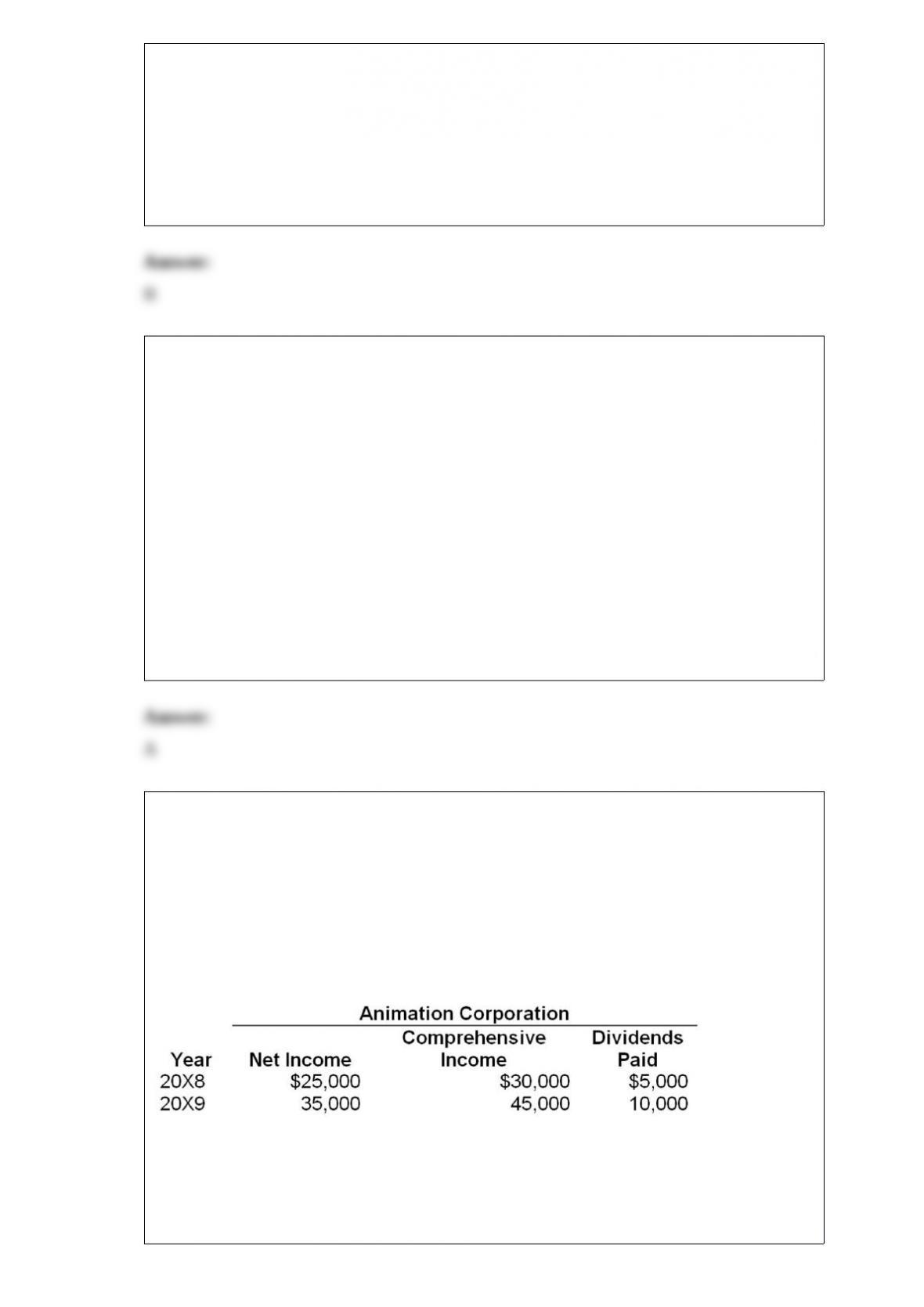
12) On January 1, 20X9, A Company acquired 85 percent of B Company’s voting
common stock for $425,000. At that date, the fair value of the noncontrolling interest of
B Company was $75,000. Immediately after A Company acquired its ownership, B
Company acquired 75 percent of C Company’s stock for $150,000. The fair value of the
noncontrolling interest of C Company was $50,000 at that date. At January 1, 20X9, the
stockholders’ equity sections of the balance sheets of the companies were as follows:
During 20X9, A Company reported operating income of $175,000 and paid dividends
of $50,000. B Company reported operating income of $125,000 and paid dividends of
$40,000. C Company reported net income of $100,000 and paid dividends of $25,000.
Based on the information provided, the equity-method income recorded by A Company
is:
A.$125,000
B.$200,000
C.$170,000
D.$181,250
13) Mortar Corporation acquired 80 percent of Granite Corporation’s voting common
stock on January 1, 20X7. On January 1, 20X8, Mortar received $350,000 from Granite
for equipment Mortar had purchased on January 1, 20X5, for $400,000. The equipment
is expected to have a 10-year useful life and no salvage value. Both companies
depreciate equipment on a straight-line basis.
Based on the preceding information, in the preparation of elimination entries related to
the equipment transfer for the 20X8 consolidated financial statements, net effect on
accumulated depreciation will be:
A.a decrease of $50,000
B.an increase of $110,000
C.an increase of $120,000
D.a decrease of $160,000
14) Master Corporation owns 85 percent of Servant Corporation’s voting shares. On
January 1, 20X8, Master Corporation sold $200,000 par value 8 percent bonds to
Servant for $245,000. The bonds mature in 10 years and pay interest semiannually on
January 1 and July 1.
Based on the information given above, what amount of investment in bonds will be
eliminated in the preparation of the 20X8 consolidated financial statements?
A.$240,500
B.$200,000
C.$245,000
D.$211,500
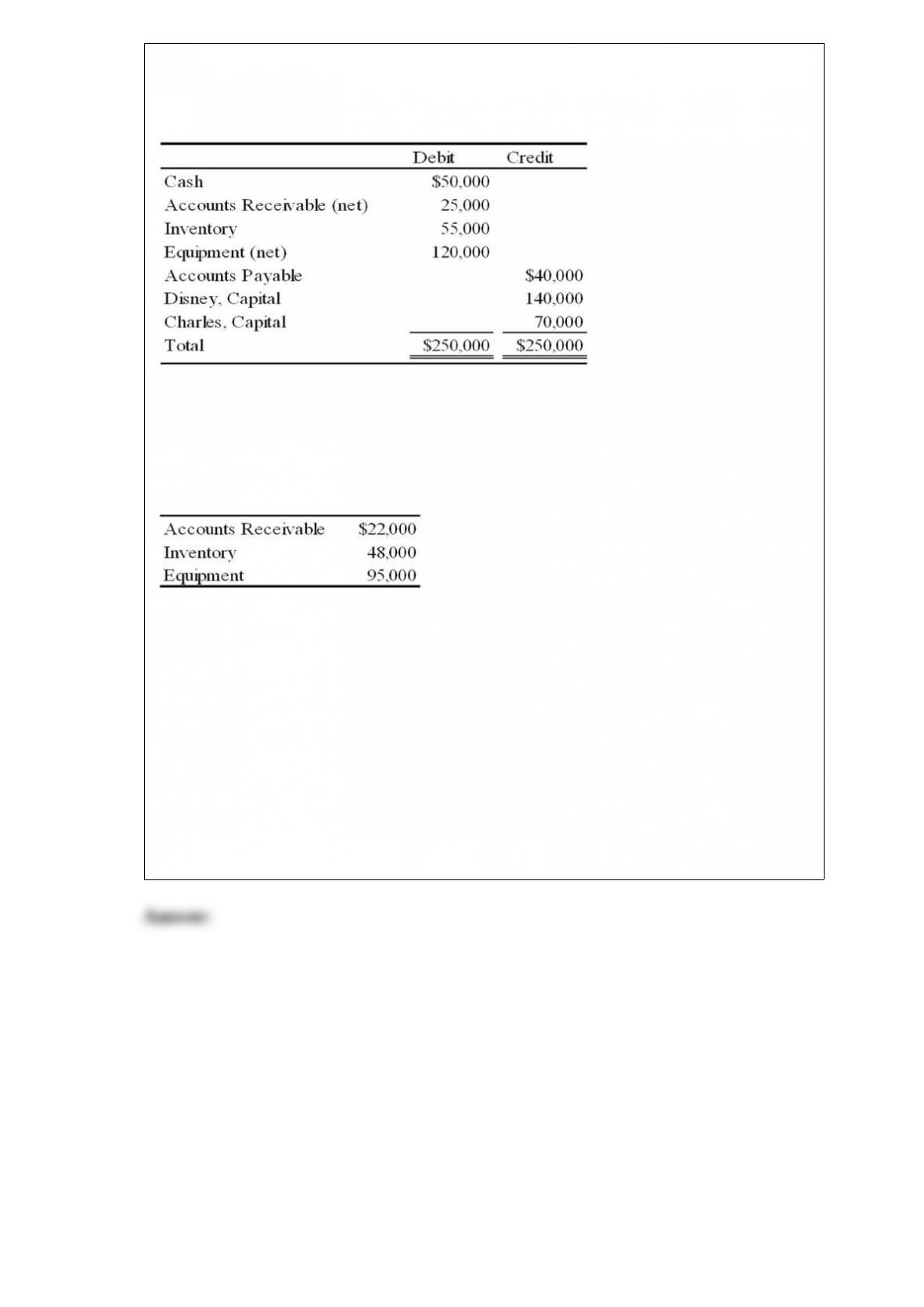
15) On January 1, 20X8, Bristol Company acquired 80 percent of Animation
Company’s common stock for $280,000 cash. At that date, Animation reported common
stock outstanding of $200,000 and retained earnings of $100,000, and the fair value of
the noncontrolling interest was $70,000. The book values and fair values of Animation’s
assets and liabilities were equal, except for other intangible assets which had a fair
value $50,000 greater than book value and an 8-year remaining life. Animation reported
the following data for 20X8 and 20X9:
Bristol reported net income of $100,000 and paid dividends of $30,000 for both the
years.
Based on the preceding information, what is the amount of consolidated comprehensive

income reported for 20X8?
A.$125,000
B.$123,750
C.$118,750
D.$130,000
16) Note: This is a Kaplan CPA Review Question
Elm City issued a purchase order for supplies with an estimated cost of $5,000. When
the supplies were received, the accompanying invoice indicated an actual price of
$4,950. What amount should Elm debit (credit) to the budgetary fund balance account
after the supplies and invoice were received?
A.$4,950
B.($50)
C.$50
D.$5,000
17) In the RST partnership, Ron’s capital is $80,000, Stella’s is $75,000, and Tiffany’s is
$50,000. They share income in a 3:2:1 ratio, respectively. Tiffany is retiring from the
partnership. Each of the following question is independent of the others.
Refer to the above information. Tiffany is paid $60,000, and no goodwill is recorded. In
the journal entry to record Tiffany’s withdrawal:
A.Tiffany, Capital will be credited for $60,000
B.Ron, Capital will be debited for $5,000
C.Stella, Capital will be debited for $4,000
D.Cash will be debited for $60,000
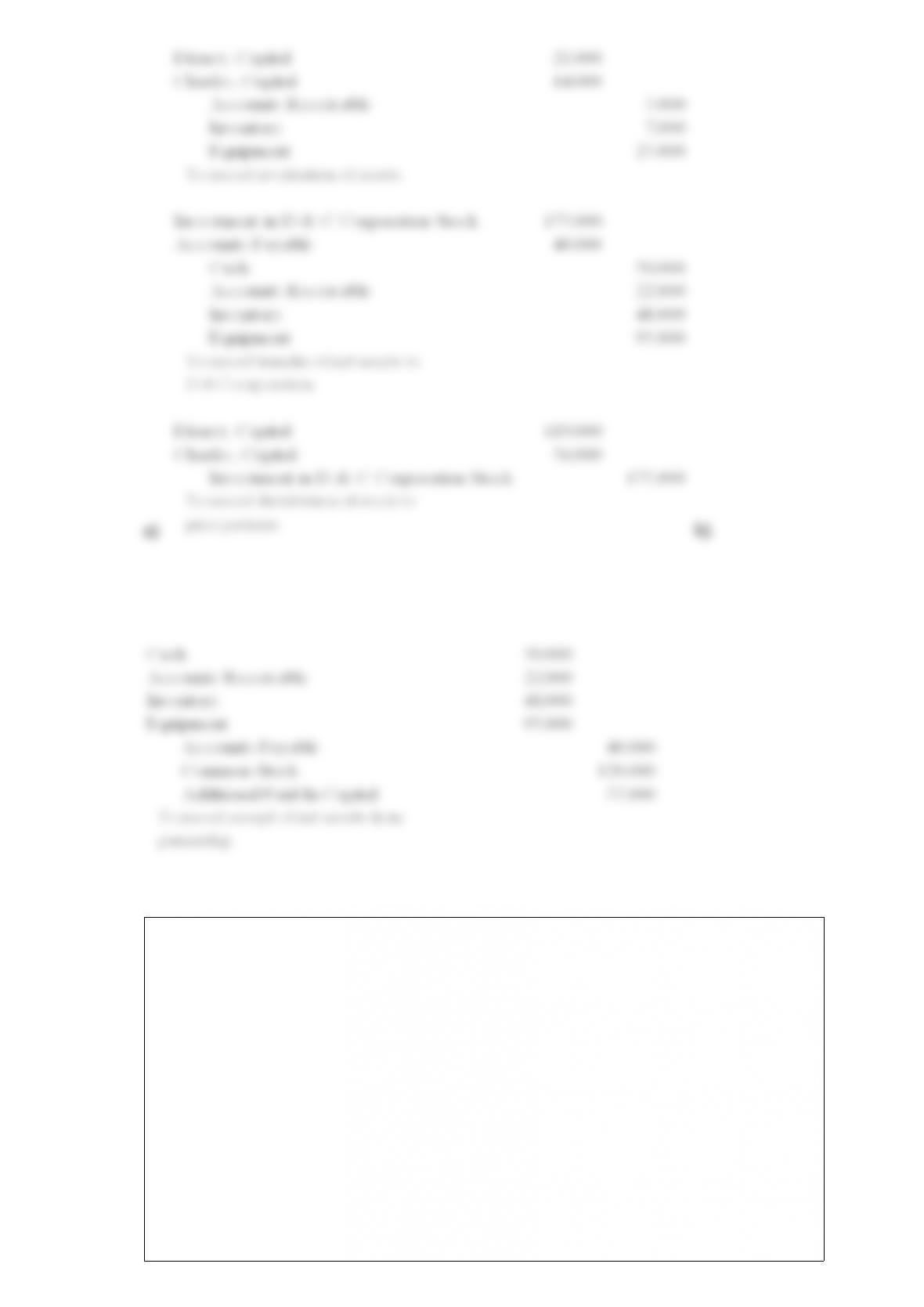
18) When Disney and Charles decided to incorporate their partnership, the trial balance
was as follows:
The partnership’s books will be closed, and new books will be used for D & C
Corporation. The following additional information is available:
1> The estimated fair values of the assets follow:
2> All assets and liabilities are transferred to the corporation.
3> The common stock is $5 par. Alice and Betty receive a total of 24,000 shares.
4> Disney and Charles share profits and losses in the ratio 6:4.
Required:
a. Prepare the entries on the partnership’s books to record (1) the revaluation of assets,
(2) the transfer of the assets to the D & C Corporation and the receipt of the common
stock, and (3) the closing of the books.
b. Prepare the entries on D & C Corporation’s books to record the assets and the
issuance of the common stock.
19) The transactions described in the following questions occurred in a voluntary health
and welfare organization during the year ended December 31, 20X8. For each
transaction, indicate its effect(s) on the organization’s statement of activities prepared
for the year ended December 31, 20X8. List all effects of transactions affecting more
than one class of net assets. Indicate your choice(s) by entering the letter corresponding
to the effects listed here:
Effects of Transactions on Statement of Activities
A. Increases unrestricted net assets.
B. Decreases unrestricted net assets.
C. Increases temporarily restricted net assets.
D. Decreases temporarily restricted net assets.
E. Increases permanently restricted net assets.

F. Decreases permanently restricted net assets.
G. Transaction is not reported on the statement of activities.
Depreciation expense for the year was recorded.
20) West, Inc. holds 100 percent of the common stock of Coast Company, an
investment acquired for $680,000. Immediately following the combination, West’s net
assets have a book value of $1,150,000 and a fair value of $1,390,000. The book value
and the fair value of Coast’s net assets on the date of combination are $400,000 and
$550,000, respectively. Immediately following the combination, a consolidated balance
sheet is prepared.
Based on the information given above, at what amount will West’s investment in Coast
stock be reported in the consolidated balance sheet?
A.$0
B.$400,000
C.$440,000
D.$480,000
21) Granite Company issued $200,000 of 10 percent first mortgage bonds on January 1,
20X4, at 105. The bonds mature in 10 years and pay interest semiannually on January 1
and July 1. Mortar Corporation purchased $140,000 of Granite’s bonds from the
original purchaser on December 31, 20X8, for $125,000. Mortar owns 75 percent of
Granite’s voting common stock.
Based on the information given above, what amount of gain or loss on bond retirement
will be reported in the 20X8 consolidated financial statements?
A.$17,000 loss
B.$12,800 loss
C.$18,500 gain
D.$22,200 gain
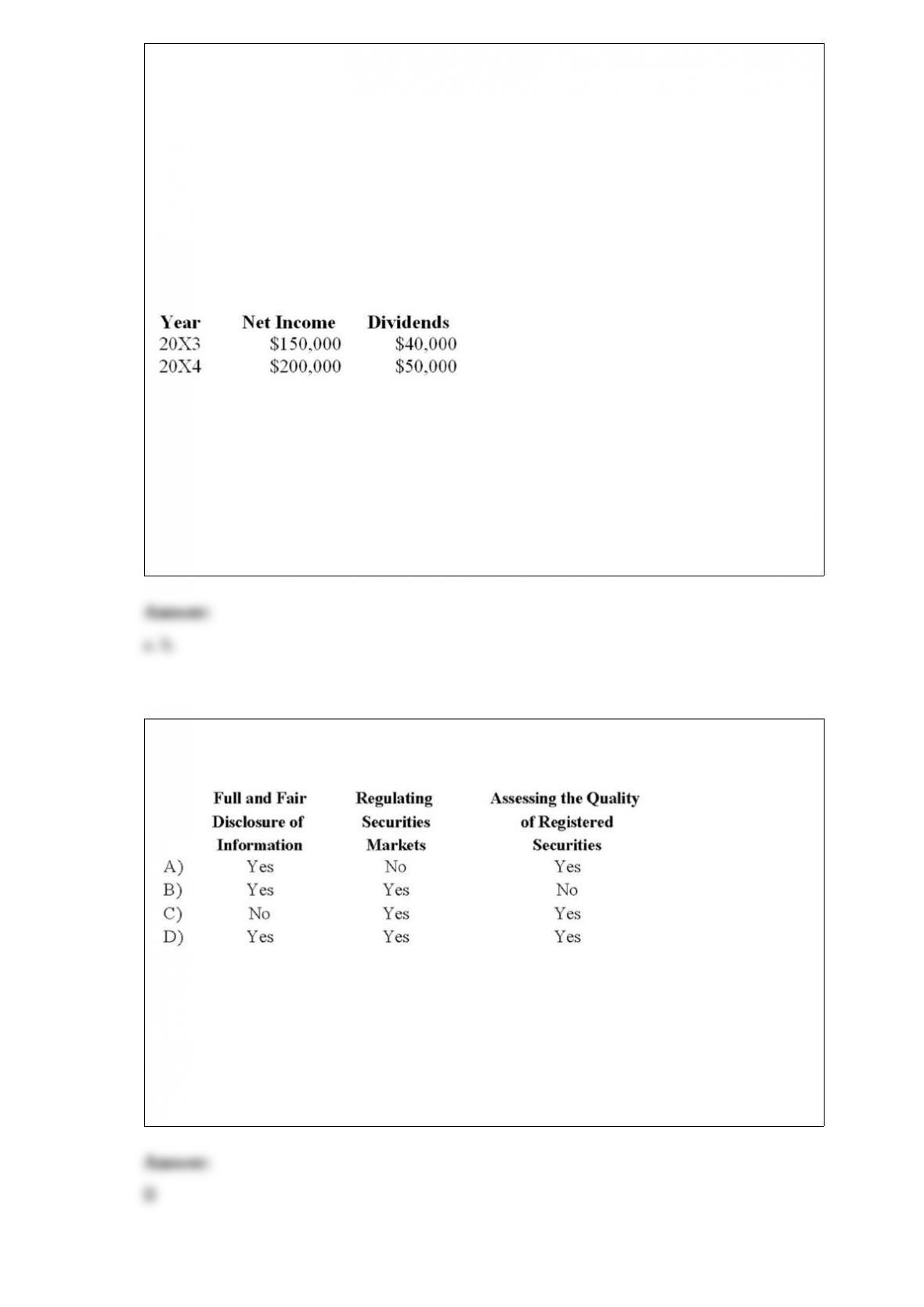
22) Pisa Company acquired 75 percent of Siena Company on January 1, 20X3 for
$712,500. The fair value of the noncontrolling interest was equal to 25 percent of book
value. On the date of acquisition, Siena had common stock outstanding of $300,000 and
a balance in retained earnings of $650,000. During 20X3, Siena purchased inventory for
$35,000 and sold it to Pisa for $50,000. Of this amount, Pisa reported $20,000 in ending
inventory in 20X3 and later sold it in 20X4. In 20X4, Pisa sold inventory it had
purchased for $40,000 to Siena for $60,000. Siena sold $45,000 of this inventory in
20X4.
Income and dividend information for Siena for 20X3 and 20X4 are as follows:
Pisa Company uses the modified equity method.
Required:
a. Present the worksheet elimination entries necessary to prepare consolidated financial
statements for 20X3.
b. Present the worksheet elimination entries necessary to prepare consolidated financial
statements for 20X4.
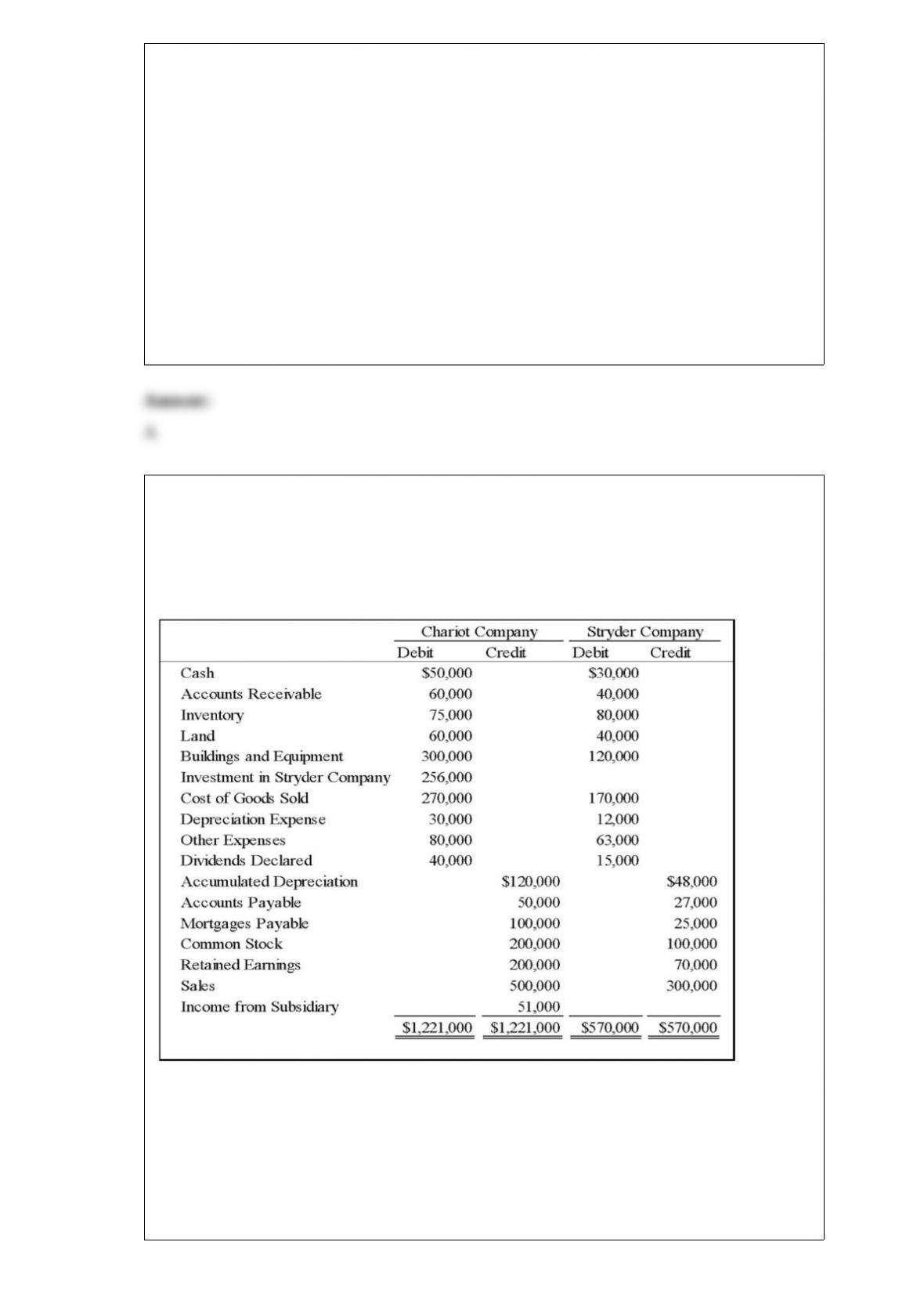
23) The Securities and Exchange Commission is responsible for:
A.Option A
B.Option B
C.Option C
D.Option D
24) At the end of the year, a parent acquires a wholly owned subsidiary’s bonds from
unaffiliated parties at a cost less than the subsidiary’s carrying value. The consolidated
net income for the year of acquisition should include the parent’s separate operating
income plus:
A.the subsidiary’s net income increased by the gain on constructive retirement of debt
B.the subsidiary’s net income decreased by the loss on constructive retirement of debt
C.the subsidiary’s net income increased by the gain on constructive retirement of debt,
and decreased by the subsidiary’s bond interest expense
D.the subsidiary’s net income decreased by the loss on constructive retirement of debt,
and decreased by the subsidiary’s bond interest expense
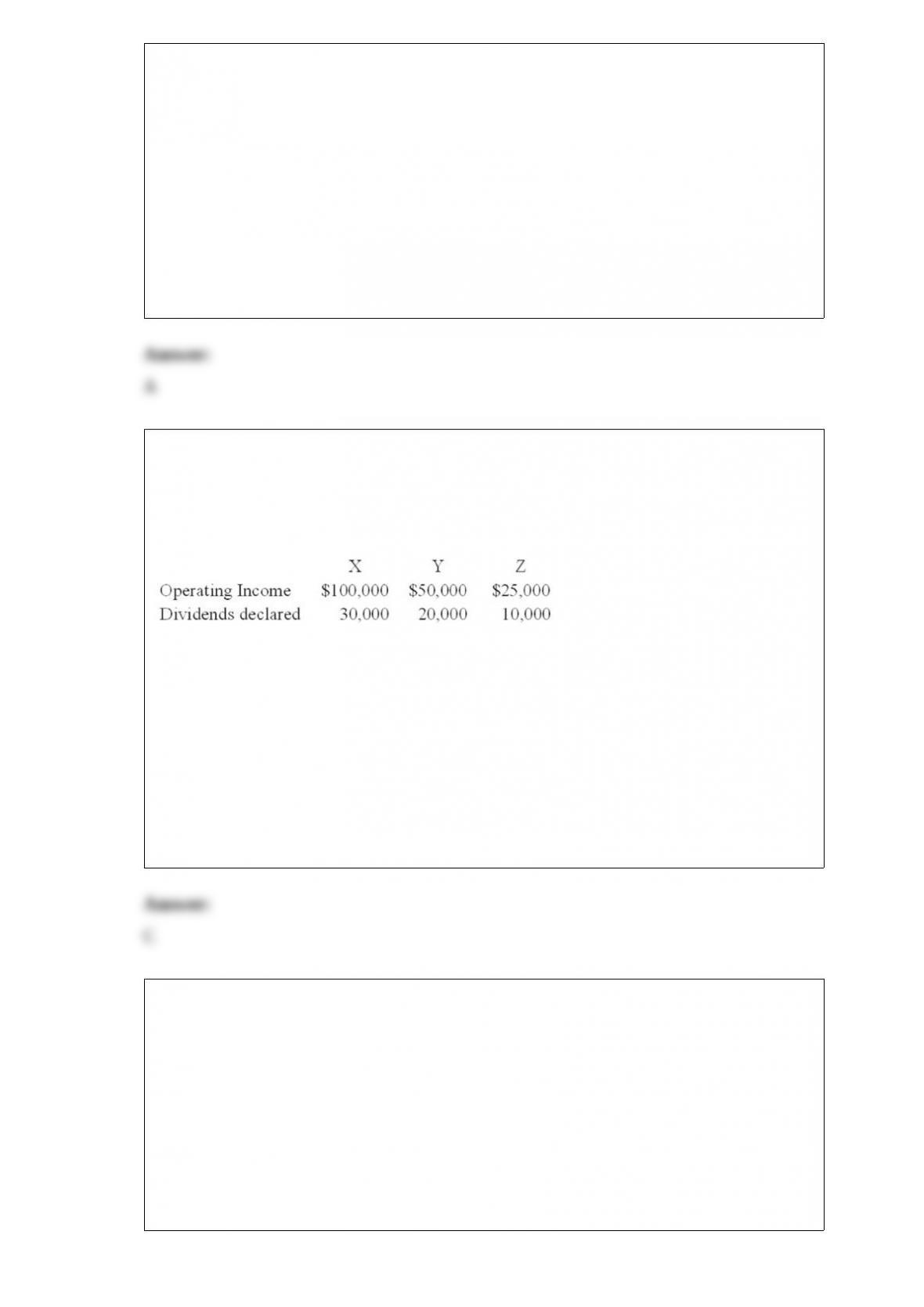
25) On January 1, 20X8, Chariot Company acquired 100 percent of Stryder Company
for $220,000 cash. The trial balances for the two companies on December 31, 20X8,
included the following amounts:
On the acquisition date, Stryder reported net assets with a book value of $170,000. A
total of $10,000 of the acquisition price is applied to goodwill, which was not impaired
in 20X8. Stryder’s depreciable assets had an estimated economic life of 10 years on the
date of combination.The difference between fair value and book value of tangible assets
is related entirely to buildings and equipment. Chariot used the equity method in
accounting for its investment in Stryder. Analysis of receivables and payables revealed
that Stryder owed Chariot $10,000 on December 31, 20X8.
Based on the information provided, what amount of retained earnings will be reported
in the consolidated financial statements for the year?
A.$331,000
B.$110,000
C.$441,000
D.$456,000
26) X Corporation owns 80 percent of Y Corporation’s common stock and 40 percent of
Z Corporation’s common stock. Additionally, Y Corporation owns 35 percent of Z
Corporation’s common stock. The acquisitions were made at book values. The
following information is available for 20X8:
Based on the information provided, what amount of income will be assigned to the
noncontrolling interest in the 20X8 consolidated income statement?
A.$23,750
B.$25,000
C.$18,000
D.$33,750
27) A private university received $280,000 from student tuition and fees for the year
20X9 summer session. The session began on June 20, 20X9, and ended on July 30,
20X9. The university’s fiscal year end is June 30. According to the
A.Current revenue of $280,000
B.Current revenue of $70,000 and deferred revenue of $210,000
C.Deferred revenue of $280,000
D.Restricted current revenue of $280,000
28) Lemon Corporation acquired 80 percent of Bricks Corporation’s common shares on
January 1, 20X7, at underlying book value. At that date, the fair value of the
noncontrolling interest was equal to 20 percent of the book value of Bricks Corporation.
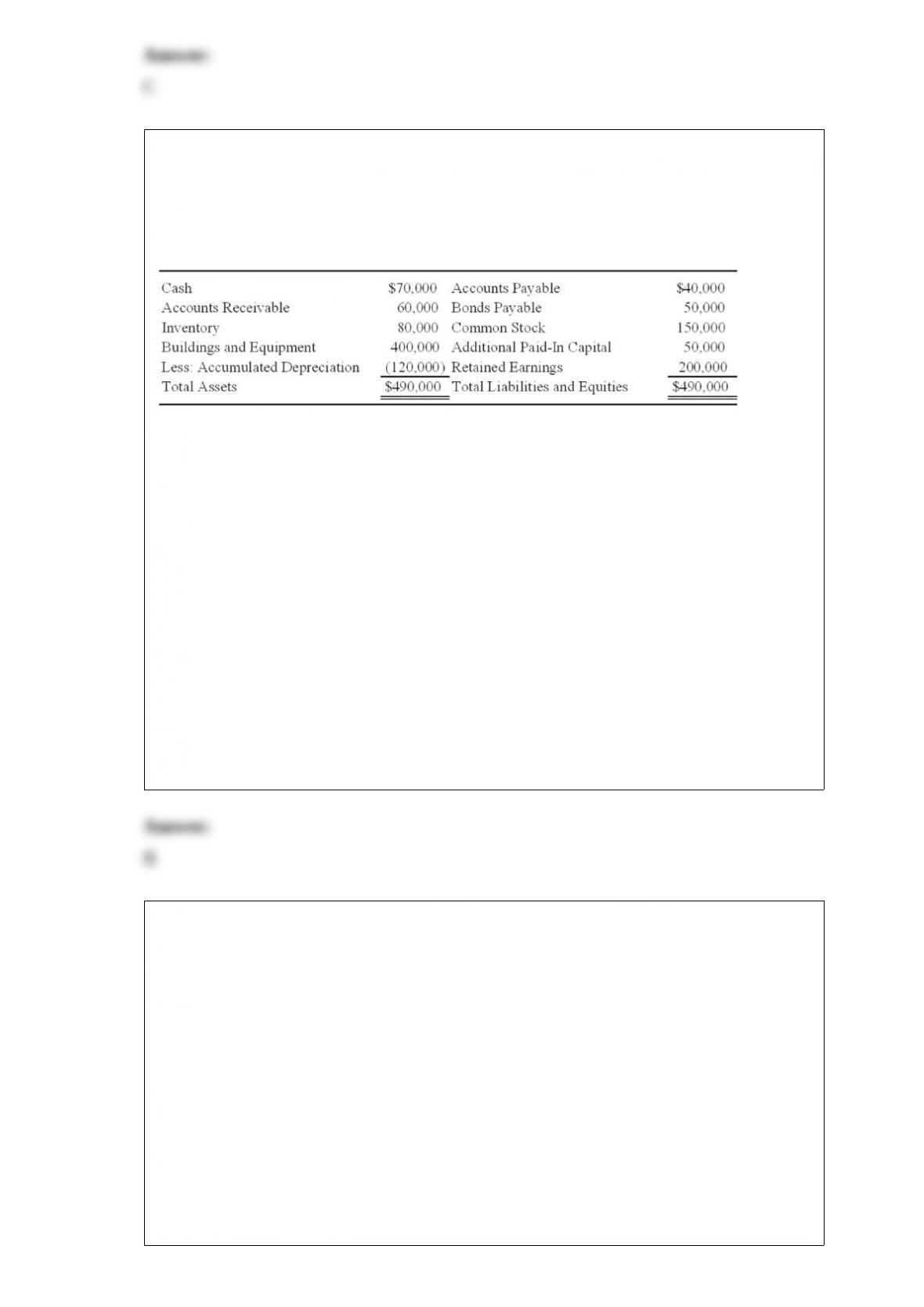
Bricks prepared the following balance sheet as of December 31, 20X8:
On January 1, 20X9, Bricks declares a stock dividend of 9,000 shares on its $5 par
value common stock. The current market price per share of Bricks stock on January 1,
20X9, is $20.
Begin with information provided, but assume instead that Bricks declared a stock
dividend of 3,000 shares on its $5 par value common stock. The investment elimination
entry required to prepare a consolidated balance sheet immediately after the stock
dividend is issued will include a debit to Additional Paid-In Capital for:
A.$65,000
B.$95,000
C.$50,000
D.$110,000
29) Sky Corporation owns 75 percent of Earth Company’s stock. On July 1, 20X8, Sky
sold a building to Earth for $33,000. Sky had purchased this building on January 1,
20X6, for $36,000. The building’s original eight-year estimated total economic life
remains unchanged. Both companies use straight-line depreciation. The equipment’s
residual value is considered negligible.
Based on the information provided, in the preparation of the 20X8 consolidated
financial statements, building will be _____ in the eliminating entries.
A.debited for $33,000
B.debited for $36,000
C.credited for $36,000

D.debited for $3,000
30) Note: This is a Kaplan CPA Review Question
Reportable segments are not required to disclose which of the following:
A.Amortization expense
B.Intersegment sales
C.Capital expenditures
D.Long-term debt
31) Granite Company issued $200,000 of 10 percent first mortgage bonds on January 1,
20X4, at 105. The bonds mature in 10 years and pay interest semiannually on January 1
and July 1. Mortar Corporation purchased $140,000 of Granite’s bonds from the
original purchaser on December 31, 20X8, for $125,000. Mortar owns 75 percent of
Granite’s voting common stock.
Based on the information given above, what amount of interest income will be
eliminated in the preparation of the 20X9 consolidated financial statements?
A.$17,000
B.$13,300
C.$18,500
D.$22,200
32) Perfect Corporation acquired 70 percent of Trevor Company’s shares on December
31, 2008, for $140,000. At that date, the fair value of the noncontrolling interest was
$60,000. On January 1, 2010, Perfect acquired an additional 10 percent of Trevor’s
common stock for $32,500. Summarized balance sheets for Trevor on the dates
indicated are as follows:

Trevor paid dividends of $10,000 in each of the three years. Perfect uses the fully
adjusted equity method in accounting for its investment in Trevor and amortizes all
differentials over 5 years against the related investment income.All differentials are
assigned to patents in the consolidated financial statements.
Based on the preceding information, Trevor Company’s net income for 2009 and 2010
are:
A.$10,000 and $20,000 respectively
B.$25,000 and $35,000 respectively
C.$35,000 and $45,000 respectively
D.$25,000 and $45,000 respectively
33) Which of the following statements concerning pro forma disclosures is not true?
A.They show the effects of major transactions that occur after the end of the fiscal
period
B.They show the effects of major transactions that have occurred during the year but
are not fully reflected in the company’s historical cost financial statements
C.The SEC requires these to be presented only when the company has made an unusual
asset exchange, or a restructuring of existing indebtedness
D.They often take the form of summarized financial statements

34) Which of the following statement is true regarding permanent funds?
A.Permanent funds do not have any donor restrictions when they are established
B.Permanent funds have a donor restriction on the fund principal but the income from
the fund may be used to benefit the government’s program
C.Permanent funds have a donor restriction on the income generated from the fund
principal but the principal may be used to benefit the government’s program
D.The cash or accrual basis of accounting may be used to account for a permanent fund
35) Which of the following items is not recognized as revenue by a governmental unit?
A.sales tax proceeds
B.property tax levies
C.bond proceeds
D.grants received from other governmental units
36) In accordance with the Single Audit Act of 1984, external auditors issue the
standard audit report on the governmental unit’s financial statements and must also
issue:
I. a special report on the effectiveness with which the governmental unit is achieving its
social objectives.
II. a special report on the governmental unit’s internal control system.
III. a special report on the governmental unit’s compliance with laws and regulations.
A.I only
B.I and II
C.II and III
D.I, II, and III
37) Chicago based Corporation X has a number of importing transactions with

companies based in UK. Importing activities result in payables. If the settlement
currency is the British Pound, which of the following will happen by changes in the
direct or indirect exchange rates?
A.Option A
B.Option B
C.Option C
D.Option D