If 50,000 shares are authorized, 41,000 shares are issued, and 2,000 shares are
reacquired, the number of outstanding shares is 43,000.
Answer:
A large public corporation normally uses registrars and transfer agents to maintain
records of the stockholders.
Answer:
If the principal products of a manufacturing process are identical, a process cost system
is more appropriate than a job order cost system.
Answer:
The cash budget summarizes future plans for acquisition of fixed assets.

Answer:
Standard costs are a useful management tool that can be used solely as a statistical
device apart from the ledger or they can be incorporated in the accounts.
Answer:
The ratio of the sum of cash, receivables, and marketable securities to current liabilities
is referred to as the current ratio.
Answer:
A qualitative characteristic that may impact upon capital investment analysis is
manufacturing control.

Answer:
Those unusual items reported as deductions from income from continuing operations
should be listed net of the related income tax.
Answer:
The Sarbanes-Oxley Act requires that financial statements of all public companies
report on management’s conclusions about the effectiveness of the company’s internal
control procedures.
Answer:
The product cost concept includes all manufacturing costs plus selling and
administrative expenses in the cost amount to which the markup is added to determine
product price.

Answer:
Journalizing a transaction with both the debit and the credit for $69 instead of $96 will
cause the trial balance to be out of balance.
Answer:
If total assets increased by $190,000 during a specific period and liabilities decreased
by $10,000 during the same period, the period’s change in total owner’s equity was a
$200,000 increase.
Answer:
The statement of cost of goods manufactured is an extension of the income statement
for a manufacturing company.
Answer:

When merchandise that was sold is returned, a credit to sales returns and allowances is
made.
Answer:
Deferrals are recorded transactions that delay the recognition of an expense or revenue.
Answer:
Any difference between the fair market values of the securities and their cost is a
realized gain or loss.
Answer:

The amount journalized showing the cost added to finished goods is taken from the cost
of production report.
Answer:
An intangible asset is one that has a physical existence.
Answer:
In a partnership liquidation, if a partner has a debit capital balance in his or her capital
account, he or she is responsible for contributing personal assets sufficient to eliminate
the deficit.
Answer:

The normal balance of the accumulated depreciation account is debit.
Answer:
The direct write-off method records Bad Debt Expense in the year the specific account
receivable is determined to be uncollectible.
Answer:
Comparing dividends per share to earnings per share indicates the extent to which the
corporation is retaining its earnings for use in operations.
Answer:
Revenue recognition concept requires that the reporting of revenue be included in the
period when cash for the service is received.

Answer:
An account receivable is a claim against a customer arising from a sale on account.
Answer:
Functional depreciation occurs when a fixed asset is no longer able to provide services
at the level for which it was intended.
Answer:
Employees view budgeting more positively when goals are established for them by
senior management.

Answer:
The service department will determine its service department charge rate and charge the
company’s divisions or departments according to their use of that particular service
department.
Answer:
The investor carrying an investment by the equity method records cash dividends
received as an increase in the carrying amount of the investment.
Answer:
In the retail inventory method, the cost to retail ratio is equal to the cost of goods sold
divided by the retail price of the good sold.
Answer:
When a bond is purchased for an investment, the purchase price, minus the brokerage
commission, plus any accrued interest is recorded.
Answer:
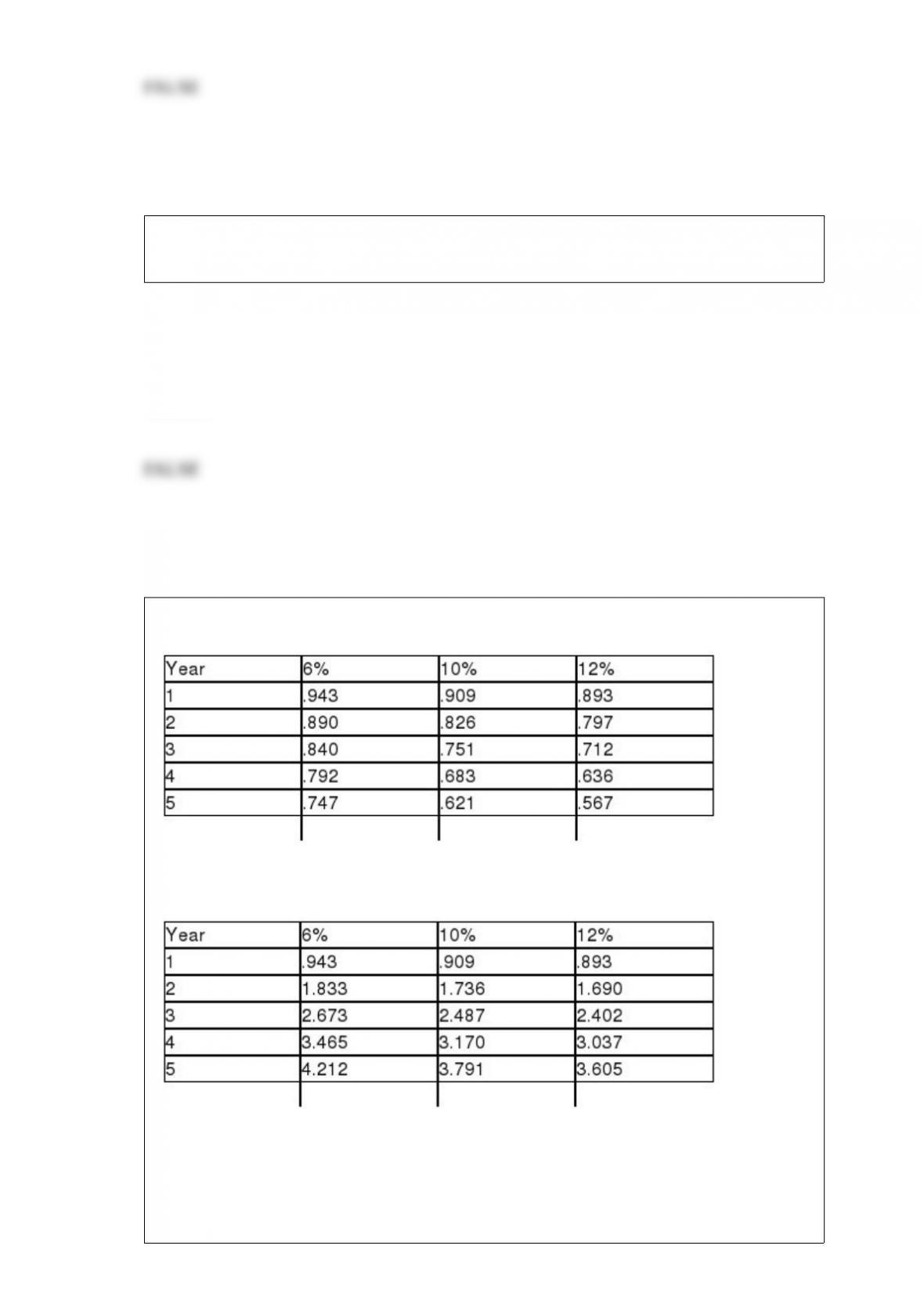
Below is a table for the present value of $1 at Compound interest.
Below is a table for the present value of an annuity of $1 at compound interest.
Using the tables above, what would be the internal rate of return of an investment that
required an investment of $189,550, and would generate an annual cash inflow of
$50,000 for the next 5 years?

A.6%
B.10%
C.12%
D.cannot be determined from the data given.
Answer:
Immediately prior to the admission of Allen, the Sanson-Jeremy Partnership assets had
been adjusted to current market prices, and the capital balances of Sanson and Jeremy
were $80,000 and $120,000 respectively. If the parties agree that the business is worth
$240,000, what is the amount of bonus that should be recognized in the accounts at the
admission of Allen?
A.$60,000
B.$80,000
C.$40,000
D.$100,000
Answer:

When a company exchanges machinery and receives a trade-in allowance less than the
book value, this transaction would be recorded with the following entry:
A.debit Machinery and Accumulated Depreciation; credit Machinery and Cash
B.debit Cash and Machinery; credit Accumulated Depreciation
C.debit Cash and Machinery; credit Accumulated Depreciation and Machinery
D.debit Machinery, Accumulated Depreciation, and Loss on Disposal; credit Machinery
and Cash
Answer:
In which journal is the return of supplies purchased on account recorded?
A.General journal
B.Cash Receipts journal
C.Cash Payments journal
D.Purchases journal
Answer:
Receipts from cash sales of $3,200 were recorded incorrectly in the cash receipts
journal as $2,300. This item would be included on the bank reconciliation as a(n)
A.deduction from the balance per company’s records
B.addition to the balance per bank statement
C.deduction from the balance per bank statement
D.addition to the balance per company’s records
Answer:
Indicate whether each of the following would be reported in the financial statements as
a(n) (a) current asset, (b) current liability, (c) revenue, or (d) expense:
Answer:

A company uses the allowance method to account for uncollectible accounts
receivables. When the firm writes off a specific customer’s account receivable
A.total current assets are reduced
B.total expenses for the period are increased
C.net realizable value of accounts receivable increases
D.there is no effect on total current assets or total expenses
Answer:
A series of budgets for varying rates of activity is termed a(n):
A.flexible budget
B.variable budget
C.master budget
D.activity budget
Answer:
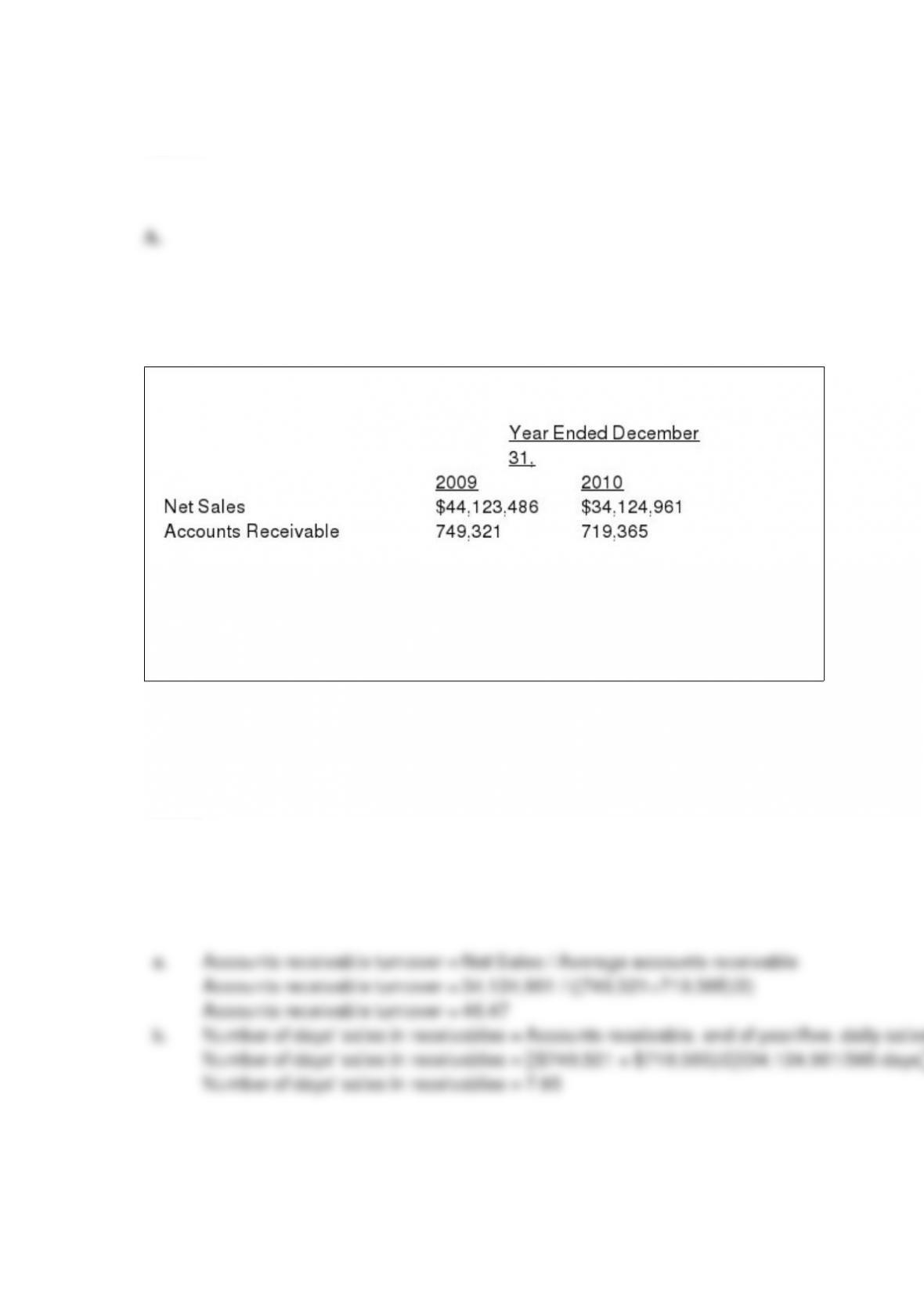
For the fiscal years 2009 and 2010, Apple Co. reported the following:
a. Compute the accounts receivable turnover for 2010.
b. Compute the number of days’ sales in receivable at the end of
Answer:
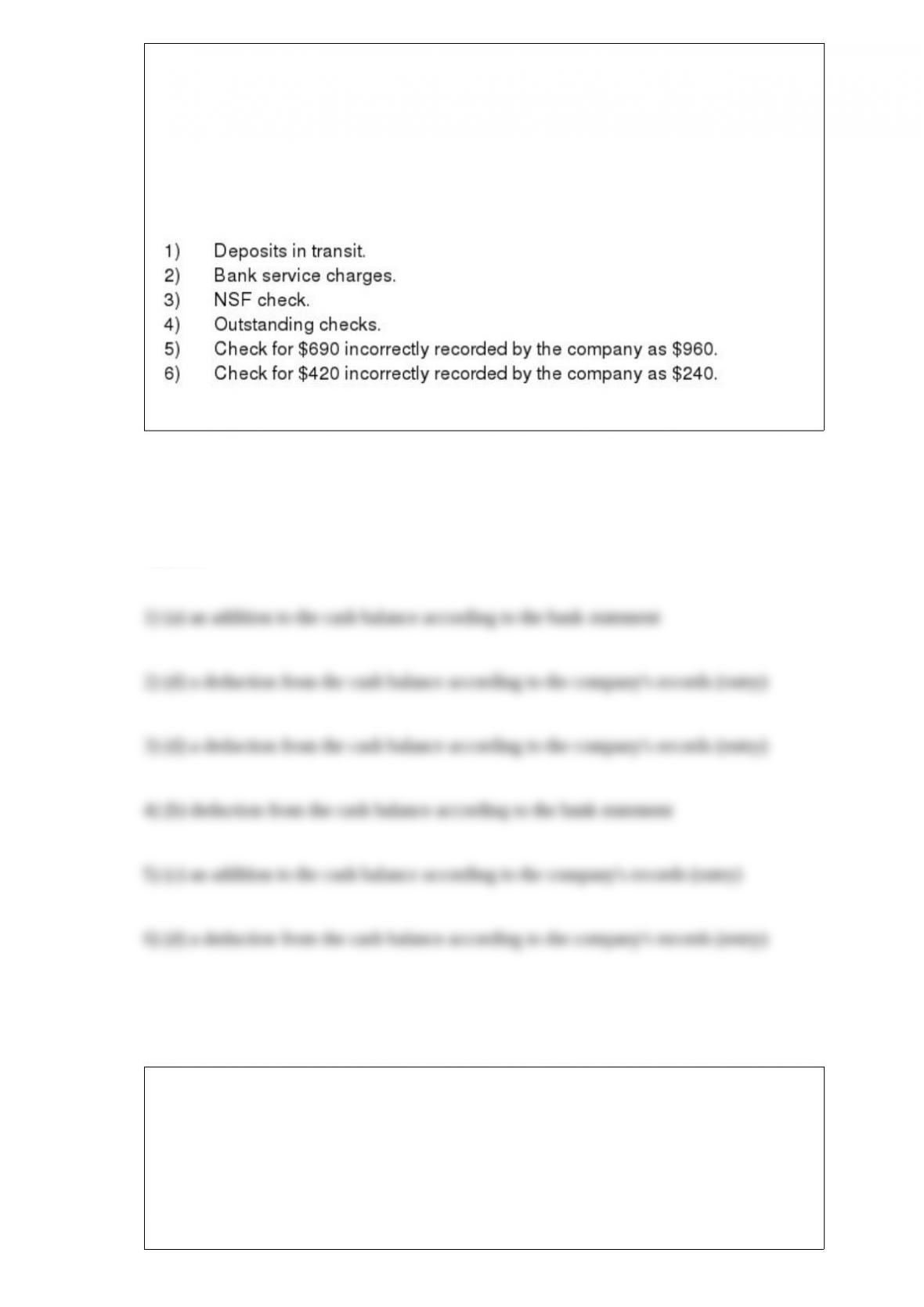
Identify each of the following reconciling items as (a) an addition to the cash balance
according to the bank statement, (b) deduction from the cash balance according to the
bank statement, (c) an addition to the cash balance according to the company’s records,
or (d) a deduction from the cash balance according to the company’s records. Assume
that none of the transactions reported by bank debit and credit memos have been
recorded by the company. Also, indicate by writing (Entry) those items that will require
a journal entry in the company’s accounts.
Answer:
Under the periodic inventory system, the journal entry to record the cost of merchandise
sold at the point of sale will include the following account
A.No entry is made.
B.Cost of merchandise sold
C.Inventory
D.Purchases
Answer:
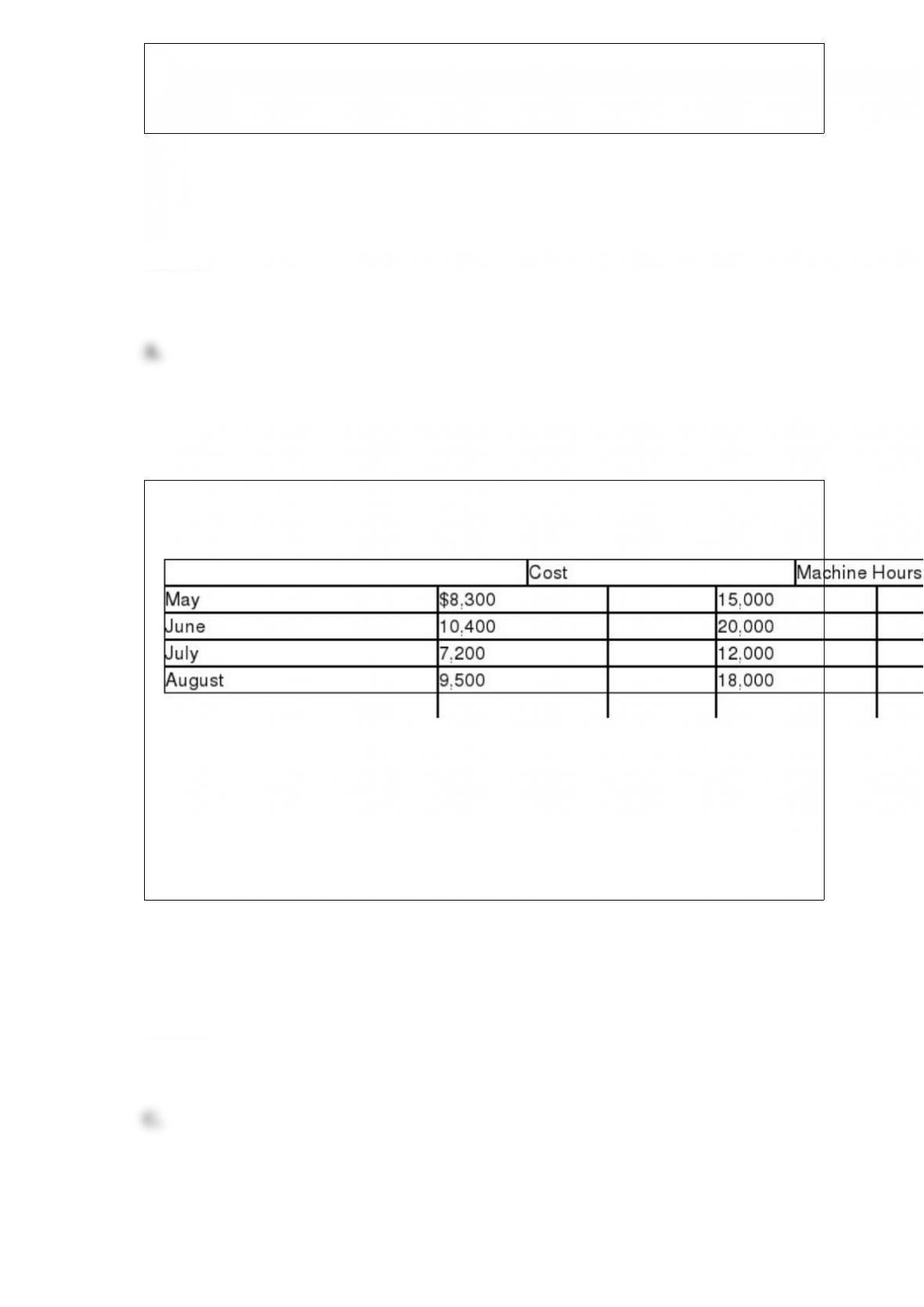
Given the following cost and activity observations for Taco Company’s utilities, use the
high-low method to calculate Taco’s variable utilities costs per machine hour.
A.$10.00
B.$.60
C.$.40
D.$.52
Answer:

A variant of fiscal-year budgeting whereby a twelve-month projection into the future is
maintained at all times is termed:
A.flexible budgeting
B.continuous budgeting
C.zero-based budgeting
D.master budgeting
Answer:
Expenses can result from:
A.increasing owner’s equity.
B.consuming services.
C.using up liabilities.
D.all are true.
Answer:
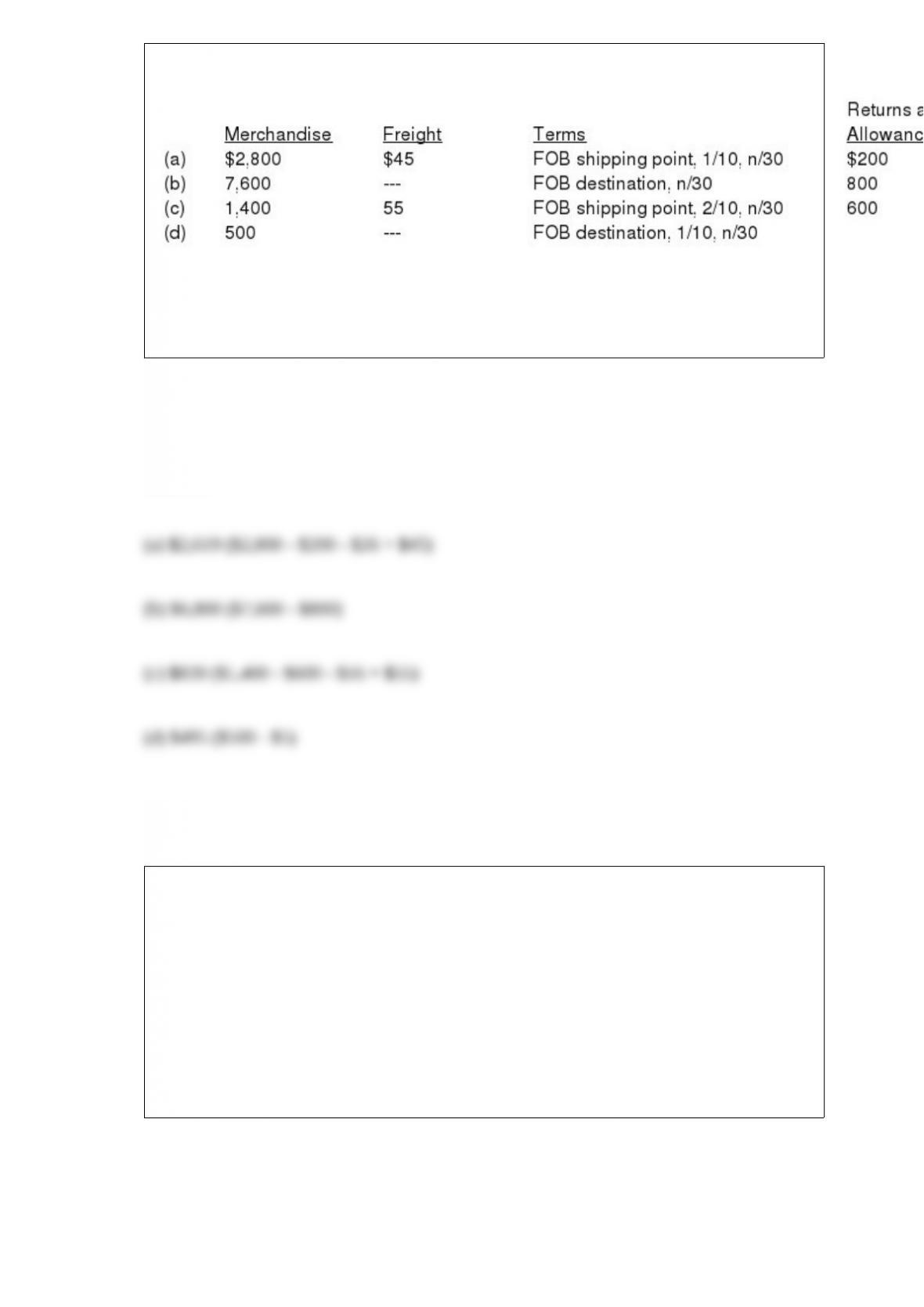
Details of invoices for purchases of merchandise are as follows:
Determine the amount to be paid in full settlement of each of the invoices, assuming
that credit for returns and allowances was received prior to payment and that all
invoices were paid within the discount period.
Answer:
The cumulative effect of the declaration and payment of a cash dividend on a
company’s financial statements is to
A.decrease total liabilities and stockholders’ equity.
B.increase total expenses and total liabilities.
C.increase total assets and stockholders’ equity.
D.decrease total assets and stockholders’ equity.
Answer:

Merchandise inventory at the end of the year was inadvertently overstated. Which of the
following statements correctly states the effect of the error on net income, assets, and
owner’s equity?
A.net income is overstated, assets are overstated, owner’s equity is understated
B.net income is overstated, assets are overstated, owner’s equity is overstated
C.net income is understated, assets are understated, owner’s equity is understated
D.net income is understated, assets are understated, owner’s equity is overstated
Answer:
A series of budgets for varying rates of activity is termed a(n):
A.flexible budget
B.variable budget
C.master budget
D.activity budget
Answer:

For March, sales revenue is $1,000,000; sales commissions are 5% of sales; the sales
manager’s salary is $80,000; advertising expenses are $75,000; shipping expenses total
1% of sales; and miscellaneous selling expenses are $2,100 plus 1% of sales. Total
selling expenses for the month of March are:
A.$227,100
B.$215,000
C.$217,100
D.$152,100
Answer:
Procedures designed to protect cash from theft and misuse from the time it is received
until it can be deposited in a bank are called
A.accounting controls
B.cash controls
C.preventive controls
D.detective controls

Answer:
Discounts taken by a buyer because of early payment are recorded on the seller’s
accounting records as
A.Purchases discount
B.Sales discount
C.Trade discount
D.Early payment discount
Answer:
The Cardinal Company had a finished goods inventory of 55,000 units on January 1. Its
projected sales for the next four months were: January – 200,000 units; February –
180,000 units; March – 210,000 units; and April – 230,000 units. The Cardinal Company
wishes to maintain a desired ending finished goods inventory of 20% of the following
months sales.
What would be the budgeted production for February?
A.186,000
B.181,000
C.222,000
D.174,000

Answer:
A firm produces its products by a continuous process involving three production
departments, 1 through 3. Present entries to record the following selected transactions
related to production during August:
(a) Materials purchased on account, $120,000.
(b) Material requisitioned for use in Department 1, $125,700, of which $124,200
entered directly into the product.
(c) Labor cost incurred in Department 1, $195,400, of which $174,000 was used
directly in the manufacture of the product.
(d) Factory overhead costs for Department 1 incurred on account, $54,700.
(e) Depreciation on machinery in Department 1, $29,200.
(f) Expiration of prepaid insurance chargeable to Department 1, $7,000.
(g) Factory overhead applied to production, $106,300.
(h) Output of Department 1 transferred to Department 2, $362,700.
Answer:
Mocha Coffee Shop has asked the accountant to keep track of the purchases for
beverage, food, and retail items. The accountant has implemented a purchases journal.
Which of the following columns should be included in the new purchases journal?
A.Accounts Payable – Cr., Beverage Supplies – Dr, Food Supplies – Dr, Retail Items
Supplies – Dr, Other – Dr.
B.Accounts Payable – Dr, Other – Dr, Beverage Supplies – Cr, Food Supplies -Cr, Retain
Items Supplies – Cr.
C.Beverage Supplies – Dr, Food Supplies – Dr, Retail Items Supplies – Dr, Other – Dr,
Cash – Cr.
D.Beverage Supplies – Dr, Food Supplies – Dr, Retail Items Supplies – Dr, Other – Cr,
Accounts Payable – Dr.
Answer:
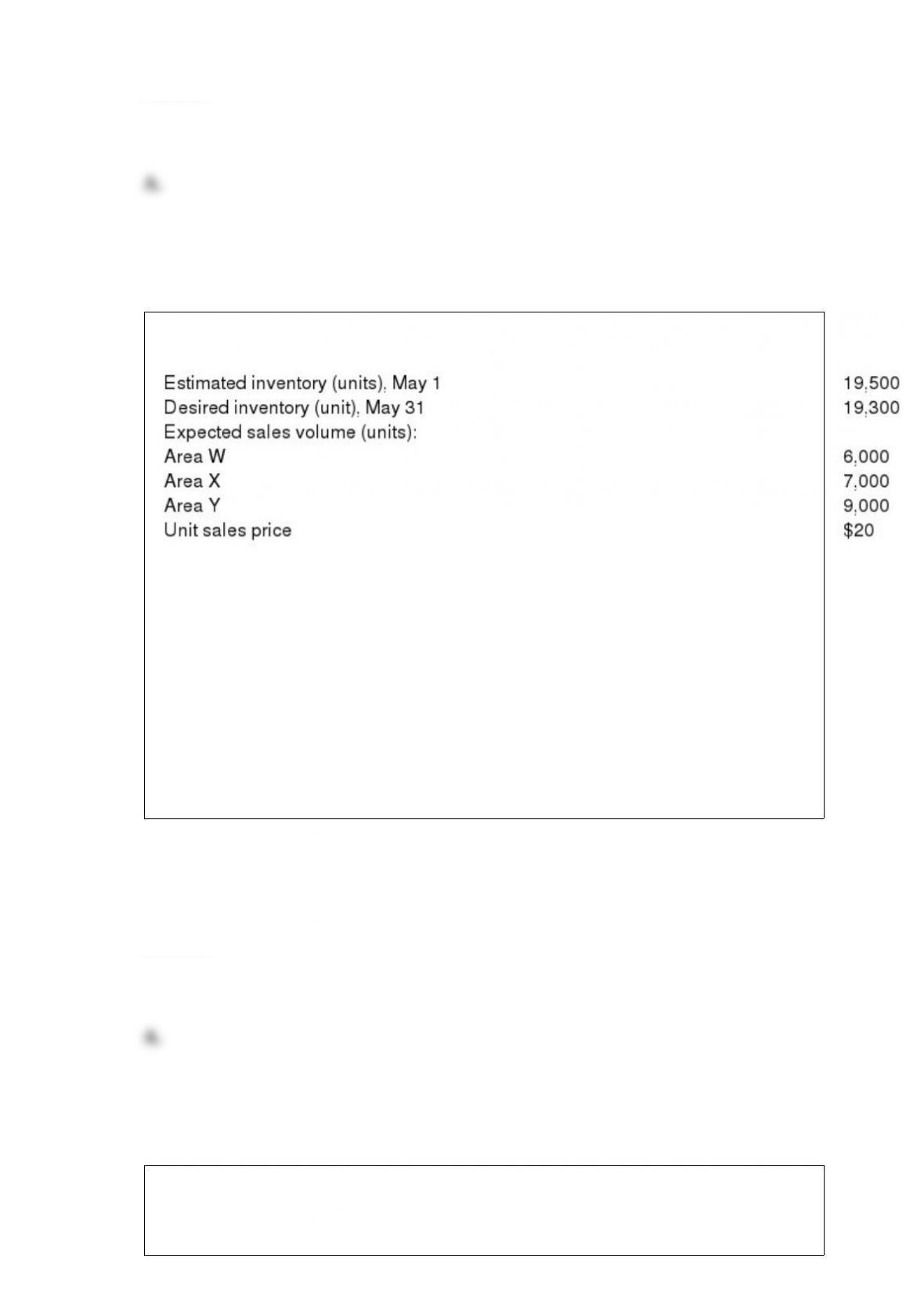
Production and sales estimates for May for the Robin Co. are as follows:
The number of units expected to be sold in May is:
A.22,000
B. 2,700
C.21,800
D.19,300
Answer:
On October 30, Seba Salon, Inc. issued a 90-day note with a face amount of $60,000 to
Reyes Products, Inc. for merchandise inventory. Assuming a 360-day year, determine
the proceeds of the note assuming the note is discounted at 8%.

A.$55,200
B.$64,800
C.$58,800
D.$61,200
Answer:
The process by which management plans, evaluates, and controls long-term investment
decisions involving fixed assets is called:
A.absorption cost analysis
B.variable cost analysis
C.capital investment analysis
D.cost-volume-profit analysis
Answer:
The primary difference between a static budget and a flexible budget is that a static

budget
A.is suitable in volatile demand situation while flexible budget is suitable in a stable
demand situation.
B.is concerned only with future acquisitions of fixed assets, whereas a flexible budget is
concerned with expenses that vary with sales.
C.includes only fixed costs, whereas a flexible budget includes only variable costs.
D.is a plan for a single level of production, whereas a flexible budget can be converted
to any level of production.
Answer:
Which one of the following is not a characteristic generally evaluated in ratio analysis?
A.liquidity
B.profitability
C.solvency
D.marketability
Answer:
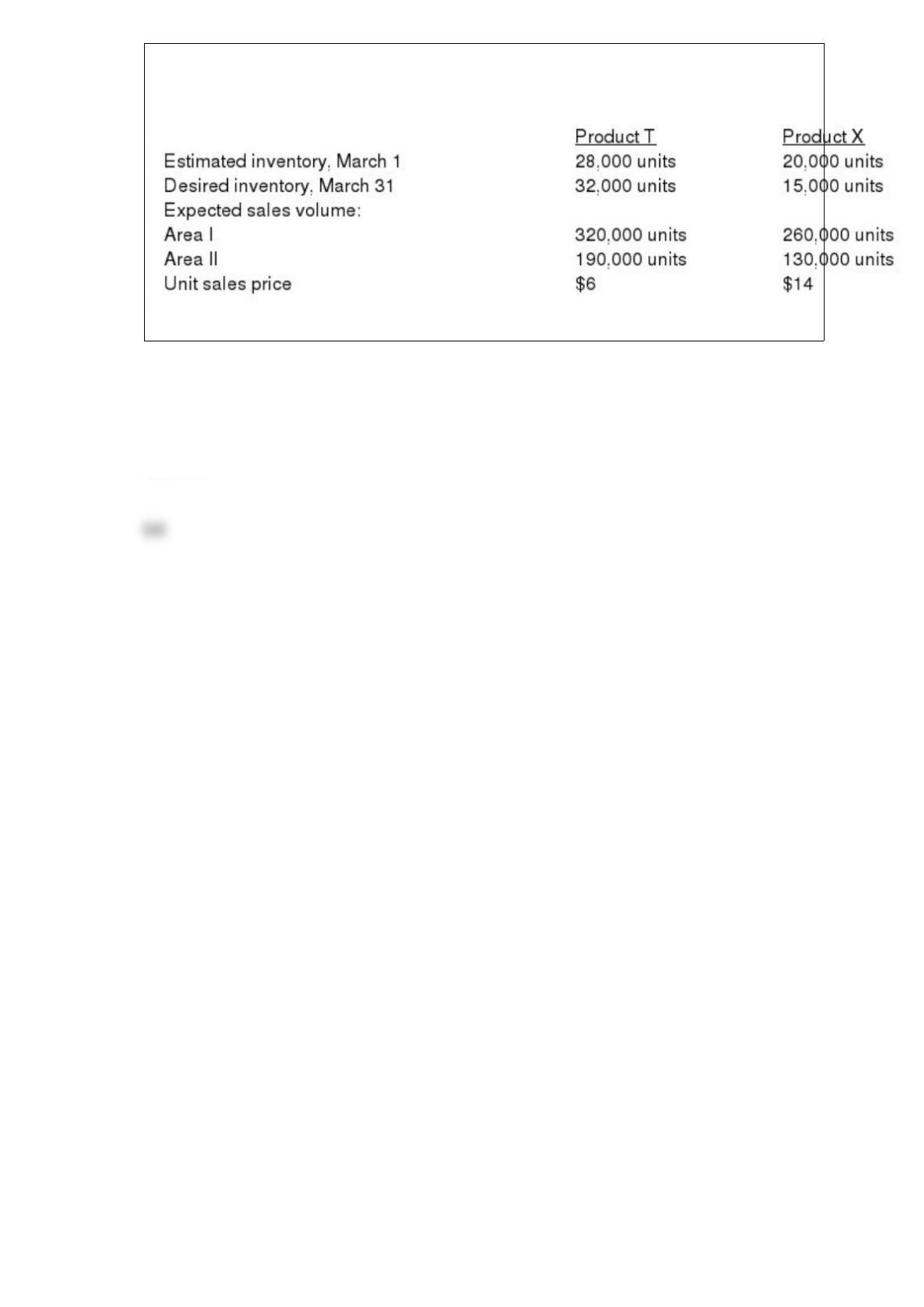
Based on the following production and sales data of Shingle Co. for March of the
current year, prepare (a) a sales budget and (b) a production budget.
Answer:

Which of the following is required to be withheld from employee’s gross pay?
A.both federal and state unemployment compensation
B.only federal unemployment compensation tax
C.only federal income tax
D.only state unemployment compensation tax
Answer:
If the revenues are correctly reported and the Gross Profit of a company is understated,
what is the effect on Owner’s Equity?
A.Understated
B.Overstated
C.Correctly Stated
D.None of the above
Answer:
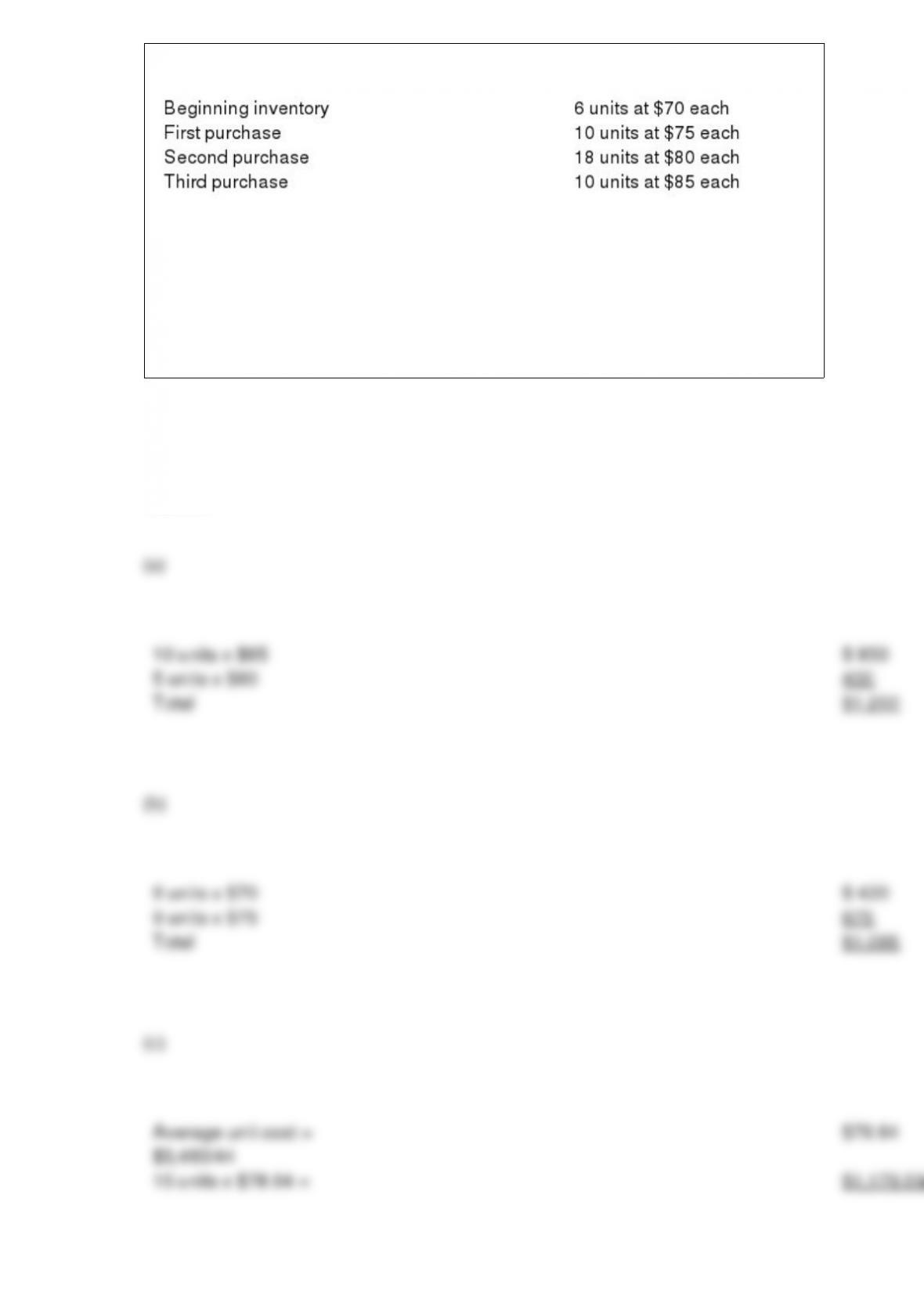
The beginning inventory and purchases of an item for the period were as follows:
The company uses the periodic system, and there were 15 units in the inventory at the
end of the period. Determine the cost of the 15 units in the inventory by each of the
following methods, presenting details of your computations: (a) first-in, first-out; (b)
last-in, first-out; (c) average cost. Do not round your intermediate calculations. Round
your final answer to two decimal places.
Answer:

On December 31, Strike Company has decided to sell one of its batting cages. The
initial cost of the equipment was $310,000 with an accumulated depreciation of
$260,000. Depreciation has been taken up to the end of the year. The company found a
company that is willing to buy the equipment for $50,000. What is the amount of the
gain or loss on this transaction?
A.Gain of $50,000
B.Loss of $50,000
C.No gain or loss
D.Cannot be determined
Answer:
A separate account for each material is found in a
A.general ledger
B.materials ledger
C.receiving report
D.job cost sheet
Answer:
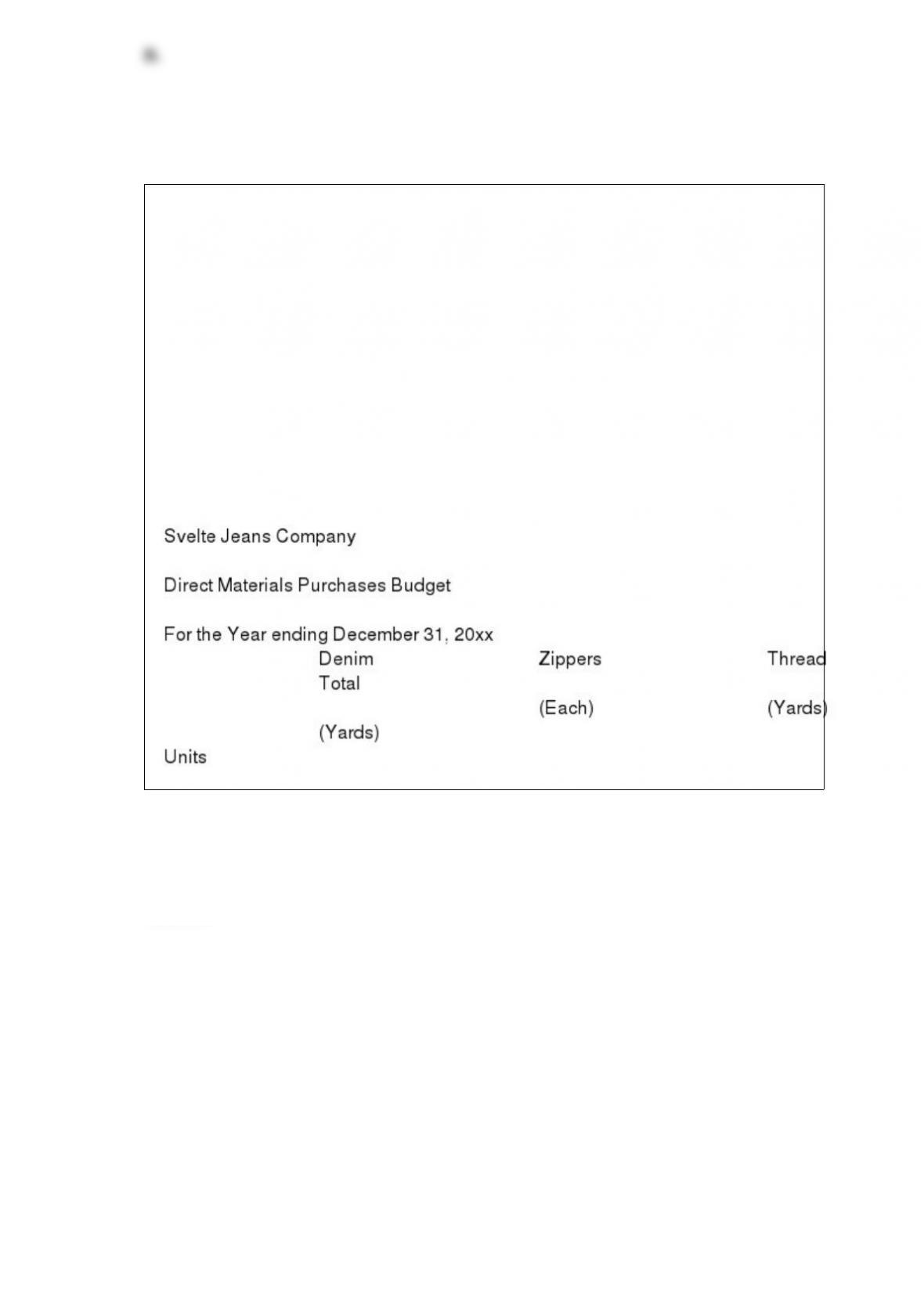
The Svelte Jeans Company produces two different types of jeans. One is called the
“Simple Life” and the other is called the “Fancy Life”. The company sales budget
estimates that 350,000 of the Simple Life Jeans and 200,000 of the Fancy Life will be
sold during 20xx. The Production Budget requires 353,500 units of Simple Life jeans
and 196,000 Fancy Life jeans be manufactured. The Simple Life jeans require 3 yards
of denim material, a zipper, and 25 yards of thread. The Fancy Life jeans require 4.5
yards of denim material, a zipper, and 40 yards of thread. Each yard of denim material
costs $3.25, the zipper costs $.75 each, and the thread is $.01 per yard. There is enough
material to make 2,000 jeans of each type at the beginning of the year. The desired
amount of materials left in ending inventory is to have enough to manufacture 3,500
jeans of each type. Prepare a Direct Materials Purchases Budget.
Ans:
Answer:
Crow Manufacturers, Inc. projected sales of 75,000 bicycles for 2012. The estimated
January 1, 2012, inventory is 5,000 units, and the desired December 31, 2012, inventory
is 8,000 units. What is the budgeted production (in units) for 2012?
Answer:
On February 1 of the current year, Motor, Inc. issued 700 shares of $2 par common
stock to an attorney in return for preparing and filing the Articles of Incorporation. The
value of the services is $9,600. Journalize this transaction.
Answer:
The units of an item available for sale during the year were as follows:
There are 30 units of the item in the physical inventory at December 31. The periodic
inventory system is used. Determine the ending inventory cost using FIFO.
Answer:
Technics Inc., a manufacturing company, utilizes job order costing. Each division

establishes its own estimates regarding overhead which are as follows:
Division A Division B
Total estimated overhead $128,000 $261,000
Total estimated machine hours 16,000 72,500
Total estimated direct labor costs $155,000 $290,000
If Division A allocates overhead on the basis of machine hours, and Division B
allocates overhead as a percentage of direct labor costs, what would the predetermined
overhead rate be for each division?
Answer:
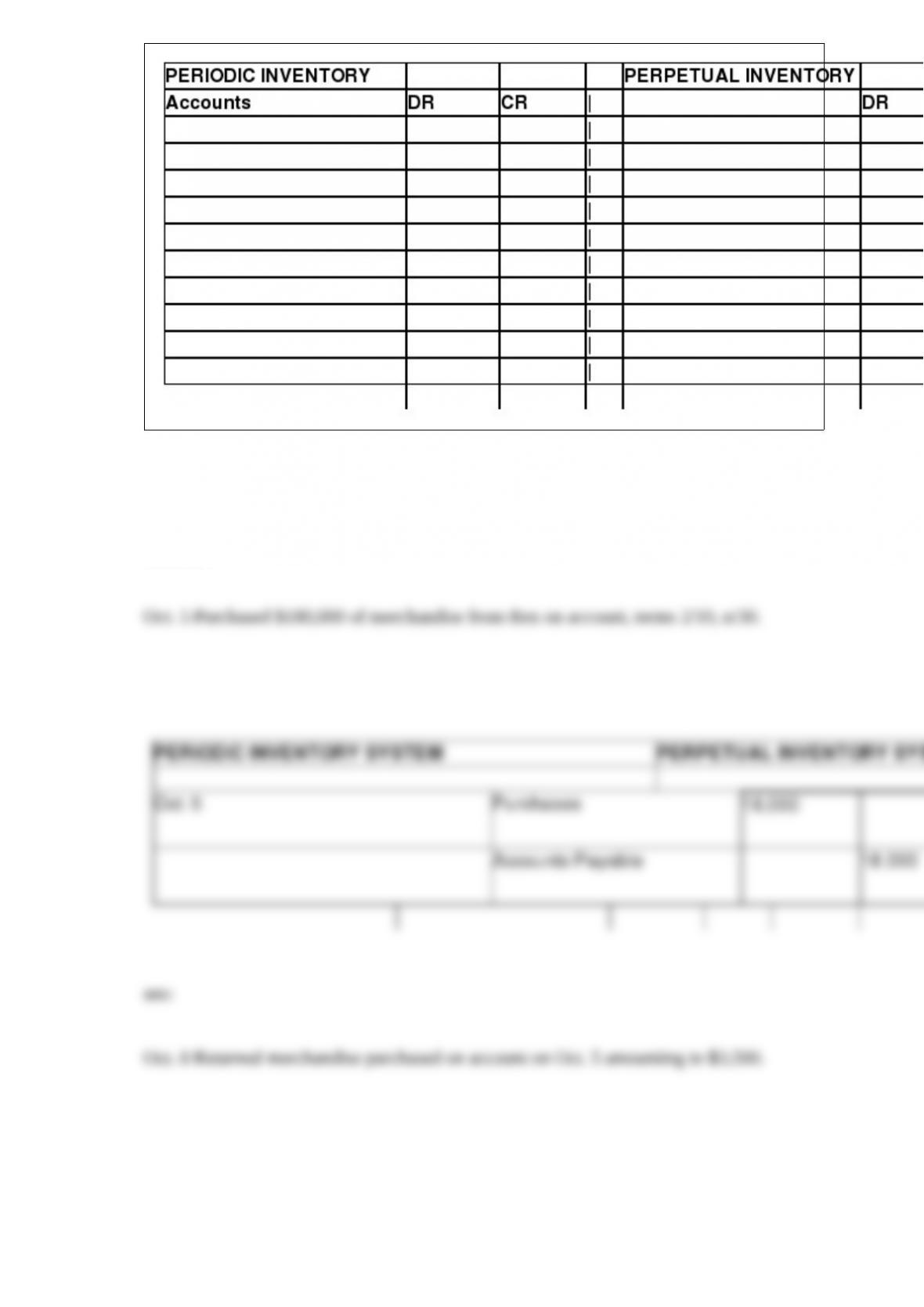
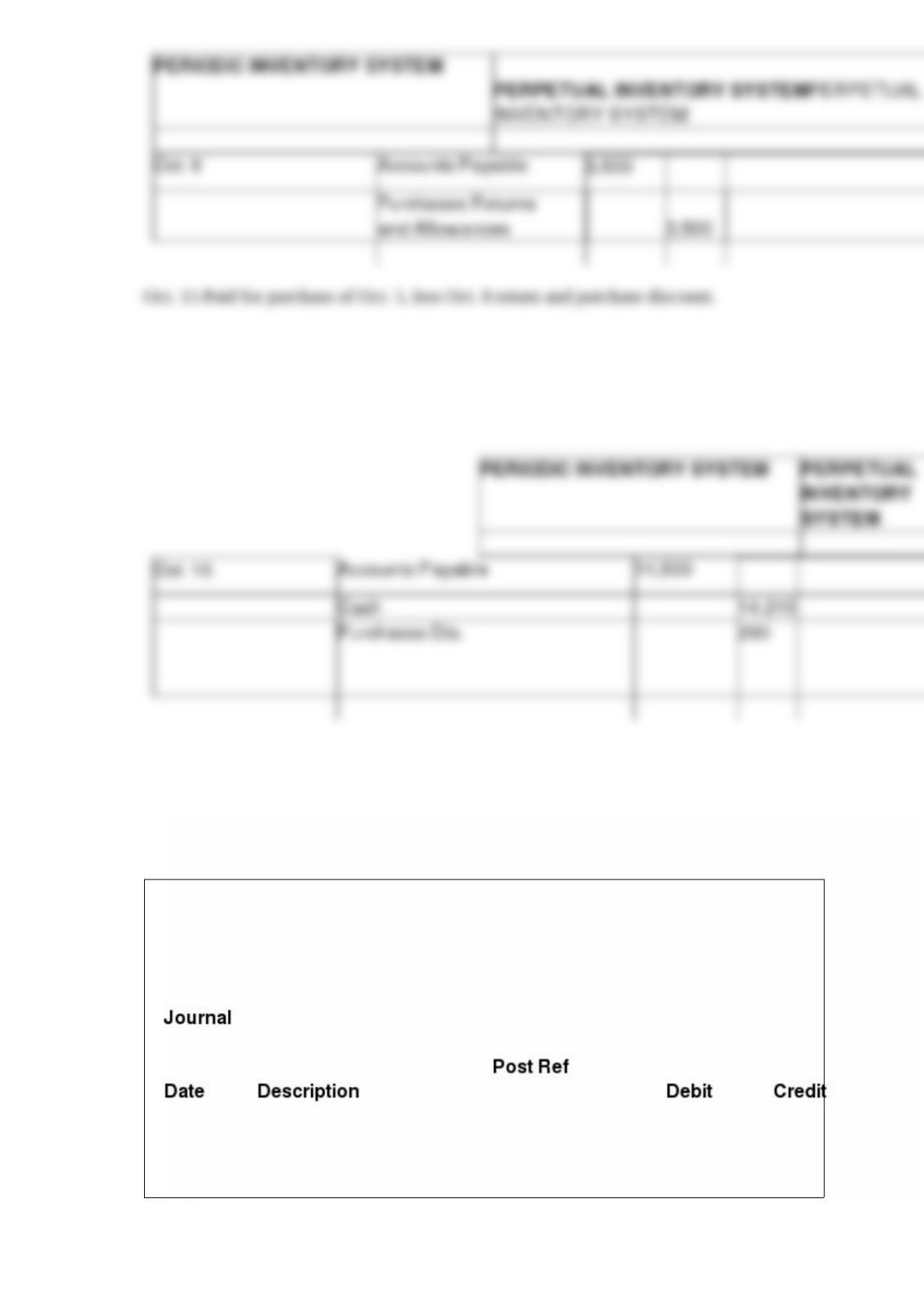
Journalize the following transactions for Donnell Inc. using both the periodic inventory
system and the perpetual inventory system, presented in a side-by-side format shown at
the end of this exercise.
Oct. 5 Purchased $18,000 of merchandise from Rex on account, terms 2/10, n/30.
Oct. 8 Returned merchandise purchased on account on Oct. 5 amounting to $3,500.
Oct. 15 Paid for purchase of Oct. 5, less Oct. 8 return and purchase discount.
Answer:
The records of Nevada Co. indicated that $420,000 of merchandise should be on hand
on December 31, 2010. The physical inventory indicates that $370,000 of merchandise
is actually on hand. Journalize the adjusting entry for the inventory shrinkage for the
year ended December 31, 2010.
Answer:
On March 25, 2014, Patton Company sold merchandise on account,$10,000. The
applicable sales tax percentage is 8.5%. Record the transaction.
Answer:
At the beginning of the period, the Molding Department budgeted direct labor of
$33,000 and supervisor salaries of $24,000 for 3,000 hours of production. The
department actually completed 2,500 hours of production. Determine the budget for the
department assuming that it uses flexible budgeting?
Answer:
Depreciation on Office Equipment is $3,300. The adjusting entry on December 31,
2011 would be:
Answer:
At the end of the period, Carson Company had the following balances in selected
accounts:
Raw Materials Inventory $ 80,000
Finished Goods 190,000
Work in Process Inventory 70,000
Cost of Goods Sold 1,000,000
Factory Overhead 30,000
Answer:
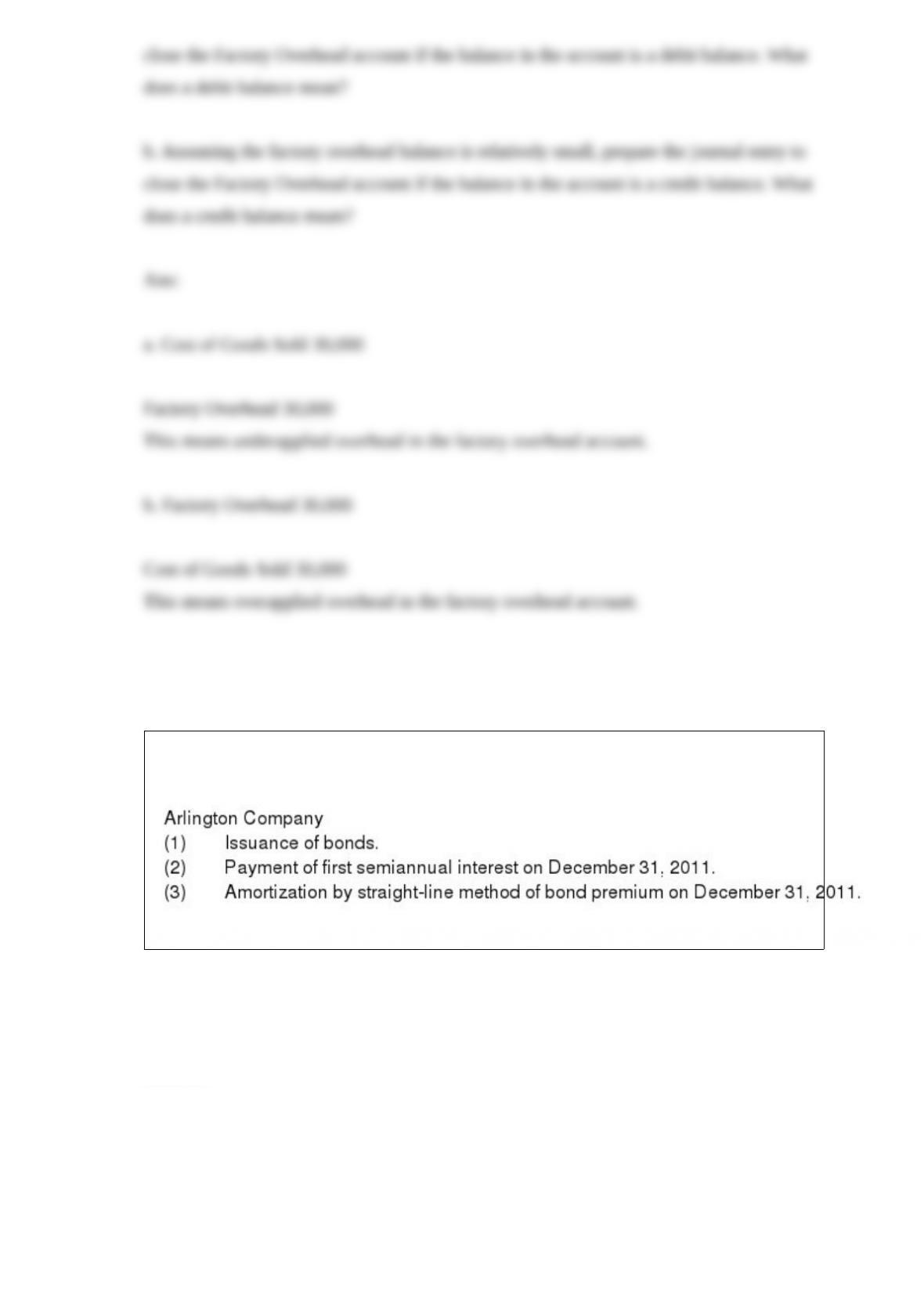
On June 30, 2011, Arlington Company issued $1,500,000 of 10-year, 8% bonds, dated
June 30, for $1,540,000. Present entries to record the following transactions:
Answer:
Magnolia, Inc. manufactures bedding sets. The budgeted production is for 55,000
comforters in 2012. Each comforter requires 7 yards of material. The estimated January
1, 2012, beginning inventory is 31,000 yards. The desired ending balance is 30,000
yards of material. If the material costs $4.00 per yard, determine the materials budget
for 2012.
Answer:
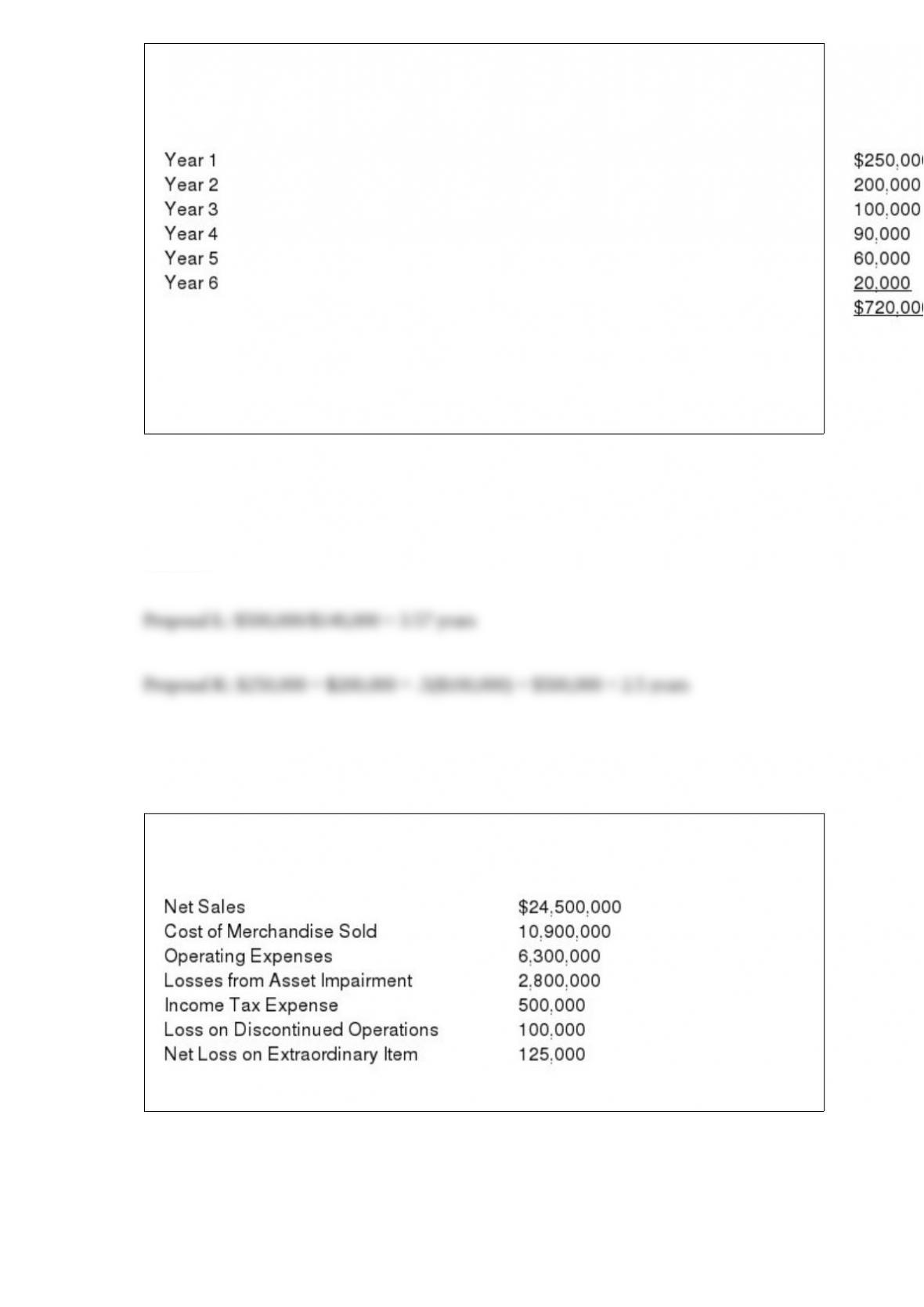
Proposals L and K each cost $500,000, have 6-year lives, and have expected total cash
flows of $720,000. Proposal L is expected to provide equal annual net cash flows of
$140,000, while the net cash flows for Proposal K are as follows:
Determine the cash payback period for each proposal. Round your answers to two
decimal places.
Answer:
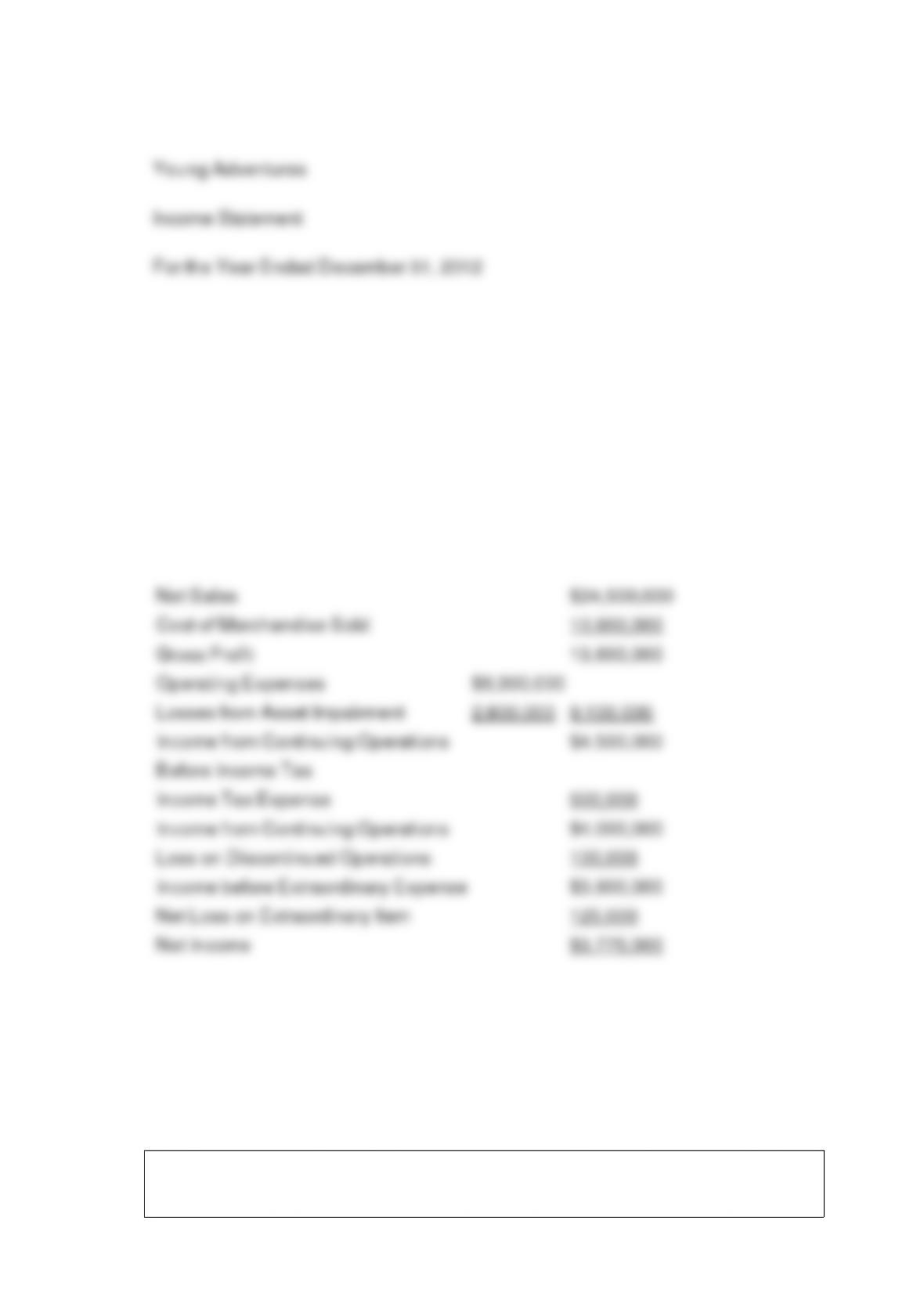
Prepare an Income Statement using the following data for Young Adventures for the
year ended December 31, 2012:
Answer:
Compare and contrast why companies invest cash in short-term temporary investments
vs. long-term investments.
Answer:
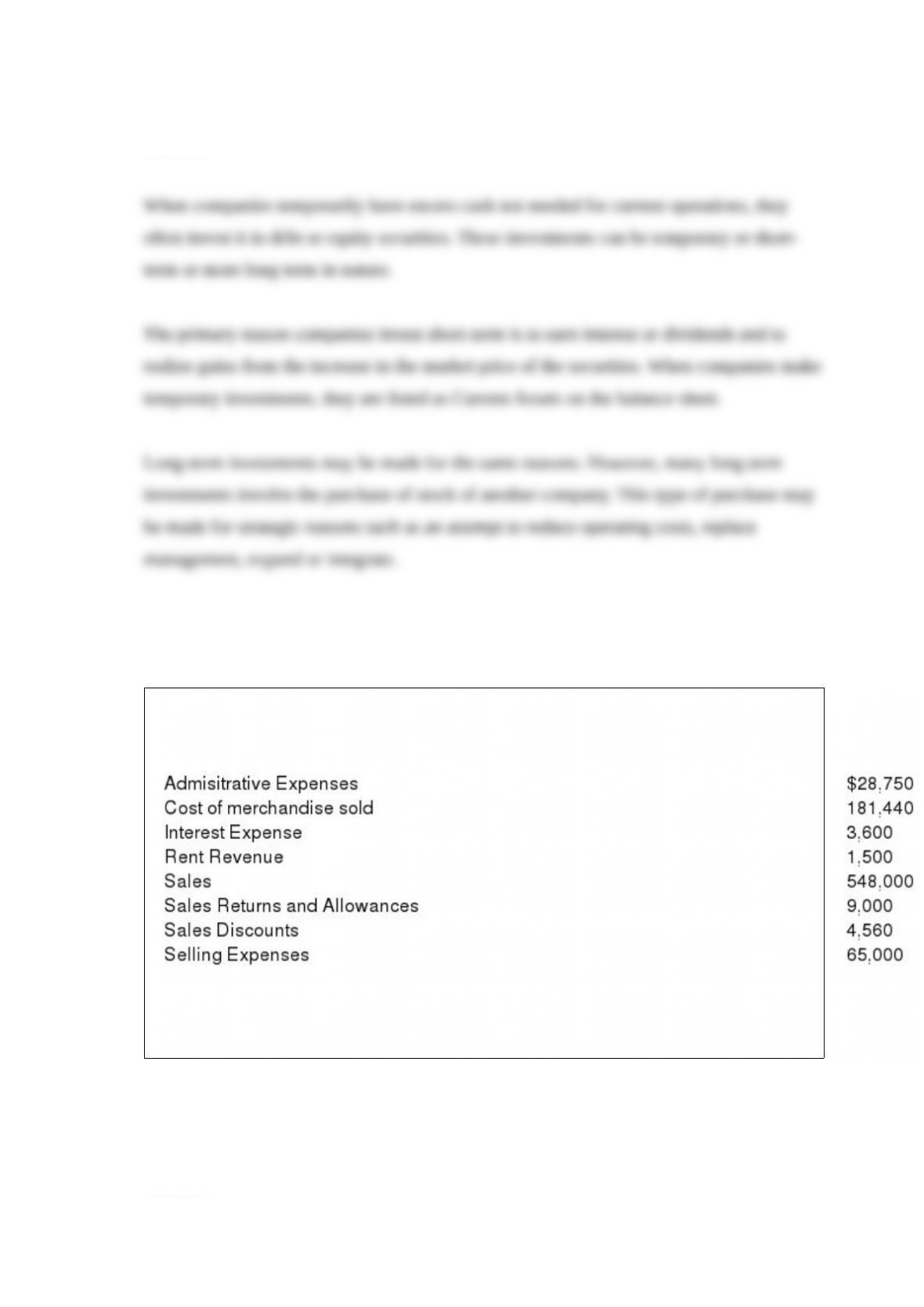
The following data for the current year ended June 30 were extracted from the
accounting records of Excel Co.:
Prepare a multiple-step income statement for the year ended June 30, 2014.
Answer: