
Managerial accountants would most likely prepare all of the following reports except:
A.A performance report identifying amounts of scrap.
B.A control report comparing direct material usage over time.
C.A sales report targeting monthly sales and potential bonuses.
D.An annual report for external regulators such as the SEC.
Answer:
The budget that needs to be completed first when preparing the master budget is the:
A.Production Budget
B.Sales Budget
C.Cash Budget
D.Capital Expenditures Budget
Answer:
Mason Corporation had $650,000 in invested assets, sales of $700,000, income from
operations amounting to $99,000, and a desired minimum rate of return of 15%.
The profit margin for Mason is:
A.7.1%
B.20%
C.15.2%
D.14.1%
Answer:
The following information pertains to Carlton Company. Assume that all balance sheet
amounts represent both average and ending balance figures. Assume that all sales were
on credit.
Assets
Liabilities and Stockholders’ Equity
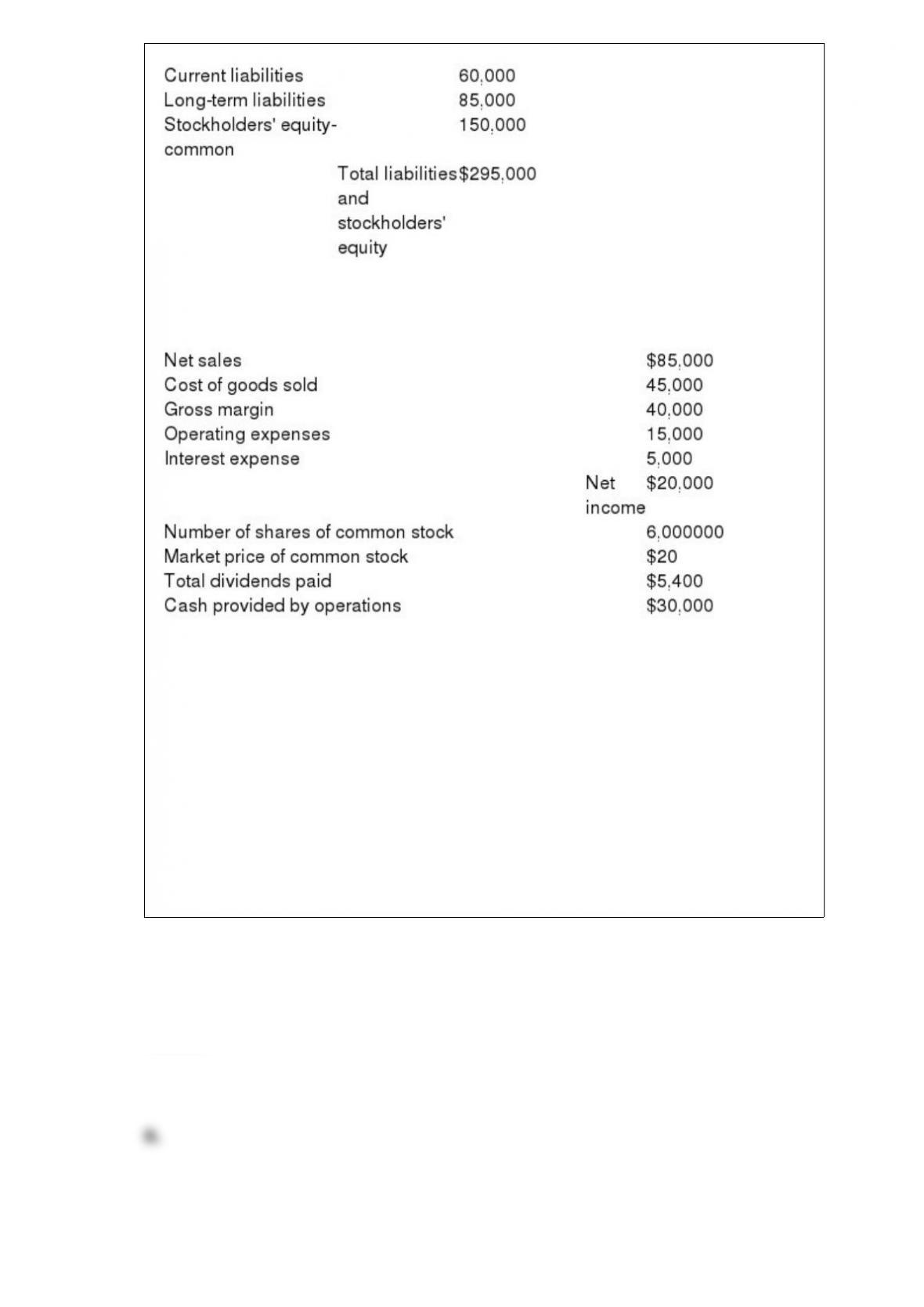
Income Statement
What is the rate earned on common stockholders’ equity for this company? Round your
answer to one decimal point.
A.6.8%
B.13.3%
C.16.7%
D.23.3%
Answer:

The two methods of accounting for uncollectible receivables are the allowance method
and the
A.equity method
B.direct write-off method
C.interest method
D.cost method
Answer:
If the physical count of the inventory revealed $158,000 of merchandise on hand and
the inventory records reported $163,000, what would be the necessary adjusting entry
to record inventory shortage?
A.Merchandise inventory debit $158,000; Cost of Merchandise Sold credit $158,000.
B.Merchandise inventory debit $5,000; Cost of Merchandise Sold credit $5,000.
C.Cost of Merchandise Sold debit $163,000; Merchandise Inventory credit $158,000.
D.Cost of Merchandise Sold debit $5,000; Merchandise Inventory credit $5,000.
Answer:

Which of the following is not a part of comprehensive income?
A.foreign currency items
B.cash flows from stock investments
C.unrealized gains and losses
D.pension liability adjustments
Answer:
Using a perpetual inventory system, the entry to record the return from a customer of
merchandise sold on account includes a
A.credit to Sales Returns and Allowances
B.debit to Merchandise Inventory
C.credit to Merchandise Inventory
D.debit to Cost of Merchandise Sold
Answer:
The formula to compute direct labor rate variance is to calculate the difference between
A.actual costs + (actual hours * standard rate)
B.actual costs – standard cost
C.(actual hours * standard rate) – standard costs
D.actual costs – (actual hours * standard rate)
Answer:
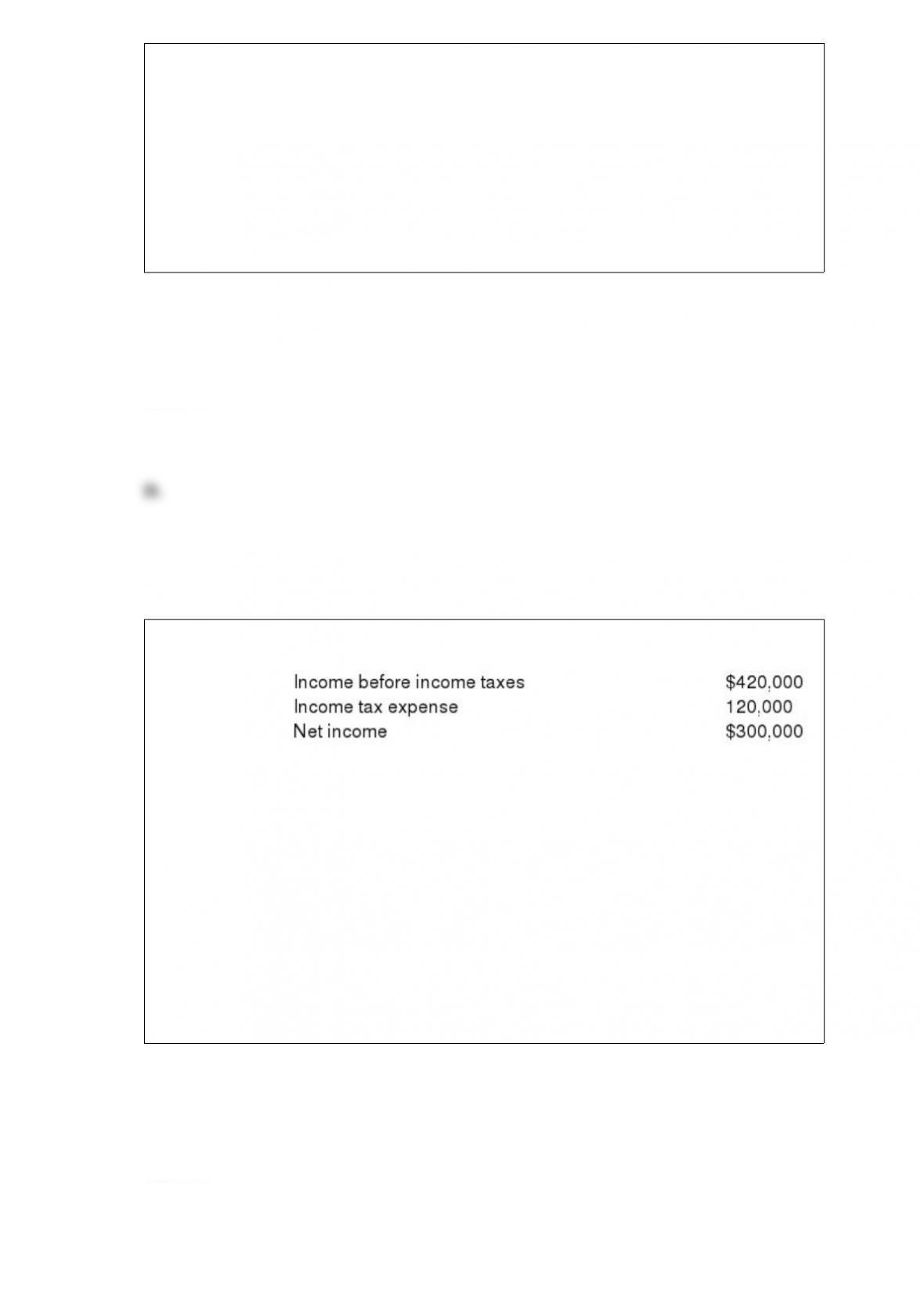
Hsu Company reported the following on its income statement:
An analysis of the income statement revealed that interest expense was $80,000. Hsu
Company’s times interest earned was
A.8 times.
B.6.25 times.
C.5.25 times.
D.5 times.
Answer:

The proper journal entry to record the receipt of inventory purchased on account in a
perpetual inventory system would be:
A.Jan 1 Merchandise Inventory 1,500
Accounts Payable 1,500
B.Jan 1 Office Supplies 1,500
Accounts Payable 1,500
C.Jan 1 Purchases 1,500
Accounts Payable 1,500
D.Jan 1 Purchases 1,500
Accounts Receivable 1,500
Answer:
A loss due to a discontinued operation should be reported in the income statement
A.above income from continuing operations.
B.without related tax effect.
C.below income from continuing operations.
D.as an operating expense.

Answer:
Which of the following should be added to net income in calculating net cash flow from
operating activities using the indirect method?
A.depreciation expense
B.an increase in inventory
C.a gain on the sale of equipment
D.dividends declared and paid
Answer:
For each of the following, determine the amount of net income or net loss for the year.
(a) Revenues for the year totaled $71,300 and expenses totaled $35,500. The owner
made an additional investment of $15,000 during the year.
(b) Revenues for the year totaled $220,500 and expenses totaled $175,000. The owner
withdrew $40,000 during the year.
(c) Revenues for the year totaled $149,000 and expenses totaled $172,000. The owner
invested an additional $12,000 and withdrew $16,000 during the year.
(d) Revenues for Konner Co. totaled $198,150 and expenses totaled $174,200. Cash
withdrawals of $35,000 were paid during the year.

Answer:
The three most common cost behavior classifications are:
A.variable costs, product costs, and sunk costs
B.fixed costs, variable costs, and mixed costs
C.variable costs, period costs, and differential costs
D.variable costs, sunk costs, and opportunity costs
Answer:
Income from operations for Division K is $220,000, and income from operations before
service department charges is $975,000. Therefore:
A.total operating expenses are $755,000

B.total manufacturing expenses are $755,000
C.direct materials, direct labor, and factory overhead total $755,000
D.total service department charges are $755,000
Answer:
If a manufacturer ships merchandise to a retailer on consignment, the unsold
merchandise should be included in the inventory of the
A.consignee
B.retailer
C.manufacturer
D.shipper
Answer:
Which of the following expenses incurred by a department store is an indirect expense?
A.Insurance on merchandise inventory

B.Sales salaries
C.Depreciation on store equipment
D.Salary of vice-president of finance
Answer:
Which of the following is recorded in the cash payments journal?
A.adjusting entry for accrued salaries
B.receipt of cash on supplies returned
C.receipt of cash from services rendered
D.payment of employees’ salaries
Answer:
When a business sells more than one product at varying selling prices, the business’s
break-even point can be determined as long as the number of products does not exceed:
A.two

B.three
C.fifteen
D.there is no limit
Answer:
Which of the following is the principle reason for preparing managerial accounting
reports?
A.Usefulness to management
B.Cost of preparation
C.Clarity
D.GAAP
Answer:
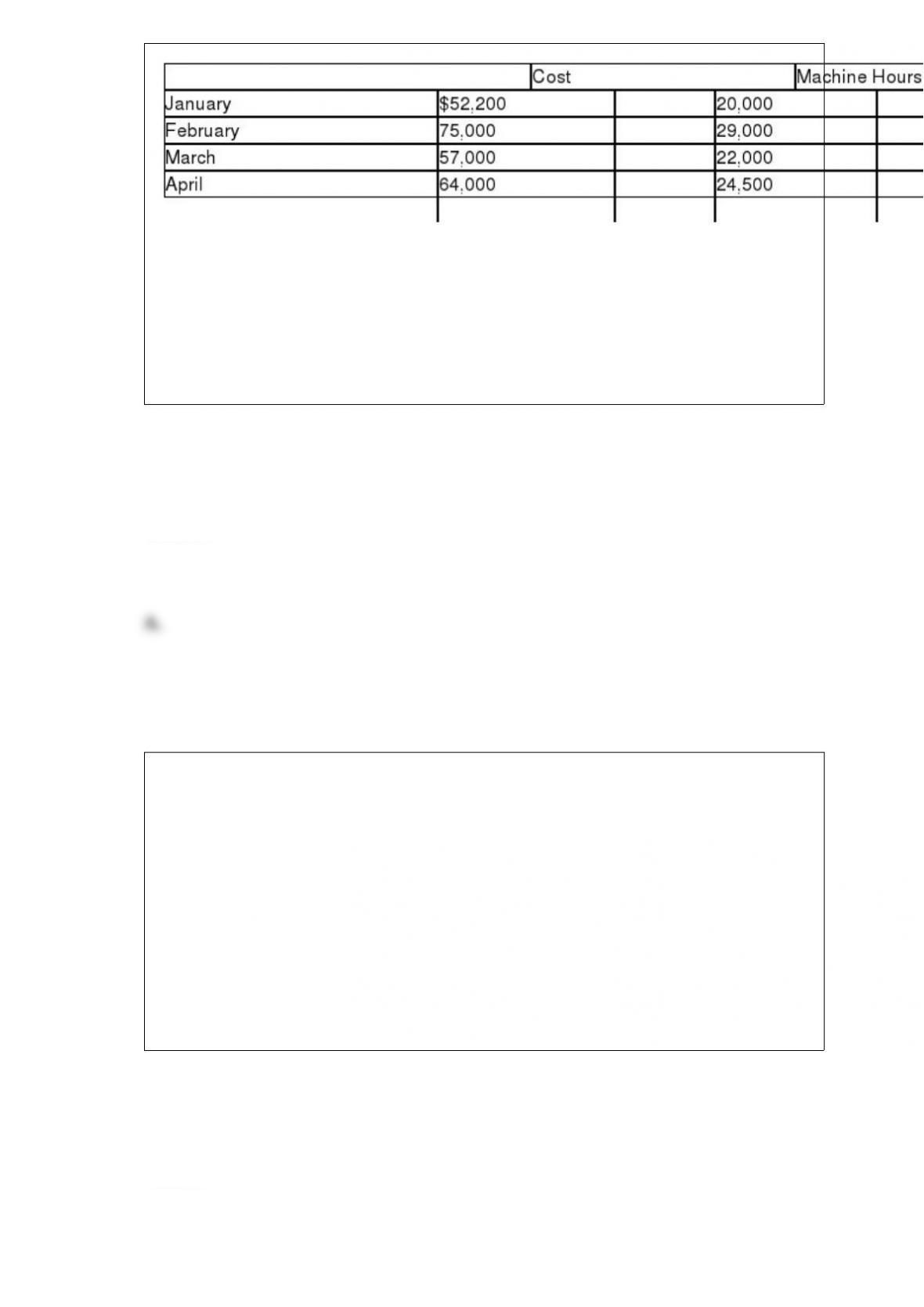
Given the following cost and activity observations for Smithson Company’s utilities,
use the high-low method to calculate Smithson’s fixed costs per month. Do not round
your intermediate calculations.
A.$1,533
B.$2,530
C.$22,800
D.$50,600
Answer:
The Sneed Corporation issues 10,000 shares of $50 par value preferred stock for cash at
$75 per share. The entry to record the transaction will consist of a debit to Cash for
$750,000 and a credit or credits to
A.Preferred Stock for $750,000.
B.Preferred stock for $500,000 and Paid-in Capital in Excess of Par ValuePreferred
Stock for $250,000.
C.Preferred Stock for $500,000 and Retained Earnings for $250,000.
D.Paid-in Capital from Preferred Stock for $750,000.
Answer:

When using the total cost concept of applying the cost-plus approach to product pricing,
what is included in the markup?
A.Total selling and administrative expenses plus desired profit
B.Total fixed manufacturing costs, total fixed selling and administrative expenses, and
desired profit
C.Total costs plus desired profit
D.Desired profit
Answer:
Periodic comparisons between planned objectives and actual performance are reported
in:
A.zero-base reports
B.budget performance reports
C.master budgets
D.budgets
Answer:

Ramone Company had $600,000 in Net Sales for the year 2010. The total assets at the
beginning of the year were $240,000 and total assets at the end of the year were
$280,000. The ratio of net sales to total assets is (round answer to 2 decimal places):
A.2.31
B.1.15
C..43
D..87
Answer:
Entries are made to the Petty Cash account when
A.making payments out of the fund.
B.recording shortages in the fund.
C.replenishing the petty cash fund.
D.establishing the fund.
Answer:
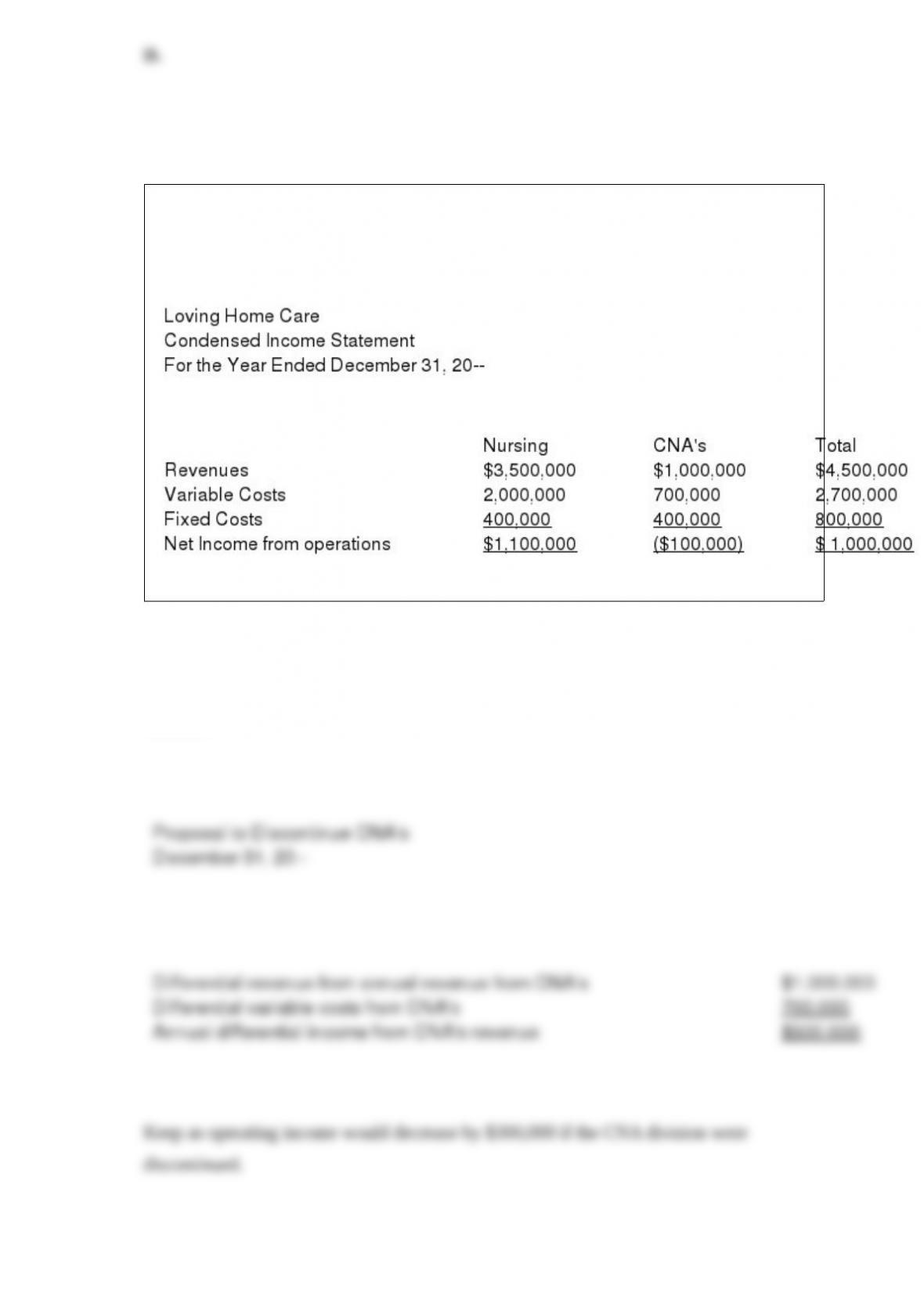
Due to Medicare reimbursement cuts, Loving Home Care is considering shutting down
its Certified Nursing Assistant (CNA) Division. Fixed costs will have to be transferred
to the Nursing Division if the CNA division is discontinued. Based on the following
income statement make a recommendation to the president regarding this decision.
Answer:
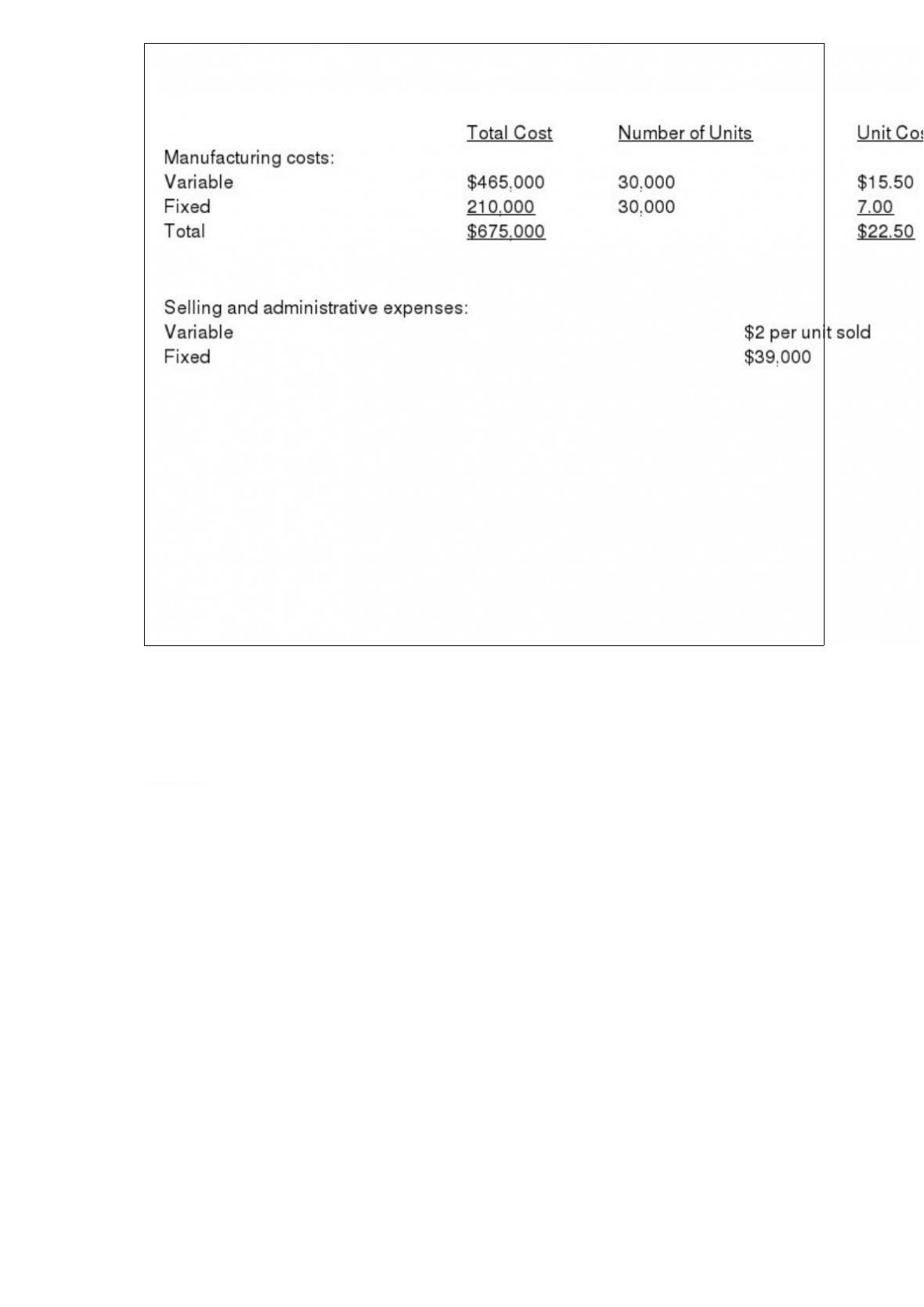
Kissimmee Paint Co. reported the following data for the month of July. There were no
beginning inventories and all units were completed (no work in process).
In the month of July, 28,000 of the 30,000 units manufactured were sold at a price of
$80 per unit.
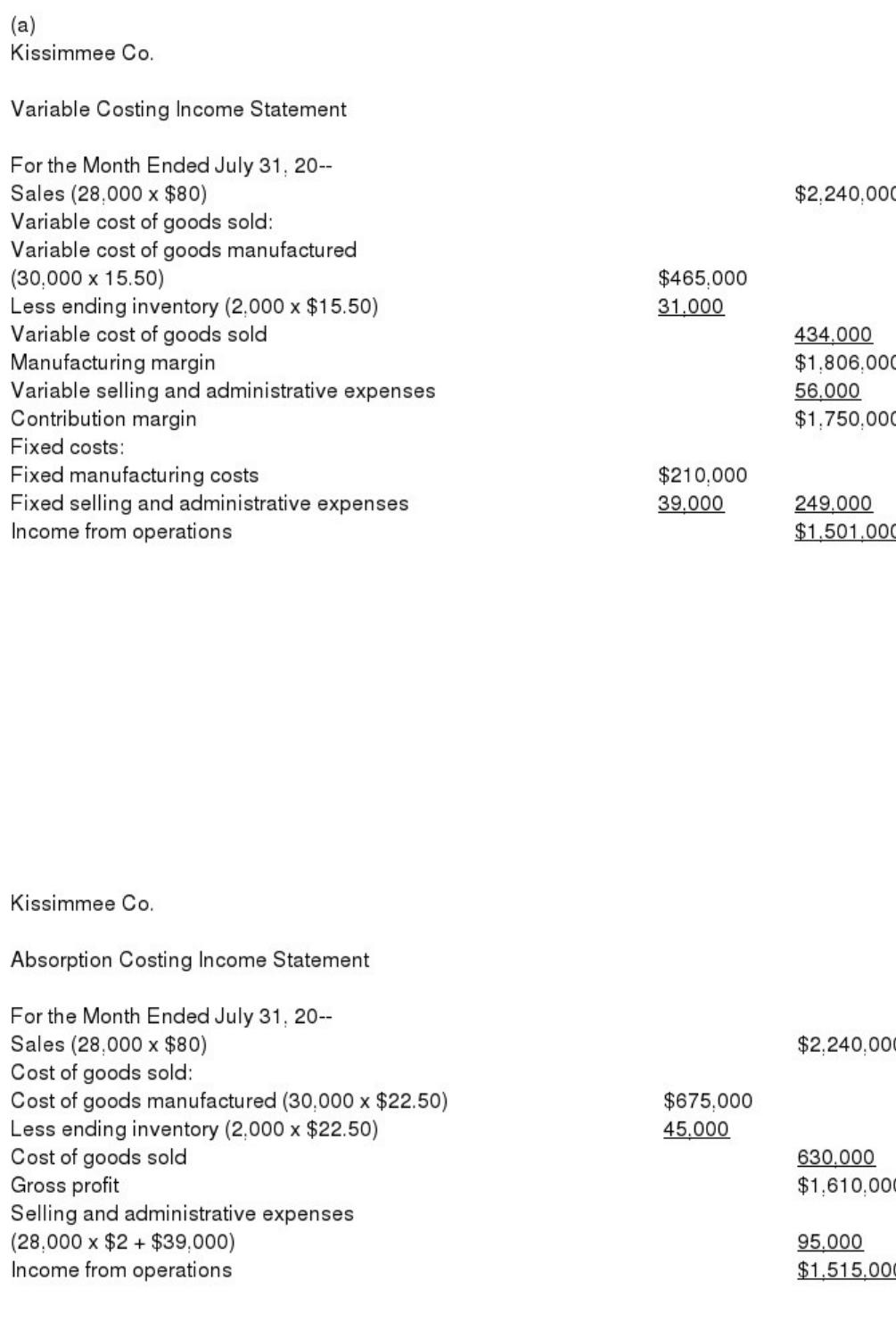
(a) Prepare a variable costing income statement.
(b) Prepare an absorption costing income statement.
(c) Briefly explain why there is a difference in income from operations between the two
methods.
Answer:

Which of the following budgets provides the starting point for the preparation of the
direct labor cost budget?
A.Direct materials purchases budget
B.Cash budget
C.Production budget
D.Sales budget
Answer:
A company’s history indicates that 20% of its sales are for cash and the rest are on
credit. Collections on credit sales are 20% in the month of the sale, 50% in the next
month, 25% the following month, and 5% is uncollectible. Projected sales for
December, January, and February are $60,000, $85,000, and $95,000, respectively. The
February expected cash receipts from all current and prior credit sales is:
A.$61,200
B.$57,000
C.$66,400

D.$90,250
Answer:
The percentage analysis of increases and decreases in individual items in comparative
financial statements is called
A.vertical analysis
B.solvency analysis
C.profitability analysis
D.horizontal analysis
Answer: