
Costs that will not vary with activity levels in the short run are known as:
A.fixed costs.
B.variable costs.
C.sunk costs.
D.opportunity costs.
What is the study of the need for activities and whether they are operating efficiently
called?
A.direct and indirect cost management.
B.variable and fixed cost management.
C.activity-based management.
D.total quality management.
Multiple products make using financial models more complex. To deal with this,
managers can do which of the following?
A.assume that all products have the a different contribution margin.
B.assume a weighted average contribution margin.
C.use contribution margin as a measure of volume.
D.All of the answers are correct.
Which of the following is true?
A.A change in fixed costs (other than for inflation or other price changes) usually
involves a change in long-term assets, whereas a change in semi-fixed costs often does
not.
B.A change in fixed costs (other than for inflation or other price changes) usually
involves a change in short-term assets, whereas a change in semi-fixed costs often does
not.
C.A change in semivariable costs (other than for inflation or other price changes)
usually involves a change in long-term assets, whereas a change in semi-fixed costs
often does not.
D.A change in semivariable costs (other than for inflation or other price changes)
usually involves a change in short-term assets, whereas a change in semi-fixed costs
often does not.
Doug’s Delivery Company
Doug’s Delivery Company reports the following information for 2010:
Actual:
Standard:
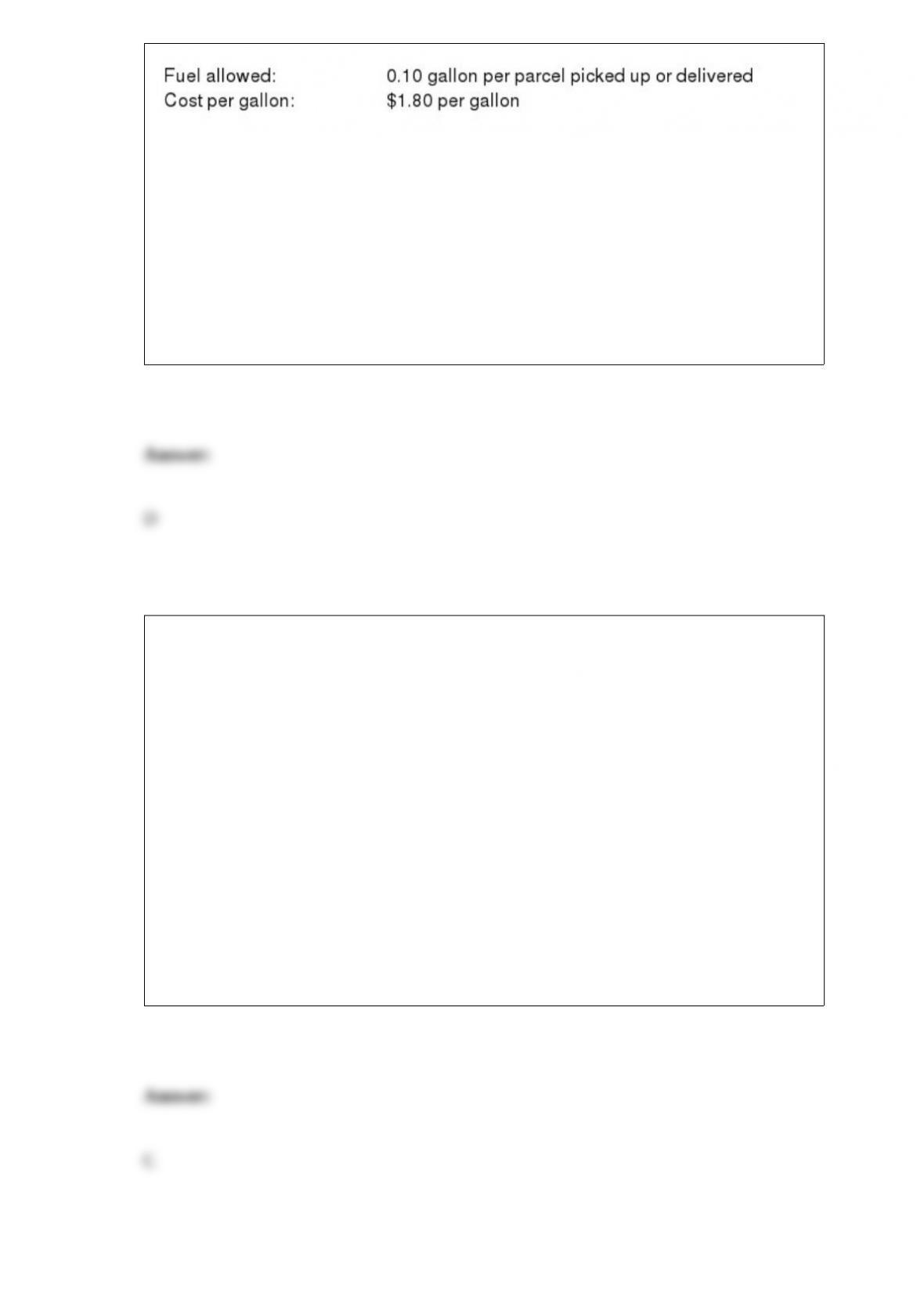
Refer to Doug’s Delivery Company. What is the variable overhead efficiency variance
for fuel costs?
A.$20.00 U
B.$20.00 F
C.$18.00 U
D.$18.00 F
Carson Company’s market for the Model A has changed significantly, and Carson has
had to drop the price per unit from $265 to $125. There are some units in the work in
process inventory that have costs of $150 per unit associated with them. Carson could
sell these units in their current state for $100 each. It will cost Carson $10 per unit to
complete these units so that they can be sold for $125 each.
Based on the information about Carson, which of the following is not considered a
relevant value for this problem?
A.$10 = cost to complete units
B.$125 = current price
C.$265 = former price
D.$100 = price for partially completed units

When is the discount rate used?
A.When determining the applicable treasury rate.
B.When computing the present value of future cash flows.
C.To reduce the price of an investment.
D.When determining the future value of the firm’s cash inflows and outflows.
In considering a special order that will enable a company to make use of presently idle
capacity, which of the following costs would be irrelevant?
A.Materials
B.Depreciation
C.Direct Labor
D.Variable Overhead
Ambros Company
In the Ambros Company, Division A has a product that can be sold either to outside
customers or to Division B. Information about these divisions is given below:
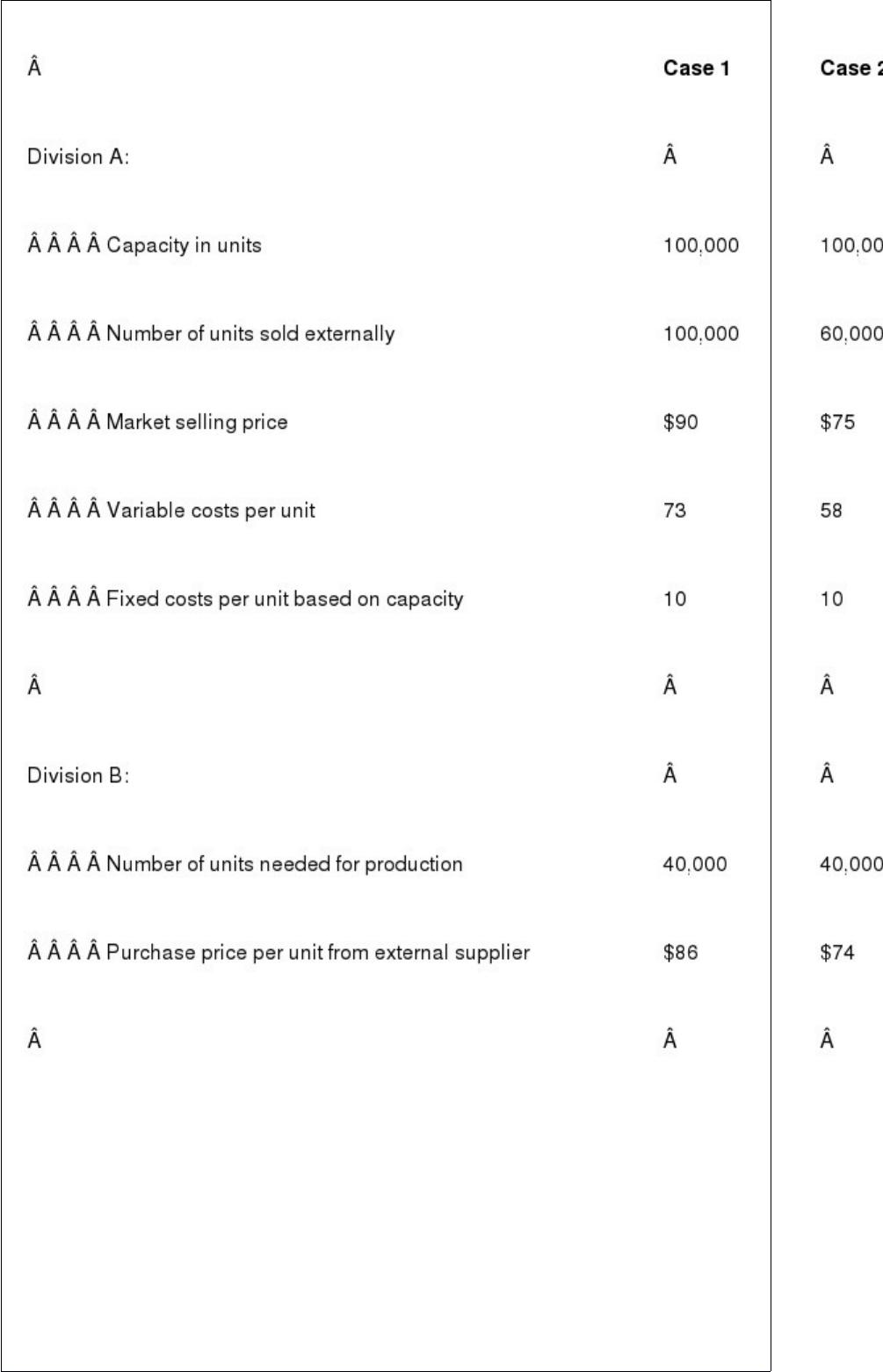
Refer to Ambros Company. The company uses the opportunity cost approach to transfer
pricing. What is the maximum transfer price in Case 1?
A.$91.
B.$90.
C.$86.
D.$73.

The cost hierarchy can be used to organize cost information for decision-making.
Which cost isnot part of the product cost hierarchy of expenses?
A.Capacity-sustaining.
B.Product-sustaining.
C.Customer-sustaining.
D.Employee-sustaining.
What are common causes of financial fraud?
A.short-term profit orientation.
B.pressure to achieve unreasonable targets.
C.sudden decreases in revenue or market share.
D.All of the answers are correct.
Which is not a reason direct labor variances may occur?
A.Managers do not correctly anticipate changes in wage rates.
B.Poor materials are used in production.
C.Prices rise with direct materials.
D.All of the above.
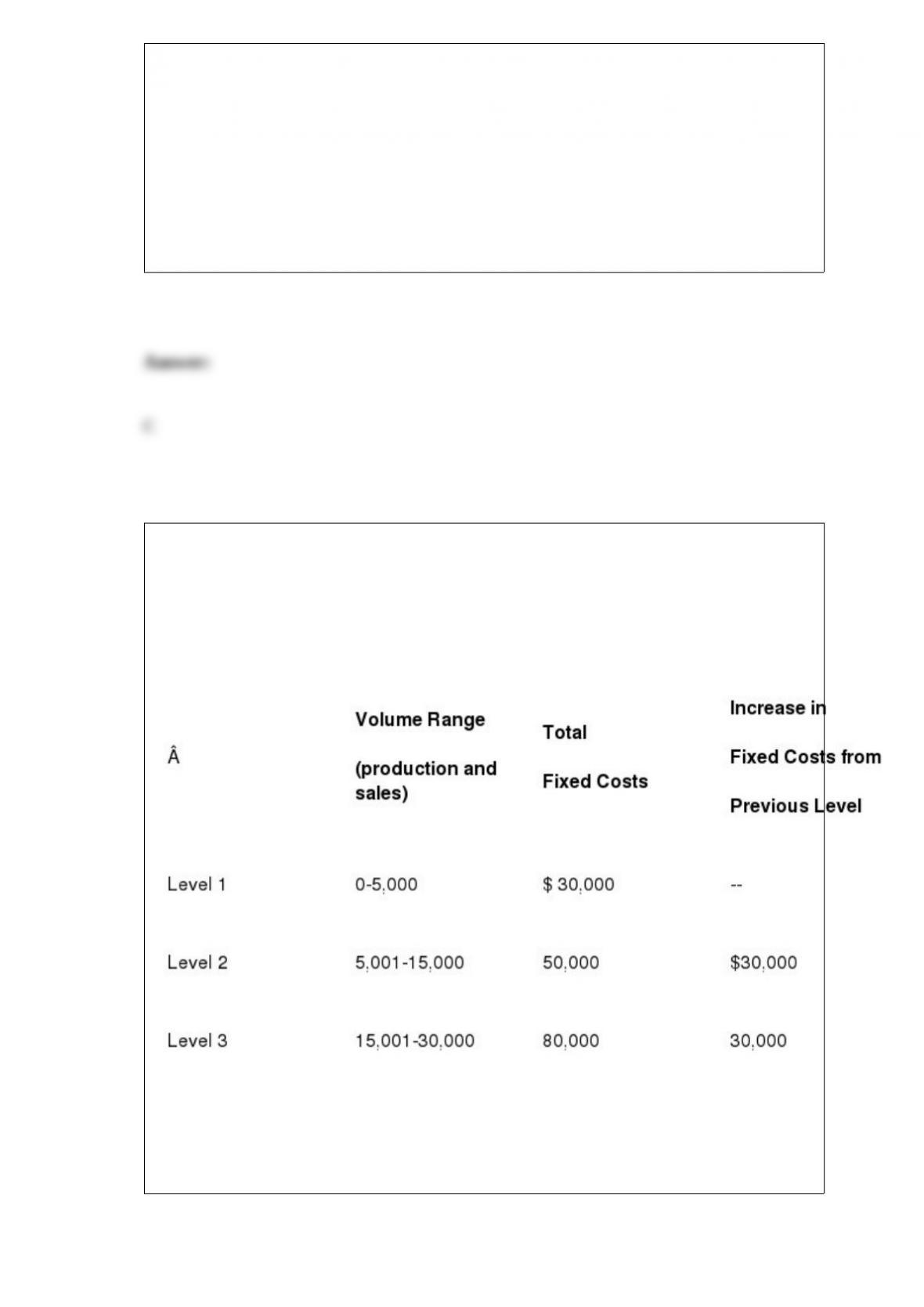
CVP analysis with step costs. Techniques Company has one product: customized
thumb drives with logos for various businesses. The sales price of $18 remains constant
per unit regardless of volume, as does the variable cost of $10 per unit. The company is
considering operating at one of the following three monthly levels of operations:
Required: a. Calculate the break-even point(s) in units.
b. If the company can sell everything it makes, should it operate at level 1, level 2, or
level 3? Support your answer.
Which of the following statements is true concerning activity-based costing (ABC)?
A.ABC can only be used in manufacturing.
B.ABC can be used for manufacturing, marketing, or administrative activities.
C.ABC should only be used for service companies.
D.ABC can be used for manufacturing and administrative activities, but not for
marketing activities.