The Acme Corporation starts the year with a beginning inventory of 300 units at $5 per
unit. The company purchases 500 units at $4 each in February and 200 units at $6 each
in October. Acme sells 150 units during the year. Acme has a periodic inventory system
and uses the FIFO inventory costing method. What is the amount of cost of goods sold?
A) $600
B) $934
C) $750
D) $900
Choose the appropriate term to match the term and the definition. Not all definitions
will be used.
Term:
1> _____ Corporation
2> _____ Par Value
3> _____ Growth Investment
4> _____ LLC
5> _____ Current Dividend Preference
6> _____ Partnership
7> _____ Market Value

8> _____ Income Investment
9> _____ Cumulative Dividend Preference
10> _____ Sole Proprietorship
Definition:
A. When preferred stockholders are paid dividends before other stockholders.
B. When stockholders prefer to receive dividends at the end of the year rather than each
quarter.
C. The current stock price.
D. A company that issues stock on one of the major stock exchanges.
E. An unincorporated business that is owned by a single individual.
F. A stock that is currently selling for its original issue price.
G. A company that has a separate legal identity from its owners.
H. When companies are obligated to pay preferred stockholders past dividends not yet
distributed before paying dividends to owners of common stock.
I. The nominal value per share of stock set by the company’s charter.
J. Stock of companies that tend to reinvest earnings to provide for greater future sales
and profits.
K. A company that is like a partnership in nature except that it has limited liability.
L. Stock of companies that tend to pay relatively high dividends compared to the stock
price.
M. An unincorporated business owned by two or more individuals.
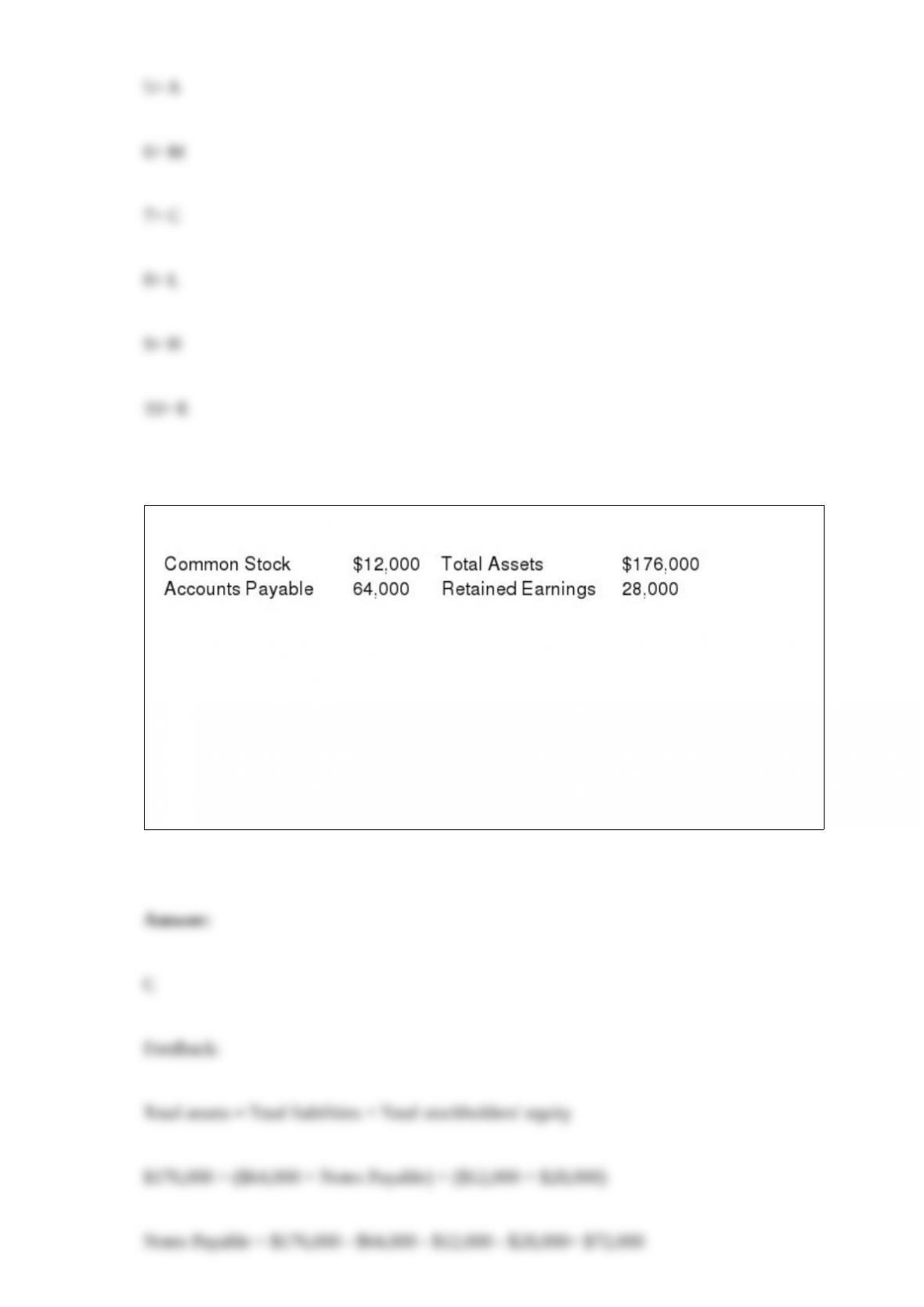
A company’s balance sheet contained the following information:
Notes Payable is the only other item on the balance sheet. Notes Payable must equal:
A) $200,000.
B) $8,000.
C) $72,000.
D) $344,000.
Assume a periodic inventory system is used. The LIFO inventory costing method
assumes that the cost of the units most recently purchased is the:
A) last to be assigned to cost of goods sold.
B) first to be assigned to ending inventory.
C) first to be assigned to cost of goods sold.
D) last to be assigned to units available for sale.
A company has total revenue of $560,000 and total expenses of $330,000. If the
company overstates sales by $10,000, what is the effect on the company’s net profit
margin?
A) Net profit margin would be overstated.
B) Net profit margin would be understated.
C) Net profit margin would be unaffected.
D) Net profit margin cannot be computed because overstating sales is unethical.
At the end of the accounting period, but before the closing entries have been recorded,
Harry, the proprietor of Harry’s Bar and Grill, has a debit of $24,500 in his drawing
account and a credit of $126,800 in his capital account. If his capital account has a
credit balance of $137,900 after the closing, what was his net income?
A) $11,100
B) $35,600
C) $113,400
D) $13,400
Censing Company collected $5,000 from a customer on account. What journal entry
will be prepared by Censing to record this transaction?
A) Debit Cash and credit Accounts Receivable.
B) Debit Cash and credit Service Revenue.
C) Debit Accounts Receivable and credit Service Revenue.
D) Debit Accounts Receivable and credit Cash.
Under the direct write-off method, the entry to write off a customer’s account would
include a debit to:
A) Bad Debt Expense and a credit to Allowance for Doubtful Accounts.
B) Bad Debt Expense and a credit to Accounts Receivable.
C) Write-off Expense and a credit to Accounts Receivable.
D) Sales and a credit to Accounts Receivable.
On January 1, your company issues a 5-year bond with a face value of $10,000 and a
stated interest rate of 7%. The market interest rate is 5%. The issue price of the bond
was $10,866. Your company used the effective-interest method of amortization. At the
end of the first year, your company should:
A) debit Interest Expense for $543, debit Premium on Bonds Payable for $157, and
credit Interest Payable for $700.
B) debit Interest Expense for $700, credit Premium on Bonds Payable for $157, and
credit Interest Payable for $543.
C) debit Interest Expense for $700, debit Premium on Bonds Payable for $157, and
credit Interest Payable for $543.
D) debit Interest Expense for $543 and credit Interest Payable for $543.
On January 1, 2016, a company issues 3-year bonds with a face value of $50,000 and a
stated interest rate of 7%. Because the market interest rate is 9%, the company receives
$47,469 for the bond.
Required:
Part a. Determine the interest expense, the cash payment for interest, and the amount of
the premium that will be amortized during the year ending December 31, 2016.
Part b. Prepare the journal entry to record the first interest payment on December 31,
2016.