Which of the following is not usually associated with bonds?
A. Coupon rate.
B. Maturity value.
C. Face amount.
D. Maturity rate.
_____________ allows managers to focus their attention on maximizing an amount of
earnings above a minimum required ROI.
A. Optimization
B. The DuPont model
C. Residual income
D. Transfer pricing
When bonds are issued at a premium:
A. interest expense on the bonds will be less than the interest paid.
B. interest expense on the bonds will be more than the interest paid.
C. the bonds are sold for less than their face amount.
D. the coupon interest rate is less than the market interest rate.
Current maturities of long-term debt:
A. reflect overdue installments of bonds payable.
B. are classified with long-term debt.
C. represent cash that has been set aside for debt payments due within a year.
D. permit a more accurate determination of working capital.
Which of the following is not a right or attribute of common stock ownership?
A. Electing directors.
B. Liability limited to amount invested.
C. Approving changes in corporate charter.
D. Determining dividend policy.
The decision to continue or discontinue a segment of the business should focus on:
A. sales minus total variable expenses and total fixed expenses.
B. sales minus total variable expenses and avoidable fixed expenses of the segment.
C. sales minus total variable expenses and allocated fixed expenses of the business.
D. none of the above.
The development of the operating budget is complete when:
A. the sales forecast for next year is complete.
B. the budgeted cash flow statement is complete.
C. the budgeted income statement is complete.
D. the budgeted balance sheet is complete.
Additional paid-in-capital represents:
A. The difference between the total amounts invested by the stockholders and the par or
stated value of the stock.
B. Distributions of earnings that have been made to the stockholders.
C. Distributions of earnings that have not been made to the stockholders.
D. The summation of the total amount invested by the stockholders and the par or stated
value of the stock.
The principal challenge to calculating depletion is estimating:
A. the cost of the asset.
B. the salvage value of the exploration equipment.
C. the demand for the product.
D. the quantity of material to be recovered.
When the firm’s activity requires it to operate at a level above the upper boundary of the
relevant range, fixed expenses are likely to:
A. increase.
B. decrease.
C. remain the same.
D. be eliminated.
The key difference between a controllable cost and a noncontrollable cost is:
A. the large amount of the cost.
B. the frequency of cost incurrence.
C. the short term ability to influence the cost by the manager.
D. whether the cost is fixed or variable.
Which of the following is the correct calculation for the contribution margin ratio?
A. sales revenue divided by variable costs.
B. sales revenue divided by contribution margin.
C. contribution margin divided by sales revenue.
D. contribution margin divided by variable costs.
The time frame associated with a balance sheet is:
A. a point in time in the past.
B. a one-year past period of time.
C. a single date in the future.
D. a function of the information included in it.
An important reason for imposing a minimum cash balance in the cash budget is:
A. it provides a cushion that can absorb forecast errors.
B. it provides extra funds for managers to spend.
C. it makes the balance sheet look better.
D. all of the above.
Lone Star Sales & Service acquired a new machine that cost $84,000 in early 2016. The
machine is expected to have a five-year useful life and is estimated to have a salvage
value of $14,000 at the end of its life. (Round your final answers to the nearest dollar.)
(a.) Using the straight-line depreciation method, calculate the depreciation expense to
be recognized in the second year of the machine’s life and calculate the accumulated
depreciation after the third year of the machine’s life.
(b.) Using the double-declining-balance depreciation method, calculate the depreciation
expense for the third year of the machine’s life and the net book value of the machine at
this point in time.

Simplifying assumptions made when using cost behavior pattern data include:
A. relevant range and liquidity.
B. fixed activity and linearity.
C. relevant range and linearity.
D. activity range and variability.
Which of the following are examples of physical measures of activity that are
sometimes disclosed in corporate annual reports?
A. Sales in units.
B. Number of employees.
C. Gross profit per square foot of selling space.
D. None of the above are examples of physical measures of activity that are sometimes
reported in corporate annual reports.
E. A, B, and C above are all examples of physical measures of activity that are
sometimes reported in corporate annual reports.
Martin & Associates borrowed $15,000 on April 1, 2016 at 8% interest with both
principal and interest due on March 31, 2017.
How much should be in the firm’s interest payable account at December 31, 2016?
A. $900
B. $1,200
C. $0
D. $1,000
Another term for return on investment is:
A. Return on equity.
B. Return on assets.
C. Return on retained earnings.
D. Return to sender.
When a firm purchases supplies for its business:
A. the supplies account should always be debited.
B. the supplies expense account should always be debited.
C. either the supplies account or the supplies expense account should be credited.
D. an adjustment will probably be required as supplies are used.
The difference between standard and actual cost per unit of input is measured by:
A. the raw materials price variance.
B. the direct labor rate variance.
C. the variable overhead spending variance.
D. all of the above.
The Statement of Cash Flows:
A. shows how cash changed during the period.
B. is an optional financial statement.
C. shows the change in the fair value of the entity’s common stock during the period.
D. shows the dividends that will be paid in the future.
Which of the terms is not used to identify owners’ equity or stockholders’ equity?
A. Partner’s capital.
B. Proprietor’s capital.
C. Paid-in-capital and retained earnings.
D. Additional-paid-in-retained earnings.
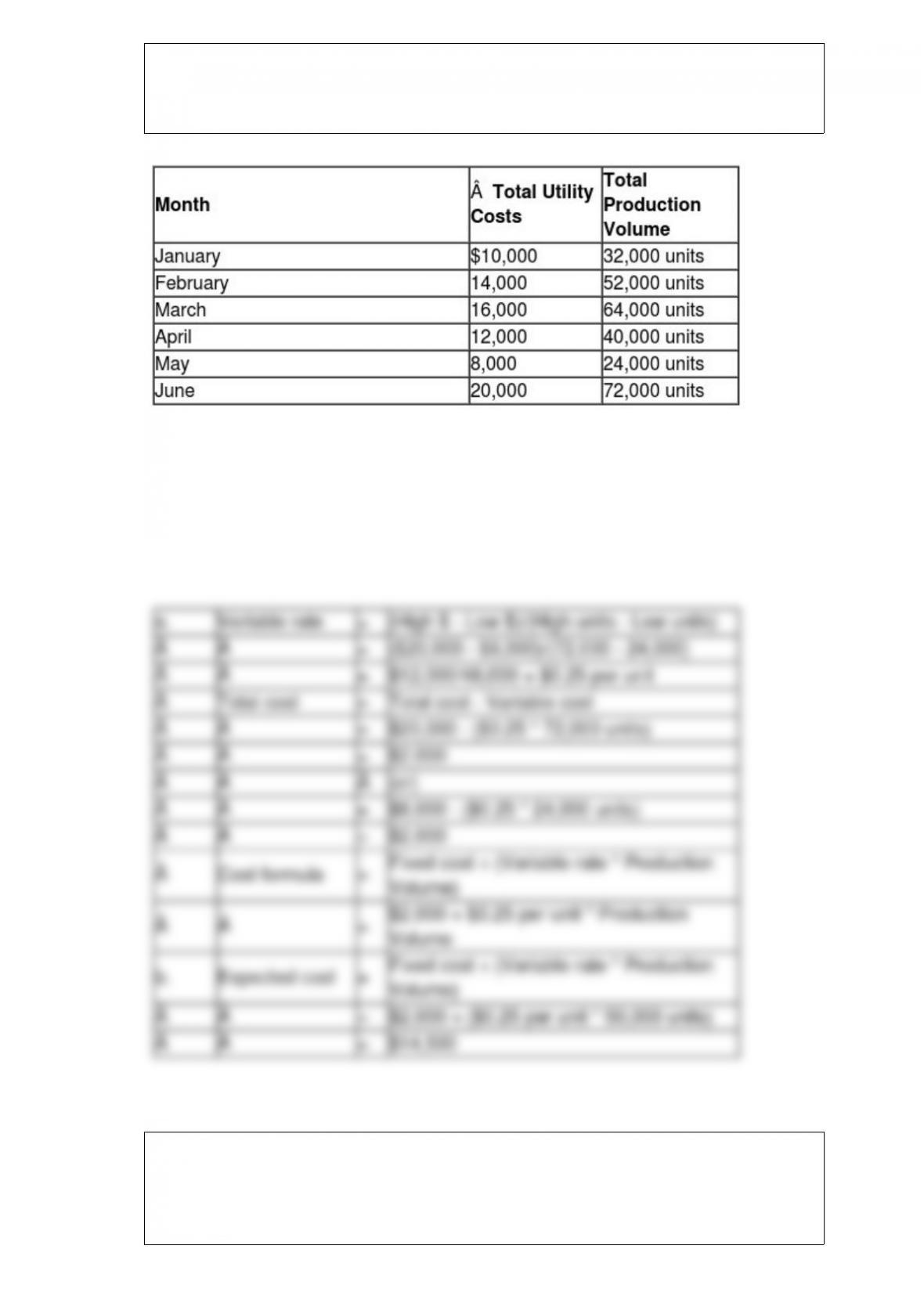
During the months of January through June, the following total utility costs were paid at
various production volumes:
a. Use the high-low method to calculate the cost formula utility costs.
b. If the production volume were expected to be 50,000 units for the month of July, what
amount of total costs would be expected?
Asset turnover calculations:
A. are made by dividing the average asset balance during the year by the sales for the
year.
B. are made by dividing sales for the year by the asset balance at the end of the year.

C. communicate information about how promptly the entity pays its bills.
D. should be evaluated by observing the turnover trend over a period of time.
An example of a cost that is noncontrollable in the short run is:
A. direct labor.
B. property taxes.
C. raw materials.
D. supervisors salaries.
The number of shares of a class of stock that are outstanding is:
A. the number of shares authorized minus the number of shares issued.
B. the number of shares authorized minus the number of shares held as treasury stock.
C. the number of shares issued minus the number of shares held as treasury stock.
D. the number of shares issued minus the number of shares owned by directors.
Standard costing is developed and used for:
A. planning purposes.
B. control purposes.
C. product costing purposes.
D. all of the above.
The sequence of activities that add value to the organization are:
A. the value processes.
B. the chain of production events.
C. the value chain.
D. the strategic cost initiatives.

An individual interested in making a judgment about the profitability of a company
should:
A. review the trend of working capital for several years.
B. calculate the company’s ROI for the most recent year.
C. review the trend of the company’s ROI for several years.
D. compare the company’s ROI for the most recent year with the industry average ROI
for the most recent year.
Braizen, Inc. produces a product with a $30 per-unit variable cost and an $80 per-unit
sales price. Fixed manufacturing overhead costs are $100,000. The firm has a one-time
opportunity to sell an additional 1,000 units at $60 each that would not affect its current
sales. Assuming the company has sufficient capacity to produce the additional units,
how would the acceptance of the special order affect net income?
A. income would decrease by $30,000.
B. income would increase by $30,000.
C. income would increase by $140,000.
D. income would increase by $40,000. $60 – $30 = $30/per unit; $30 × 1000 = $30,000
Which of the following accounting methods accomplishes much of the matching of
revenues and expenses?
A. Match accounting.
B. Cash accounting.
C. Accrual accounting.
D. Full disclosure accounting.
The production cost of a single unit of a manufactured product is determined by:
A. dividing total direct materials and direct labor for a production run by the number of
units made.
B. dividing total direct materials, direct labor, and manufacturing overhead for a
production run by the number of units made.
C. dividing total direct materials, direct labor, manufacturing overhead and selling
expenses for a production run by the number of units made.
D. dividing the selling price by the gross profit ratio.
Claudette, Inc., provides warranties for many of its products. The January 1, 2017,
balance of the Estimated Warranty Liability account was $77,000. Based on an analysis
of warranty claims during the past several years, this year’s warranty provision was
estimated to be 0.8 percent of sales. During 2017, the actual costs of servicing products
under warranty were $102,000, and sales were $10,600,000.
(a.) What amount of Warranty Expense will appear on the income statement for 2017?
(b.) What amount will be reported in the Estimated Warranty Liability account on the
December 31, 2017, balance sheet?
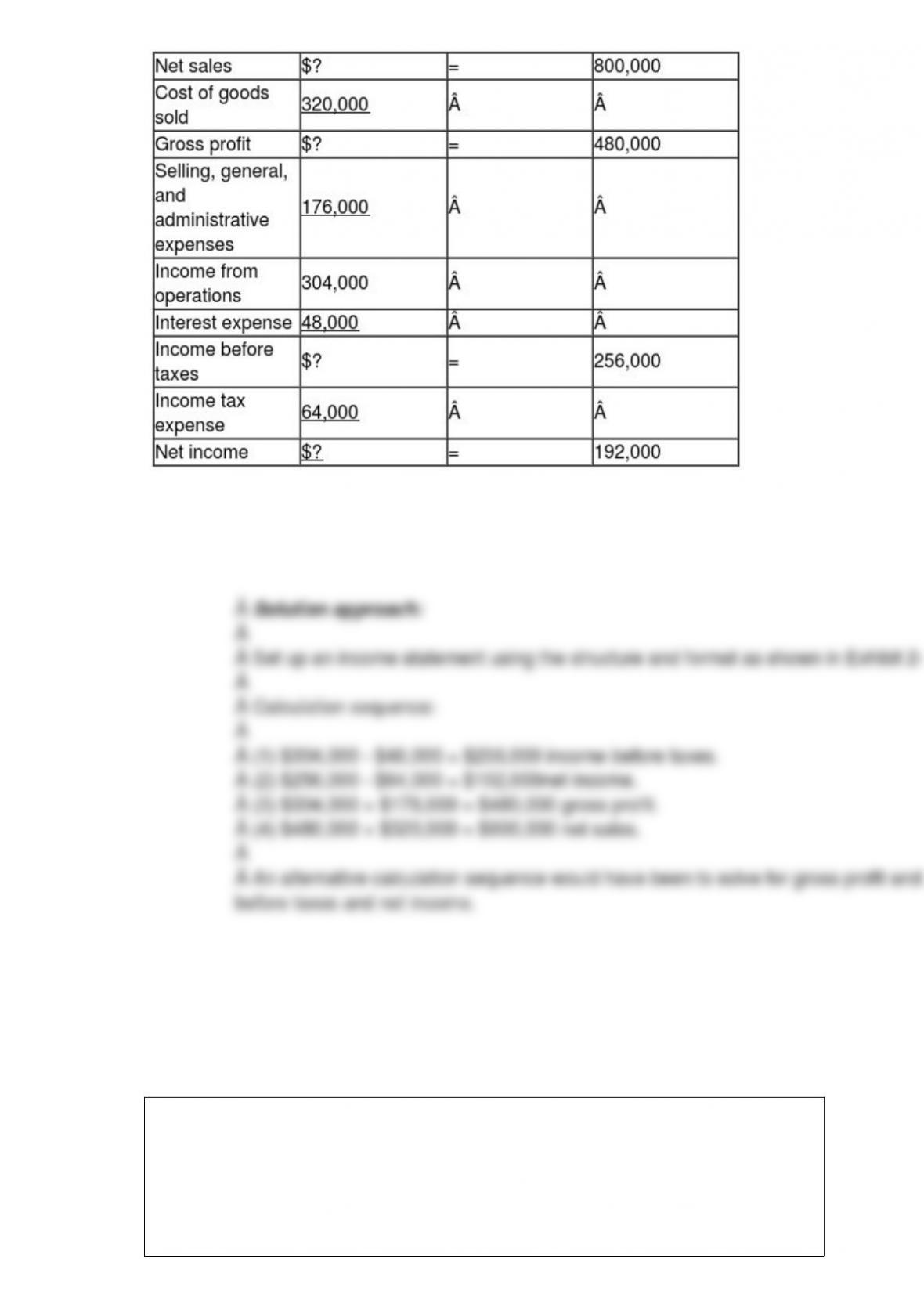
During the year, cost of goods sold was $320,000; income from operations was
$304,000; income tax expense was $64,000; interest expense was $48,000; and selling,
general, and administrative expenses were $176,000.
Required:
Calculate net sales, gross profit, income before taxes, and net income.
Innovation Inc.’s production budget for January is 35,000 units and includes the
following component unit costs: direct materials, $16; direct labor, $20; variable
overhead, $12. Budgeted fixed overhead is $70,000 (35,000 units × 1/2hour × $4unit).
Actual production in January was 36,000 units. Actual unit component costs incurred
during January include direct materials, $16.50; direct labor, $18.90; variable overhead,
$13.64. Actual fixed overhead was $67,000. The standard fixed overhead application
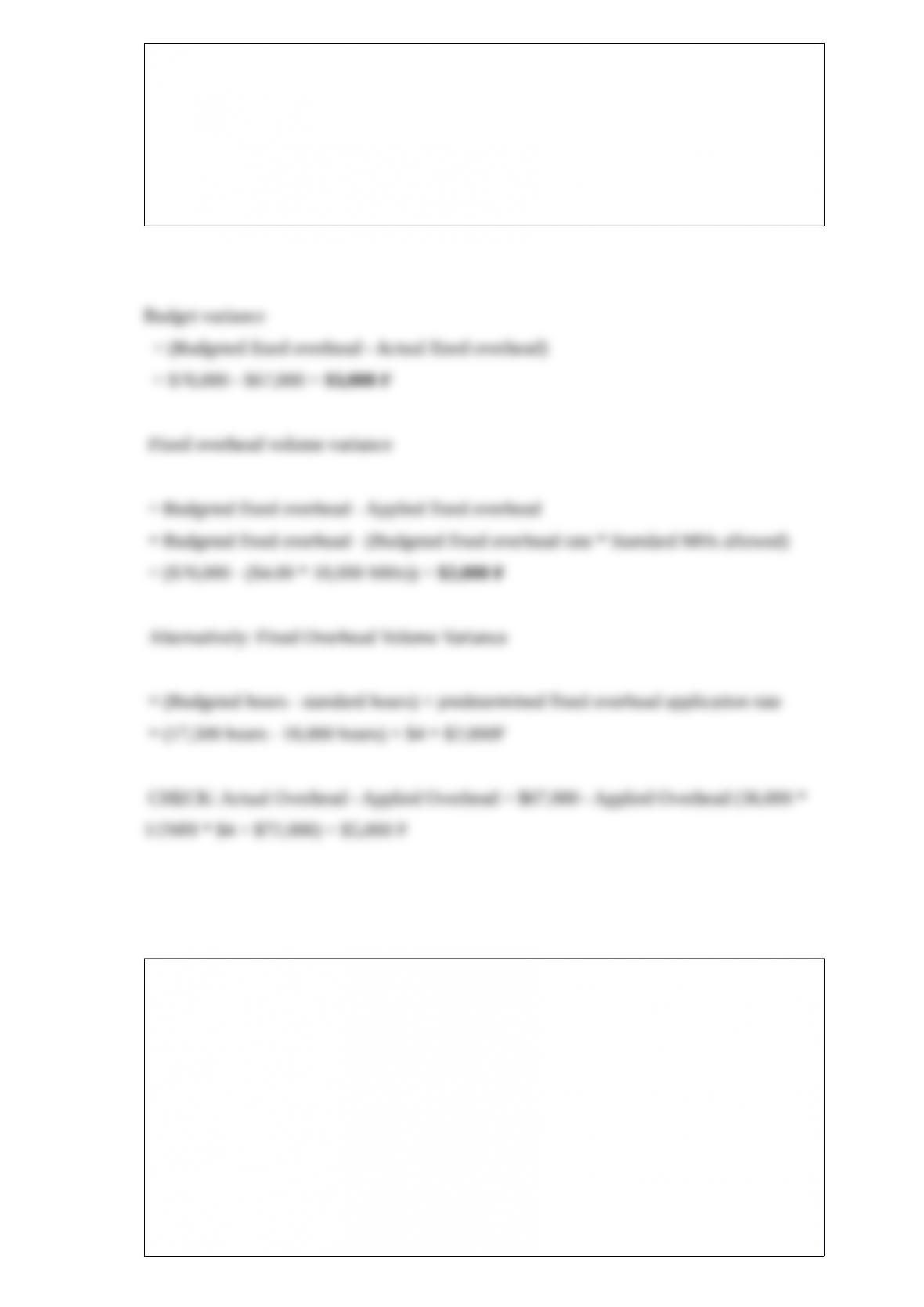
rate per unit consists of $4 per machine hour and each unit is allowed a standard of 1/2
hour of machine time.
Calculate the fixed overhead budget variance and the fixed overhead volume variance.
XYZ, Inc., processes soy beans into Product A and Product B and the company’s
productivity and cost standards follow:
• From every bushel of beans processed, 6 pounds of Product A and 4 pounds of
Product B should be produced.
• Standard direct labor and variable overhead total $0.85 per bushel of beans processed.
• Standard fixed overhead (the predetermined fixed overhead application rate) is $0.70
per bushel processed.
Calculate the standard absorption cost per pound for Product A and Product B produced
from the processing of 24,000 bushels of beans if the average cost per bushel is $3.75.
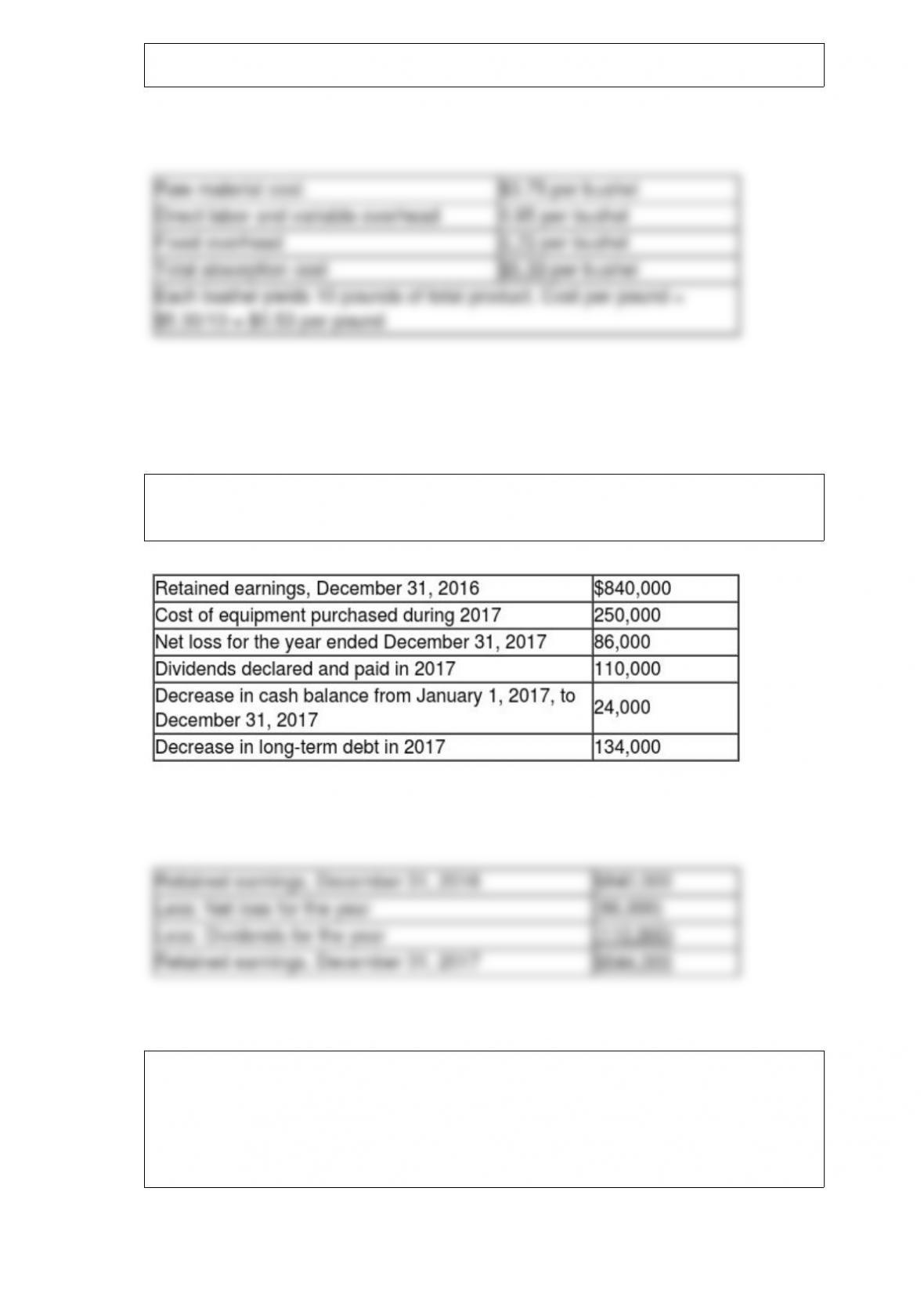
From the data given below, calculate the Retained Earnings balance as of December 31,
2017.
Patrick Company manufactures a single product. The original budget for April was
based on expected production of 12,000 units; actual production for April was 10,600
units. The original budget and actual costs for the manufacturing department are shown
below:
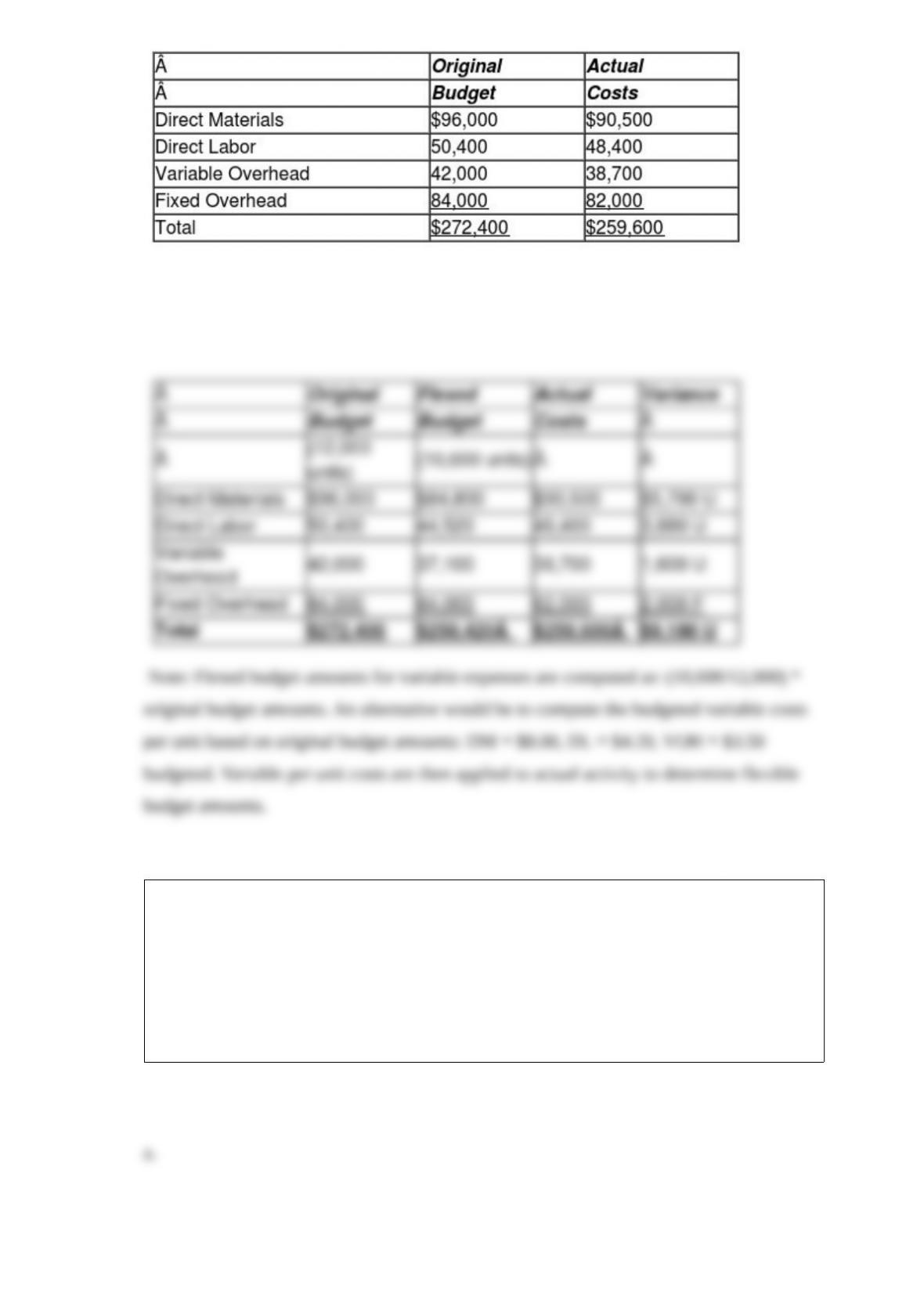
Prepare an appropriate performance report for the manufacturing department.
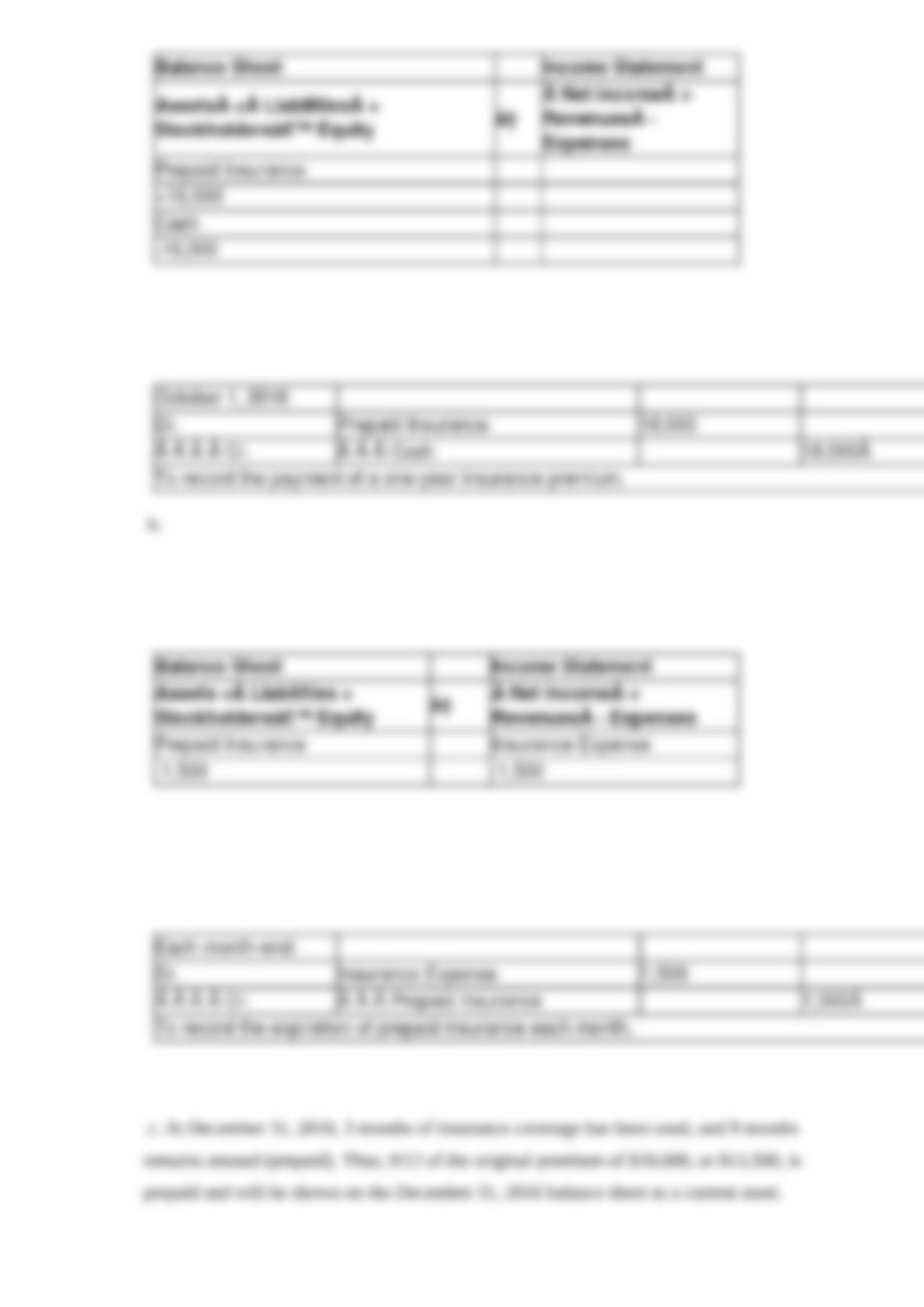
a. Use the horizontal model or write the journal entry to record the payment of a
one-year insurance premium of $18,000 on October 1, 2016.
b. Use the horizontal model or write the adjusting entry that will be made at the end of
every month to show the amount of insurance premium “used” that month.
c. Calculate the amount of prepaid insurance that should be reported on the December
31, 2016 balance sheet with respect to this policy.
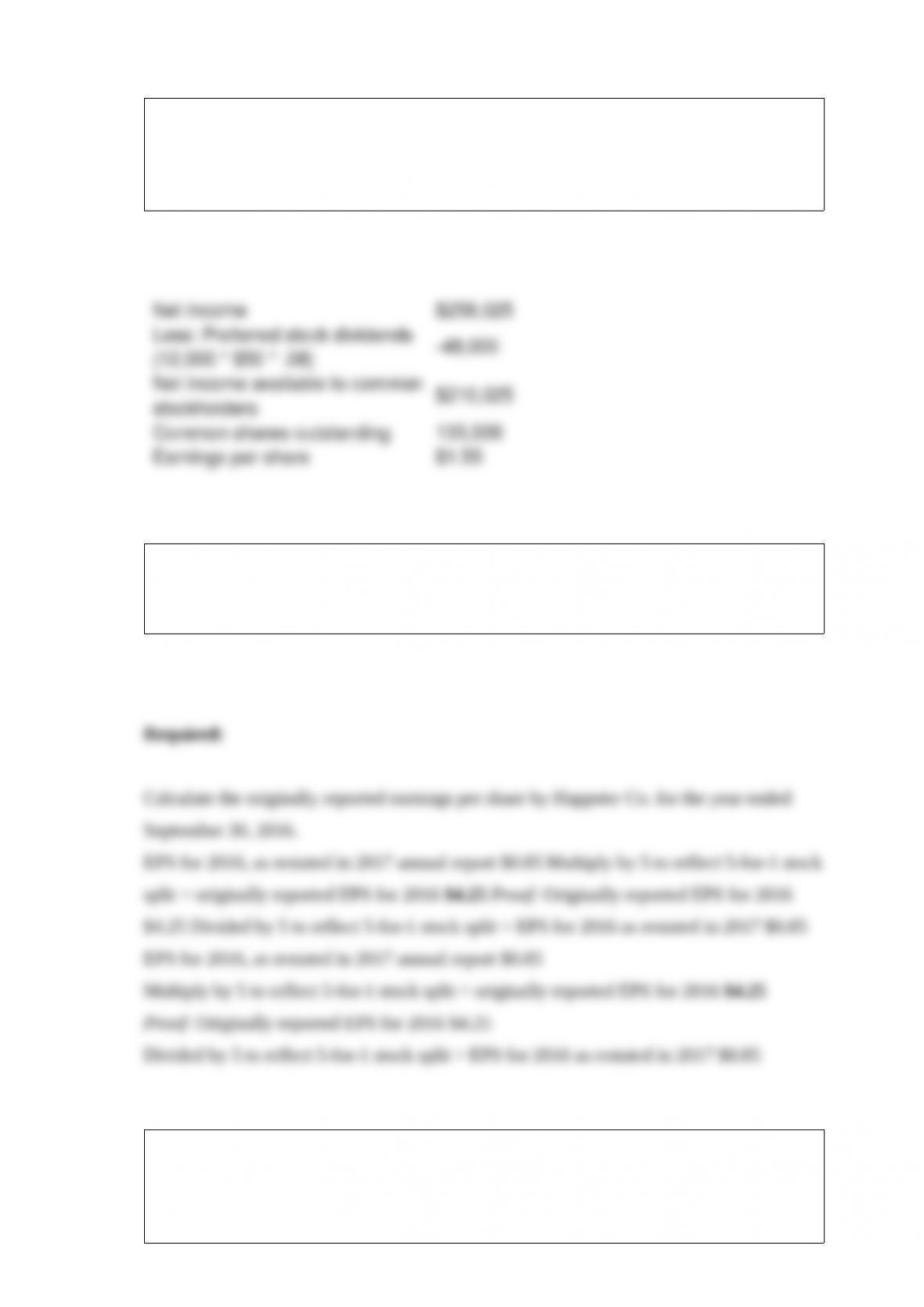
Sparkle Cleaners, Inc.Sparkle Cleaners, Inc., had net income of $258,025 for its fiscal
year ended September 30, 2017. During the year, the company had outstanding 12,000
shares of 8%, $50 par value preferred stock, and 135,500 shares of common stock.
Calculate the basic earnings per share of common stock for the 2017 fiscal year.
During the fiscal year ended September 30, 2017, Happster Co. had a 5-for-1 stock
split. In its annual report for 2017, the company reported earnings per share for the year
ended September 30, 2016, on a restated basis, of $0.85.
Peachtree’s Siding and Window Co. is a custom home improvement company. All sales
are made on account: 30 percent of a month’s sales are collected in the month of sale,
60 percent are collected in the month following the sale, and 8 percent are collected in
the second month following the sale. Cash on hand on October 1 is estimated to be
$32,000.
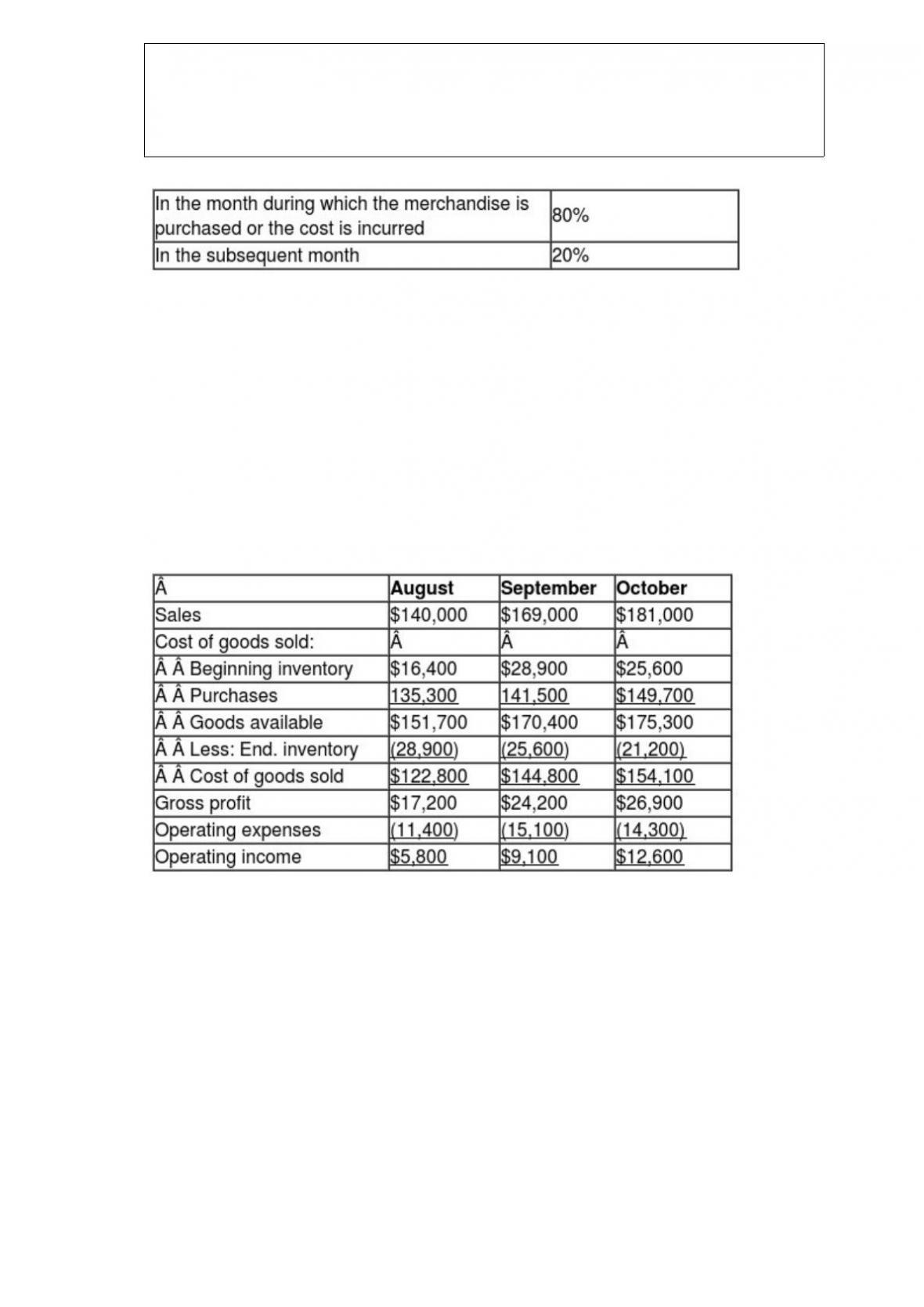
Merchandise purchases and operating expenses are paid as follows:
Peachtree’s Siding and Window Co.’s budgeted income statement for each of the next
three months is as follows:
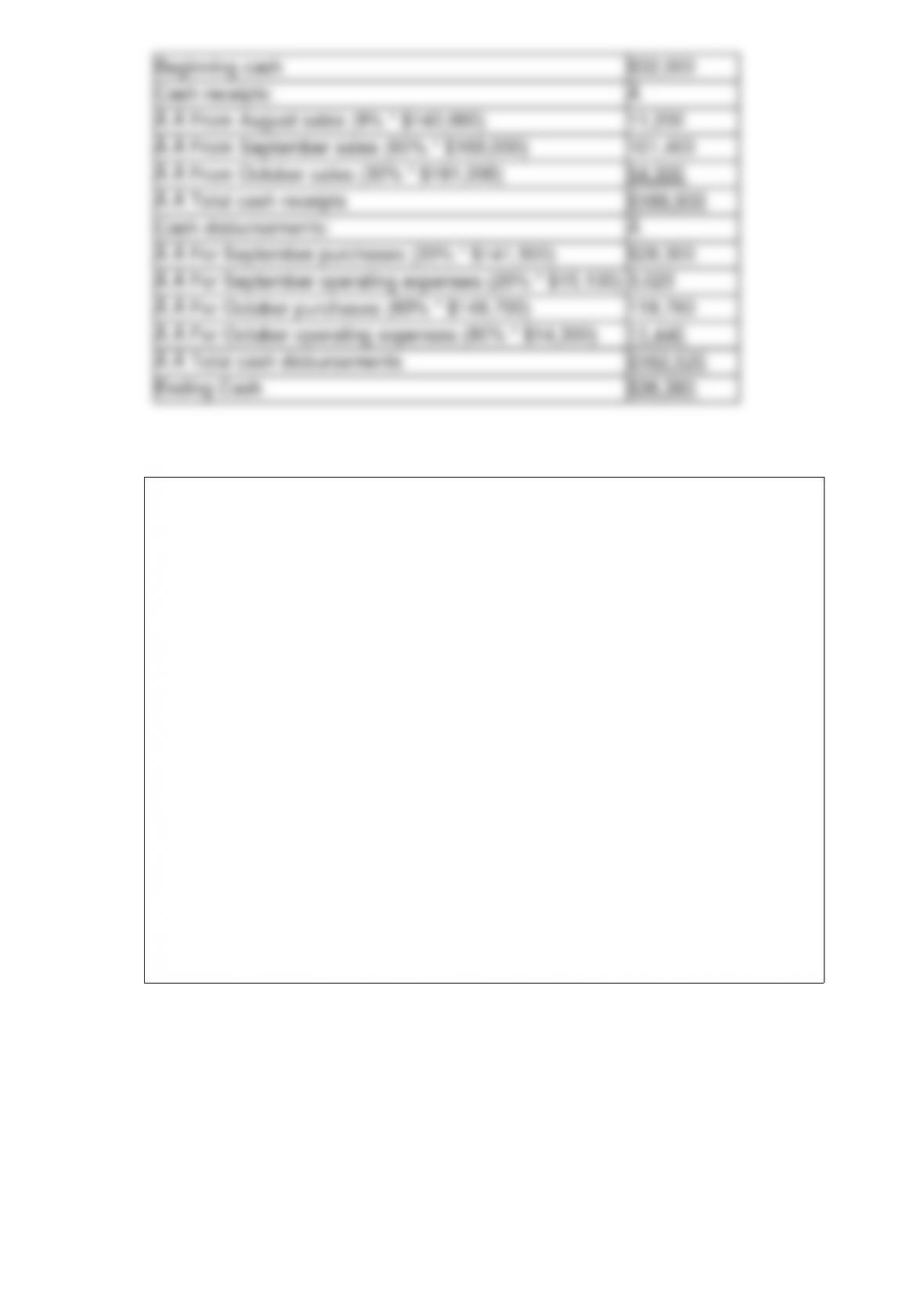
Prepare a cash budget for the month of October.
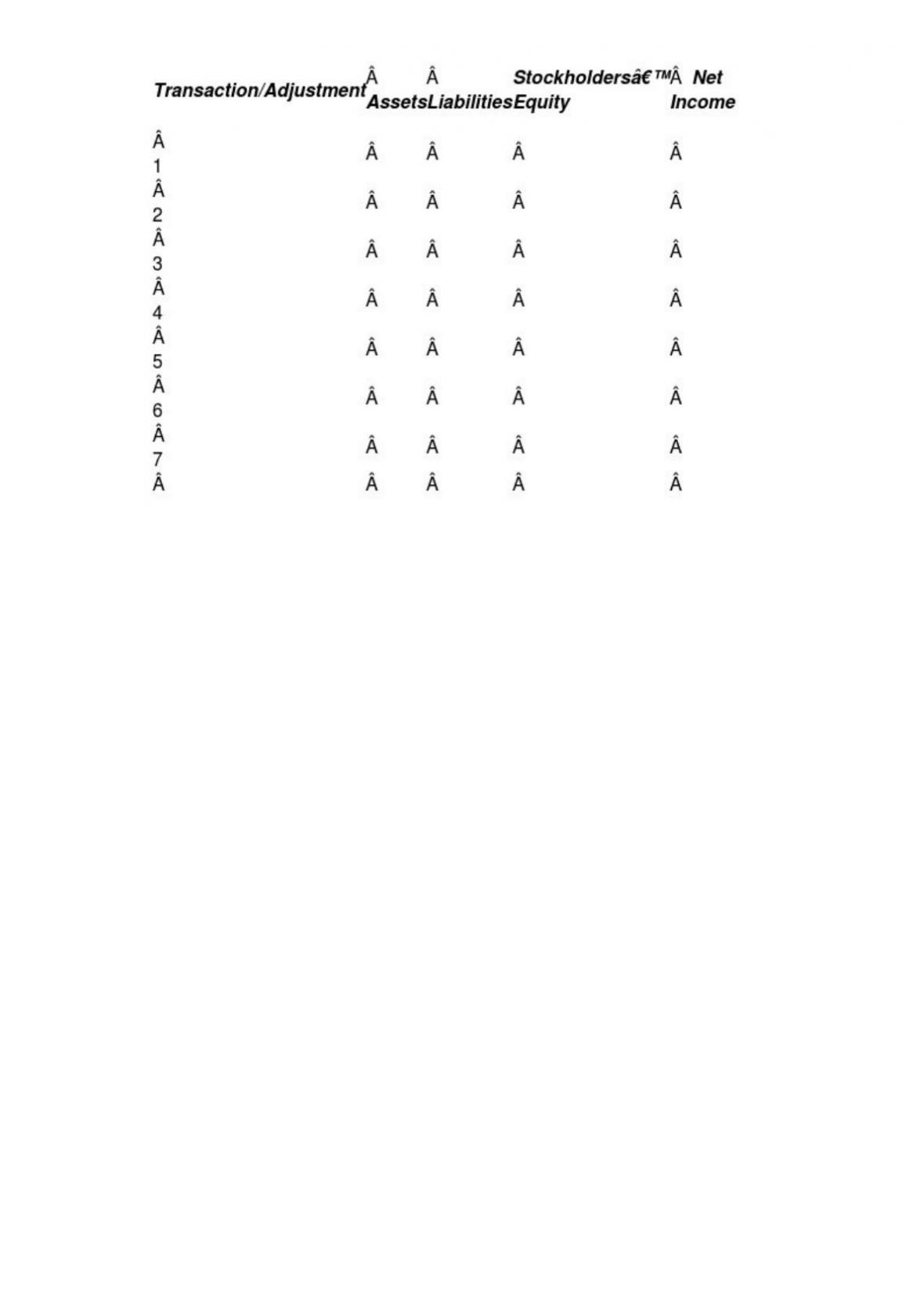
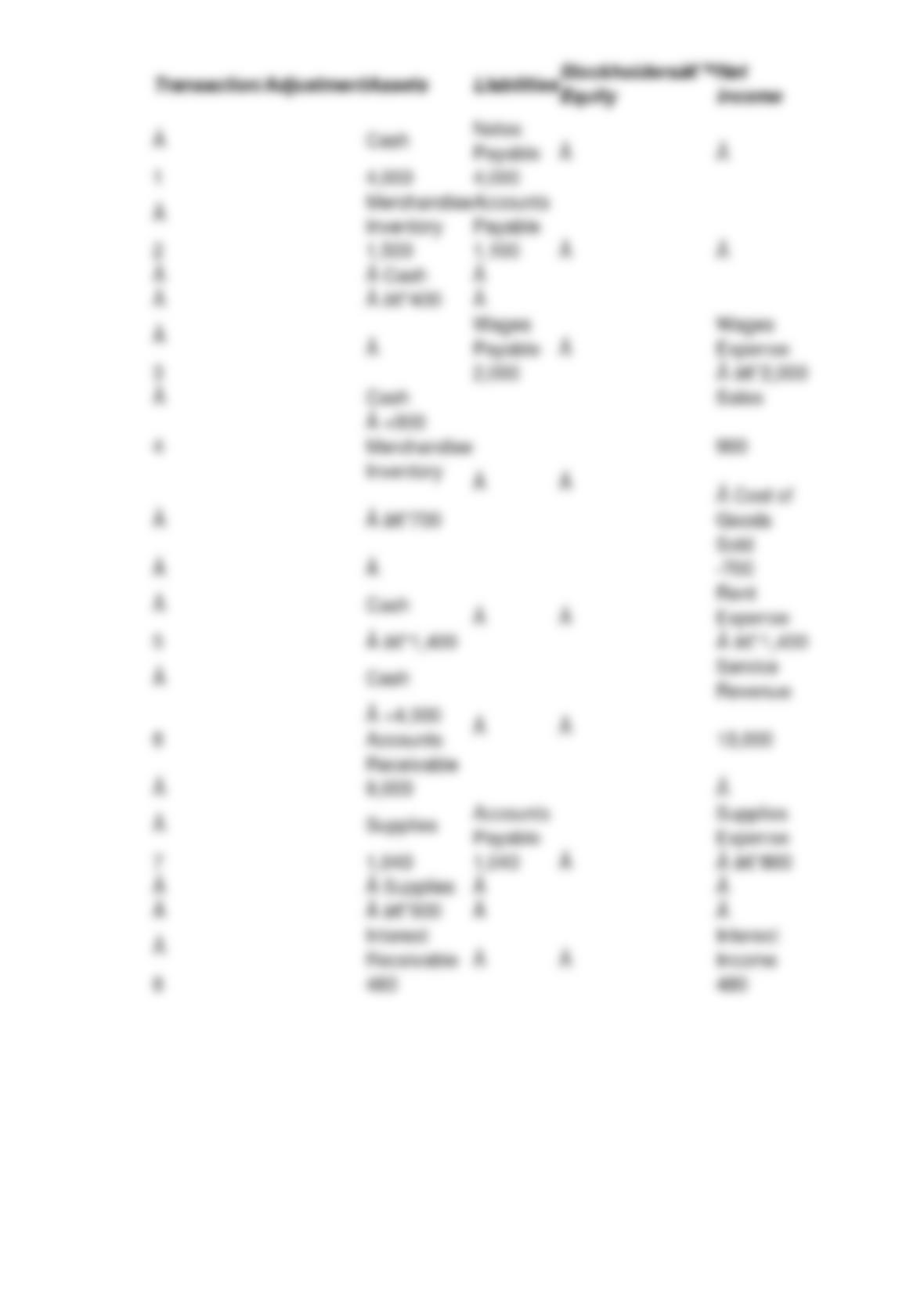
Using the column headings provided below, show the effect, if any, of the transaction
entry or adjusting entry on the appropriate balance sheet category or on the income
statement by entering the account name, amount, and indicating whether it is an
addition (+) or subtraction (-). Column headings reflect the expanded balance sheet
equation; items that affect net income should not be shown as affecting stockholders’
equity.
(1.) The firm borrowed $4,000 from the bank; a short-term note was signed.
(2.) Merchandise inventory costing $1,500 was purchased; cash of $400 was paid and
the balance is due in 30 days.
(3.) Employee wages of $2,000 were accrued at the end of the month.
(4.) Merchandise that cost $700 was sold for $900 in cash.
(5.) This month’s rent of $1,400 was paid.
(6.) Revenues from services during month totaled $13,000. Of this amount, $4,000 was
received in cash and the balance is expected to be received within 30 days.
(7.) During the month, supplies were purchased on account at a cost of $1,040, and
debited into the Supplies (asset) account. A total of $800 of supplies were used during
the month.
(8.) Interest of $480 has been earned on a note receivable, but has not yet been
received.
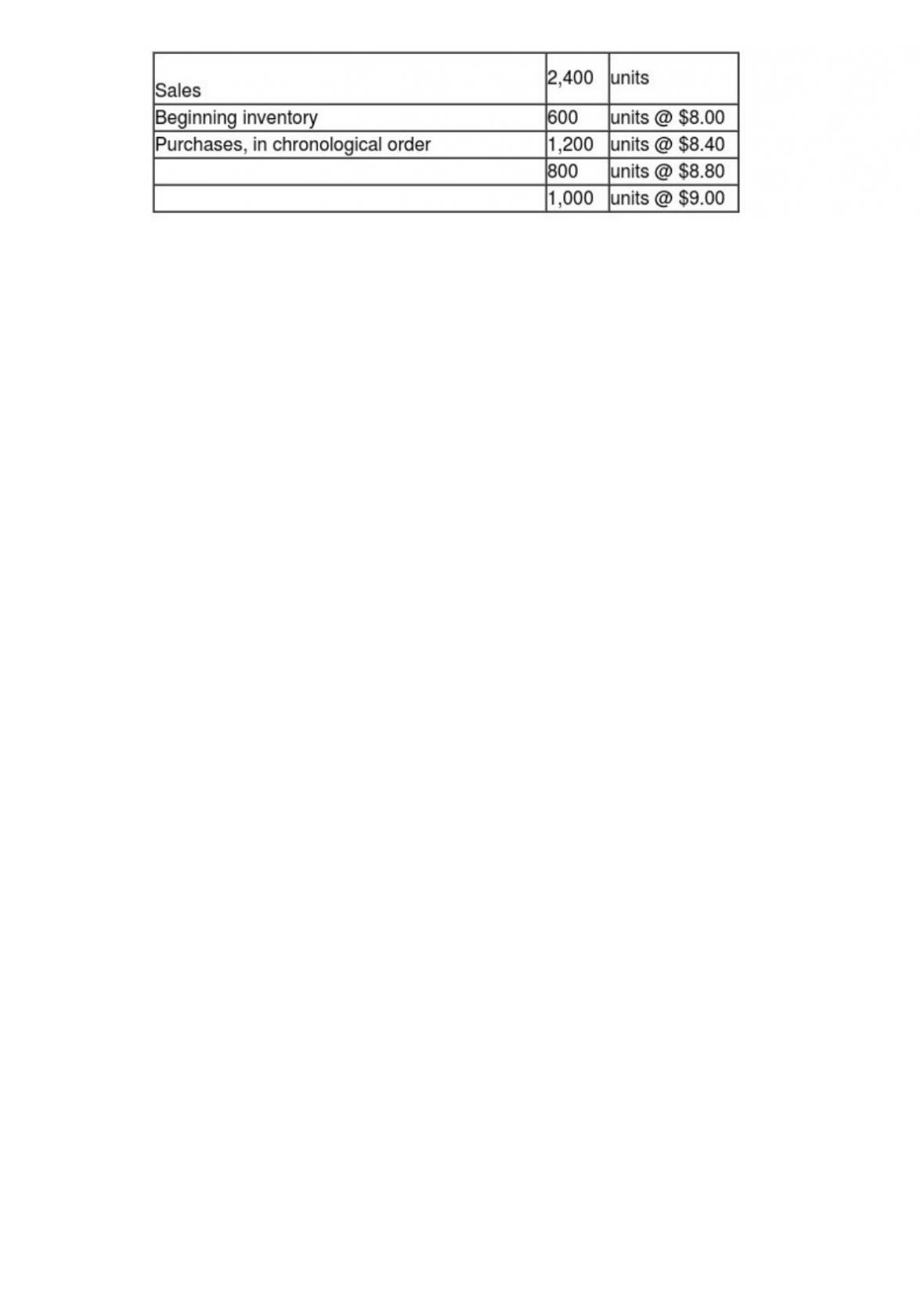
The following are data available for Blue Grass for the month of June:
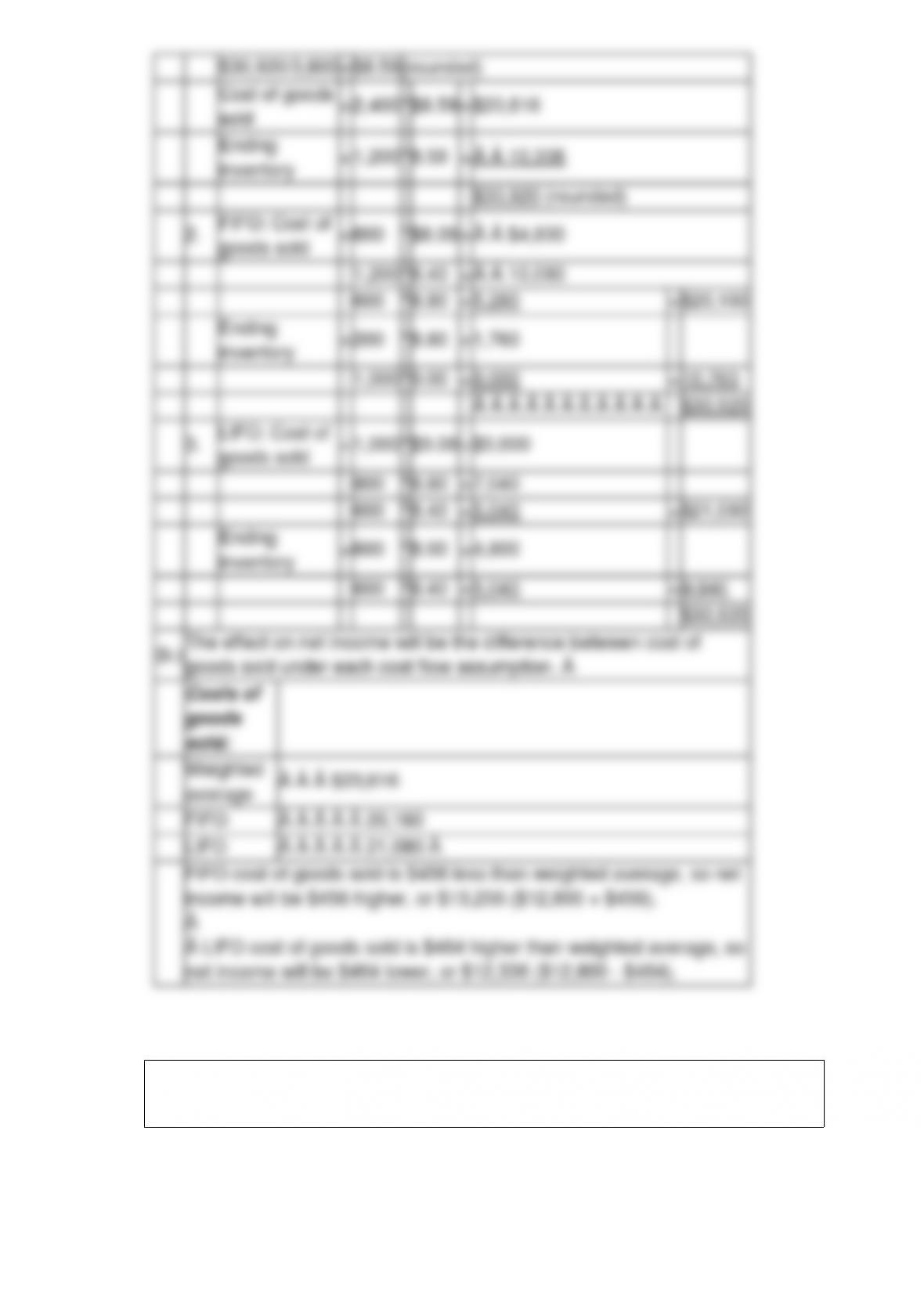
(a.) Calculate cost of goods sold and ending inventory under the following cost flow
assumptions:
(1.) Weighted-average
(2.) FIFO
(3.) LIFO
(b.) Assume net income using the weighted average cost flow assumption was $12,800.
Calculate net income under FIFO and LIFO.
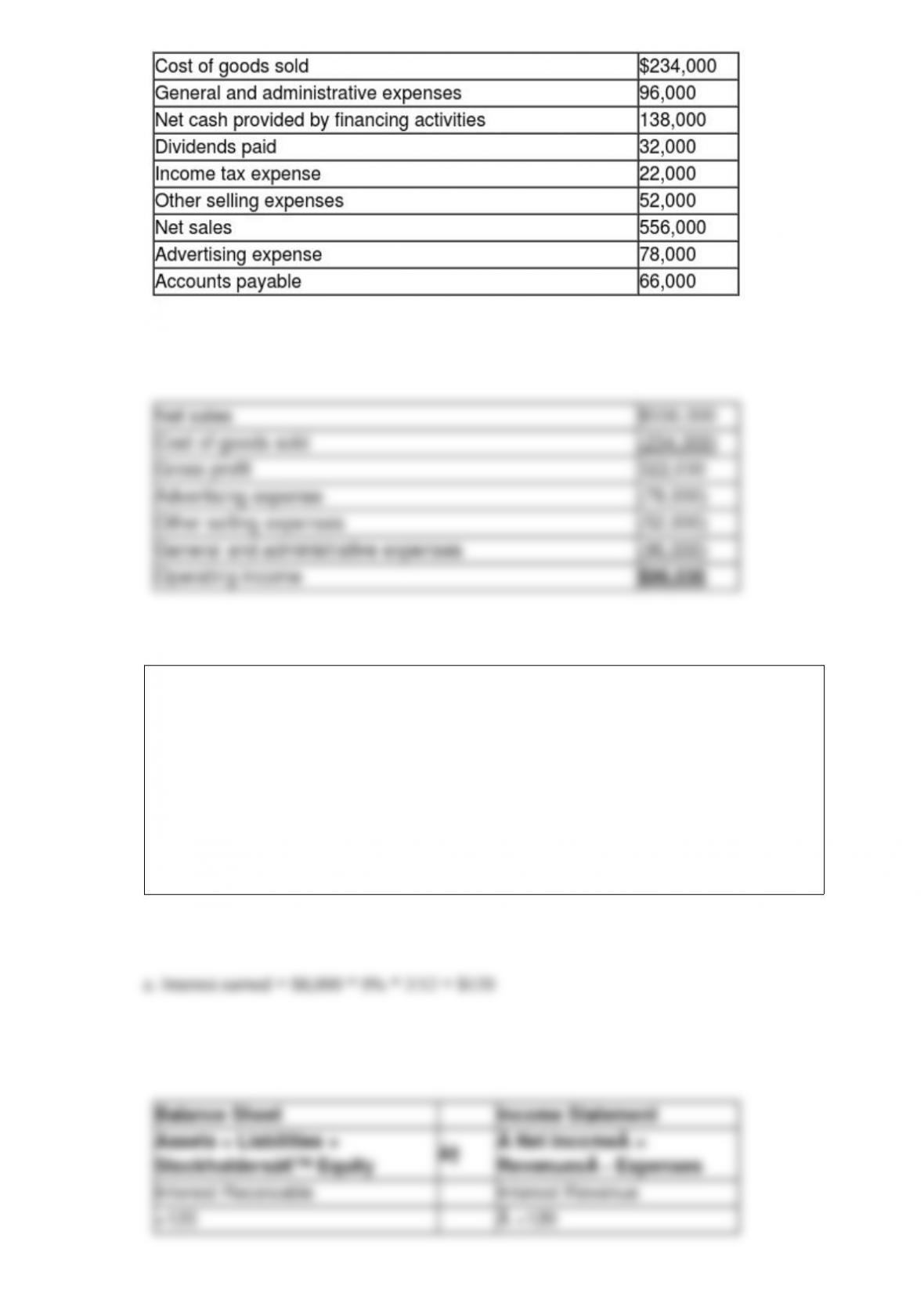
Use the appropriate information from the data provided below to calculate operating
income for the year ended December 31, 2017.
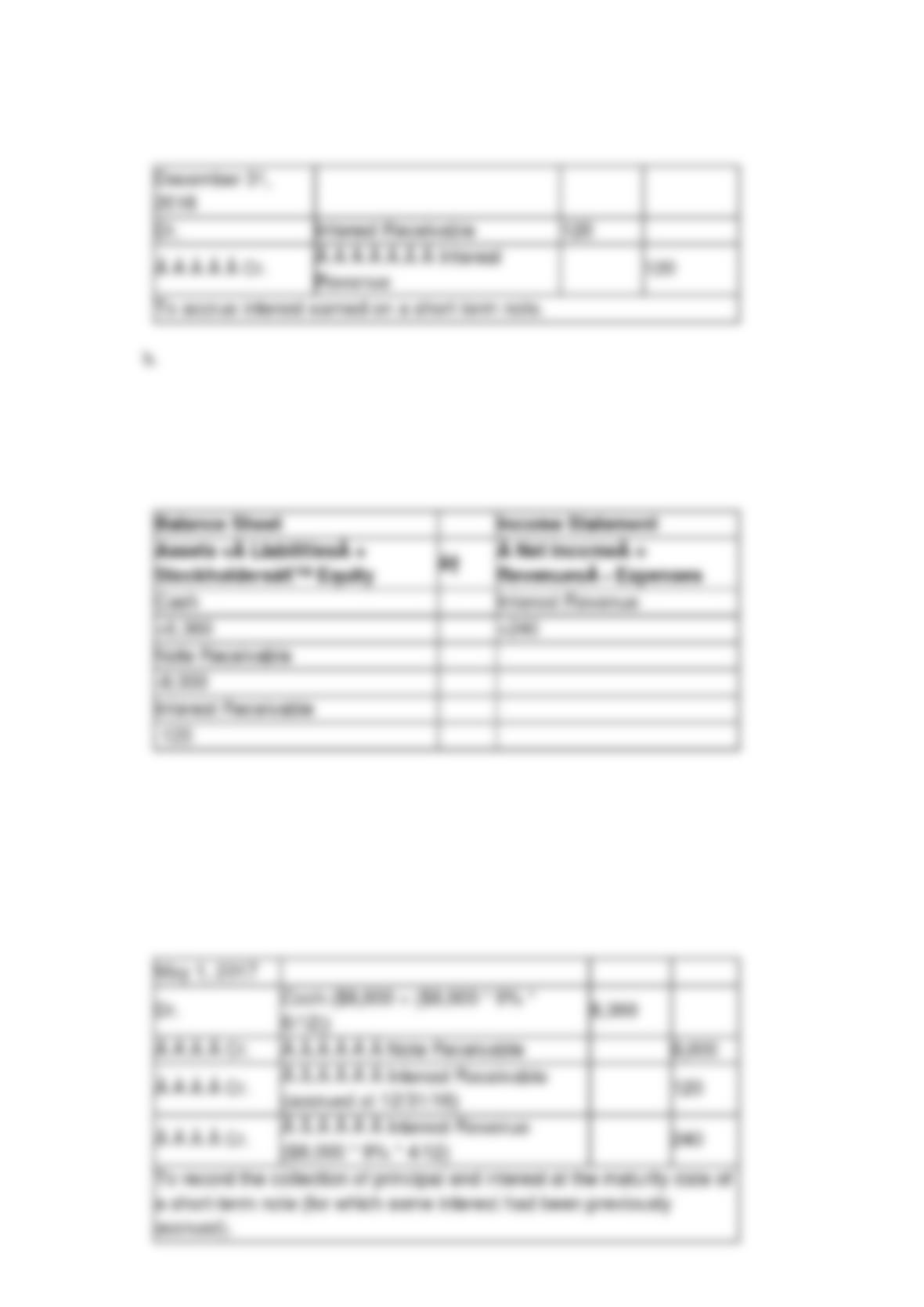
Agrico, Inc., accepted a 6-month, 9% (annual rate), $8,000 note from one of its
customers on November 1, 2016; interest is payable with the principal at maturity.
Required:
a. Use the horizontal model or write the journal entry to record the interest earned by
Agrico during its year ended December 31, 2016.
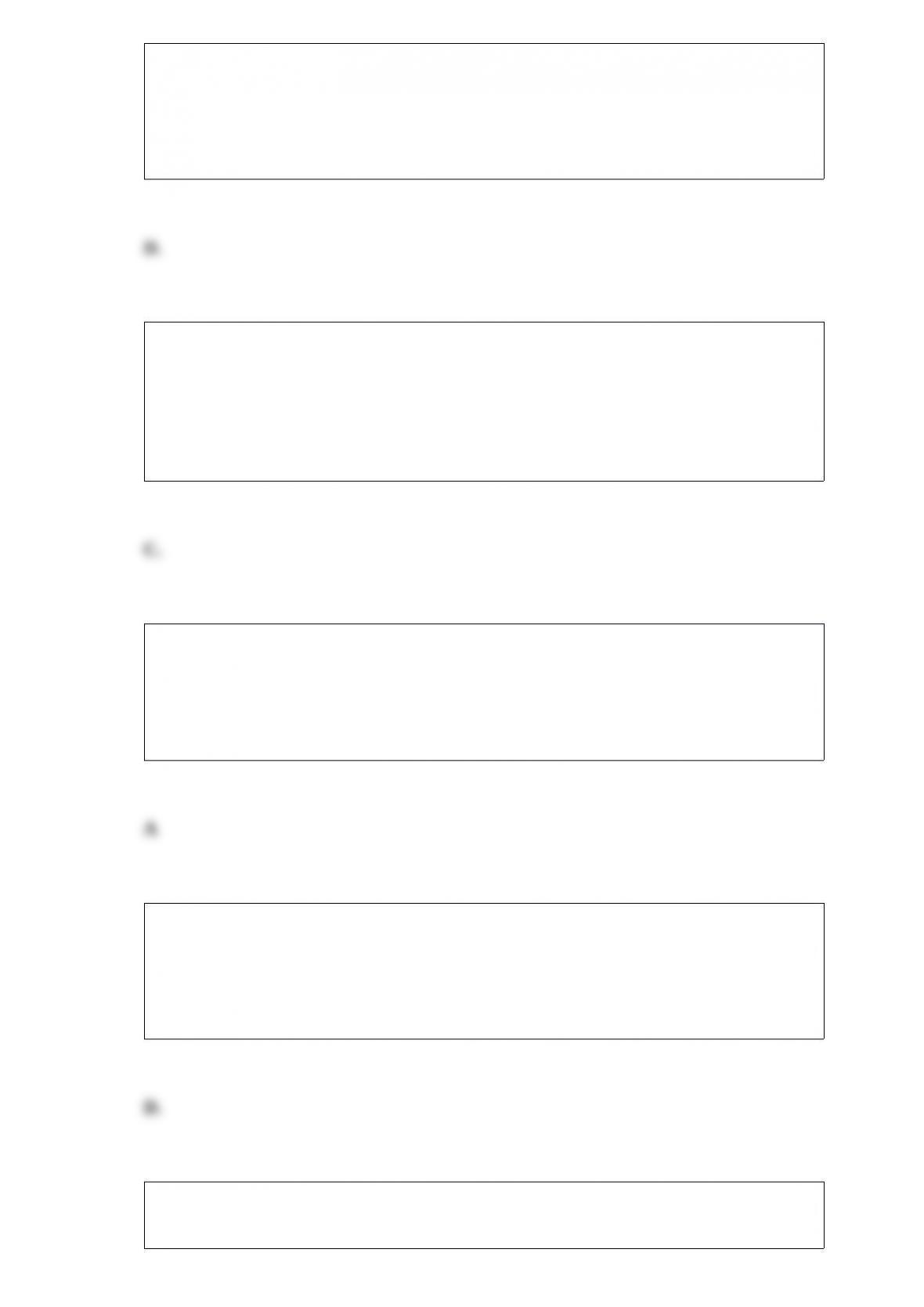
b. Use the horizontal model or write the journal entry to record collection of the note
and interest at maturity.