The payback period is the time it takes, in years, for an investment to return the original
amount of invested capital.
Identifying the activities performed in the organization is the most time consuming part
of implementing an activity-based costing system.
In calculating the net present value of a project, the appropriate discount rate should be
similar across companies.
The process of evaluating an organization’s investment in long-term assets is called
investment control.

Common-size statements are especially helpful in comparing companies of different
size.
A material variance is one that is large enough to make a difference in the outcome of a
decision.
An example of a step cost is the natural gas bill you receive for heating your apartment.
When using a standard costing system, when materials are purchased, the transaction is
recorded in the inventory account at the standard price and accounts payable is charged
for the full amount owed to the supplier.
When the annual cash flows are uneven, you must use the annuity table method to
calculate the internal rate of return.
Because depreciation is a fixed cost that is not avoidable, it is irrelevant in making an
outsourcing decision.
Match the following terms to the appropriate statement by placing the letter to the left
of each statement. a. Application Base f. Overhead Application
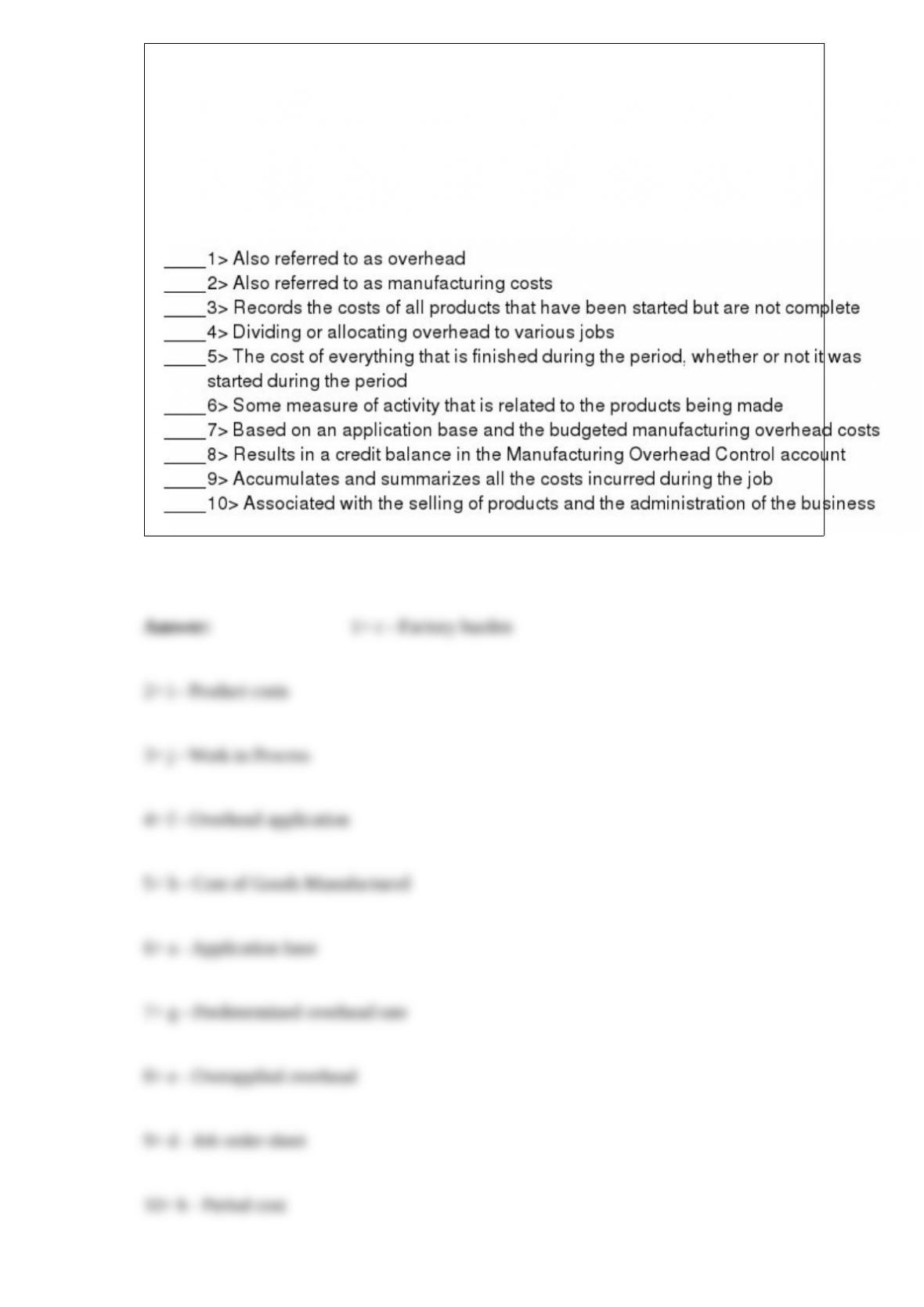
b. Cost of Goods Manufactured g. Predetermined Overhead Rate
c. Factory Burden h. Period Costs
d. Job Order Sheet i. Product Costs
e. Overapplied Overhead j. Work in Process Inventory Account

Which of the following items is not classified as direct labor for Family Ice Cream
Parlor?
a. Salary of workers making banana splits
b. Salary of workers adding toppings to sundaes
c. Salary of store manager
d. All of these answer choices classified as direct labor.
When choosing between alternatives, the contribution margin of the next-best
alternative is called
a. Incremental revenue.
b. Opportunity cost.
c. Sunk cost.
d. None of these answer choices are correct.
Fixed costs are $600,000 and the variable costs are 75% of the unit selling price. What
is the break-even point in dollars?
a. $1,400,000

b. $1,800,000
c. $2,400,000
d. $800,000
Which of the following is not a category for performance measures used for a balanced
scorecard?
a.Learning and growth
b.Competitive
c.Internal business processes
d.Customer
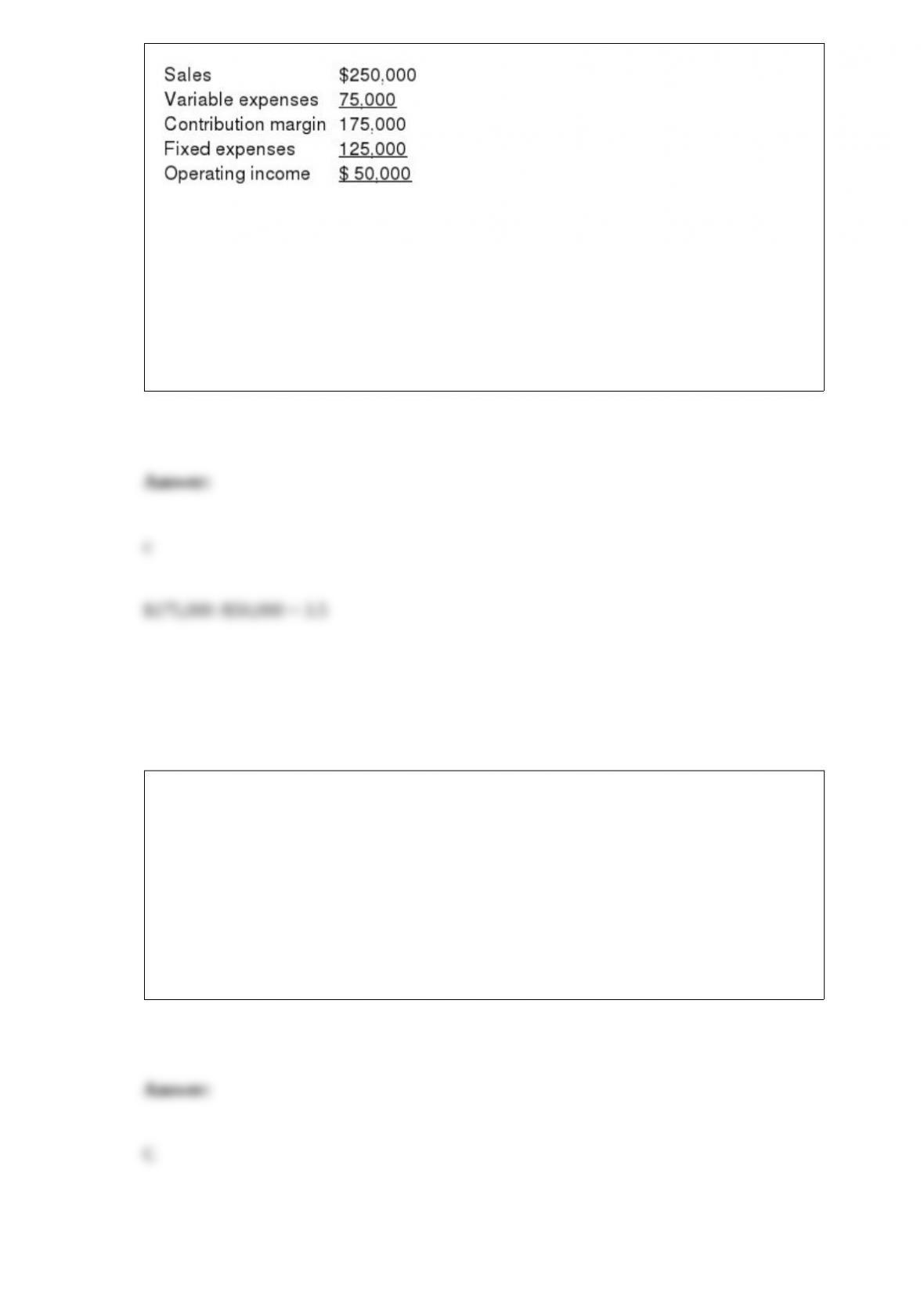
Brandi’s Bakery’s income statement for last month is given below. What is Brandi’s
degree of operating leverage?
a. 0.2
b. 1.4
c. 3.5
d. 5.0
Which of the following is not a criterion of relevant information?
a. It differs between the alternatives
b. Differences among alternatives will occur in the future.
c. The information always relates to variable costs.
d. All of these answer choices are correct.

The accounting rate of return differs from other methods in that it
a. Does not focus on cash flows.
b. The calculation is complex.
c. It ignores the time value of money.
d. None of these answer choices are correct.
A manager estimates that revenues for the coming period will be $85,000 but includes
only $80,000 in her budget. This is an example of
a. Pro-forma variance.
b. Revenue slack.
c. Budgetary padding.
d. None of these answer choices are correct.
Which of the following is a difference between job order costing and process costing
systems?
a. Companies that use a process costing system mass-produce identical products while
companies that use a job order costing system produce many different types of
products.
b. Companies that use a process costing system accumulate product costs throughout
the production process while companies that use a job order costing system accumulate

product cost only at the end of the production process.
c. Companies that use a process costing system accumulate direct material and direct
labor, but not manufacturing overhead while companies that use a job order costing
systems accumulate direct material, direct labor and manufacturing overhead.
d. All of these answer choices are differences between process costing and job order
costing systems.
Which of the following is not a reason to allocate overhead?
a. Unlike direct materials and direct labor, the amount of overhead actually incurred
may not be known at the time a job is being worked on.
b. Manufacturing overhead is an indirect cost that cannot be physically or economically
traced back to a specific item.
c. Allocation is more accurate than tracing items directly to jobs.
d. Some overhead costs are seasonal, and should be spread over production for the
entire year.
On July 31st of the current year Bridges Industries borrowed $50,000 from the First
National Bank. On December 31st the company made its first payment of $1,000, of
which $900 was applied to principal and $100 was interest. How will these transactions
be reported in the statement of cash flows? Operating Section Investing Section
Financing Section
a. $100 use $900 use $50,000 source

b. $0 $0 $50,000 source/$1,000 use
c. $100 use $0 $50,000 source/$900 use
d. $0 $0 $50,000 source/$900 use
Since a batch-level activity is based on the existence of the batch, a batch consumes
resources
a. Proportionately with the number of units in the batch.
b. Inversely with the number of units in the batch
c. The same amount of resources whether it contains 20 units or 2,000 units.
d. None of these answer choices are correct..
Gabbard and Fink CPA firm leases tax software from BGG Tax Software Company to
prepare federal and state income tax returns. The lease agreement calls for a base charge
of $5,000 per year plus $100 per year for each state for which returns are prepared. In
addition, Gabbard and Fink are charged $2 ($1 for federal and $1 for state) for each tax
return prepared. All of their clients have federal and state returns prepared, with 60
percent in Arkansas and 40 percent in Oklahoma.
Required:
a.What is the firm’s total annual cost for the software if a total 2,500 returns are
prepared?
b.What is the firm’s cost per unit at a level of 2,500 returns?
c.What is the firm’s cost per return if 2,000 are prepared?
d.Besides software lease cost, list five other costs that Gabbard and Fink must consider
when they set the price they will charge their clients.
Which of the following is not one of the top ten reasons companies outsource their
operations?
a. Redirects resources to core activities
b. Frees managers ‘ time to focus on more important issues
c. Reduces and controls operating costs
d. Provides diversity so as to produce better quality product
When the interest from year one is built into the principal balance, the interest is
referred to as
a. Differential interest

b. Discounted interest
c. Compound interest
d. None of these answer choices are correct
Which of the following is not a step in implementing an activity-based costing system?
a. Developing activity cost pools
b. Identifying activities
c. Calculating pre-determined overhead rates
d. Calculate the unit product cost
When using a standard costing system, at the end of the accounting period the balances
in all inventory and cost of goods sold accounts will be at standard amounts. Variances
for direct materials, direct labor and manufacturing overhead have been recorded
throughout the period.
Required:
For each of the following variances, identify how it is calculated, at what point the
variance is recorded, and the interpretation of an unfavorable variance.
a. Direct material price variance
b. Direct material quantity variance
c. Direct labor rate variance
d. Direct labor efficiency variance
e. Variable overhead spending variance
f. Variable overhead efficiency variance
g. Fixed overhead spending variance
h. Fixed overhead volume variance
Direct labor is considered a
a. Period cost
b. Overhead
c. Variable cost
d. Mixed cost
Restate the following income statement in contribution format.
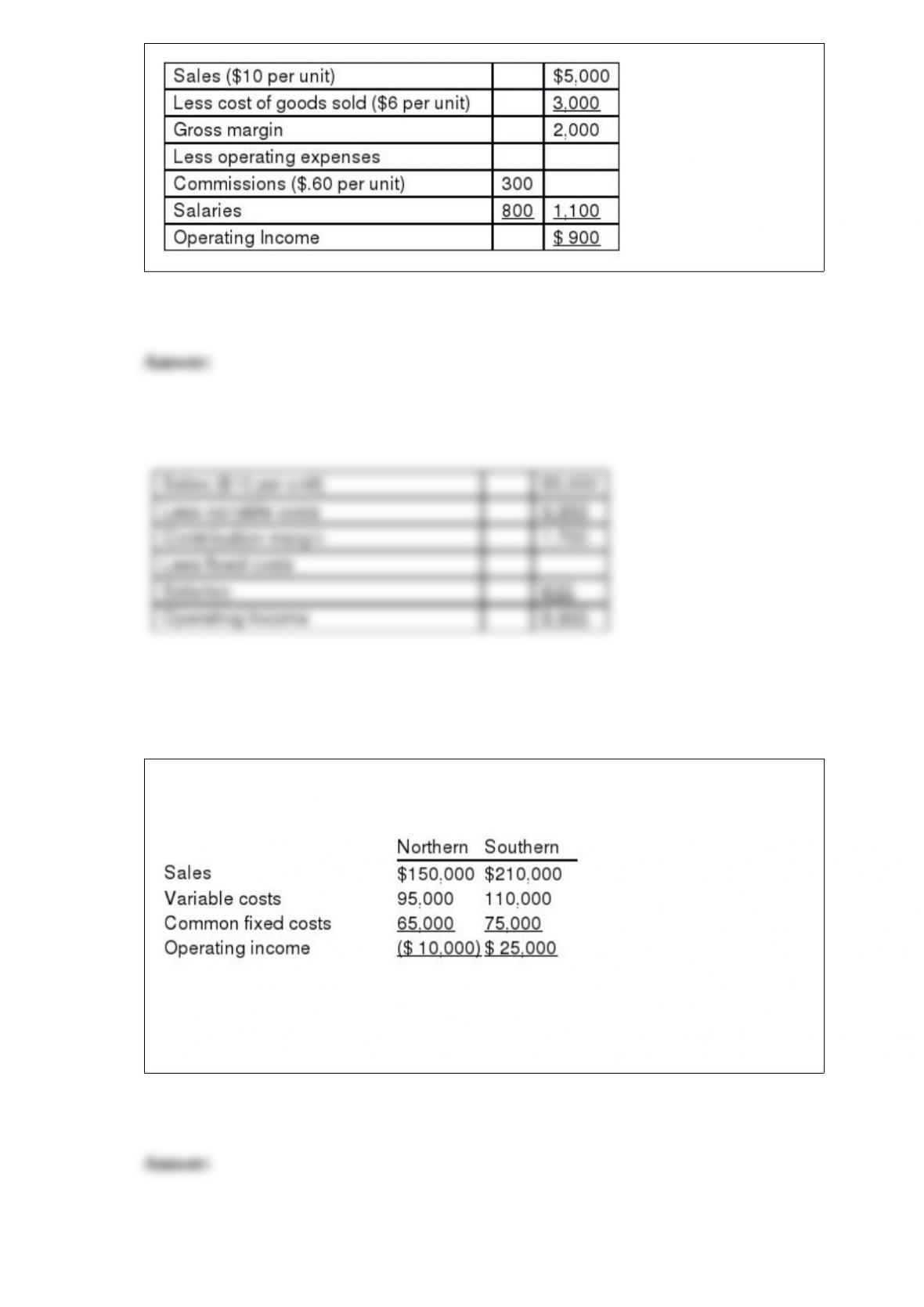
Kentucky Distributors has two divisions -Northern and Southern. The divisions have
provided the following financial information:
Kentucky ‘s executives are considering the elimination of the Northern division. If the
division is eliminated, the common fixed costs will remain unchanged. Given these
data, should the Northern division be eliminated? Why?
Paper Moon, a manufacturer of outdoor lighting fixtures is operating at less than full
capacity. The plant manager is considering making the mounting brackets now being
purchased from a supplier at $8 each. Paper Moon already has the equipment to
produce the brackets. The plant manager has analyzed the cost of producing the
brackets and determined that each bracket will require $2 of direct material, $1 of direct
labor, and $8 of manufacturing overhead. Seventy-five percent of the manufacturing
overhead is a fixed cost that would not be affected by the decision to manufacture the
brackets. Should Paper Moon continue to purchase the brackets or produce them
internally?
Felder’s manufacturing is considering the purchase of new equipment that costs
$750,000 to replace equipment that is old and inefficient. Felder has found a buyer for
the old equipment who will pay $8,000 for it. The new equipment is expected to
produce $12,000 of additional revenue each year, but will result in additional
maintenance cost of $2,000. The new equipment will have a salvage of $10,000 and
will be depreciated over 10 years.
Required:
Identify the amount and timing of the cash flows relevant to Felder’s decision to
purchase the new equipment.
Luckett Company’s standards call for two feet of direct material for each unit. The
standard price of one foot is $2. Actual production was 50,000 units requiring 105,000
feet of direct material. Luckett purchased 107,000 feet at a unit price of $2.10 per foot.
Required:
Calculate the direct materials price and quantity variances and indicate whether the
variances are favorable or unfavorable.
The price at which an exchange between divisions is recorded is referred to as the
intermediate price.
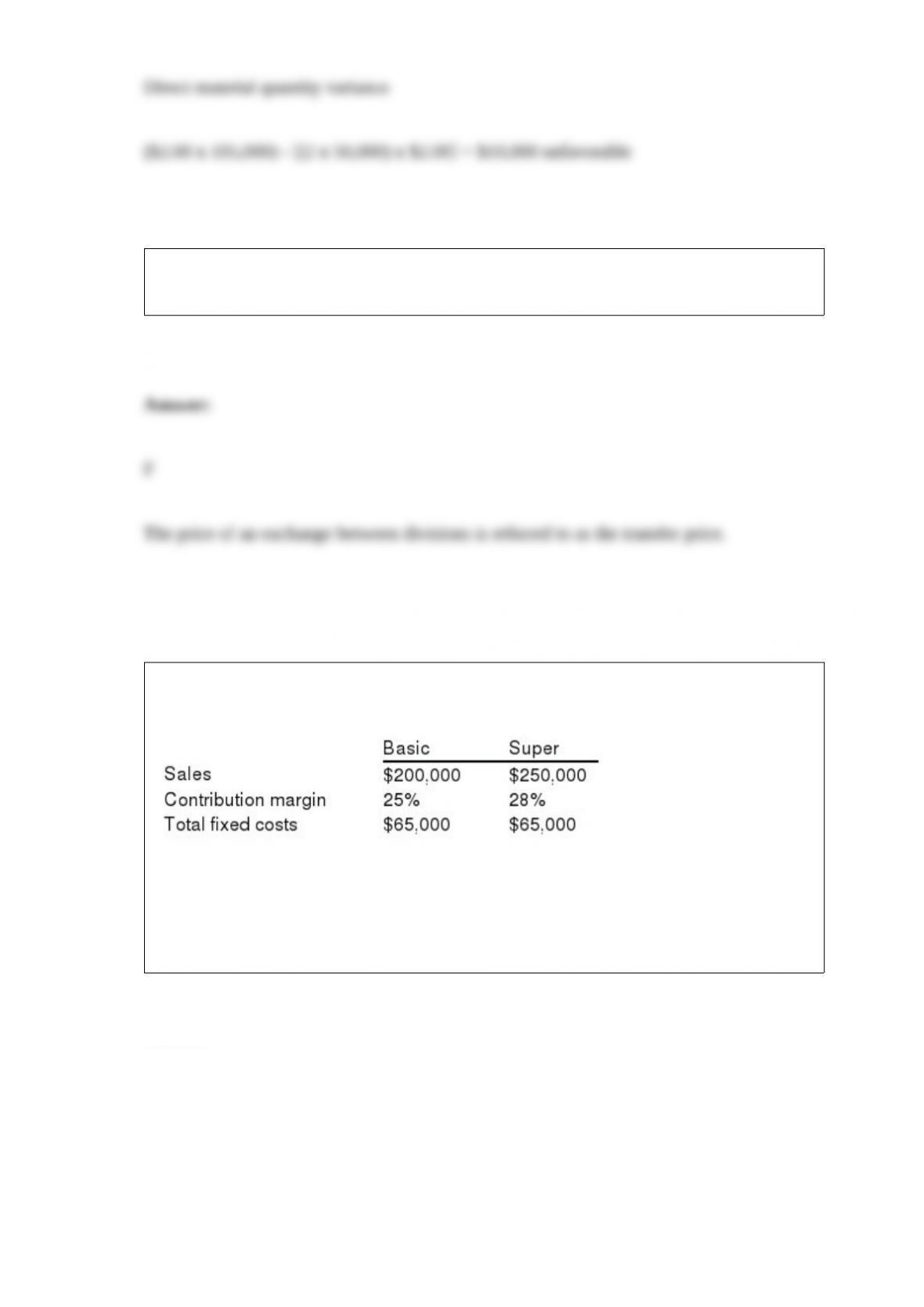
Mounce Corporation produces and sells two products, Basic and Super. Data for
activity during March are as follows:
Required:
Prepare a Segment Margin income statement. Common fixed costs of $25,000 are
allocated Basic and $30,000 to Super.