The Richburn Manufacturing Company increased its merchandise inventory by
$17,000 over the year. The company also granted its customers more liberal credit
terms which increased the accounts receivable by $37,500. Sales were $975,000 and the
accounts payable decreased by $27,500. The gross profit on sales is 45%. Selling and
administrative expenses were $145,000; this included depreciation expense of $4,000.
What were the cash disbursements for the year?
A. $721,750.
B. $706,500.
C. $689,500.
D. $599,750.
Answer:
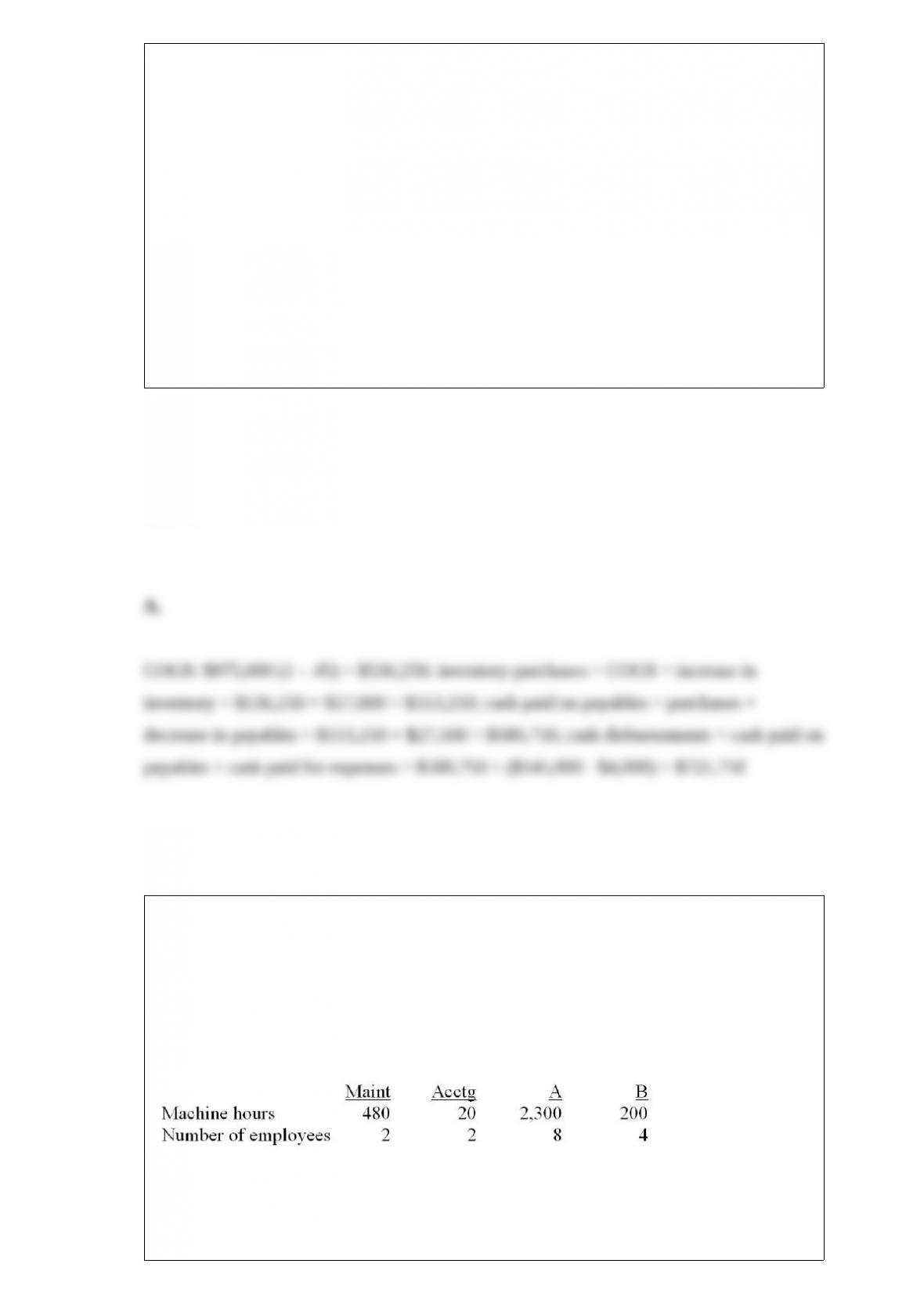
The RAH Manufacturing Company has two service departments: Maintenance and
Accounting. The Maintenance Department’s costs of $300,000 are allocated on the basis
of machine hours. The Accounting Department’s costs of $120,000 are allocated on the
basis of the number of employees within a specific department. The direct departmental
costs for A and B are $300,000 and $500,000, respectively.
What is the Accounting Department’s cost allocated to Department B using the direct
method?

A. $40,000
B. $80,000
C. $20,000
D. $10,000
Answer:
The Bisson Company had the following transactions and events during its first year of
operations. Estimated overhead for the year was $770,000; estimated direct labor cost
for the year was $350,000.
a) Purchased materials on account, $567,000.
b) Requisitioned materials for production as follows: direct materials – 85 percent of
purchases, indirect materials – 12 percent of purchases
c) Direct labor for production is $331,000, indirect labor is $125,000.
d) Overhead incurred (not including materials or labor): $529,000.
e) Overhead is applied to production based on direct labor cost at the rate of ___
percent.
f) Goods costing $976,000 were completed during the period.
g) Goods costing $513,200 were sold on account for $776,000.
Required:
Determine the ending balances for:
(a) Materials inventory
(b) Work-in-process inventory
(c) Finished goods inventory
Answer:
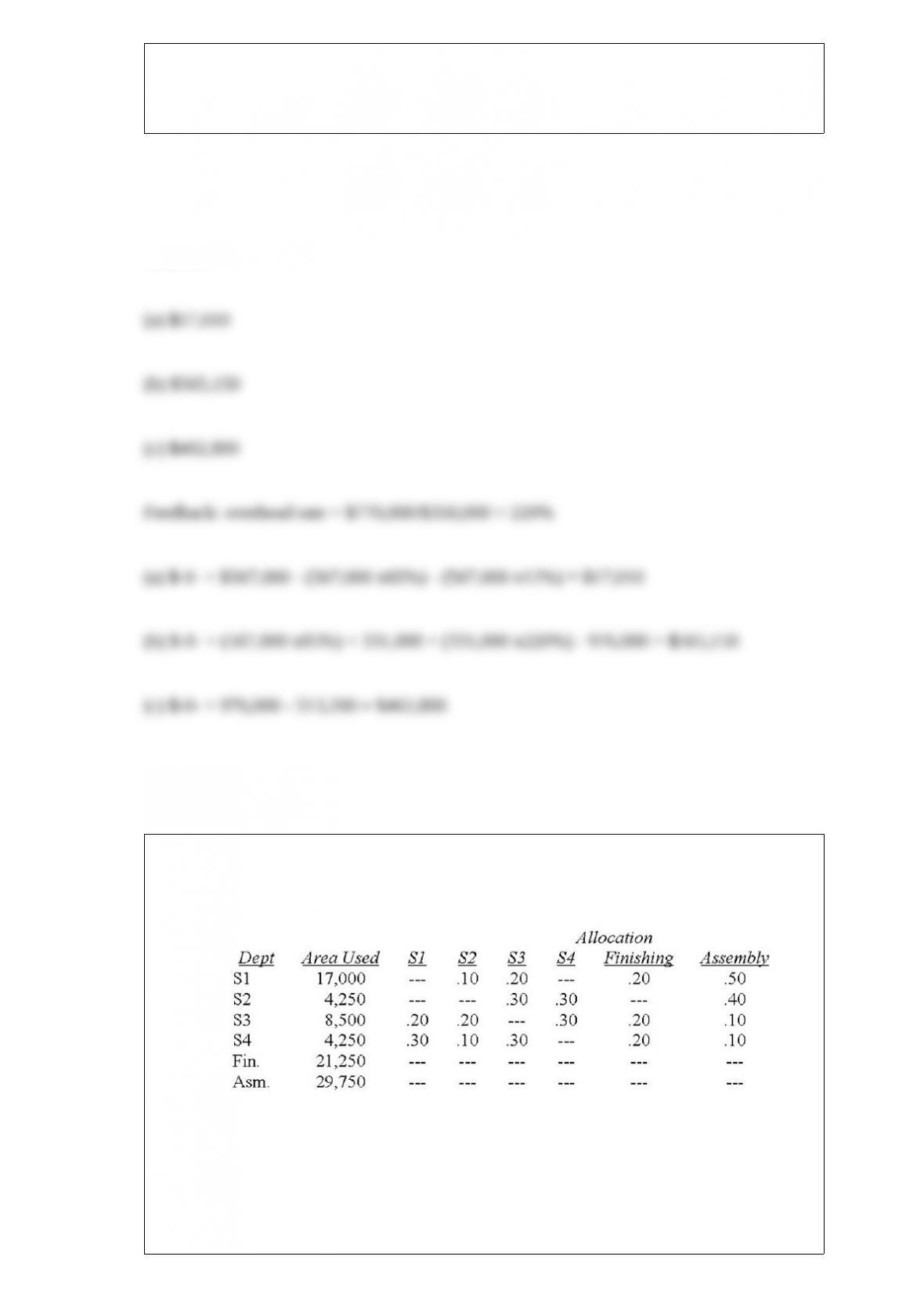
The Emery Construction Company occupies 85,000 square feet for construction of
mobile homes. There are two manufacturing departments, finishing and assembly, and
four service departments labeled S1, S2, S3 and S4. Information relevant to Emery is as
follows:
Rent paid for the area used is $720,000
How much rent is allocable to the assembly department using the direct method of
allocation?
A. $420,000
B. $332,500
C. $300,000
D. $252,000
Answer:
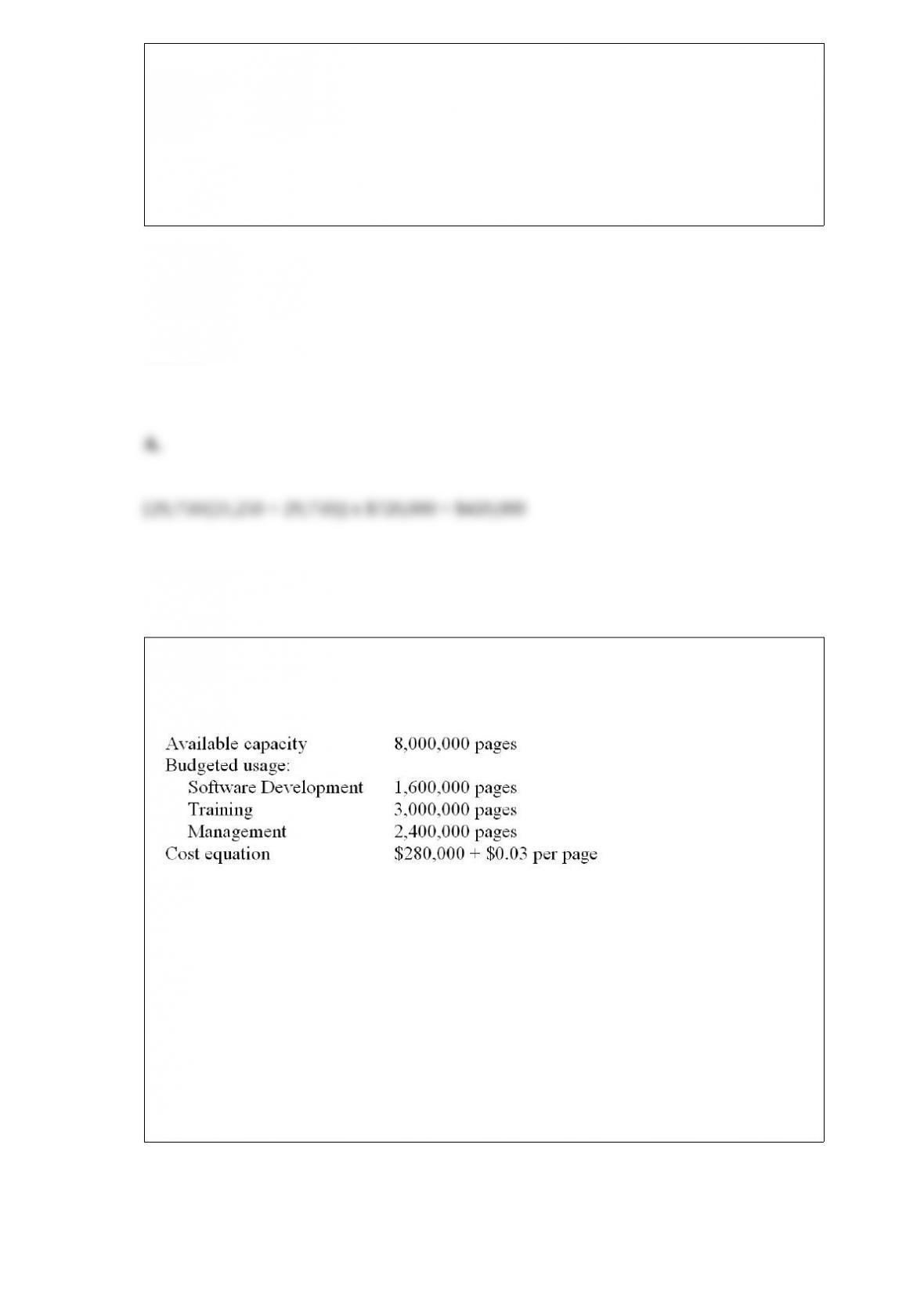
The Document Creation Center (DCC) for Alegis Corp. provides photocopying and
document services for three departments in the St. Paul office. The following budget
has been prepared for the year.
If DCC uses a dual rate for allocating its costs based on usage, how much cost will be
allocated to the Management Department?
A. $168,000
B. $156,000
C. $178,286
D. $147,000
Answer:
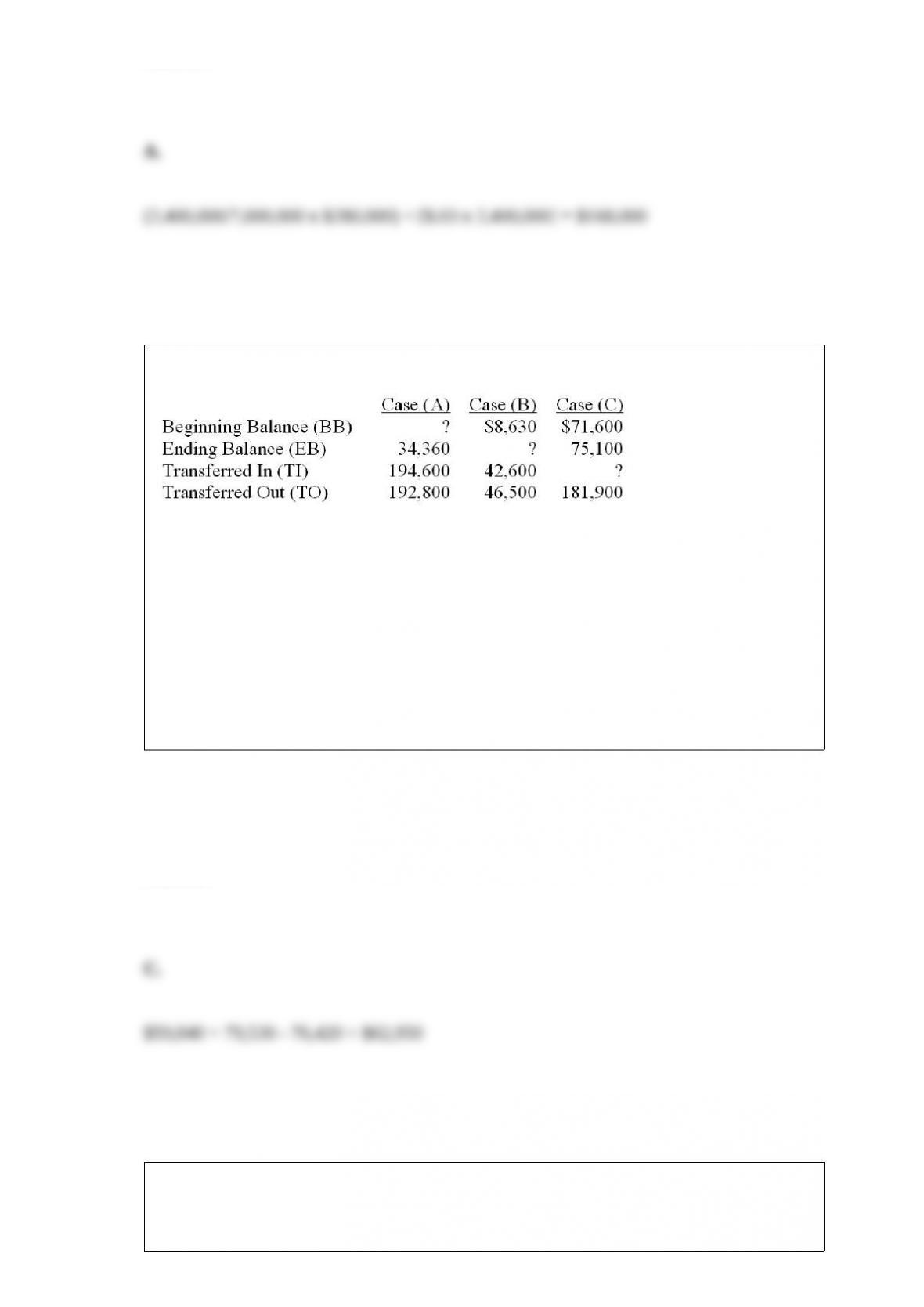
For Case (B) above, what is the Ending Balance (EB)?
A. $139,300
B. $136,260
C. $62,950
D. $56,730
Answer:
Scottso Corporation applies overhead using an actual costing approach. Budgeted
factory overhead was $266,400, budgeted machine-hours were 18,500. Actual factory
overhead was $287,920, actual machine-hours were 19,050. How much is the over- or
underapplied overhead?
A. $21,520 underapplied
B. $13,600 underapplied
C. $7,920 overapplied
D. $0
Answer:
Which of the following is not a characteristic of a decentralized organization?
A. better use of local knowledge
B. better use of top management’s time
C. reduced response time to environmental changes
D. more decisions made by relatively few individuals
Answer:
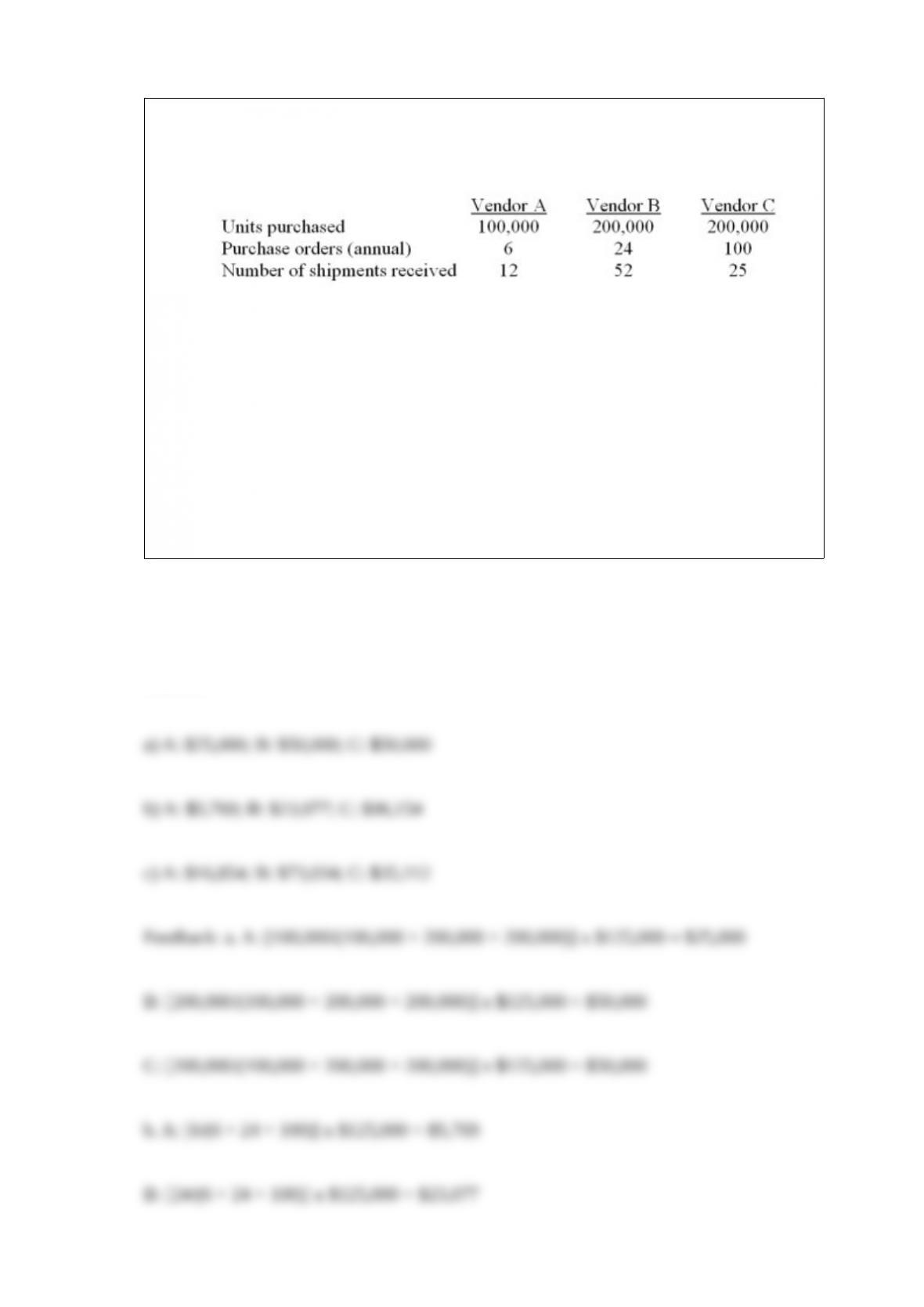
Rogers Company is preparing its annual profit plan. As part of its analysis of the cost
of its purchasing activity, management estimates that the $125,000 for purchasing
support should be assigned to the individual vendors from the information given as
follows:
Required:
a) Prepare a schedule to allocate the purchasing costs to the three vendors, assuming
Rogers uses units purchased to compute activity-based costs?
b) Prepare a schedule to allocate the purchasing costs to the three vendors, assuming
Rogers uses purchases orders to compute activity-based costs?
c) Prepare a schedule to allocate the purchasing costs to the three vendors, assuming
Rogers uses number of shipments to compute activity-based costs?
Answer:
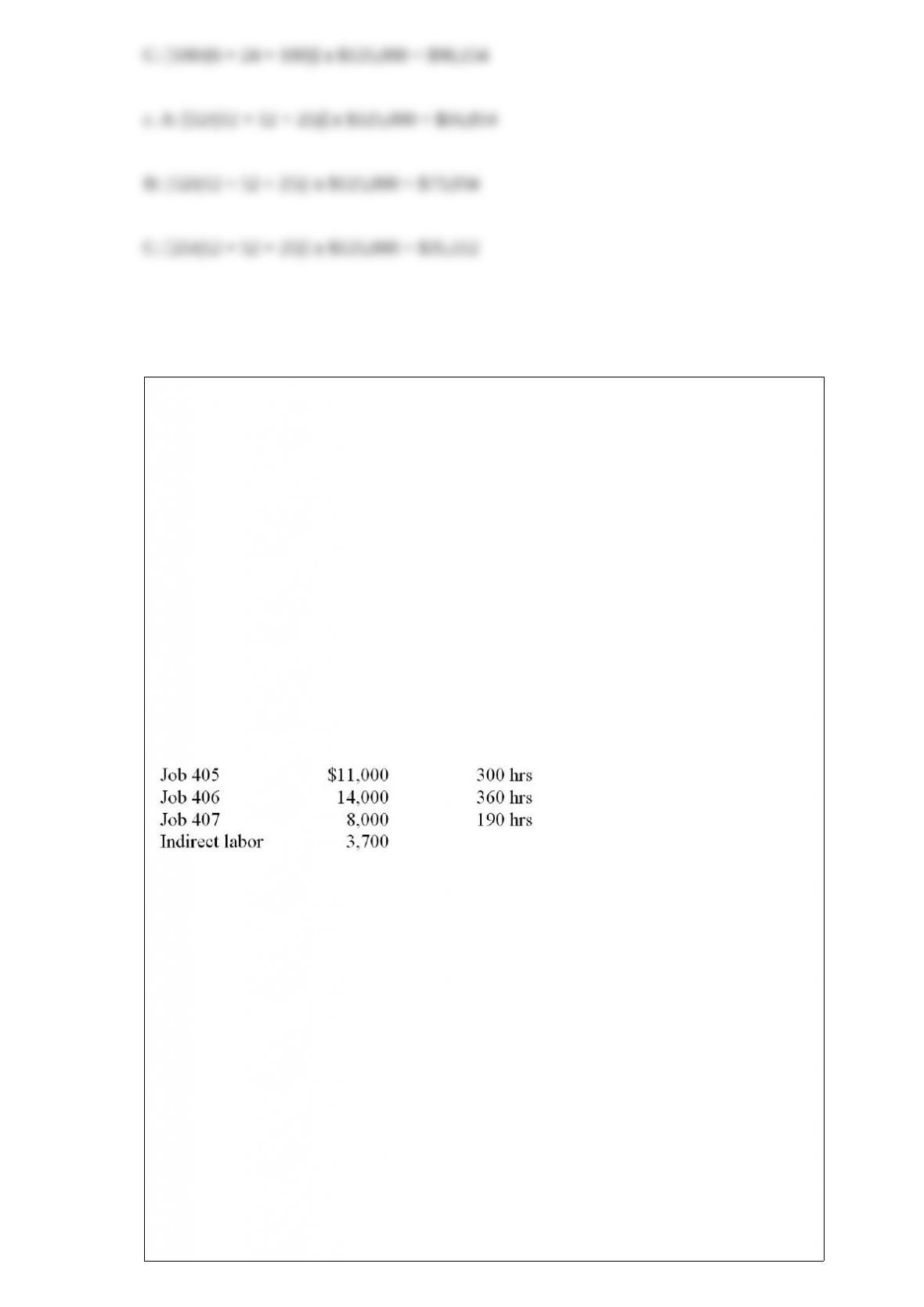
The following selected data were taken from the books of the Bixby Box Company.
The company uses job costing to account for manufacturing costs. The data relate to
June operations.
A) Materials and supplies were requisitioned from the stores clerk as follows:
Job 405, material X, $7,000.
Job 406, material X, $3,000; material Y, $6,000.
Job 407, material X, $7,000; material Y, $3,200.
For general factory use: materials A, B, and C, $2,300.
B) Time tickets for the month were chargeable as follows:
C) Other information:
Beginning work-in-process, June 1, $-0-
Factory paychecks for $36,700 were issued during the month.
Various factory overhead charges of $19,400 were incurred on account.
Depreciation of factory equipment for the month was $5,400.
Factory overhead was applied to jobs at the rate of $35.00 per direct labor hour.
Job orders completed during the month: Job 405 and Job 406.
Selling and administrative costs were $2,100.
Factory overhead is closed out only at the end of the year.
Required:
(a) Determine the ending work-in-process balance on June 30.
(b) Determine the cost of goods manufactured for June.
(c) Is factory overhead over- or underapplied for June? What is the monthly value?
Answer:
At the break-even point the total contribution margin equals total: (CPA adapted)
A. Variable costs
B. Sales revenues
C. Selling and administrative costs
D. Fixed costs
Answer:
Zeppo Supply Company manufactures cleaning products. During the year, the
company spent $600,000 on chemicals and $728,000 on conversion costs. Overhead is
applied at a rate of 180% of direct labor costs. How much did the company spend on
manufacturing overhead during the year?
A. $260,000
B. $468,000
C. $128,000
D. $404,444
Answer:
A manager can always increase his/her return on investment (ROI) by
A. reducing the asset turnover.
B. decreasing residual income.
C. increasing the operating profit margin.
D. expanding operating assets while holding sales and expenses constant.
Answer:
Which of the following is not a mistake often made when measuring nonfinancial
performance?
A. Using subjective rather than objective measures.
B. Not linking measure to strategy.
C. Not validating links between activities and strategies.
D. Not setting appropriate performance targets.
Answer:
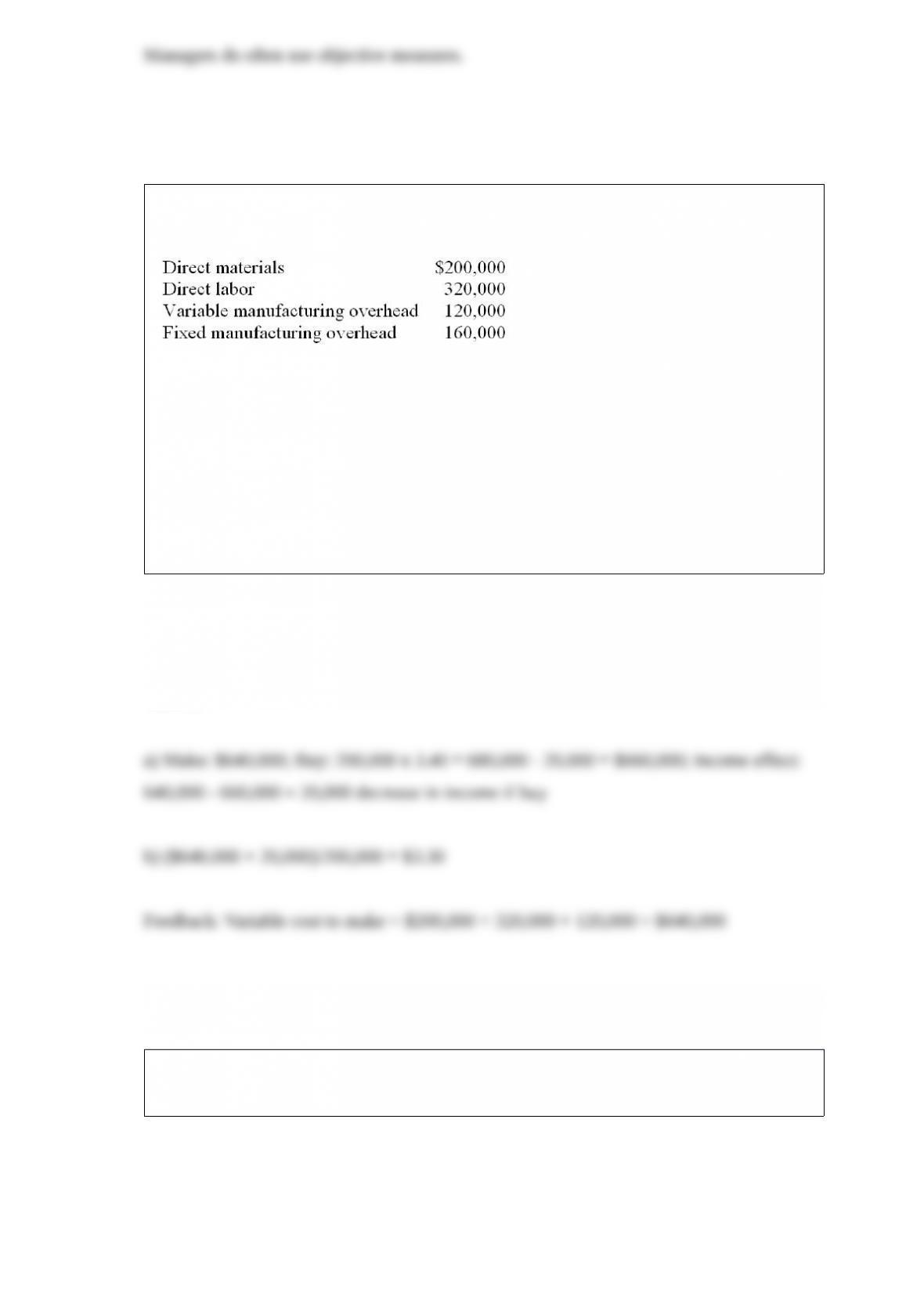
Bruce Industries manufactures 200,000 components per year. The manufacturing cost
of the components was determined as follows:
An outside supplier has offered to sell the component for $3.40. If Bruce purchases the
component from the outside supplier, the manufacturing facilities would be unused and
could be rented out for $20,000.
a) If Bruce purchases the component from the supplier instead of manufacturing it, the
effect on income would be
b) What is the maximum price Bruce would be willing to pay the outside supplier?
Answer:
You have been provided with the following information:
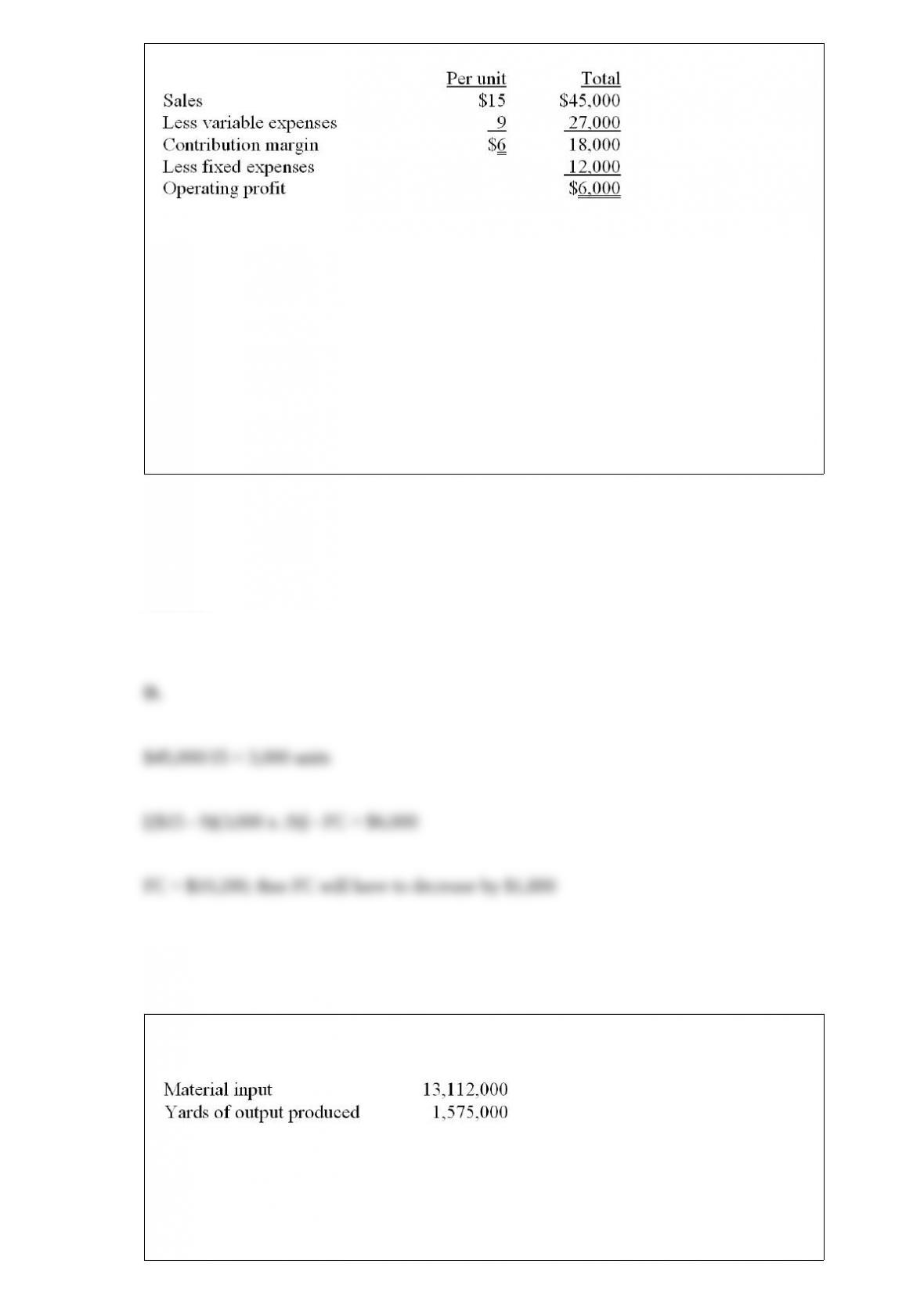
If unit sales decrease by 10%, how much will fixed expenses have to be reduced by to
maintain the current operating profit?
A. $12,000.
B. $4,500.
C. $6,000.
D. $1,800.
Answer:
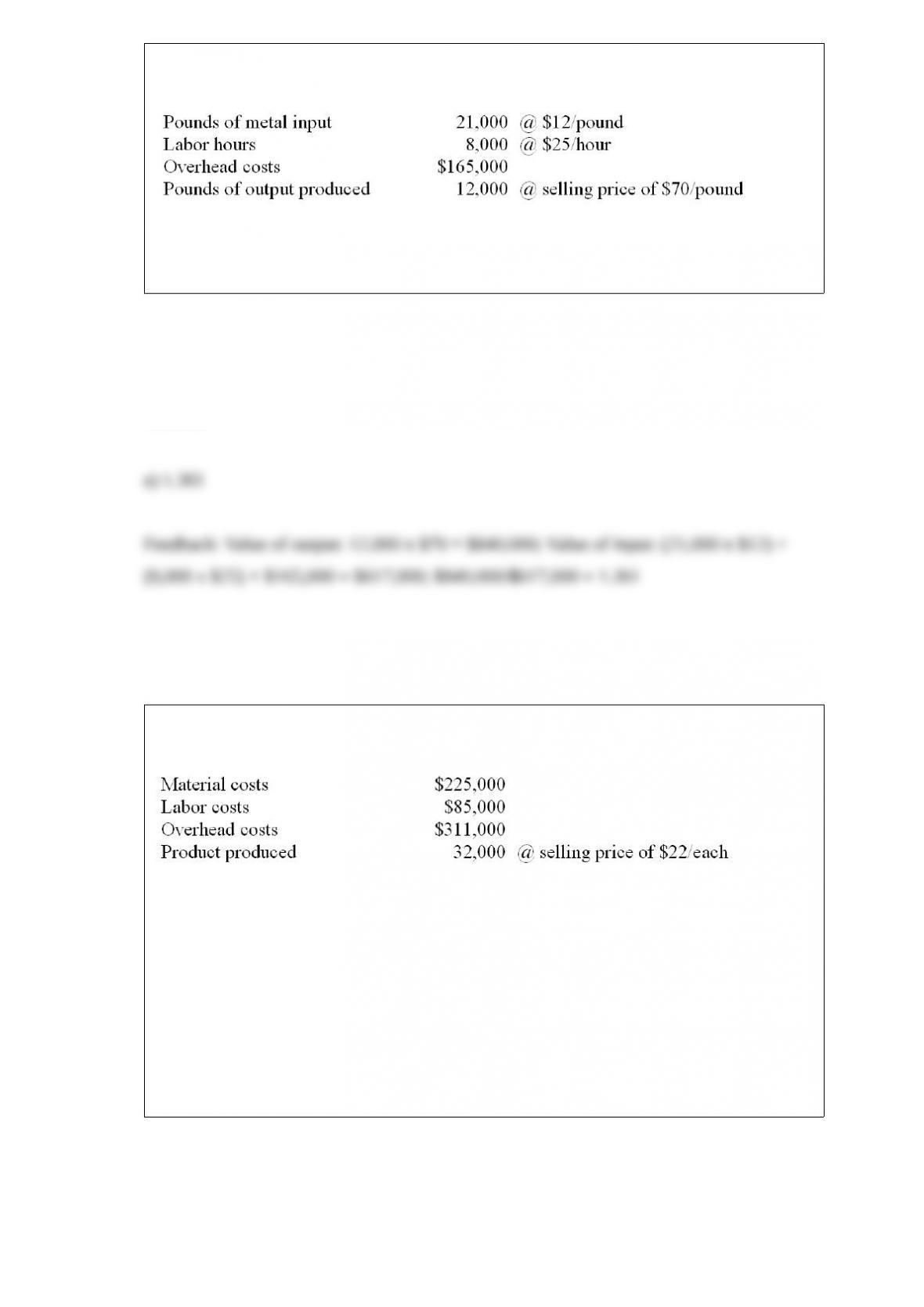
The Brindle Milling Co has the following information for last year
The partial productivity for materials is
A. 0.12
B. 1.31
C. 8.33
D. 15.75
Answer:
What is the value of the ending Work-in-Process Inventory?
A. $13,261.50
B. $14,200
C. $88,410.00
D. $95,060.50
Answer:
Spooner Metalworks Co. has provided the following information for last year:
Required:
a) Calculate the total factor productivity measure.
Answer:
Scottso Enterprises has provided the following information for last year:
The total factor productivity measure is:
A. 1.003
B. 1.134
C. 0.882
D. 0.362
Answer:
In the cost equation TC = F + VX, X is best described as the:
A. costs that do not vary with changes in the activity level.
B. costs that do vary with changes in the activity level.
C. total cost estimate at a particular activity level.
D. activity level used to estimate the total cost.
Answer:
The term “relevant range” as used in cost accounting means the range over which:
A. relevant costs are incurred.
B. costs may fluctuate.
C. cost relationships are valid.
D. cost data is available.

Answer:
When using a flexible budget, what will happen to variable costs on a per-unit basis as
production increases within the relevant range?
A. Decrease.
B. Increase.
C. Remain unchanged.
D. Fixed costs are not considered in flexible budgeting.
Answer:
Eastern Company manufactures special electrical equipment and parts. Eastern
employs a standard cost accounting system with separate standards established for each
product.
A special transformer is manufactured in the Transformer Department. Production
volume is measured by direct labor hours in this department and a flexible budget
system is used to plan and control department overhead. Standard costs for the special
transformer are determined annually in September for the coming year. The standard
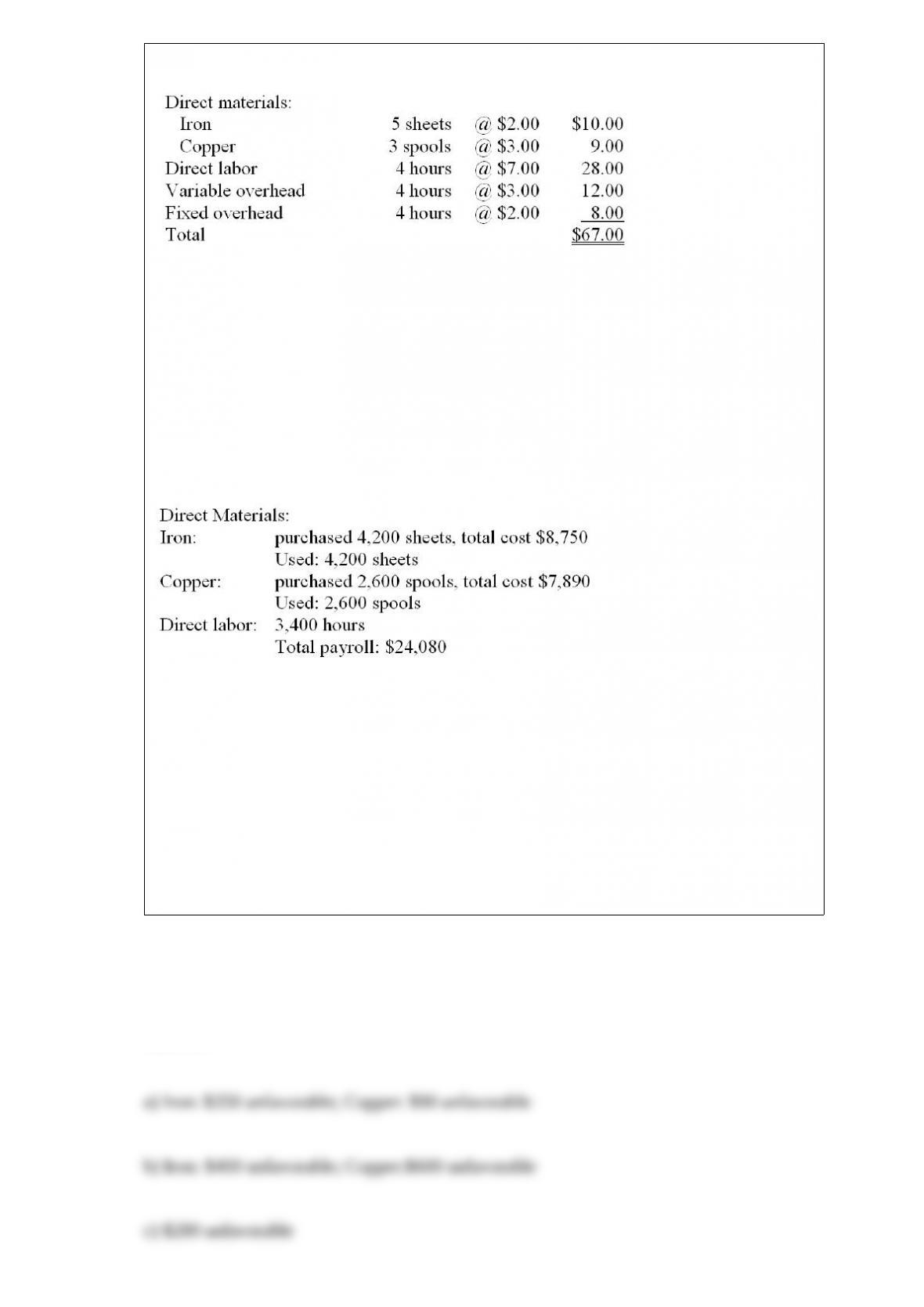
cost of a transformer was computed at $67.00 as shown below.
Overhead rates were based upon normal and expected monthly capacity, both of which
were 4,000 direct labor hours. Practical capacity for this department is 5,000 direct
labor hours per month. Variable overhead costs are expected to vary with the number of
direct labor hours actually used. During October, 800 transformers were produced. This
was below expectations because a work stoppage occurred at the copper supplier and
shipments were delayed.
The following costs were incurred in October:
Required: Compute each of the following variances, showing all your work. Be sure to
indicate whether the variances are favorable or unfavorable.
a) Direct materials price variance for both iron and copper
b) Direct material efficiency (quantity) variance for both iron and copper
c) Direct labor rate variance
d) Direct labor efficiency variance
Answer:
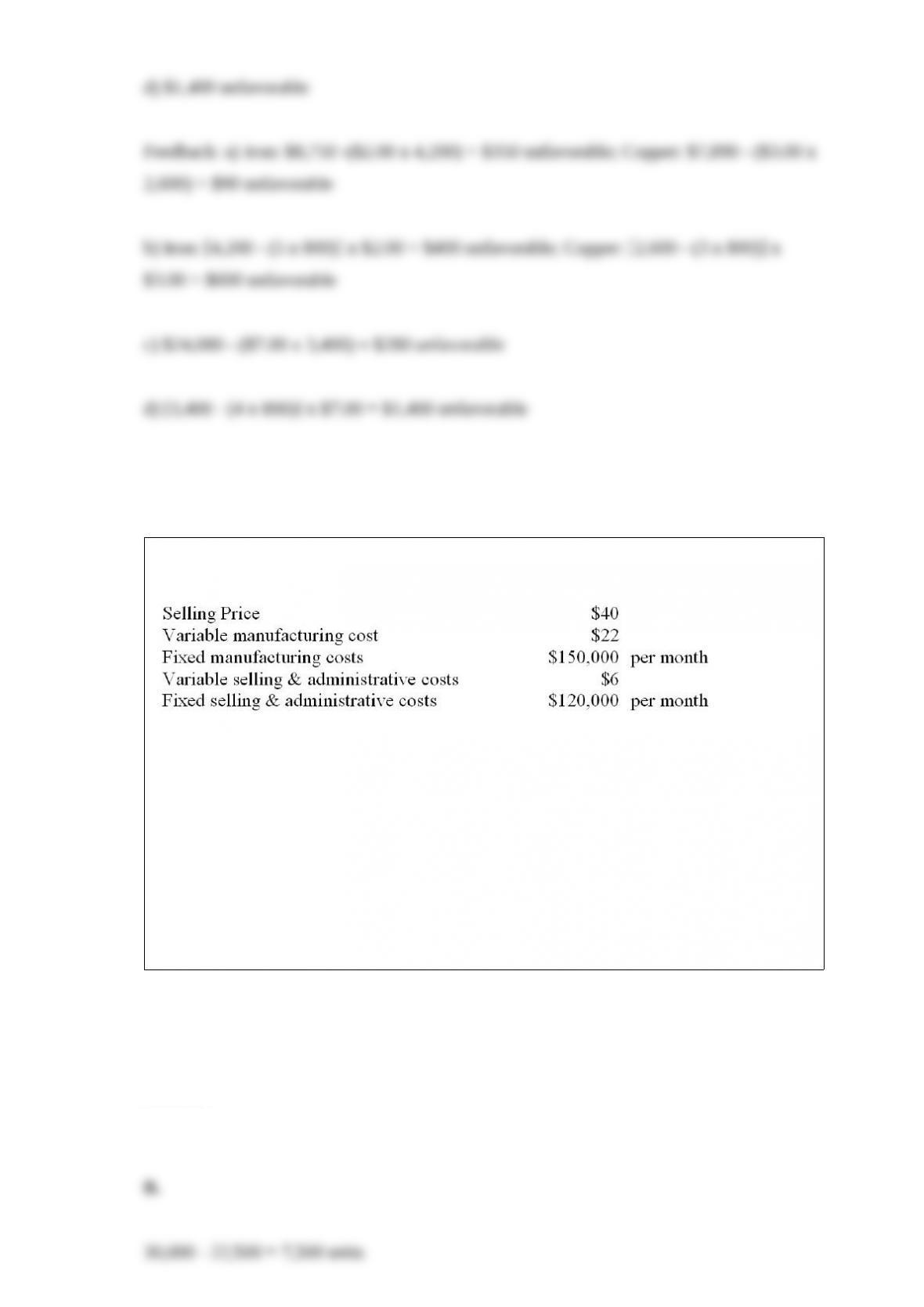
Sanfran has the following data:
If Sanfran produces and sells 30,000 units, what is the margin of safety?
A. 5,000 units
B. 7,500 units
C. 22,500 units
D. 30,000 units
Answer:
The controllability concept states that managers should be held responsible for
A. all items over which they have decision-making authority.
B. costs and revenues, but not investments in assets used in their division.
C. only items that are allocated to their divisions on a per-unit basis.
D. fixed compensation items, but not contingent compensation items.
Answer:
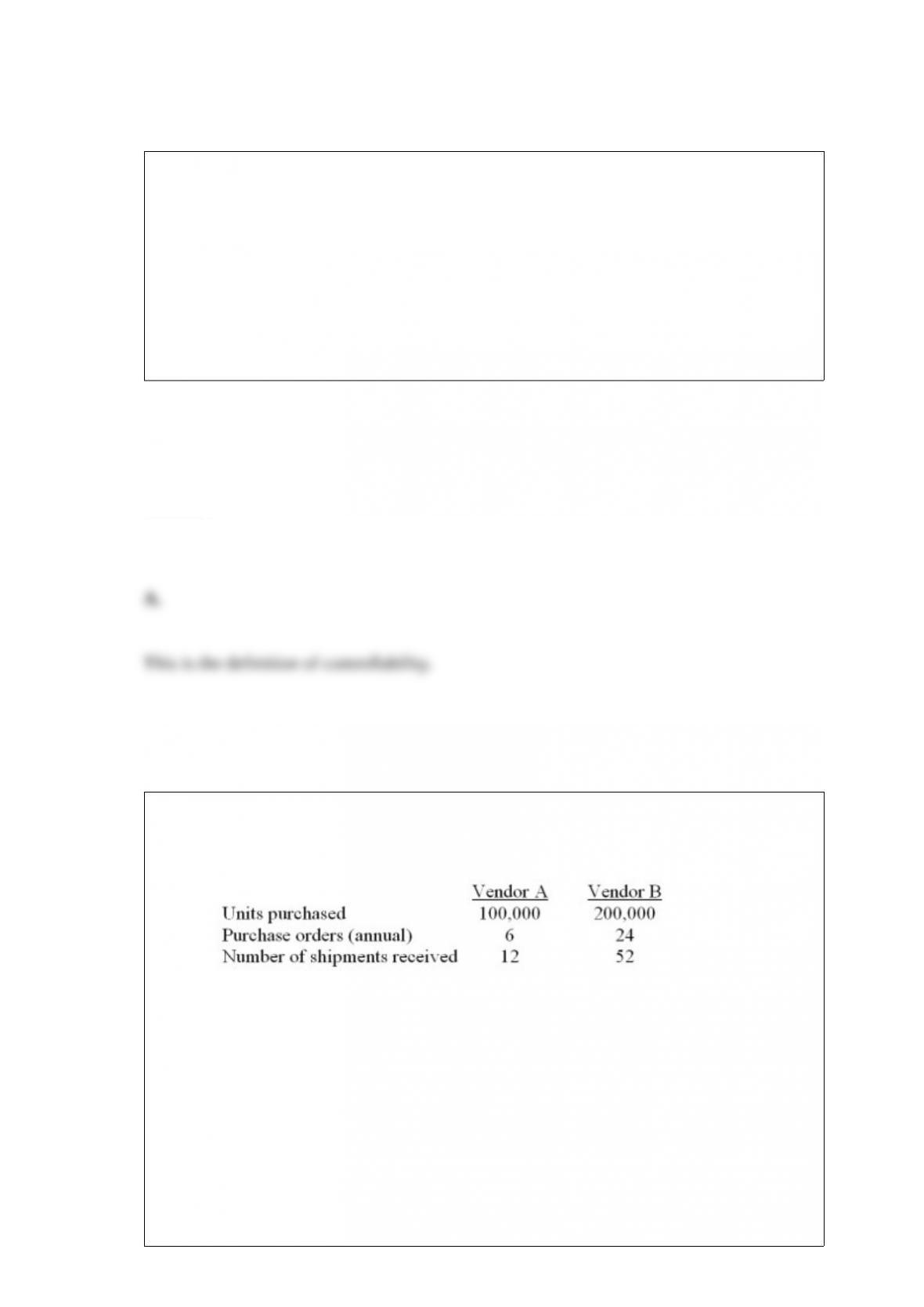
Rogers Company is preparing its annual profit plan. As part of its analysis of the cost
of its purchasing activity, management estimates that the $48,000 for purchasing
support should be assigned to the individual vendors from the information given as
follows:
What is the amount of the purchasing costs that should be allocated to Vendor B
assuming Rogers uses units purchased to compute activity-based costs?
A. $9,600
B. $16,000
C. $32,000
D. $38,400

Answer:
Predetermined manufacturing overhead rates can be used in all of the following costing
systems except
A. job costing.
B. process costing.
C. operations costing.
D. actual costing.
Answer:
Schroeder Forging Co. has provided the following information for last year:
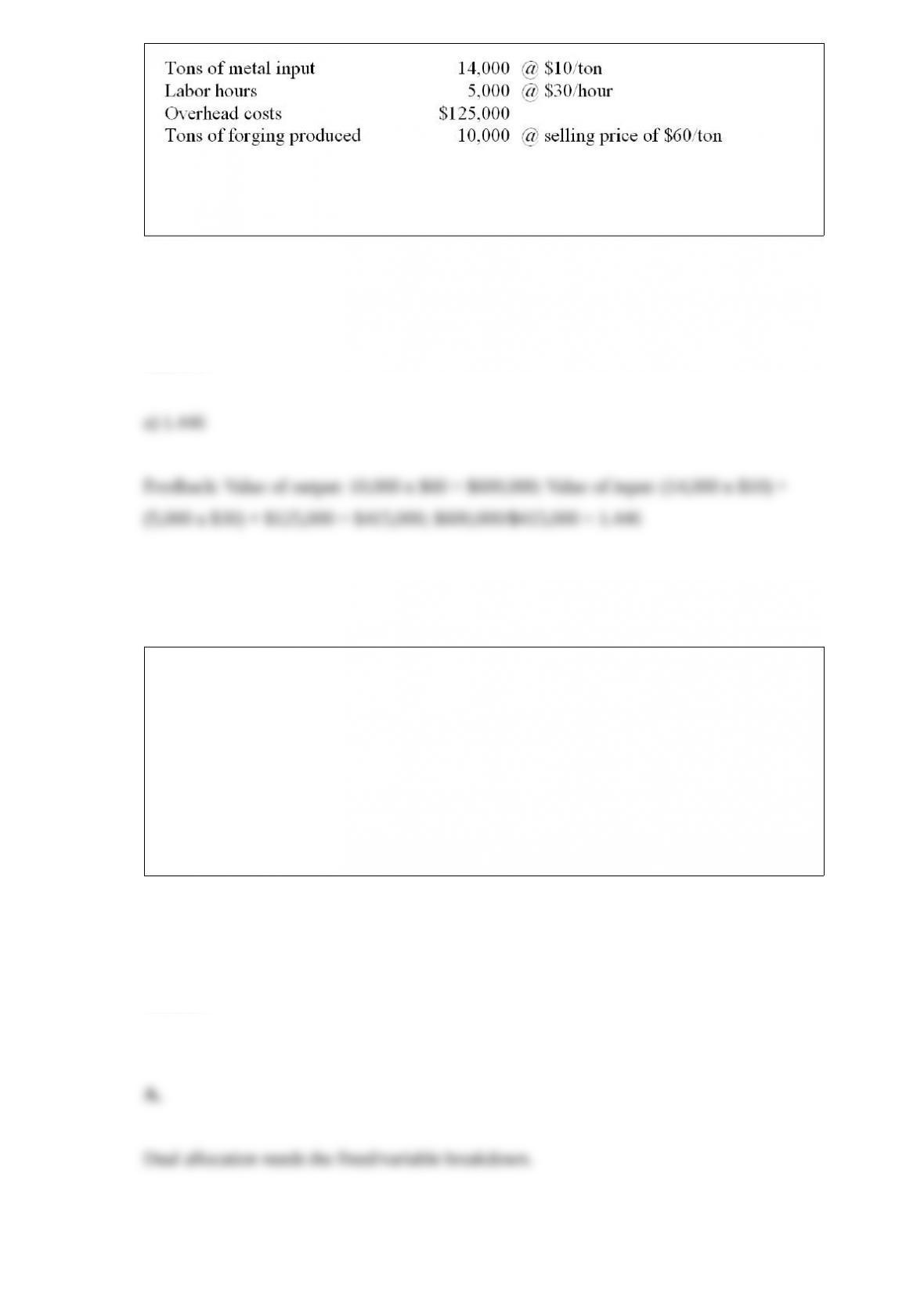
Required:
a) Calculate the total factor productivity measure.
Answer:
The use of dual rates in a cost allocation system assumes that common costs can be
A. separated into their fixed and variable components.
B. traced directly to a specific division or manager.
C. allocated based on a physical quantities measure.
D. assigned to an investment responsibility center.
Answer:
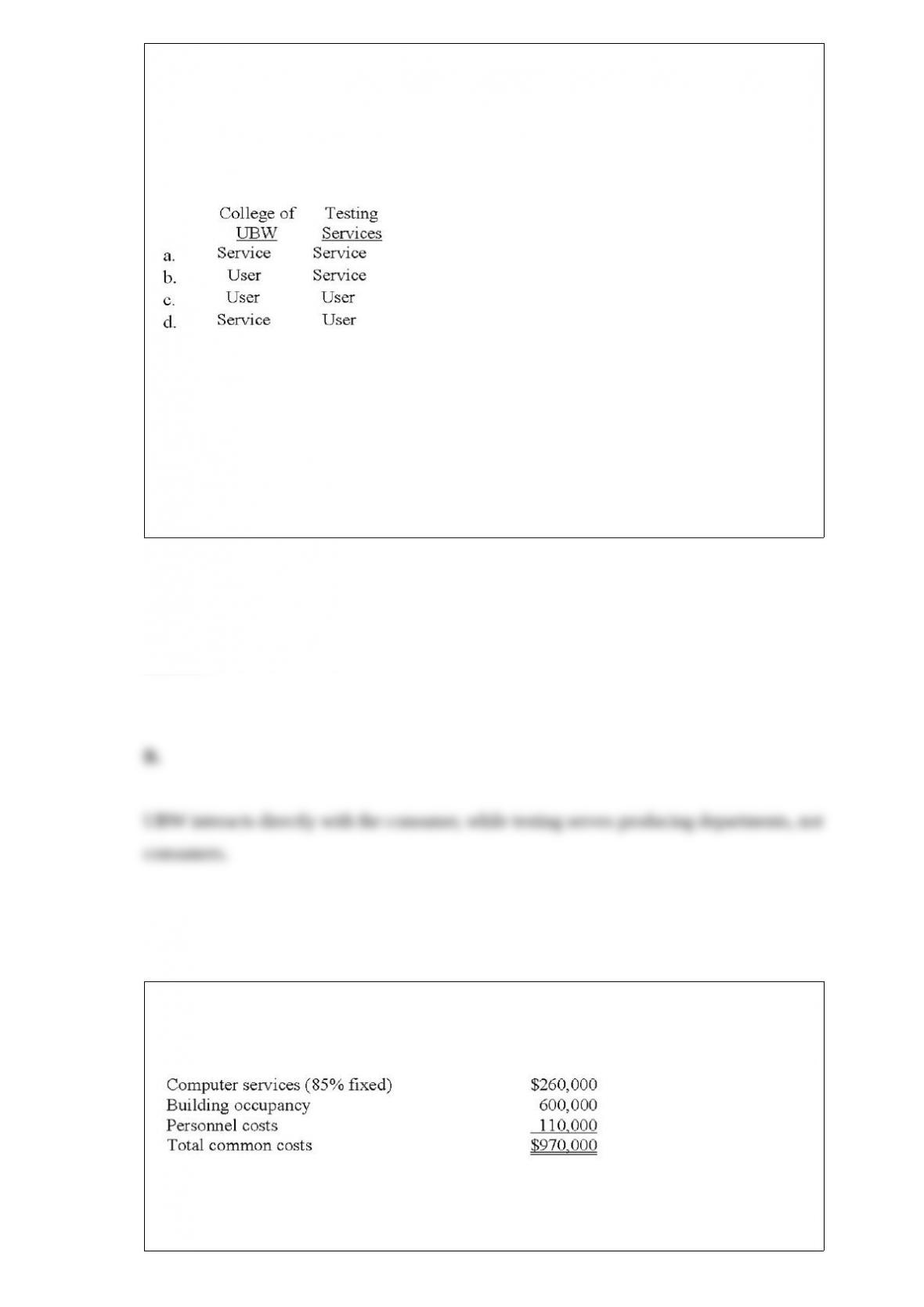
LaCrescent University has 20 departments. Two of its best departments are the (1)
College of UBW (Underwater Basket Weaving) and (2) Testing Services. The College
of UBW attempts to teach students the difficult, but useful, skill of weaving baskets
underwater. Testing Services grades examinations for professors. How would these two
departments be classified?
A. a
B. b
C. c
D. d
Answer:
Cincinnati Million, Inc. operates two user divisions as separate cost objects. To
determine the costs of each division, the company allocates common costs to the
divisions. During the past month, the following common costs were incurred:
The following information is available concerning various activity measures and
service usages by each of the divisions:
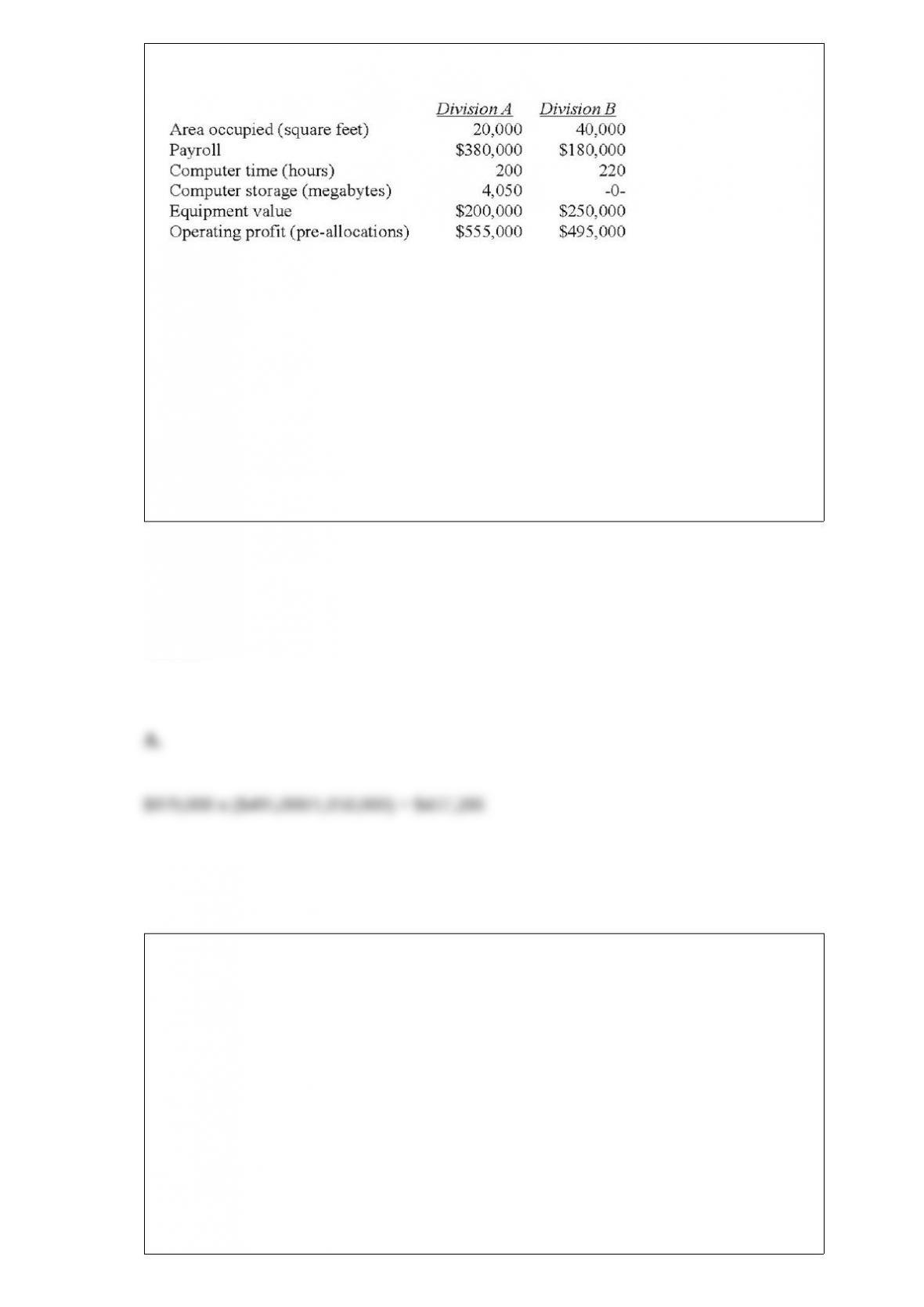
If all common costs are allocated using operating profit as the allocation basis, what is
the total cost allocated to Division B?
A. $457,286
B. $512,714
C. $555,000
D. $1,087,576
Answer:
Department D has recently purchased and installed new computerized equipment for
Product X. This equipment will increase the overhead costs by $2,700 and decrease
labor costs (due to time savings) in Department D by $3.00 per case. Machine hours
will not change. If Smelly uses a plantwide rate based on direct labor hours, what is the
revised product cost per case for Product X?
A. $82.50
B. $74.00
C. $79.50
D. $69.50
Answer:
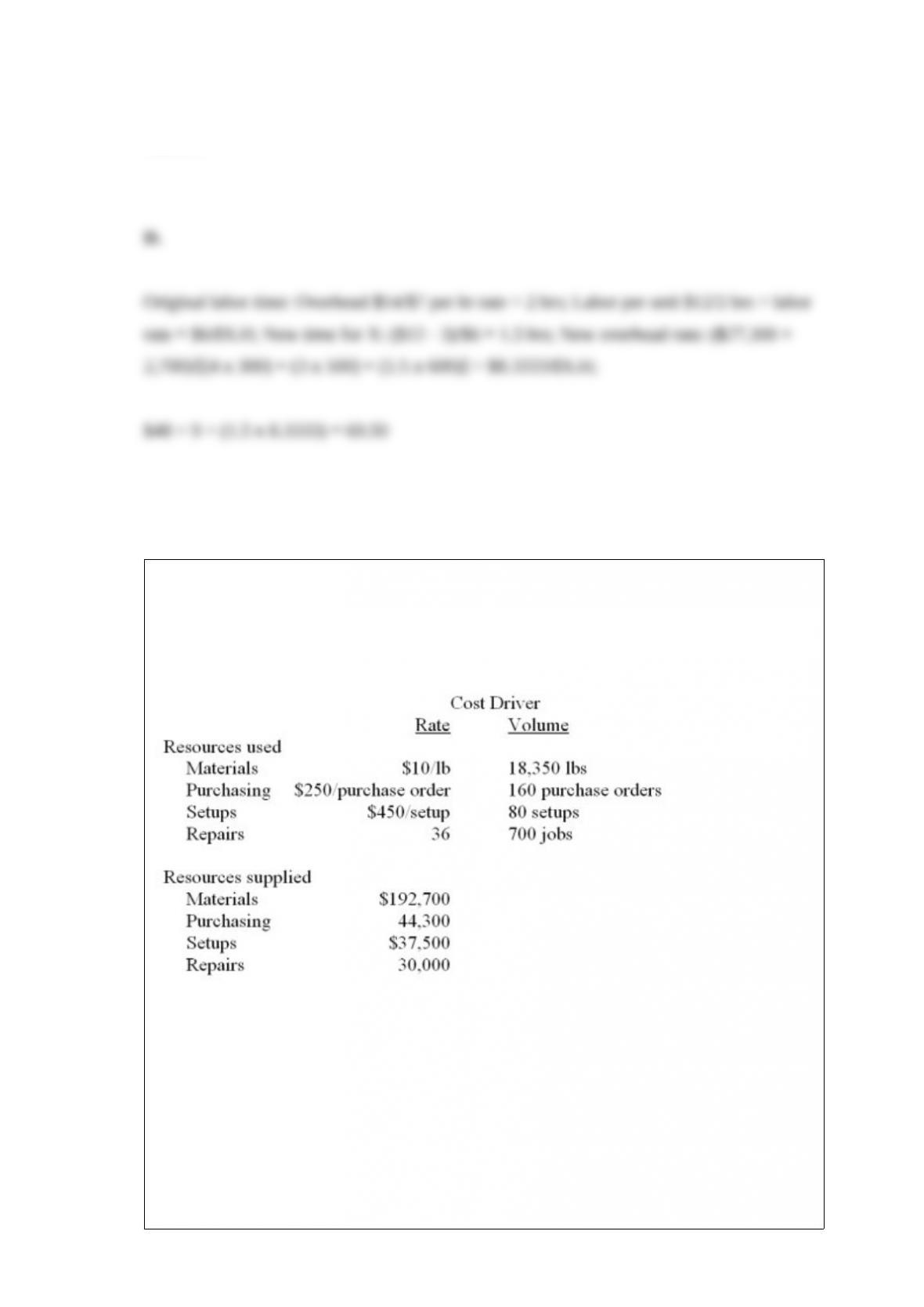
Sullivan Inc. reports the following information about resources. At the beginning of
the year, Sullivan estimated it would spend $180,000 for materials, $42,000 for
purchasing, $35,000 for setups and $36,000 for repairs.
Compute unused resource capacity for purchasing for Sullivan.
A. $5,538
B. $2,000
C. $4,300
D. $2,300
Answer: