
Title to merchandise shipped FOB shipping point passes to the buyer upon delivery of
the merchandise to the buyer’s place of business.
Answer:
The relationship of each asset item as a percent of total assets is an example of vertical
analysis.
Answer:
Purchased goods in transit, shipped FOB destination, should be excluded from ending
inventory of the buyer.
Answer:
The income summary account is also known as the clearing account.
Answer:
Part of the cash budget is based on information drawn from the capital expenditures
budget.
Answer:
On the work sheet, the capital and drawing account balances are extended to the
Balance Sheet columns.
Answer:
The Other Accounts column in the Cash Payments journal is used for recording debits
to any account for which there is no specialized debit column.

Answer:
The post reference column of the revenue journal will reference the account number of
the customer.
Answer:
Make or buy options often arise when a manufacturer has excess productive capacity in
the form of unused equipment, space, and labor.
Answer:
In an absorption costing income statement, the manufacturing margin is the excess of
sales over the variable cost of goods sold.
Answer:

The debit to factory overhead for the cost of indirect materials is obtained from the
summary of the materials requisitions.
Answer:
Under the total cost concept, manufacturing cost plus desired profit is included in the
total cost per unit.
Answer:
The increase side of all accounts is the normal balance.
Answer:

The internal rate of return method of analyzing capital investment proposals uses the
present value concept to compute an internal rate of return expected from the proposals.
Answer:
The first budget to be prepared is usually the sales budget.
Answer:
The balance sheet accounts are referred to as real or permanent accounts.
Answer:
Even though GAAP requires the accrual basis of accounting, some businesses prefer

using the cash basis of accounting.
Answer:
Supervisor salaries, maintenance, and indirect factory wages would normally appear in
the factory overhead cost budget.
Answer:
Organizational expenses are classified as intangible assets on the balance sheet.
Answer:
Depending upon when an unfunded pension liability is to be paid, it will be classified
on the balance sheet as either a long-term or a current liability.

Answer:
The maturity value of a note receivable is always the same as its face value.
Answer:
Process manufacturers typically use large machines to process a continuous flow of raw
materials into a finished state.
Answer:
A business using the perpetual inventory system, with its detailed subsidiary records,
does not need to take a physical inventory.
Answer:

At 12/31/2009, the cash and securities held in a sinking fund to redeem bonds in 2011
are classified on the balance sheet as current assets.
Answer:
Cash flows from investing activities, as part of the statement of cash flows, include
receipts from the issuance of bonds payable.
Answer:
The party promising to pay a note at maturity is the maker.
Answer:

If a new partner is to be admitted to a partnership and a bonus is attributed to the old
partnership, the bonus should be divided between the capital accounts of the original
partners according to their capital balances.
Answer:
After the sales budget is prepared, the capital expenditures budget is normally prepared
next.
Answer:
Nonfinancial performance output measures are used to improve the input measures.
Answer:

The updating of accounts is called the adjusting process.
Answer:
The minimum amount of desired divisional income from operations is set by top
management by establishing a minimum rate of return considered acceptable for
invested assets.
Answer:
A seller may grant a buyer a reduction in selling price and this is called a sales
allowance.
Answer:
As with other assets, the cost of a bond investment includes all costs related to the
purchase.

Answer:
When purchases of merchandise are made for cash, the transaction may be recorded
with the following entry
A.debit Cash; credit Merchandise Inventory
B.debit Merchandise Inventory; credit Cash
C.debit Merchandise Inventory; credit Cash Discounts
D.debit Merchandise Inventory; credit Purchases
Answer:
Inventory controls start when the merchandise is shelved in the store area.
Answer:

Which of the following is the appropriate general journal entry to record the declaration
of a cash dividends?
A.Retained earnings
Cash
B.Cash Dividends payable
Cash
C.Paid-in capital
Cash Dividends payable
D.Cash Dividends
Cash Dividends Payable
Answer:
The type of account and normal balance of Accumulated Depreciation is
A.asset, credit
B.asset, debit
C.contra asset, credit
D.contra asset, debit
Answer:

In which of the following types of accounts are increases recorded by credits?
A.revenues and liabilities
B.drawing and assets
C.liabilities and drawing
D.expenses and liabilities
Answer:
Who pays the freight cost when the terms are FOB destination?
A.the seller
B.the buyer
C.the customer
D.either the buyer or the seller
Answer:
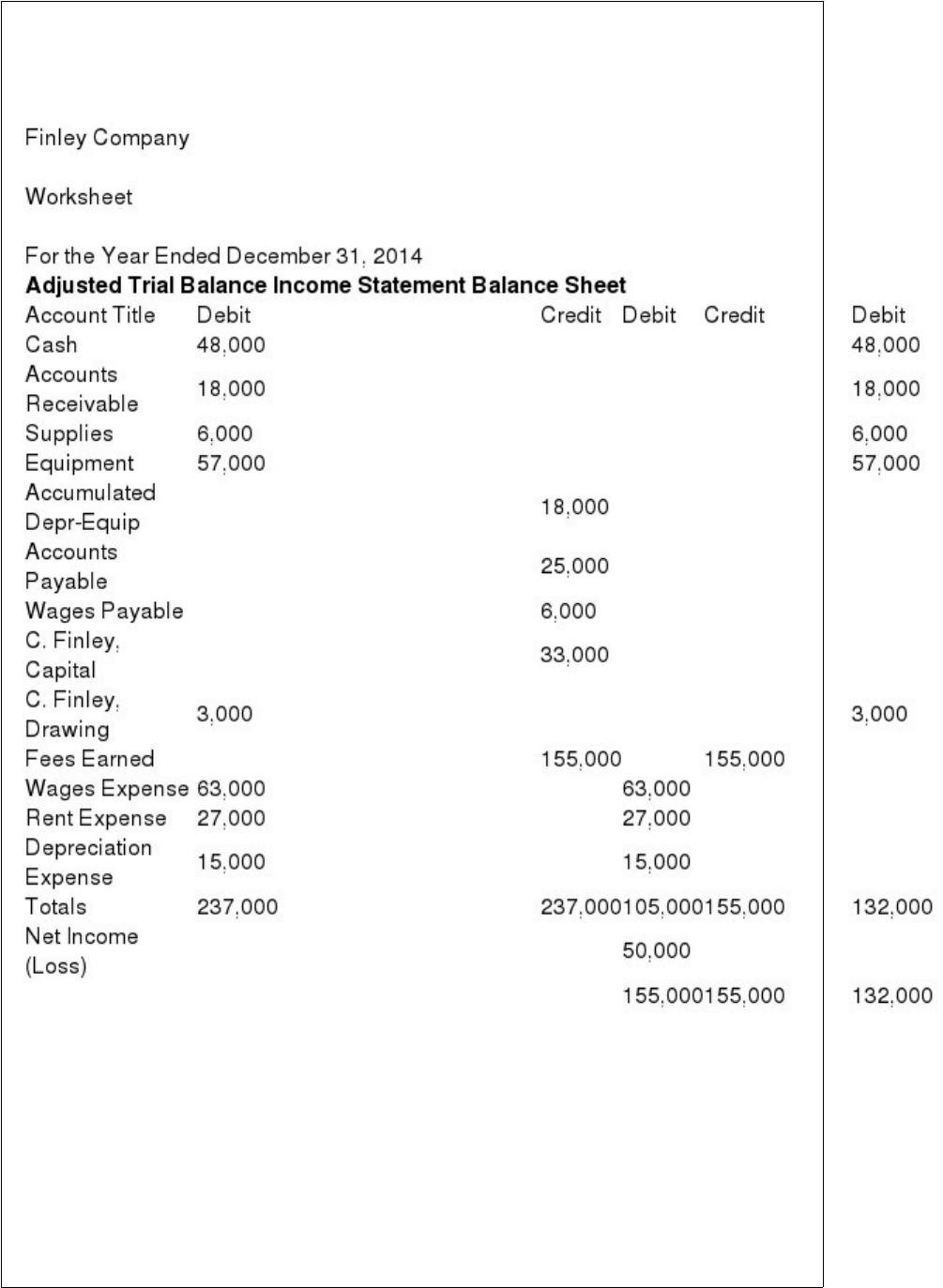
Use the following worksheet to answer the following questions.
The journal entry to close revenues would be:
A.debit Income Summary $155,000, credit Fees Earned $155,000
B.debit C. Finley, Capital $155,000, credit Fees Earned $155,000
C.debit Fees Earned $155,000; credit Income Summary $155,000
D.credit Fees Earned $155,000; credit C. Finley, Capital $155,000

Answer:
Scott Manufacturing Co.’s static budget at 10,000 units of production includes $40,000
for direct labor and $4,000 for electric power. Total fixed costs are $25,000. At 12,000
units of production, a flexible budget would show:
A.variable costs of $52,800 and $30,000 of fixed costs
B.variable costs of $44,000 and $25,000 of fixed costs
C.variable costs of $52,800 and $25,000 of fixed costs
D.variable and fixed costs totaling $69,000
Answer:
Income from operations of the Commercial Aviation Division is $2,225,000. If income
from operations before service department charges is $3,250,000:
A.operating expenses are $1,025,000
B.total service department charges are $1,025,000
C.noncontrollable charges are $1,025,000
D.direct manufacturing charges are $1,025,000

Answer:
Parker Company owns 83% of the outstanding stock of Tadeo Company. Parker
Company is referred to as the
A.parent
B.minority interest
C.affiliate
D.subsidiary
Answer:
Which of the following provisions of the Internal Revenue Code can be used to reduce
the amount of the income tax expense arising from capital investment projects?
A.Deductions for individuals
B.Depreciation deduction
C.Minimum tax provision
D.Charitable contributions
Answer:
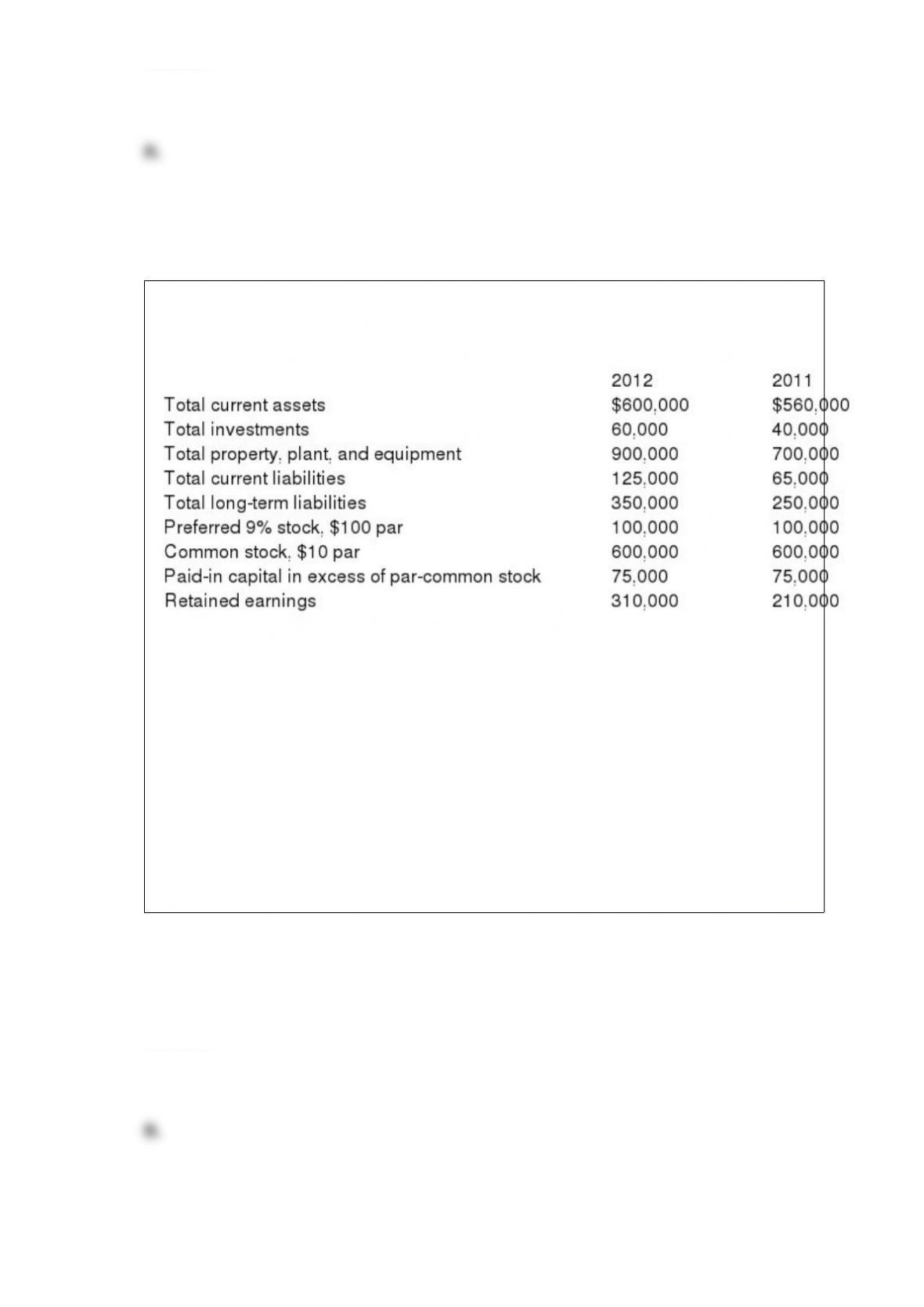
The balance sheets at the end of each of the first two years of operations indicate the
following:
If net income is $115,000 and interest expense is $30,000 for 2012 what is the rate
earned on total assets for 2012 (round percent to one decimal point)?
A.9.3%
B.10.1%
C.8.0%
D.7.4%
Answer:
Investment in certificates of deposit and other securities that do not change in value are
reported in the balance sheet as:
A.equity investments
B.available-for-sale securities
C.cash and cash equivalents
D.held to maturity securities
Answer:
On December 15th, Great Designs Company hired an independent contractor for a
project. The contractor completed the project on December 29th and submitted an
invoice for $2,425 which was due on January 15th. The amount was duly paid on
January 15th.
(a) Prepare the journal entries necessary to record these transactions.
(b) Explain why you prepared this/these journal entries.
Answer:
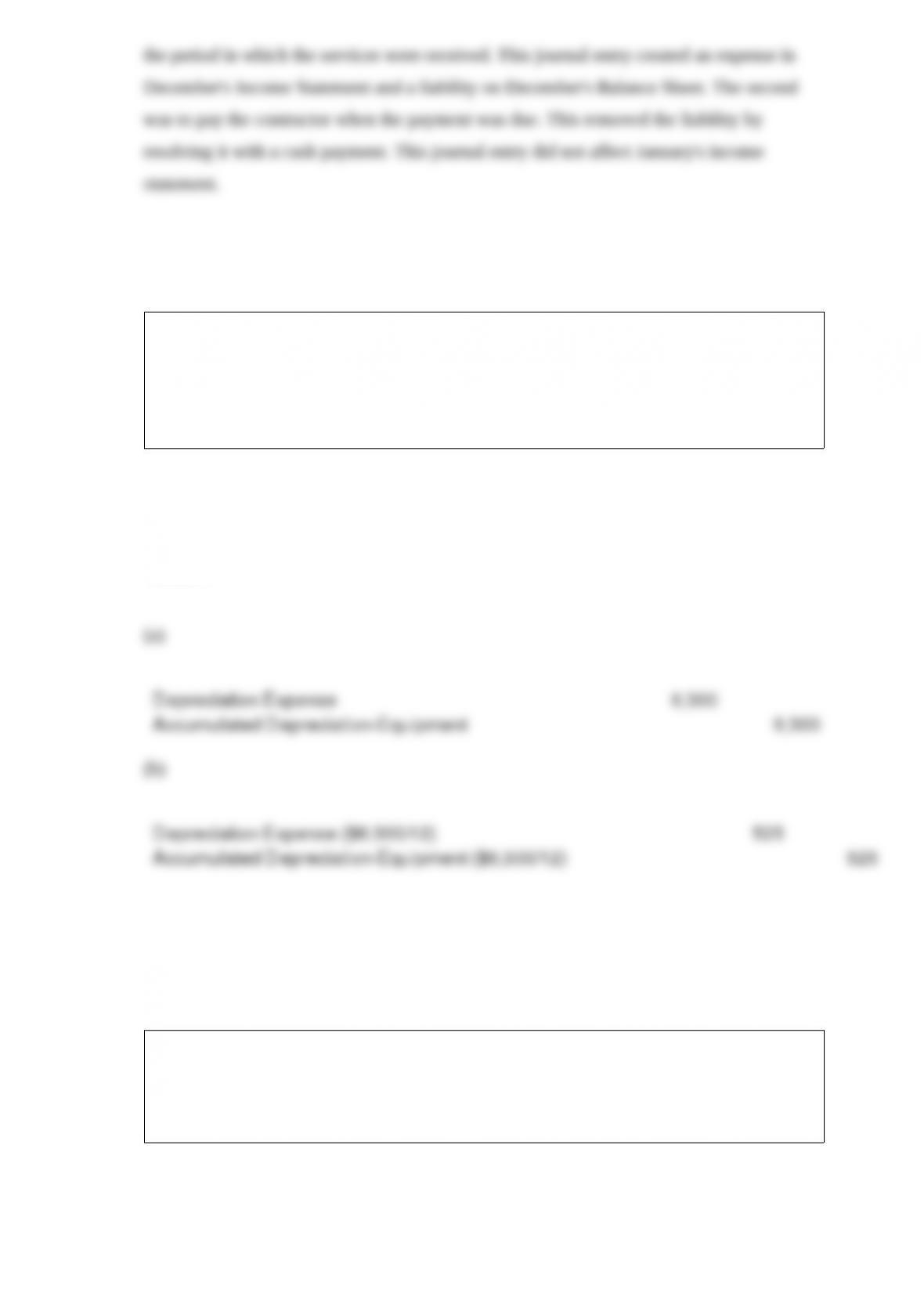
Depreciation on equipment for the year is $6,300.
(a) Record the journal entry if the company adjusts its account once a year.
(b) Record the journal entry if the company adjusts its account on a monthly basis.
Answer:
Use the following information to answer the following questions.
The Boxwood Company sells blankets for $60 each. The following was taken from the
inventory records during May. The company had no beginning inventory on May 1.
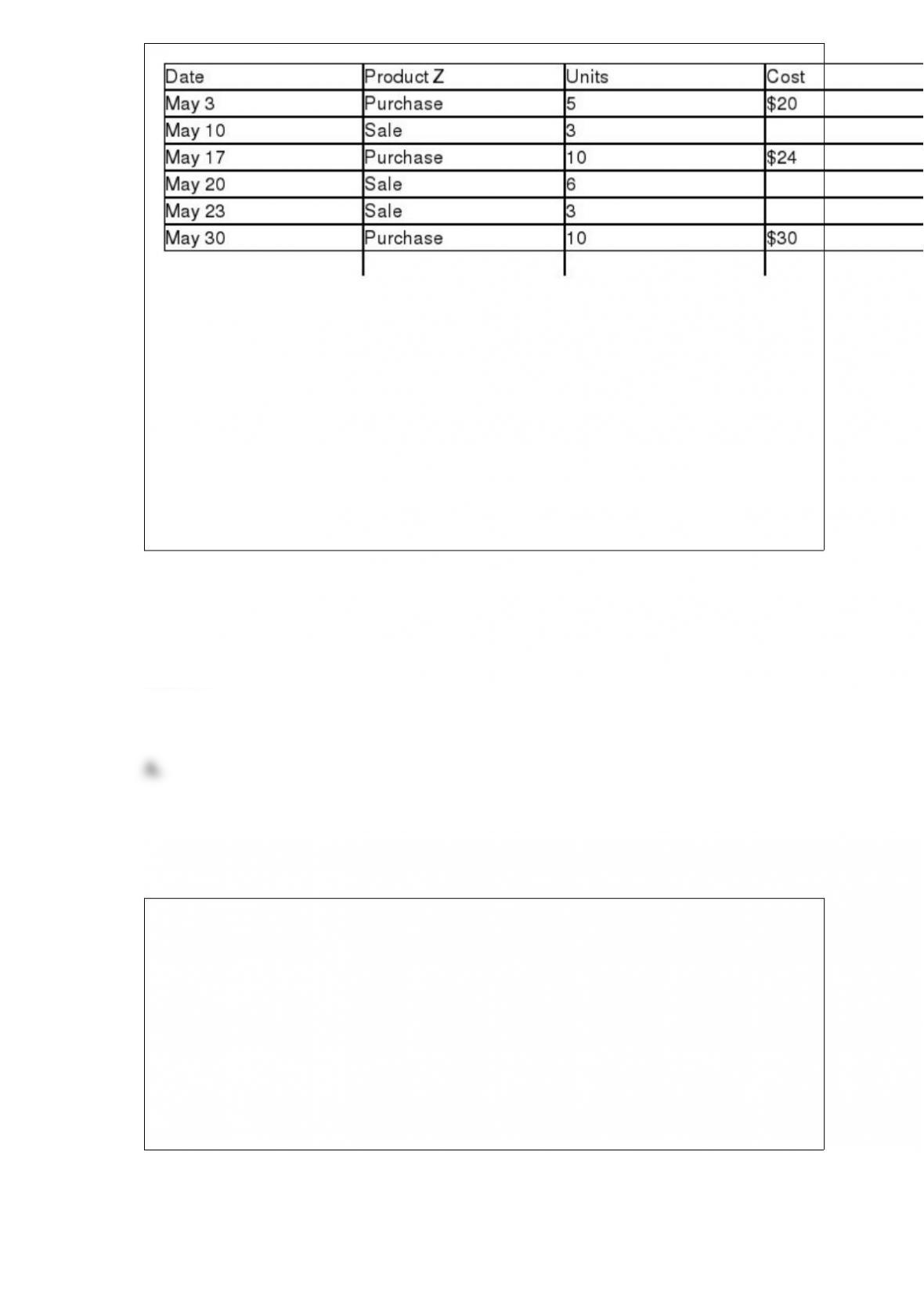
Assuming that the company uses the perpetual inventory system, determine the gross
profit for the sale of May 23 using the FIFO inventory cost method.
A.$108
B.$120
C.$72
D.$180
Answer:
If fixed costs are $500,000, the unit selling price is $55, and the unit variable costs are
$30, what is the break-even sales (units) if fixed costs are increased by $80,000?
A.10,545 units
B.19,333 units
C.23,200 units
D.25,000 units

Answer:
Finished goods inventory is reported on the:
A.income statement as a period cost
B.balance sheet as a long-term asset
C.balance sheet as a current asset
D.income statement as revenue
Answer:
The following procedures were recently implemented at the Health Station, Inc. For
each procedure, indicate whether the internal control over cash represents (1) a strength
or (2) a weakness. If it is a weakness, please explain why.
(a) All mail is opened by the mail clerk, who forwards all cash remittances to the
cashier. The cashier prepares a listing of the cash receipts and forwards a copy of the
list to the accounts receivable clerk for recording in the accounts.
(b) The accounts payable clerk prepares a voucher for each disbursement. The voucher
along with the supporting documentation is forwarded to the treasurer’s office for
approval.
(c) At the end of each day, all cash receipts are placed in the bank’s night depository.
(d) The bank reconciliation is prepared by the cashier, who works under the supervision
of the treasurer.
Answer:
Below is budgeted production and sales information for Bluebird Company for the
month of December:
The unit selling price for product XXX is $5 and for product ZZZ is $14.
Budgeted production for product XXX during the month is:
A.522,000 units
B.552,000 units
C.518,000 units
D.520,000 units

Answer:
What is the term applied to the excess of net revenue from sales over the cost of
merchandise sold?
A.gross profit
B.income from operations
C.net income
D.gross sales
Answer:
On the first day of the fiscal year, Lisbon Co. issued $1,000,000 of 10-year, 7% bonds
for $1,050,000, with interest payable semiannually. Orange Inc. purchased the bonds on
the issue date for the issue price. The journal entry to record the amortization of the
premium (by the straight line method) for the year by Lisbon Co. includes a debit to:
A.Interest Expense for $2,500
B.Premium on Bonds Payable for $2,500
C.Interest Expense for $5,000
D.Premium on Bonds Payable for $5,000

Answer:
Identify the following costs as (a) prime cost, (b) conversion cost, (c) or both for a cake
factory.
1_____ Frosting
2 _____ Wages of the baker
3 _____ Sprinkles for the topping (considered an indirect material)
4 _____ Depreciation on oven
Answer:
Cost of goods sold for a manufacturer equals cost of goods manufactured plus:
A.beginning work in process inventory less ending work in process inventory
B.ending work in process inventory less beginning work in process inventory
C.beginning finished goods inventory less ending finished goods inventory

D.ending finished goods inventory less beginning finished goods inventory
Answer:
The business entity concept means that
A.the owner is part of the business entity
B.an entity is organized according to state or federal statutes
C.an entity is organized according to the rules set by the FASB
D.the entity is an individual economic unit for which data are recorded, analyzed, and
reported
Answer:
Present entries to record the following summarized operations related to production for
a company using a job order cost system:
(a) Materials purchased on account $167,000
(b) Prepaid expenses incurred on account 12,200

(c) Materials requisitioned:
For production orders 153,700
For general factory use 2,700
(d) Factory labor used:
On production orders 141,300
For general factory purposes 12,000
(e) Depreciation on factory equipment 37,000
(f) Expiration of prepaid expenses,
chargeable to factory 6,100
(g) Factory overhead costs incurred on account 67,000
(h) Factory overhead applied, based on machine hours 105,300
(i) Jobs finished 415,300
(j) Jobs shipped to customers: cost, $412,000;
selling price 638,000
Answer:
A $6,000, 60-day, 12% note recorded on November 21 is not paid by the maker at
maturity. The journal entry to recognize this event is
A.debit Cash, $6,120; credit Notes Receivable, $6,120
B.debit Accounts Receivable, $6,120; credit Notes Receivable, $6,000; Credit Interest
Receivable, $120
C.debit Notes Receivable, $6,060; credit Accounts Receivable, $6,060

D.debit Accounts Receivable, $6,120; credit Notes Receivable, $6,000; Credit Interest
Revenue, $120
Answer:
In capital rationing, alternative proposals that survive initial and secondary screening
are normally evaluated in terms of:
A.present value
B.non-financial factors
C.maximum cost
D.net cash flow
Answer:
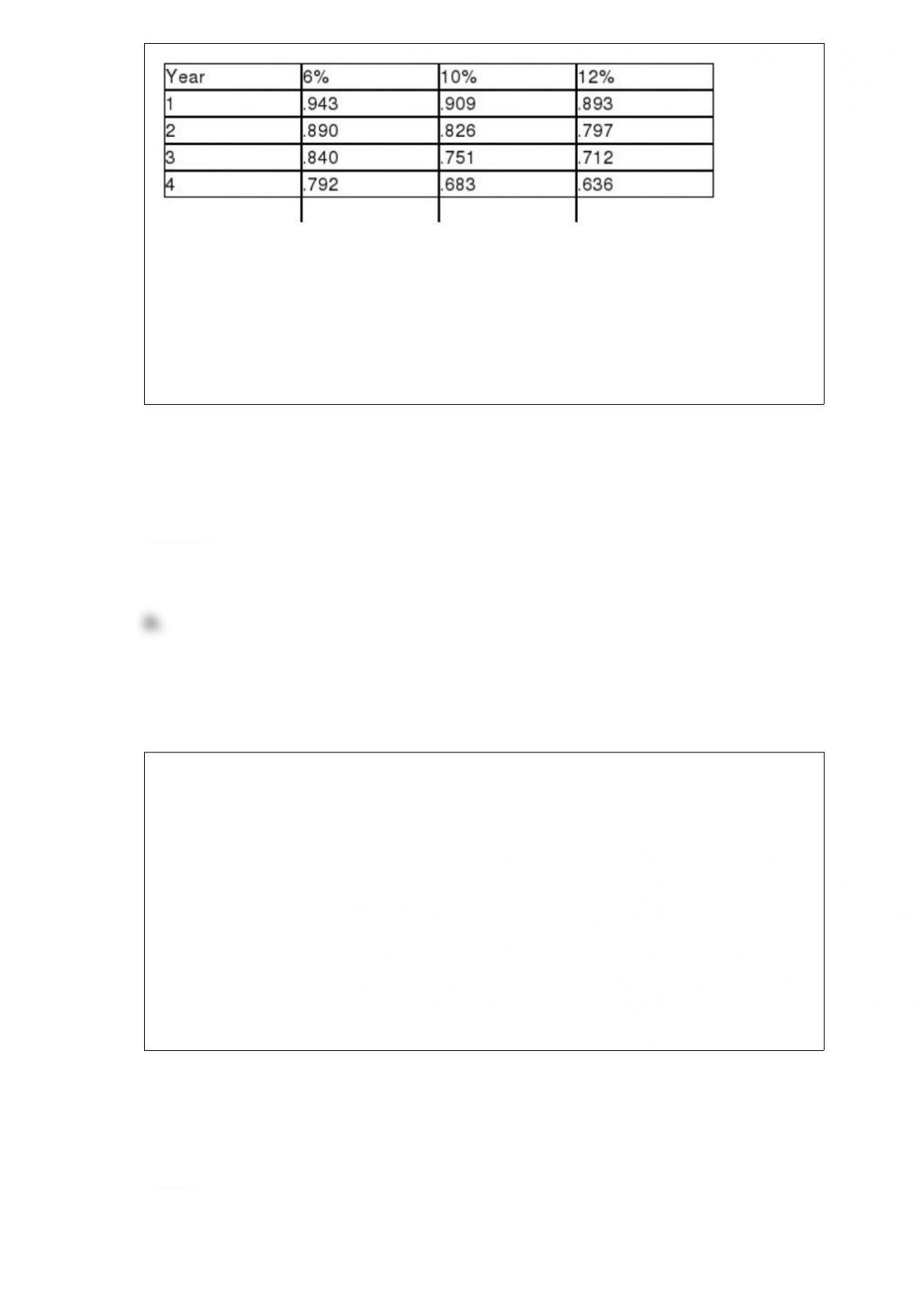
The rate of earnings is 10% and the cash to be received in two year is $10,000.
Determine the present value amount, using the following partial table of present value
of $1 at compound interest:
A.$8,900
B.$9,090
C.$7,970
D.$8,260
Answer:
Pheasant Co. can further process Product B to produce Product C. Product B is
currently selling for $30 per pound and costs $28 per pound to produce. Product C
would sell for $60 per pound and would require an additional cost of $24 per pound to
produce. What is the differential cost of producing Product C?
A.$30 per pound
B.$24 per pound
C.$28 per pound
D.$60 per pound
Answer:
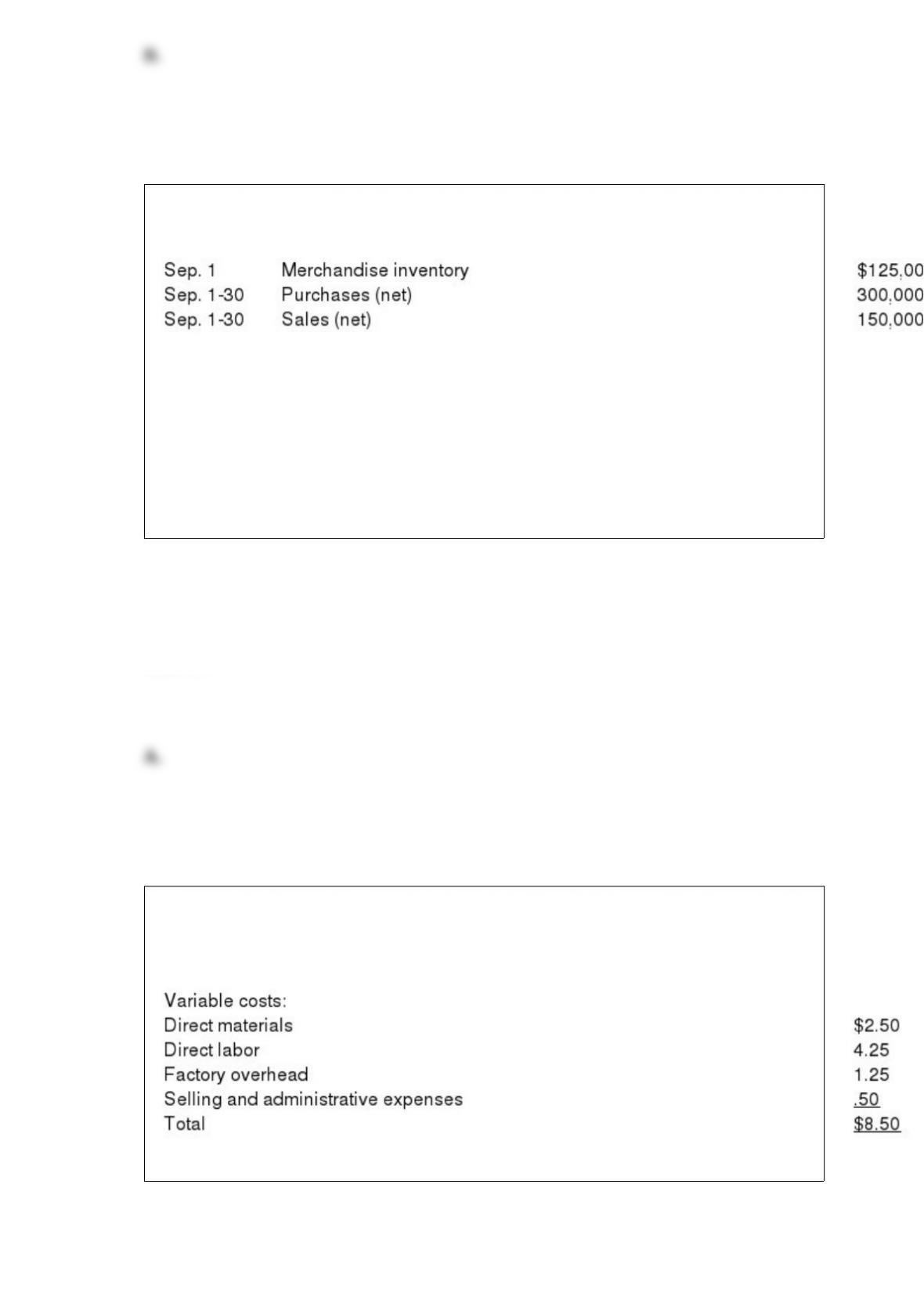
If the estimated rate of gross profit is 30%, what is the estimated cost of the
merchandise inventory on September 30, based on the following data?
A.$320,000
B.$192,500
C.$275,000
D.$105,000
Answer:
Hummingbird Company uses the product cost concept of applying the cost-plus
approach to product pricing. The costs and expenses of producing 25,000 units of
Product K are as follows:
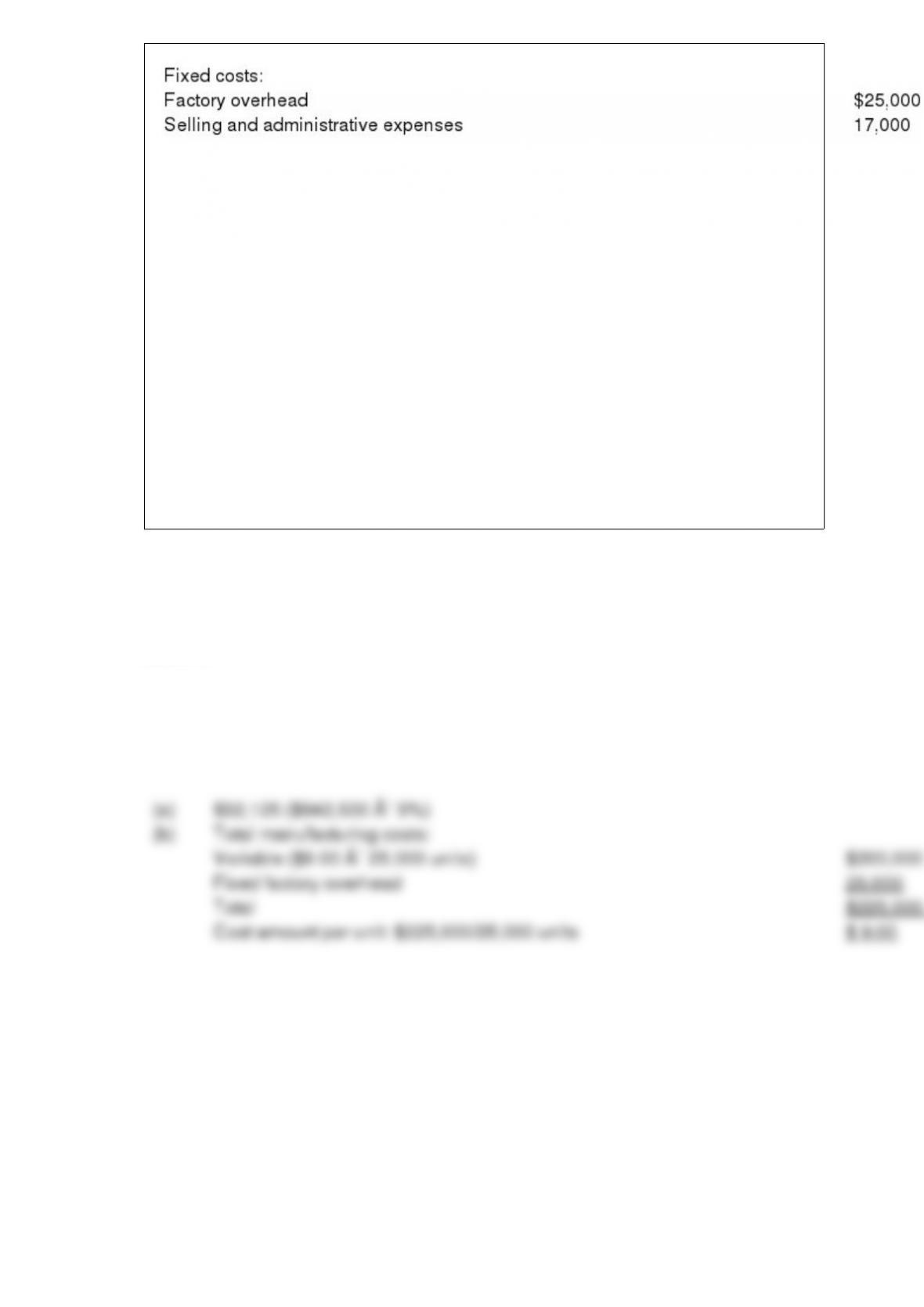
Hummingbird desires a profit equal to a 5% rate of return on invested assets of
$642,500.
(a) Determine the amount of desired profit from the production and sale of Product K.
(b) Determine the total manufacturing costs and the cost amount per unit for the
production and sale of 25,000 units of Product K.
(c) Determine the markup percentage for Product K.
(d) Determine the selling price of Product K.
Round your markup percentage to one decimal place, and other intermediate
calculations and final answer to two decimal places.
Answer:
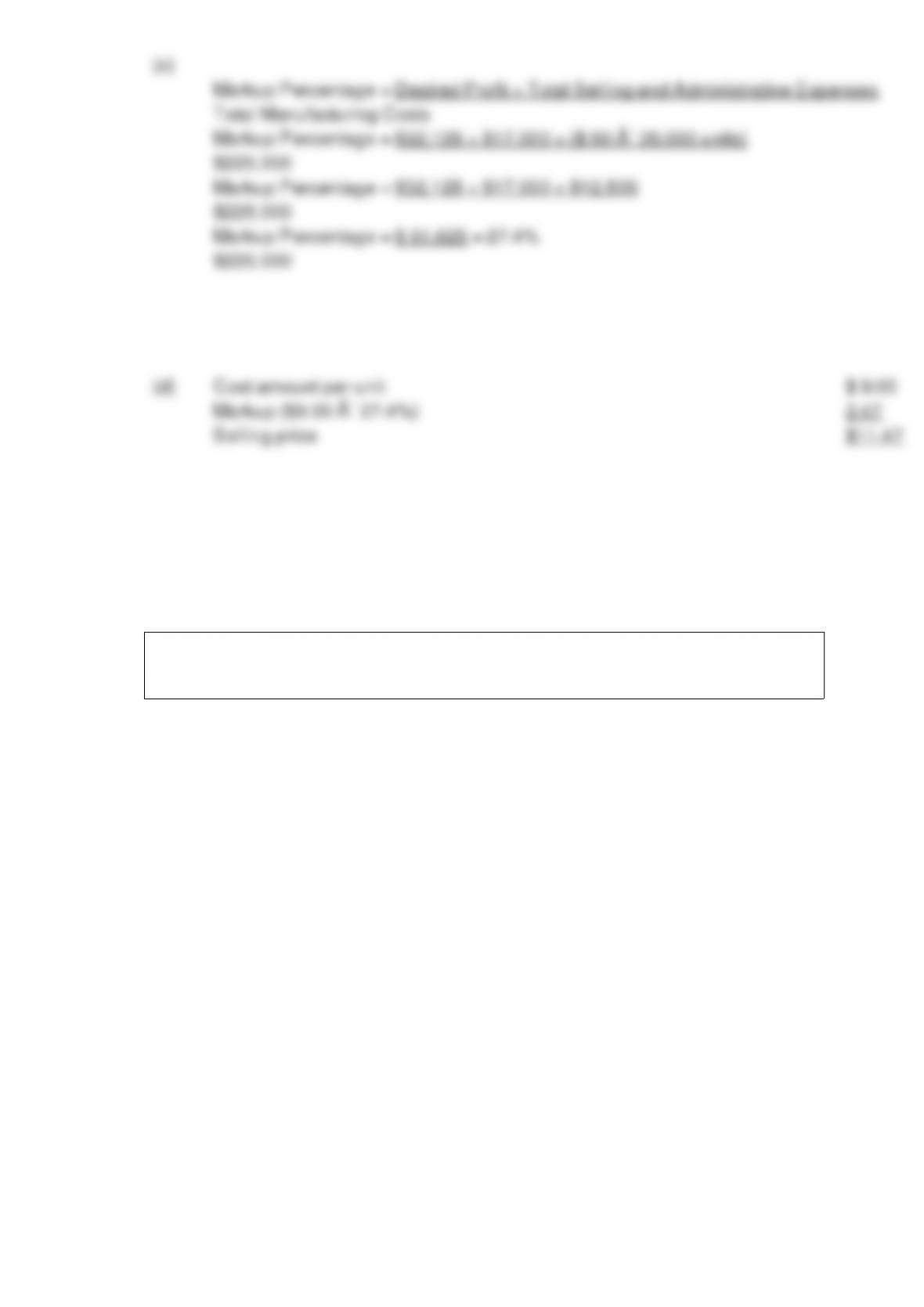
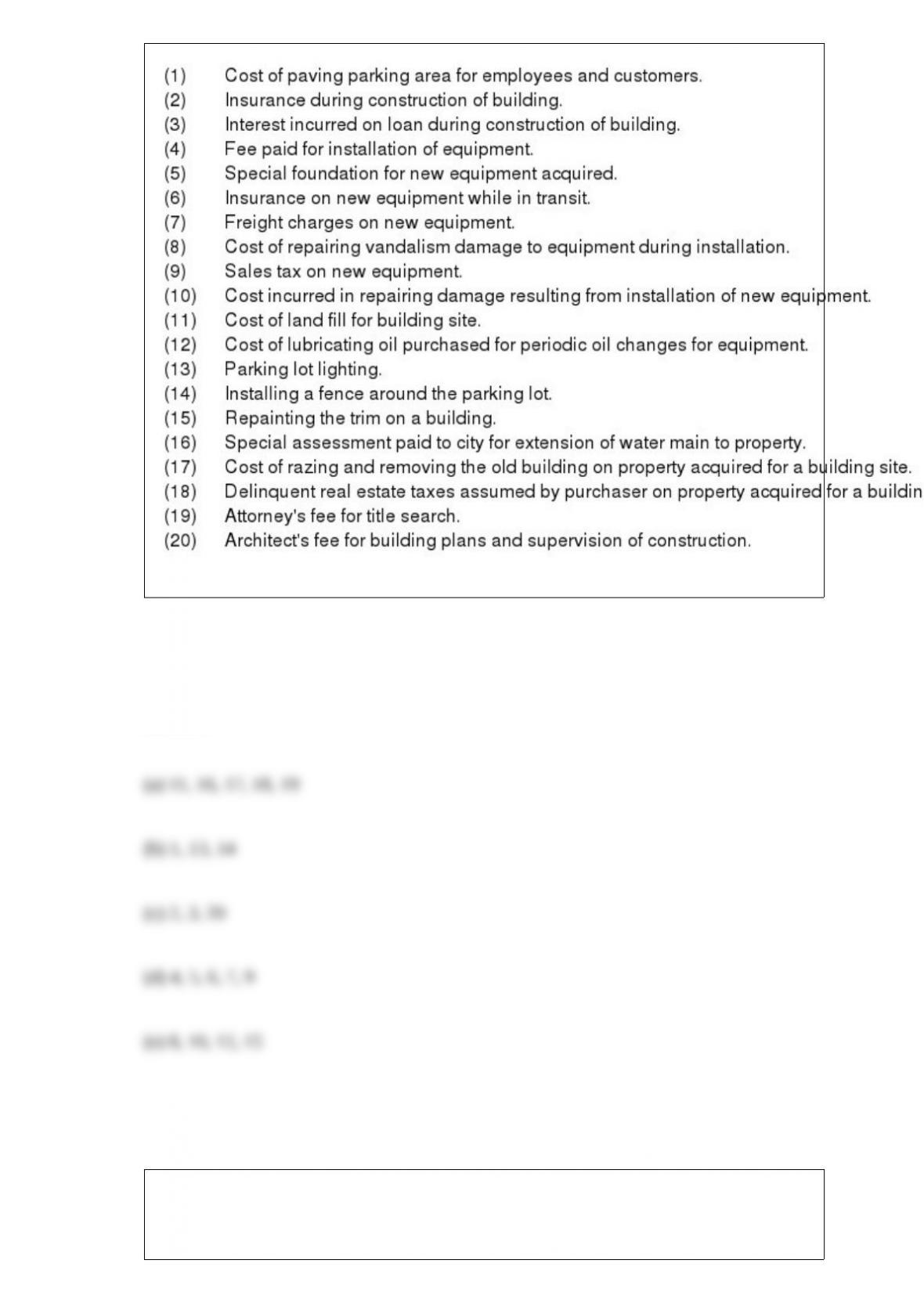
Identify each of the following expenditures as chargeable to (a) Land, (b) Land
Improvements, (c) Buildings, (d) Machinery and Equipment, or (e) other account.
Answer:
Answer:
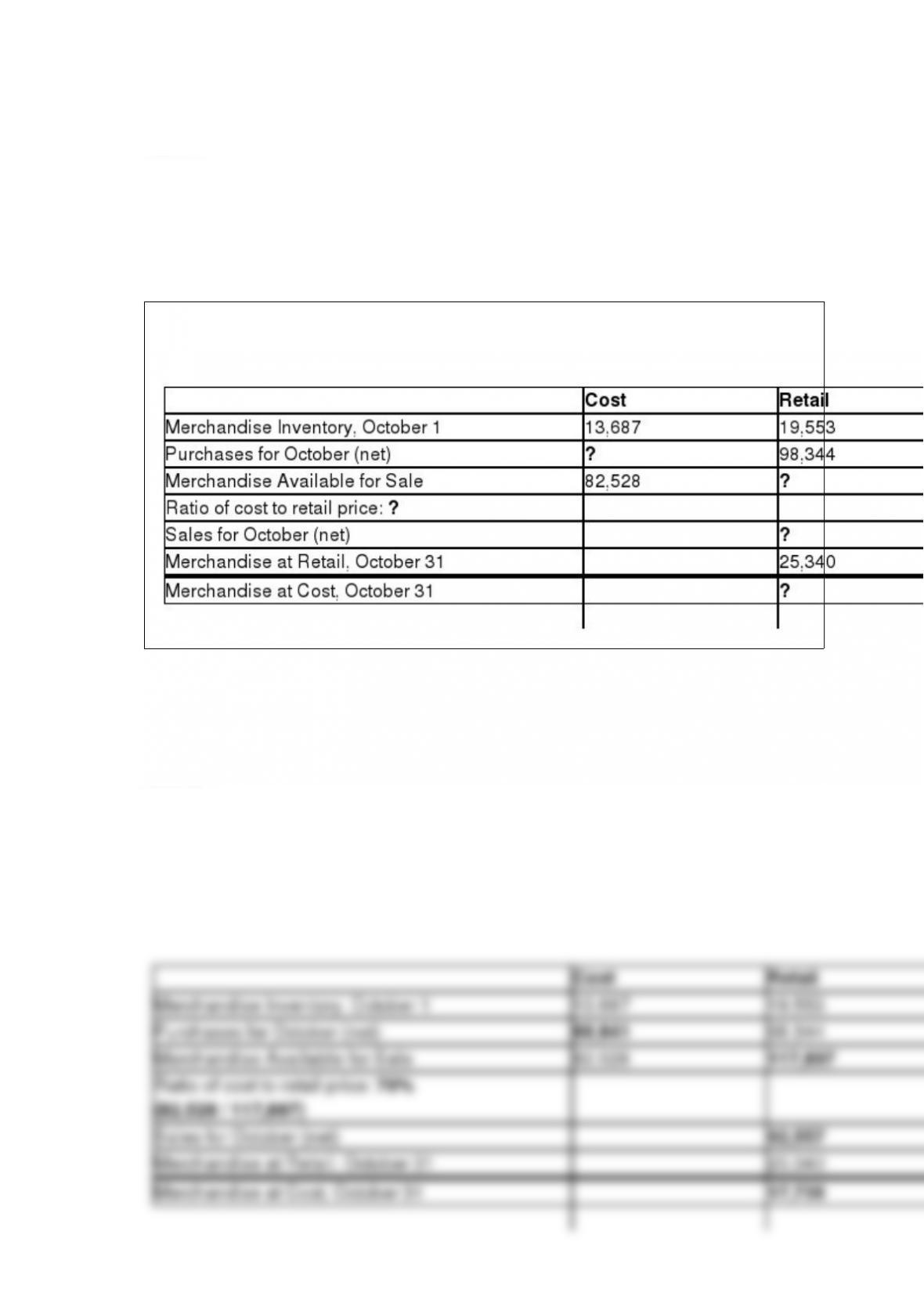
Fill in the missing amounts from the chart below regarding the calculation of Bean
Corporation’s estimated inventory using the retail method of estimation.
Answer:
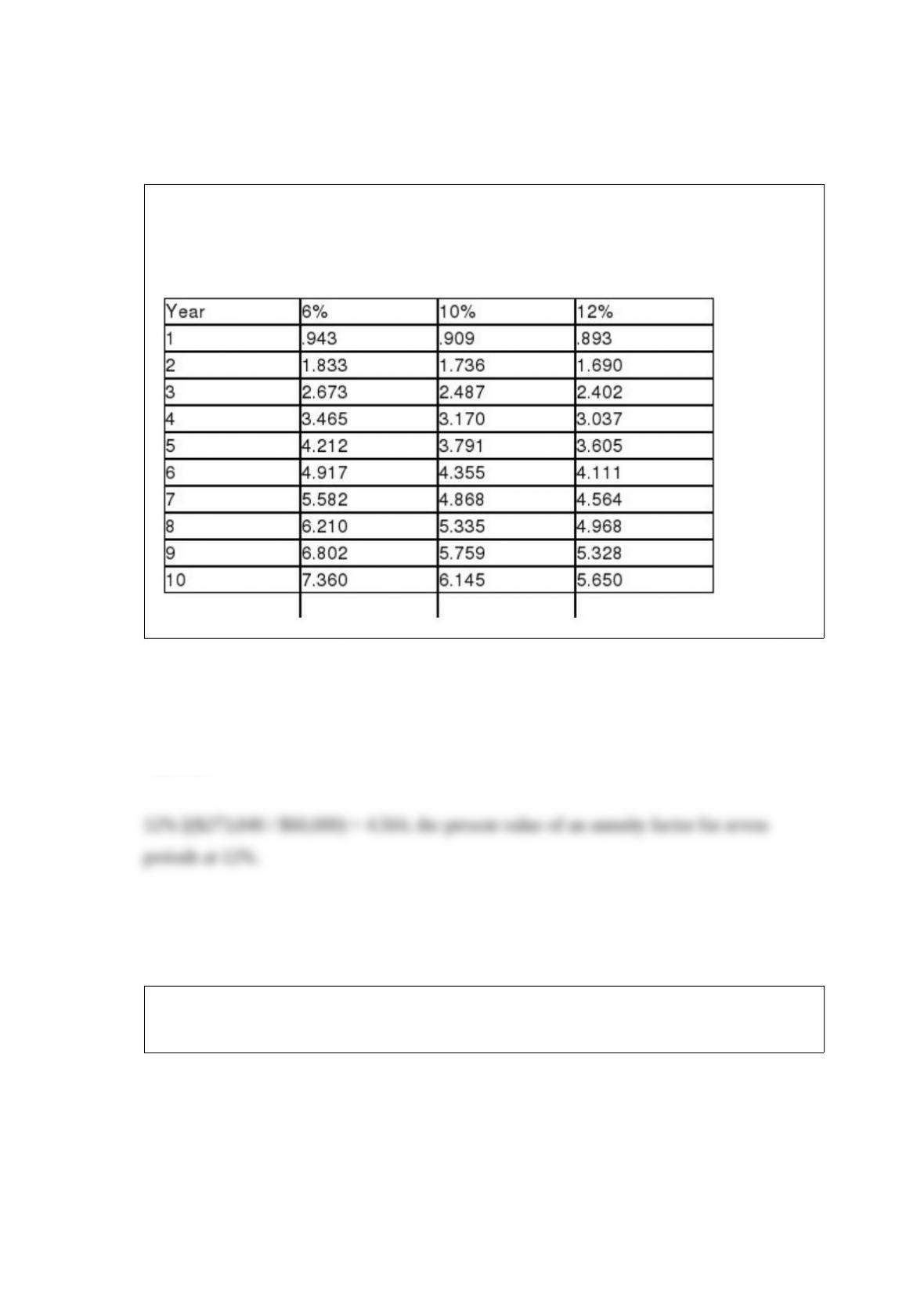
A project is estimated to cost $273,840 and provide annual cash flows of $60,000 for
seven years. Determine the internal rate of return for this project, using the following
table.
Answer:
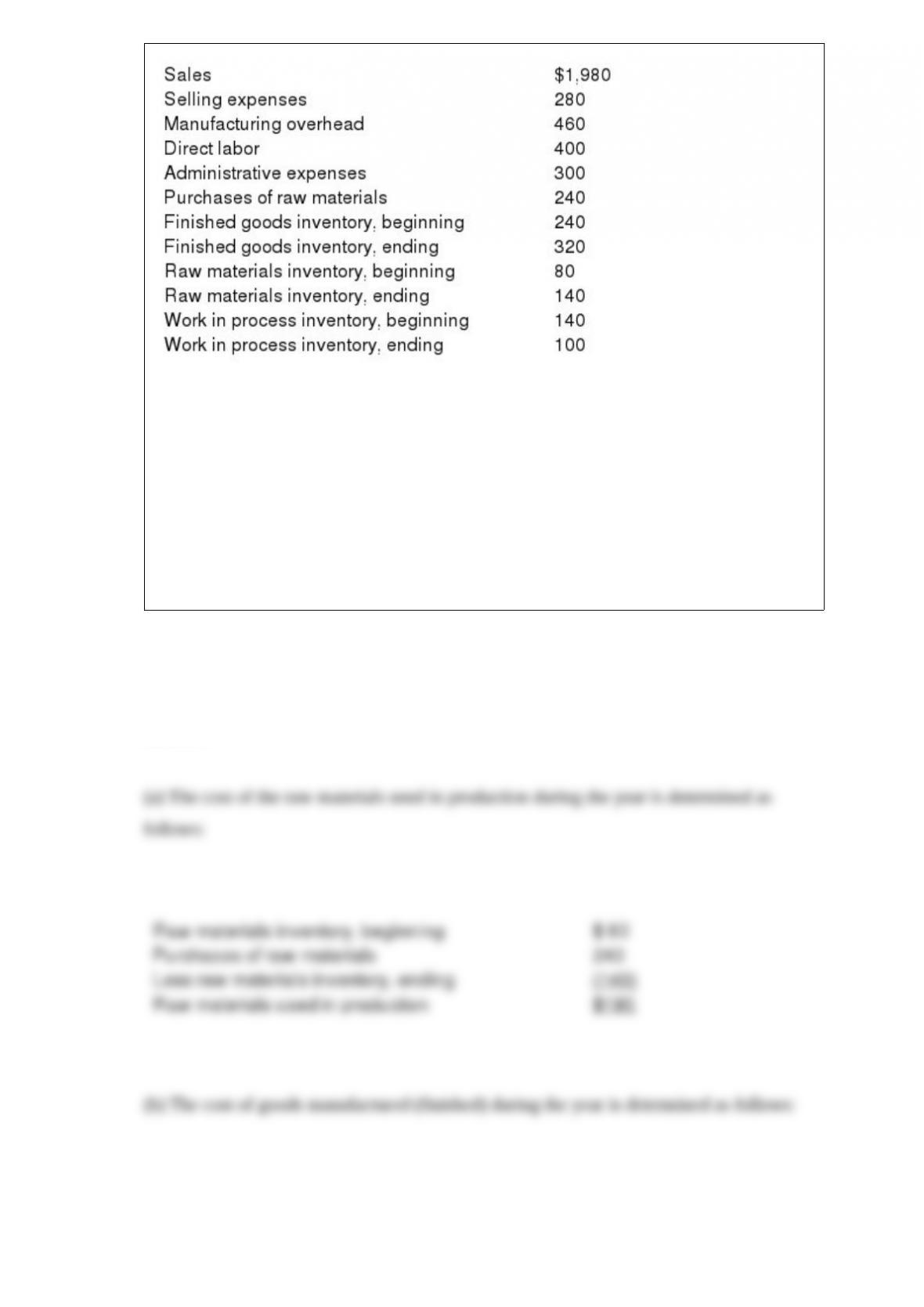
The following data (in thousands of dollars) have been taken from the accounting
records of Rayburn Corporation for the current year.
(Present all reports and calculations in thousands of dollars)
(a) What was the cost of the raw materials used in production during the year?
(b) What was the cost of goods manufactured (finished) for the year?
(c) What was the cost of goods sold for the year?
(d) What was the net income for the year?
Answer:
On April 1, 2015, ValueTime, Inc. had a market price per common share of $24. For the
previous year ValueTime paid a dividend of $1.50 per share. Compute the dividend
yield for ValueTime, Inc.
Answer:
Pepito Company purchased 40% of the outstanding stock of Reyes Company on
January 1, 2012. Reyes reported net income of $75,000 and declared dividends of
$15,000 during 2012. How much would Pepito adjust their investment in Reyes
Company under the equity method?
Answer:
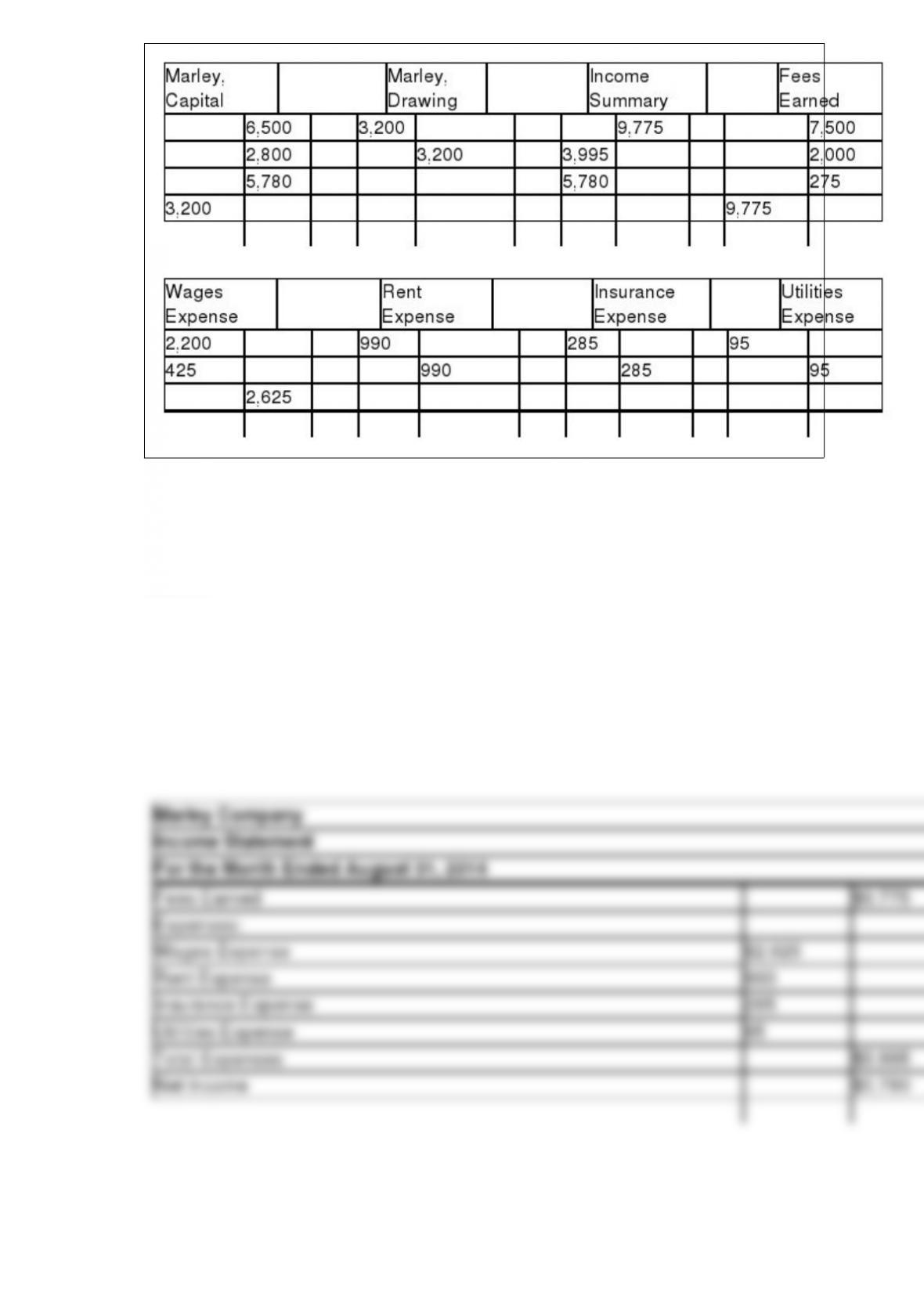
Prepare an income statement and a statement of owner’s equity, for the month ended
August 31, 2014, from the following T-Accounts of Marley Company.
Answer:
Flanders Industries collects 35% of its sales on account in the month of the sale and
65% in the month following the sale. If sales on account are budgeted to be $175,000
for May and $225,000 for June, what are the budgeted cash receipts from sales on
account for June?
Answer:
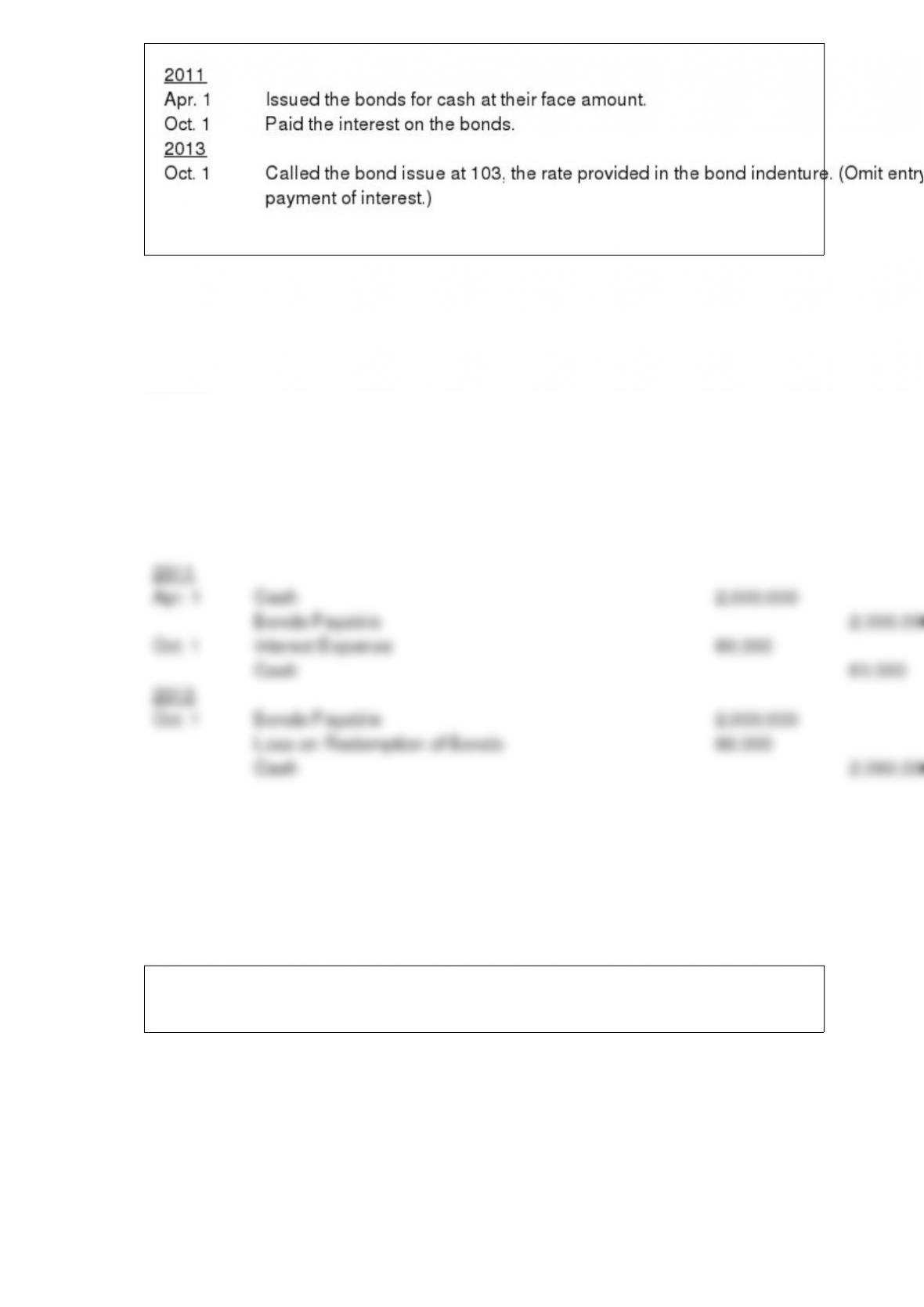
A company issued $2,000,000 of 30-year, 8% callable bonds on April 1, 2011, with
interest payable on April 1 and October 1. The fiscal year of the company is the
calendar year. Journalize the entries to record the following selected transactions:
Answer:
The following totals for the month of February were taken from the payroll register of
Arcon Company:
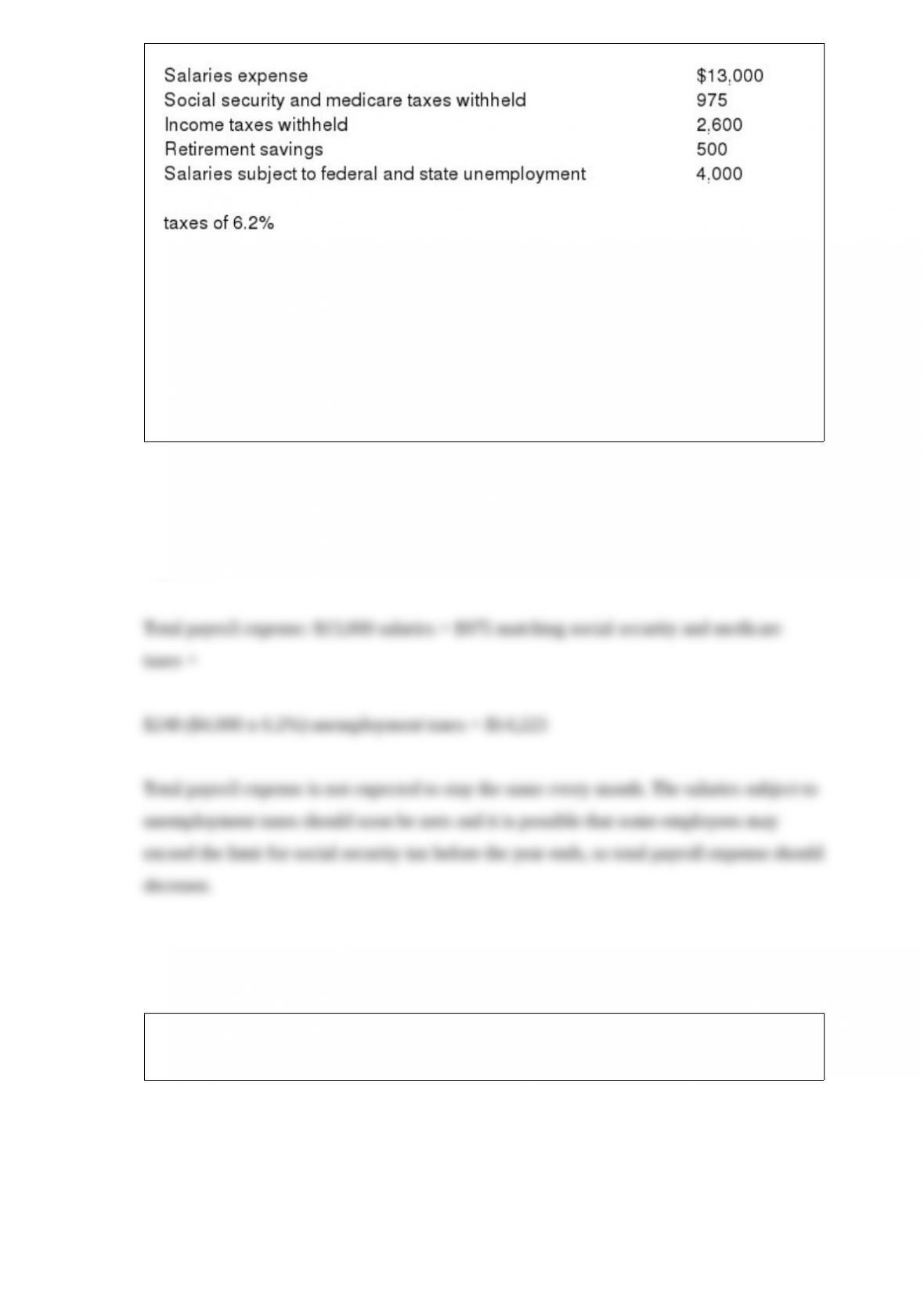
How much is the total payroll expense for Arcon Company for this payroll?
Assume that the monthly salaries expense remains the same for the entire year and no
employees are hired or fired during that time. Based on what you learned in Chapter 11
about payroll taxes, do you expect the total payroll expense to stay the same every
month? Explain.
Answer:
The following accounts were taken from the Adjusted Trial Balance columns of the
work sheet for April 30, 2010 for Finnegan Co.:
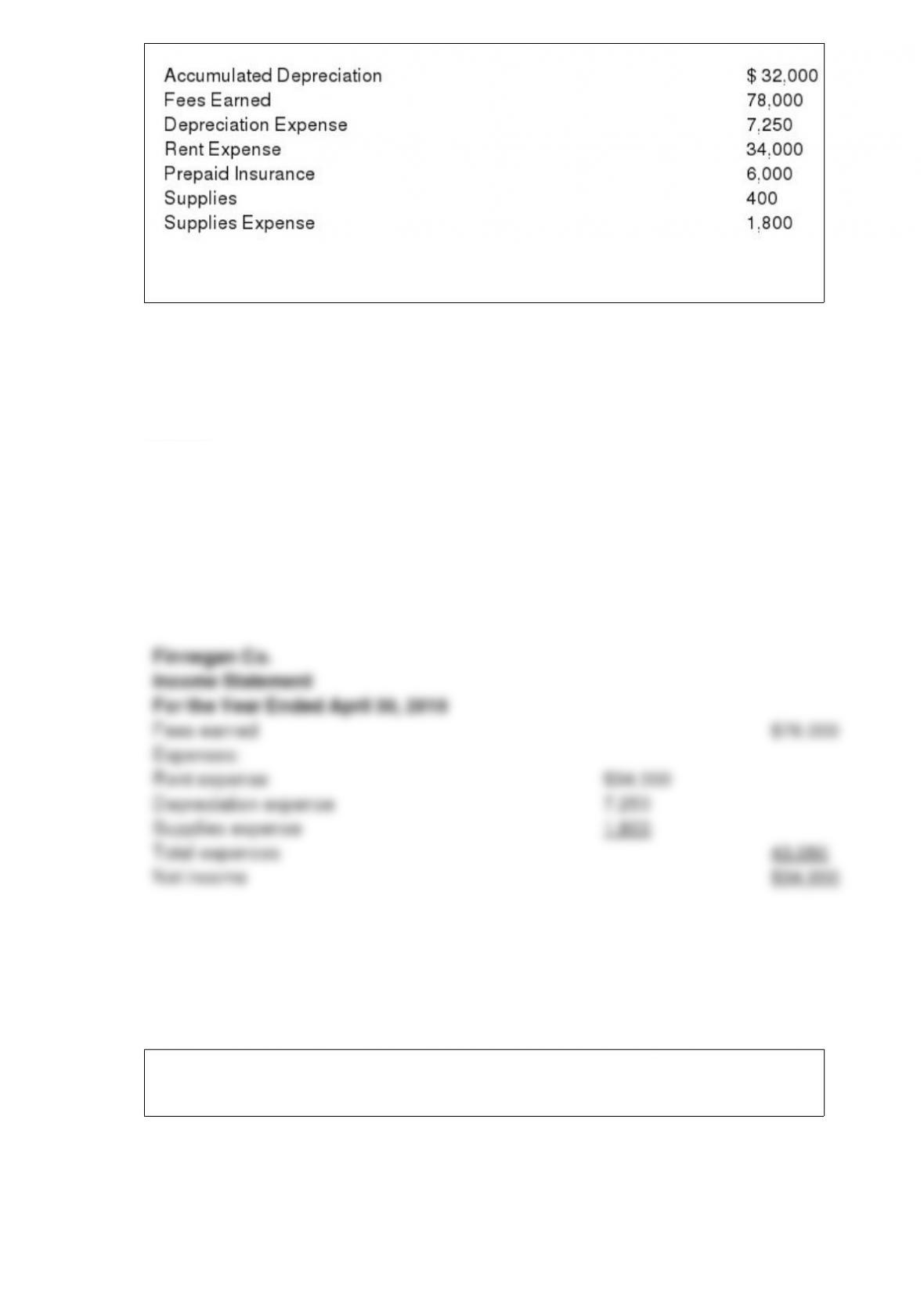
Prepare an income statement.
Answer:
The Dean Company has sales of $500,000, and the break-even point in sales dollars of
$300,000. Determine the company’s margin of safety percentage.
Answer:
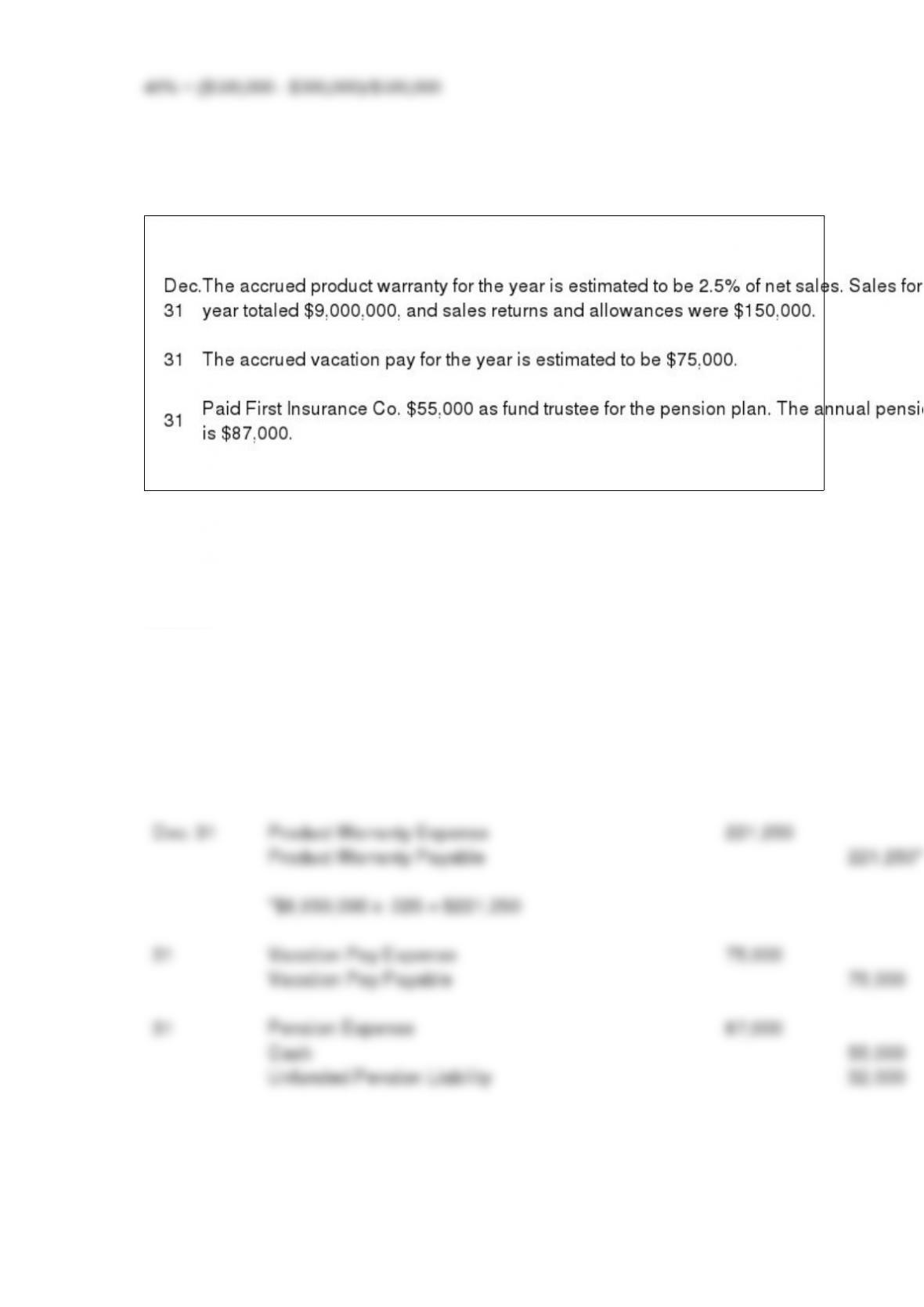
Journalize the following transactions for Riley Corporation:
Answer:
List five internal controls that relate directly to payroll.
Answer:
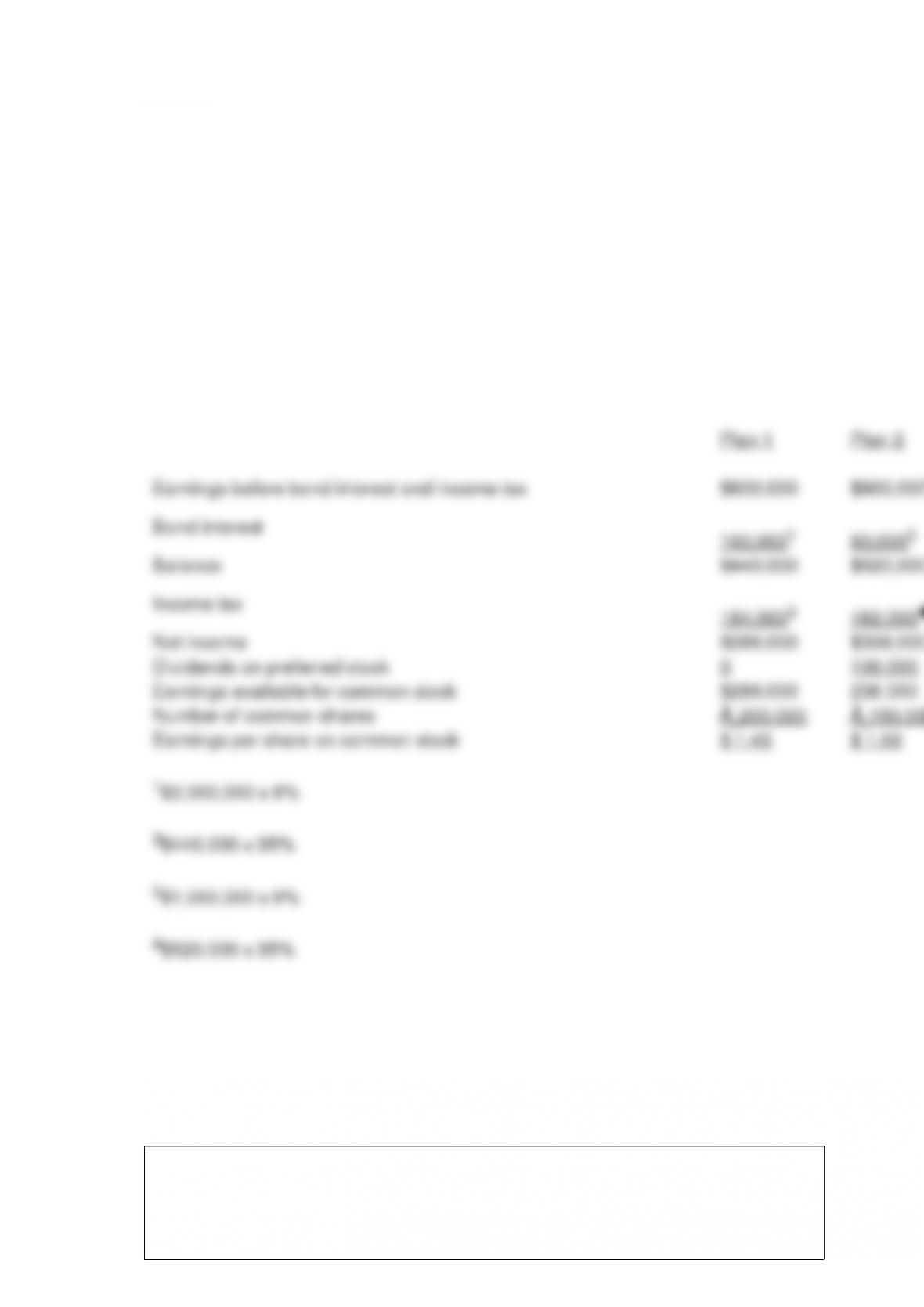
Ulmer Company is considering the following alternative financing plans:
Income tax is estimated at 35% of income. Dividends of $1 per share were declared and
paid on the preferred stock.Determine the earnings per share of common stock,
assuming income before bond interest and income tax is $600,000.
Answer:
On November 30th, Damien Lawson is informed by his accountant that $550 of a
transaction recording the purchase of office supplies was really office equipment. He
has been asked to correct this journal entry. Write the journal entry to correct this
situation.
Answer:
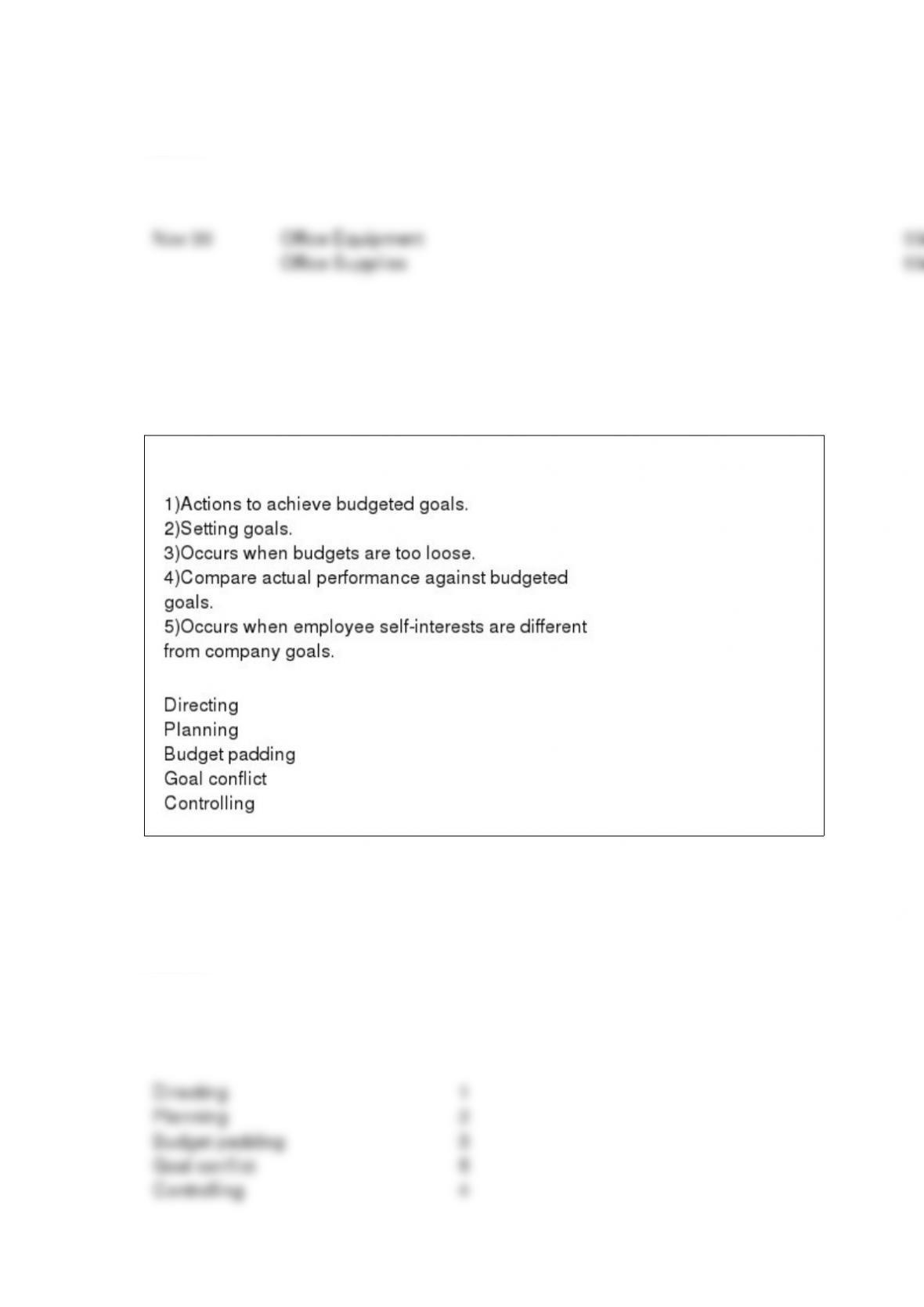
Match the following terms with the best definition given.
Answer:
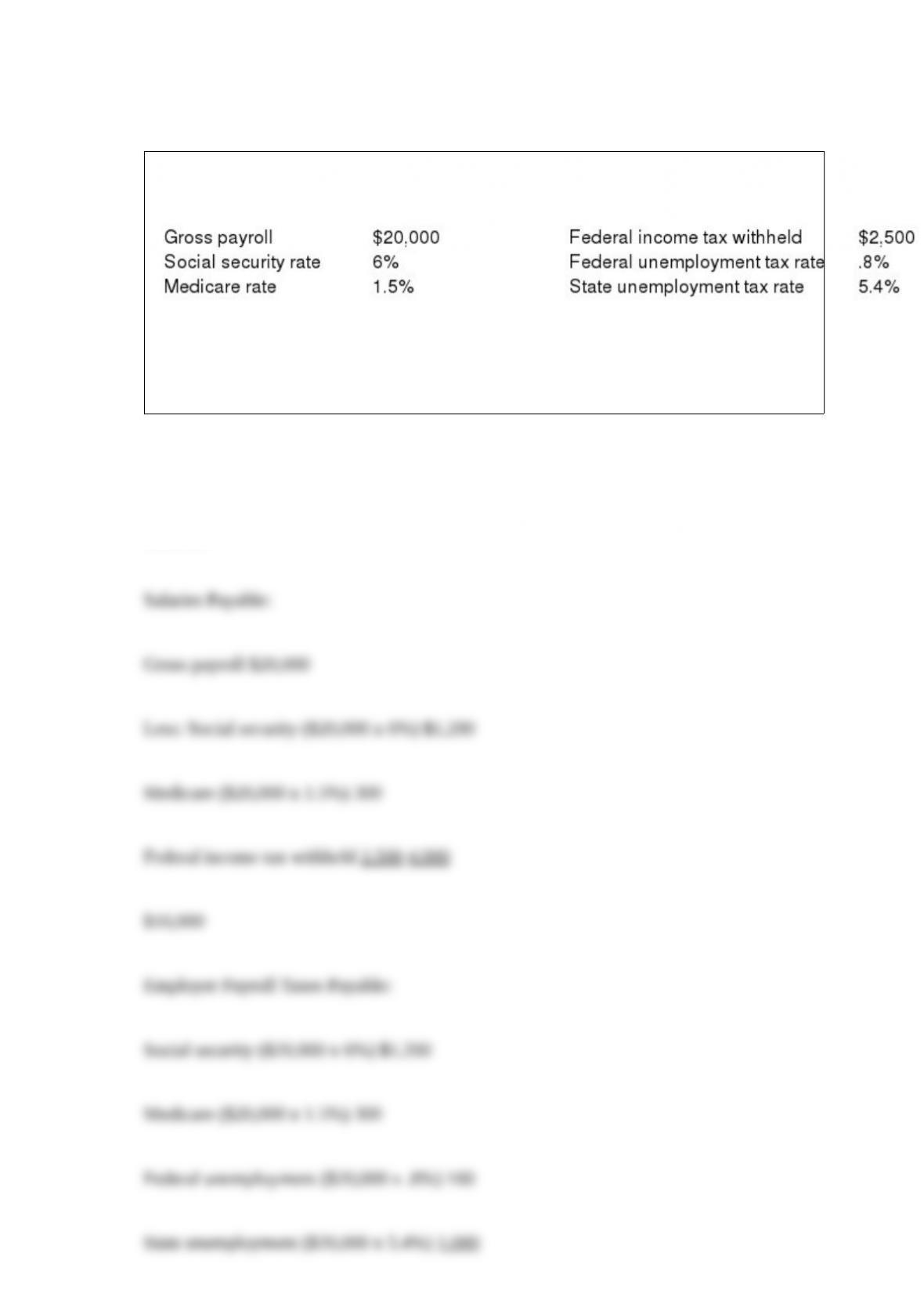
Darius Company has the following information for the pay period of January 15 – 31,
20xx.
Assuming no employees are subject to ceilings for their earnings, calculate Salaries
Payable and Employer Payroll Taxes Payable.
Answer:

The following information relates to manufacturing overhead for the Chapman
Company:
Standards:
Total fixed factory overhead – $450,000
Estimated production – 25,000 units (100% of capacity)
Overhead rates are based on machine hours.
Standard hours allowed per unit produced – 2
Fixed overhead rate – $9.00 per machine hour
Variable overhead rate – $3.50 per hour
Actual:
Fixed factory overhead – $450,000
Production – 24,000 units
Variable overhead – $170,000
(a) Compute the volume variance.
(b) Compute the controllable variance.
(c) Compute the total factory overhead cost variance.
Answer:
The following data is given for the Taylor Company:
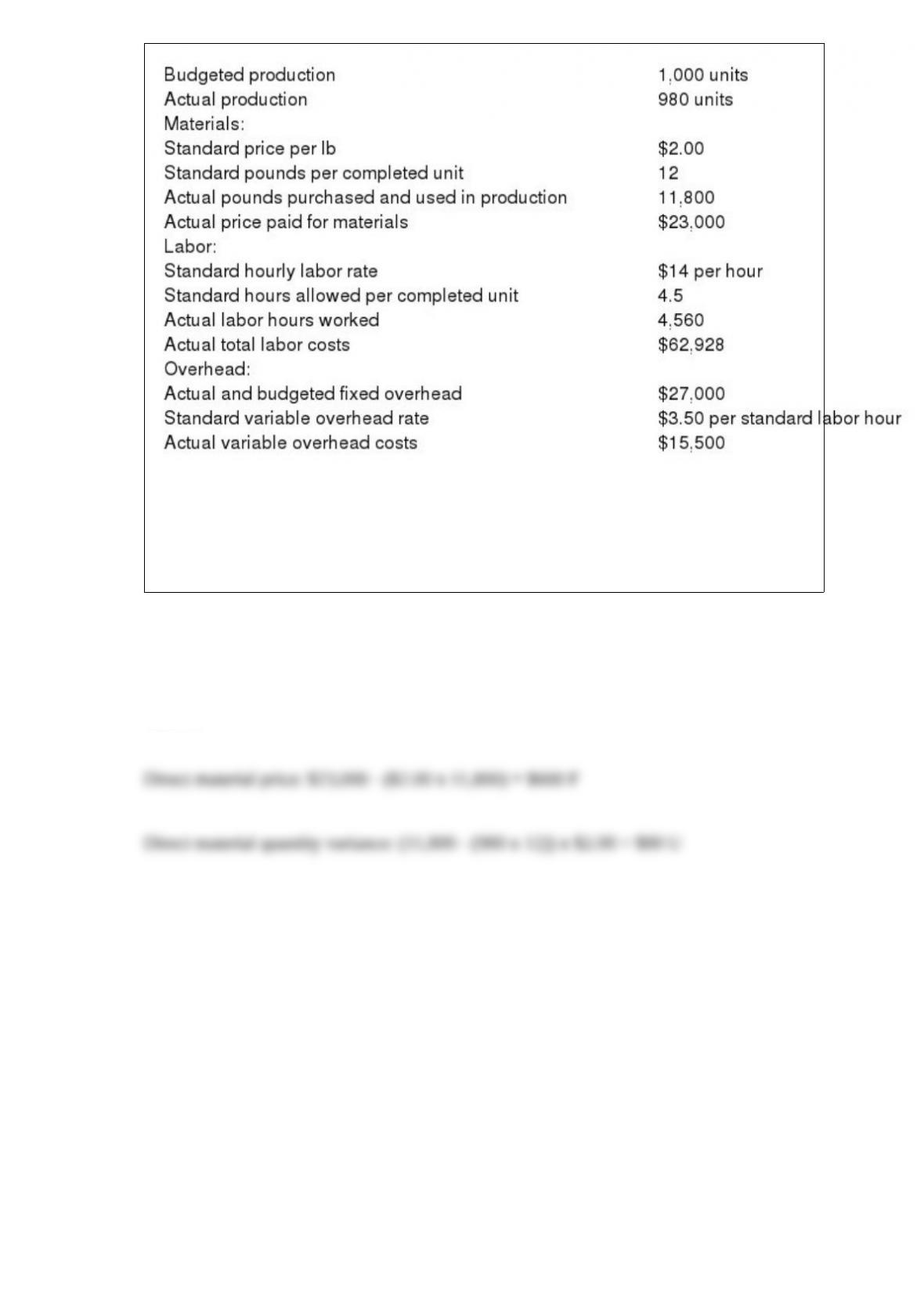
Overhead is applied on standard labor hours.
Compute the direct material price and quantity variances for Taylor Company.
Answer: