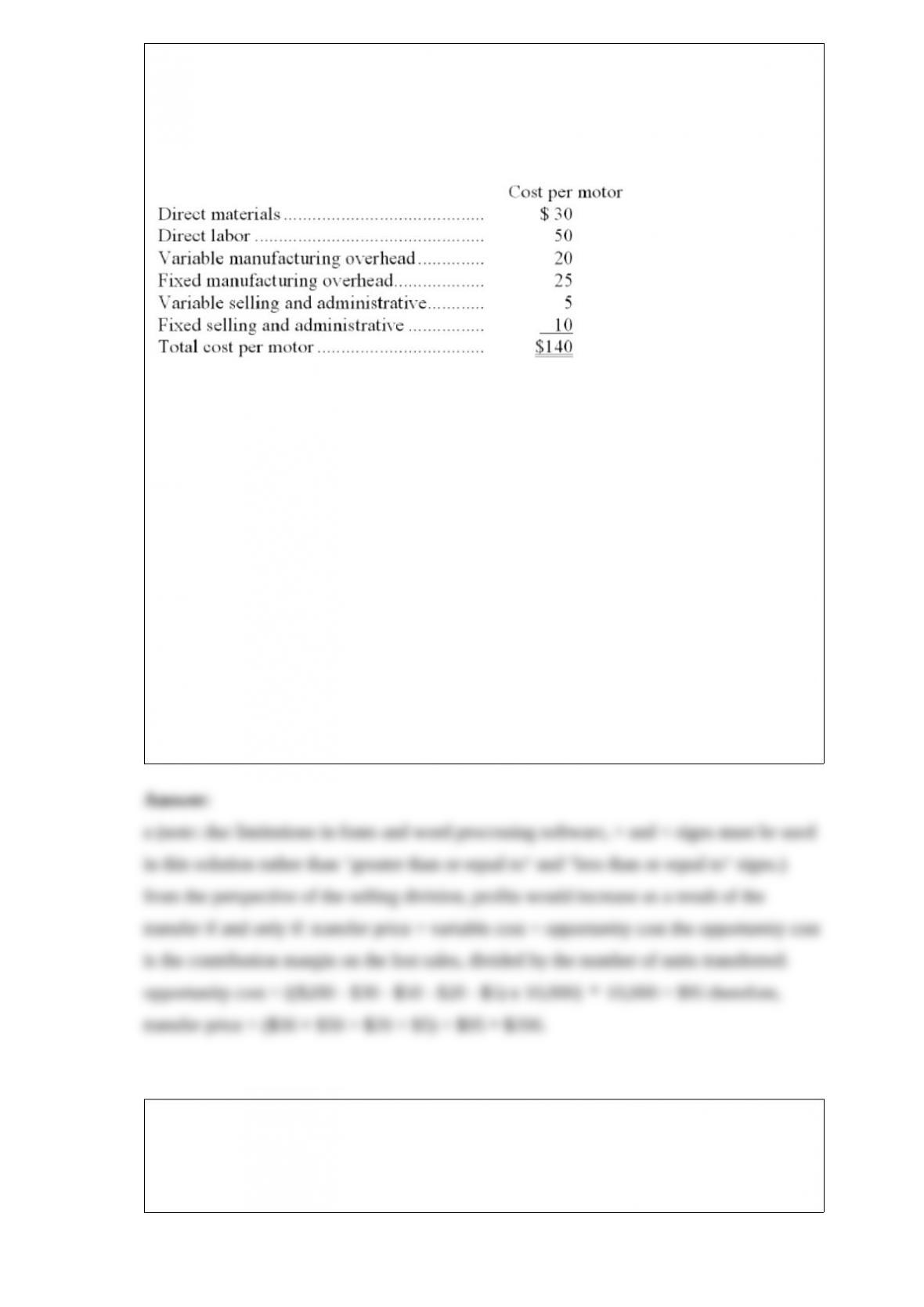
1) the commando motorcycle company has decided to become decentralized and split
its operations into two divisions, motor and assembly. both divisions will be treated as
investment centers. the motor division is currently operating at its capacity of 30,000
motors per year. motor’s costs at this level of production are as follows:
motor sells 10,000 of its motors to a snowmobile manufacturer and transfers the
remaining 20,000 motors to the assembly division. the two divisions are currently in a
debate over an appropriate transfer price to charge for the 20,000 motors. motor
currently charges the snowmobile manufacturer $200 per motor. the final selling price
of the motorcycles that commando produces is $7,200 per cycle. this selling price will
not change regardless of the transfer price charged between the two divisions. motor has
no market for the 20,000 motors if they are not transferred to assembly. variable selling
and administrative costs are incurred on both internal and external sales.
assume that the assembly division wants to also purchase the additional 10,000 motors
that the motor division currently sells to the snowmobile manufacturer. according to the
formula in the text, what is the lowest acceptable transfer price for these additional
motors from the viewpoint of the selling division?
a.$200 per motor
b.$105 per motor
c.$125 per motor
d.$140 per motor
2) innes company recently changed the selling price of one of its products. data
concerning sales for comparable periods before and after the price change are presented
below.
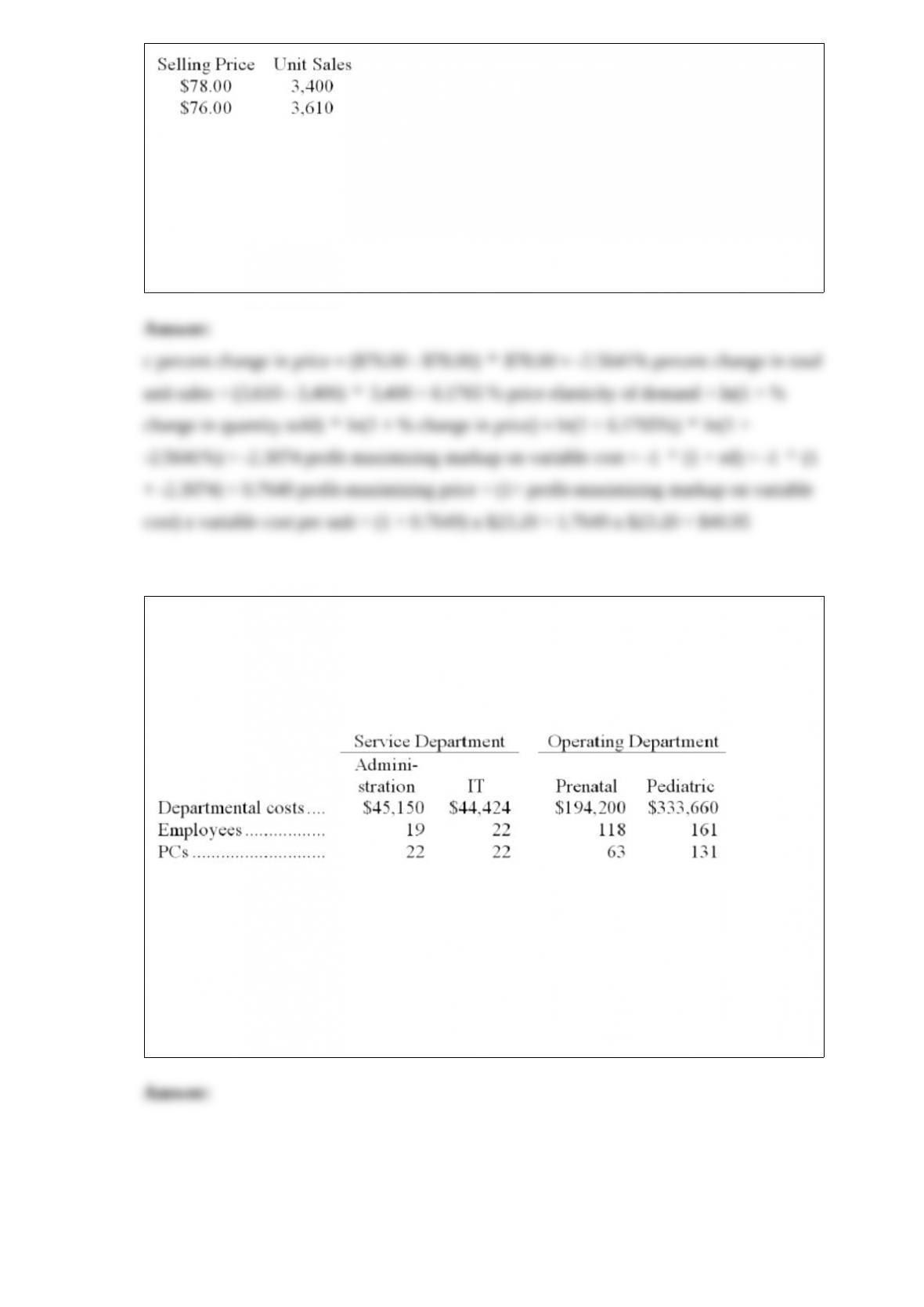
the product’s variable cost is $23.20 per unit.
according to the formula in the text, the product’s profit-maximizing price is closest to:
a.$44.10
b.$25.23
c.$40.95
d.$44.71
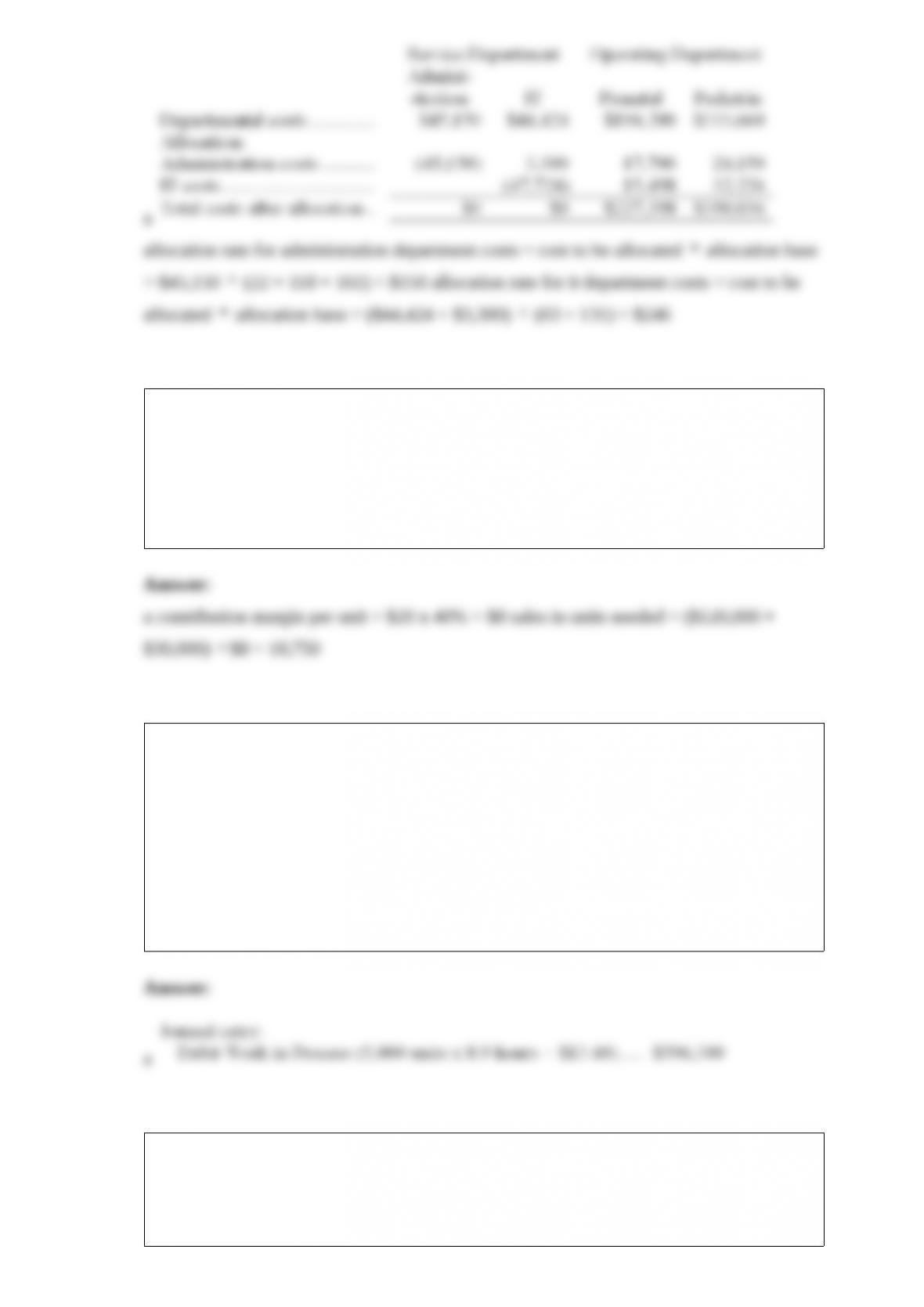
3) wiedenheft children’s clinic allocates service department costs to operating
departments using the step-down method. the clinic has two service departments,
administration and information technology (it), and two operating departments, prenatal
and pediatric. data concerning those departments follow:
administration costs are allocated first on the basis of employees and it costs are
allocated second on the basis of pcs. the total pediatric department cost after allocations
is closest to:
a.$390,036
b.$380,828
c.$389,712
d.$365,886
4) a product sells for $20 per unit, and has a contribution margin ratio of 40%. fixed
expenses are $120,000. how many units must be sold to yield a profit of $30,000?
a.18,750
b.20,000
c.25,000
d.12,500
5) kirsch corporation’s standard wage rate is $13.40 per direct labor-hour (dlh) and
according to the standards, each unit of output requires 8.9 dlhs. in may, 5,000 units
were produced, the actual wage rate was $12.80 per dlh, and the actual hours were
41,790 dlhs. in the journal entry to record the incurrence of direct labor costs in may,
the work in process entry would consist of a:
a.debit of $596,300
b.debit of $534,912
c.credit of $534,912
d.credit of $596,300
6) the standard hours allowed to make one unit of finished product are:
a.1.0
b.1.2
c.1.5
d.2.0
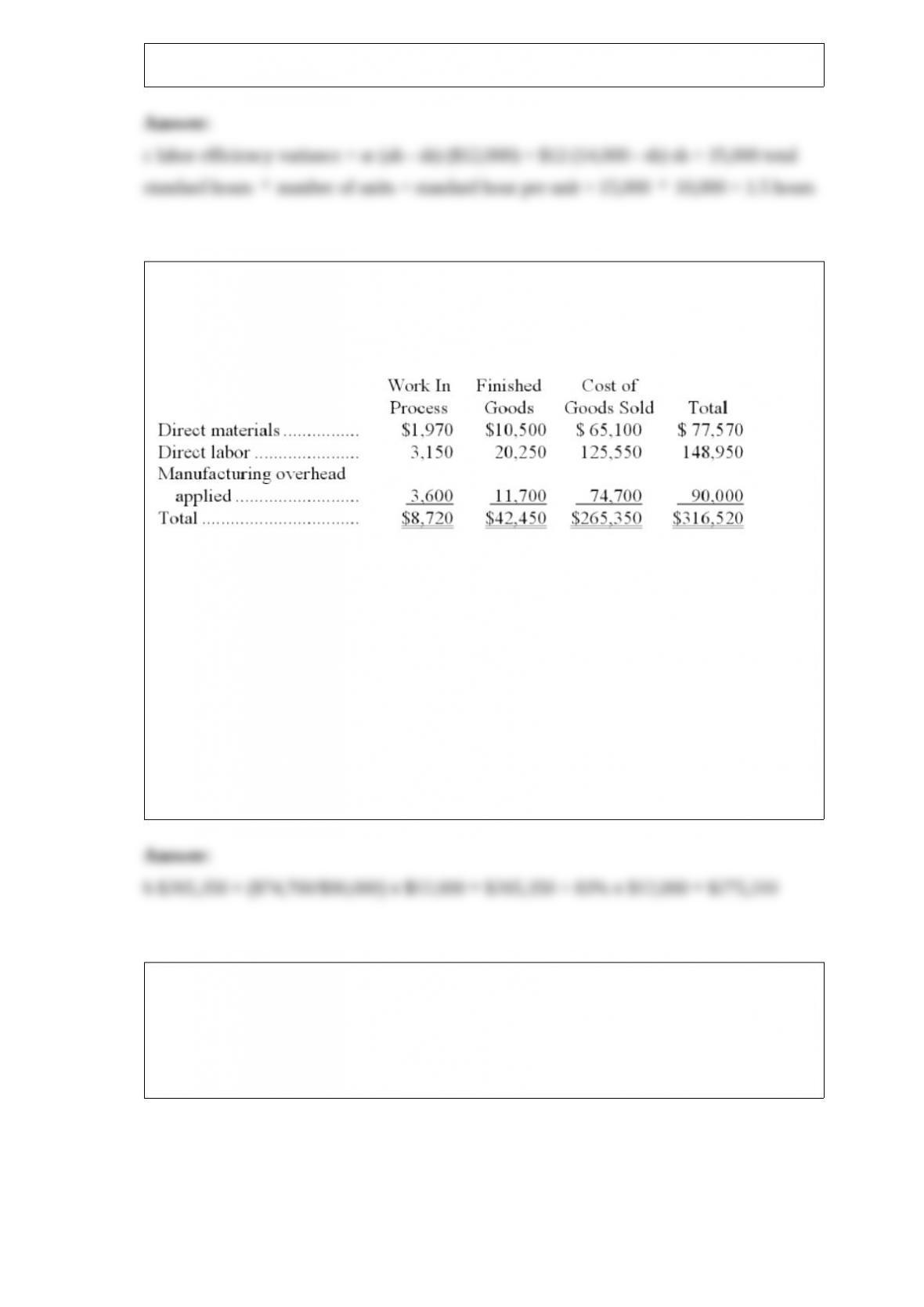
7) mcgarey inc. has provided the following data for the month of november. there were
no beginning inventories; consequently, the direct materials, direct labor, and
manufacturing overhead applied listed below are all for the current month.
manufacturing overhead for the month was underapplied by $12,000.
the company allocates any underapplied or overapplied overhead among work in
process, finished goods, and cost of goods sold at the end of the month on the basis of
the overhead applied during the month in those accounts.
the cost of goods sold for november after allocation of any underapplied or overapplied
overhead for the month is closest to:
a.$253,350
b.$275,310
c.$255,390
d.$277,350
8) mah clinic uses client-visits as its measure of activity. during april, the clinic
budgeted for 3,800 client-visits, but its actual level of activity was 3,750 client-visits.
the clinic has provided the following data concerning the formulas to be used in its
budgeting:
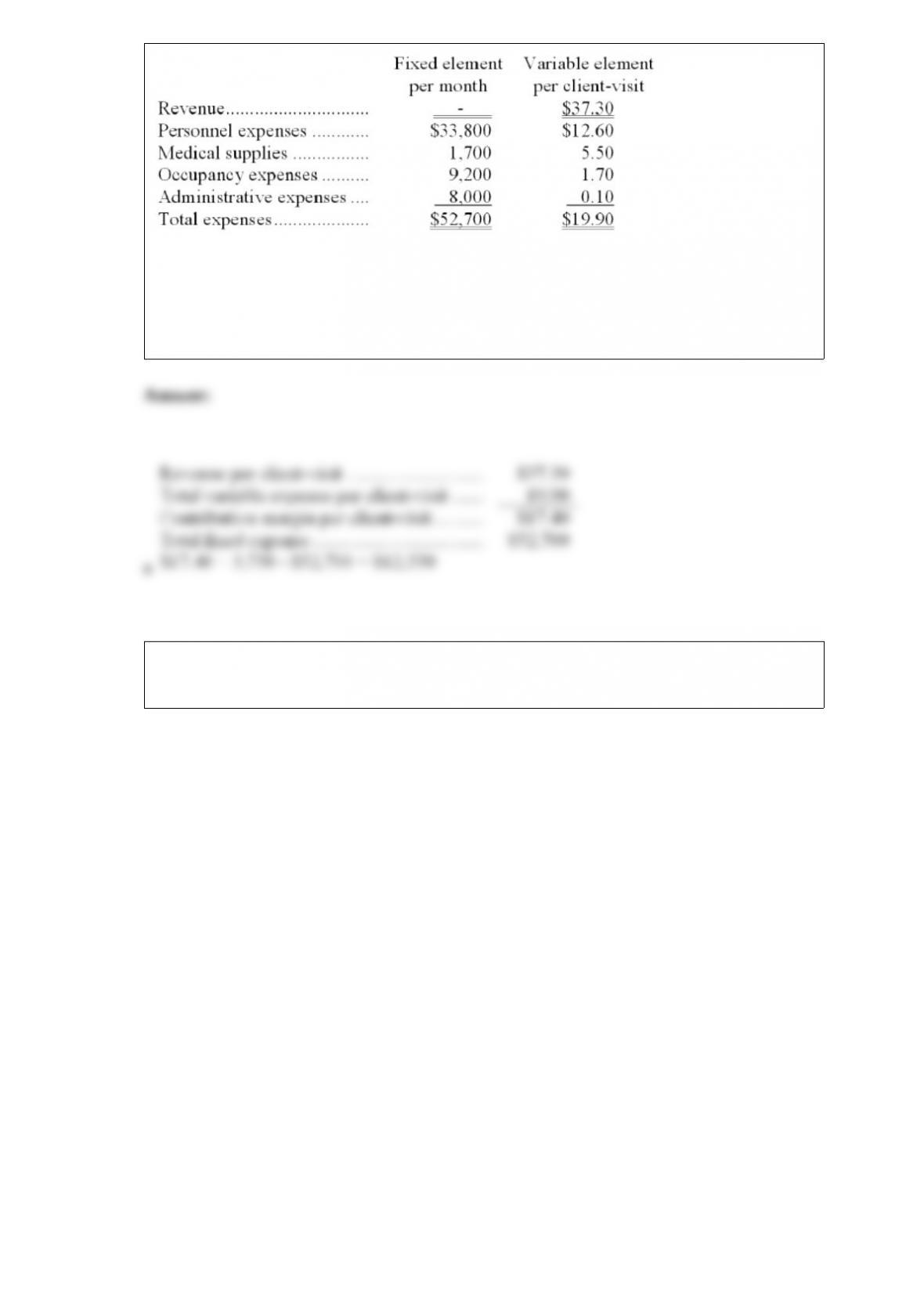
the net operating income in the flexible budget for april would be closest to:
a.$12,550
b.$14,987
c.$13,420
d.$14,595
9) the most recent comparative balance sheet of benefield corporation appears below:
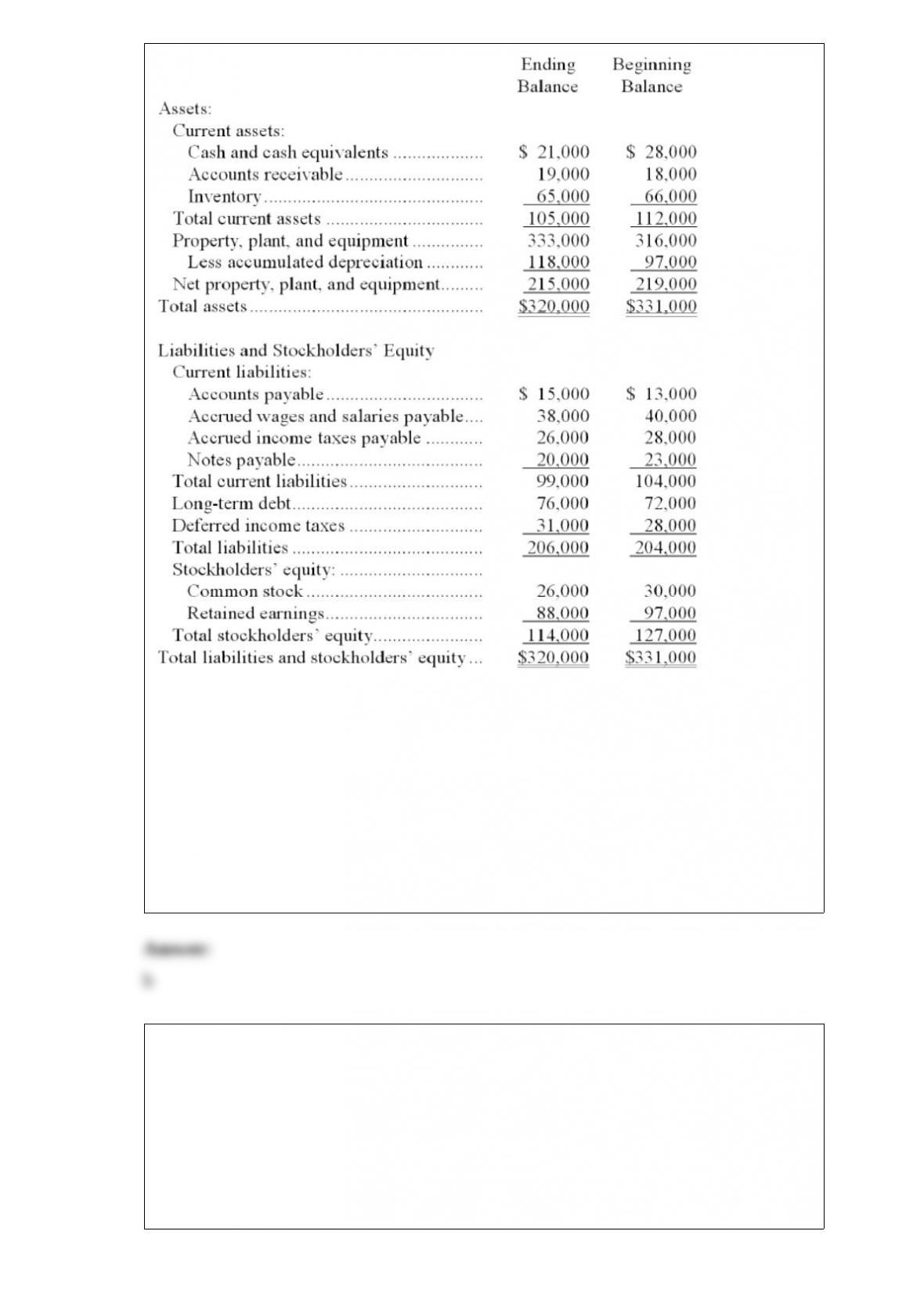
which of the following classifications of changes in balance sheet accounts as sources
and uses is correct?
a.the change in property, plant, and equipment is a source; the change in long-term debt
is a use
b.the change in property, plant, and equipment is a use; the change in long-term debt is
a source
c.the change in property, plant, and equipment is a source; the change in long-term debt
is a source
d.the change in property, plant, and equipment is a use; the change in long-term debt is
a use
10) (ignore income taxes in this problem.) valdivieso roofing is considering the
purchase of a crane that would cost $137,885, would have a useful life of 9 years, and
would have no salvage value. the use of the crane would result in labor savings of
$23,000 per year. the internal rate of return on the investment in the crane is closest to:
a.6%
b.8%
c.11%
d.9%
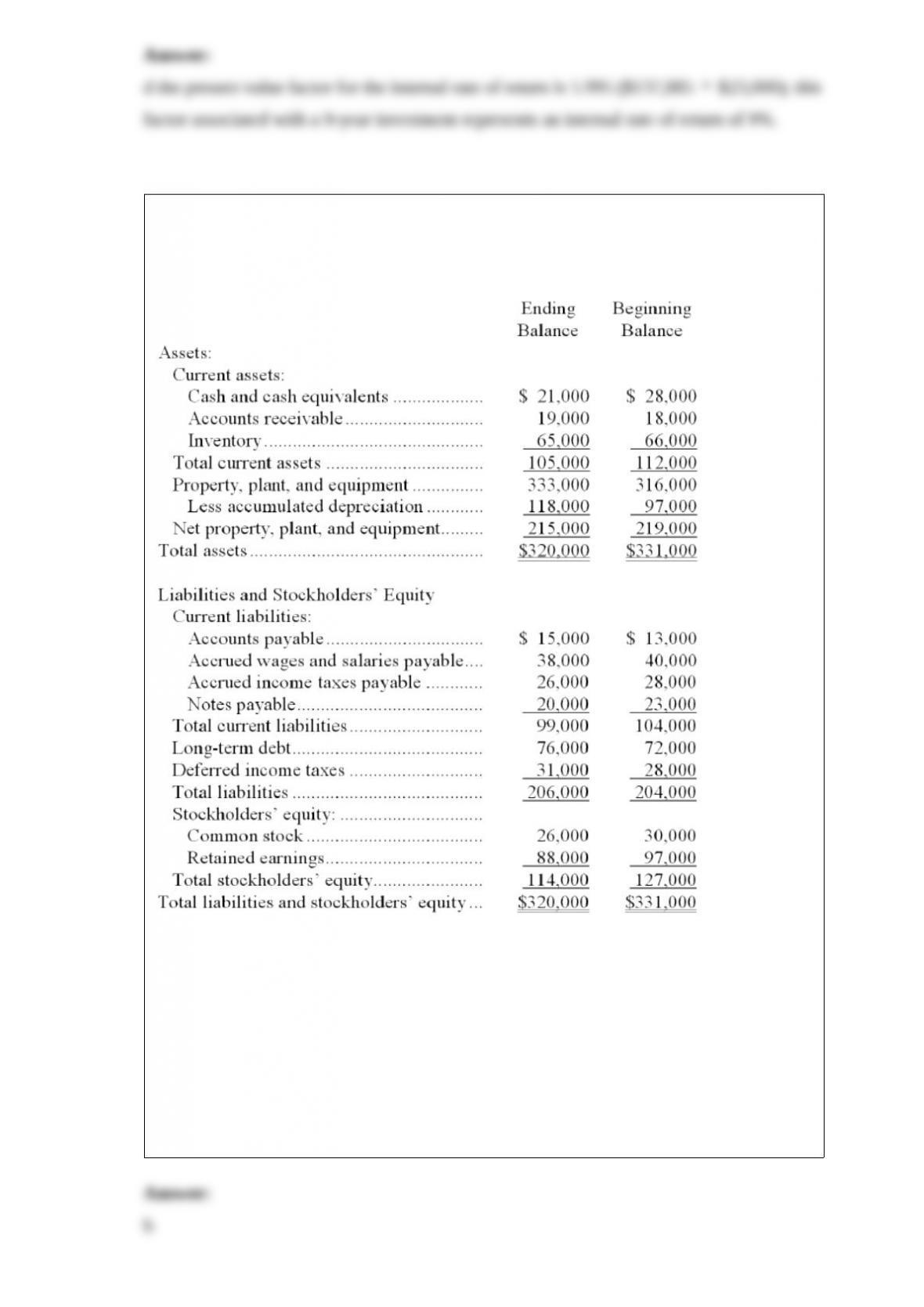
11) the most recent comparative balance sheet of benefield corporation appears below:
which of the following classifications of changes in balance sheet accounts as sources
and uses is correct?
a.the change in accounts payable is a use; the change in accrued wages and salaries
payable is a source
b.the change in accounts payable is a source; the change in accrued wages and salaries
payable is a use
c.the change in accounts payable is a source; the change in accrued wages and salaries
payable is a source
d.the change in accounts payable is a use; the change in accrued wages and salaries
payable is a use
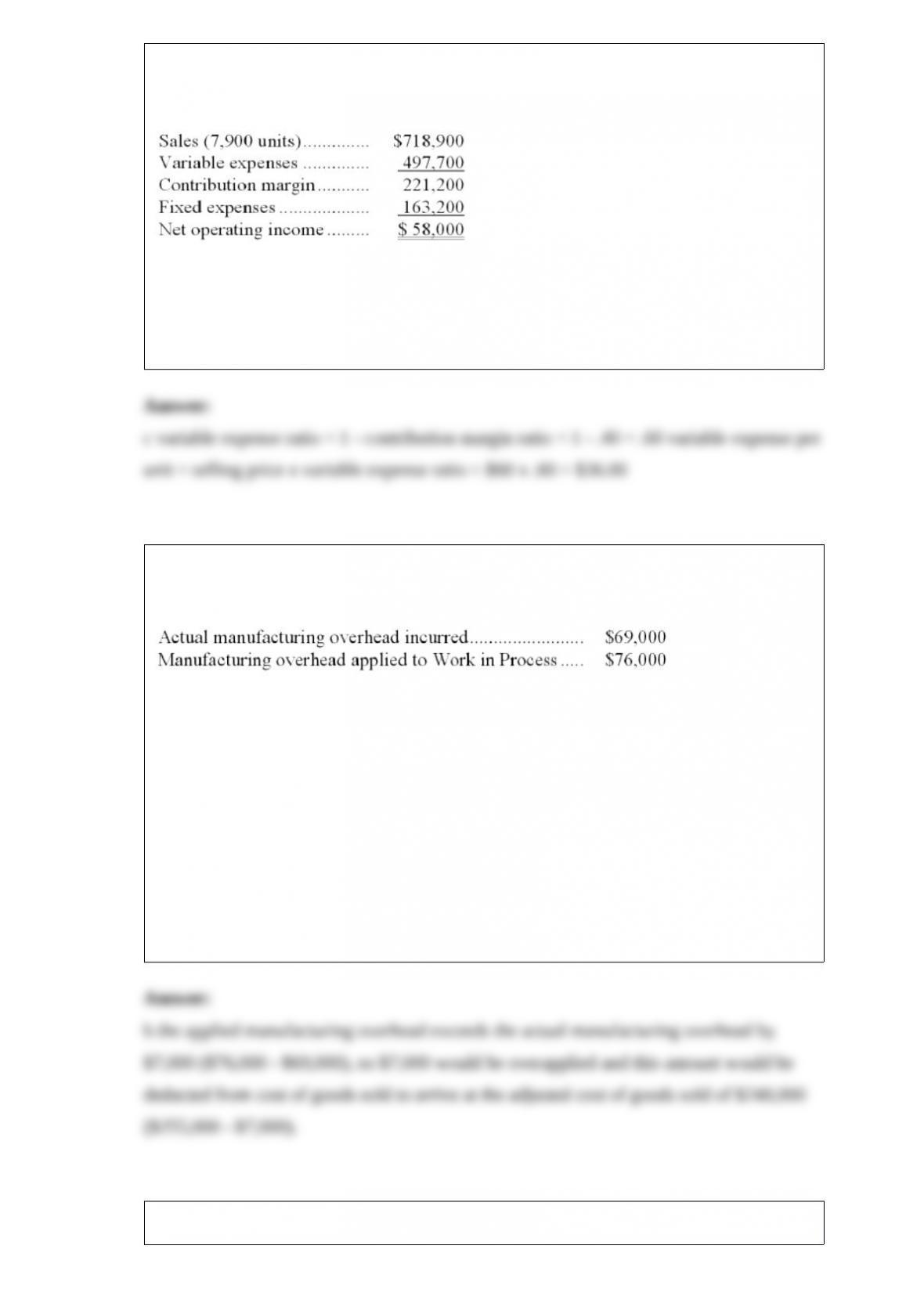
12) erdmann corporation has provided its contribution format income statement for july.
the company produces and sells a single product.
the variable expense per unit is:
a.$31.20
b.$24.00
c.$36.00
d.$28.80
13) molano corporation has provided the following data concerning manufacturing
overhead for june:
the company’s cost of goods sold was $255,000 prior to closing out its manufacturing
overhead account. the company closes out its manufacturing overhead account to cost
of goods sold. which of the following statements is true?
a.manufacturing overhead was underapplied by $7,000; cost of goods sold after closing
out the manufacturing overhead account is $248,000
b.manufacturing overhead was overapplied by $7,000; cost of goods sold after closing
out the manufacturing overhead account is $248,000
c.manufacturing overhead was underapplied by $7,000; cost of goods sold after closing
out the manufacturing overhead account is $262,000
d.manufacturing overhead was overapplied by $7,000; cost of goods sold after closing
out the manufacturing overhead account is $262,000
14) deavila inc. produces and sells two products. data concerning those products for the
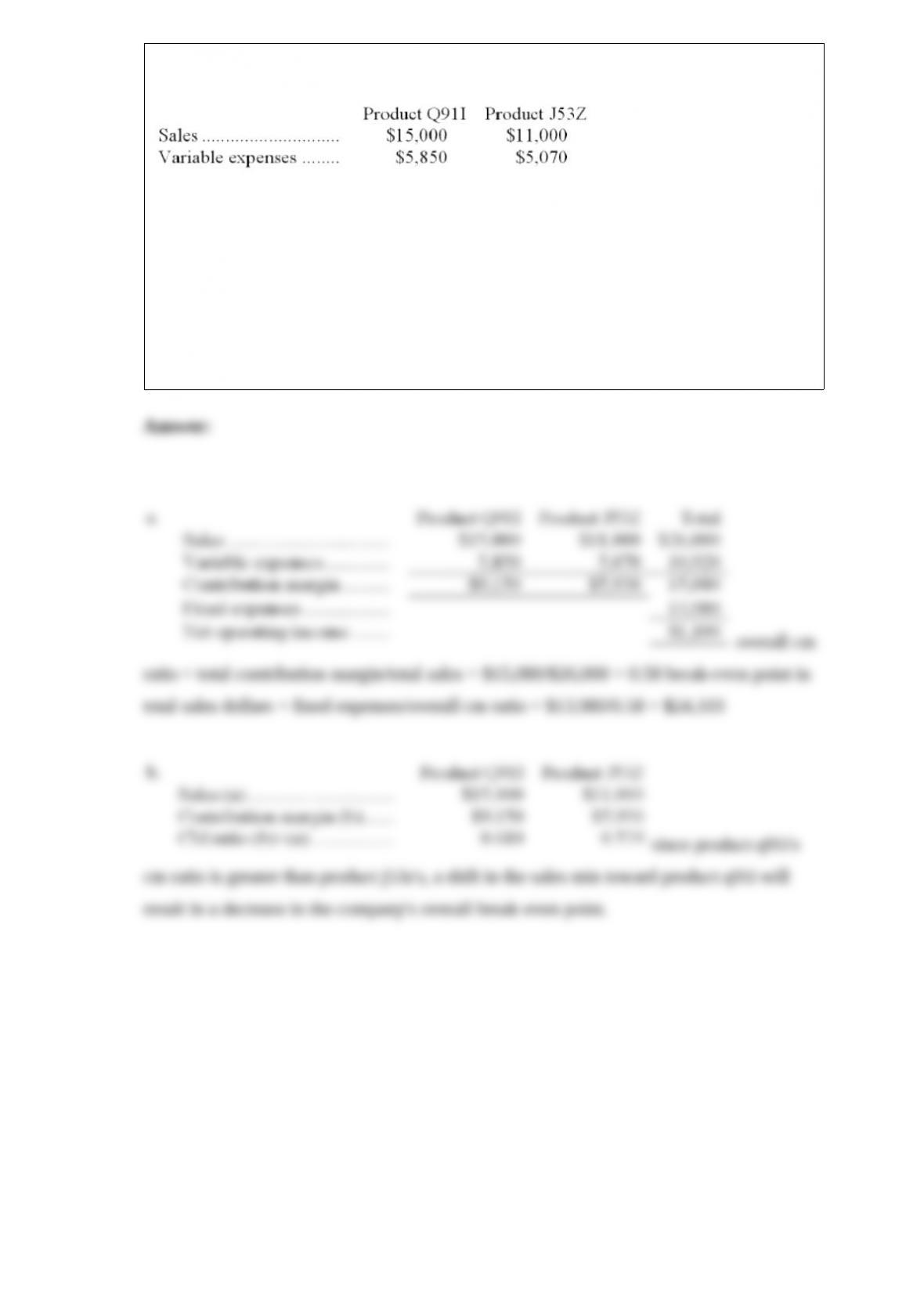
most recent month appear below:
fixed expenses for the entire company were $13,980.
required:
a. determine the overall break-even point for the company. show your work!
b. if the sales mix shifts toward product q91i with no change in total sales, what will
happen to the break-even point for the company? explain.