1) Which of the following is not classified as a cash outflow from operating activities?
a. Cash payments to creditors for interest
b. Cash payments to stockholders for dividends
c. Cash payments to employees for services rendered
d. Cash payments on payables to material suppliers
2) When would the replacement cost of inventory be used as the market value under the
lower-of-cost-or-market method?
a. Always
b. When replacement cost is above net realizable value
c. When replacement cost is below net realizable value and above net realizable value
less normal profit margin
d. When replacement cost is below net realizable value less normal profit margin
3) The amortization of patents should be presented in a statement of cash flows
prepared using the indirect method as a(n)
a. inflow and outflow of cash
b. outflow of cash
c. addition to net income in the adjustments to reconcile net income to cash from
operating activities
d. deduction from net income in the adjustments to reconcile net income to cash from
operating activities
4) Which of the following is not an example of an accounting error, as distinguished
from a change in accounting principle or change in accounting estimate?
a. Misstatement of assets, liabilities, or owners equity
b. Incorrect classification of an expenditure as between expense and an asset
c. Failure to recognize accruals and deferrals
d. Recognition of a gain on disposal of fully depreciated property
5) Inca Company purchases a call option to hedge an investment of 20,000 shares of
Limbaugh Company stock. The option agreement provides that if the prices of a share
of Limbaugh Company stock is greater than $30 on October 25, Inca receives the

difference (multiplied by 20,000 shares). Alternatively, if the price of the stock is less
than $30, the option is worthless and will be allowed to expire. Which of the following
statements regarding this call option is correct?
a. The call option effectively hedges the investment in the shares of Limbaugh stock
b. The call option is an option to sell Limbaugh Company stock at a fixed price
c. The call option represents a speculative option rather than a hedge
d. Inca could have purchased a put option or a call option to effectively hedge the
investment in the shares of Limbaugh stock
6) How many board members serve on the FASB?
a. 5
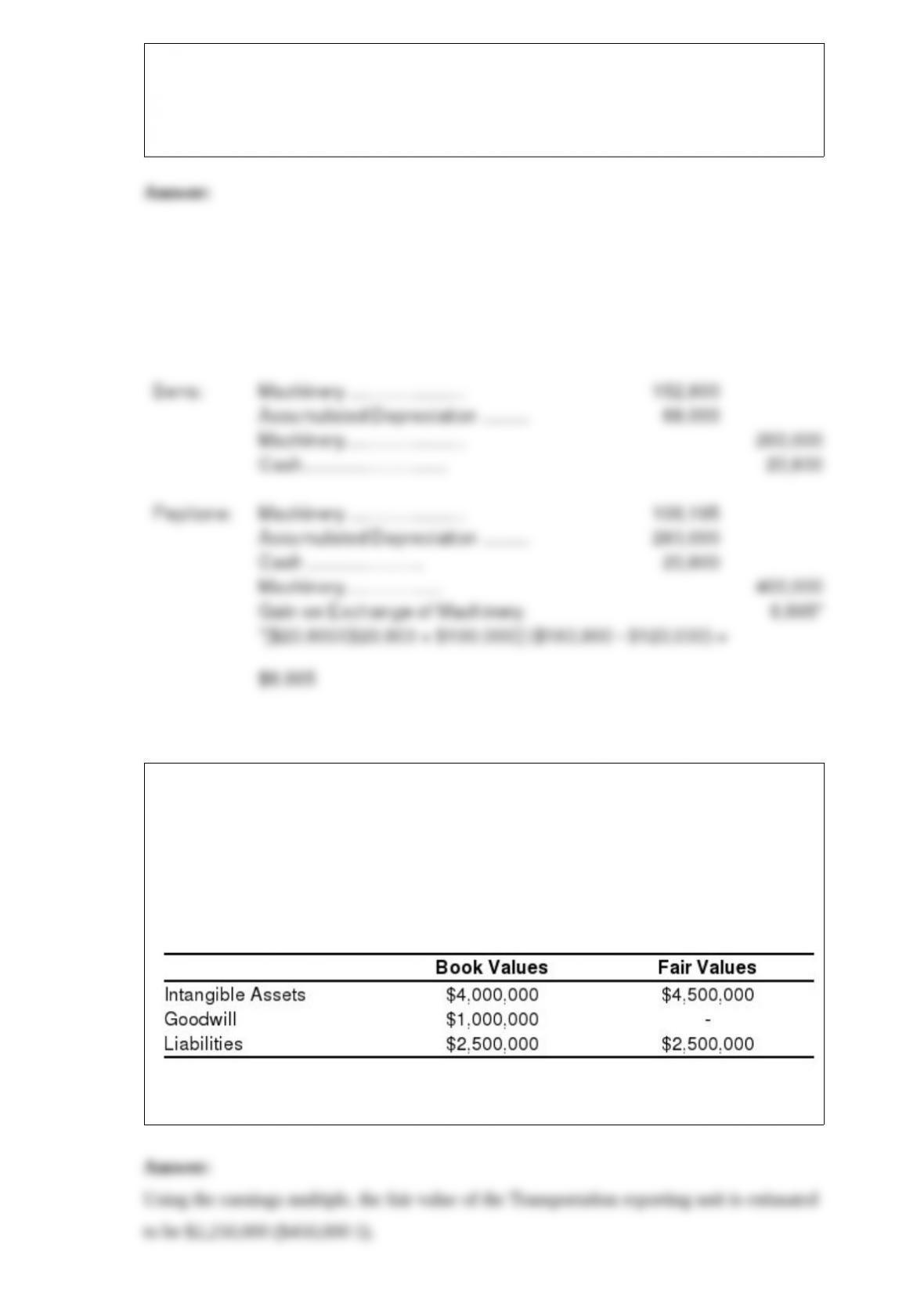
b. 7
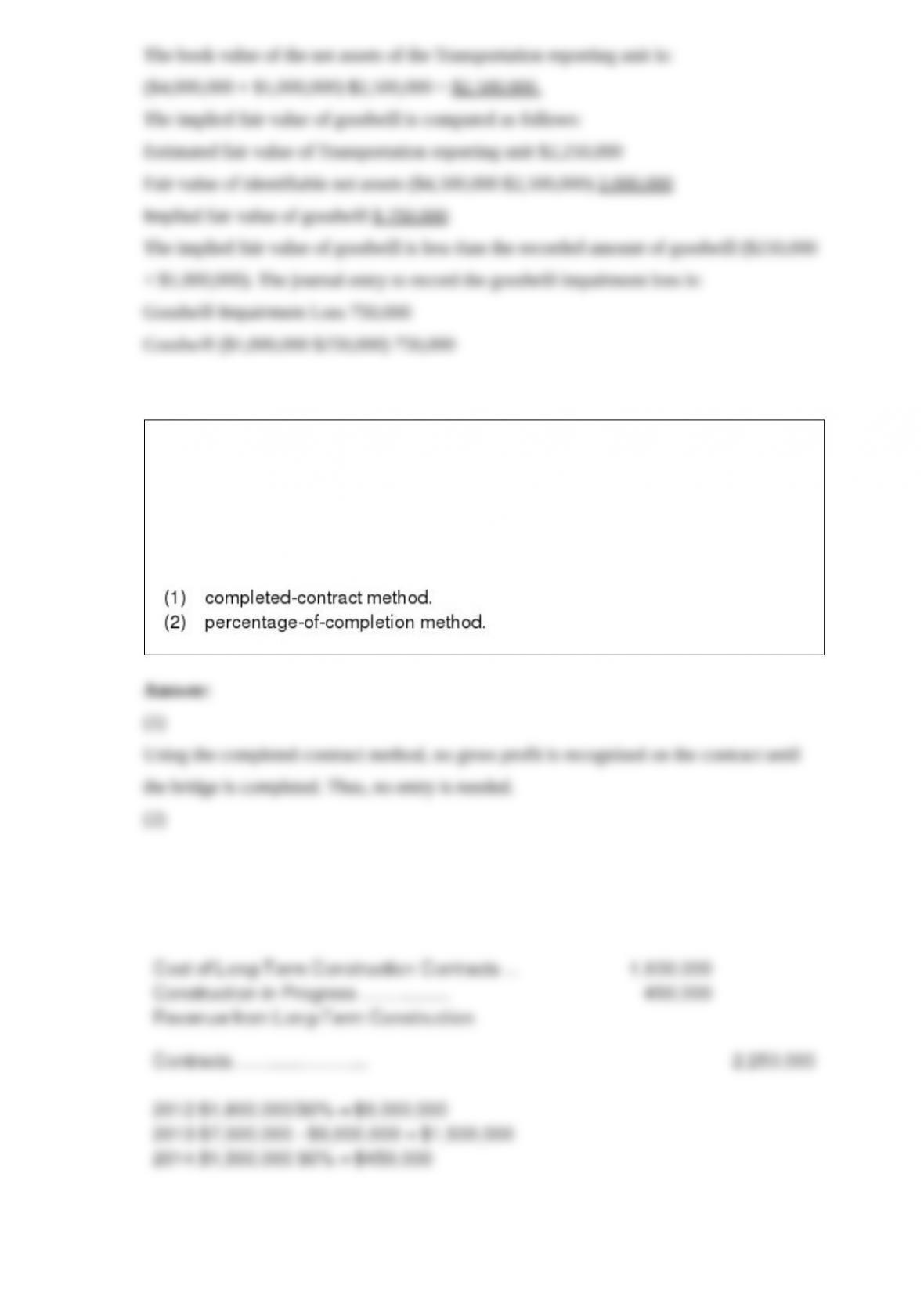
c. 14
d. 20
7) From the standpoint of the lessee, the minimum lease payment includes all of the
following except
a. the guaranteed residual value
b. the lessee’s obligation to pay executory costs
c. the bargain purchase option
d. any payment that the lessee must make upon failure to extend or renew the lease
8) Under international accounting standards, deferred tax assets and liabilities are
classified as
a. neither current or noncurrent but are disclosed in a separate section of the balance
sheet
b. current and noncurrent
c. only current
d. only noncurrent
9) On December 1, 2014, Laramie Company received a $10,000, 60-day, 6% note from
a customer. On December 31, 2014, the company discounted the note at the bank. The
banks discount rate is 9%. What were the proceeds that Barnes received from the
discounting of the note?
a. $10,024.25
b. $9,700.00
c. $9,924.25
d. $10,050.00
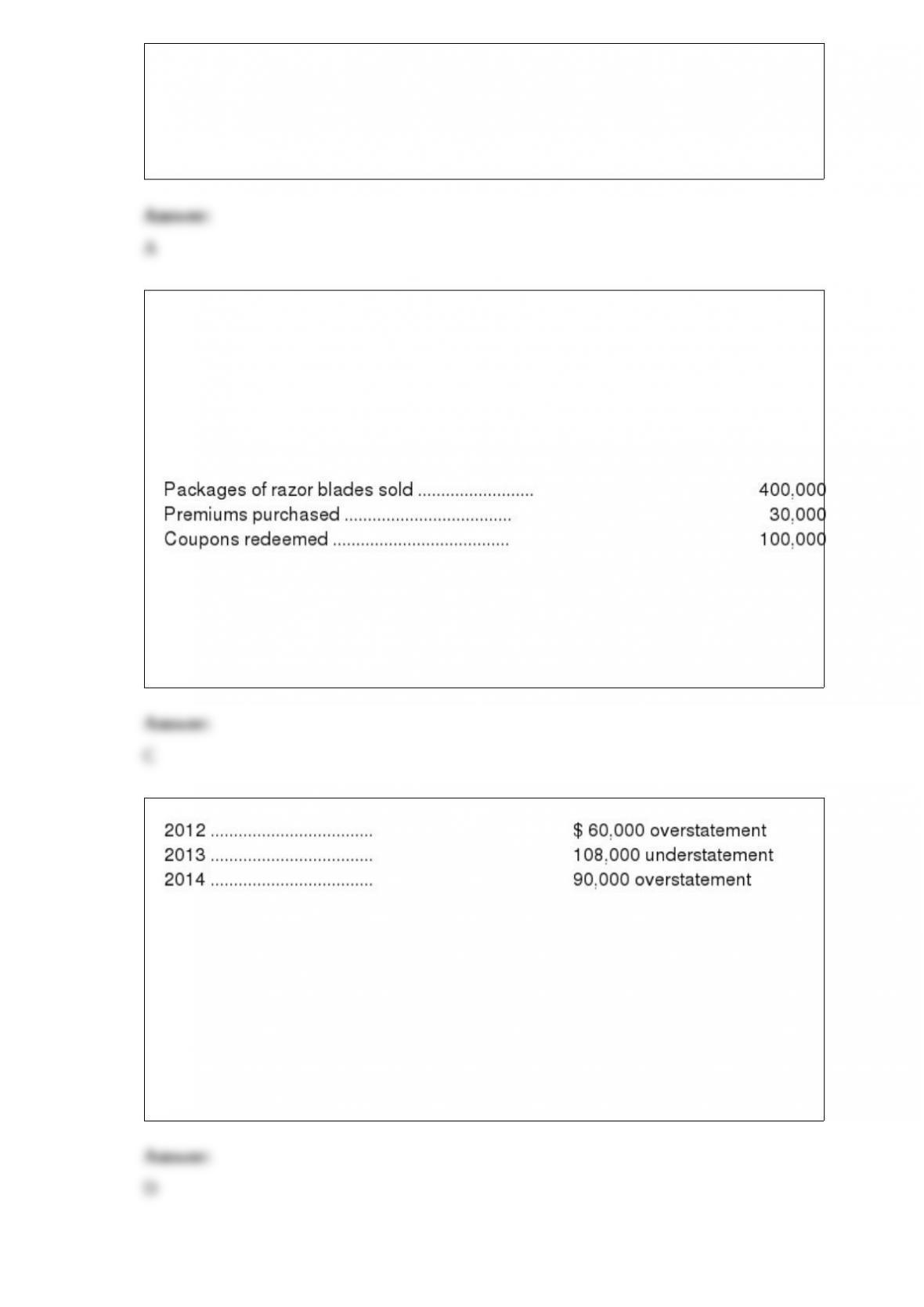
10) In an effort to increase sales, Sharpy Razor Blade Company inaugurated a sales
promotion campaign on June 30, 2014, whereby Sharpy placed a coupon in each
package of razor blades sold, the coupons being redeemable for a premium. Each
premium costs Sharpy $0.75, and five coupons must be presented by a customer to
receive a premium. Sharpy estimated that only 60 percent of the coupons issued will be
redeemed. For the six months ended December 31, 2014, the following information is
available:
What is the estimated liability for premium claims outstanding at December 31, 2014?
a. $15,000
b. $20,000
c. $21,000
d. $22,500
11) The entry to correct the accounts at the end of 2014 is
a. Retained Earnings ………………. 48,000 Cost of Goods Sold ……………… 42,000
Inventory …………………… 90,000
b. Retained Earnings ………………. 18,000 Cost of Goods Sold ……………… 72,000
Inventory …………………… 90,000
c. Inventory …………………….. 90,000 Cost of Goods Sold …………… 18,000 Retained
Earnings …………… 72,000
d. Cost of Goods Sold ……………… 198,000 Retained Earnings ……………. 108,000
Inventory …………………… 90,000
12) The process of establishing financial accounting standards is
a. a democratic process in that a majority of practicing accountants must agree with a
standard before it becomes implemented
b. a legislative process based on rules promulgated by government agencies
c. based solely on economic analysis of the effects each standard will have if it is
implemented
d. a social process which incorporates political actions of various interested user groups
as well as professional research and logic
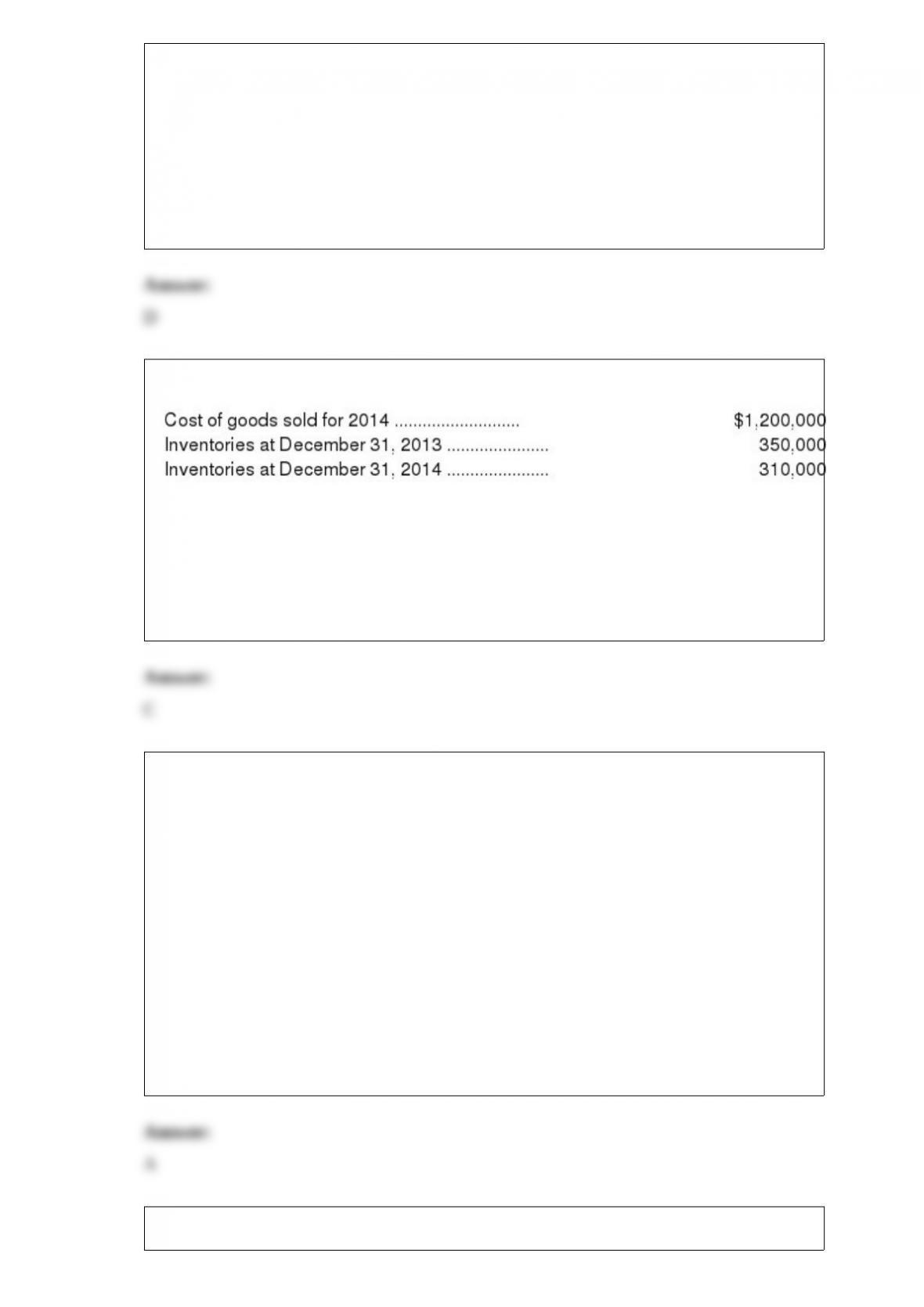
13) The following information is available for Orange Company:
Assuming that a business year consists of 360 days, the number of days’ sales in
average inventories for 2014 was
a. 49.5
b. 93
c. 99
d. 105
14) When a firm changed its method of accounting for inventory from LIFO to FIFO in
2014, it decided that the 2014 financial statements should be shown comparatively with
the 2013 results.
Which of the following statements concerning reporting the change in the retained
earnings statement is correct?
a. Both the January 1, 2013, and January 1, 2014, retained earnings balances are
reported at different amounts to reflect the effects of the change in earnings before those
respective dates
b. Only the January 1, 2013, retained earnings balance is reported at a different amount
to reflect the effects of the change in earnings
c. Only the January 1, 2014, retained earnings balance is reported at a different amount
to reflect the effects of the change in earnings
d. No direct change to retained earnings is needed since earnings for both years have
been adjusted to reflect the change
15) In a statement of cash flows prepared using the direct method, if wages payable

increased during the year, the cash paid for wages would be
a. the same as salary expense
b. salary expense plus wages payable at the beginning of the year
c. salary expense plus the increase in wages payable from the beginning to the end of
the year
d. salary expense less the increase in wages payable from the beginning to the end of
the year
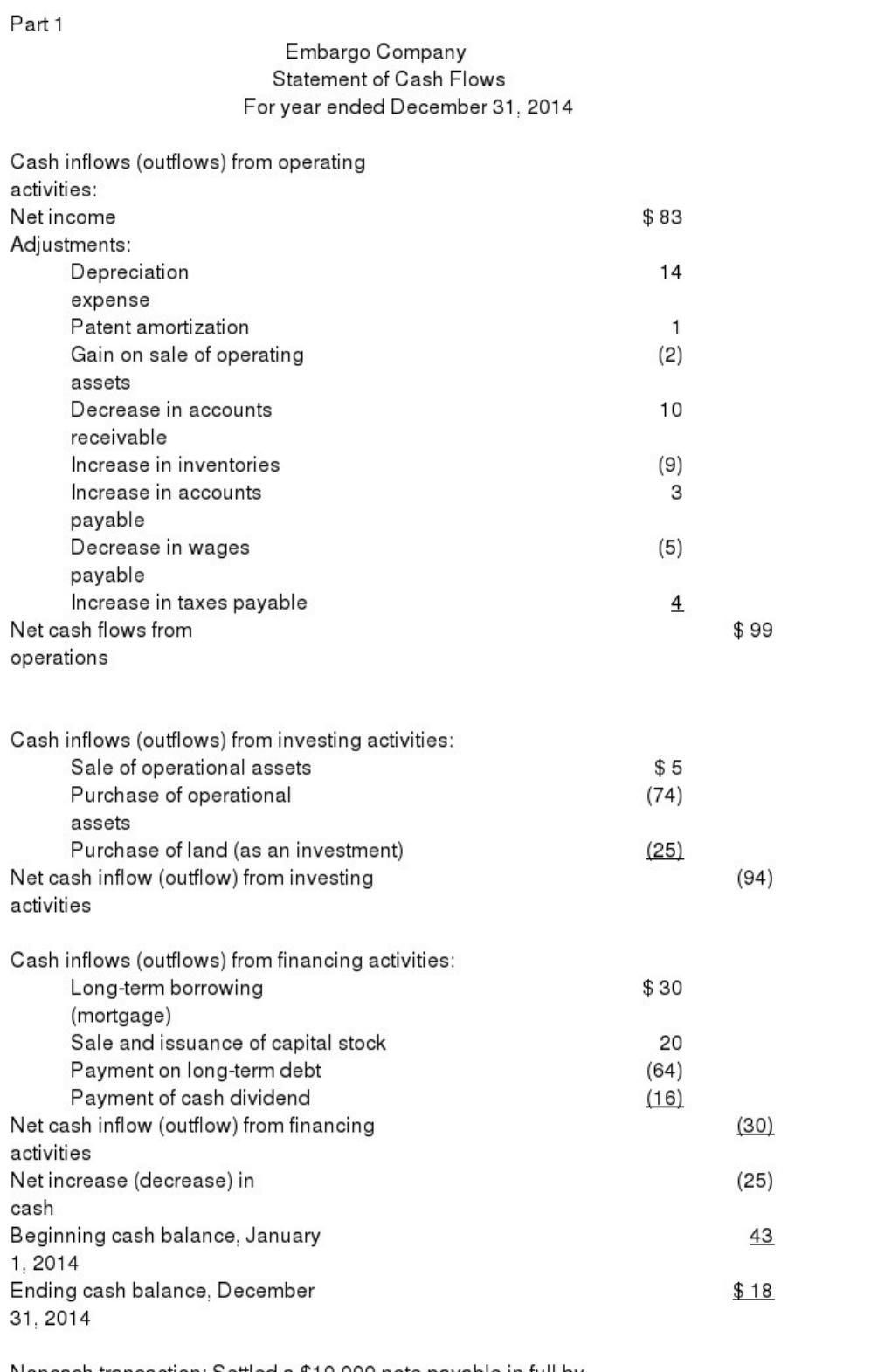
16) The following information is available from the Embargo Company accounting
records:
1) Cash account balances: January 1, 2014, $43,000; December 31, 2014, $18,000
2) The balance in accounts receivable decreased by $10,000 during the year from
$60,000.
The company had no short-term investments.
3) Inventory increased $9,000 to $80,000.
4) Accounts payable increased $3,000 during the year to $32,000. Income tax payable
increased $4,000 during the year to $8,000. Wages payable decreased by $5,000 to
$4,000.
There were no other current liabilities.
5) During December 2014, the company settled a $10,000 note payable by issuing
shares of
its own capital stock with equivalent value.
6) Cash expenditures during 2014 were
a. payment of long-term debts, $64,000;
b. purchase of new operational assets, $74,000;
c. payment of a cash dividend, $16,000;
d. purchase of land as an investment, $25,000.
7) Sale and issuance of Embargo Company capital stock for $20,000 cash.
8) Issuance of long-term mortgage note, $30,000.
9) Total assets at December 31, 2014, equaled $1,000,000.
10) Sale of some old operational assets resulting in the following entry:
Cash 5,000
Accumulated Depreciation 12,000
Operational Assets 15,000
Gain on Sale of Operational Assets 2,000
11) Income statement data:
Sales revenue (net credit sales) $ 295,000
Cost of goods sold (140,000)
Depreciation expense (14,000)
Patent amortization (1,000)
Income tax expense (17,000)
Selling and administrative expenses (42,000)
Gain on sale of operational assets 2,000
Net income $ 83,000
Required:
1> Prepare a statement of cash flows in thousands of dollars using the indirect method.
2> Calculate the following ratios:

a. Current ratio
b. Quick ratio
c. Working capital to total assets
d. Accounts receivable turnover
e. Age of accounts receivable
f. Inventory turnover
g. Working capital turnover
h. Net cash flow to current liabilities
i. Profit margin on sales
j. Dividend payout ratio (income based)
17) Order backlogs are an example of which general category of intangible asset that
should be recognized separately according to current generally accepted accounting
principles?
a. Marketing-related
b. Customer-related
c. Artistic-related
d. Contract-based
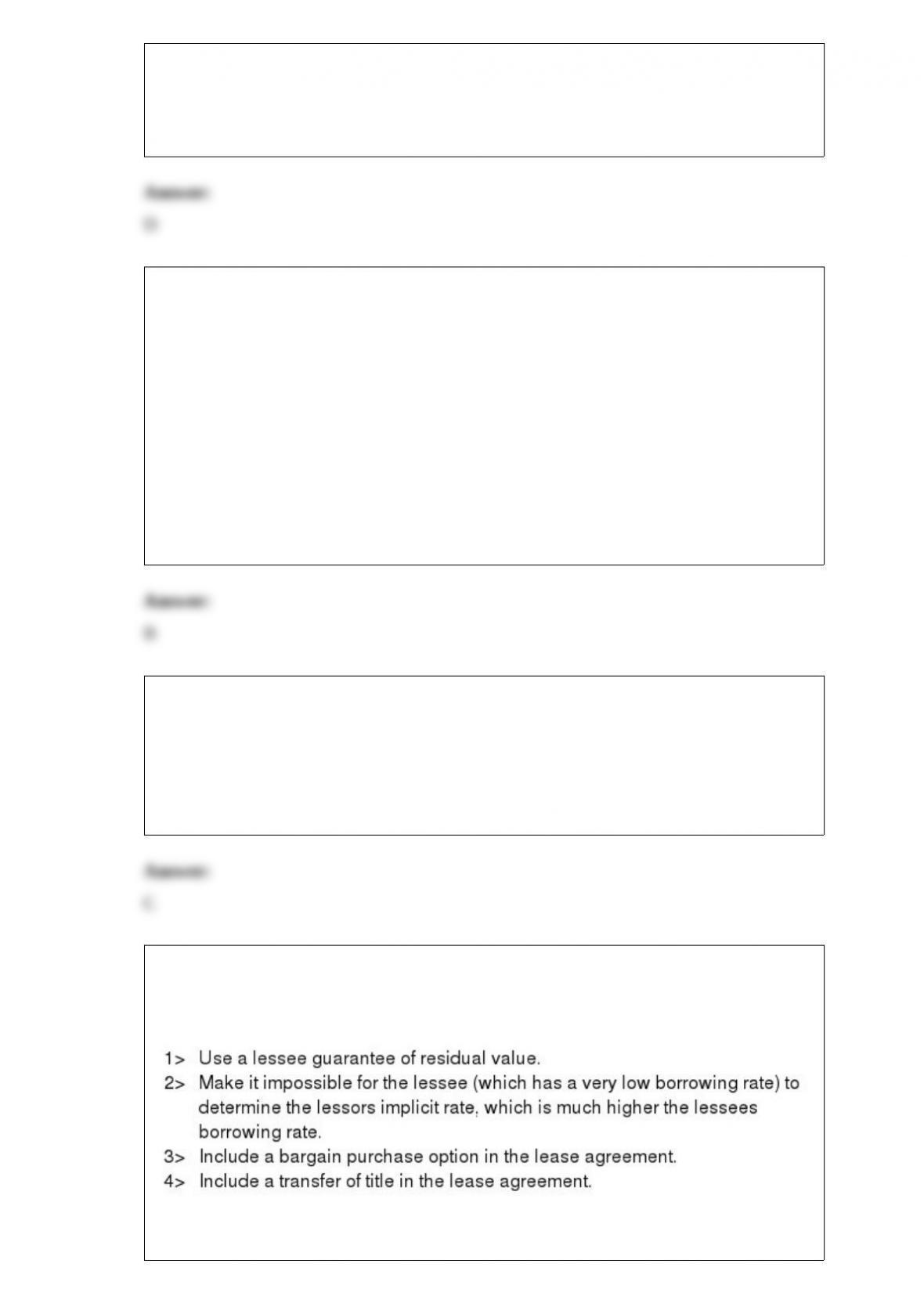
18) Valve Corporation has the following pension information for the year ended
December 31, 2014:
Assuming the expected return on plan assets and the settlement rate are both 10 percent,
what amount should Valve report for pension expense for 2014?
a. $225,000
b. $285,000
c. $315,000
d. $495,000
19) Which of the following criteria is not required for the recognition of a liability for
compensated absences under FASB ASC Topic 710?
a. The amount of the obligation must be estimable
b. Payment of the obligation must be probable
c. Payment of the obligation will require the use of current assets
d. The compensation either vests with the employee or can be carried forward to
subsequent years
20) The amount of income reported for tax purposes
a. is normally greater than the net income reported to stockholders
b. must be computed according to GAAP
c. is used to compute earnings per share
d. may differ from the amount of income determined for financial reporting purposes
21) Island Company has 1,000,000 shares of common stock authorized with a par value
of $3 per share of which 600,000 shares are outstanding. Island authorized a stock
dividend when the market value was $8 per share, entitling its stockholders to one
additional share for each share held. The par value of the stock was not changed.
Assuming the declaration is not recorded separately, what entry, if any, should Island
make to record distribution of the stock dividend?
a. Retained Earnings……….. 4,800,000 Common Stock………….. 1,800,000 Gain on
Stock Dividends… 3,000,000
b. Retained Earnings……….. 1,800,000 Common Stock………….. 1,800,000
c. Retained Earnings……….. 4,800,000 Common Stock………….. 1,800,000 Paid-In
Capital from Stock Dividends 3,000,000
d. Memorandum entry noting the number of additional shares issued as a dividend
22) When financial reports from two different companies have been prepared and
presented in a similar manner, the information exhibits the characteristic of
a. relevance
b. reliability
c. comparability
d. consistency
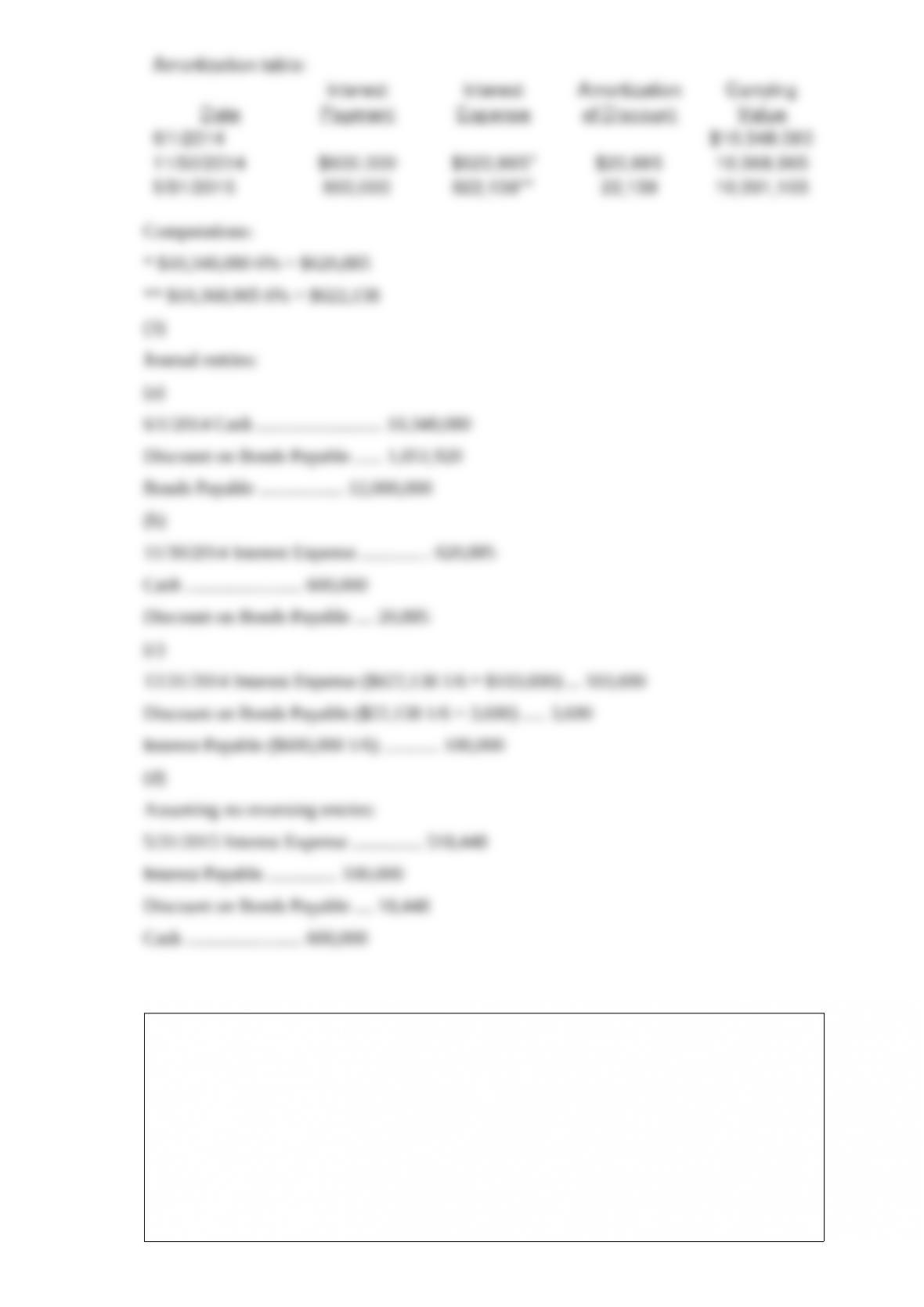
23) A lessee wants to lease an asset on a long-term noncancelable basis, but wants to
avoid capitalizing the lease. The lessee is considering the following strategies to
accomplish its objective:
Which of the strategies above will provide the desired result?
a. only 2

b. 1 and 3
c. 1 and 4
d. None
24) In January of 2014, Bonnie Corporation acquired 20% of the outstanding voting
common stock of Clyde Company for $280,000. This investment enabled Bonnie to
exercise significant influence over Clyde. The book value of the acquired shares was
$210,000. The excess of cost over book value was attributed to an identifiable
intangible asset that was undervalued on Clydes balance sheet and that had a remaining
useful life of 10 years.
For the year ended December 31, 2014, Clyde reported income of $63,000 and paid
cash dividends of $14,000 on its common stock. What is the proper carrying value of
Bonnies investment in Clyde at December 31, 2014?
a. $270,000
b. $273,000
c. $280,000
d. $282,800
25) Which of the following is NOT a basic characteristic of a system of cash control?
a. Use of a voucher system
b. Combined responsibility for handling and recording cash
c. Daily deposit of all cash received
d. Internal audits at irregular intervals
26) Which of the following is correct regarding the treatment of short-term obligations
expected to be refinanced?
a. If an obligation has actually been refinanced or a firm refinancing agreement is in
place by the date financial statements are issued, then reclassify the short-term
obligation as long-term
b. Classify the short-term obligation as long-term if the obligation has been refinanced
by the date the financial statements are issued
c. Classify the short-term obligation as long-term if the obligation has been refinanced
by the balance sheet date
d. There is no provision for reclassifying short-term obligations expected to refinanced
as long-term obligations under international accounting standards

27) Which of the following statements regarding international accounting standards for
the impairment of tangible assets is correct?
a. Impairment losses cannot be subsequently reversed
b. Impairment losses can be subsequently reversed to the extent of the amount of the
initial impairment loss
c. International accounting standards require a two-step test of impairment of a tangible
asset
d. Accounting for impairments is not necessary since entities are required under
international accounting standards to adjust the values of property, plant, and equipment
to fair value at the end of each reporting period for which reports are prepared
28) On June 1, 2014, Minute Controls, Inc. issued $12,000,000 of 10 percent bonds to
yield 12 percent. Interest is payable semiannually on May 31 and November 30. The
bonds mature in 15 years. Minute Controls, Inc. is a calendar-year corporation.
(1) Determine the issue price of the bonds. Show computations.
(2) Prepare an amortization table through the first two interest periods using the
effective-interest method.
(3) Prepare the journal entries to record bond-related transactions as of the following
dates:
(a) June 1, 2014
(b) November 30, 2014
(c) December 31, 2014
(d) May 31, 2015
29) The cumulative effect on prior years’ earnings of a change in accounting principle
should be reported separately as an adjustment to retained earnings for the earliest
period presented for all of the following changes except
a. completed-contract method of accounting for long-term construction-type contracts
to the percentage-of-completion method
b. percentage-of-completion method of accounting for long-term construction-type
contracts to the completed-contract method
c. FIFO method of inventory pricing to LIFO method
d. LIFO method of inventory pricing to the weighted-average method
30) A deferred tax liability arising from the use of an accelerated method of
depreciation for tax purposes and the straight-line method for financial reporting
purposes would be classified on the balance sheet as
a. a current liability
b. a noncurrent liability
c. a current liability for the portion of the temporary difference reversing within a year
and a noncurrent liability for the remainder
d. an offset to the accumulated depreciation reported on the balance sheet
31) Which of the following would be used in the calculation of the gross profit
recognized in the third and final year of a construction contract that is accounted for
using the percentage-of-completion method?
Actual Income
Contract Total Previously
Price Costs Recognized
a. Yes Yes No
b. Yes Yes Yes
c. Yes No Yes
d. No Yes Yes
32) During the year, Franklin Corporation incurred the following costs in connection
with the issuance of bonds:
The amount recorded as a deferred charge to be amortized over the term of the bonds is
a. $0
b. $30,000
c. $300,000
d. $510,000

33) The amortization of bond discount related to long-term debt should be presented in
a statement of cash flows prepared using the indirect method as a(n)
a. addition to net income in the adjustments to reconcile net income to cash from
operating activities
b. deduction from net income in the adjustments to reconcile net income to cash from
operating activities
c. outflow of cash
d. inflow and outflow of cash
34) Pension-related estimates (not funding data) are provided by the
a. employer company
b. independent actuary
c. pension fund trustees
d. employee union
35) How much premium or discount should be amortized on June 30, 2014?
a. $2,790
b. $2,280
c. $2,000
d. $1,970
36) Under which of the following conditions would hurricane damage be considered an
extraordinary item for financial reporting purposes?
a. Under any circumstances hurricane damage should be classified as an extraordinary
item
b. Only if hurricanes are unusual in nature and infrequent in occurrence in the
geographic area
c. Only if hurricanes are normal in the geographic area but do not occur frequently
d. Only if hurricanes occur frequently in the geographic area but have been insured
against
37) Assume the following facts for Lowmann Company: The month-end bank statement
shows a balance of $40,000; outstanding checks total $2,000; a deposit of $8,000 is in
transit at month-end; and a check for $400 was erroneously charged against the account
by the bank. What is the correct cash balance at the end of the month?
a. $33,600
b. $34,400
c. $45,600
d. $46,400
38) You have just been promoted to the position of senior accountant with the public
accounting firm of Ohm and Dylan. Your first audit client as senior accountant is to be
the United Manufacturing Company. You have had a considerable amount of experience
both in planning and conducting the audit procedures for current asset accounts such as
cash, receivables, and inventory. This is your first experience, however, in planning the
audit of the property, plant, and equipment accounts. Compare the nature of current
assets with property, plant, and equipment, and describe how any differences might
affect your audit generally.
39) Pepitone Inc. exchanged a machine costing $400,000 with accumulated
depreciation of $280,000 for a machine from the Berra Company. Berra paid $20,800
cash in addition to its machine (which cost $200,000 with accumulated depreciation of
$68,000) for the Pepitone machine. The Berra machine has a fair value of $160,000.
Provide the necessary entries to record the transactions on both companies’ books
assuming the machine lacks commercial substance.
40) Roadworthy Company acquired Highway Company on January 1, 2014. As part of
the acquisition, $1,000,000 in goodwill was recognized and assigned to Roadworthy’s
Transportation reporting unit. For 2014, earnings from the Transportation reporting unit
were $450,000. Separately traded companies with operations similar to the
Transportation reporting unit had market values approximately equal to five times
earnings. As of December 31, 2014, book values and fair values of the Transportation
reporting unit were:
Prepare the impairment test of goodwill as well as any entry needed to record an
impairment loss.
41) Simpson Construction entered into a contract to construct a floating bridge across a
lake. The contract price for the bridge is $7,500,000. During 2012, costs of $1,800,000
were incurred representing 30% of total expected costs.
Prepare the necessary entries for 2014 to recognize gross profit for the year assuming
the firm uses the
42) Sinbad Company is expected to pay a $0.50 per share dividend at the end of the
year. The dividend is expected to grow at a constant rate of 7 percent per year. The
required rate of return on the stock is 15 percent.
Required:
What is the value per share of the companys stock?
43) Thermocore is a medium-sized company that produces wall paneling. Thermocore
is a wholly-owned subsidiary of a holding company called Tempra-Sure, Inc. Both
Thermocore and Tempra-Sure, Inc. are owned by the same individuals as principal
shareholders.
Thermocore has fallen on hard times due to a downturn in the construction industry in
the primary market area the company serves. Sales of the company have declined and
net losses have occurred for each of the last three years. The company is in dire need of
cash but the owners of Tempra-Sure, Inc. and Thermocore know that additional
financing from a bank or other source is unlikely due to the companys weakened
financial condition.
The owners of Tempra-Sure, Inc. and Thermocore believe that the downturn in
construction will eventually reverse and that Thermocore will return to profitability
when conditions improve. Based on these beliefs, the owners have proposed to the
independent auditors a plan whereby the holding company (Tempra-Sure, Inc.) would
obtain a loan from a bank and then make an intercompany loan to Thermocore. Under
this plan, the owners would sell their personal residences to Tempra-Sure, Inc.. Lease
agreements between Tempra-Sure, Inc. and the owners would be drafted. These lease
agreements would allow the owners to continue to occupy their homes. Title to the
homes would pass to Tempra-Sure, Inc.. Tempra-Sure, Inc. would become involved in
property management in addition to holding the stock of Thermocore. Tempra-Sure,
Inc. would have no additional properties other than the personal residences of the
owners. The acquisition of additional properties by Tempra-Sure, Inc. is unlikely.
Required:
Assume that you are the partner in the public accounting firm performing the audit of
Tempra-Sure, Inc. and Thermocore. Prepare your response to the owners of
Tempra-Sure, Inc. and Thermocore regarding the plan to obtain additional financing.
Include references to the Conceptual Framework and underlying assumptions of
accounting in your response.
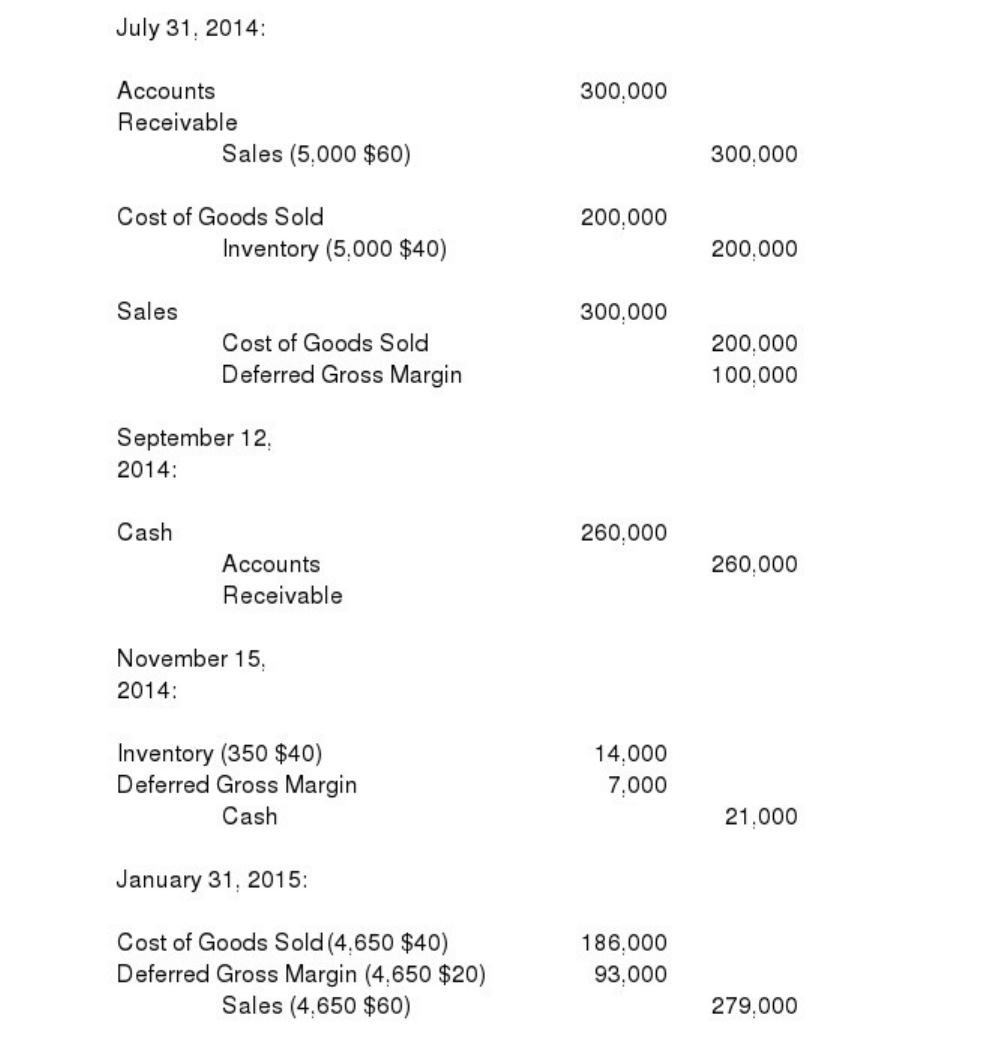
44) Franklyn Publishing Company is marketing a new principles of accounting text.
The new text is quite revolutionary in its approach. The use of the new approach raises
some question as to the marketability of the text, however.
On July 31, 2014, Franklyn sold 5,000 copies of the new text to college bookstores at a
unit price of $60. The textbooks have a unit cost to Franklyn of $40. Franklyn uses a
perpetual inventory system. The companys accounting period ends on December 31.
In view of the uncertainty regarding the marketability of the text, Franklyn sold the text
with terms of net 30 days, but has allowed the bookstores until January 31, 2015, to
return any unsold texts for a cash refund. Franklyn has no means of estimating the
number of texts that will be returned.
On September 12, 2014, Franklyn collected $260,000 on the account receivable. On
November 15, 2014, 350 texts were returned by the bookstore to Franklyn.
Required:
45) The application of SFAS No. 109 results in the recording on the financial statements
of an enterprise of deferred tax assets and liabilities. The initial identification of these
deferred tax assets and liabilities raises the issue as to how these amounts should be
shown on the balance sheet in terms of current and noncurrent classifications. One
approach advocated by some in the profession is to classify all deferred taxes as
noncurrent.
Required:
Explain the advantages and disadvantages of this approach and indicate if this approach
is acceptable under SFAS No. 109.