1) The DuPont formula uses financial and nonfinancial information to measure the
performance of a business.
2) For short-run production planning, information in the variable costing format is more
useful to management than is information in the absorption costing concept format.
3) If the balance in Cash Short and Over at the end of a period is a credit, it should be
reported as an “other income” item on the income statement.
4) Accrued taxes payable are generally reported on the balance sheet as a current
liability.
5) If cash dividends of $135,000 were paid during the year and the company sold 1,000
shares of common stock at $30 per share, the statement of cash flows would report net
cash flow from financing activities as $165,000.
6) An example of deferred revenue is Unearned Rent.
7) Transactions are listed in the journal chronologically.
8) When merchandise inventory is shown on the balance sheet, both the method of
determining the cost of the inventory and the method of valuing the inventory should be
shown.
9) If the market rate of interest is 8% and a corporation’s bonds bear interest at 7%, the
bonds will sell at a premium.
10) The master budget of a small manufacturer would normally include all necessary
component budgets except the capital expenditures budget.
11) The costs of materials and labor that do not enter directly into the finished product
are classified as factory overhead.
12) In a pull manufacturing system, raw materials are released to production based on
forecasted demand.
13) There is no difference in the Investing and Financing sections of the statement of
cash flows using the indirect and direct method.
14) The relevant activity base for a cost depends upon which base is most closely
associated with the cost and the decision-making needs of management.
15) Industries that typically use process cost systems include chemicals, oil, metals,
food, paper, and pharmaceuticals.
16) Contribution margin reporting and analysis is appropriate only for manufacturing
firms, not for service firms.
17) The two most widely used methods for determining the cost of inventory are
A.FIFO and LIFO
B.FIFO and average
C.LIFO and average
D.gross profit and average
18) The Brass Works is in the process of determining manufacturing overhead.
Journalize events (a) – (d) to Factory Overhead, Miscellaneous Expense, or allocated
between the two as appropriate. All items were paid in cash at the time of acquisition.
Next calculate the overhead application rate and apply overhead to Work-in-Process.
(a) Brass Works purchases an insurance policy for $4,000. It is computed that 80% of
the value of the policy protects production, the balance protects the administrative
offices.
(b) The electric bill is received showing an amount due of $1,200. This meter is utilized
only by production as the office spaces have their own meter.
(c) Payroll reports that the sales managers salary for the period is $3,500 and that
production supervisors wages for the period are $5,500.
(d) The stockroom reports that $2,575 in materials were purchased for the production
maintenance department.
(e) If the driver for the application of overhead is drop-forge strokes and there are
expected to be 1,000 strokes in this period, what is the rate per stroke? Do not round
your answer.
(f) Assuming that there are 1,150 drop-forge strokes in this period, apply factory
overhead to Work In Process. Round your answers to nearest dollar.
Round overhead rate to four decimal places and total cost to nearest dollar.
19) If the seller is to pay the freight costs of delivering merchandise, the delivery terms
are stated as
A.FOB shipping point
B.FOB destination
C.FOB n/30
D.FOB seller
20) The entry to close the appropriate insurance account at the end of the accounting
period is
A.debit Income Summary; credit Prepaid Insurance
B.debit Prepaid Insurance; credit Income Summary
C.debit Insurance Expense; credit Income Summary
D.debit Income Summary; credit Insurance Expense
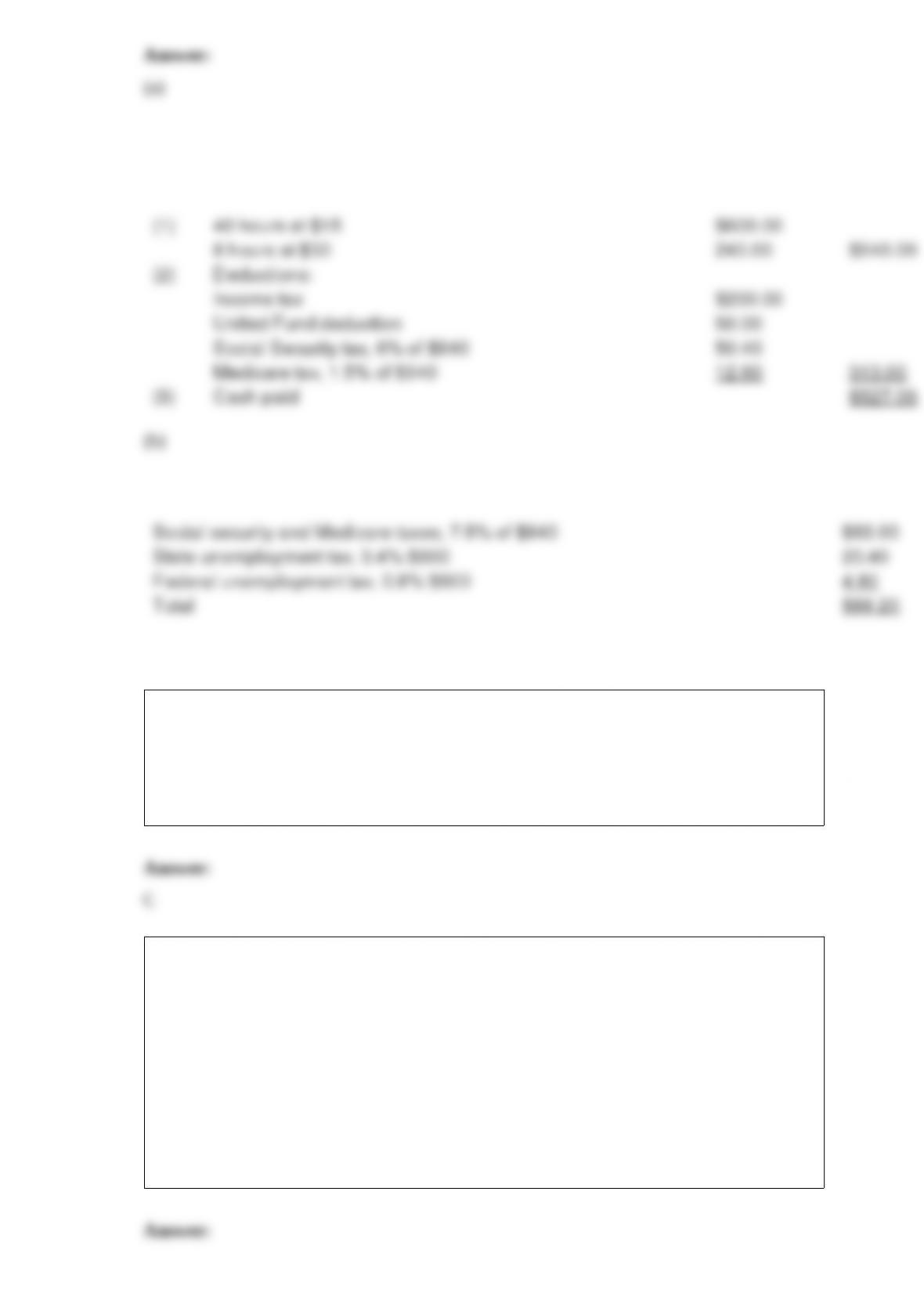
21) The following information is for employee Ella Dodd for the week ended March15.
Total hours worked: 48
Rate: $15 per hour, with double time for all hours in excess of 40
Federal income tax withheld: $200
United Fund deduction: $50
Cumulative earnings prior to current week: $6,400
Tax rates:
Social security: 6% on maximum earnings of $100,000. Medicare tax:
1.5% on all earnings.
State unemployment: 3.4% on maximum earnings of $7,000; on employer
Federal unemployment: 0.8% on maximum earnings of $7,000; on employer
22) Which side of the account increases a cash account?
A.credit
B.neither a debit or a credit
C.debit
D.both a debit and a credit
23) At the end of its accounting period, December 31, 2011, Hsus Financial Services
has assets of $575,000 and stockholders equity of $335,000. Using the accounting
equation and considering each case independently, determine the following amounts.
a. Hsus liabilities as of December 31, 2011.
b. Hsus liabilities as of December 31, 2012, assuming that assets increased by $56,000
and stockholders equity decreased by $32,000.
c. Net income or net loss during 2012, assuming that as of December 31, 2012, assets
were $592,000, liabilities were $450,000, and there were no additional capital stock
sales or dividends paid in 2012.
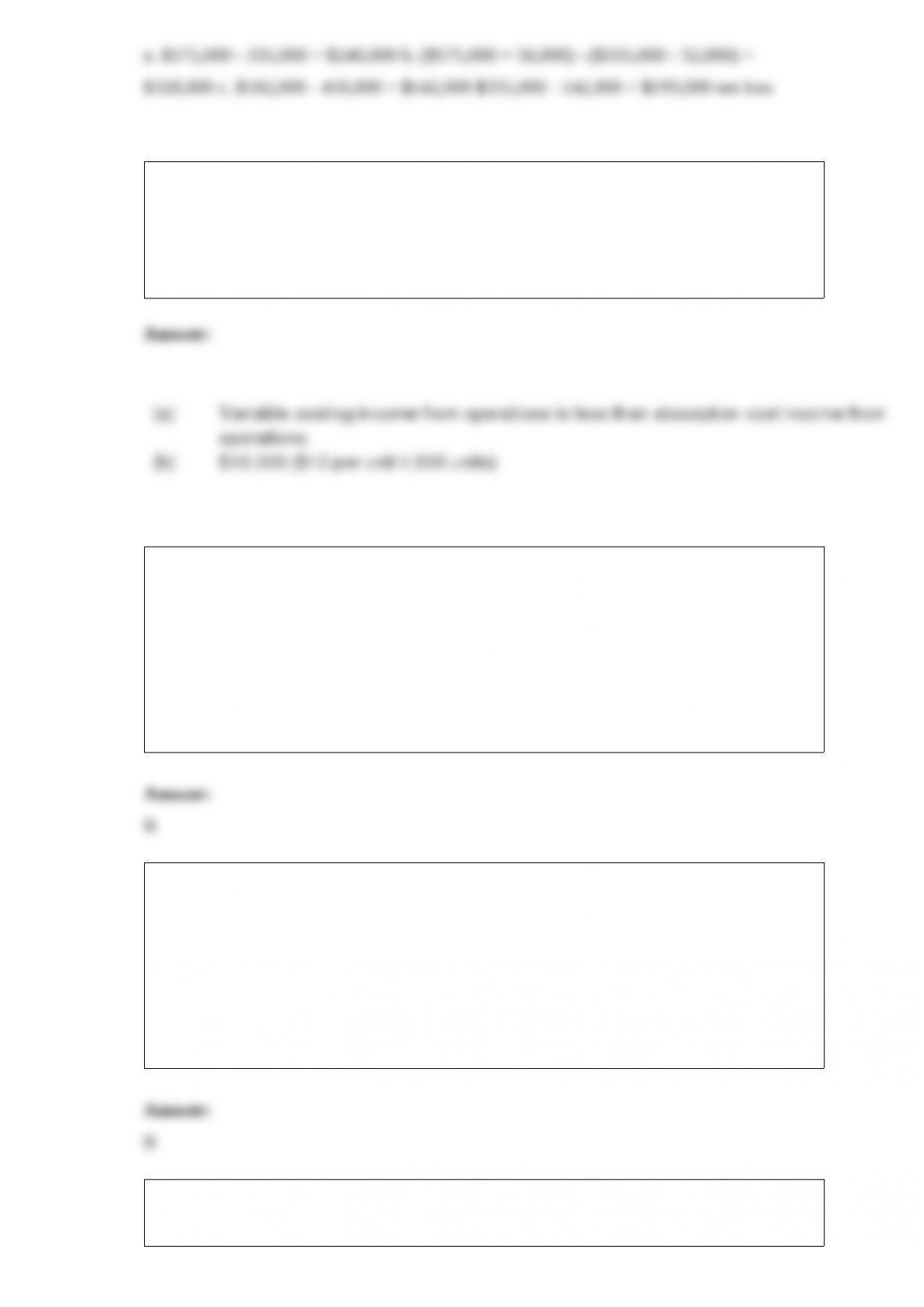
24) Fixed costs are $10 per unit and variable costs are $25 per unit. Production was
13,000 units, while sales were 12,000 units. Determine (a) whether variable cost
income from operations is less than or greater than absorption costing income from
operations, and (b) the difference in variable costing and absorption costing income
from operations.
25) Closing entries are dated in the journal as of
A.the date they are actually journalized, although they are generally prepared after the
end of the accounting period
B.the last day of the accounting period, although they are actually journalized after the
end of the accounting period
C.the first day of the accounting period, although they are actually journalized after the
end of the accounting period
D.the first day of the subsequent accounting period
26) Land, originally purchased for $30,000, is sold for $62,000 in cash. What is the
effect of the sale on the accounting equation?
A.assets increase $62,000; stockholders equity increases $62,000
B.assets increase $32,000; stockholders equity increases $32,000
C.assets increase $62,000; liabilities decrease $30,000; stockholders equity increases
$32,000
D.assets increase $30,000; no change for liabilities; stockholders equity increases
$62,000
27) Managers of what type of decentralized units have authority and responsibility for
revenues, costs, and assets invested in the unit?
A.Profit center
B.Investment center
C.Production center
D.Cost center
28) The company whose more than 50% stock is owned by the another company is
called the
A.controlling company
B.investee company
C.subsidiary company
D.sibling company
29) When a work sheet is complete, the adjustment columns should have
A.total credits greater than total debits if a net income was earned
B.total debits greater than total credits if a net loss was incurred
C.total debits greater than total credits if a net income was earned
D.total debits equal total credits
30) Treasury stock which was purchased for $3,000 is sold for $3,500. As a result of
these two transactions combined
A.income will be increased by $500
B.stockholders’ equity will be increased by $3,500
C.stockholders’ equity will be increased by $500
D.stockholders’ equity will not change
31) A credit balance in which of the following accounts would indicate a likely error?
A.Fees Earned
B.Salary Expense
C.Retained Earnings
D.Accounts Payable
32) If sales are $820,000, variable costs are 45% of sales, and operating income is
$260,000, what is the contribution margin ratio?
A.45%
B.55%
C.62%
D.32%
33) Which of the following would be included in the cost of a product manufactured
according to absorption costing?
A.advertising expense
B.sales salaries
C.depreciation expense on factory building
D.office supplies costs
34) Sales to customers who use bank credit cards, such as MasterCard and Visa, are
generally treated as
A.sales on account
B.sales returns
C.cash sales
D.sales when the credit card company remits the cash
35) If variable selling and administrative expenses totaled $124,000 for the year
(80,000 units at $1.55 each) and the planned variable selling and administrative
expenses totaled $136,500 (78,000 units at $1.75 each), the effect of the quantity factor
on the change in variable selling and administrative expenses is:
A.$3,000 increase
B.$3,500 decrease
C.$3,000 decrease
D.$3,500 increase
36) Which transfer price approach is used when the transfer price is set at the amount
sold to outside buyers?
A.Market Price
B.Cost Price
C.Negotiated Price
D.Variable Price
37) The journal entry a company uses to record the issuance of an interest-bearing note
for the purpose of borrowing funds for the business is
A.debit Accounts Payable; credit Notes Payable
B.debit Cash; credit Notes Payable
C.debit Notes Payable; credit Cash
D.debit Cash and Interest Expense; credit Notes Payable
38) For the year ended December 31, 2014 Depot Maxs cost of merchandise sold was
$56,900. Inventory at the beginning of the year was $6,540. Ending inventory was
$7,250. Compute Depot Maxs inventory turnover for the year.
A.8.7
B.7.8
C.8.3
D.44
39) All of the following accounts are increased with a debit except
A.Unearned Revenues
B.Land
C.Accounts Receivable
D.Cash
40) What is the last account that should be listed in the post-closing trial balance?
A.Income Summary
B.Retained Earnings
C.Cash
D.Fees Earned
41) A $100 petty cash fund contains $91 in petty cash receipts, and $4.75 in currency
and coins. The journal entry to record the replenishment of the fund would include a
A.credit to Petty Cash for $95.75
B.credit to Cash for $90
C.debit to Cash Short and Over for $4.25
D.credit to Cash Short and Over for $4.25
42) Zenith Corporation sells some of its used store fixtures. The acquisition cost of the
fixtures is $12,500, the accumulated depreciation on these fixtures is $9,750 at the time
of sale. The fixtures are sold for $5,300. The value of this transaction in the Investing
section of the statement of cash flows is:
A.$12,500
B.$5,300
C.$2,750
D.$2,550
43) The journal entry Stanton will record on June 30, 2014, will include:
A.a credit to Interest Revenue for $2,400
B.a debit to Cash for $3,600
C.a credit to Cash for $2,400
D.a credit to Interest Receivable for $1,200
44) At the end of the fiscal year, the usual adjusting entry for depreciation on equipment
was omitted. Which of the following statements is true?
A.Total assets will be understated at the end of the current year
B.The balance sheet and income statement will be misstated, but the retained earnings
statement will be correct for the current year
C.Net income will be overstated for the current year
D.Total liabilities and total assets will be understated
45) All of the following statements regarding a horizontal analysis are true except
A.A horizontal analysis is used to compare an item in a current statement with the same
item in prior statements
B.A horizontal analysis can be performed on a balance sheet and income statement, but
not on a statement of cash flows
C.If Fees Earned in 2013 is $125,000 and Fees Earned in 2014 is $143,750, a horizontal
analysis will indicate a 15% increase over this period
D.When two statements are compared in horizontal analysis, the earlier statement is
used as the base for computing the amount and the percent of change
46) All of the following are examples of indirect labor except:
A.maintenance personnel
B.janitorial personnel
C.machine operators
D.plant managers
47) In the manufacture of 10,000 units of a product, direct materials cost incurred was
$145,800, direct labor cost incurred was $82,000, and applied factory overhead was
$45,500. What is the total conversion cost?
A.$127,500
B.$145,800
C.$272,200
D.$273,300
48) If accounts payable have increased during a period
A.revenues on an accrual basis are less than revenues on a cash basis
B.expenses on an accrual basis are less than expenses on a cash basis
C.expenses on an accrual basis are the same as expenses on a cash basis
D.expenses on an accrual basis are greater than expenses on a cash basis
49) If the maker of a promissory note fails to pay the note on the due date, the note is
said to be
A.displaced
B.disallowed
C.dishonored
D.discounted
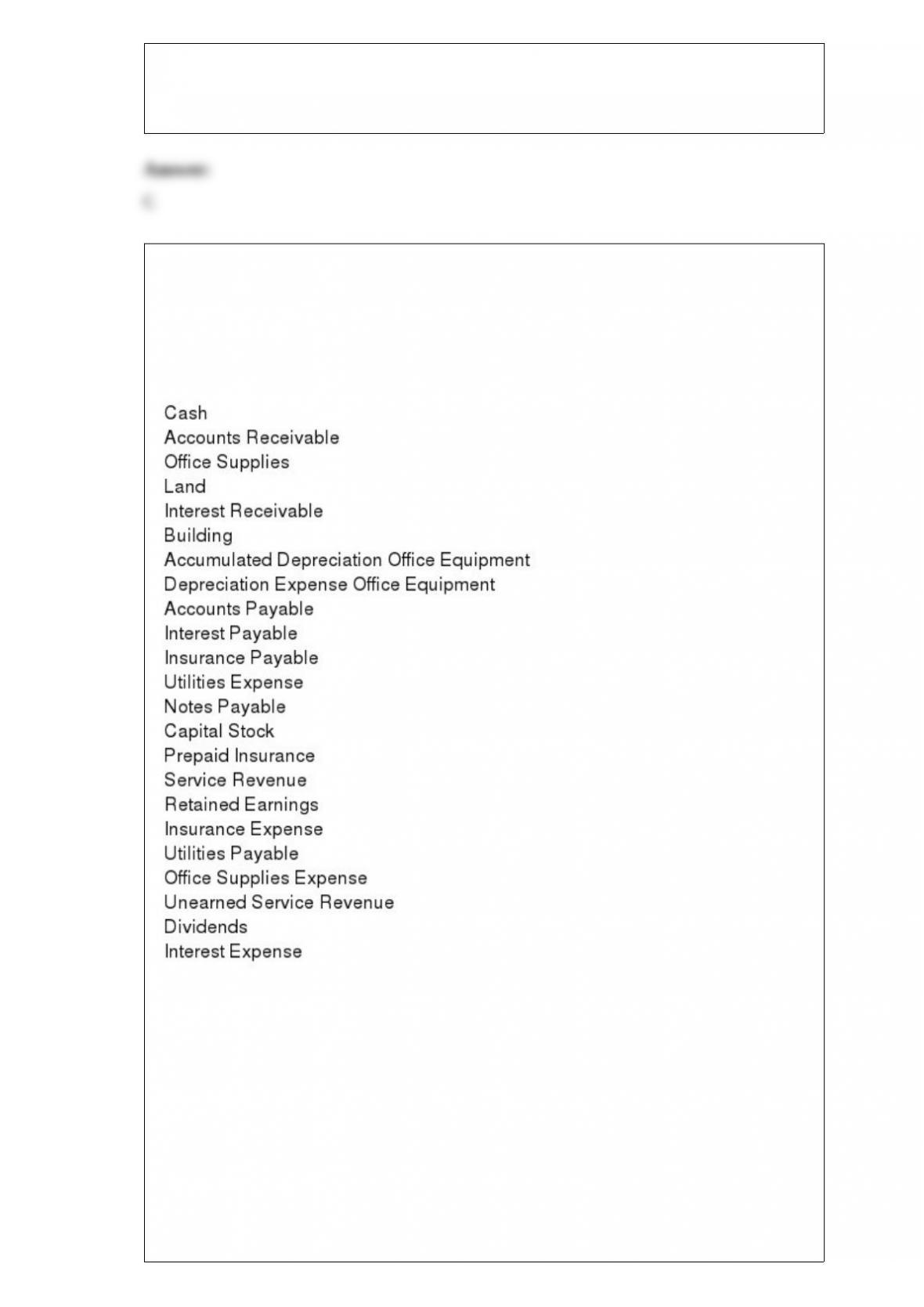
50) Listed below are accounts to use for transactions (a) through (j), each identified by
a number. Following this list are the transactions. You are to indicate for each
transaction the accounts that should be debited and credited by placing the account
number(s) in the appropriate box.
Transactions Account(s) Debited Account(s) Credited
a. Utility bill is received; payment will be made in 10 days.
b. Paid the utility bill previously recorded in transaction (a).
c. Bought a three-year insurance policy and paid in full.
d. Made an entry to adjust for the expired portion of the insurance premium (for the
policy mentioned in transaction (c).)
e. Received $7,000 from a contract to perform accounting services over the next two
years.
f. Made an entry to adjust for half of the services performed in (e).
g. Purchased office supplies, paying part cash and charging the balance on account.
h. Borrowed money from a bank and signed a note payable due in six months.
i. Recorded one-months accrued interest on the note payable in (h).
j. Depreciation is recorded on office equipment.
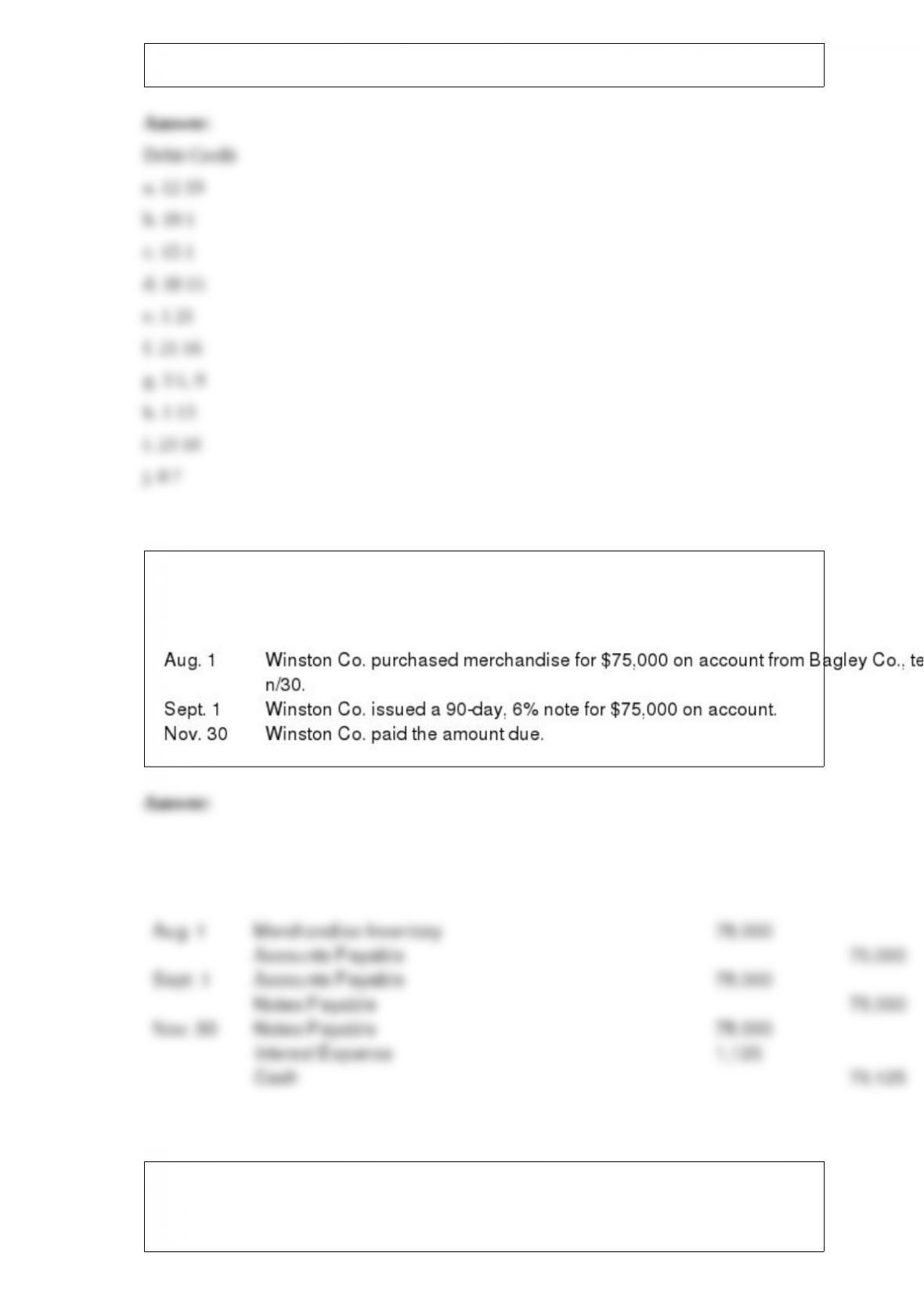
51) Journalize the following entries on the books of Winston Co. for August 1,
September 1, and November 30. (Assume a 360-day year is used for interest
calculations.)
52) The Trumpet Company produced 8,700 units of a product that required 3.25
standard hours per unit. The standard fixed overhead cost per unit is $1.20 per hour at
29,000 hours, which is 100% of normal capacity. Determine the fixed factory overhead
volume variance.
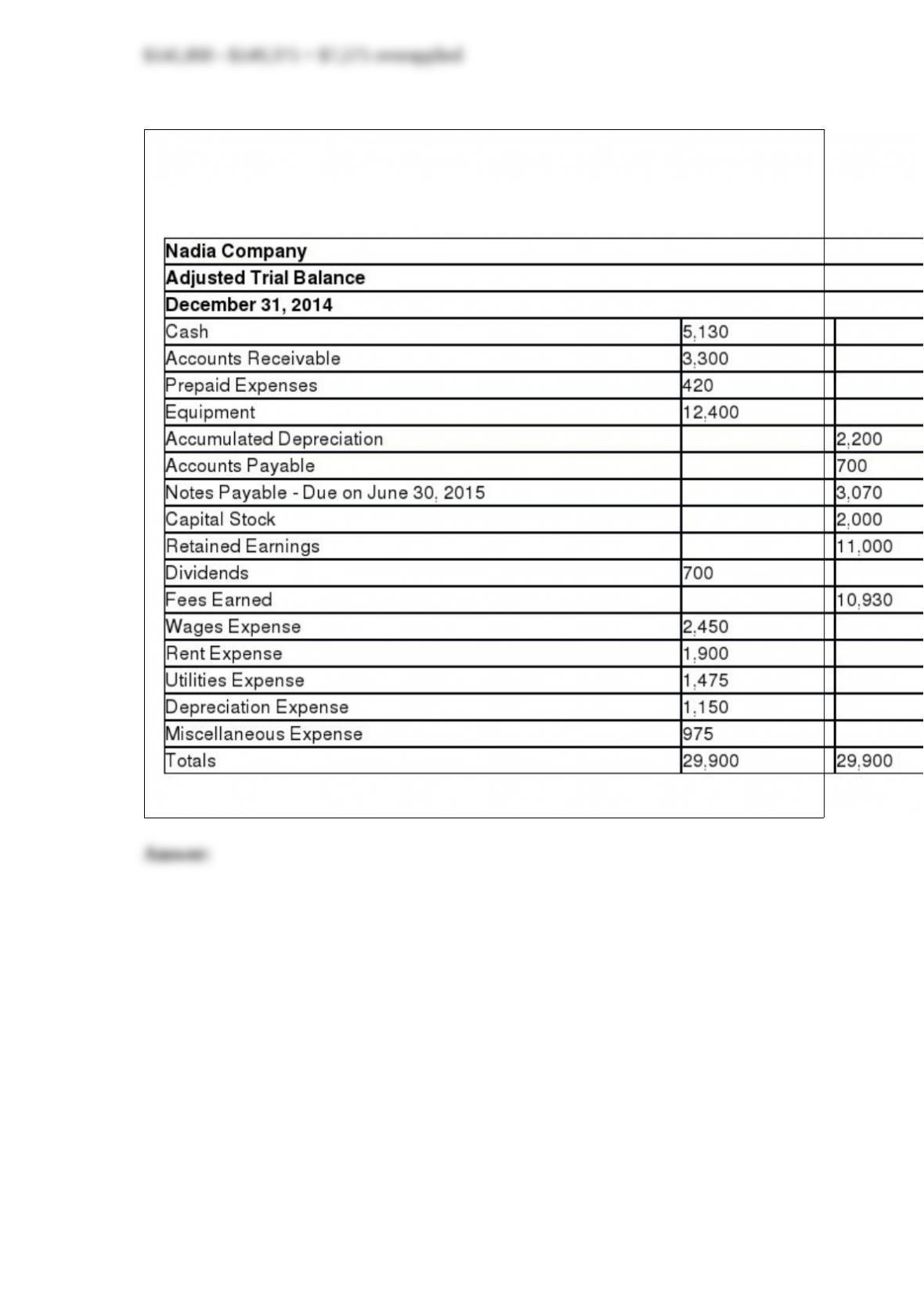
53) Using the following accounts and balances, prepare the Stockholders Equity section
of the balance sheet. Fifty thousand shares of common stock are authorized, and 5,000
shares have been reacquired.
54) The Cavy Company estimates that the factory overhead for the following year will
be $1,250,000. The company has decided that the basis for applying factory overhead
should be machine hours, which is estimated to be 40,000 hours. The machine hours for
the month of April for all of the jobs was 4,780. If the actual factory overhead totaled
$141,800, determine the over or under applied amount for the month.
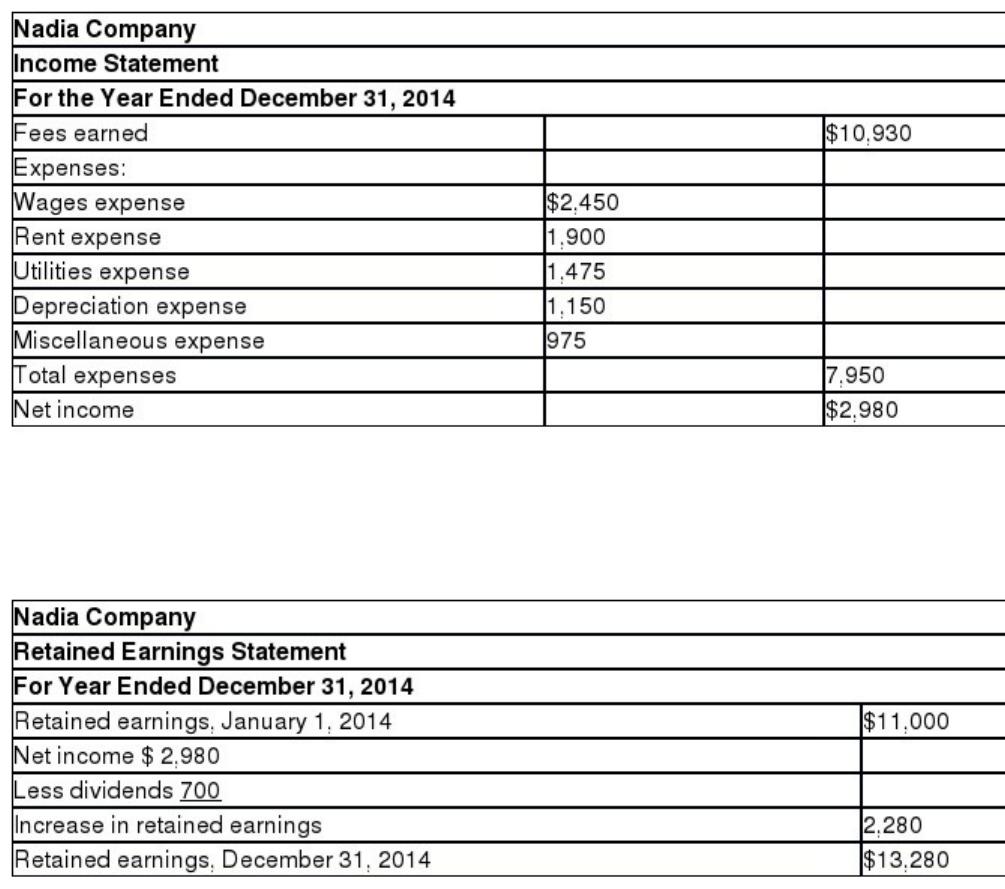
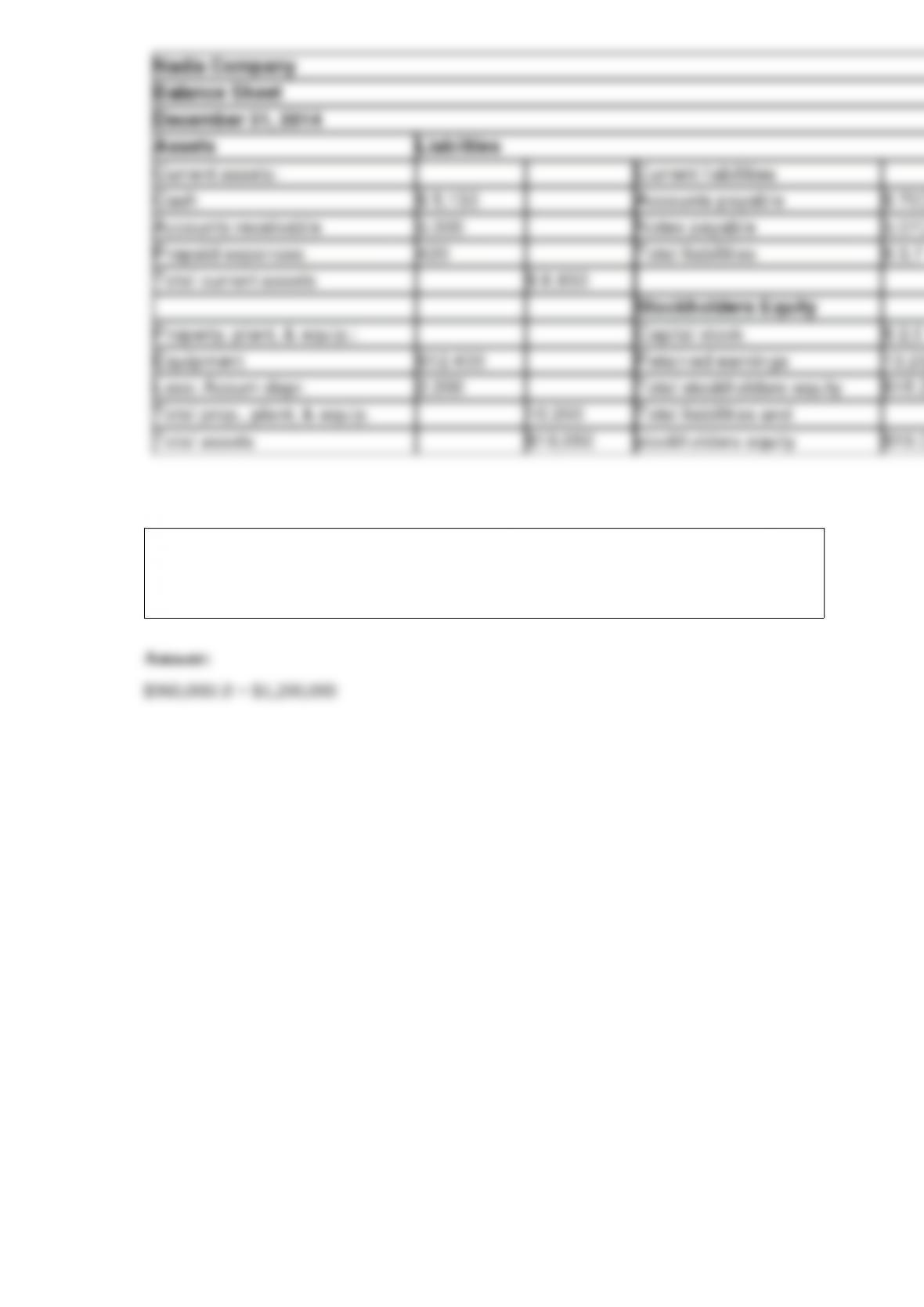
55) The following is the adjusted trial balance for Nadia Company prepared at the end
of Nadias fiscal year.
Prepare an income statement, retained earnings statement, and classified balance sheet.
56) A business had a margin of safety ratio of 20%, variable costs of 75% of sales, fixed
costs of $240,000, a break-even point of $960,000, and operating income of $60,000 for
the current year. Calculate the current year’s sales.