The threshold for recording contingent liabilities under IFRS is lower than that under
GAAP.
Answer:
Which of the following statements isTRUE about retained earnings?
A. Retained earnings represents cash available to pay dividends to stockholders.
B. Retained earnings cannot be restricted by loan covenants.
C. Retained earnings generally consists of cumulative net income less any net losses
and dividends since inception.
D. Retained earnings is reduced by the par value of stock splits.
Answer:
Prepaid expense accounts are reported as assets on the balance sheet.
Answer:
All revenues come from selling the company’s goods or services.
Answer:
The acquisition of equipment in an exchange for a company’s stock would increase the
current ratio of the company.
Answer:
Which of the following statements regarding the roles of accounting information is
notTRUE?
A. When creditors use accounting information to administer contracts, it serves a
contracting role.
B. When accounting data are used to assess the worth of a company or its stock, the
data are said to be used in a valuation role.
C. When accounting information is used in managing the business, it is being used in a
management function.
D. When directors use financial information, the information is being used in an audit
function.
Answer:
Manufacturers have three types of inventory: raw materials, work in process, and
finished goods, whereas merchandisers have only raw materials inventory.
Answer:
If total assets increase, then either liabilities or stockholders’ equity must also increase.
Answer:
When the times interest earned ratio declines, the likelihood of default on liabilities
increases.
Answer:
A company purchased a computer system on January 2, 2013 for $1,600,000. The
company used the straight-line depreciation method with an estimated useful life of 6
years and a residual value of $130,000. The company prepares financial statements at
December 31.
Use the information above to answer the following question. Which of the following
isTRUE about the depreciation recorded?
A. Accumulated depreciation will be debited for $266,667.
B. The net book value of the computer system at December 31, 2013 will be
$1,225,000.
C. Depreciation expense will be debited for $245,000.
D. The depreciable cost of the computer system is $1,600,000.
Answer:
Under current laws dealing with misstatements of financial results, which of the
following statements isTRUE?
A. Managers found guilty can escape paying fines if they declare bankruptcy.
B. Managers can be sentenced to long prison terms of up to 20 years per violation.
C. Managers found guilty may keep any bonuses or profits from the misrepresentation
if their fines are less than such bonuses or profits.
D. If you blow the whistle on your boss for misstating financial results, you can be
fired.
Answer:
A company forgot to make an adjusting entry to record wages incurred but unpaid at the
end of the period. This would understate Total Liabilities and overstate Retained
Earnings on the Balance Sheet.
Answer:
When assets are purchased as a group, the total cost must be divided up and allocated to
each asset in proportion to the market value of the assets as a whole.
Answer:

Which of the following statements regarding cash flows from investing activities
isTRUE?
A. The proceeds from sales of investments are reported as cash inflows from investing
activities.
B. Cash flows from investing activities are calculated by making adjustments to net
income.
C. Cash paid to acquire long-lived assets is reported as a cash inflow from investing
activities.
D. Cash received from issuing a long-term payable is reported as a cash inflow from
investing activities.
Answer:
Internal controls include the policies and procedures a company implements to protect
against theft of assets, to promote efficiency, and to ensure compliance with laws and
regulations.
Answer:
Which of the following statements regarding calculation of cash flows from operating
activities under the indirect method isTRUE?
A. When the indirect method is used, changes in current liabilities are subtracted while
changes in current assets are added to convert net income to net cash flow from
operating activities.
B. When the indirect method is used, depreciation expense is added to net income as a
step in the process of calculating net cash flow from operating activities.
C. When the indirect method is used, gains on the sale of property, plant and equipment
are added to convert net income to net cash flow from operating activities.
D. When the indirect method is used, changes in long-term liabilities are subtracted to
convert net income to net cash flow from operating activities.
Answer:
Which of the following isTRUE about reissuing treasury stock?
A. If treasury stock is sold at a higher price than the stock’s cost when the company
reacquired it, a gain will be recognized.
B. If treasury stock is sold at a higher price than the stock’s par value, a gain will be
recognized.
C. If the treasury stock is sold at a lower price than the amount of the original issuance,
a loss will be recognized.
D. A gain or loss on the reissuance of treasury stock is never recognized.
Answer:
In normal circumstances, the allowance for doubtful accounts for a company should be
a fairly consistent percentage of gross accounts receivable.
Answer:
Which of the following statements regarding a stock split isTRUE?
A. A stock split decreases retained earnings.
B. Stock splits do not require a journal entry.
C. Stock splits are the same as stock dividends.
D. Stock splits increase the par value per share.
Answer:
Sales revenue is $367,810 while sales returns and allowances and sales discounts total
$24,180. The cost of goods sold is $216,490, operating and other expenses are $28,500,
and the company pays $31,640 in income tax. Which of the following isTRUE?
A. Net sales is $343,630 and gross profit is $98,640.
B. Net sales is $67,000 and gross profit is $98,640.
C. Net sales is $343,630 and gross profit is $127,140.
D. Net sales is $367,810 and gross profit is $67,000.
Answer:
Bonds allow a company to borrow large sums of money from many different investors.
Answer:
Which of the following statements regarding the calculations used for the weighted
average inventory costing method isTRUE?
A. Under the weighted average cost method, if the goods in inventory were purchased
at three different prices, the three different prices would be added and then divided by
three to find the weighted average cost per unit.
B. When the weighted average inventory costing method is used, ending inventory and
cost of goods sold are calculated using different costs per unit.
C. There is no difference in the calculations under the weighted average method
whether a perpetual or periodic inventory system is used.
D. The weighted-average method will produce an inventory cost which is between the
results of FIFO and LIFO inventory costing methods.
Answer:
Which of the following statements is notTRUE?
A. Adjusting entries affect the cash account.
B. Adjustments to prepaid expenses and unearned revenues are deferral adjustments.
C. Adjustments for wages and income taxes are normally accrual adjustments.
D. Adjusting entries involve one income statement account and one balance sheet
account.
Answer:
Which of the following is notTRUE about the net realizable value of receivables?

A. It is equal to the total accounts receivable minus the allowance for doubtful
accounts.
B. It is equal to accounts receivable, net.
C. It is equal to the amount of receivables the company actually expects to collect.
D. It is a contra-asset account.
Answer:
Inventory levels increase by 10% at your company during the fourth quarter. Based on
this increase, which of the following statements isTRUE?
A. This is always good news because inventories are an asset to the company.
B. This could be good news if the company is ordering more goods because sales
appear to be rising.
C. This could be bad news if the company is ordering more goods because unit costs are
falling.
D. This is always bad news because higher inventories mean higher costs.
Answer:
Which of the following is not aTRUE statement?
A. Expenses are closed with a credit.
B. Revenues are closed with a debit.
C. Dividends are closed with a credit.
D. Retained earnings are closed with a debit.
Answer:
Contingent liabilities arise from past transactions, but depend on future events.
Answer:

Sales discounts are discounts that consumers get from buying clearance items at a
reduced price.
Answer:
Which of the following statements isTRUE?
A. The accumulated depreciation account includes cash flows that may be categorized
as both operating and investing.
B. Inventory includes cash flows that may be categorized as both operating and
investing.
C. Retained earnings includes cash flows that may be categorized as both operating and
investing.
D. Bonds payable includes cash flows that may be categorized as both operating and
financing.
Answer:
Special items such as gains or losses relating to changes in the value of certain balance
sheet accounts are reported below the net income line on the income statement.
Answer:
A company has a debt to assets ratio of 0.45. If the company then borrows cash from
the bank to finance a building acquisition, which of the following is aTRUE statement?
A. The debt to assets ratio will be unchanged.
B. The debt to assets ratio will increase.
C. The debt to assets ratio will decrease.
D. The debt to assets ratio will increase as a result of the cash received and then
decrease as a result of the building acquisition.
Answer:
If a company decides to record an expenditure made this period as an expense, when it
should have been recorded as an asset, net income will be overstated in the current
period as a result.
Answer:
On the date a dividend is declared, the company:
A. debits Dividends Declared and credits Dividends Payable for the amount of the
dividend.
B. debits Dividend Expense and credits Cash for the dividend amount.
C. debits Dividends Payable and credits Cash for the dividend amount.
D. establishes who will receive the dividend payment.
Answer:
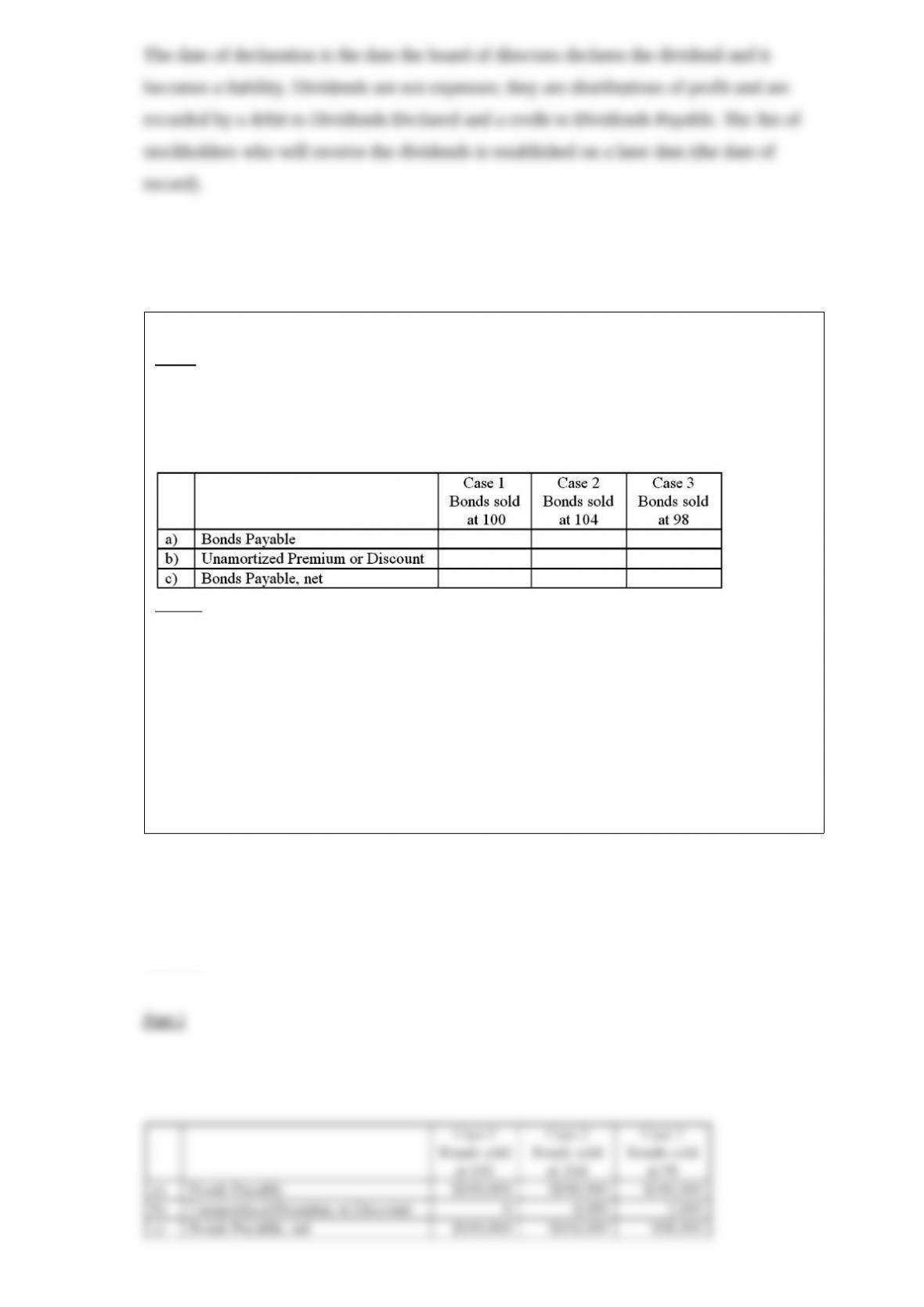
Part I
FWP Co. issued $100,000, 10-year bonds on January 1, 2013. The stated rate of interest
on the bonds is 10% payable annually on 12/31. Provide the requested information for
the bonds immediately after issuance (January 1, 2013) under each of the three
independent scenarios described below:
Part II
On January 1, 2014, FWP sells $2 million of 8% bonds at face value with interest to be
paid at the end of each year. Prepare the journal entries on the following dates:
a) January 1, 2014 (the initial bond sale).
b) March 31, 2014 (the end of the first quarter).
c) December 31, 2014 (the payment of interest at the end of the year; assume that the
interest owed for each of the first three quarters has been properly accrued).
Answer:
An additional paid-in capital account could be used with all of the following
transactions except:
A. The issuance of par value stock at a price greater than the par value.
B. The reissuance of treasury stock at a price less than the price paid when the stock
was reacquired.
C. The reissuance of treasury stock at a price greater than the price paid when the stock
was reacquired.
D. The issuance of no par stock.
Answer:
Which ratio is used to evaluate how a company is managing its property, plant and
equipment?
A. Accounts receivable turnover.
B. Inventory turnover.
C. Fixed asset turnover.
D. Asset turnover.
Answer:
Intel makes microchips from raw materials acquired from suppliers. Intel is a:
A. service company.
B. retail company.
C. manufacturer.
D. merchandising company.
Answer:
Which of the following accounts has a normal credit balance?
A. Cash
B. Notes receivable
C. Wage expense
D. Unearned revenue
Answer:
Which of the following would not appear as a possible liability on the balance sheet?
A. Accounts payable
B. Contributed capital
C. Notes payable
D. Wages payable
Answer:
Which of the following is calculated by dividing net sales by average accounts
receivable?
A. Days to sell ratio.
B. Current ratio.
C. Profit margin.
D. Accounts receivable turnover ratio.
Answer:
Closing entries:
A. are prepared before financial statements are prepared.
B. reduce the number of permanent accounts.
C. cause the revenue and expense accounts to have zero balances.
D. summarize the activity in every account.
Answer:
A company pays $18,000 in interest on notes, consisting of $12,000 interest that
accrued during the last accounting period and $6,000 of interest accumulated during
this accounting period but not previously recorded on the books. The journal entry for
the interest payment should:
A. debit Interest Expense for $18,000 and credit Cash for $18,000.
B. debit Cash for $18,000 and credit Interest Payable for $18,000.
C. debit Interest Expense for $6,000, debit Interest Payable $12,000 and credit Cash for
$18,000.
D. debit Interest Payable for $12,000, debit Accrued Interest $6,000 and credit Cash for
$18,000.
Answer:
In October, you borrow $50,000 in order to buy new equipment. The loan is repayable
in five years, at 8% annual interest. Semiannual interest payments are due each March
and September. Assuming no other long-term debt, what is the initial balance in the
long-term debt account?
A. $54,000
B. $50,000
C. $46,000
D. $52,000
Answer:
Below is an alphabetical listing of all of the accounts for T.O.’s Dance Studio on
12/31/14. Assume all adjustments have been made and all balances are “normal”.
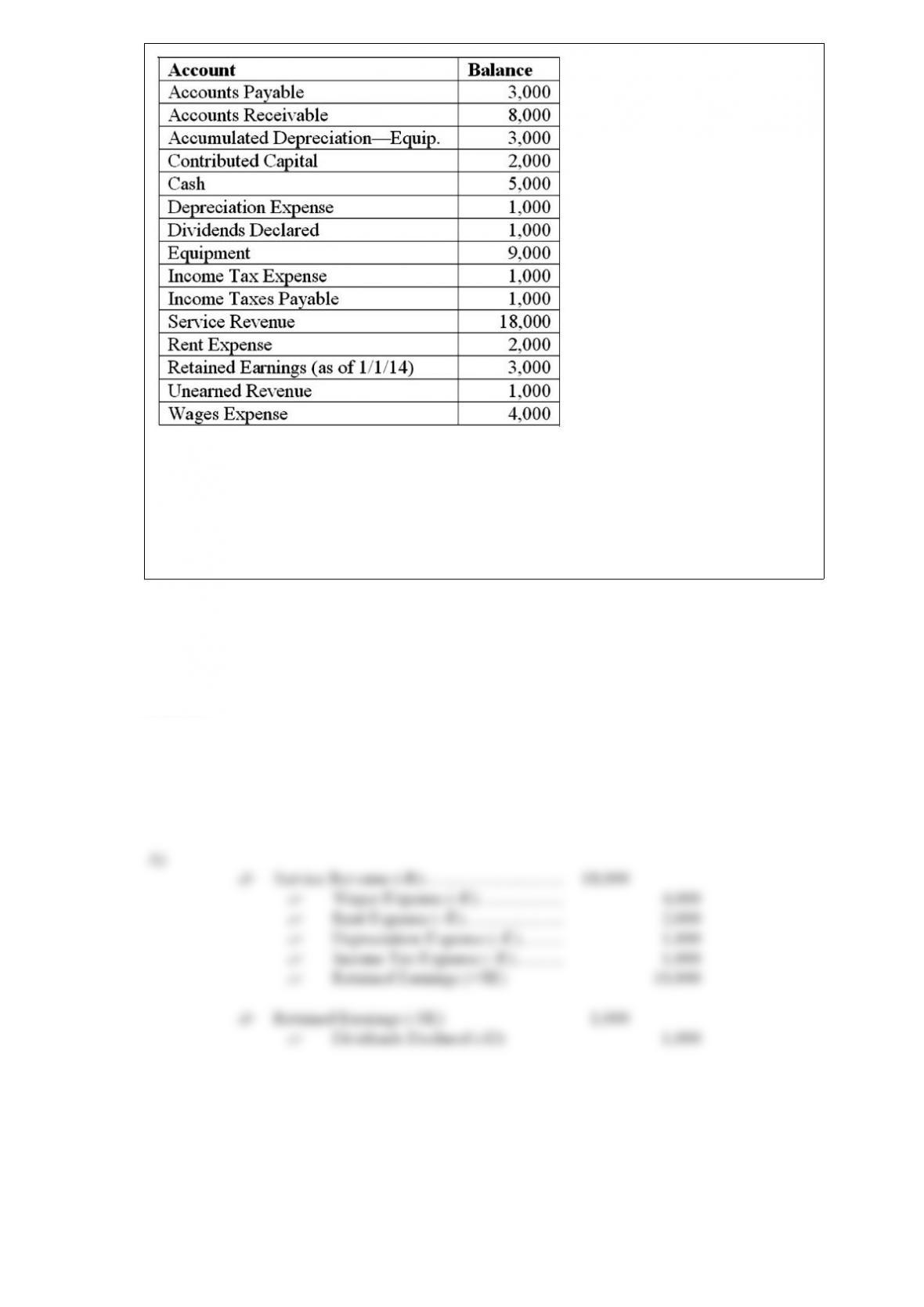
A) Prepare closing entries for T.O.’s Dance Studio.
B) Prepare the post-closing trial balance for T.O.’s Dance Studio.
C) Prepare the classified balance sheet for T.O.’s Dance Studio.
Answer:
Your company sells $50,000 of bonds for an issue price of $52,000. Which of the

following statements is correct?
A. The bond sold at a price of 52, implying a premium of $2,000.
B. The bond sold at a price of 104, implying a discount of $2,000.
C. The bond sold at a price of 52, implying a discount of $2,000.
D. The bond sold at a price of 104, implying a premium of $2,000.
Answer:
Use the information above to answer the following question. The entry made by the
company to record this loan to the employee will include a:
A. Debit to Accounts Receivable for $10,000.
B. Credit to Sales for $10,000.
C. Debit to Notes Receivable for $10,000.
D. Credit to Notes Payable for $10,000.
Answer:

According to Generally Accepted Accounting Principles, which of the following is not a
characteristic of useful financial information?
A. comparable.
B. verifiable.
C. timely.
D. ethical.
Answer:
Faithful representation is a characteristic of external financial reporting that means
A. the financial reports of a business are assumed to include the results of only that
business’s activities.
B. financial information can be compared across businesses because similar accounting
methods are applied.
C. the results of business activities are reported using an appropriate monetary unit.
D. financial information depicts the economic substance of business activities.
Answer:
A company sells goods at a selling price of $20,000. The cost of the goods is $15,000.
Under a perpetual inventory system the journal entries to record the sale will include:
A. $15,000 will be debited to Inventory and $15,000 will be credited to Sales.
B. $15,000 will be debited to Cost of goods sold and $15,000 will be credited to
Inventory.
C. $15,000 will be credited to Inventory and $15,000 will be credited to Sales.
D. $15,000 will be debited to Cost of goods sold and $15,000 will be credited to Sales.
Answer:
In reviewing the accounts receivable, the net receivables value is $17,000 before
writing off a $1,500 account. What is the net receivables value after the write-off?
A. $17,000.
B. $1,500.
C. $18,500.
D. $15,500.
Answer:
Differences between GAAP and IFRS do not include which of the following?
A. The order in which assets are presented on the balance sheet.
B. The system of analyzing, recording, and summarizing transactions.
C. The names given to the income statement, balance sheet, and statement of
stockholders’ equity.
D. The standard-setting body with authority to establish accounting principles.
Answer:

The first year of operations for a company was 2013. The net income for the year 2013
was $20,000 and dividends of $12,000 were paid. In 2014, the company reported net
income of $34,000 and paid dividends of $5,000. At the end of 2013, the company had
total assets of $150,000, and at the end of 2014, total assets were $240,000.
What is the amount of retained earnings at the end of 2014?
A. $37,000.
B. $240,000.
C. $29,000.
D. $269,000.
Answer:
If a corporation declares and distributes a 10% stock dividend on its common shares,
the account debited is:

A. Dividends Payable.
B. Common Stock.
C. Additional Paid-in Capital.
D. Retained Earnings.
Answer:
Net Income refers to:
A. The difference between what was earned and the costs incurred during a period.
B. The difference between the cash received and the cash paid out during a period.
C. The difference between what is owned and what is owed at a point in time.
D. The change in the value of the company during a period.
Answer:
A company bought a piece of equipment for $40,000, expecting to use it for eight years.
The company then plans to sell it for $3,500. The company has already recorded
depreciation of $35,995. Using the double-declining-balance method, the company’s
annual depreciation expense for the upcoming year would be:
A. $1,001.
B. $9,125.
C. $505.
D. $10,000.
Answer:
Which of the following would be in the finished goods inventory of a company making
cheese?

A. Milk and cream used to make the cheese.
B. Cheese that has been made but is curing before being ready to sell.
C. Cured cheese that is waiting to be shipped to retailers.
D. Cured cheese that has been sold to retailers.
Answer:
Numerous accounting scandals and material financial misrepresentations resulted in the
SEC:
A. taking over responsibility for setting accounting rules in the United States.
B. requiring companies to issue monthly reports on financial data.
C. requiring companies to have two different accounting firms audit the financial
statements included in the annual report on Form 10-K.
D. introducing severe legal consequences for managers found guilty of such actions.
Answer:
What is the detailed report that companies file annually with the Securities and
Exchange Commission?
A. Form 8-K.
B. Form 10-Q.
C. Form 10-K.
D. Form 5-K.
Answer:
Which one of the following would not be considered an operating activity?
A. pay employees for work completed
B. buy supplies on account
C. purchase equipment for cash
D. sell goods to customers
Answer:
According to the principle of conservatism, when faced with uncertainty about the
value of an item, a company should use the measure that avoids:
A. overstating assets and liabilities.
B. overstating assets and understating liabilities.
C. understating assets and overstating liabilities.
D. understating assets and liabilities.
Answer:
Debentures are
A. unsecured bonds.
B. secured bonds.
C. serial bonds.
D. callable bonds.
Answer:
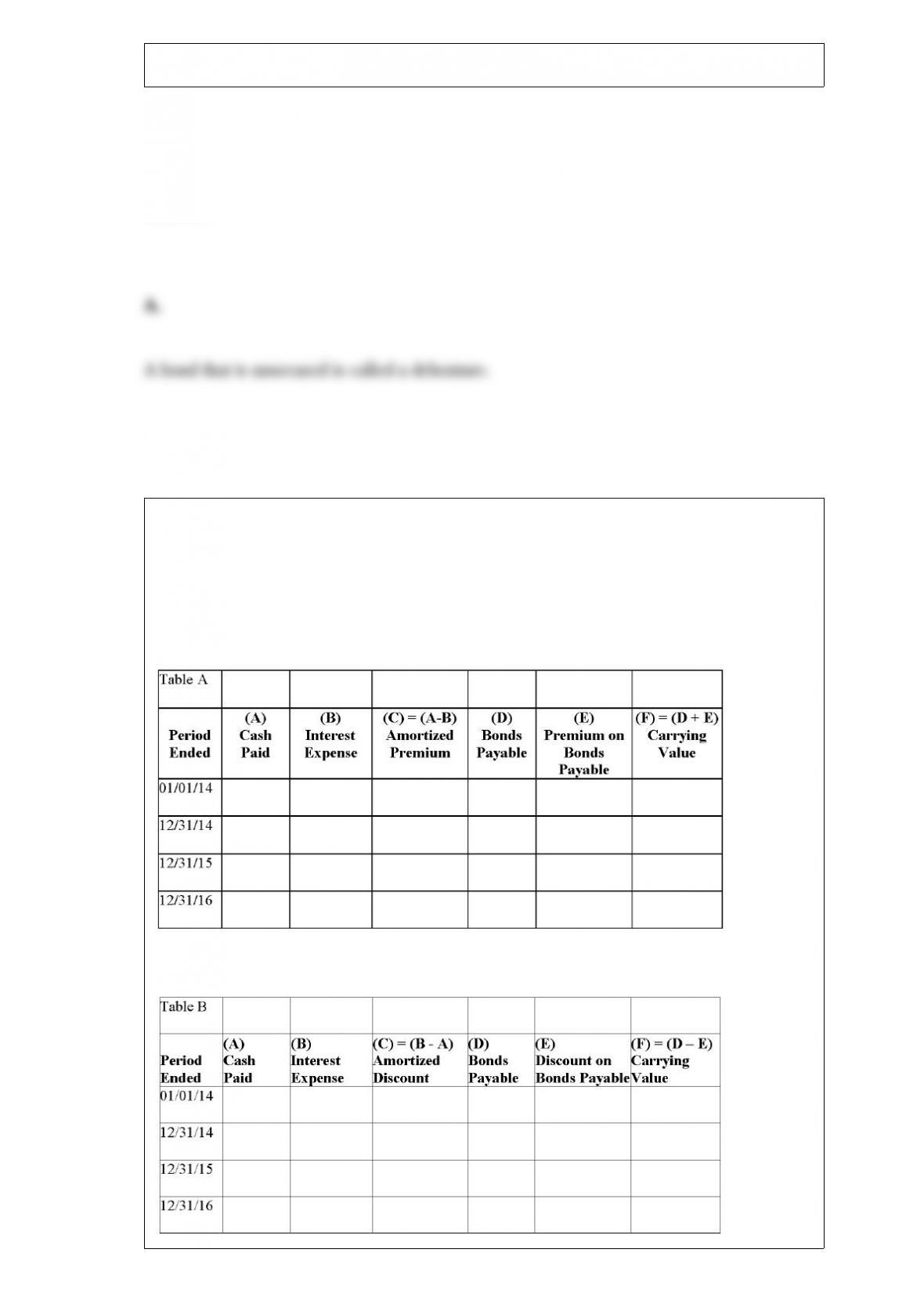
On January 1, 2014, a company sells a 3-year bond with a face value of $50,000 and a
stated interest rate of 7%. Because the market interest rate is 5%, the company receives
$52,723 for the bond. The company uses the effective interest method of amortization.
Fill in Table A. Fill in Table B assuming the market interest rate is 9%, and the
company received only $47,469 for the bond and the company uses the
effective-interest method.

Answer:
Company A uses an accelerated depreciation method while Company B uses the
straight-line method. All other things being equal, during the first few years of the
asset’s use, Company A will show which of the following compared to Company B?
A. Higher asset values and higher net income.
B. Lower asset values and higher net income.
C. Higher asset values and lower net income.
D. Lower asset values and lower net income.
Answer:
The unadjusted trial balance:
A. is a preliminary financial statement for external and internal users.
B. generally lists account names in alphabetical order.
C. is created to determine that total debits equal total credits.
D. indicates whether or not errors were made in recording transactions.
Answer:
A company began the year with assets of $100,000 and liabilities of $75,000. During
the year assets increased by $12,000 and liabilities decreased by $9,000.
What is the amount of stockholders’ equity at the beginning of the year?
A. $0.
B. $25,000.
C. $175,000.
D. $100,000.
Answer:

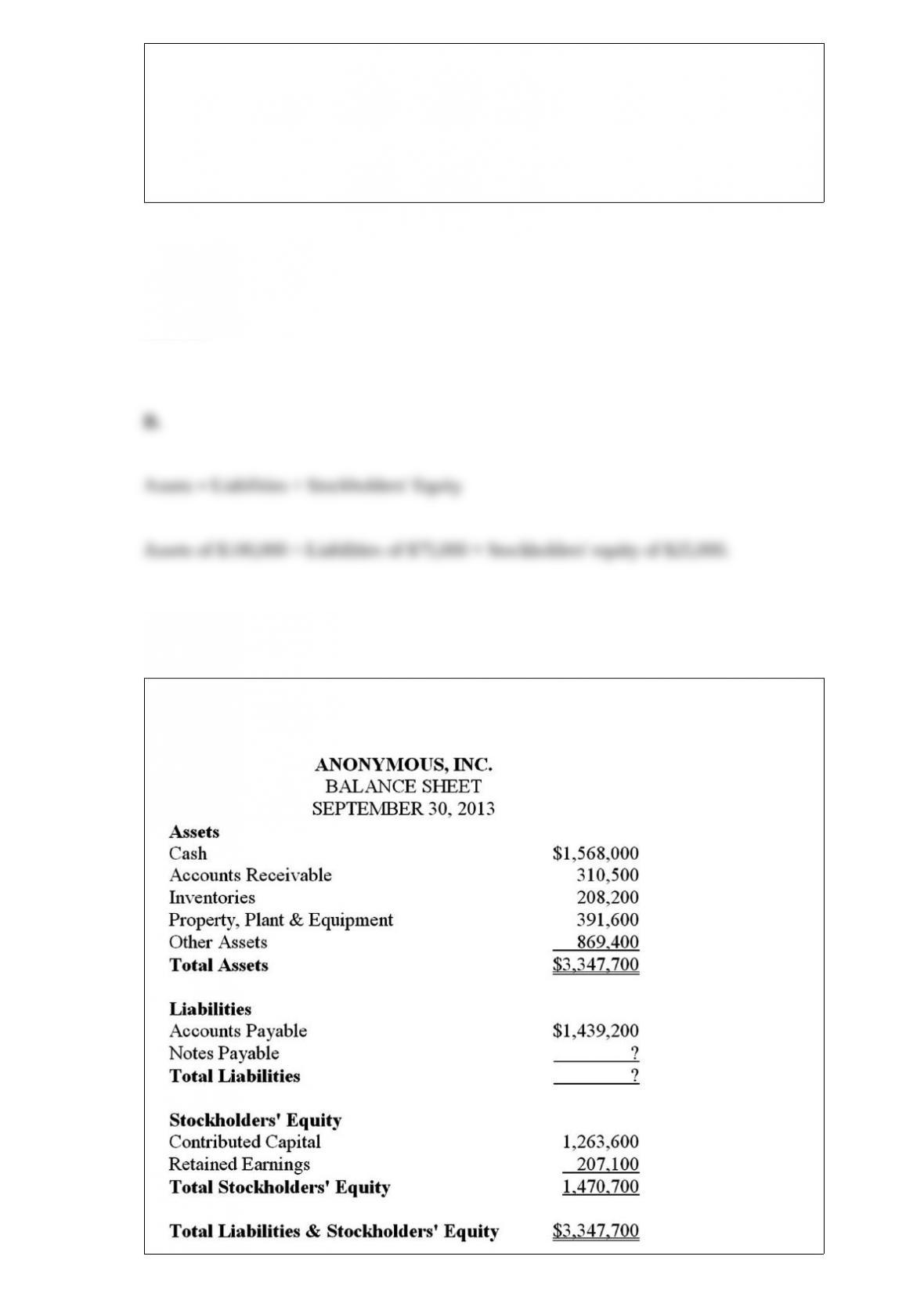
What is the missing amount for Total Liabilities?
A. $3,347,700
B. $1,439,200
C. $1,470,700
D. $1,877,000
Answer:
During 2014, Company X sells 500,000 units for $8 each. Sales discounts are $100,000
and sales returns and allowances are $300,000. The company reported a total of
$710,000 in fixed assets on January 1, 2014 and $890,000 in fixed assets on December
31, 2014.
a. Calculate net sales revenue.
b. Calculate average fixed assets.
c. Calculate the fixed asset turnover ratio.
d. Assume the 2014 fixed asset turnover ratio was lower than the 2013 ratio. Describe
one circumstance where this change would indicate bad news and one circumstance
where this change would be consistent with good news.
Answer: