Which of the following is not a step in estimating total cost using the high-low method?
a.Identify the highest and lowest levels of activity
b.Visually “fit” a line to the plotted points
c.Compute the variable cost per unit
d.Calculate the fixed cost using either the high point or the low point.
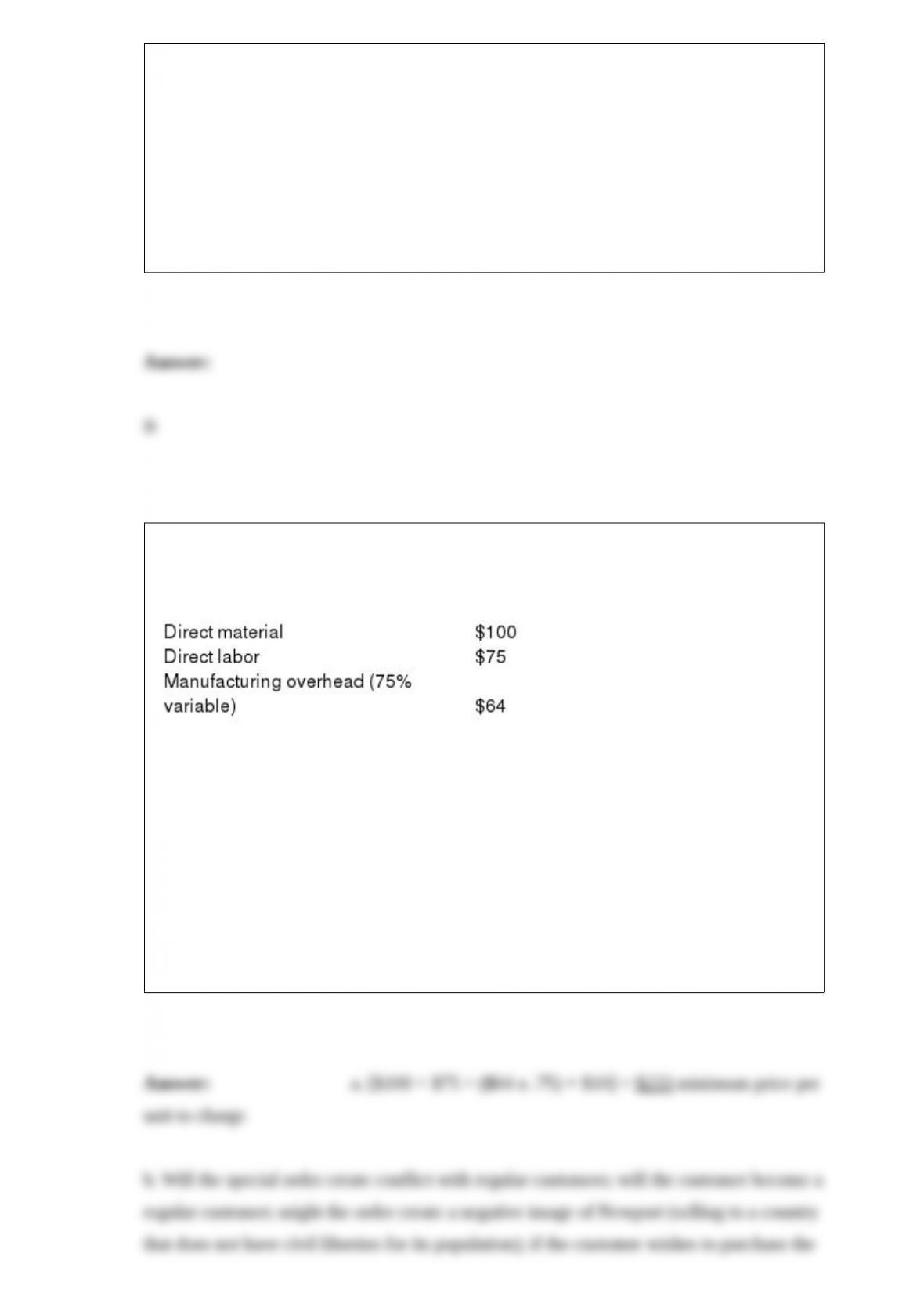
Newport Manufacturing makes and sells backyard fire pits. Each fire pit regularly sells
for $269. The following cost data per unit are based on a full capacity of 3,000 fire pits
produced each period.
Newport is negotiating a special order for the sale of 75 fire pits to an overseas
customer who is located in a country that does not have civil liberties for its population.
The only selling cost that would be incurred on the special order would be a $10 sales
commission. Newport is expected to make 2,500 fire pits before the special order.
Required:
a. What is the minimum selling price Newport should negotiate for the special order?
b. What are three factors other than relevant costs that Newport should consider
concerning this special order?
The formula for operating income is
a. Sales revenue – variable costs – fixed costs
b. Sales revenue – variable costs – fixed costs – profit
c. Sales revenue – contribution margin – variable costs
d. Sales revenue – gross margin – fixed costs
Without affecting their ability to meet customer demand, some companies have found
they can reduce inventory levels by using a just-in-time system as much as
a.5% to 10%
b.20% to 25%
c.35% to 40%
d.50% to 60%
Logan Corporation reported the following operating data for the past year:
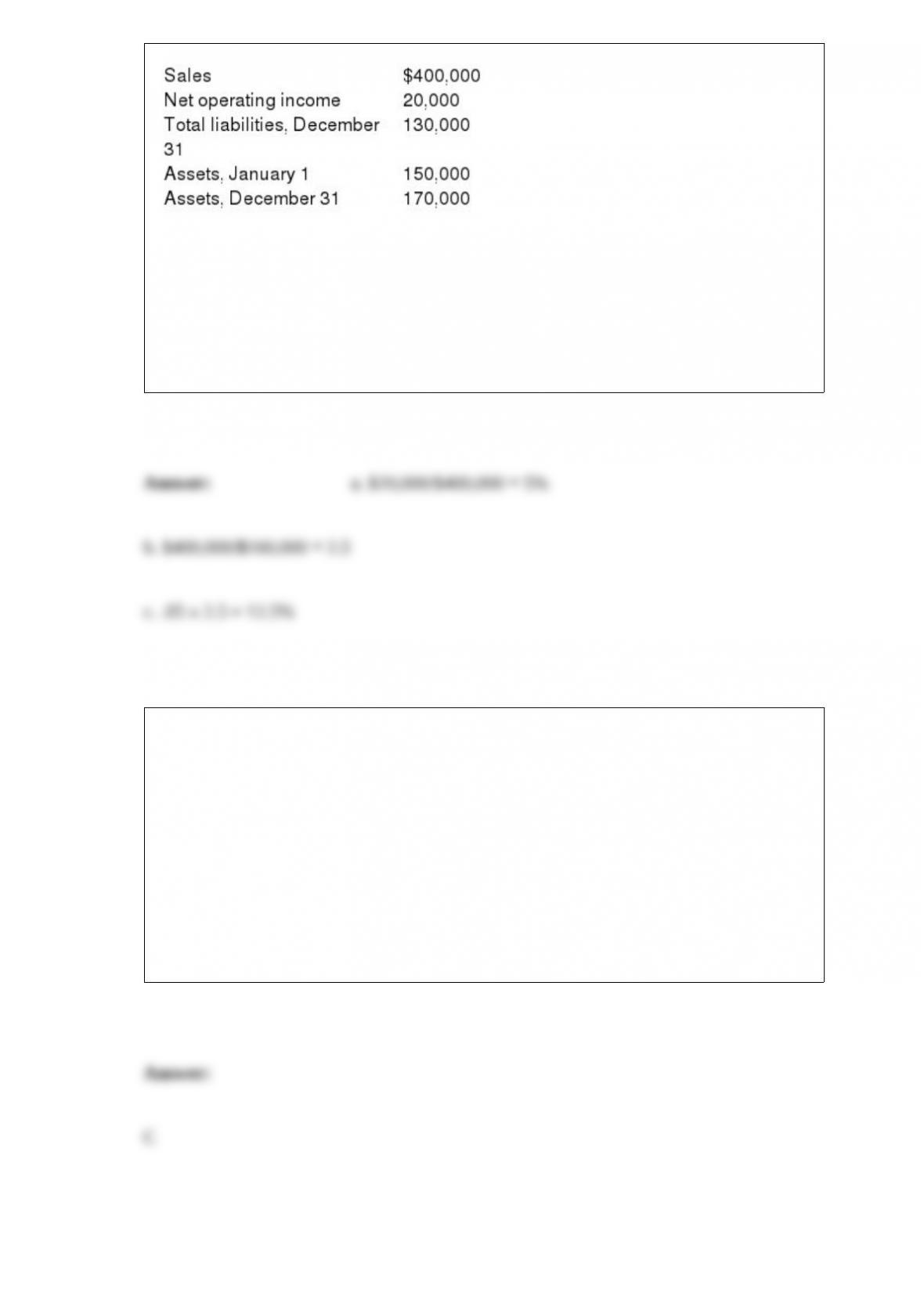
Required:
a. Calculate Logan ‘s margin.
b. Calculate Logan ‘s asset turnover.
c. Calculate Logan ‘s ROI.
Before you can calculate the present value of a cash flow, you must
a. Identify the amount and timing of each cash flow
b. Determine the appropriate discount rate
c. Both identify the amount and timing of each cash flow and determine the appropriate
discount rate
d. Neither identify the amount and timing of each cash flow nor determine the
appropriate discount rate

All other things equal, a company can increase its operating leverage by converting
a. Commission- based salespeople to salaried.
b. Increase the amount of depreciation charges.
c. Direct costs to indirect costs.
d. Manufacturing overhead to general and administrative expenses.
Which of the following is not a characteristic of zero-based budgeting?
a. This method of budgeting is often used in governmental entities.
b. This method of budgeting is much more time-consuming than incremental budgeting.
c. This method of budgeting encourages budgetary slack.
d. All of these answer choices are characteristics of zero-based budgeting.
Walker’s Manufacturing began its operations on January 1 of the current year. Walker
produced 10,000 units during the year, sold 8,000 units at an average cost of $22 per
unit, and had 2,000 units in ending inventory. Variable production cost were $14 per
unit, variable selling expenses were $2 per unit, fixed overhead totaled $12,000, and
fixed selling and administrative expenses totaled $30,000. Under variable costing, what
was Walker’s operating income?
a. ($26,000)
b. $6,000
c. $8,400
d. $10,000
A company’s salaries payable account decreased by $1,000 during the year. Which of
the following would appear on the statement of cash flows prepared using the indirect
method?
a. An addition under investing activities
b. A deduction under investing activities
c. An addition under operating activities
d. A deduction under operating activities
A management tool that focuses on improving the efficiency and effectiveness of an
organization’s business processes through radical change is referred to as
a. Business process reengineering.
b. Process improvement.
c. Radical analysis.
d. Activity-based management.

At Devoe Manufacturing, the vice-president of the Southern Division is responsible for
the production and selling of products in fifteen states as well as securing the
productive assets needed to create the product. This division is an example of which of
the following responsibility centers?
a. Cost center
b. Revenue center
c. Profit center
d. Investment center