
1) Freeman Co. had net sales of $4.2 million and ending accounts receivable of $0.8
million. Its days’ sales uncollected equals:
A.5.3 days.
B.69.5 days.
C.19.2 days.
D.11.5 days.
E.292 days.
2) Which of the following transactions or events should be reported as a source of cash
from operating activities when using the direct method?
A.Credit sales.
B.Cash collections from customers.
C.Depreciation expense.
D.Cash received from the sale of a building.
E.Cash received from the sale of treasury stock.
3) The statement of cash flows is:
A.Another name for the statement of financial position.
B.A financial statement that presents information about changes in equity during a
period.
C.A financial statement that reports the cash inflows and cash outflows for an
accounting period, and that classifies those cash flows as operating activities, investing
activities, or financing activities.
D.A financial statement that lists the types and amounts of assets, liabilities, and equity
of a business on a specific date.
E.A financial statement that lists the types and amounts of the revenues and expenses of
a business for an accounting period.
4) A company purchased $1,800 of merchandise on July 5 with terms 2/10, n/30. On
July 7, it returned $200 worth of merchandise. On July 8, it paid the full amount due.
The amount of the cash paid on July 8 equals:
A.$200.
B.$1,564.
C.$1,568.
D.$1,600.
E.$1,800.
5) Claremont Company specializes in selling refurbished copiers. During the month, the
company sold 180 copiers for total sales of $540,000. The budget for the month was to
sell 175 copiers at an average price of $3,200. The sales price variance for the month
was.
A.$20,000 unfavorable.
B.$20,000 favorable.
C.$36,000 unfavorable.
D.$32,000 unfavorable.
E.$36,000 favorable.
6) All of the following statements regarding stock dividends are true except:
A.Directors can use stock dividends to keep the market price of the stock affordable.
B.Stock dividends provide evidence of management’s confidence that the company is
doing well.
C.Stock dividends do not reduce assets or equity.
D.Stock dividends decrease the number of shares outstanding.
E.Stock dividends transfer a portion of equity from retained earnings to contributed
capital.
Match the following terms with the definitions.
7) 1)Costing system that measures costs per unit upon completion of a job.
2)Report of total costs charged to a department, describes its equivalent units of
production achieved, and allocates costs among units worked on in the period.
3)A manufacturing system that contains features of both process costing and job order
costing systems.
4)Number of units that could have been started and completed given the costs incurred
during the period.
5)System of measuring unit costs at the end of a period by combining costs per
equivalent unit from each separate department.
6)Document that summarizes the materials a department uses when inventory moves
continuously through the manufacturing process during a reporting period; replaces
materials requisition.
7)Mass production of similar products in a continuous flow of sequential processes.
A. Job order costing system
B. Materials consumption report
C. Process cost summary
D. Hybrid costing system
E. Equivalent units of production
F. Process costing system
G. Process operations
8) Once the estimated depreciation expense for an asset is calculated:
A.It cannot be changed, based on the historical cost principle.
B.It may be revised based on new information.
C.Any changes are accumulated and recognized when the asset is sold.
D.The estimate itself cannot be changed; however, new information should be disclosed
in financial statement footnotes.
E.It cannot be changed, based on the consistency principle.
9) Standard costs are:
A.Actual costs incurred to produce a specific product or perform a service.
B.Preset costs for delivering a product or service under normal conditions.
C.Established by the IMA.
D.Rarely achieved.
E.Uniform among companies within an industry.
10) Comparative calendar year financial data for a company are shown below. Calculate
the following ratios for 2016:
(a) return on total assets
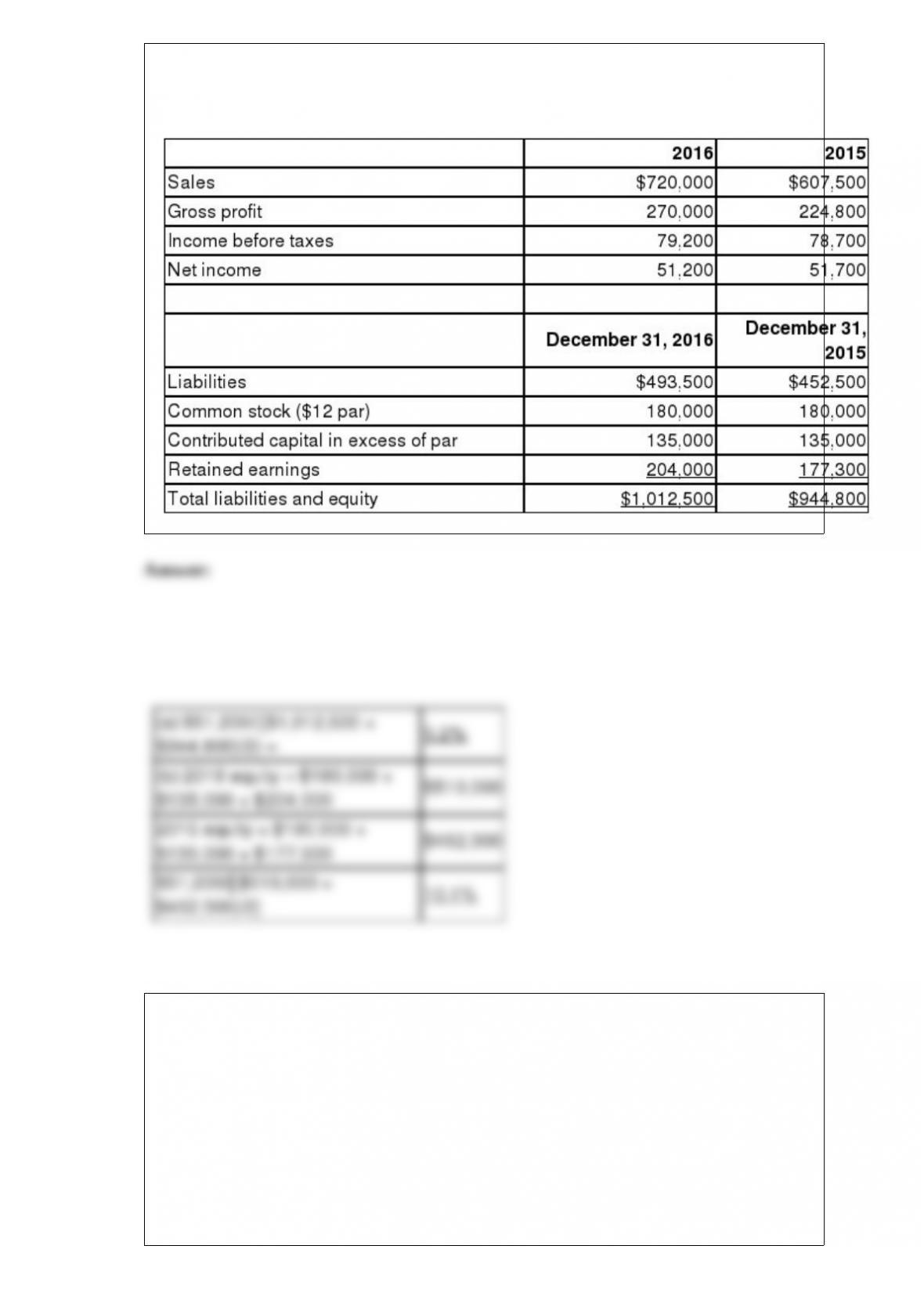
(b) return on common stockholders’ equity.
11) Product A requires 5 machine hours per unit to be produced, Product B requires
only 3 machine hours per unit, and the company’s productive capacity is limited to
240,000 machine hours. Product A sells for $16 per unit and has variable costs of $6 per
unit. Product B sells for $12 per unit and has variable costs of $5 per unit. Assuming the
company can sell as many units of either product as it produces, the company should:
A.Produce only Product A.
B.Produce only Product B.
C.Produce equal amounts of A and B.
D.Produce A and B in the ratio of 62.5% A to 37.5% B.
E.Produce A and B in the ratio of 40% A and 60% B.
12) A company has the choice of either selling 1,000 defective units as scrap or
rebuilding them. The company could sell the defective units as they are for $4.00 per
unit. Alternatively, it could rebuild them with incremental costs of $1.00 per unit for
materials, $2.00 per unit for labor, and $1.50 per unit for overhead, and then sell the
rebuilt units for $8.00 each. What should the company do?
A.Sell the units as scrap.
B.Rebuild the units.
C.It does not matter because both alternatives have the same result.
D.Neither sell nor rebuild because both alternatives produce a loss. Instead, the
company should store the units permanently.
E.Throw the units away.
13) Identify the five steps involved in managerial decision making.
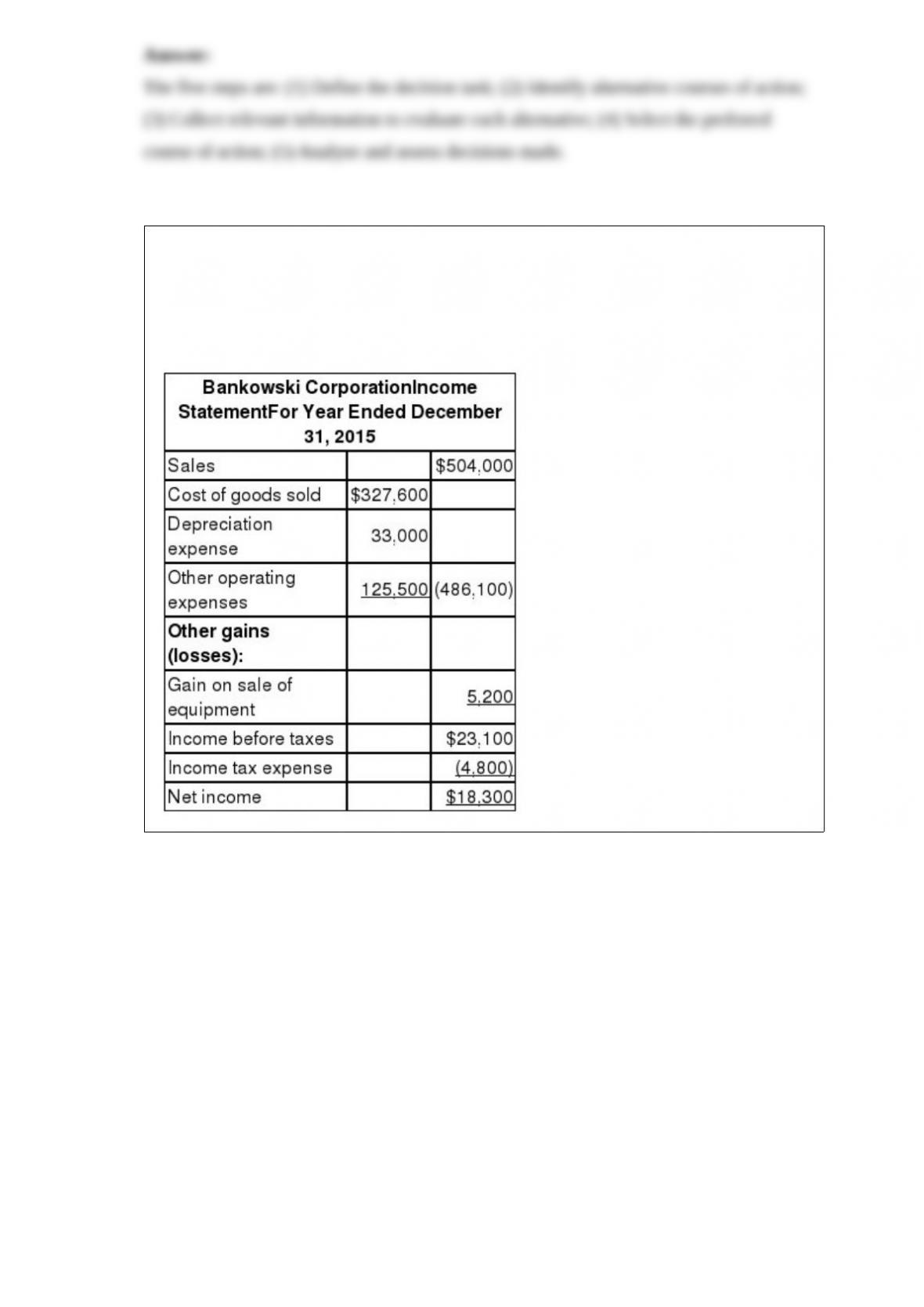
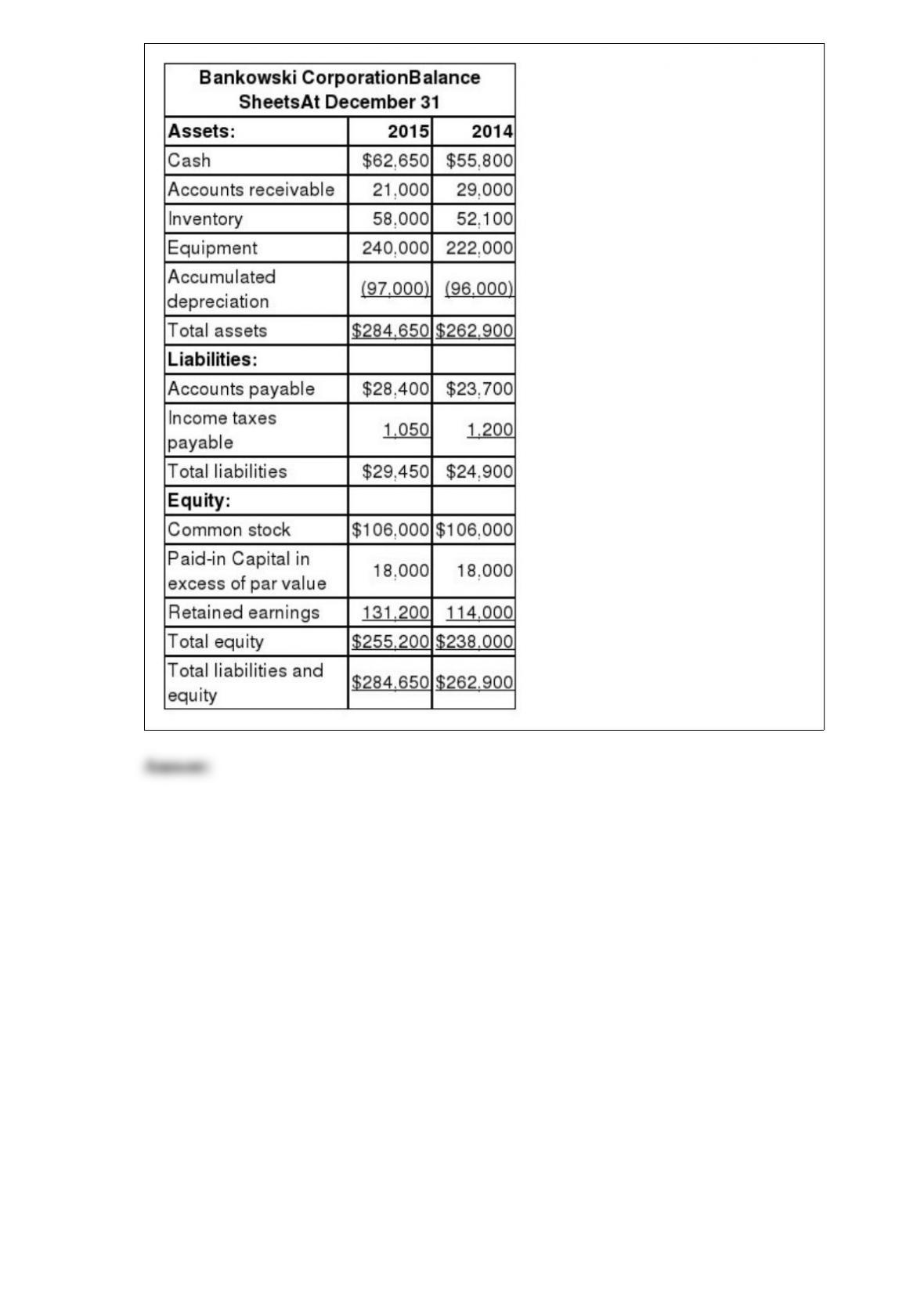
14) Based on the following income statement and balance sheet for Bankowski
Corporation, determine the cash flows from operating activities using the indirect
method.
15) On January 1, 2016, a company disposed of equipment for $16,200 cash that had
cost $35,000, a salvage value of $5,000, and a useful life 10 years. The
double-declining-balance depreciation method was used. On December 31, 2015,
accumulated depreciation was $20,664. Prepare a journal entry to record the disposal of
the equipment.
16) Identify and discuss the key characteristics of partnerships. Also, identify other
organizations that possess partnership characteristics.
17) A company’s predetermined overhead rate is applied at 130% of direct labor cost.
How much overhead would be allocated to Job No. 105 if it required total direct labor
costs of $60,000?
18) The current ratio and acid-test ratio are used to reflect the ____________ of a
business.
19) Revenue expenditures to keep an asset in normal, good operating condition; they
are necessary if an asset is to perform to expectations over its useful life are called
_____________________.
20) Describe the flow of the employee labor, both direct and indirect, through the
inventory accounts.
21) Obligations due within one year or the company’s operating cycle, whichever is
longer, are ________________________.