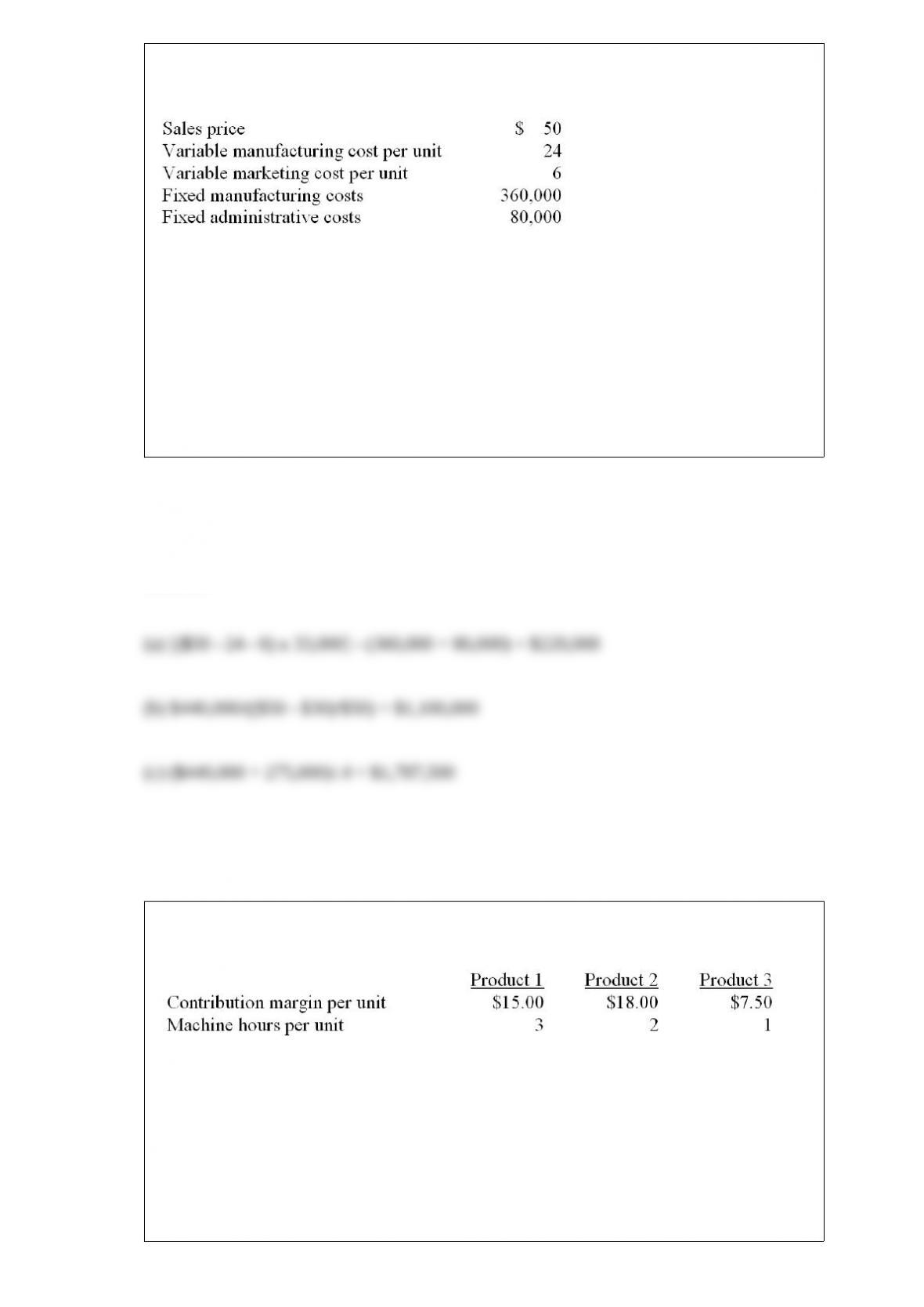
You have been provided with the following information regarding the VLCD
Manufacturing Company:
This information is based on forecasted sales of 33,000 units.
Required:
(a) What are the expected operating profits for the upcoming year?
(b) What is the break-even point in dollars?
(c) How much in sales dollars is required to generate an operating profit of $275,000?
Answer:
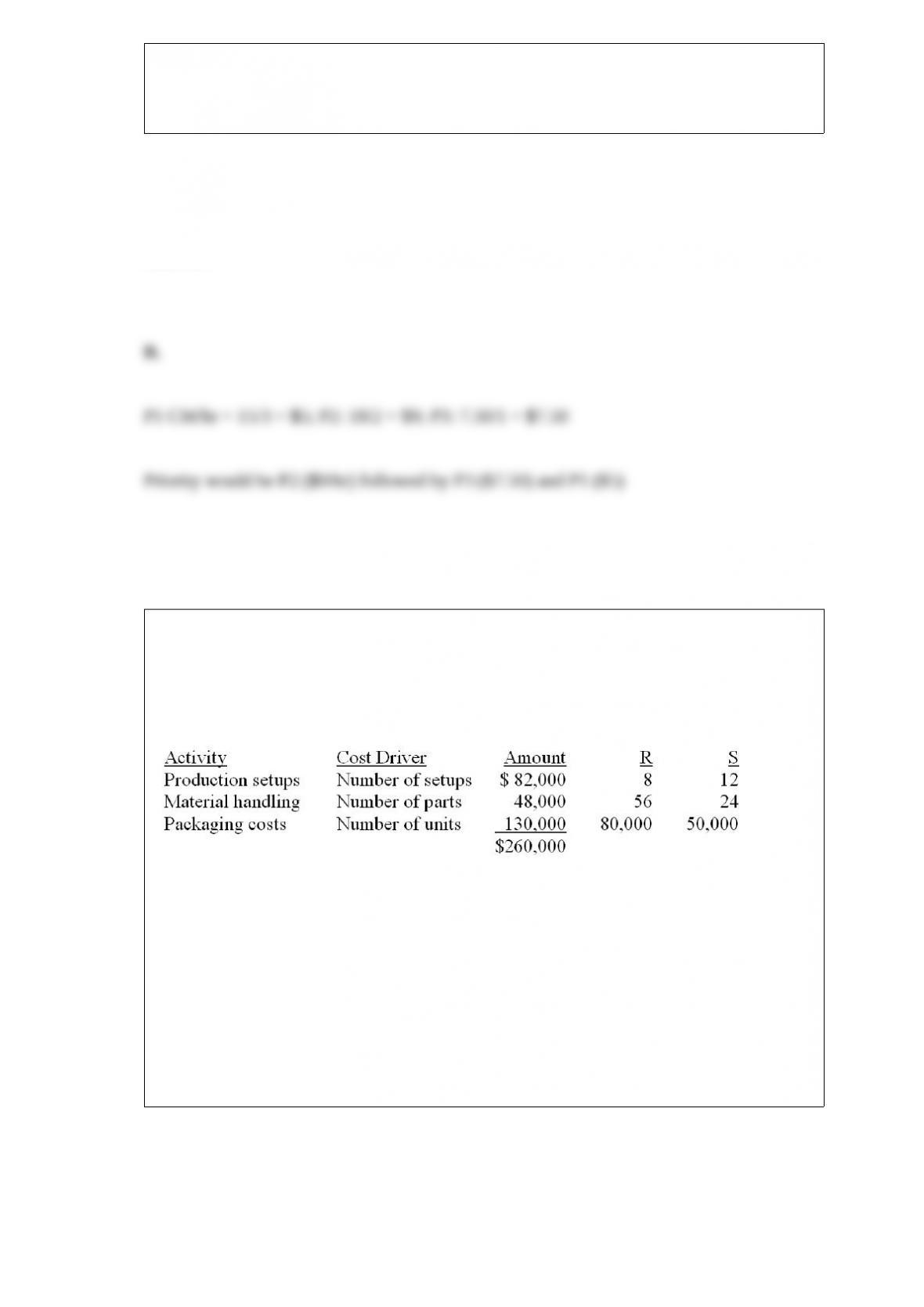
Roswell Inc has 5,400 machine hours available each month. The following information
on the company’s three products is available:
If market demand exceeds the available capacity, in what sequence should orders be
filled to maximize the company’s profits?
A. Product 1 first, product 2 second, and product 3 third
B. Product 2 first, product 3 second, and product 1 third
C. Product 3 first, product 2 second, and product 1 third
D. Product 3 first, product 1 second, and product 2 third
Answer:
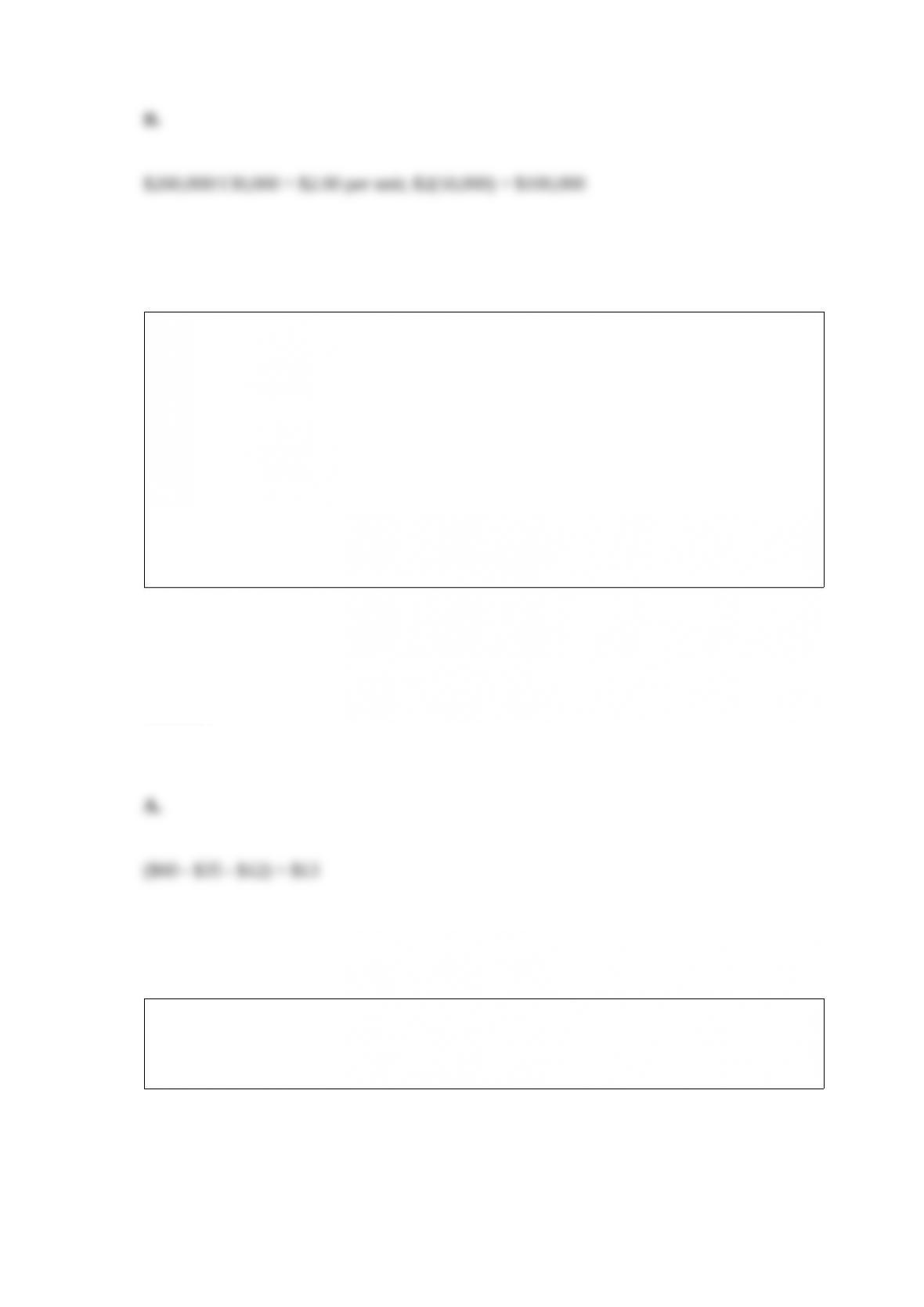
RS Company manufactures and distributes two products, R and S. Overhead costs are
currently allocated using the number of units produced as the allocation base. The
controller has recommended changing to an activity-based costing (ABC) system. She
has collected the following information:
What is the total overhead allocated to Product S using the current system?
A. $113,600
B. $100,000
C. $146,400
D. $160,000
Answer:
A division can sell externally for $60 per unit. Its variable manufacturing costs are $35
per unit, and its variable marketing costs are $12 per unit. What is the opportunity cost
of transferring internally, assuming the division is operating at capacity?
A. $13
B. $25
C. $35
D. $47
Answer:
Misa Corporation manufactures circuit boards and is in the process of preparing next
year’s budget. The pro forma income statement for the current year is presented below.
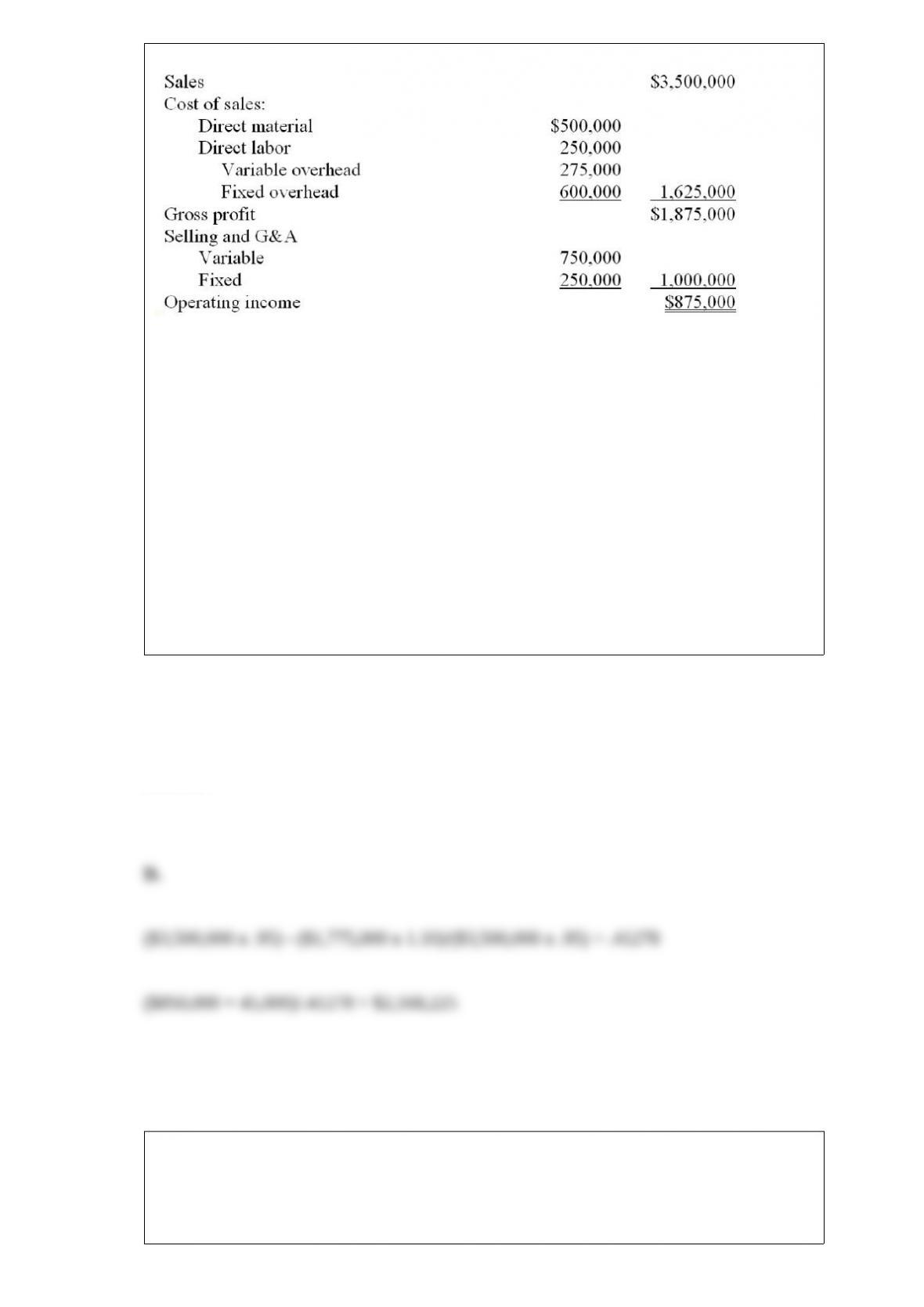
For the coming year, the management of Misa Corporation anticipates a 5 percent
decrease in sales, a 10 percent increase in variable costs, and a $45,000 increase in
fixed expenses.
The break-even point for next year would be
A. $3,022,500.
B. $2,947,500.
C. $2,668,750.
D. $2,168,225.
Answer:
Under Pick Co.’s job order costing system manufacturing overhead is applied to work
in process using a predetermined annual overhead rate. During January, Pick’s
transactions included the following:
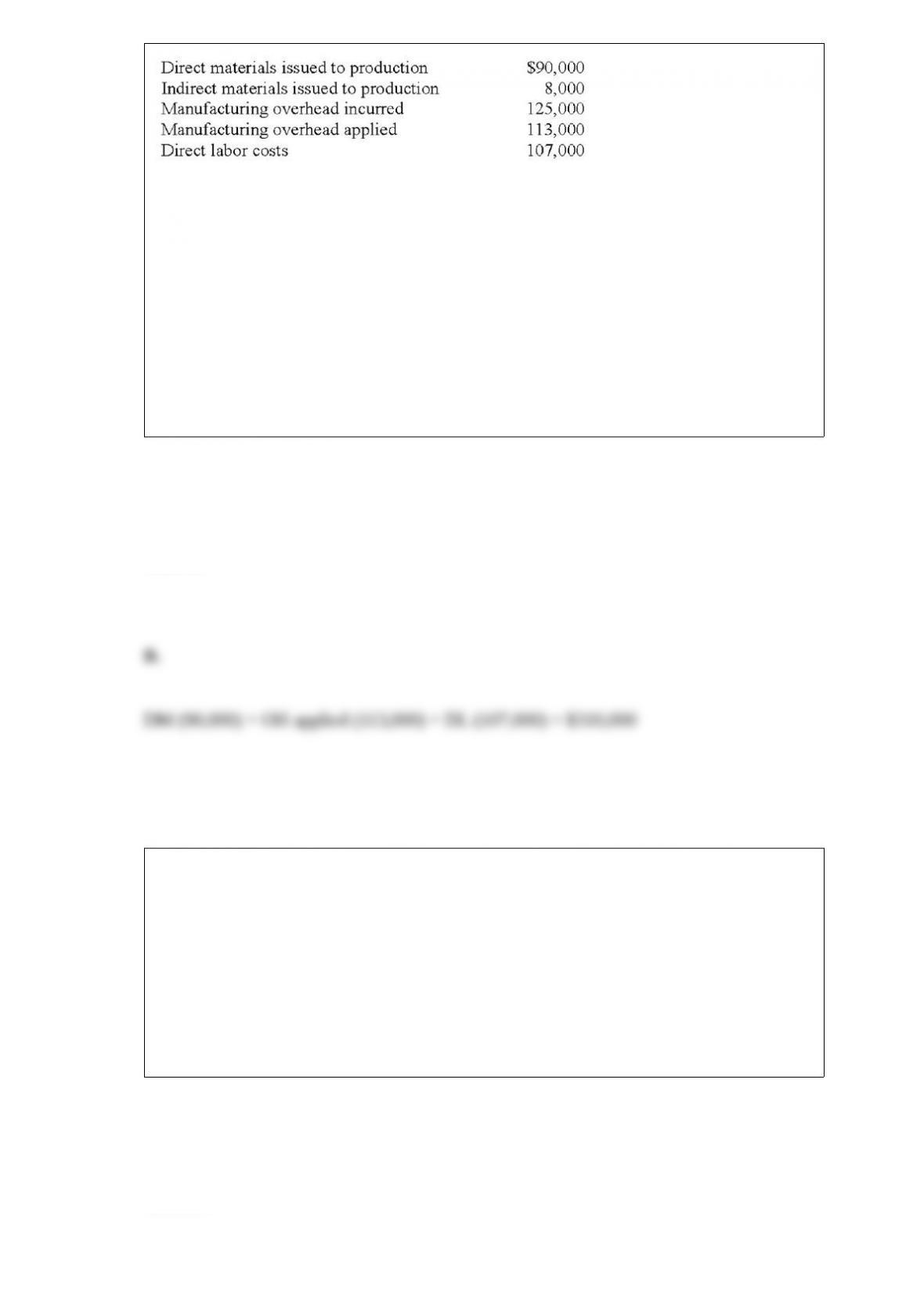
Pick had neither beginning nor ending inventory in Work-in-Process Inventory. What
was the cost of jobs completed in January? (CPA adapted)
A. $302,000
B. $310,000
C. $322,000
D. $330,000
Answer:
Which of the following is a weakness of the step method of service cost allocations?
A. Computations are more complex than the reciprocal method.
B. All interdepartmental services are ignored.
C. All intradepartmental services are ignored.
D. The order of service department allocation has to be determined.
Answer:
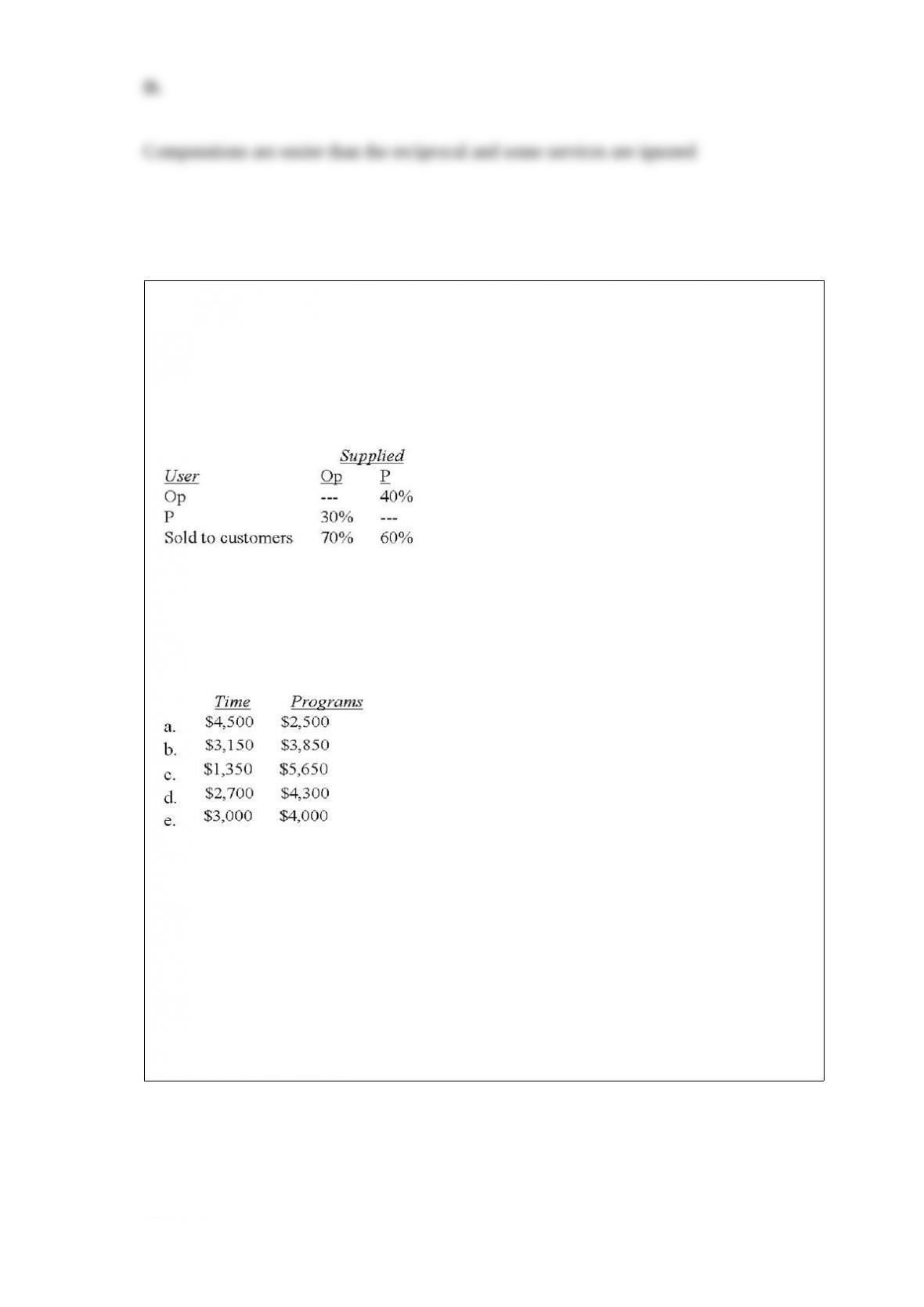
Computer Complex, Inc. has two main services: (1) time on a timeshared computer
system, and (2) proprietary computer programs. Computer time is provided by the
operation department (Op) and programs are written by the programming department
(P)
The percentage of each service used by each department for a typical period is:
In a typical period, the operation department (Op) spends $4,500 and the programming
department (P) spends $2,500.Under the step method (Op first), what is the cost of the
computer time and the computer programs for sale?
A. a
B. b
C. c
D. d
E. e
Answer:
Activity-based costing (ABC) information cannot be used by managerial
decision-makers to evaluate the
A. profitability of a customer.
B. market potential of a product.
C. cost of using a particular supplier.
D. whether to continue providing a service.
Answer:
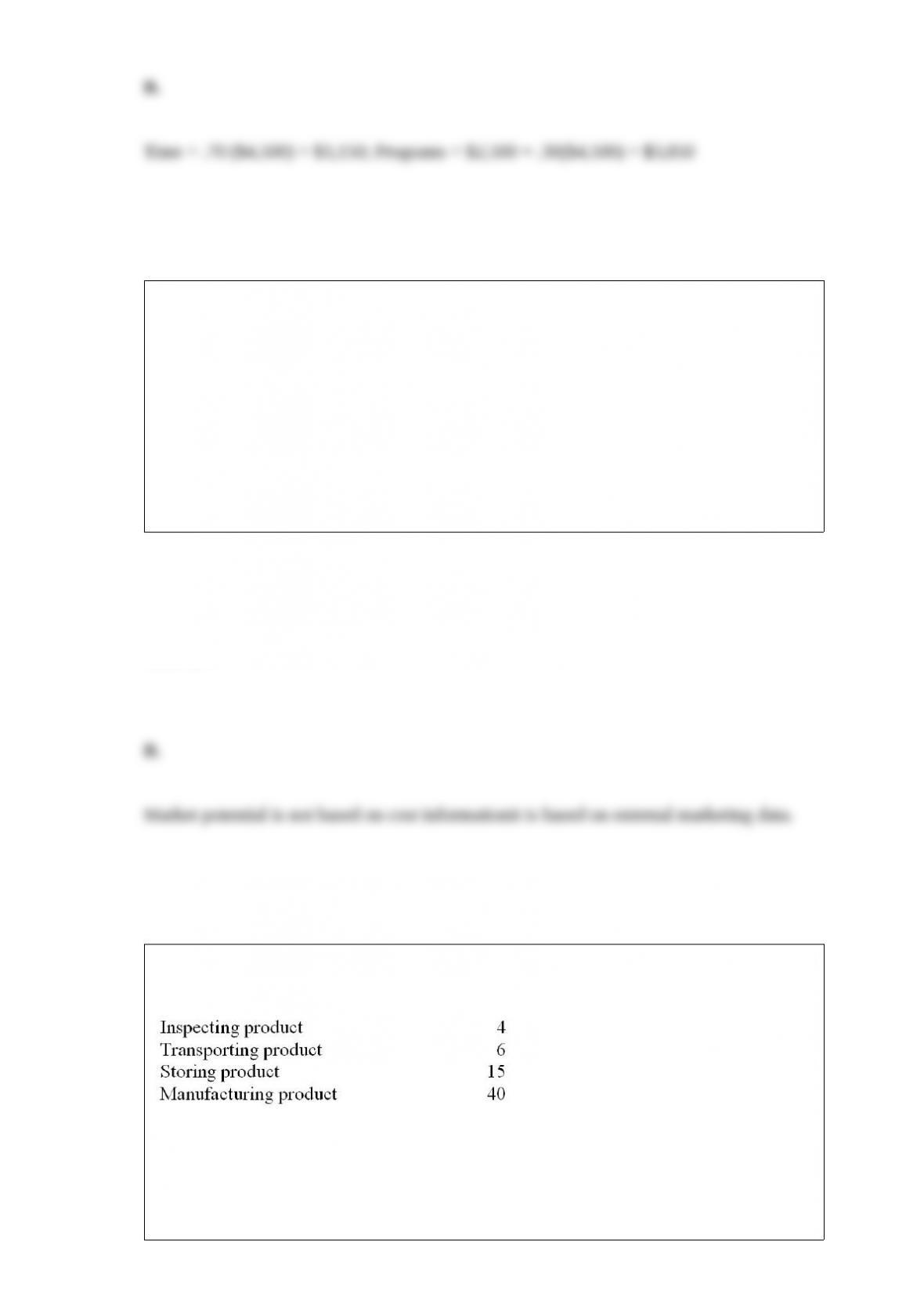
The Alma Company collected the following information (in days):
What is the manufacturing cycle time?
A. 21 days
B. 65 days
C. 55 days
D. 46 days
Answer:
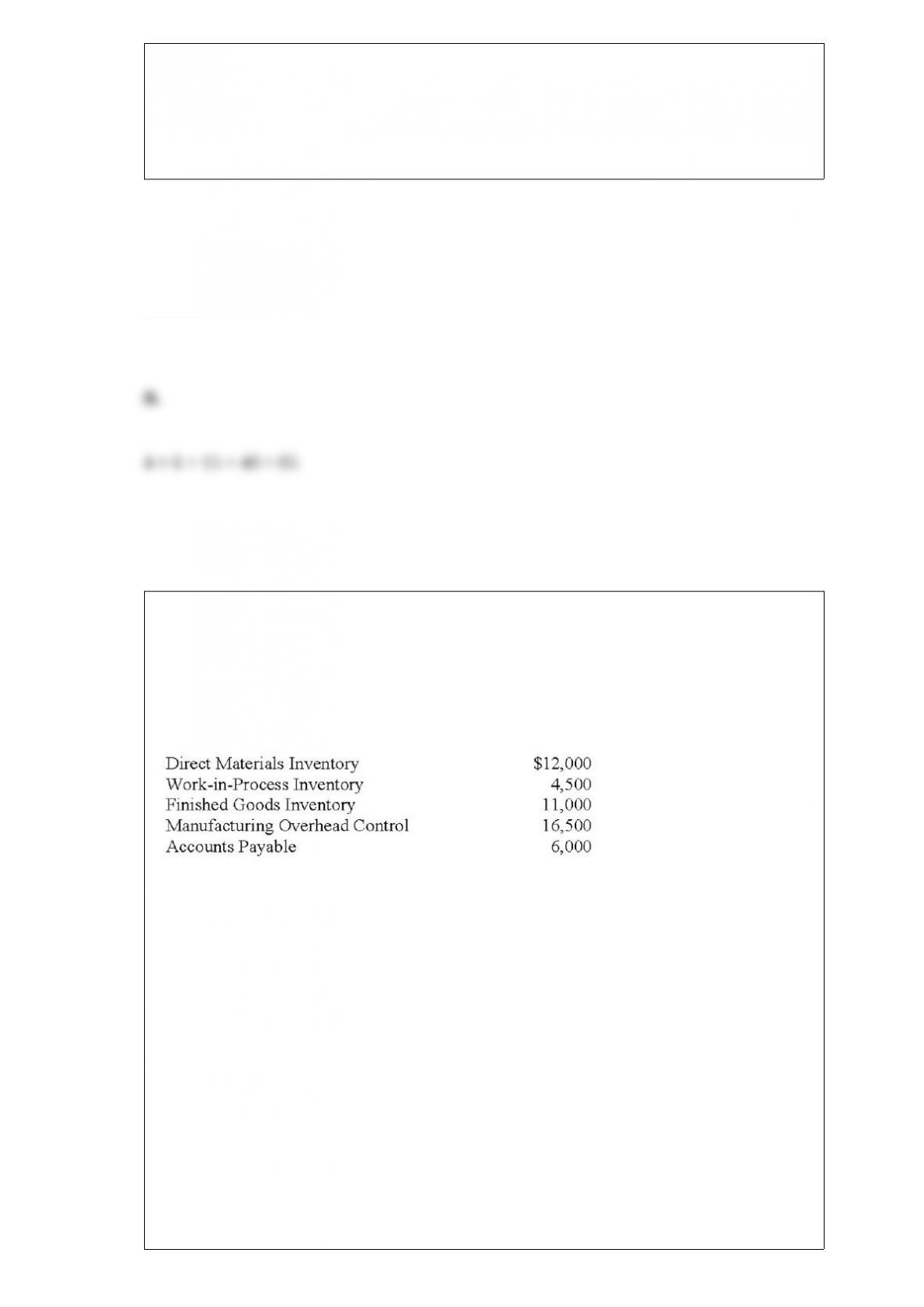
The Update Company does not maintain backup documents for its computer files. In
June, some of the current data were lost, and you have been asked to help reconstruct
the data. The following beginning balances on June 1 are known:
Reviewing old documents and interviewing selected employees have generated the
following additional information:
The production superintendent’s job cost sheets indicated that materials of $2,600 were
included in the June 30 Work-in-Process Inventory. Also, 300 direct labor hours had
been paid at $6.00 per hour for the jobs in process on June 30.
The Accounts Payable account is only for direct material purchases. The clerk
remembers clearly that the balance in the Accounts Payable on June 30 was $8,000. An
analysis of canceled checks indicated payments of $40,000 were made to suppliers
during June.
Payroll records indicate that 5,200 direct labor hours were recorded for June. It was
verified that there were no variations in pay rates among employees during June.
Records at the warehouse indicate that the Finished Goods Inventory totaled $16,000 on
June 30.
Another record kept manually indicates that the Cost of Goods Sold in June totaled
$84,000.
The predetermined overhead rate was based on an estimated 60,000 direct labor hours
for the year and an estimated $180,000 in manufacturing overhead costs.
What is the ending balance in the Work-in-Process Inventory on June 30?
A. $4,800
B. $5,300
C. $9,300
D. $9,800
Answer:
EM Sales had $2,200,000 in sales last month. The contribution margin ratio was 30%
and operating profits were $180,000. What is EM’s margin of safety?
A. $480,000
B. $600,000
C. $2,020,000
D. Cannot determine with the information given.
Answer:
Joint products and byproducts are produced simultaneously by a single process or
series of processes and
A. joint products are salable at the split-off point, but byproducts are not.
B. byproducts are salable at the split-off point, but joint products are not.
C. the revenue from byproducts may be recognized at the time of production.
D. all byproducts must be allocated some portion of joint costs.
Answer:
Avery Corporation has two divisions, A and B, which are both organized as profit
centers; Division A produces and sells widgets to Division B and to outside customers.
Division A has total costs of $35, $20 of which are variable. Division A is operating
significantly below capacity and sells the widgets for $50.
Division B has received an offer from an outsider vendor to supply all the widgets it
needs (20,000 widgets) at a cost of $45. The manager of Division B is considering the
offer but wants to approach Division A first.
What is the minimum transfer price from Division A to Division B?
A. $20
B. $35
C. $45
D. $50
Answer:
Chetek Industries manufactures 15,000 components per year. The manufacturing cost
of the components was determined to be as follows:
Assume that the fixed manufacturing overhead reflects the cost of Chetek’s
manufacturing facility. This facility cannot be used for any other purpose. An outside
supplier has offered to sell the component to Chetek for $34. If Chetek Industries
purchases the component from the outside supplier, the effect on income would be a
A. $30,000 decrease
B. $30,000 increase
C. $90,000 decrease
D. $90,000 increase
Answer:
A target cost is computed as
A. cost to manufacture plus a desired markup
B. cost to manufacture plus designated selling expenses
C. market willingness to pay – cost to manufacture
D. market willingness to pay – desired profit
Answer:
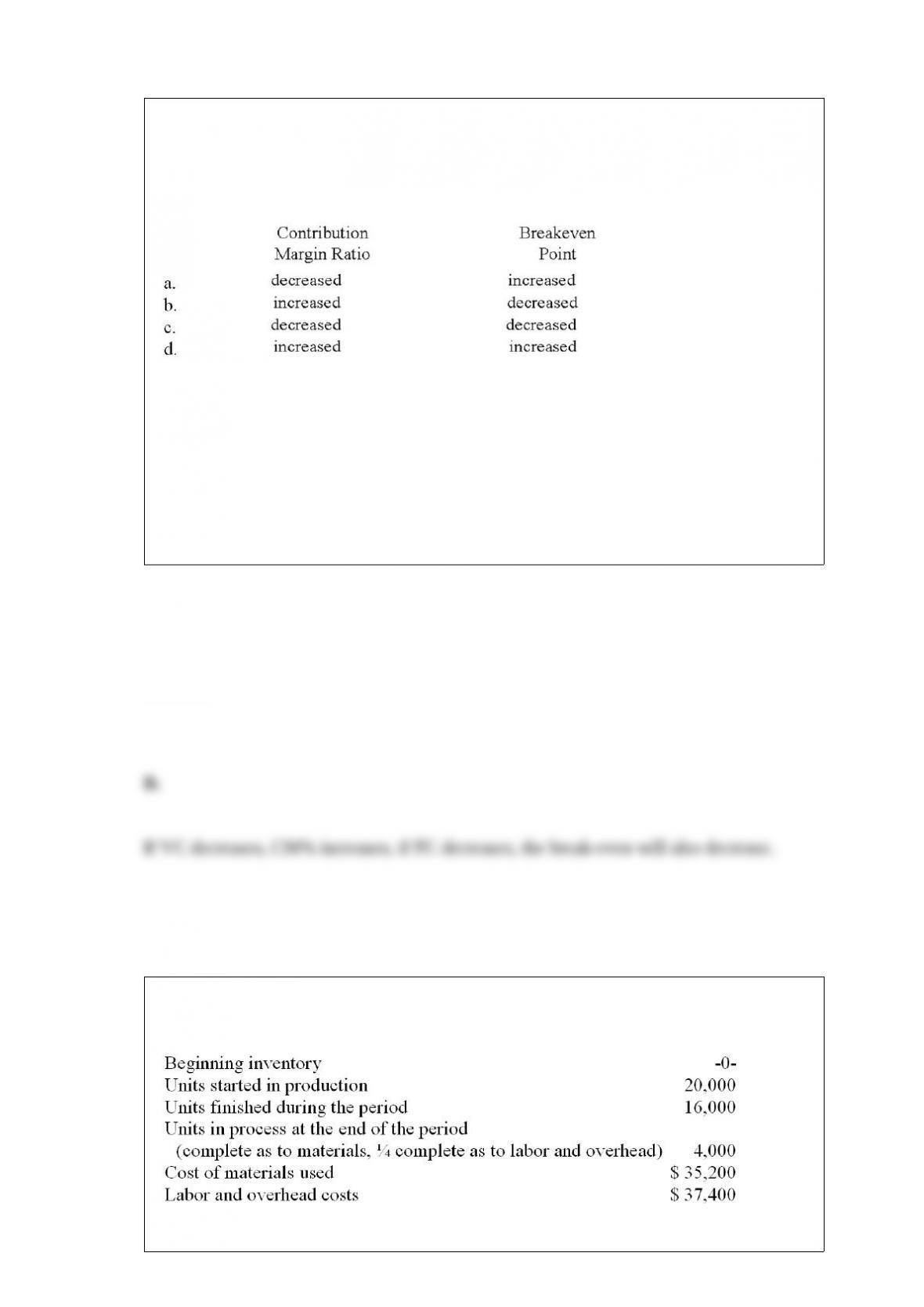
If the fixed costs for a product decrease and the variable costs (as a percentage of sales
dollars) decrease, what will be the effect on the contribution margin ratio and the
break-even point respectively?
A. a
B. b
C. c
D. d
Answer:
The WISCO Company uses a weighted-average process costing system. The following
data are available:
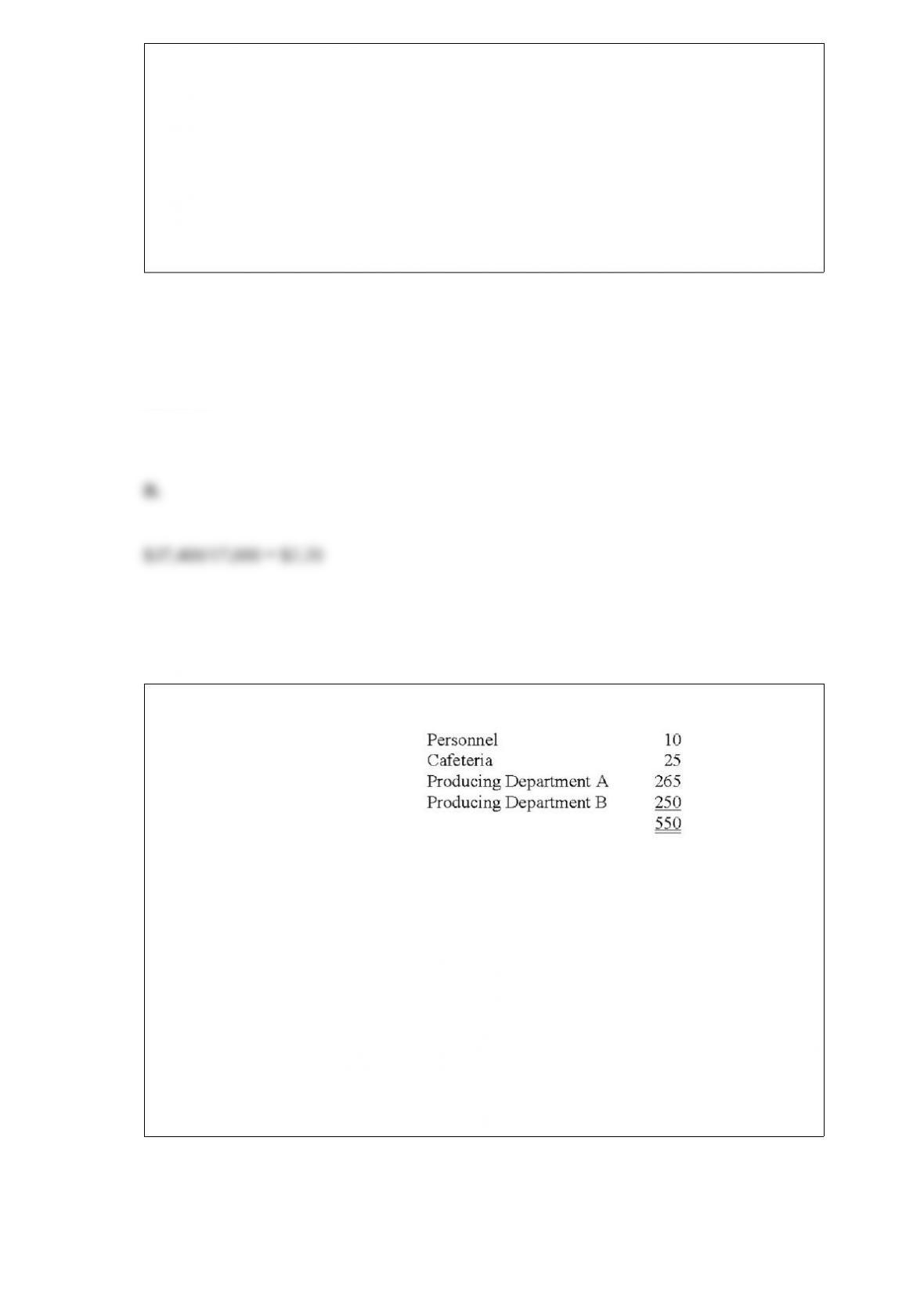
Unit cost of labor and overhead is
A. $2.34.
B. $2.20.
C. $1.97.
D. $1.87.
Answer:
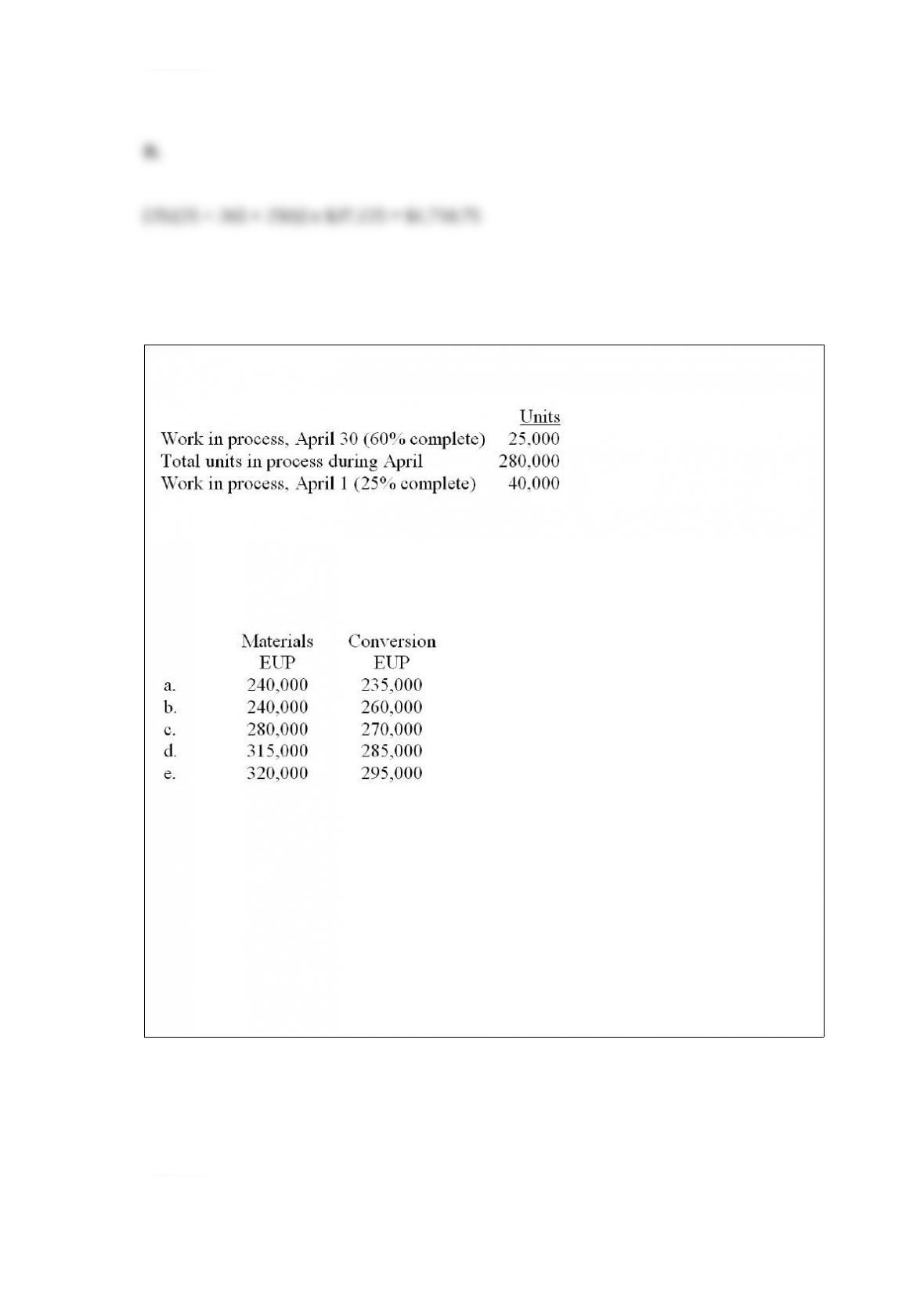
Castle Company has two service departments and two user departments. The number
of employees in each department is
The fixed costs of the Personnel Department are allocated on a basis of the number of
employees. If these costs are budgeted at $37,125 during a given period, the amount of
cost allocated to the Cafeteria under the step method would be
A. $0.
B. $1,718.75.
C. $1,687.50.
D. $1,802.18.
Answer:
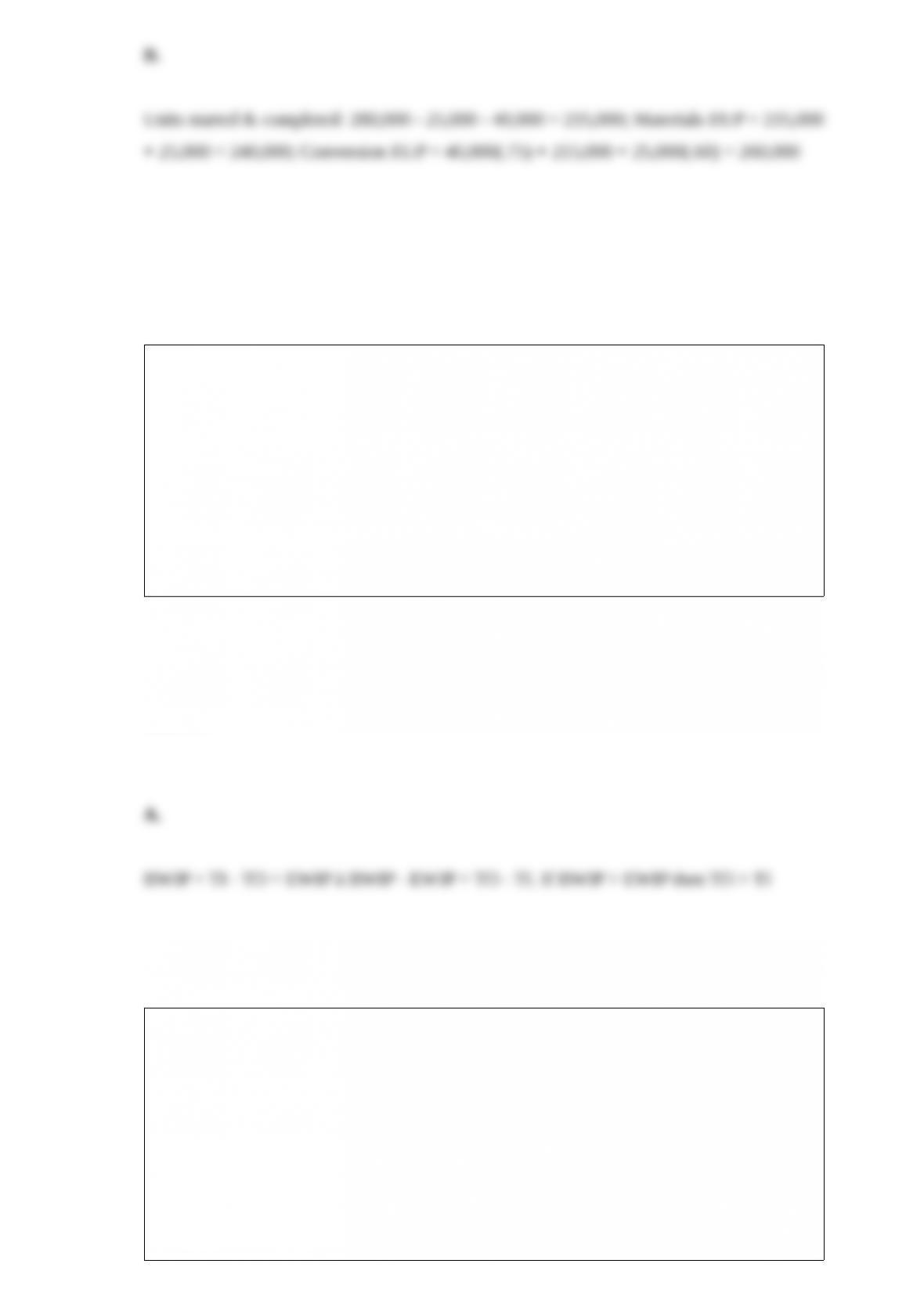
Sussex Corporation’s production cycle starts in the Mixing Department. The following
information is available for April:
Materials are added at the beginning of the process in the Mixing Department. What are
the equivalent units of production for the month of April, assuming Sussex uses first-in,
first-out (FIFO), process costing.
A. a
B. b
C. c
D. d
E. e
Answer:
If the units in the beginning Work-in-Process Inventory are greater than the units in the
ending Work-in-Process Inventory, then the units transferred out are
A. more than the units started during the period.
B. equal to the equivalent units of production.
C. less than the units started during the period.
D. equal to the actual work done during the period.
Answer:
The cost accountant determined $1,700,000 of the server network’s costs were fixed
and should be allocated based on the number of connections. The remaining costs
should be allocated based on the time on the network. What is total server network costs
allocated to the Consumer Division assuming the company uses dual-rates to allocate
common costs?
A. $1,200,000
B. $1,093,333
C. $954,896
D. $750,000
Answer:
A business model attempts to minimize problems associated with
A. decentralization.
B. divisional autonomy.
C. goal congruence.
D. maximizing profits.
Answer:
The characteristic that is most often used to distinguish a product as either a main
product or a by-product is the amount of
A. sales value of the products produced during the common production process.
B. direct manufacturing costs (e.g., materials) incurred before the split-off point.
C. physical measures in the products produced during the common production process.
D. time (i.e., labor) required to produce the products from start to finish.
Answer:
The optimal transfer price when there are intermediate markets is
A. full cost.
B. outlay costs.
C. variable cost.
D. market prices.
E. negotiated market prices.
Answer:
ABC Company has a beginning Work-in-Process Inventory of 25,000 units (40%
complete). During the period, 110,000 units were started and the ending
Work-in-Process Inventory consisted of 20,000 units (80%). What are the equivalent
units for conversion costs using weighted-average process costing?
A. 110,000
B. 115,000
C. 121,000
D. 131,000
Answer:
Which of the following statements is (are) false regarding cost allocations and product
costing?
(A) It is easier to determine the individual product cost for a manufacturer than it is for
a wholesaler.
(B) In general, indirect costs are assigned, while direct costs are allocated.
A. Only A is false.
B. Only B is false.
C. Both A and B are false.
D. Neither A nor B is false.
Answer:
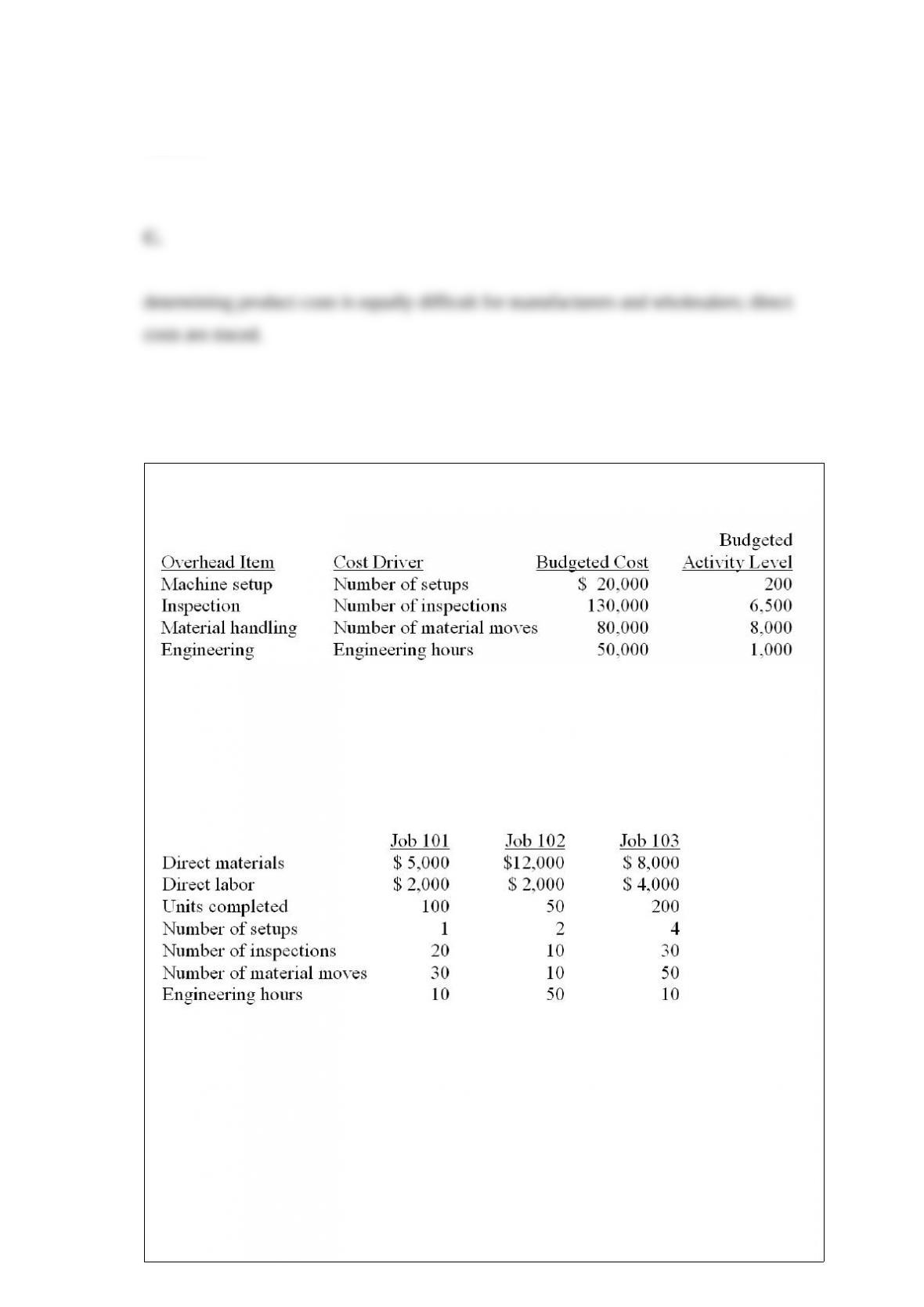
A company has identified the following overhead costs and cost drivers for the coming
year: (CIA adapted)
Budgeted direct labor cost was $100,000 and budgeted direct material cost was
$280,000. The following information was collected on three jobs that were completed
during the year:
If the company uses traditional costing and allocates overhead using direct labor cost,
how much overhead cost should be assigned to Job 101?
A. $1,300
B. $2,000
C. $5,000
D. $5,600
Answer:
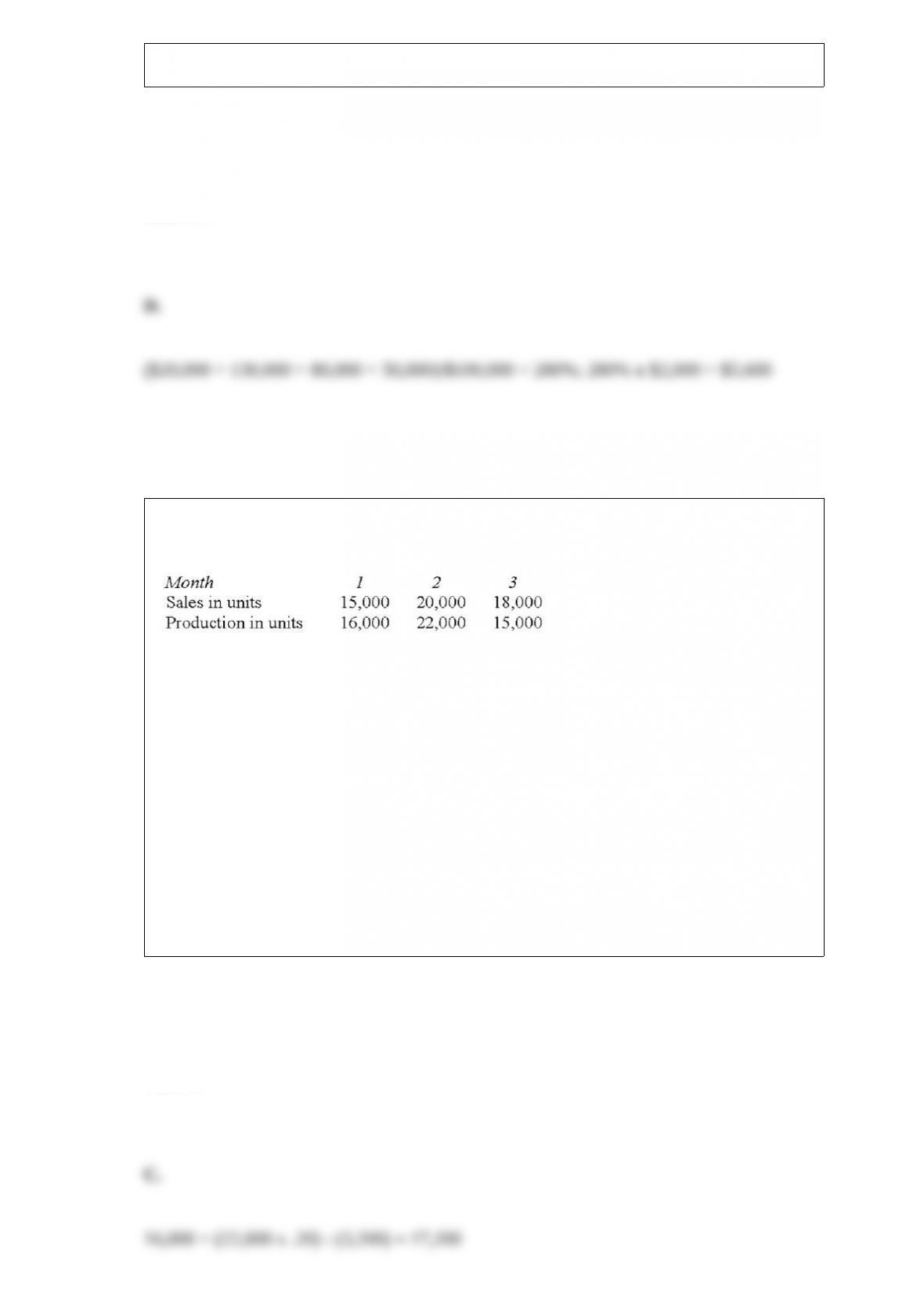
The following budgeted information is provided:
One pound of material is required for each finished unit. The inventory of materials at
the end of each month should equal 20% of the following month’s production needs. At
the beginning of Month 1, there was 3,200 lbs. of materials on hand. Purchases of raw
materials for Month 1 would be (in pounds)
A. 25,000.
B. 23,400.
C. 17,200.
D. 22,000.
Answer:
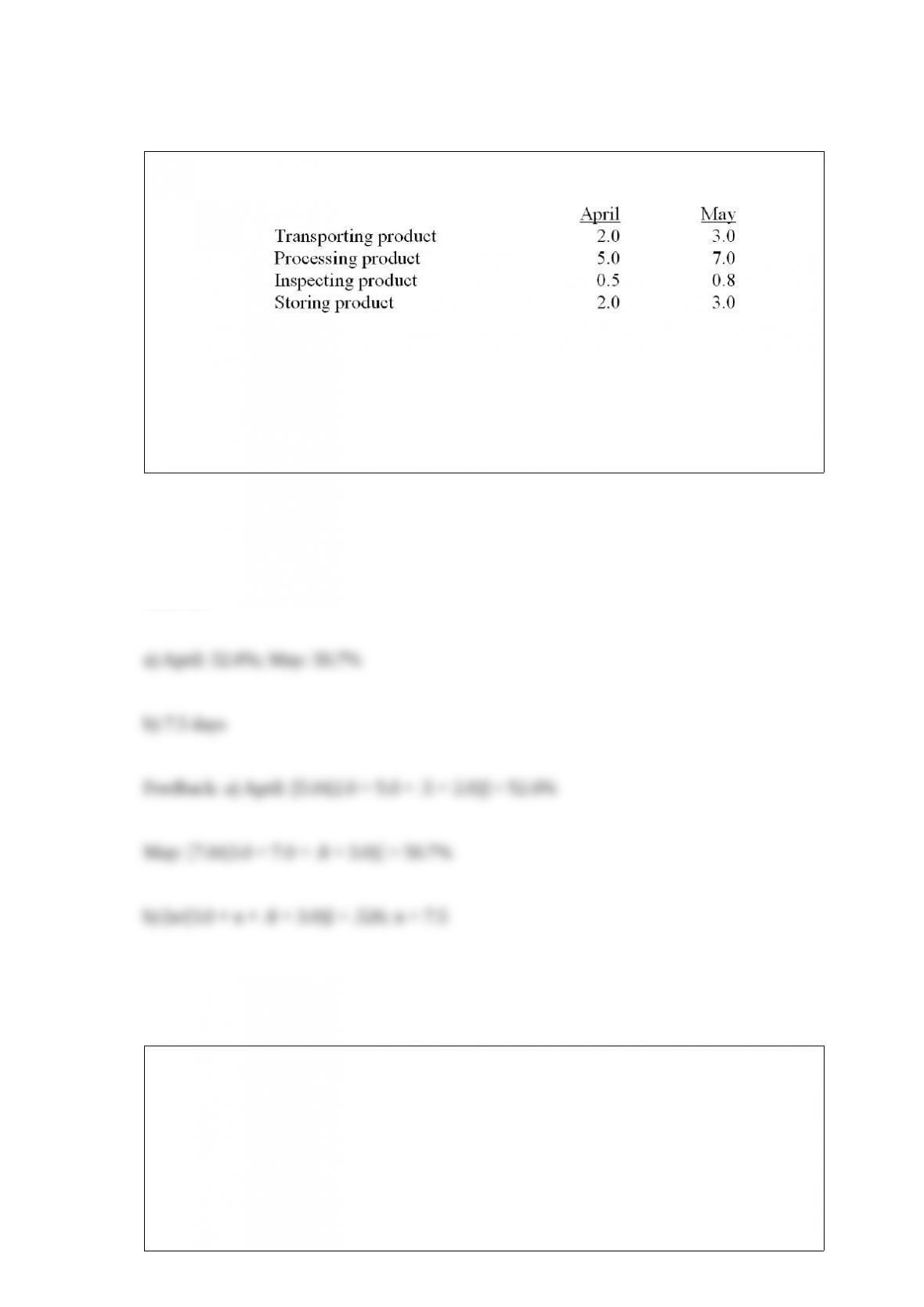
The ABC Manufacturing Company collected the following information (in days) for
April and May.
Required:
a) Calculate the manufacturing cycle efficiency for April and May.
b) Calculate the processing time required for May so that May’s manufacturing cycle
efficiency is equal to April’s manufacturing cycle efficiency.
Answer:
In a traditional job order costing system, the issue of indirect materials to a production
department increases: (CPA adapted)
A. Stores control.
B. Work-in-Process control.
C. Factory overhead control.
D. Factory overhead applied.
Answer: