1) What are unit-level costs? Give two examples.
2) Distinguish between static and flexible budgets. Give an example of how flexible
budgets might be used by a business.
3) For an equipment replacement decision, what costs are relevant, and what costs are
not relevant?
4) What is a postaudit of a capital investment decision, and how should the postaudit be
conducted?
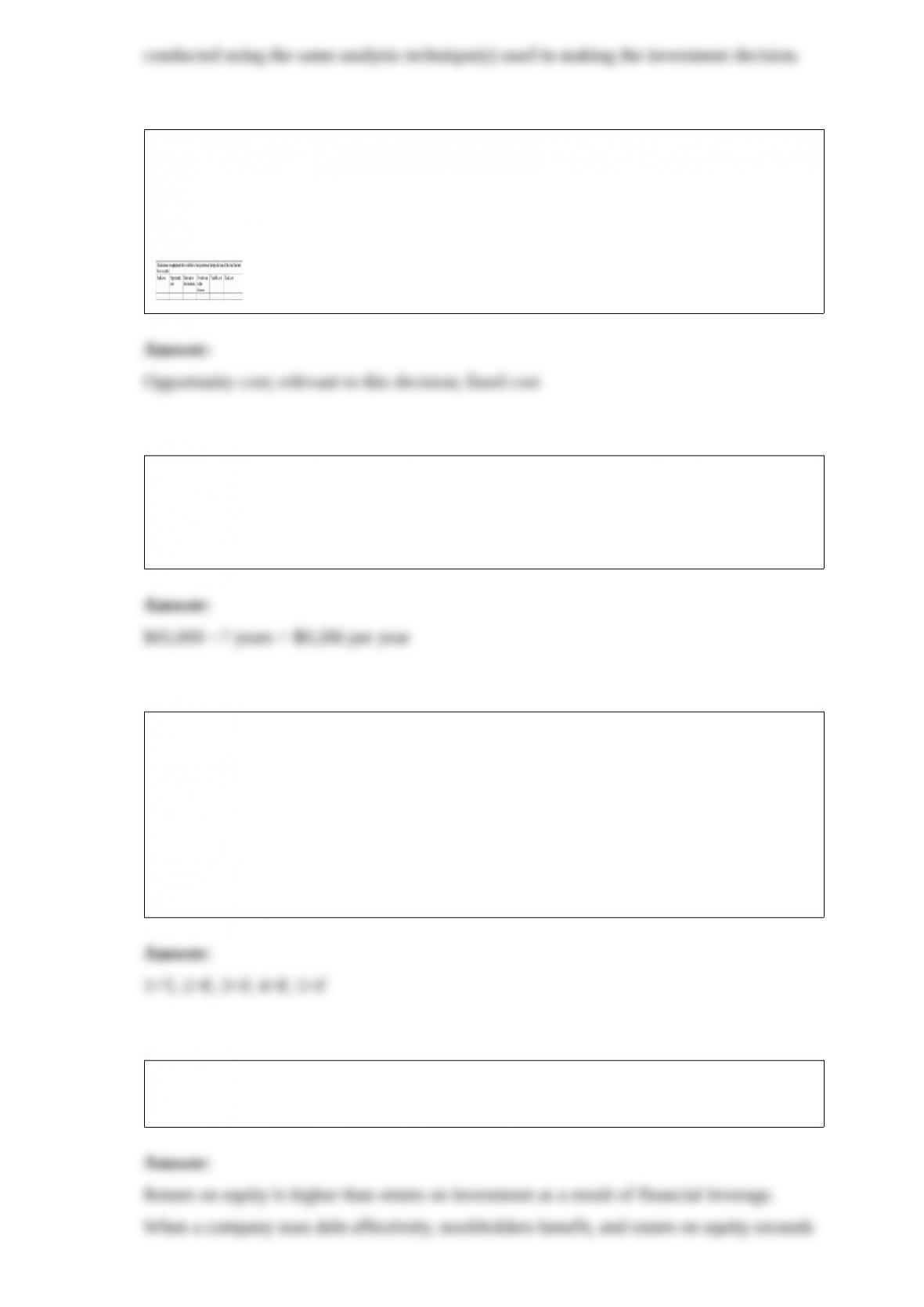
5) Halley Company has just received a special order for 1,000 deck chairs. Halley has
sufficient idle capacity to accept the order. Indicate whether the given cost is a sunk
cost, opportunity cost, relevant or not relevant to the decision to accept the special
order, variable or fixed, by placing X’s below the headings as appropriate. A variable
cost is one that varies with the number of chairs that Halley makes.
6) In 2012, Harold Corporation Co. acquired a patent from a competitor for $65,000. At
the time of purchase, it had 12 years of its legal life remaining; however, Harold
believes that the patent will only be useful for 7 years. Compute the amortization
expense for 2012 .
7) Indicate whether each of the following statements is true or false.
1>A master budget is a group of detailed, related budgets and schedules
2>The first step in preparing the master budget is to prepare an estimate of cash that
will be needed during the period
3>Capital budgets include the sales budget and inventory purchases budget
4>The master budget includes only operating budgets
5>A sales budget includes a schedule of cash payments for inventory
8) For Pann Corporation, return on equity is higher than return on investment. What
does that tell you about the company?