1) All of the following statements regarding uncertainty in liabilities are true except:
A.Liabilities can involve uncertainty in whom to pay.
B.A company can create a liability with a known amount even when the holder of the
note may not be known until the maturity date.
C.A company can have an obligation of a known amount to a known creditor but not
know when it must be paid.
D.A company only records liabilities when it knows whom to pay, when to pay, and
how much to pay.
E.A company can be aware of an obligation but not know how much will be required to
settle it.
2) Raw materials that are tangible components of the finished product and can be
separately and readily traced through the manufacturing process are called:
A.Raw materials sold.
B.Chargeable materials.
C.Work in process.
D.Indirect materials.
E.Direct materials.
3) Capital budgeting decisions are risky because all of the following are true except:
A.The outcome is uncertain.
B.Large amounts of money are usually involved.
C.The investment involves a long-term commitment.
D.The decision could be difficult or impossible to reverse.
E. They rarely produce net cash flows.
4) A leasehold is:
A.A short-term rental agreement.
B.The same as a patent.
C.The rights granted to the lessee by the lessor of a lease.
D.Recorded as revenue expenditure when paid.
E.An asset held as an investment.
5) The Cash Over and Short account:
A.Is used when the cash account reports a credit balance.
B.Is used to record the income effects of errors in making change and/or processing
petty cash transactions.
C.Is not necessary in a computerized accounting system.
D.Can never have a debit balance.
E.Can never have a credit balance.
6) Companies may use a special bank account solely for the purpose of paying
employees, by depositing an amount equal to the total employees’ net pay into the
account each pay period and drawing the employees’ payroll checks on the account.
This account is a(n):
A.Federal depository bank account.
B.Employee’s Individual Earnings account.
C.Employees’ bank account.
D.Payroll register account.
E.Payroll bank account.
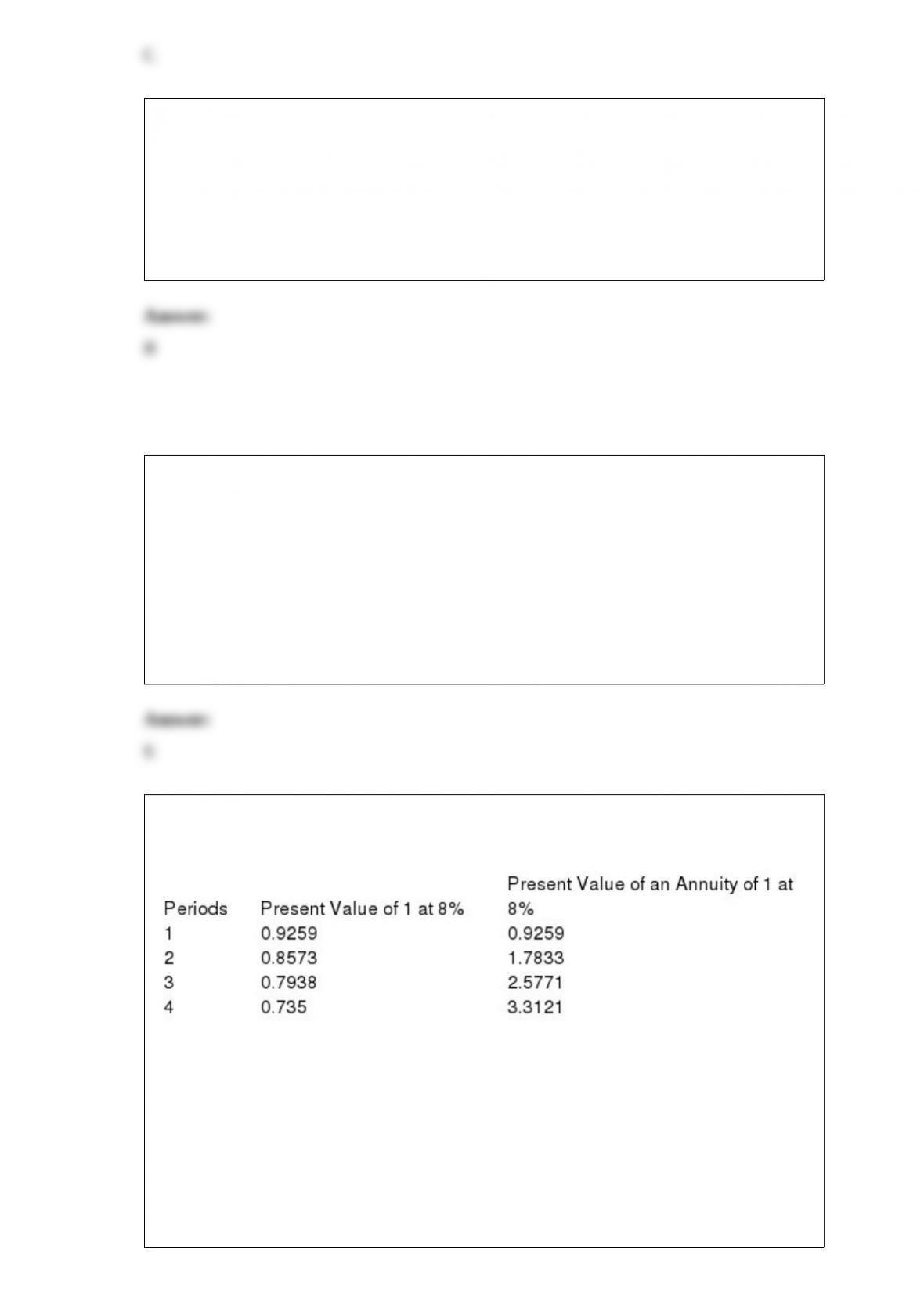
7) The following present value factors are provided for use in this problem.
Cliff Co. wants to purchase a machine for $40,000, but needs to earn an 8% return. The
expected year-end net cash flows are $12,000 in each of the first three years, and
$16,000 in the fourth year. What is the machine’s net present value (round to the nearest
whole dollar)?
A.$(9,075).
B.$2,685.
C.$42,685.
D.$(28,240).
E.$52,000.

8) All of the following are classified as assets except:
A.Accounts Receivable.
B.Supplies.
C.Equipment.
D.Accounts Payable.
E.Land.
9) Soar Incorporated is considering eliminating its mountain bike division, which
reported an operating loss for the recent year of $3,000. The division sales for the year
were $1,050,000 and the variable costs were $860,000. The fixed costs of the division
were $193,000. If the mountain bike division is dropped, 30% of the fixed costs
allocated to that division could be eliminated. The impact on operating income for
eliminating this business segment would be:
A.$57,900 decrease
B.$132,100 decrease
C.$54,900 decrease
D.$190,000 increase
E.$190,000 decrease
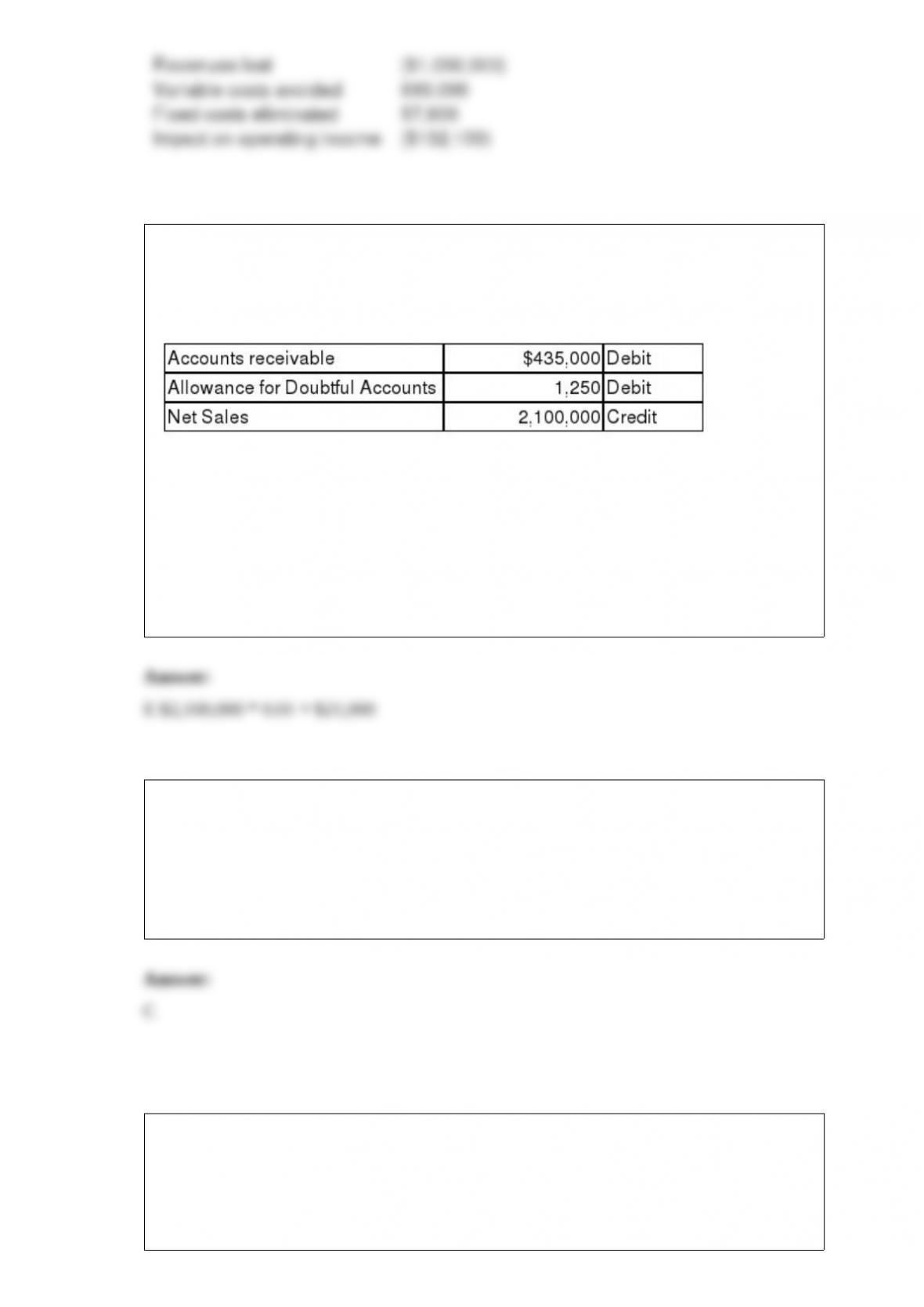
10) The following selected amounts are reported on the year-end unadjusted trial
balance report for a company that uses the percent of sales method to determine its bad
debts expense.
All sales are made on credit. Based on past experience, the company estimates 1% of
credit sales to be uncollectible. What adjusting entry should the company make at the
end of the current year to record its estimated bad debts expense?
A.Debit Bad Debts Expense $19,750; credit Allowance for Doubtful Accounts $19,750.
B.Debit Bad Debts Expense $15,225; credit Allowance for Doubtful Accounts $15,225.
C.Debit Bad Debts Expense $22,250; credit Allowance for Doubtful Accounts $22,250.
D.Debit Bad Debts Expense $7,350; credit Allowance for Doubtful Accounts $7,350.
E.Debit Bad Debts Expense $21,000; credit Allowance for Doubtful Accounts $21,000.
11) A the company’s required rate of return, typically its cost of capital is called the:
A.Internal rate of return.
B.Average rate of return.
C.Hurdle rate.
D.Maximum rate.
E. Payback rate.
12) The master budgeting process typically begins with the sales budget and ends with a
cash budget and:
A.Budgeted financial statements.
B.Forecast budget.
C.Capital expenditures budget.
D.Rolling budget.
E.Production budget.
13) A company uses a process costing system. Its Assembly Department’s beginning
inventory consisted of 30,000 units, 75% complete with respect to direct labor and
overhead. The department completed and transferred out 127,500 units this period. The
ending inventory consists of 20,000 units that are 25% complete with respect to direct
labor and overhead. All direct materials are added at the beginning of the process. The
department incurred direct labor costs of $24,000 and overhead costs of $32,000 for the
period. Assuming the weighted average method, the direct labor cost per equivalent unit
(rounded to the nearest cent) is:
A.$0.14.
B.$0.16.
C.$0.18.
D.$0.30.
E.$0.37.
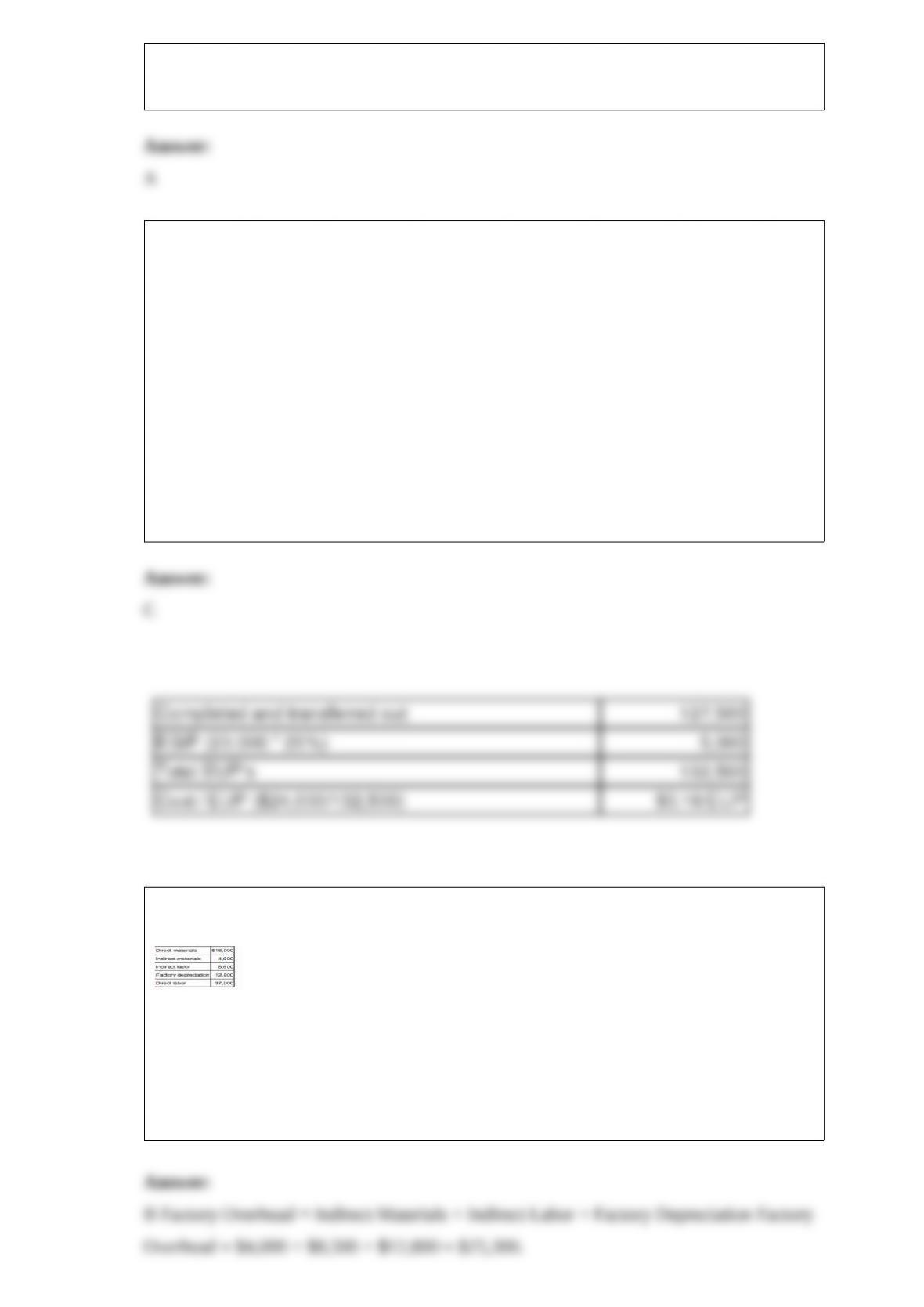
14) Asteroid Industries accumulated the following cost information for the year:
Using the above information, total factory overhead costs would be:
A.$78,300.
B.$25,300.
C.$12,800.
D.$16,800.
E.$53,000.
15) Describe the journal entries required to record the issuance of bonds at par and the
payment of bond interest.
16) _________ are beliefs that separate right from wrong and are considered accepted
standards of good and bad behavior.
17) On December 14 Branch Company received $3,100 cash for consulting services
that will be completed on January 12. Branch records all such prepayments by
customers in a liability account. Prepare the January 12 adjusting journal entry.
18) ___________________________ reveals how many times a company uses its raw
materials inventory in production during a period.
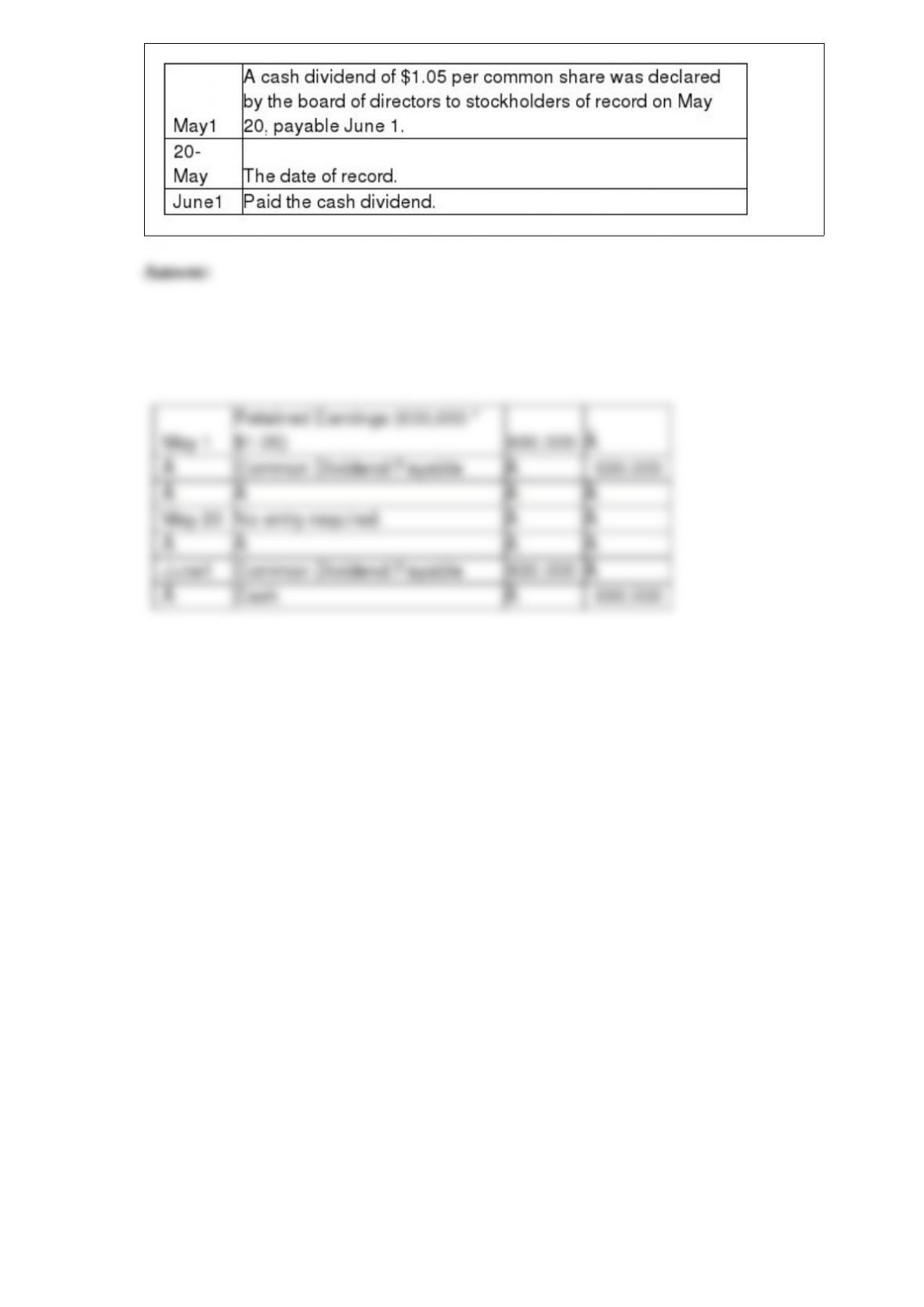
19) Cactus Joe Corporation reported stockholders’ equity on January 1 of the current
year as follows: Common Stock, $5 par value, 1,000,000 shares authorized, 600,000
shares issued; Paid-in Capital in Excess of Par Value, Common Stock, $1,025,000;
Retained Earnings, $1,850,000. Prepare journal entries to record the following
transactions: