1) The Allianz Company produces a specialty wood furniture product, and has the
following information available concerning its inventory items:
Relevant ordering costs per purchase order$450
Relevant carrying costs per year for each package:
Required annual return on investment15%
Required other costs per year$4
Annual demand is 30,000 packages per year. The purchase price per package is $48.
What is the annual relevant carrying costs?
A) $5,196
B) $6,971
C) $8,695
D) $3105.30
2) The breakeven point decreases if ________.
A) the variable cost per unit increases
B) the total fixed costs decrease
C) the contribution margin per unit decreases
D) the selling price per unit decreases
3) In a costing system, ________.
A) cost tracing allocates indirect costs
B) cost allocation assigns direct costs
C) a cost-allocation base can be either financial or nonfinancial
D) a cost object should be a product and not a department or a geographic territory
4) When variable overhead spending variance is unfavorable, it can be safely assumed
that ________.
A) actual rate per unit of cost-allocation base is higher than budgeted rate
B) actual quantity of cost-allocation base used is higher than budgeted quantity
C) actual rate per unit of cost-allocation base is lower than budgeted rate
D) actual quantity of cost-allocation base used is lower than budgeted quantity
5) Which of the following best describes practical capacity?
A) It is the level of capacity that reduces theoretical capacity by considering
unavoidable operating interruptions, such as scheduled maintenance time and
shutdowns for holidays.
B) It is the level of capacity based on producing at full efficiency all the time.
C) It is the level of capacity utilization that satisfies average customer demand over a
period that includes seasonal, cyclical, and trend factors.
D) It is the level of capacity utilization that managers expect for the current budget
period, which is typically one year.
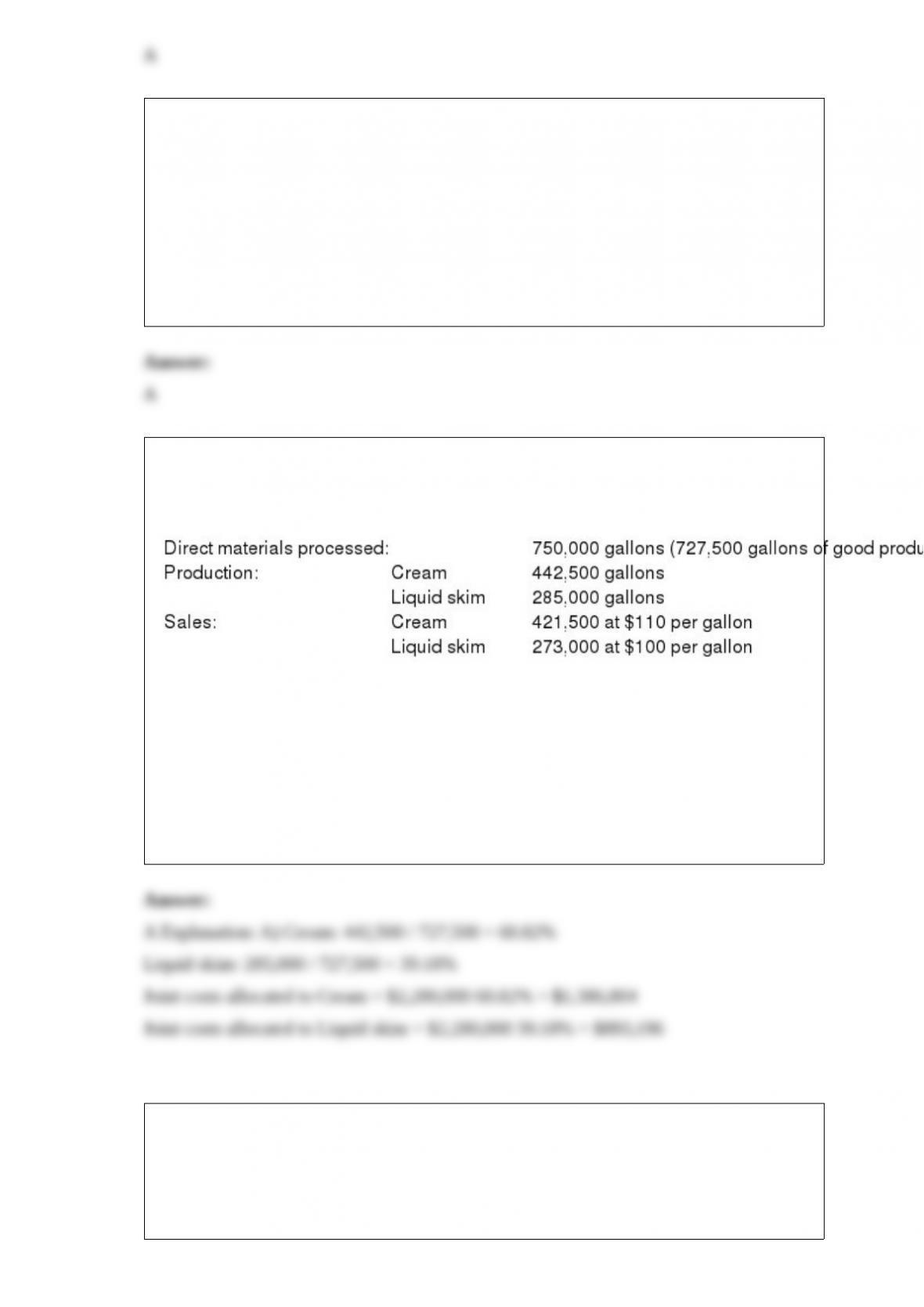
6) The Alfarm Corporation processes raw milk up to the splitoff point where two
products, cream and liquid skim, are produced and sold. There was no beginning
inventory. The following material was collected for the month of February:
The cost of purchasing 750,000 gallons of direct materials and processing it up to the
splitoff point to yield a total of 727,500 gallons of good product was $2,280,000.
When using a physical-volume measure, what is the approximate amount of joint costs
that will be allocated to cream and liquid skim?
A) $1,386,804 and $893,196
B) $1,140,000 and $1,140,000
C) $1,368,000 and $912,000
D) $1,254,00 and $1,026,000
7) Which of the following information is required by a company’s manager while
preparing a manufacturing overhead costs budget?
A) estimated incentives to be paid to marketing personnel
B) estimated expense for office supplies
C) estimated expense for maintenance of factory building
D) rent expense for lease of office building
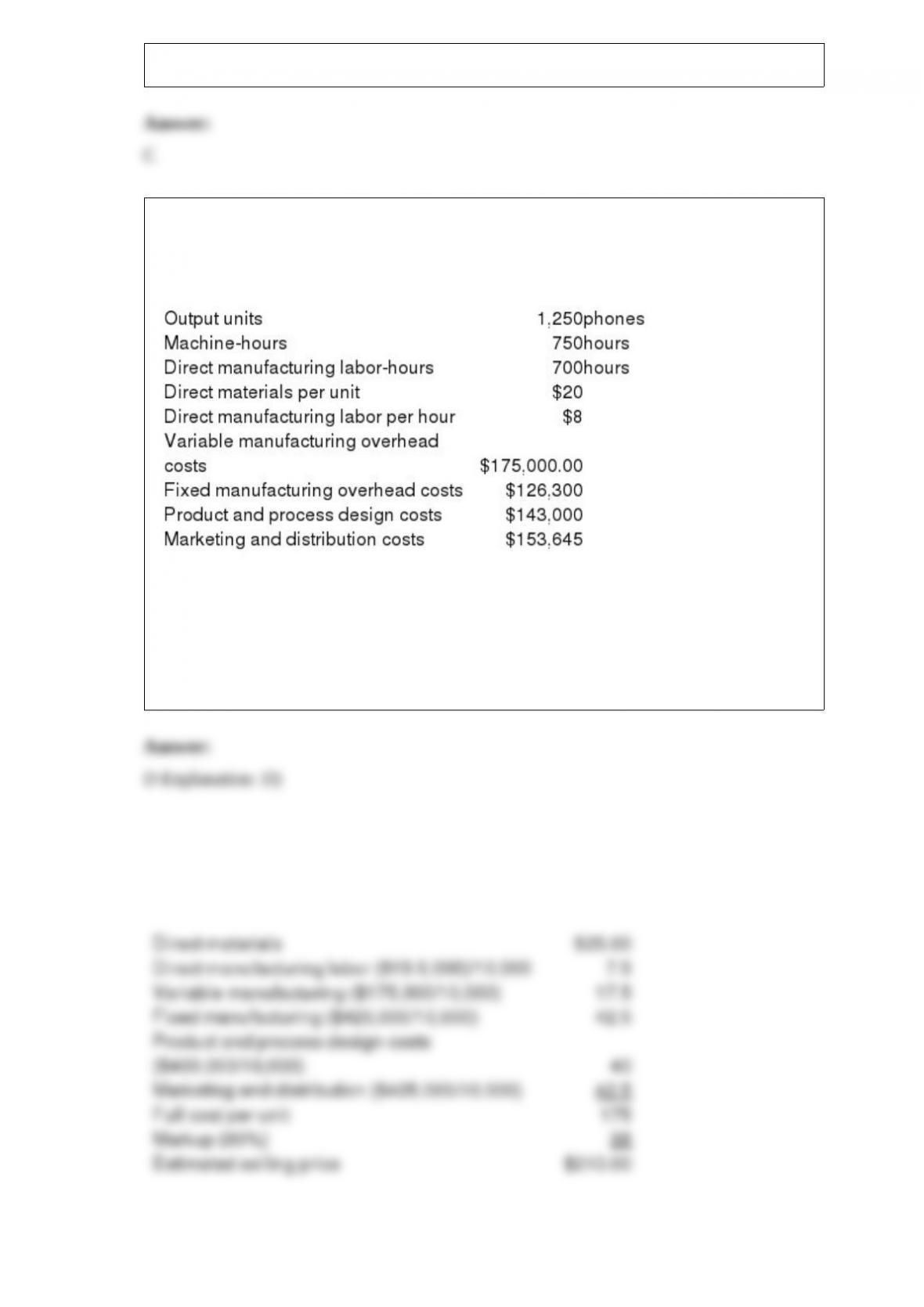
8) Quick Connect manufactures high-tech cell phones. Quick Connect has a policy of
adding a 20% markup to full costs and currently has excess capacity. The following
information pertains to the company’s normal operations per month:
For long-run pricing of the cell phones, what price will most likely be used by Quick
Connect?
A) $95.00
B) $135.00
C) $175.00
D) $210.00
9) Nonfinancial performance measures ________.
A) are usually used in combination with financial measures for control purposes
B) are used to evaluate overall cost efficiency
C) allow managers to make informed tradeoffs
D) are often the sole basis of a manager’s performance evaluations
10) The method that measures the time it will take to recoup, in the form of future cash
inflows, the total dollars invested in a project is called ________.
A) the accrued accounting rate-of-return method
B) the payback method
C) the internal rate-of-return method
D) the book-value method