1) Which of the following accounts would not be considered an intangible asset?
A.Goodwill
B.Patents
C.Research and development costs
D.Trademarks
2) Which of the following is correct?
A.If a company fails to record depreciation expense, net income and expenses are
overstated.
B.If a company fails to record depreciation expense, net income and assets are
overstated.
C.If a company overstates depreciation expense, net income is overstated and assets are
understated.
D. If a company fails to record depreciation expense, stockholders’ equity, net income,
and assets are understated.
3) Which of the following statements is incorrect?
A.The currently maturing portion of long-term debt must be classified as a current
liability.
B.The non-current portion of long-term debt will be correctly reported as a long-term
liability.
C.Even when a company plans to refinance the currently maturing debt on a long-term
basis, and has the ability to do so, it must still report the currently maturing debt as a
current liability.
D.The currently maturing portion of long-term debt is a current liability if it is due
within one year or from the date of the balance sheet, or within the operating cycle,
whichever is longer.
4) Which of the following transactions and events results in a decrease in both total
assets and net income?
A.The accrual of salaries expense at year-end.
B.Collecting cash from an account receivable.
C.Recognizing previously recorded deferred revenue as revenue.
D.Adjustment of the prepaid rent account for rent used during the period.
5) Which of the following is not one of the three steps taken by a corporation to assure
the accuracy of its records?
A.Implementing a system of controls over the company’s records and assets.
B.Hiring an independent auditor to report on the fairness of the financial statements.
C.Hiring a financial analyst to ensure the actual results of operations are similar to
planned results.
D.Forming a committee made up of board of directors’ members to oversee the integrity
of the corporation’s system of controls and the hiring of the independent auditors.
The three steps to ensure the accuracy of records include implementing a system of
controls, hiring external auditors, and having a board of directors with an audit
committee. A financial analyst does not provide services that help a corporation assure
the accuracy of its records.
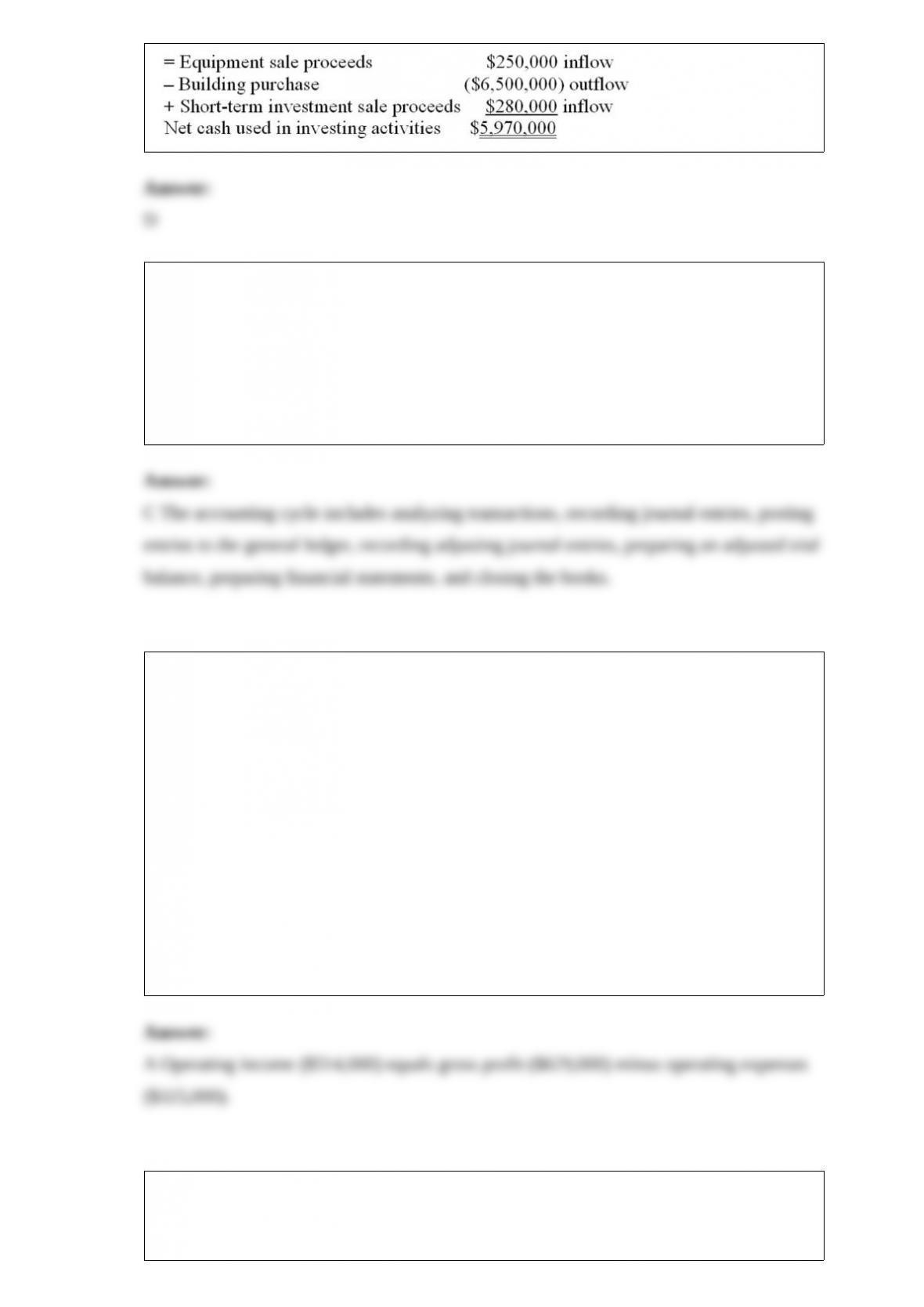
6) Roberts Company sold equipment for $250,000, purchased a building for
$6,500,000, sold short-term investments for $280,000, repaid principal on a note
payable for $2,300,000 plus $230,000 of interest, and paid cash dividends of $20,000.
What was the net cash flow from investing activities?
A.$6,250,000 outflow.
B.$8,320,000 outflow.
C.$8,270,000 outflow.
D.$5,970,000 outflow.
Net investing cash outflow = $5,970,000
7) Which is the correct sequence of the following steps in the accounting cycle?
A.Prepare journal entries, analyze transactions, prepare adjusted trial balance.
B.Prepare adjusted trial balance, prepare closing entries, and prepare financial
statements.
C.Post adjusting journal entries, prepare adjusted trial balance, prepare financial
statements.
D.Post closing entries, prepare financial statements, prepare adjusted trial balance.
8) The Nellie Company has provided the following information:
Operating expenses were $115,000;
Gross profit was $629,000;
Cost of goods sold was $470,000;
Interest expense was $17,000;
Extraordinary loss was $29,000;
Income tax expense was $199,000.
What was Nellie’s operating income?
A.$514,000.
B.$468,000.
C.$497,000.
D.$298,000.
9) Merchandise was sold on credit for $10,000, terms 2/10, n/30. Which of the
following journal entry descriptions correctly describes the cash collection?
A.Cash is debited for $10,000 and accounts receivable is credited for $10,000 if the
collection is within the discount period.
B.Cash is debited for $10,000, accounts receivable is credited for $9,800, and sales
discounts is credited for $200 if the collection is within the discount period.
C.Cash is debited for $10,000, accounts receivable is credited for $9,800, and sales
discounts is credited for $200 if the collection is after the discount period.
D.Cash is debited for $10,000 and accounts receivable is credited for $10,000 if the
collection is after the discount period.
When the payment is received after the discount period, a sales discount is not recorded
and cash is debited and accounts receivable is credited for the selling price.
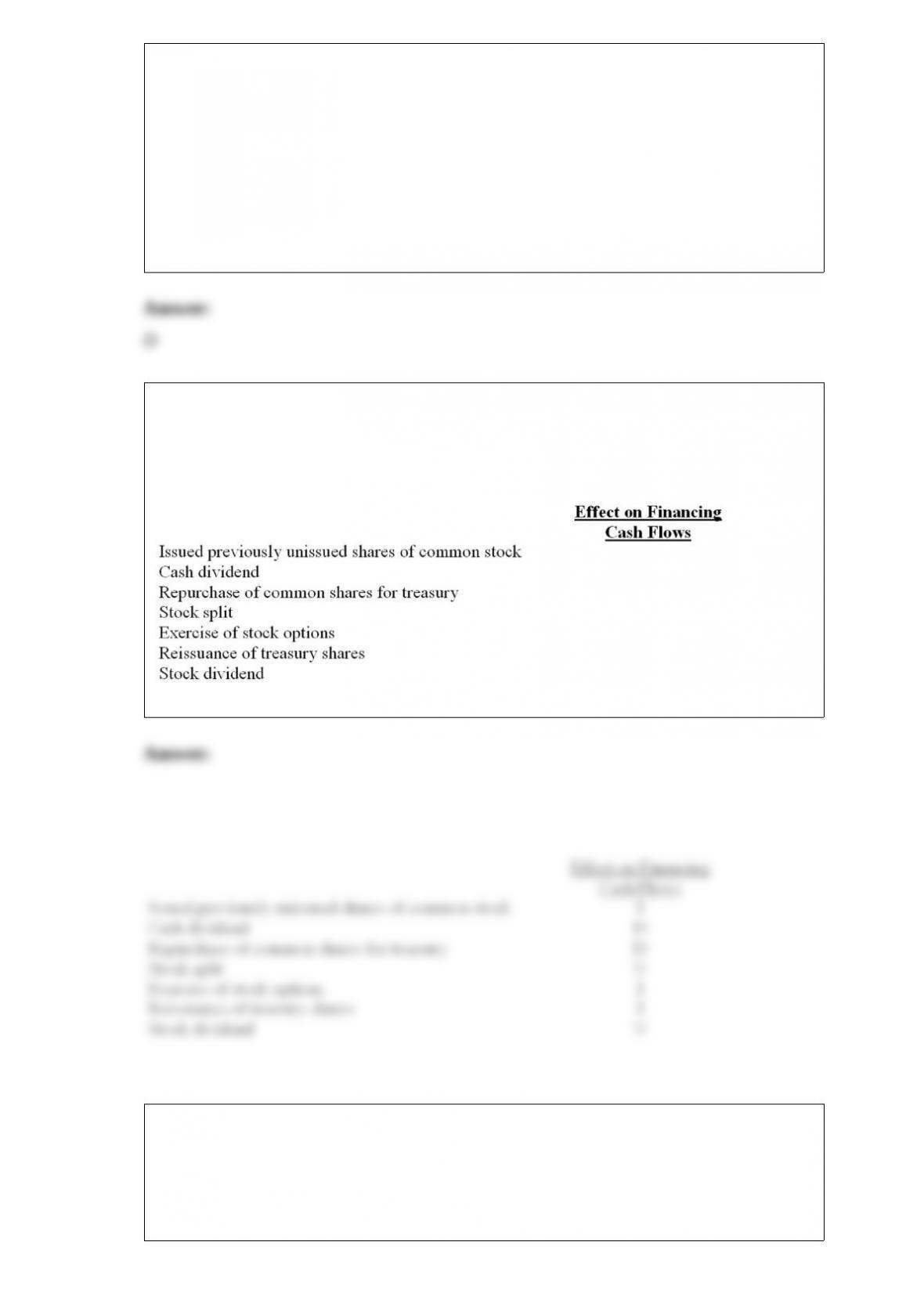
10) For the listed items below, identify the effects on cash flow from financing
activities as increasing (I), decreasing (D), or (N) having no effect on financing cash
flows:
11) Which of the following transactions decreases the quality of income ratio?
A.The accrual of interest expense.
B.Collecting cash on an account receivable.
C.Selling inventory on account for a profit.
D.Making a payment of principal on a loan.
12) Which of the following items about the statement of cash flows is correct?
A.Noncash expenses such as depreciation are subtracted from net income when using
the indirect method for computing cash flows from operating activities.
B.Cash equivalents are highly liquid investments with maturities at the date of purchase
of less than three months.
C.The acquisition of land by issuing bonds payable would not appear on the statement
of cash flows.
D.Cash paid for interest would be classified as a financing cash flow.
Cash equivalents are highly liquid investments and have maturities of three months or
less at the date of purchase.
13) Which of the following costs is most likely to be the largest expense reported on the
income statement of a merchandiser such as Wal-Mart stores?
A.Utilities expense.
B.Cost of goods sold.
C.Advertising expense.
D.Income tax expense.
14) Which of the following would most likely increase retained earnings?
A.An increase in expenses.
B.An increase in revenues.
C.Declaring a cash dividend.
D.Issuing additional common stock.
Net income increases retained earnings. Increased revenue, given a fixed expense
amount, would increase net income.
15) Trent Corp. purchased $1,000,000 of bonds at 96 when the market yield was 8%.
The bonds pay interest at the rate of 6%. Miller intends to hold these bonds to maturity
and will not need to sell the bonds before that date. Which of the following statements
is correct?
A.Since the bonds were purchased at a discount, the cash interest will be more than
interest revenue.
B.Since the bonds were purchased at a discount, the book value of the bond investment
will increase toward its maturity value.
C.The bond investment will be classified as available-for-sale.
D.The company will recognize unrealized gains or losses on the bonds.
The bond investment was purchased at other than par value and as it is amortized, the
book value approaches the maturity value. Since the bonds were bought at less than par
value, they were bought at a discount. To approach maturity value, the bonds will be
increased when the cost is amortized over time.
16) Which of the following journal entries does not reflect the initial cash sale of shares
of common stock?
A.Option A
B.Option B
C.Option C
D.Option D
17) Watson Company has provided the following data about its common stock:
♦ Par value is $1 per share
♦ 10,000,000 authorized shares
♦ 4,300,000 shares are outstanding
♦ 4,700,000 shares are issued
How many shares of treasury stock are there?
A.0.
B.400,000.
C.5,300,000.
D.5,700,000.
18) What is the effect on the financial statements when a company fails to adjust the
unearned revenue account for revenues earned at year-end?
A.Net income is understated and assets are understated.
B.Revenues are understated and liabilities are understated.
C.Net income is understated and liabilities are overstated.
D. Revenues are understated and stockholders’ equity is overstated.