1) The expense recognition principle recognizes expenses in the period they are paid.
2) Taxable income should always match pretax accounting income.
3) A current ratio below 1.0 is a sign of financial strength for a company.
4) A book value per share of common stock is the same amount as the market value per
share.
5) Patents are issued by the federal government.
6) The principal amount of a note is the amount borrowed by the creditor.
7) It is NOT the independent auditor’s responsibility to determine whether the audited
company’s financial statements comply with GAAP.
8) In the retail industry, revenue is recognized under IFRS when the cash is received.
9) On the statement of cash flows of a healthy company, Net Cash Provided by
Operating Activities generally exceeds net income because depreciation expense is
added back to net income.
10) Purchasing merchandise inventory on account results in an accounts receivable.
11) A balance sheet reports the company’s financial position over a period of time.
12) The change in Cash on the comparative balance sheets is the “check figure” for the
statement of cash flows.
13) The Cost of Goods Sold Model can be used to estimate ending inventory.
14) Which of the following financial statement(s) is(are) prepared using the adjusted
trial balance?
A) The balance sheet and the income statement only
B) Balance sheet, income statement, and statement of retained earnings
C) The balance sheet only
D) The income statement only
15) A malicious program that enters program code without consent and performs
destructive actions in the victim’s computer files or programs is a(n):
A) encryption device
B) phishing expedition
C) computer virus
D) fidelity bond
16) Wolverine Corporation owns 29% of Buckeye Corporation. Net income for
Buckeye for the year is $250,000. The journal entry prepared by Wolverine Corporation
is:
A) debit Equity-Method Investment for $72,500 and credit Cash for $72,500
B) debit Equity-Method Investment for $72,500 and credit Equity-Method Investment
Revenue for $72,500
C) debit Cash for $72,500 and credit Equity-Method Investment for $72,500
D) debit Equity-Method Investment for $250,000 and credit Equity-Method Investment
Revenue for $250,000
17) An important rule to remember when working with T accounts is:
A) when you debit an account, you are entering an amount of the right-hand side on the
T account
B) an increase to accounts payable will be recorded as a debit
C) to credit an account means to enter an amount on the right-hand side of the T
account
D) the debit side of a T account is on the right-hand side of the T account for assets and
expenses
18) Szidon Company reports the following data:
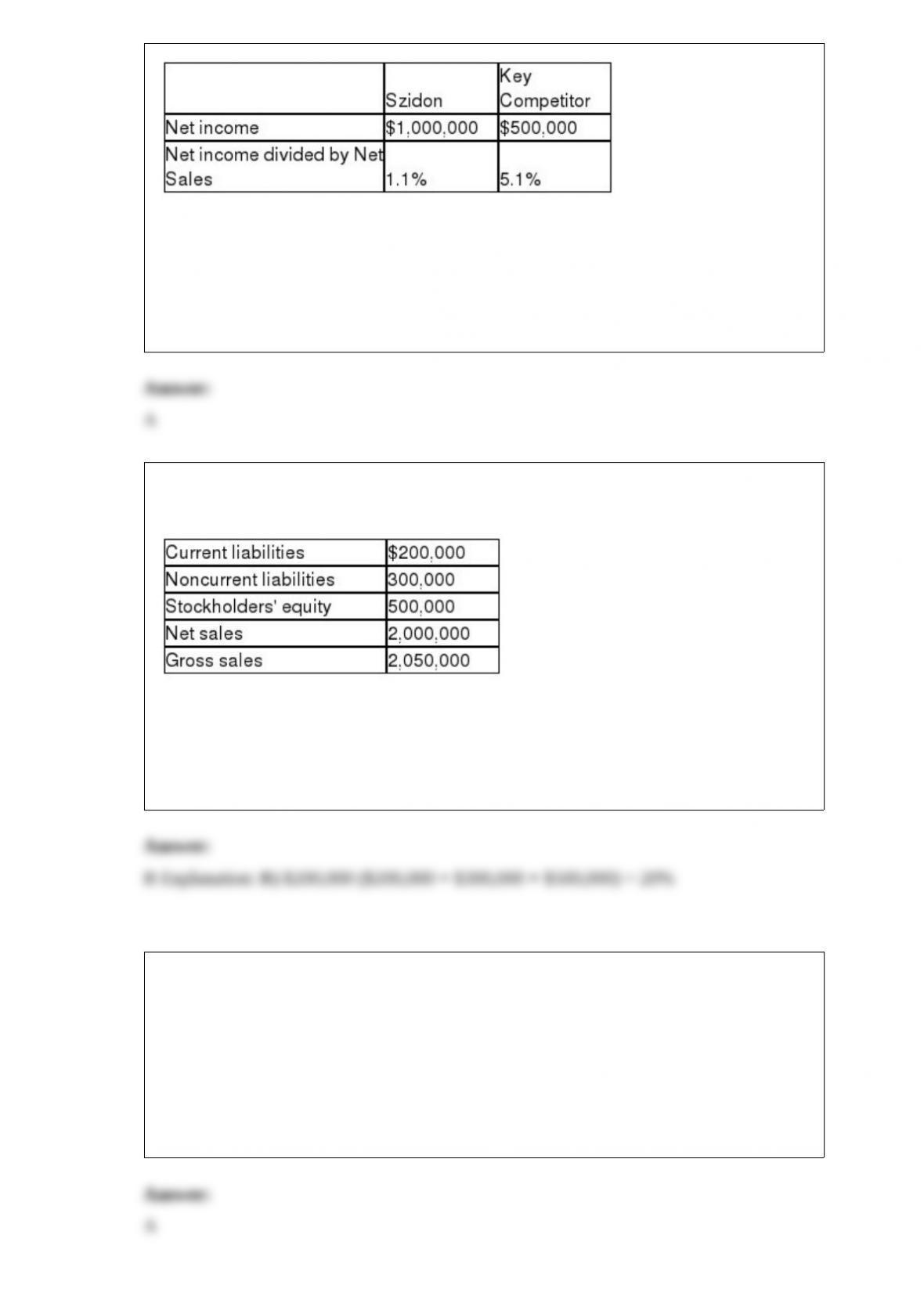
Using benchmarking, what can be said about Szidon Company?
A) Szidon is inferior to the key competitor because the key competitor’s net income
percentage is higher
B) Szidon is superior to the key competitor because net income is higher
C) There is not enough information to make any conclusions
D) There is conflicting information so no conclusions can be reached
19) Given the following data:
In vertical analysis, current liabilities would be expressed as:
A) 10%
B) 20%
C) 40%
D) 50%
20) An error in the ending inventory for the year ended December 31, 2015:
A) automatically creates errors in Cost of Goods Sold in the 2015 and 2016 financial
statements
B) has no effect on the 2015 financial statements, but will create an error in the 2016
financial statements
C) automatically creates errors in the ending inventory balance in the 2015 and 2016
financial statements
D) affects only the 2015 financial statements
21) The Accounts Receivable account for Johnny’s Mechanic Shop had a beginning
balance of $32,000 During the month, Johnny made sales on account of $42,000 The
ending balance in the Accounts Receivable account is $30,000 What are cash
collections for the month?
A) $32,000
B) $42,000
C) $44,000
D) $74,000
22) The three types of activities reported on the statement of cash flows are:
A) operating, investments, and financing
B) operating, investing, and free flow
C) operating, investing, and financing
D) operating, indirect, and direct
23) Cash-basis accounting does NOT record:
A) receipt of cash from interest earned on note receivable
B) payment of salaries to employees
C) expiration of prepaid rent
D) borrowing money from the local bank
24) A company reports Cost of Goods Sold of $400,000, Ending Inventory of $50,000,
Beginning Inventory of $30,000, Ending Accounts Payable of $40,000 and Beginning
Accounts Payable of $32,000. What is the days’ payable outstanding?
A) 31.2 days
B) 32.9 days
C) 36.5 days
D) 45.6 days
25) The journal entry to record salaries earned by 10 employees will:
A) debit Salary Expense and credit Salary Payable for the net pay
B) debit Salary Expense and credit Salary Payable for the gross pay
C) debit Salary Expense for the gross pay, credit FICA Tax Payable, credit Employee
Income Tax Payable and credit Salary Payable for the net pay
D) debit Salary Expense for the net pay, debit FICA Tax Payable, debit Employee
Income Tax Payable, and credit Salary Payable for the gross pay
26) The fair value of a long-term available-for-sale security has decreased from the last
carrying value. The journal entry to record this decrease will include:
A) a debit to the Allowance to Adjust Investment in Available-for-Sale Securities to
Market
B) a credit to the Allowance to Adjust Investment in Available-for-Sale Securities to
Market
C) a credit to the Unrealized Loss on Investment in Available-for-Sale Securities
D) a debit to the Unrealized Gain on Investment in Available-for-Sale Securities
27) A company reports the purchase of equipment for $1,000,000 in cash. On a
statement of cash flows, this is a(n) example of:
A) cash outflow from financing activity
B) cash outflow from operating activity
C) cash outflow from investing activity
D) noncash activity
28) When total expenses exceed total revenues, the result is:
A) a net profit
B) a net loss
C) a dividend
D) excess cash
29) A type of analysis that indicates the direction a business is taking is:
A) benchmarking
B) economic value added analysis
C) vertical analysis
D) trend percentages
30) Which of the following is typically used as the base in a vertical analysis of an
income statement?
A) gross profit
B) operating income
C) net income
D) net sales
31) Income tax payable appears on the:
A) statement of retained earnings
B) statement of stockholders’ equity
C) income statement
D) balance sheet
32) The income statement is used to prepare the:
A) Statement of Retained Earnings only
B) Statement of Cash Flows only
C) balance sheet only
D) Statement of Retained Earnings and Statement of Cash Flows
33) The cash paid to purchase a held-to-maturity investment in bonds is reported on the
statement of cash flows as a(n):
A) increase in financing activities
B) decrease in financing activities
C) increase in investing activities
D) decrease in investing activities

34) We have used transaction analysis and the accounting equation to record several
transactions for a company. The transactions are now recorded on a multi-column
spreadsheet of the assets, liabilities and stockholders’ equity of the company. If you
wanted to prepare a balance sheet with this spreadsheet, which column(s) would you
use?
A) final balances of asset columns only
B) final balances of liability columns only
C) final balances of stockholders’ equity columns only
D) all of the above
35) U.S. Generally Accepted Accounting Principles require the reporting of plant assets
at ________ on the balance sheet. International Financial Reporting Standards allow the
reporting of plant assets at ________ on the balance sheet.
A) current replacement cost; fair market value
B) fair market value; fair market value
C) historical cost; fair market value
D) historical cost; net realizable value
36) The gross profit percentage is calculated as:
A) cost of goods sold divided by net sales revenue
B) net sales revenue minus gross profit on sales
C) net sales revenue minus cost of goods sold
D) gross profit divided by net sales revenue
37) There is an error in computing ending inventory in Year 1. Which statement is
TRUE?
A) The error will have no effect on Year 2 financial statements
B) After three years, the inventory error will counterbalance
C) Gross profit will continue to be incorrect until an adjusting entry is made
D) The total gross profit for Year 1 and Year 2 combined will be correct

38) Information must be sufficiently transparent so that it makes sense to reasonably
informed users of the financial statements, such as creditors. This qualitative
characteristic of information is called:
A) verifiability
B) faithful representative
C) relevant
D) understandability
39) The Council of the Blind Store has ending inventory with a historical cost of
$630,000. Assume the store uses the perpetual inventory system. The current
replacement cost of the inventory is $608,000. The net realizable value is $650,000.
Before any adjustments at the end of the period, the cost of goods sold account has a
balance of $900,000. What journal entry is required under U.S. GAAP?
A) debit Cost of Goods Sold for $20,000 and credit Inventory for $20,000
B) debit Inventory for $20,000 and credit Cost of Goods Sold for $20,000
C) debit Cost of Goods Sold for $22,000 and credit Inventory for $22,000
D) debit Inventory for $22,000 and credit Cost of Goods Sold for $22,000
40) When recording a nonmonetary exchange of two plant assets, what information is
NOT needed?
A) book value of the asset given up
B) book value of asset receiving
C) fair value of asset given up
D) fair value of asset receiving
41) A company’s debt ratio is increasing every year and currently stands at 0.90. This
indicates:
A) an improving financial position
B) an increase in financial risk
C) a greater ability to pay current and long-term liabilities
D) a company that is going bankrupt
42) A $5,000, 7% bond is sold at 95. When the bond is issued, the Cash account will be
increased by:
A) $4,750
B) $5,000
C) $5,100
D) $5,250
43) On January 1, 2014, Conner Corporation purchased 70,000 of the 210,000 shares of
outstanding stock of JJ Company for $600,000. Net income reported by JJ Company for
2014 was $600,000. Dividends paid by JJ Company during 2014 were $150,000. The
Equity-Method Investment will be reported on Conner Corporation’s December 31,
2014 balance sheet in the amount of:
A) $600,000
B) $650,000
C) $750,000
D) $960,000
44) Fraudulent financial reporting is also called:
A) the fraud triangle
B) a misappropriation of assets
C) cooking the books
D) investigative reporting
45) What is the purpose of fraudulent reporting?
A) Net income and total assets are understated so managers can receive their bonuses
B) Net income and total assets are overstated so managers can receive their bonuses
C) So the stock price increases and managers benefit from share appreciation of stock
held
D) B and C
46) Hoover Company has a note payable for $300,000 on January 31, 2014. Starting on

February 1, 2014, the company is required to pay $75,000 on the note each month. The
first payment is on February 1, 2014, the second payment is on March 1, 2014, the third
payment is on April 1, 2014 and the final payment is on May 1, 2014. How will this
note be reported on the balance sheet at January 31, 2014?
A) Long-term liability, $300,000
B) Long-term liability, $225,000
C) Current liability, $75,000; long-term liability, $225,000
D) Current liability, $300,000
47) What is the last step in the journalizing process?
A) Record the transaction in the journal
B) Post the transaction to the ledger
C) Determine whether each account is increased or decreased by the transaction
D) Specify each account affected by the transaction and classify each account by type
48) An expense occurred in 2013, but it is not paid until 2014. Using the accrual basis
of accounting, the expense should appear on:
A) the 2013 income statement
B) the 2014 income statement
C) neither the 2013 nor the 2014 income statement
D) both the 2013 and 2014 income statements
49) On the statement of cash flows, cash payments from financing activities include:
A) issuing stock for property
B) sale of treasury stock
C) payment of notes payable
D) purchase of plant assets