
As a result of management’s refusal to permit the auditor to physically examine
inventory, the auditor has not accumulated sufficient evidence to conclude whether
financial statements are stated in accordance with ASPE (Accounting Standards for
Private Enterprises). The auditor must depart from the unqualified audit report because
A) the financial statements have not been prepared in accordance with GAAP.
B) the scope of the audit has been restricted by circumstances beyond either the client’s
or auditor’s control.
C) the auditor has lost independence.
D) the scope of the audit has been restricted by the client.
How is lack of understanding of a client’s knowledge and industry linked to the
auditor’s business risk?
A) sales and collection processes need to be carefully documented so that the auditor
can assess the value of accounts receivable
B) failure to fully understand the nature of the client’s transactions could result in
litigation should the client fail
C) the auditor may not be adequately trained to understand the nature of the client’s
business, conducting a poor quality audit
D) there may not be sufficient expertise assigned to the audit engagement, resulting in a
lack of understanding of complex issues

In the audit of an individual’s tax return, the auditor should demonstrate competence in
the use of
A) external databases that contain economic statistics.
B) standard personal and corporate tax preparation software.
C) the Income Tax Act and accompanying regulations.
D) database management software for the use of client based research.
Restaurant Products Company (RPC) has been an audit client of your firm for many
years. RPC has a March 31 fiscal year end. The company is a successful distributor of
restaurant and food industry products, such as trays, weigh scales, dishes, cooking
implements. The company sells to businesses only (i.e. not to end consumers), with
clients ranging from small restaurants to large food service chains and hotels. The
company does have a perpetual inventory system, but the current inventory system
relies upon accurate data entry of receipts, shipments and inventory adjustments from
paper documents.
RPC is looking to improve inventory management and maintain costs in the face of
rising competition and growth. Accordingly, it is implementing RFID (radio frequency
identification) technology for its inventory in January 2012. RFID chips will be placed
on warehouse shelf locations, boxes of products, and on large cost individual products.
At the same time the company will implement a wireless mesh system throughout the
warehouse, with wireless tracking of product movement. Effective January 31, 2012 a
new inventory management system is being implemented to facilitate better decision
making and access to online realtime inventory data. The new inventory management
system will include a new database that will include internal records of inventory on
hand, receipts and shipments of inventory, purchase order details, and payment details.
Required:
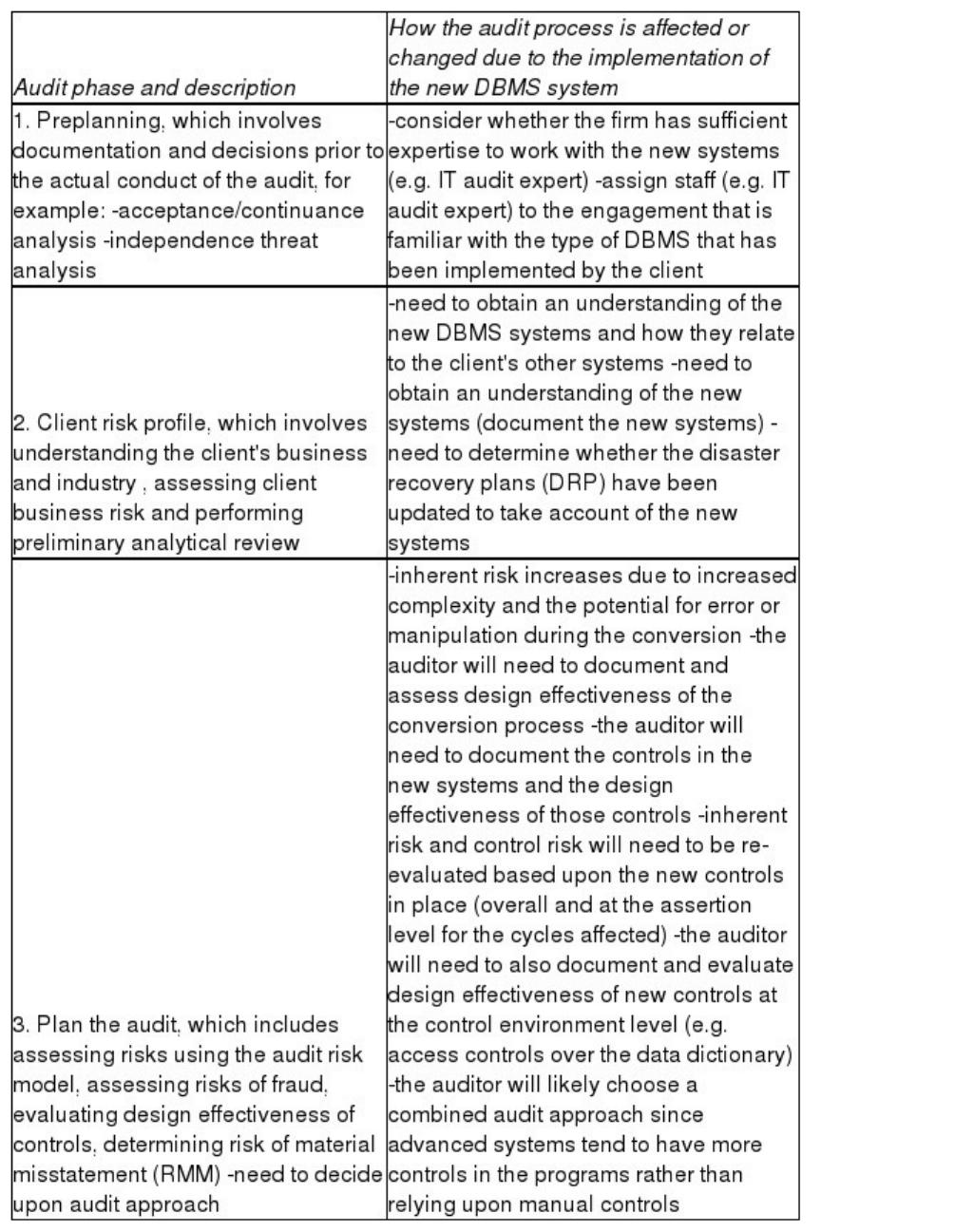
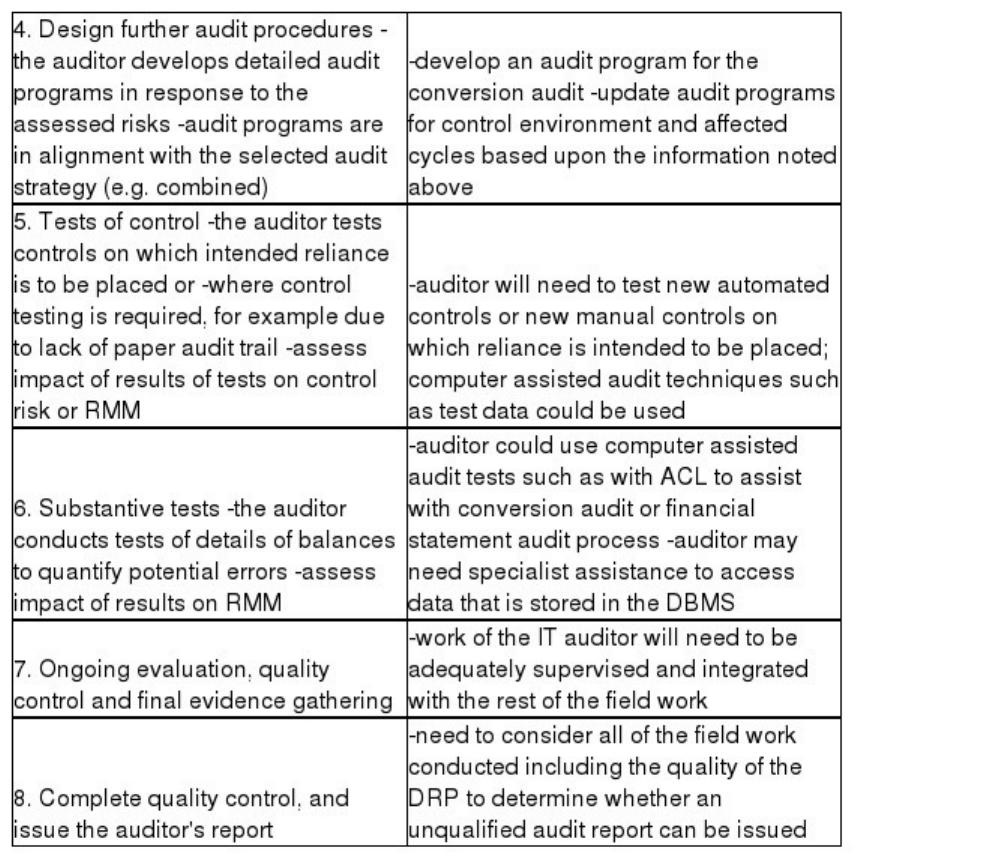
A. For each phase of the financial statement audit process, describe the phase, and
explain how the audit process is affected or changed due to the implementation of the
new database management system.
B. What is the impact of the implementation of RFID on the financial statement audit
process?

[Note that these points must be different from those raised in Part A above.]

The control test which requires the auditor to “compare recorded transactions in the
acquisitions journal with the vendor’s invoice, receiving report, and other supporting
documentation” satisfies the objective of
A) occurrence.
B) classification.
C) completeness.
D) accuracy.
The assessment against a defendant of the full loss suffered by a plaintiff regardless of
the extent to which other parties shared in the wrongdoing is called
A) separate and proportionate liability.
B) joint and several liability.
C) shared liability.
D) unitary liability.

Performing inquiry, analytical procedures and discussion with the limited objective of
assessing whether the information being reported on is plausible within the framework
of appropriate criteria, is the definition of a(n)
A) compilation.
B) review.
C) audit.
D) examination.
ProForce Inc. is facing a large lawsuit from its employees. The contingency is
significant and may lead to a going concern issue if ProForce is found guilty. ProForce
took the adequate measures, as prescribed by IFRS (International Financial Reporting
Standards), to account, disclose and present the contingency in the financial statements.
The auditor should
A) add an emphasis-of-matter paragraph after the opinion paragraph.
B) issue a standard unqualified report.
C) issue a qualified report.
D) deny an audit opinion.

During the audit of cash, the focus of the audit is to
A) do substantive tests of payments for supplies.
B) conduct control tests of sales transactions.
C) verify the bank reconciliation.
D) conduct control tests over payments.
It is common to test sales for proper classification as part of testing for
A) cutoff.
B) accuracy.
C) valuation.
D) completeness.
Mega Manufacturing Company (Mega) is thinking about acquiring Localized Small
Producer Inc. (LSP), a small manufacturing company that produces related products.
Mega has examined the financial statements of LSP, which show only a small profit in
the last five years. Management of LSP has taken reasonable salaries, and cost of goods
sold is higher than the industry average for LSP. Mega believes that it will be able to
introduce operational efficiencies at LSP, improving the profitability of the small
company, if acquired.
Required:
A) What type of engagement should be conducted to assess the operational efficiencies
of LSP? Justify your response.
B) Who should be engaged to conduct the engagement?
C) What major problems might the auditors encounter when conducting the audit and
writing the report?
Because many of the types of errors and irregularities that may be found in the
acquisition and payment cycle represent a misstatement of earnings and are of
significant concern to the auditor, the tolerable exception rate selected by the auditor for
attribute testing of this cycle will be

A) low.
B) high.
C) average.
D) 15% or less.
Which of the following situations would be an example of a self-interest threat that
would prevent a PA from auditing the client?
A) The PA’s uncle owns the business that the PA is auditing.
B) For the last two years, the client could not pay their fees, so the PA created a loan
agreement covering the fees, with the client paying 10% interest on the fees.
C) The PA has a small bank loan at normal business interest rates with the bank that his
firm is auditing.
D) The PA has purchased a used car from one of the employees of the client.
To improve the appropriateness of audit evidence, the auditor should
A) make sure to select a larger sample size for the items being tested.
B) add additional population items into the sample, improving sample variety.

C) select audit procedures that improve the reliability of the evidence.
D) select a smaller sample size that is statistically valid.
When considering the relationships between types of audit tests and evidence, which of
the following procedures is used only for tests of details of balances?
A) inspection
B) recalculation
C) reperformance
D) external confirmation
In the audit of historical financial statements by PA firms, the criteria used are
A) generally accepted auditing standards.
B) generally accepted accounting principles.
C) regulations of the Canada Revenue Agency.
D) regulations of the provincial securities commissions.

The amount of time spent verifying owners’ equity is frequently minimal for
closely-held corporations because
A) these companies are so small that it is not necessary to audit the capital section.
B) the few owners all have access to the books so the auditor spends more time on
accounts like liabilities, which affect outsiders.
C) there are few if any transactions during the year for the capital stock accounts,
except for earnings and dividends.
D) there is no public interest in these companies.
In most audits, the amounts of the balance sheet accounts related to payroll are
A) large and require substantial effort to audit.
B) small compared with the transactions.
C) large on the liability side but small on the asset side.
D) significantly larger than the related accounts on the income statement.

An auditor who is engaged to examine the financial statements of a business enterprise
will request a cutoff bank statement primarily in order to
A) verify the cash balance reported on the bank confirmation inquiry form.
B) verify reconciling items on the client’s bank reconciliation.
C) detect lapping.
D) detect kiting.
Which of the following is an example of a data entry input edit that could be used to
improve the accuracy of online data entry of sales orders?
A) matching of customer number to master file
B) automatic posting of sales to the general ledger account
C) reconciliation of the customer master file to accounts receivable
D) daily point-of-sales control totals matched to cash receipts
The test of details of balance procedure which requires the auditor to account for
unused inventory tag numbers to make sure none have been omitted is an attempt to
satisfy the objective of

A) allocation.
B) existence.
C) completeness.
D) accuracy.
When Dussault & Montgomery relied on Groves & Padden, another PA firm, to audit
the Quebec subsidiaries of one of their audit client, Dussault & Montgomery should
A) assess Groves & Padden’s professional qualifications.
B) ask Groves & Padden to also sign the auditor’s report.
C) send one of their auditors to Quebec to supervise the work being done by Groves &
Padden.
D) issue a qualified opinion for the financial information pertaining to the Quebec
subsidiaries.
The exclusion of a single transaction of the capital acquisition and repayment cycle
could be material in itself. This means that the following audit assertion is a major audit
concern
A) completeness.

B) existence.
C) accuracy.
D) rights and obligations.
When examining payroll transactions, an auditor is primarily concerned with the
possibility of
A) overpayments and unauthorized payments.
B) posting of gross payroll amounts to incorrect salary expense accounts.
C) misfootings of employee time records.
D) excess withholding of amounts required to be withheld.
“Existing payroll transactions are recorded” is the control objective of
A) authorization.
B) completeness.
C) existence.
D) accuracy.

A weak internal control system allows a foreman to clock in daily for a fictitious
employee and to approve the time card at the end of the payroll period. This fraud
would be detected if other controls were in place, such as having an independent party
A) compare the date of the recorded cheque in the payroll journal with the date on the
cancelled cheques and time cards.
B) foot the payroll journal and trace postings to the general ledger and the payroll
master file.
C) recompute hours worked from time cards.
D) distribute paycheques.
In statistical terms, acceptable risk of assessing control risk too low (ARACR)
corresponds with
A) sampling risk.
B) inherent risk.
C) control risk.
D) nonsampling risk.

Society has attached a special meaning to the term professional. A professional is
A) someone who has passed a qualifying exam to enter the job market.
B) any person who receives pay for the services performed.
C) a person who is expected to conduct himself or herself at a higher level than the
requirements of society’s laws or regulations.
D) someone who has both an education in the trade and on-the-job experience received
under an experienced supervisor.
When a company uses purchased software packages for its accounting software, such
packages normally do not permit the company to change the software package’s
functionality. This means that the auditor will consider
A) access controls as being poor.
B) program change controls as poor.
C) program change controls as excellent.
D) access controls as being excellent.
A) Describe each of the five business functions that comprise the acquisition and
payment cycle.
B) Describe the key documents used in processing purchase orders for the acquisitions
and payment cycle.
C) Discuss the key documents and records used in the recognizing the liability function
in the acquisitions and payment cycle.

One of the ways to eliminate nonsampling risk is through
A) proper supervision and instruction of the client’s employees.
B) proper supervision and instruction of the audit team.
C) the use of attribute sampling rather than variables sampling.
D) controls which ensure that the sample drawn is random and representative.
A review of any part of an organization’s procedures and methods for the purpose of
evaluating efficiency and effectiveness is classified as a(n)
A) audit of financial statements.
B) compliance audit.
C) operational audit.
D) production audit.
Bank reconciliations are normally verified on a 100-percent basis. Testing the
reasonableness of the cash balance is therefore
A) less important than for most other audit areas.

B) more important than for other audit areas.
C) equally important than for other audit areas.
D) less important than for the audit of other assets, but more important than the audit of
liabilities.
After the auditor has completed all the procedures, it is necessary to combine the
information obtained to reach an overall conclusion as to whether the financial
statements are fairly presented. This is a highly subjective process that relies heavily on
A) generally accepted auditing standards.
B) the provincial institutes’ Rules of Professional Conduct.
C) generally accepted accounting principles.
D) the auditor’s professional judgment.
Why is it important for the review engagement report to state that the review is not an
audit?
A) to make sure that the public accountant is not sued
B) to clarify that only review engagement procedures were used during the engagement

C) to make users aware that a review provides a lower level of assurance
D) so that the user does not ask any unnecessary questions about the engagement