
Traditionally, the most popular company-wide base for allocating overhead to products
was:
A. machine hours.
B. direct labor hours or costs.
C. number of units produced.
D. number of units sold.
Which of the following items typically found on the selling and administrative expense
budget will also impact the cash budget?
A. Depreciation expense
B. Administrative salaries
C. Advertising expense
D. Both administrative salaries and advertising expense are correct.
In the early days of the industrial revolution, indirect manufacturing costs:
A. were a significant cost of producing most products.
B. were relatively large compared to the direct costs of producing a product.
C. were highly correlated with the use of labor.

D. were largely fixed.
Which of the following accounts would appear on the inventory purchases budget and
pro forma balance sheet?
A. Cost of goods sold
B. Sales revenue
C. Accounts receivable
D. Accounts payable
In an organization, departments that provide support to operating departments are
called:
A. service departments.
B. primary departments.
C. operating departments.
D. strategic departments.
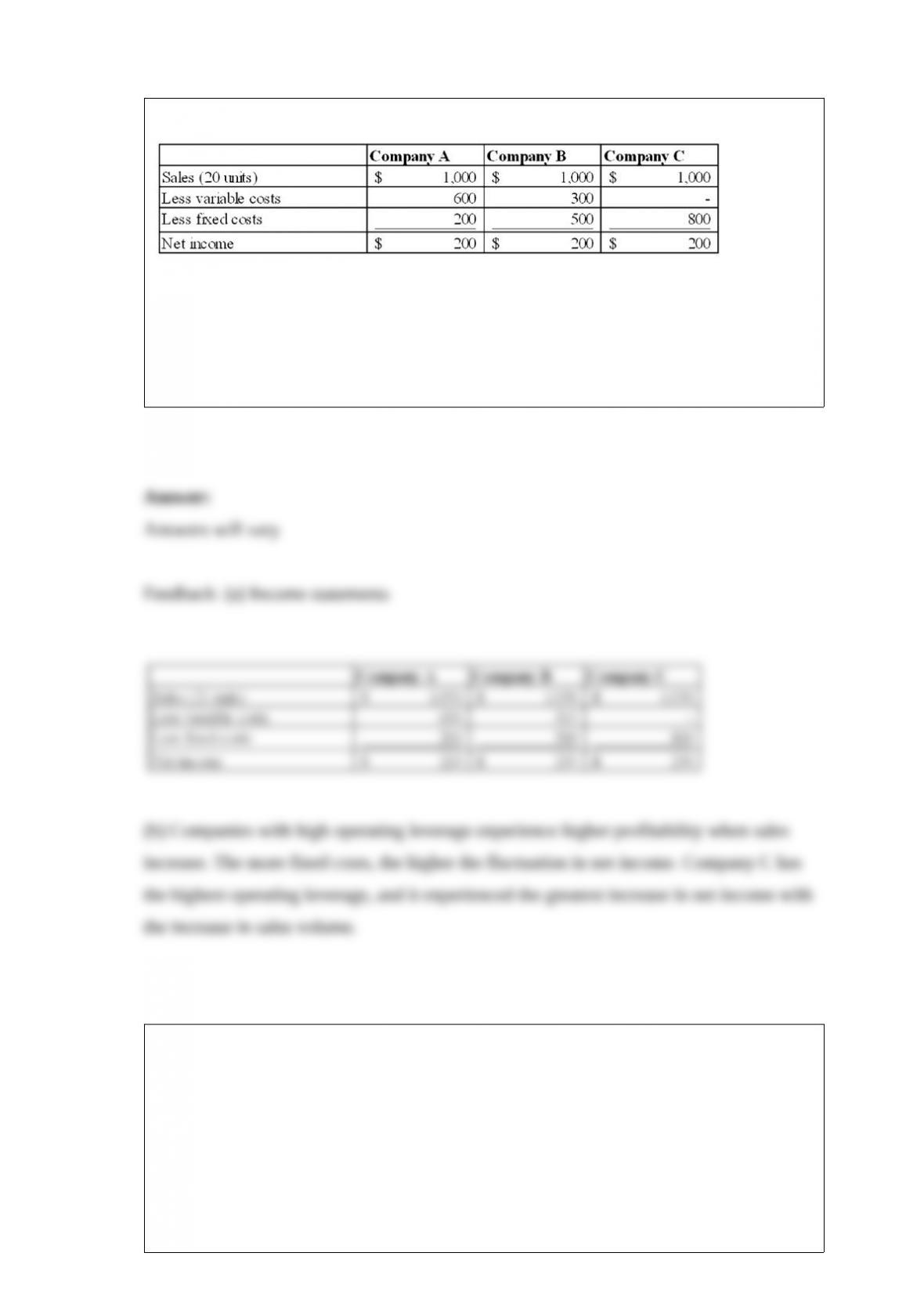
Income statements for three companies are provided below:
Required:
(a) Prepare new income statements for the firms assuming each sells one additional unit
(i.e. each firm sells 21 units)
(b) Briefly describe the effect of cost structure on profitability.
Which of the following is an appropriate cost driver for electricity used for production
equipment in a factory?
A. Machine hours
B. Number of inspections
C. Setup hours

D. Number of units
Activities that support specific products or product lines are known as:
A. facility-level activities
B. unit-level activities
C. product-level activities
D. batch-level activities
Which of the following equations can be used to compute a firm’s magnitude of
operating leverage?
A. Net income/sales
B. Fixed costs/contribution margin
C. Contribution margin/net income
D. Net income/contribution margin
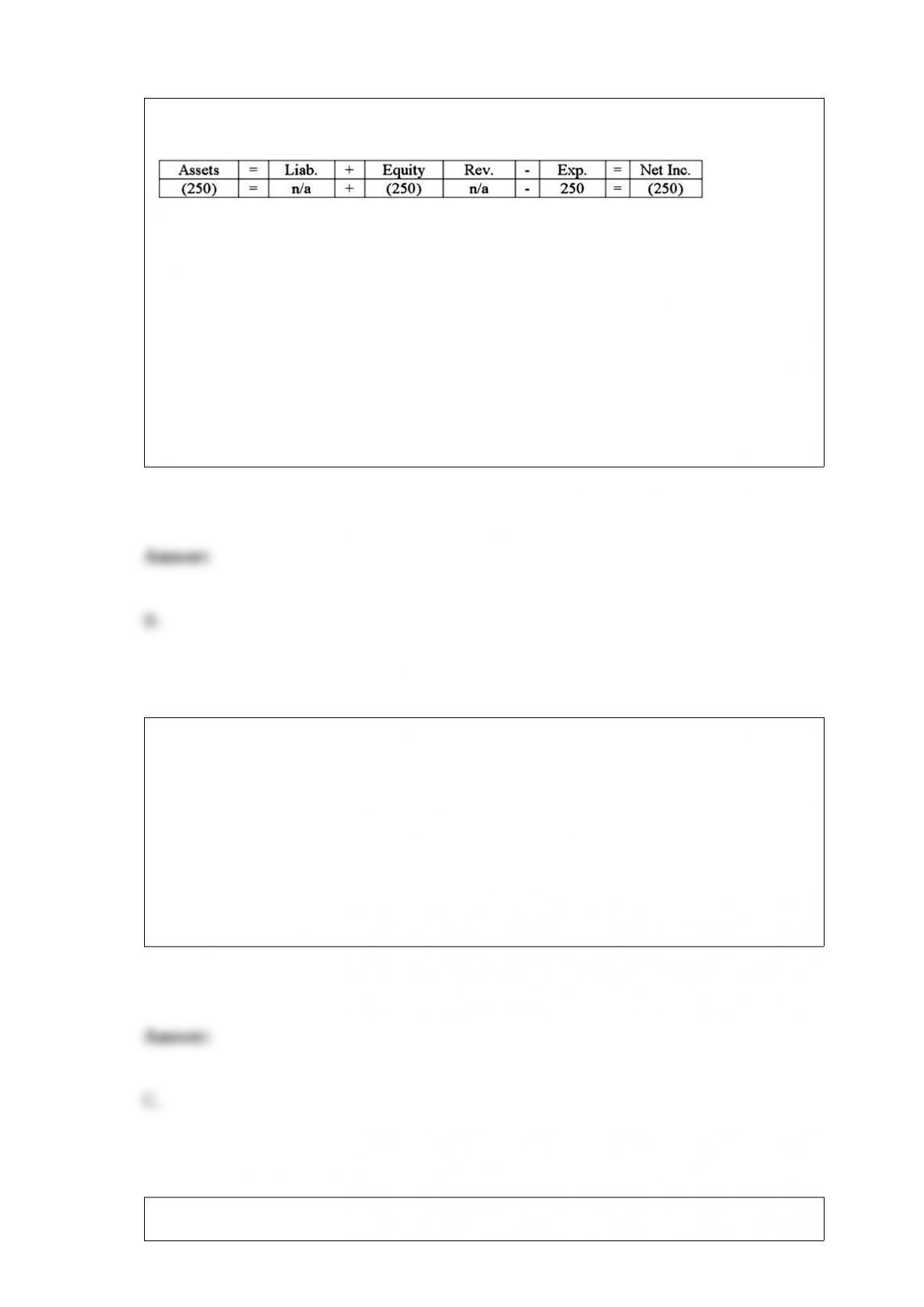
Langdon Company experienced an accounting event that affected its financial
statements as indicated below:
Which of the following transactions could have caused the indicated effects on the
company’s accounting equation?
A. Goods transferred from work in process to finished goods.
B. Allocation of underapplied overhead to cost of goods sold.
C. Collection of account receivable.
D. Allocation of overapplied overhead to cost of goods sold.
The entry to dispose of overapplied manufacturing overhead will include a:
A. Debit to cost of goods sold and a credit to manufacturing overhead.
B. Debit to cost of goods sold and a credit to finished goods.
C. Debit to manufacturing overhead and a credit to cost of goods sold.
D. Debit to finished goods and a credit to manufacturing overhead.
The following information was prepared for Standard Corporation:
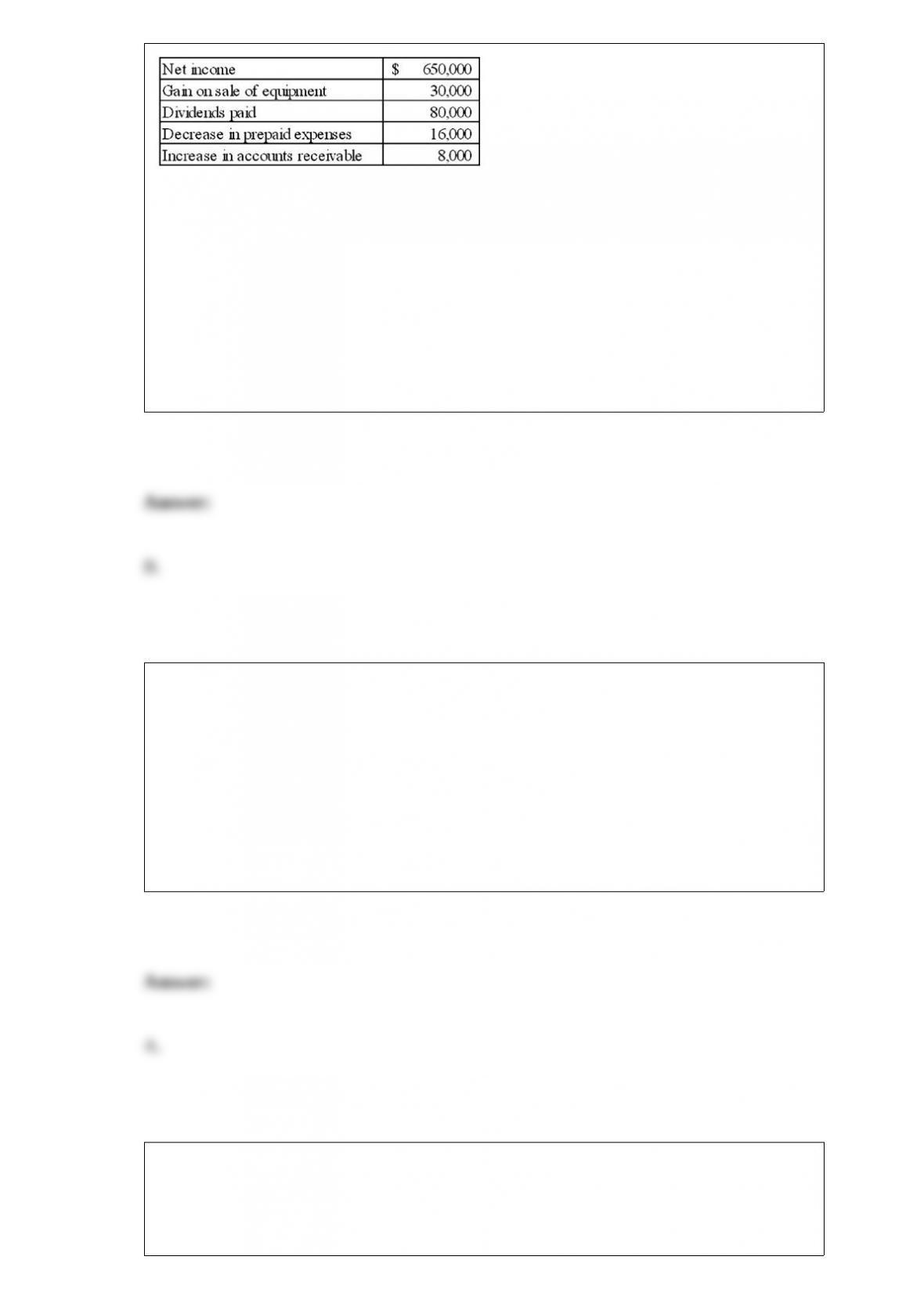
Net cash provided by operating activities is:
A. $672,000
B. $628,000
C. $658,000
D. $548,000
When would a variance be labeled as favorable?
A. When actual costs are less than standard costs
B. When standard costs are equal to actual costs
C. When standard costs are less than actual costs
D. When estimated costs are greater than actual costs
Classify each of the following costs for Harrison Company as a selling or general and
administrative period cost or as a direct or indirect product cost by entering the dollar
amount(s) in the appropriate column(s):
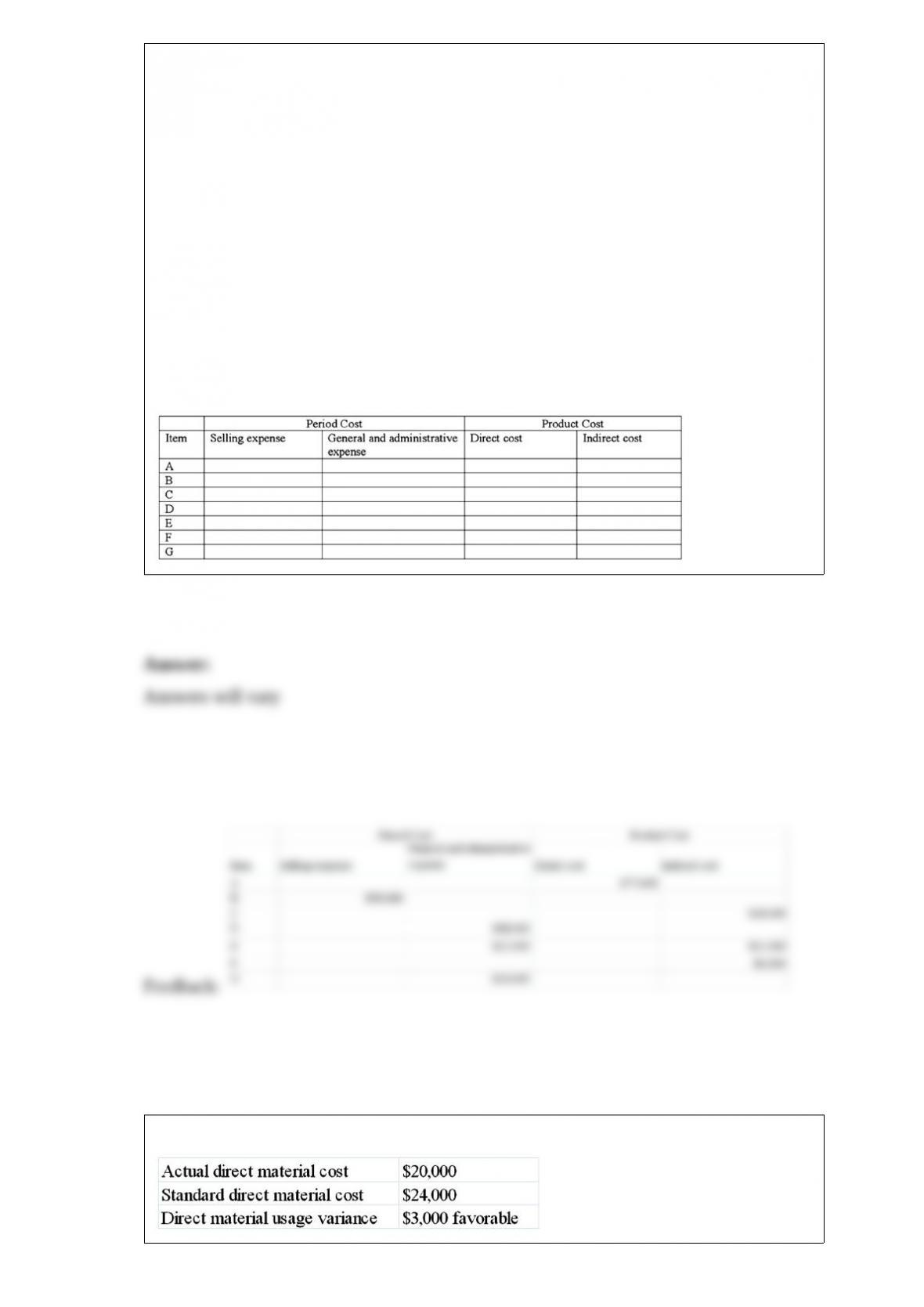
A. Paid $75,000 in wages for employees who assemble the company’s products.
B. Paid sales commissions of $58,000.
C. Paid $38,000 in salaries for factory supervisors.
D. Paid $88,000 in salaries for executives (president and vice presidents).
E. Recorded depreciation cost of $25,000. $13,000 was depreciation on factory
equipment and $12,000 was depreciation on the company headquarters building.
F. Paid $4,000 for various supplies that it used in the factory (oil and materials used in
machine maintenance).
G. Used $10,000 in prepaid corporate liability insurance.
The following information is provided by the Atlas Company:

What is the direct material price variance?
A. $1,000 favorable
B. $1,000 unfavorable
C. $5,000 unfavorable
D. Not enough information is provided
In an organization, departments that have tasks leading to the primary objectives of the
organization are:
A. service departments.
B. operating departments.
C. primary departments.
D. strategic departments.
Indicate whether each of the following statements about financial statement analysis is
true or false.
Meaningful comparisons between two companies generally should be made using
percentage analysis or ratio analysis, not absolute amounts.
The materiality of accounting information refers to whether it is viewed as favorable
(good news) or unfavorable (bad news).
Companies must account for immaterial items in compliance with generally accepted
accounting principles.
To judge the materiality of an absolute financial statement amount, one must consider
the size of the company reporting it.
Comparing percentages derived from financial statement analysis has the drawback of
varying materiality levels.
Indicate whether each of the following statements is true or false.
A cost that is relevant to one decision may be irrelevant to another.
To be relevant in decision making, cost information need not be exactly correct.
When making decisions in business, information that cannot be quantified (expressed in
numbers) generally is not relevant.
Eliminating a segment of a business may eliminate some facility-level costs.
The sacrifice represented by a lost opportunity is an opportunity cost.
At the beginning of 2014, Hilliard Company estimated that its total overhead cost
would be $250,000 and its production volume would be 80,000 units. Total actual
overhead cost for 2014 was $246,000. The actual number of units produced in 2014 was
78,000.
Required:
1) What amount of overhead was applied to the products Hilliard completed during
2014?
2) Calculate the volume variance for 2014. Indicate whether it is favorable or
unfavorable. Do not round intermediate calculations.
3) Calculate the spending variance for 2014.
Indicate whether each of the following statements is true or false.
The allocation of indirect costs using activity-based costing is a three-step process.
The first stage of activity-based costing is to calculate activity rates.
A typical business may engage in thousands of different activities.
Determining the number of activity centers to use in an activity-based costing system
should be based on a cost-benefit analysis.
A traditional cost allocation system first assigns costs to activity centers and then uses a
single volume-based cost driver to assign the costs to products.
In calculating product costs, actual direct materials and actual direct labor are charged
to the work in process account; however, an estimated amount of overhead is charged to
the account. Why is overhead accounted for differently than the other costs of
production?
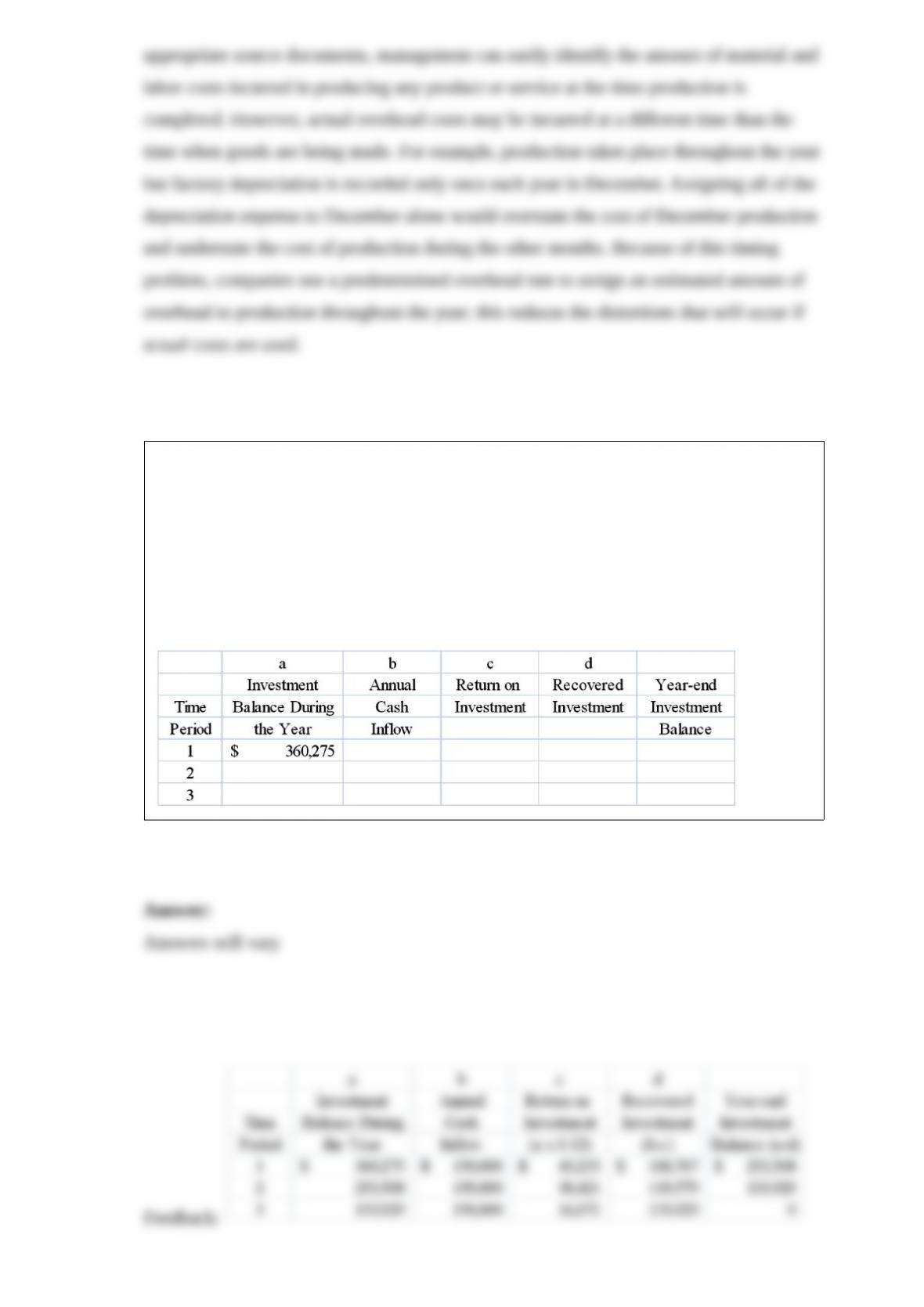
Gordon Company is considering a three-year capital investment that will return
$150,000 per year. The present value of this annuity at the company’s required rate of
return of 12% is $360,275.
Required:
Complete the table that has been started below to show the return on investment at 12%
and the amount of investment recovered each year. Remember that the investment
balance should be zero at the end of the three years.
Joyce Company began 2014 with a $21,000 balance in its accounts receivable account.
During the accounting period Joyce earned revenue on account amounting to $35,000.
At the end of the accounting period, the accounts receivable account had a balance of
$8,500. Using the above information, determine the amount of cash collected from
accounts receivable during the current accounting period.
Indicate whether each of the following statements is true or false.
Estimated overhead costs are applied to work in process inventory at the time the goods
are produced.
Overhead is applied to work in process by debiting manufacturing overhead and
crediting finished goods inventory.
Recognizing estimated overhead is an asset exchange transaction.
Actual overhead costs are recorded with a credit to manufacturing overhead.
During a company’s accounting period, manufacturing overhead is likely to be either
overapplied or underapplied.
What are indirect costs, and how are the indirect costs incurred to make products
accounted for?