
1) among the short-term obligations of lance company as of december 31, the balance
sheet date, are notes payable totaling $250,000 with the madison national bank. these
are 90-day notes, renewable for another 90-day period. these notes should be classified
on the balance sheet of lance company as
a.current liabilities
b.deferred charges
c.long-term liabilities
d.intermediate debt
2) which of the following is a condition for accruing a liability for the cost of
compensation for future absences?
a.the obligation relates to the rights that vest or accumulate
b.payment of the compensation is probable
c.the obligation is attributable to employee services already performed
d.all of these are conditions for the accrual
3) all of the following are characteristics of a derivative financial instrument except the
instrument
a.has one or more underlyings and an identified payment provision
b.requires a large investment at the inception of the contract
c.requires or permits net settlement
d.all of these are characteristics
4) solar products purchased a machine for $39,000 on july 1, 2012. the company
intends to depreciate it over 4 years using the double-declining balance method. salvage
value is $3,000. depreciation for 2012 is
a.$19,500
b.$9,750
c.$14,625
d.$9,000
5) the following accounts were abstracted from starr co.’s unadjusted trial balance at
december 31, 2012:
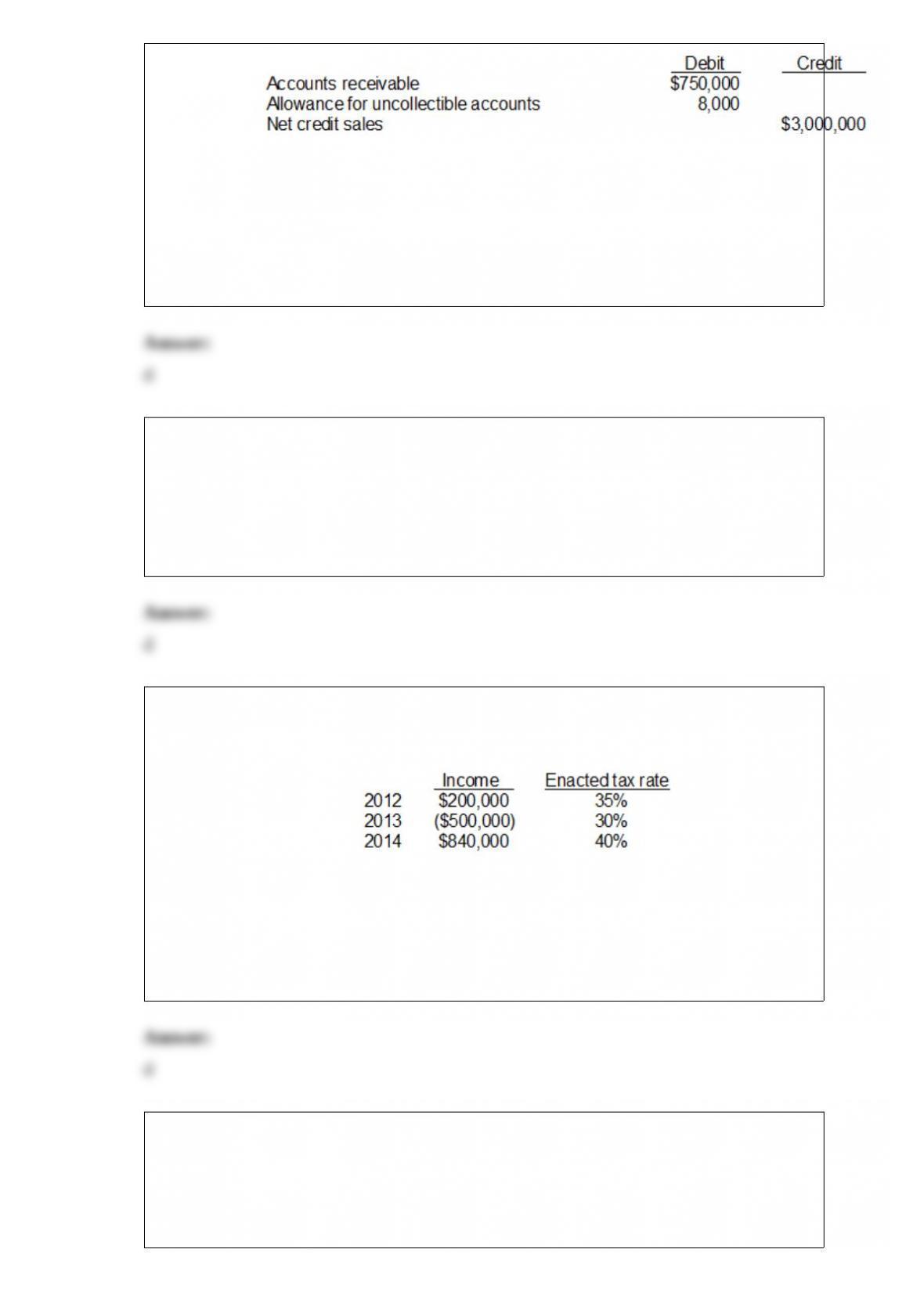
starr estimates that 4% of the gross accounts receivable will become uncollectible. after
adjustment at december 31, 2012, the allowance for uncollectible accounts should have
a credit balance of
a.$120,000
b.$112,000
c.$38,000
d.$30,000
6) which of the following is a realistic assumption of the straight-line method of
depreciation?
a.the asset’s economic usefulness is the same each year
b.the repair and maintenance expense is essentially the same each period
c.the rate of return analysis is enhanced using the straight-line method
d.depreciation is a function of time rather than a function of usage
7) operating income and tax rates for c.j. companys first three years of operations were
as
follows:
assuming that c.j. company opts to carryback its 2013 nol, what is the amount of
income tax payable at december 31, 2014?
a.$136,000
b.$336,000
c.$246,000
d.$216,000
8) the cost of land does not include
a.costs of grading, filling, draining, and clearing
b.costs of removing old buildings
c.costs of improvements with limited lives
d.special assessments
9) lyons company deducts insurance expense of $105,000 for tax purposes in 2012, but
the expense is not yet recognized for accounting purposes. in 2013, 2014, and 2015, no
insurance expense will be deducted for tax purposes, but $35,000 of insurance expense
will be reported for accounting purposes in each of these years. lyons company has a
tax rate of 40% and income taxes payable of $90,000 at the end of 2012. there were no
deferred taxes at the beginning of 2012.
what is the amount of income tax expense for 2012?
a.$132,000
b.$126,000
c.$105,000
d.$90,000
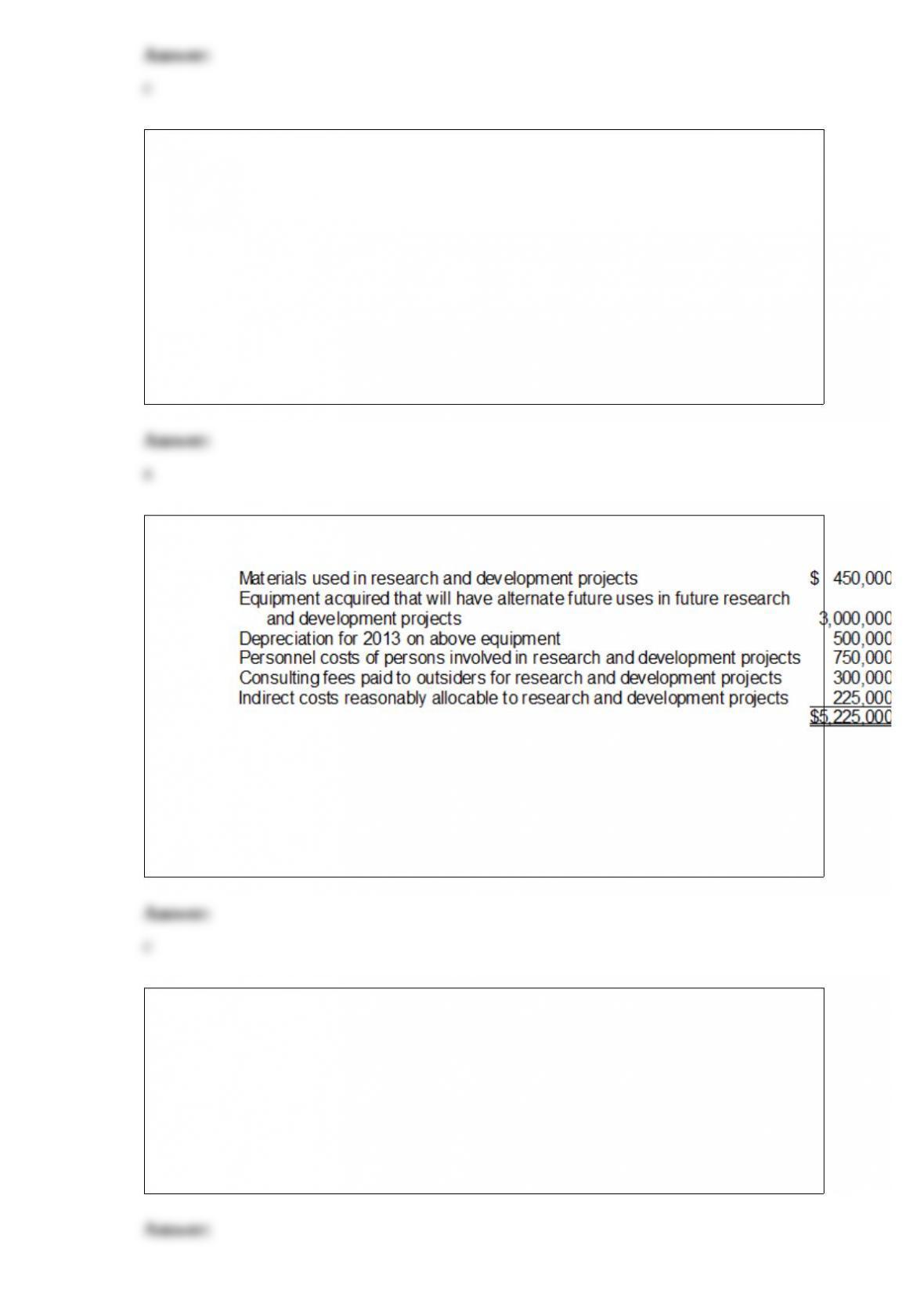
10) hall co. incurred research and development costs in 2013 as follows:
the amount of research and development costs charged to hall’s 2013 income statement
should be
a.$1,700,000
b.$2,000,000
c.$2,225,000
d.$4,700,000
11) all of the following costs should be charged against revenue in the period in which
costs are incurred except for
a.manufacturing overhead costs for a product manufactured and sold in the same
accounting period
b.costs which will not benefit any future period
c.costs from idle manufacturing capacity resulting from an unexpected plant shutdown
d.costs of normal shrinkage and scrap incurred for the manufacture of a product in
ending inventory
12) an ifrs sorie statement might include all of the following except
a.net income or loss
b.unrealized gains or losses on the revaluation of long-term assets
c.cumulative effect of a change in accounting principle
d.extraordinary gain or loss
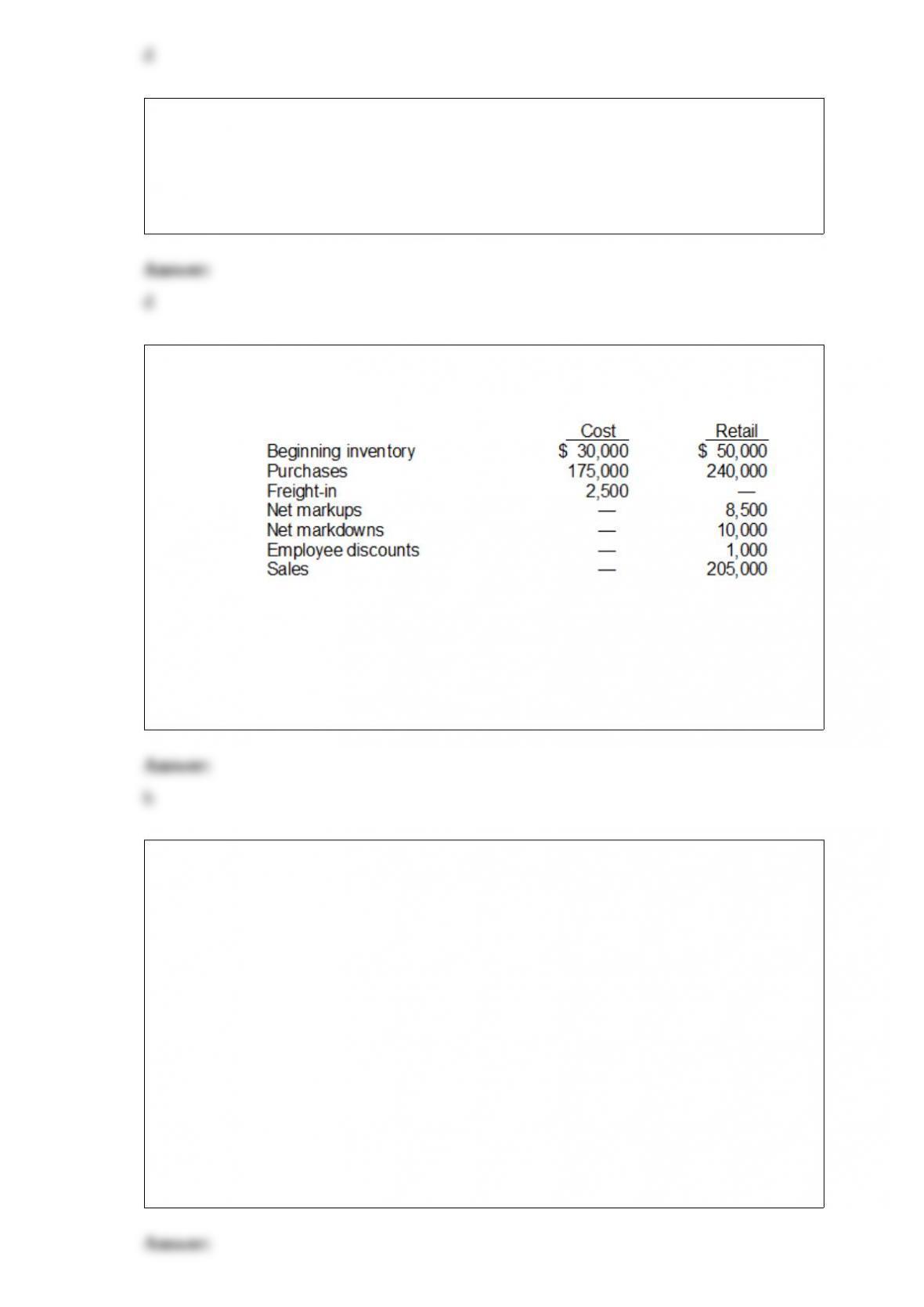
13) crane sales company uses the retail inventory method to value its merchandise
inventory. the following information is available for the current year:
if the ending inventory is to be valued at the lower-of-cost-or-market, what is the cost to
retail ratio?
a.$207,500 $290,000
b.$207,500 $298,500
c.$205,000 $300,000
d.$207,500 $288,500
14) dole corp.’s accounts payable at december 31, 2012, totaled $650,000 before any
necessary year-end adjustments relating to the following transactions:
on december 27, 2012, dole wrote and recorded checks to creditors totaling $350,000
causing an overdraft of $100,000 in dole’s bank account at december 31, 2012. the
checks were mailed out on january 10, 2013.
on december 28, 2012, dole purchased and received goods for $150,000, terms 2/10,
n/30. dole records purchases and accounts payable at net amounts. the invoice was
recorded and paid january 3, 2013.
goods shipped f.o.b. destination on december 20, 2012 from a vendor to dole were
received january 2, 2013. the invoice cost was $65,000.
at december 31, 2012, what amount should dole report as total accounts payable?
a.$1,212,000
b.$1,147,000
c.$900,000
d.$800,000
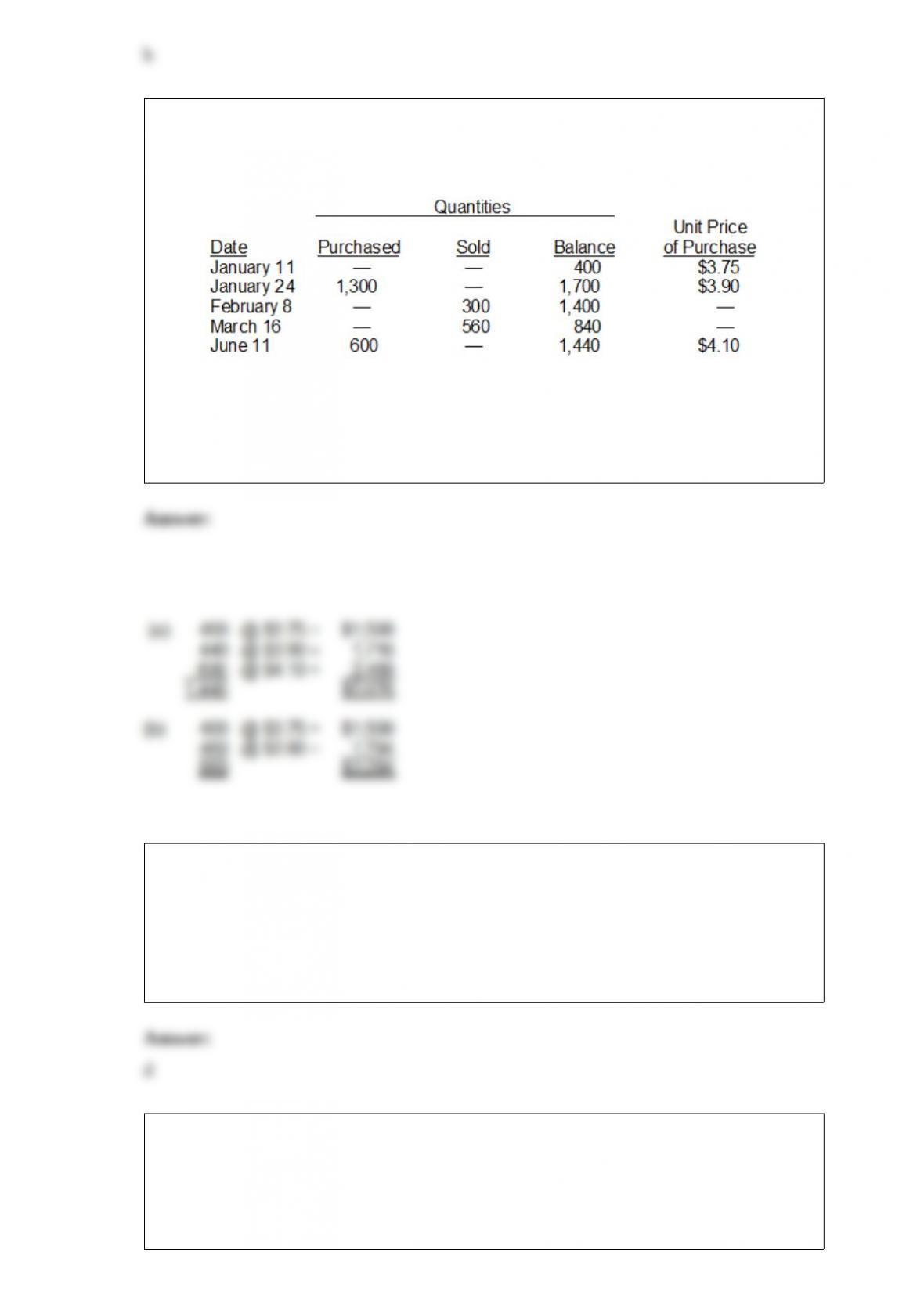
15) matlock corporation sells item a as part of its product line. information as to
balances on hand, purchases, and sales of item a are given in the following table for the
first six months of 2012.
instructions
(a)compute the ending inventory at june 30 under the perpetual lifo inventory pricing
method.
(b)compute the cost of goods sold for the first six months under the periodic fifo
inventory pricing method.
16) in order for a cost to be capitalized (capital expenditure), the following must be
present:
a.the useful life of an asset must be increased
b.the quantity of assets must be increased
c.the quality of assets must be increased
d.any one of these
17) on january 2, 2012, farr co. issued 10-year convertible bonds at 105. during 2012,
these bonds were converted into common stock having an aggregate par value equal to
the total face amount of the bonds. at conversion, the market price of farrs common
stock was 50 percent above its par value. on january 2, 2012, cash proceeds from the
issuance of the convertible bonds should be reported as

a.paid-in capital for the entire proceeds
b.paid-in capital for the portion of the proceeds attributable to the conversion feature
and as a liability for the balance
c.a liability for the face amount of the bonds and paid-in capital for the premium over
the face amount
d.a liability for the entire proceeds