If the seller is responsible for paying freight charges, then ownership of inventory
passes when goods arrive at their destination.
The current ratio is computed by dividing current liabilities by current assets.
Bond sinking funds are examples of short-term investments.
LIFO assumes that inventory costs flow in the order incurred.

A basic present value concept is that cash in the future is worth less than the same
amount of cash today.
A corporation is a legal entity separate from its owners.
Process cost accounting systems consider overhead costs to include those costs that
cannot be readily identified with any specific process.
The matching principle requires that interest expense not be accrued on a note payable
until the note is paid, even if the end of an accounting period occurs between the
signing of a note payable and its maturity date.
When posting from special journals each debit and credit entry is entered as a separate
amount in the general ledger.
An unclassified balance sheet provides more information to users than a classified
balance sheet.
The withdrawals account is normally closed by debiting it.

Good ethics are good business.
A liability is a probable future payment of assets or services that a company is presently
obligated to make as a result of past transactions or events.
If the total balance of the accounts receivable ledger equals the total of the controlling
Accounts Receivable account, then the accounts are presumed to be correct.
The journal entry for petty cash reimbursement involves a debit to the appropriate
expenses and a credit to Petty Cash.
The cost of an inventory item includes its invoice cost minus any discount, and plus any
added or incidental costs necessary to put it in a place and condition for sale.
Salary allowances are reported as salaries expense on a partnership income statement.
Enterprise resource planning software packages include the programs that manage a
company’s vital operations.

An installment note is an obligation of the issuing company that requires a series of
periodic payments to the holder.
In preparing statements from the adjusted trial balance, the balance sheet must be
prepared first.
When using the equity method, receipt of cash dividends increases the carrying (book)
value of an investment in equity securities.
The accounts receivable turnover indicates how often accounts receivable are received
and collected during the period.
An advantage of bonds is that interest does not have to be paid.
When preparing the unadjusted trial balance in a periodic inventory system, the amount
that appears as Merchandise Inventory is the ending inventory amount.
The indirect method reports individual operating cash outflows and cash inflows by
activity.
Profitability is the ability to generate future revenues and meet long-term obligations.
Installment accounts receivable is another name for aging of accounts receivable.
A reverse stock split reduces the market value per share and the par value per share of
stock.

If actual overhead incurred during a period exceeds applied overhead, the difference
will be a credit balance in the Factory Overhead account at the end of the period.
Generally accepted accounting principles are the basic assumptions, concepts, and
guidelines for preparing financial statements.
Two common subgroups for liabilities on a classified balance sheet are:
A.current liabilities and intangible liabilities.
B.present liabilities and operating liabilities.
C.general liabilities and specific liabilities.
D.intangible liabilities and long-term liabilities.
E.current liabilities and long-term liabilities.
A company has $90,000 in outstanding accounts receivable and it uses the allowance
method to account for uncollectible accounts. Experience suggests that 6% of
outstanding receivables are uncollectible. The current debit balance (before
adjustments) in the allowance for doubtful accounts is $800. The journal entry to record
the adjustment to the allowance account includes a debit to Bad Debts Expense for:
A.$4,600
B.$5,400
C.$6,200
D.$6,800
E.None of these
An asset created by prepayment of an expense is:
A.Recorded as a debit to an unearned revenue account.
B.Recorded as a debit to a prepaid expense account.
C.Recorded as a credit to an unearned revenue account.
D.Recorded as a credit to a prepaid expense account.
E.Not recorded in the accounting records until the earnings process is complete.
A company’s flexible budget for 10,000 units of production reflects sales of $200,000;
variable costs of $40,000; and fixed costs of $75,000. Calculate the expected level of
operating income if the company produces and sells 13,000 units.
A.$110,500.
B.$85,000.
C.$133,000.
D.$100,000.
E.$50,500.
Mattel had net sales of $4,235 million and ending accounts receivable of $775 million.
Its days’ sales uncollected equals:
A.298 days.
B.66.8 days.
C.19.4 days.
D.81.8 days.
E.65.2 days.

At the beginning of 2009, a company’s balance sheet reported the following balances:
Total Assets = $125,000; Total Liabilities = $75,000; and Owner’s Capital = $50,000.
During 2009, the company reported revenues of $46,000 and expenses of $30,000. In
addition, owner’s withdrawals for the year totaled $20,000. Assuming no other changes
to owner’s capital, the balance in the owner’s capital account at the end of 2009 would
be:
A.$66,000.
B.$86,000.
C.$(4,000).
D.$46,000.
E.cannot be determined from the information provided.
An example of an investing activity is:
A.Paying wages of employees.

B.Withdrawals by the owner.
C.Purchase of land.
D.Selling inventory.
E.Contribution from owner.
Departmental contribution to overhead is calculated as revenues of the department less:
A.Controllable costs.
B.Product and period costs.
C.Direct expenses.
D.Direct and indirect costs.
E.Joint costs.
A company borrowed $50,000 cash from the bank and signed a 6-year note at 7%. The
present value of an annuity for 6 years at 7% is 4.7665. The annual annuity payments
equal $10,490. The present value of the loan is:
A.$ 10,490.
B.$ 11,004.
C.$ 50,000.

D.$ 52,450.
E.$238,325.
An adjusting entry could be made for each of the following except:
A.Prepaid expenses.
B.Depreciation.
C.Owner withdrawals.
D.Unearned revenues.
E.Accrued revenues.
Plant assets are:
A.Tangible assets used in the operation of a business that have a useful life of more than
one accounting period.
B.Current assets.
C.Held for sale.
D.Intangible assets used in the operations of a business that have a useful life of more
than one accounting period.

E.Tangible assets used in the operation of business that have a useful life of less than
one accounting period.
If the exchange rate for Canadian and U.S. dollars is 0.82777 to 1, this implies that 3
Canadian dollars will buy ____ worth of U.S. dollars.
A.$ 0.2759
B.$0.82777
C.$1.82777
D.$2.48
E.None of these.
Which of the following items are management concepts that were created to improve
companies’ performances?
A.Just-in-time manufacturing.
B.Customer orientation.
C.Total quality management.
D.Continuous improvement.

E.All of these.
When graphing cost-volume-profit data on a CVP chart:
A.Units are plotted on the horizontal axis; costs on the vertical axis.
B.Units are plotted on the vertical axis; costs on the horizontal axis.
C.Both units and costs are plotted on the horizontal axis.
D.Both units and cost are plotted on the vertical axis.
E.Data points always represent expected future points.
Match each of the following terms with the appropriate definitions.
1)Depletion
2)Units-of production method
3)Revenue expenditure
4)Betterment
5)Intangible assets
6)Ordinary repairs
7)Goodwill

8) Change in accounting estimate
9)Total asset turnover
10)Accelerated depreciation
A)The process of allocating the cost of natural resources to periods when they are
consumed.
B) An expenditure to make a plant asset more efficient or productive.
C) Expenditures made to keep a plant asset in normal, good operating condition.
D)A depreciation method that charges a varying amount to expense for each period of
an asset’s useful life depending on its usage.
E)Certain nonphysical assets used in operations that confer on their owners long-term
rights, privileges, or competitive advantages.
F) A method that yields larger depreciation expense during the early years of an asset’s
life and smaller expense in the later years.
G) A change in a financial statement amount that results from new information,
subsequent developments, better insight, or improved judgment.
H)The amount by which the company’s value exceeds the value of its individual assets
and liabilities.
I)A measure of a company’s ability to use its assets to generate sales.
K) An expenditure reported on the current income statement as an expense because it
does not provide a material benefit in future periods.
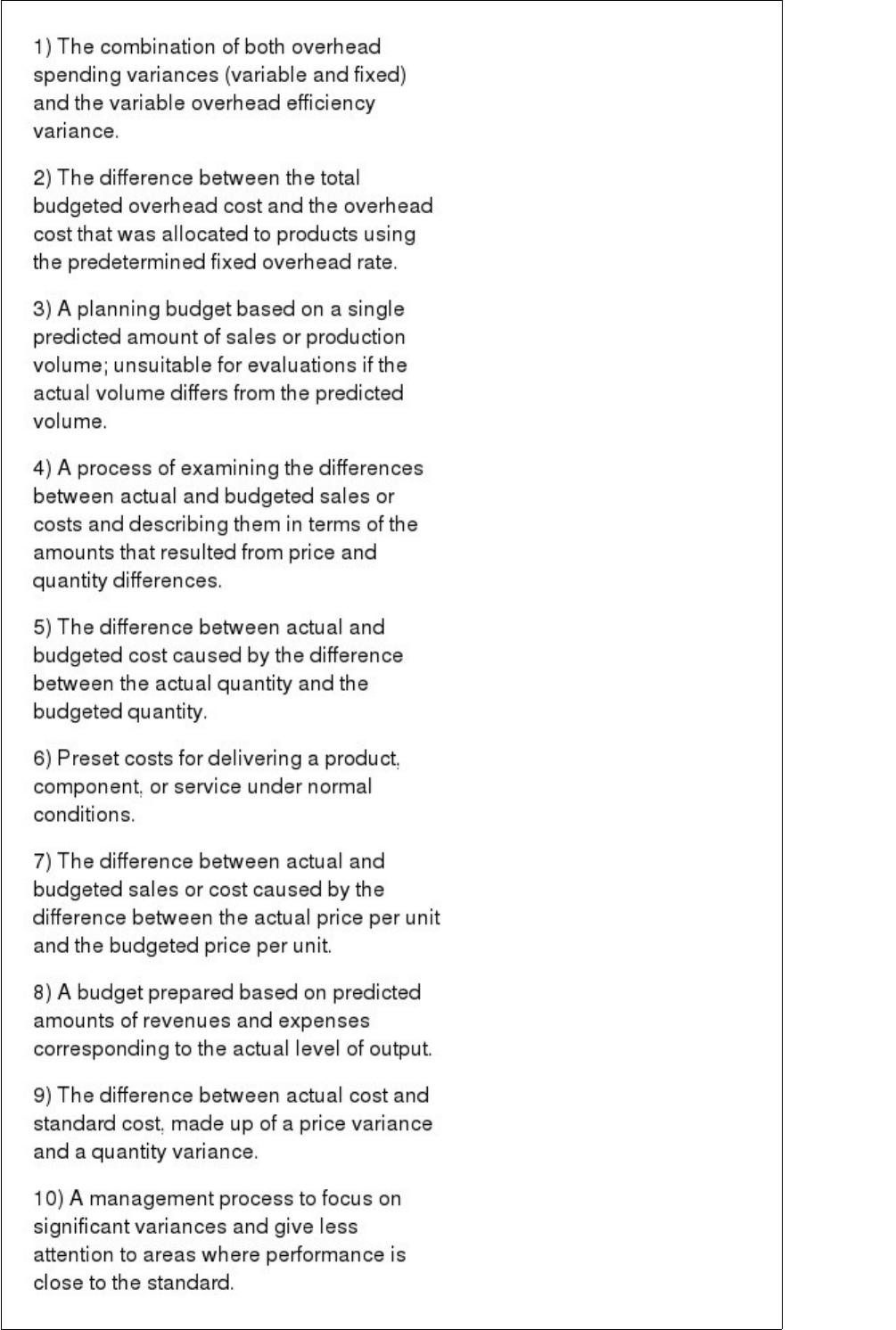
Presented below are terms preceded by letters a through j and followed by a list of
definitions 1 through 10. Enter the letter of the term with the definition, using the space
preceding the definition.
(a) Cost variance

(b) Volume variance
(c) Price variance
(d) Quantity variance
(e) Standard costs
(f) Controllable variance
(g) Fixed budget
(h) Flexible budget
(i) Variance analysis
(j) Management by exception

The production activities for a customized product represent a(n):
A.Operation.
B.Job.
C.Unit.
D.Pool.
E.Process.
The following information has been gathered for Stylish Co. to assist in preparing its
year-end adjusting entries at December 31:
(a) The company has earned $2,500 of rental revenue that has not yet been received or
recorded.
(b) Stylish has recorded $3,200 of unearned service fees. At year-end, $1,500 of this
amount has been earned.
(c) Depreciation on equipment for the year is $7,800.
(d) Employees have earned but have not yet been paid $2,750 in salaries.
Identify which of the above accounting adjustment would be reversed assuming Stylish
Co. uses reversing entries.

The appropriate section in the statement of cash flows for reporting the cash payment of
wages is:
A.Operating activities.
B.Financing activities.
C.Investing activities.
D.Schedule of noncash investing or financing activity.
E.None of these. This is not reported on the statement of cash flows.
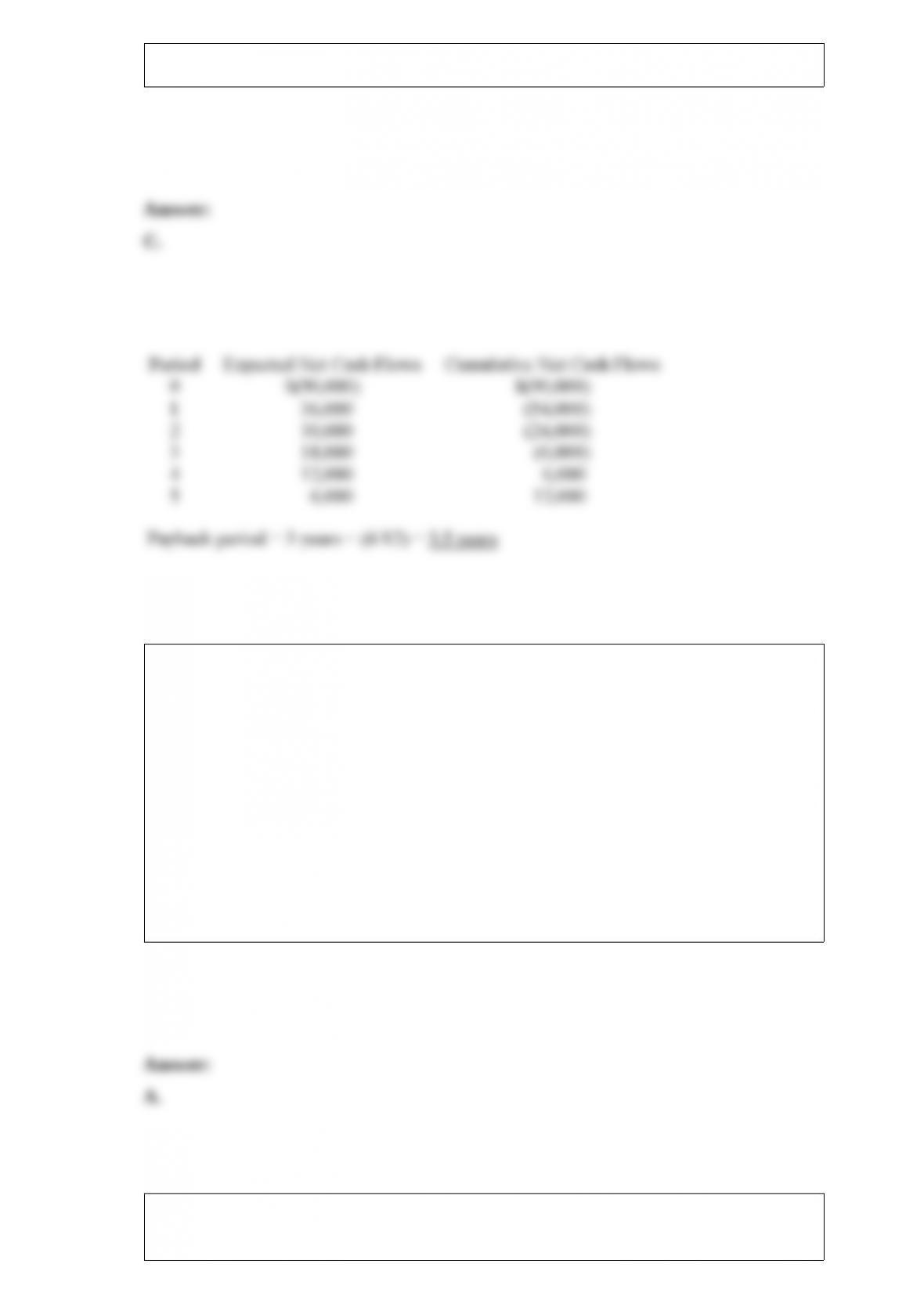
A company is considering the purchase of a new piece of equipment for $90,000.
Predicted annual cash inflows from this investment are $36,000 (year 1), $30,000 (year
2), $18,000 (year 3), $12,000 (year 4) and $6,000 (year 5). The payback period is:
A.4.50 years.
B.4.25 years.
C.3.50 years.
D.3.00 years.
E.2.50 years.
A corporation’s distribution of additional shares of its own stock to its stockholders
without the receipt of any payment in return is called a:
A.Stock dividend.
B.Stock subscription.
C.Premium on stock.
D.Discount on stock.
E.Treasury stock.
An asset can be disposed of by:

A.Discarding it.
B.Selling it.
C.Exchanging it for another asset.
D.Donating it to charity.
E.All of these.
Employees earn vacation pay at the rate of one day per month. During July, 25
employees qualify for one vacation day each. Their average daily wage is $100 per day.
What is the amount of vacation benefit expense for the month of July?
A.$25
B.$100
C.$1,200
D.$2,500
E.$30,000
On January 4, 2009, Larsen Company purchased 5,000 shares of Warner Company for
$59,500 plus a broker’s fee of $1,000. Warner Company has a total of 25,000 shares of
common stock outstanding and it is presumed the Larsen Company will have a
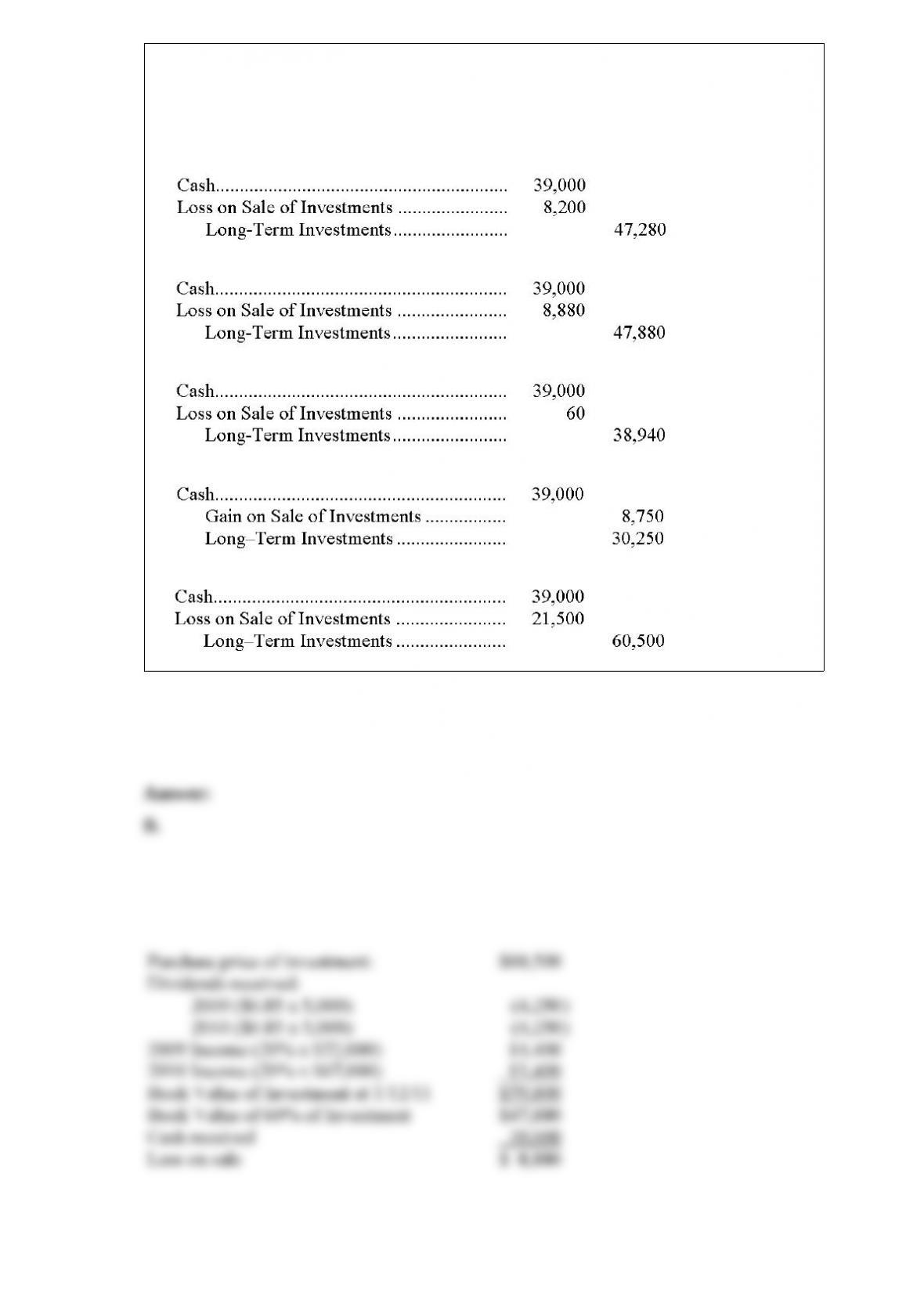
significant influence over Warner. During each of the next two years, Warner declared
and paid cash dividends of $0.85 per share, and its net income was $72,000 and
$67,000 for 2009 and 2010, respectively. The January 12, 2011, entry to record the sale
of 3,000 shares of Warner Company stock for $39,000 cash should be:
A.
B.
C.
D.
E.
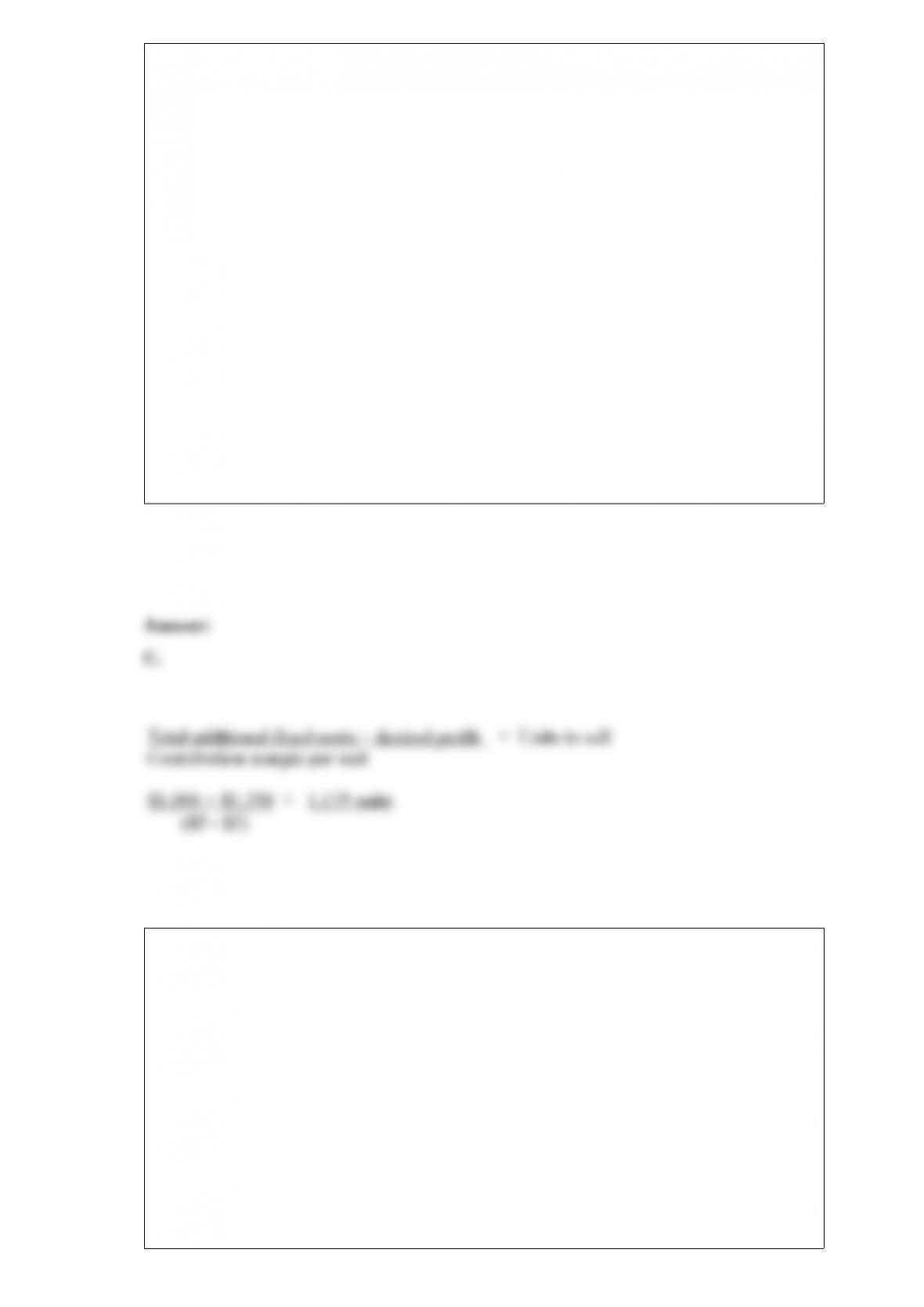
Parker Plumbing has received a special one-time order for 1,500 faucets (units) at $5
per unit. Parker currently produces and sells 7,500 units at $6.00 each. This level
represents 75% of its capacity. Production costs for these units are $4.50 per unit, which
includes $3.00 variable cost and $1.50 fixed cost. To produce the special order, a new
machine needs to be purchased at a cost of $1,000 with a zero salvage value.
Management expects no other changes in costs as a result of the additional production.
If Parker wishes to earn $1,250 on the special order, the size of the order would need to
be:
A.4,500 units.
B.2,250 units.
C.1,125 units.
D.625 units.
E.300 units.
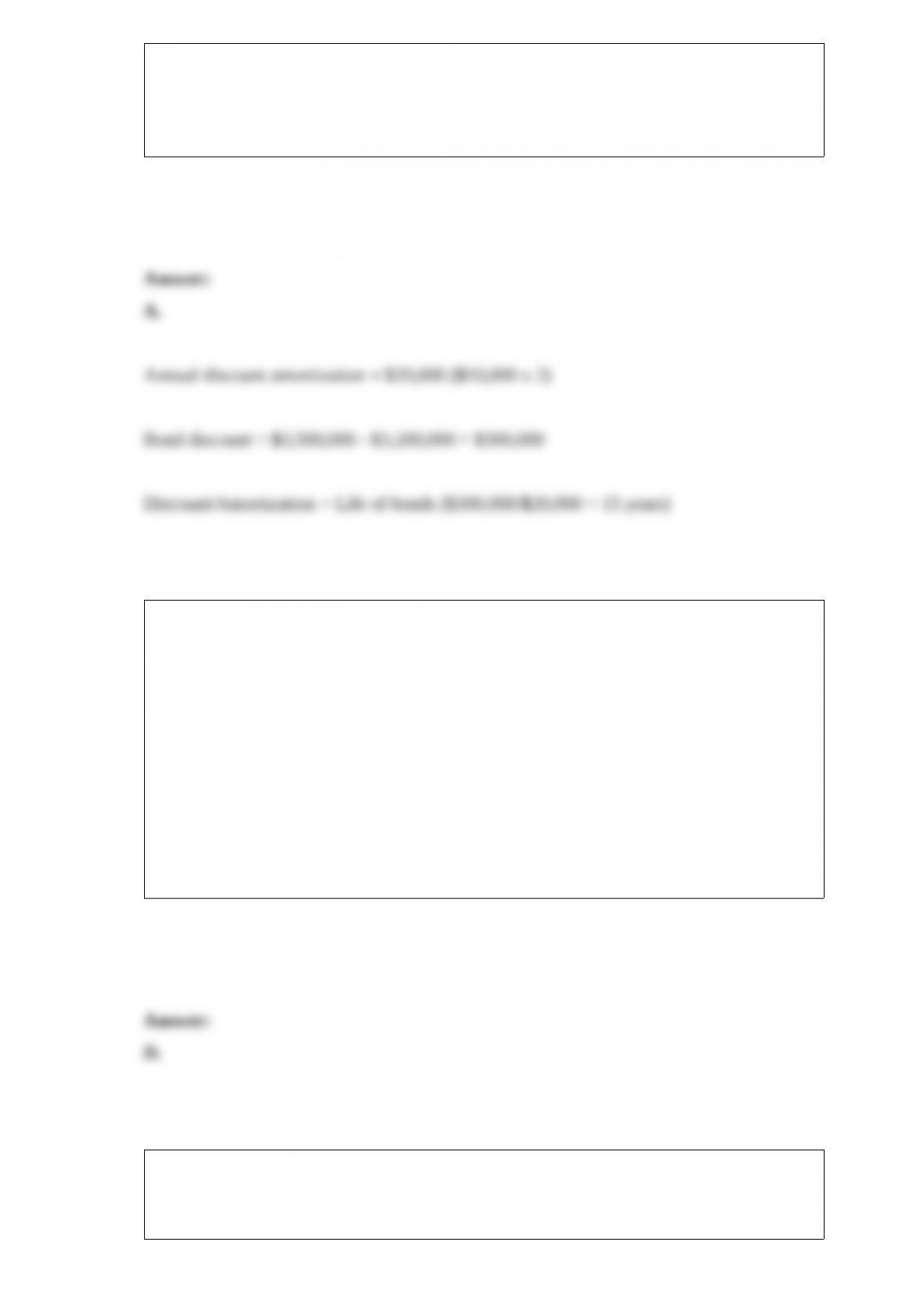
On January 1 of Year 1, Drum Line Airways issued $3,500,000 of par value bonds for
$3,200,000. The bonds pay interest semiannually on January 1 and July 1. The contract
rate of interest is 7% while the market rate of interest for similar bonds is 8%. The bond
premium or discount is being amortized using the straight-line method at a rate of
$10,000 every six months.
The life of these bonds is:
A.15 years.
B.30 years.
C.26.5 years.
D.32 years
E.35 years.
A plan that lists the types and amounts of selling expenses expected during the budget
period is called a(n):
A.Sales budget.
B.Operating budget.
C.Capital expenditures budget.
D.Selling expense budget.
E.Purchases budget.
The payment pattern for an installment note with equal total payments includes:
A.Increasing principal payments.
B.Decreasing accrued interest.
C.Constant cash payments.
D.Both A and B.
E.All of these.
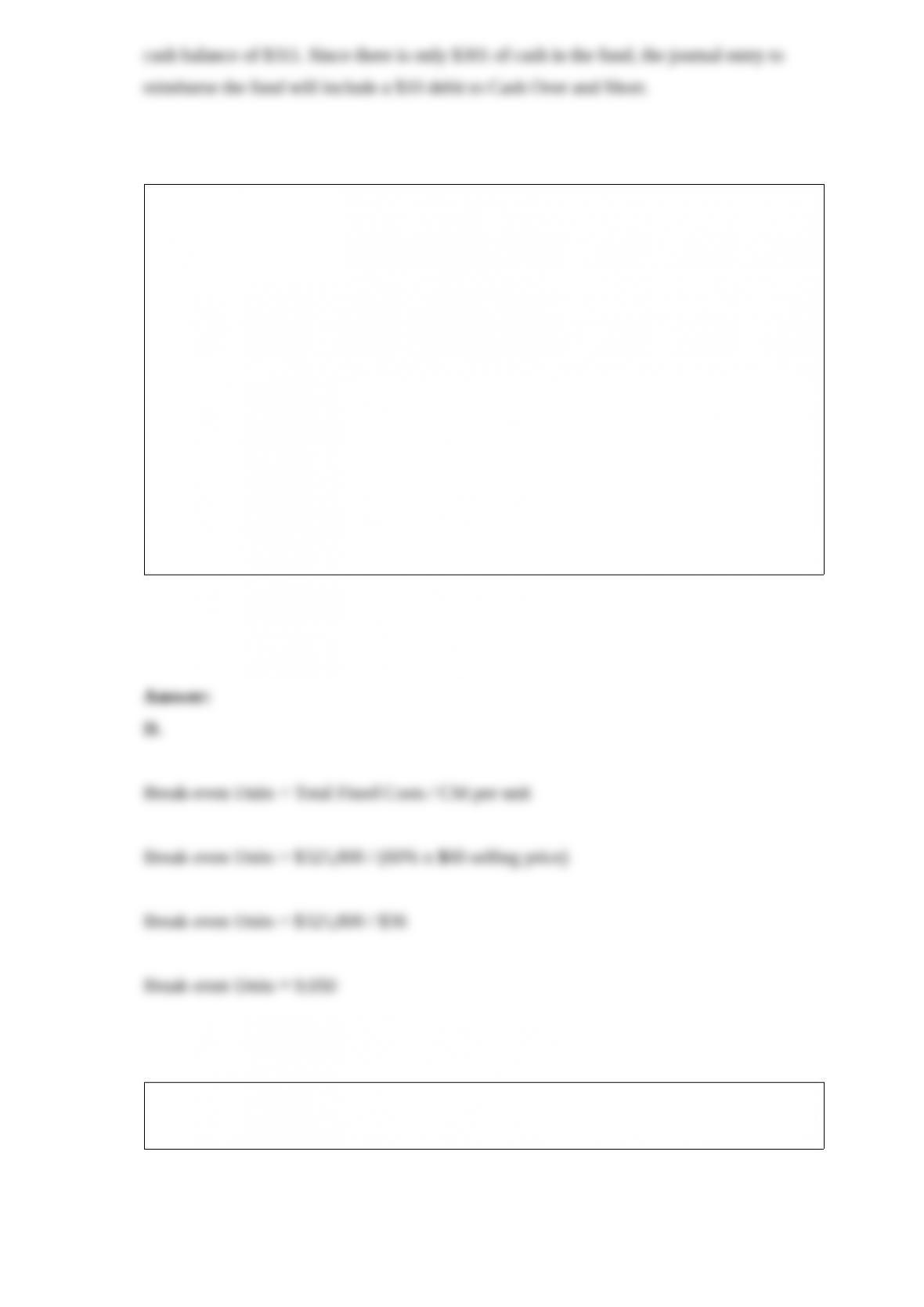
Martha Company has an established petty cash fund in the amount of $500. The fund
was last reimbursed on November 30. At the end of December, the fund contained the
following petty cash receipts:
If, in addition to these receipts, the petty cash fund contains $301 of cash, the journal
entry to reimburse the fund on December 31 will include:
A.A debit to Transportation-In of $73.
B.A debit to Transportation-Out of $73.
C.A credit to Office Supplies of $66.
D.A credit to Cash Over and Short of $10.
E.A debit to Cash Over and Short of $10.
In Davis Corporation’s most recent fiscal year, the company reported pretax earnings of
$215,000.
Fixed costs totaled $325,800, the unit selling price of the firm’s only product was $60,
and the variable costs per unit were 40% of the selling price. Based on this information,
the firm’s break-even point in units was:
A.13,575 units.
B.15,023 units.
C.13,750 units.
D.9,050 units.
E.8,750 units.
Briefly describe both the payback period method and the net present value method of
comparing investment alternatives.
What is a bond? Identify and discuss the different types of bonds.
What is the purpose of the petty cash account?
The future value of an ________________ annuity is the accumulated value of each
annuity payment with interest as of the date of the final payment.
Short-term investments in held-to-maturity debt securities are accounted for using the
___________________________.
Identify the four steps in the budgetary control process.
After preparing a bank reconciliation, a company must prepare journal entries to adjust
the book balance to the reconciled balance. Only the items reconciling the
_____________ balance require adjustment.
The interest rate is also called the __________________ rate.
Discuss the reasons companies make investments.
Shareholders are owners of a corporation and typically elect
______________________ to oversee their interests in the corporation.
Explain why the lower of cost or market rule is used to value inventory.
Describe the three important guidelines for revenue recognition.