
Which of the following is not a criteria that is used to determine whether a project is
acceptable under the net present value method?
A. If the net present value is equal to zero
B. If the net present value is greater than zero
C. If the net present value is equal to the required rate of return
D. None of these answers is correct.
Spark Company’s static budget is based on a planned activity level of 45,000 units. At
the same time the static budget was prepared, the management accountant prepared two
additional budgets, one based on 40,000 units and one based on 50,000. The company
actually produced and sold 49,000 units. In evaluating its performance, management
should compare the company’s actual revenues and costs to which of the following
budgets?
A. A budget based on 40,000 units
B. A budget based on 45,000 units
C. A budget based on 49,000 units
D. A budget based on 50,000 units
Haskins Company employs material handling employees who move materials between
production divisions at a labor cost of $360,000 a year. It is estimated that these
employees move 600,000 pounds of material per year. If 60,000 pounds are moved in
March, how much of the material handling cost should be assigned to products made in
March? (Do not round your intermediate calculations.)
A. $36,000
B. $24,000
C. $50,000
D. $38,000
Select the incorrect statement concerning the internal rate of return (IRR) method of
evaluating capital projects.
A. The higher the IRR the better.
B. The internal rate of return is that rate that makes the present value of the initial
outlay equal to zero.
C. If a project has a positive net present value then its IRR will exceed the hurdle rate.
D. A project whose IRR is less than the cost of capital should be rejected.
The following information is provided for two products:
Assume the products will be sold in a store where shelf space is a scarce resource and
there is sufficient room for only one of the two products. Expected sales for Product X
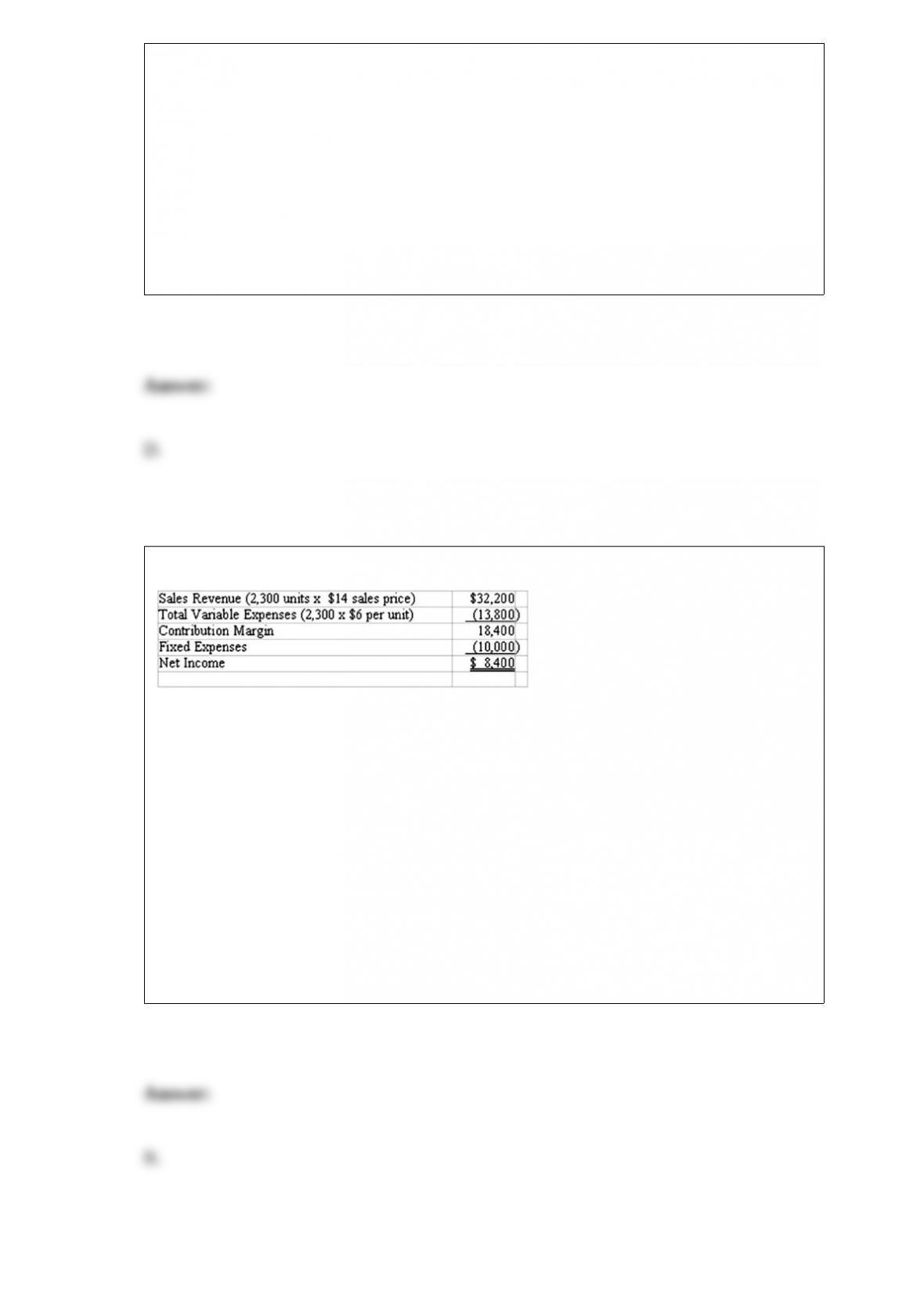
are 6,000 units, and expected sales for Product Y are 8,000 units. Which product should
be sold and why?
A. Product Y should be sold solely because expected demand is greater.
B. Product Y should be sold because sales of this product will provide a greater profit.
C. Product X should be sold because it provides a greater contribution margin per unit.
D. Product X should be sold because sales of this product will provide a greater profit.
Billings Company has developed the following budgeted income statement:
The Company is experimenting with new engineering techniques and believes it can
reduce variable cost to $4.50 per unit and significantly improve the product. The
innovations would double fixed costs but the company expects to be able to increase
sales to 3,500 units. If this strategy is pursued the company’s budgeted net income will
A. decrease by $4,250.
B. increase by $4,850.
C. increase by $13,250.
D. decrease by $4,150.
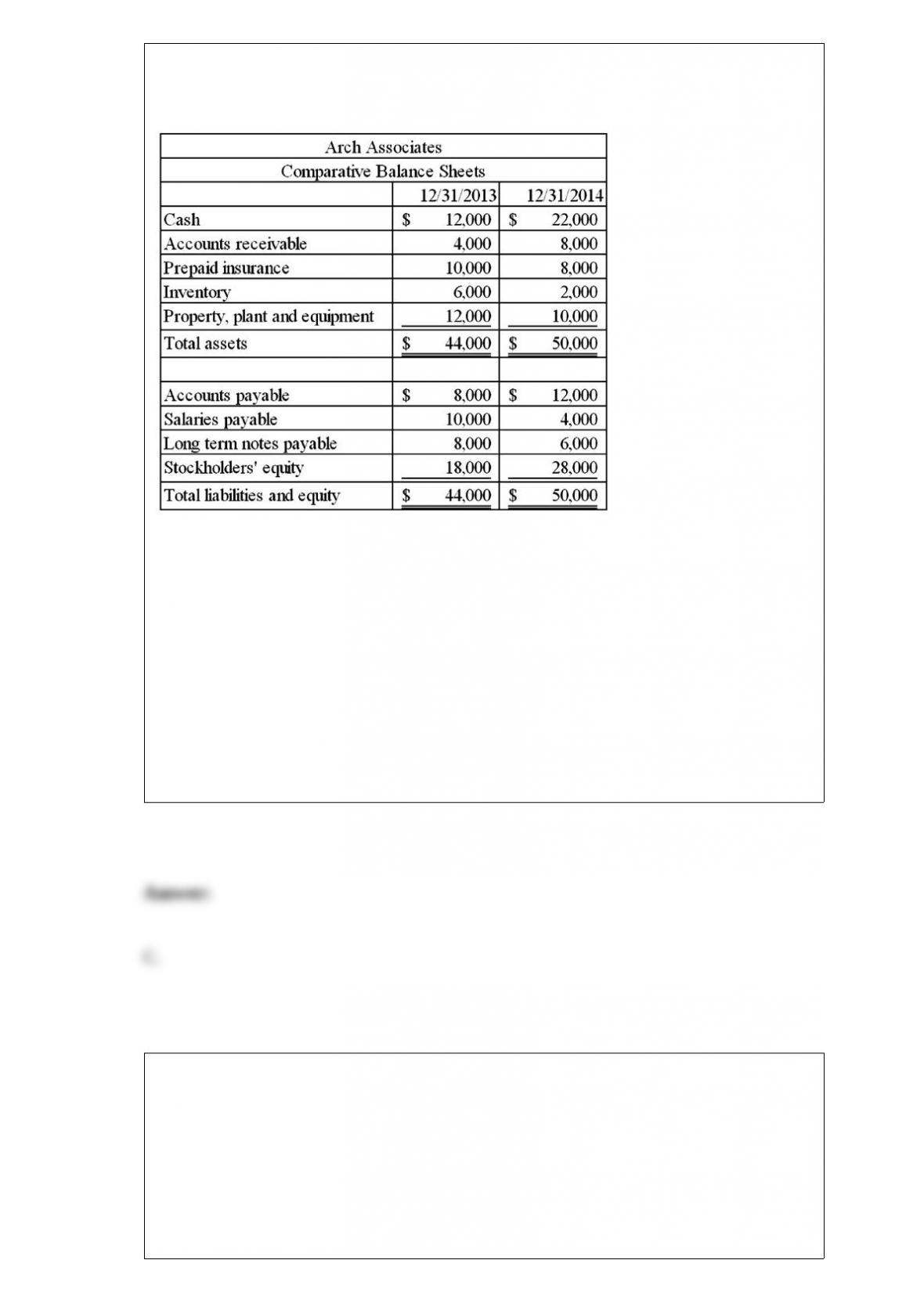
Arch Associates reports the following comparative balance sheets and income statement
information.
Which of the following cash flows would be included under the operating activities
section of the cash flow statement? (Assume the direct method is used.)
A. Cash received from issuing bonds payable.
B. Cash paid to purchase equipment.
C. Cash receipts from dividends.
D. None of these.
Beacon Company makes a product that has a variable cost of $25 per unit and a selling
price of $45 per unit. Annual fixed costs total $860,000. Beacon’s net income last year
was $240,000. Beacon’s management is considering lowering the selling price to $40.
Required:
(a) How many units did Beacon sell last year?
(b) If Beacon Company wants to maintain the same level of income that it had last year,
how many units would it have to sell at the new selling price of $35?
Rock Creek Bottling Company pays its production manager a salary of $6,000 per
month. Salespersons are paid strictly on commission, at $1.50 for each case of product
sold.
For Rock Creek Bottling Company, the salespersons’ commissions are an example of:
A. a fixed cost.
B. a variable cost.
C. a mixed cost.
D. None of these
The cost of raw materials (direct materials) flow through all of the following accounts
except:
A. manufacturing overhead.
B. work in process.
C. finished goods.
D. cost of goods sold.
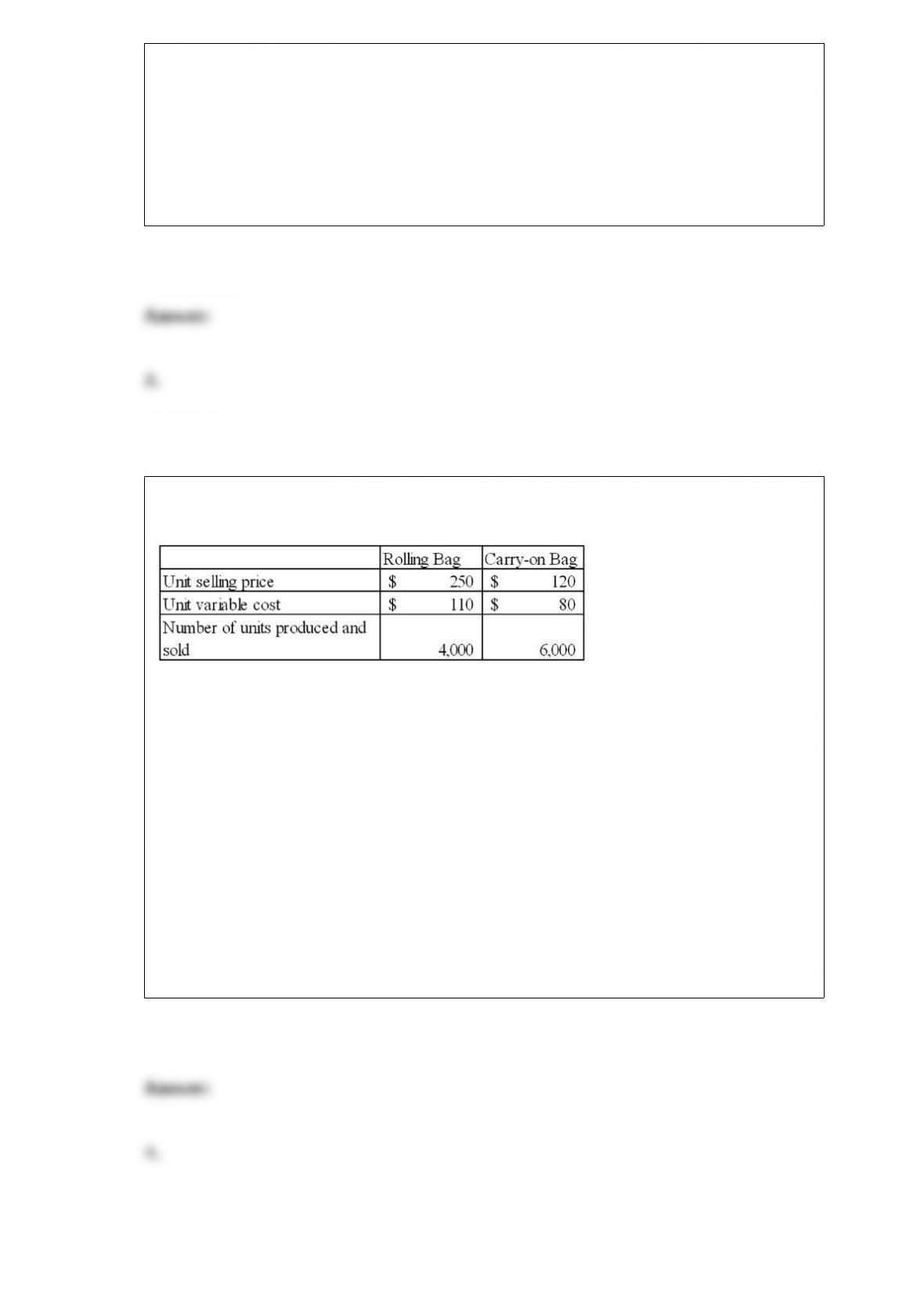
The Travel Pro Company sells two kinds of luggage. The company projected the
following cost information for the two products:
The company’s total fixed costs are expected to be $280,000.
Based on this information, what is the combined number of units of the two products
that would be required to break-even with the projected sales mix (round your answer
to the nearest whole unit)?
A. 3,500 units
B. 3,111 units
C. 1,556 units
D. None of these is correct.

A product has a contribution margin of $2.50 per unit and a selling price of $25 per
unit. Fixed costs are $20,000. Assuming new technology increases the unit contribution
margin by 50 percent but increases total fixed costs by $13,750, what is the new
breakeven point in units?
A. 3,667 units
B. 3,333 units
C. 13,500 units
D. 9,000 units
Pinkston Company completed 12,000 units of product at a total cost of $28,000. The
recording of the product completed would include a decrease to:
A. manufacturing overhead.
B. cost of goods manufactured.
C. finished goods.
D. work in process.
Jack currently works for a law firm full time and earns $60,000 a year. He is thinking of
quitting his job to pursue a medical degree. Medical school will cost him $100,000 per
year. If Jack quits his job and goes to medical school, the salary he currently earns
would be considered what type of cost?
A. Irrelevant cost

B. Sunk cost
C. Opportunity cost
D. Fixed cost
Income tax expense was $137,500 for the year. Income tax payable was $7,500 at the
beginning and $10,000 at the end of the year. Cash payments for income tax reported on
the cash flow statement using the direct method is:
A. $130,000.
B. $137,500.
C. $147,500.
D. $135,000.
During its first year of operations, Connor Company paid $50,000 for direct materials
and $36,000 in wages for production workers. Lease payments and utilities on the
production facilities amounted to $14,000. General, selling, and administrative
expenses were $16,000. The company produced 5,000 units and sold 4,000 units for
$30.00 a unit. The average cost to produce one unit is which of the following amounts?
A. $20.00
B. $16.00
C. $18.40
D. $25.00
The master budget normally covers:
A. Three months.
B. 1 year.
C. 1-5 years.
D. 5-10 years.
How can managers manage (reduce the impact of) constraints?
Indicate whether each of the following statements is true or false.
Activity-based costing systems are useful for many manufacturing companies but not
for businesses that exist to provide services to their customers.
Costs that are closely related to volume of production may be classified as unit-level
even if they do not change with each individual unit of product.
Activities related to producing groups of products are referred to as product-level
activities.
Batch-level costs are fixed with respect to the number of units produced in a single
batch of a product.
Machine setup costs are usually classified as batch-level costs.
Is McDonald’s a manufacturing company or a service company? How do they record
the cost of materials, labor, and overhead?
What inventory holding costs would be incurred by a business that holds a large amount
of inventory?
Discuss the limitations that affect financial statement analysis.
Indicate whether each of the following statements is true or false.
For a manufacturing company, “quality” means producing products that conform to
specifications.
Companies incur internal failure costs to avoid producing non-conforming products.
Voluntary costs refer to prevention and appraisal costs.
Failure costs include appraisal and external failure costs.
Managers of a company can often reduce failure costs by reducing appraisal costs.