
A company sells goods for $150,000 that cost $60,000 to manufacture. Which
statement(s) are true?
A.The company will recognize sales on the balance sheet of $150,000.
B.The company will recognize $90,000 gross profit on the balance sheet.
C.The company will decrease finished goods by $60,000.
D.All of these are true.
Answer:
Interest on a note can be calculated without knowledge of the
A.fair value of the note
B.rate of interest
C.notes duration
D.principal amount
Answer:

At the beginning of the period, the Cutting Department budgeted direct labor of
$155,000, direct material of $165,000 and fixed factory overhead of $15,000 for 9,000
hours of production. The department actually completed 10,000 hours of production.
What is the appropriate total budget for the department, assuming it uses flexible
budgeting?
A.$416,000
B.$370,556
C.$368,889
D.$335,000
Answer:
Partridge Co. can further process Product J to produce Product D. Product J is currently
selling for $21 per pound and costs $15.75 per pound to produce. Product D would sell
for $38 per pound and would require an additional cost of $9.25 per pound to produce.
What is the differential revenue of producing Product D?
A.$6.75 per pound
B.$9.25 per pound
C.$17 per pound
D.$5.25 per pound
Answer:

Scott Manufacturing Co.’s static budget at 10,000 units of production includes $40,000
for direct labor and $4,000 for electric power. Total fixed costs are $25,000. At 12,000
units of production, a flexible budget would show:
A.variable costs of $52,800 and $30,000 of fixed costs
B.variable costs of $44,000 and $25,000 of fixed costs
C.variable costs of $52,800 and $25,000 of fixed costs
D.variable and fixed costs totaling $69,000
Answer:
A person authorized to write checks drawn on a checking account at a bank must sign
and have on file with the bank a
A.signature card
B.deposit ticket
C.checkbook
D.bank card
Answer:

A difference in quantity of materials used on two comparable jobs may be caused by:
A.inadequately trained employees
B.poor quality materials
C.employee carelessness
D.all of the above
Answer:
If the direct write-off method of accounting for uncollectible receivables is used, what
general ledger account is debited to write off a customer’s account as uncollectible?
A.Uncollectible Accounts Receivable
B.Accounts Receivable
C.Allowance for Doubtful Accounts
D.Bad Debts Expense
Answer:
On December 31, Strike Company has decided to sell one of its batting cages. The
initial cost of the equipment was $310,000 with an accumulated depreciation of
$260,000. Depreciation has been taken up to the end of the year. The company found a
company that is willing to buy the equipment for $20,000. What is the amount of the
gain or loss on this transaction?
A.Gain of $20,000
B.Loss of $30,000
C.No gain or loss
D.Cannot be determined
Answer:
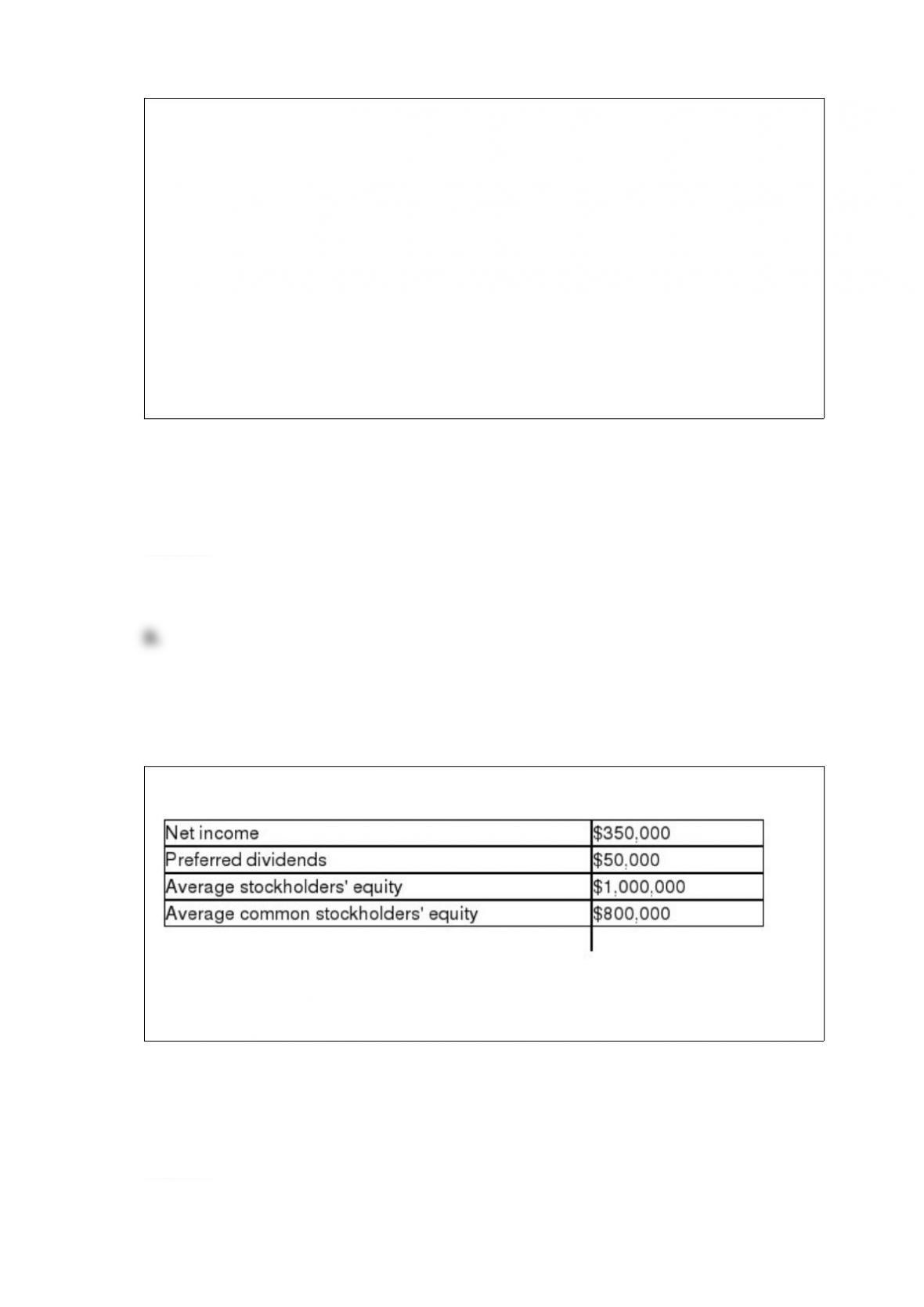
A company reports the following:
Determine the (a) rate earned on stockholders’ equity, and (b) rate earned on common
stockholders’ equity. Round your answer to one decimal place.
Answer:
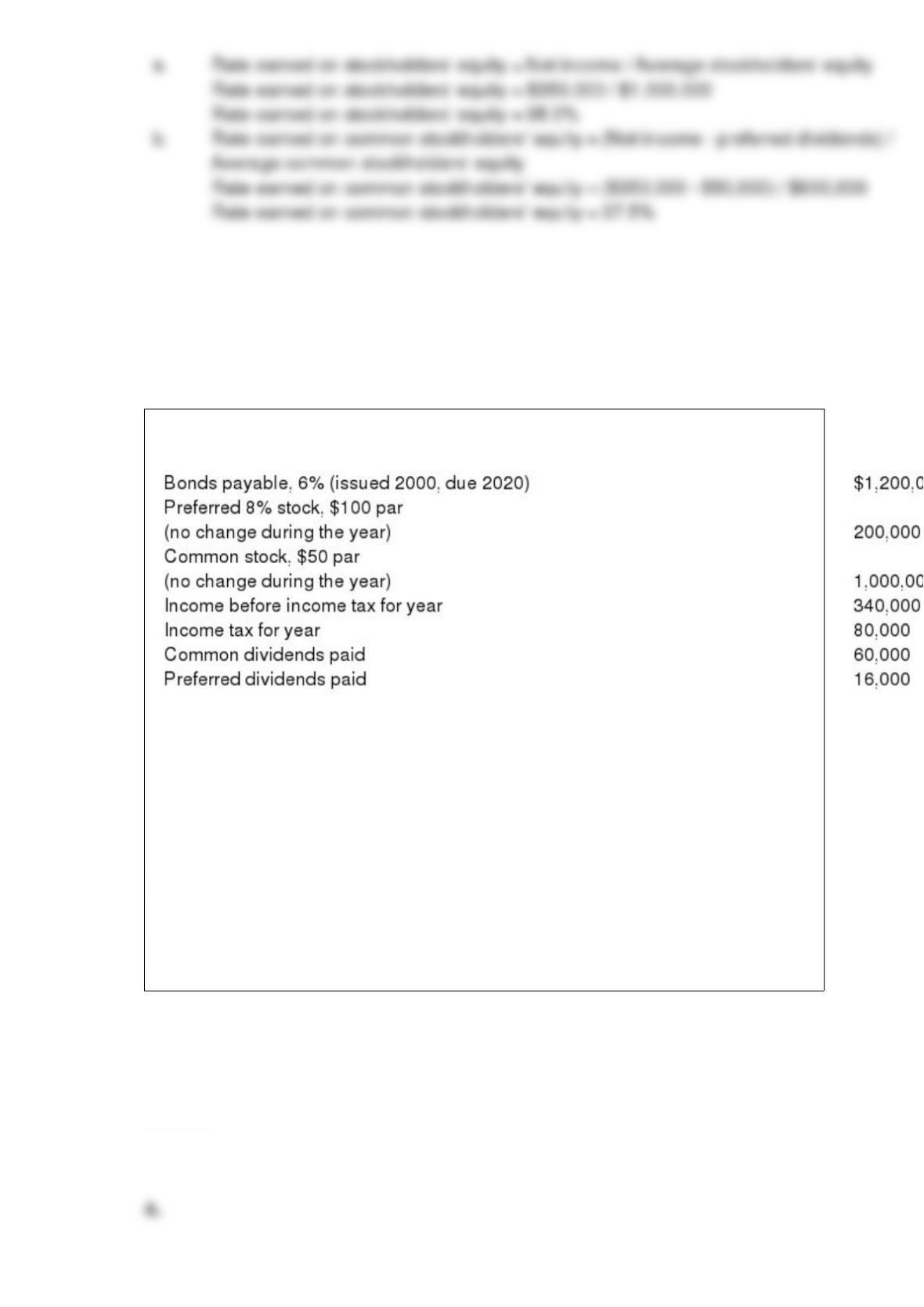
Balance sheet and income statement data indicate the following:
Based on the data presented above, what is the number of times bond interest charges
were earned (round to two decimal places)?
A.5.72
B.6.83
C.4.72
D.4.83
Answer:

Rent expense on a factory building would be treated as a(n):
A.period cost
B.product cost
C.direct cost
D.both A and C are correct
Answer:
If variable costs per unit increased because of an increase in hourly wage rates, the
break-even point would:
A.decrease
B.increase
C.remain the same
D.increase or decrease, depending upon the percentage increase in wage rates
Answer:

A corporation issues for cash $2,000,000 of 8%, 15-year bonds, interest payable
annually, at a time when the market rate of interest is 7%. The straight-line method is
adopted for the amortization of bond discount or premium. Which of the following
statements is true?
A.The carrying amount increases from its amount at issuance date to $2,000,000 at
maturity.
B.The carrying amount decreases from its amount at issuance date to $2,000,000 at
maturity.
C.The amount of annual interest paid to bondholders increases over the 15-year life of
the bonds.
D.The amount of annual interest expense decreases as the bonds approach maturity.
Answer:
Estimated cash payments are planned reductions in cash from all of the following
except:
A.manufacturing and operating expenses
B.capital expenditures
C.notes and accounts receivable collections
D.payments for interest or dividends
Answer:

When job 711 was completed, direct materials totaled $4,000; direct labor, $5,600; and
factory overhead, $2,400 respectively. Units produced totaled 1,000. Unit costs are:
A.$12,000
B.$1,200
C.$120
D.$12
Answer:
Which of the following best describes the effect on direct labor when management
adopts a just-in-time environment?
A.Workers typically perform one function.
B.The environment becomes more labor intensive.
C.Each employee runs a single machine.
D.Workers are often cross-trained to perform more than one function.
Answer:

Accounts receivable resulting from sales to customers amounted to $40,000 and
$31,000 at the beginning and end of the year, respectively. Income reported on the
income statement for the year was $120,000. Exclusive of the effect of other
adjustments, the cash flows from operating activities to be reported on the statement of
cash flows is
A.$120,000.
B.$129,000.
C.$151,000.
D.$111,000.
Answer:
Joshua Scott invests $40,000 into his new business. How would the journal entry for
this transaction be entered in the journal?
A.Cash 40,000
Joshua Scott, Capital 40,000
Invested cash in business
B.Cash 40,000
Joshua Scott, Capital 40,000
Invested cash in business
C.Joshua Scott, Capital 40,000
Cash 40,000
Invested cash in business
D.Joshua Scott, Loan 40,000
Cash 40,000
Invested cash in business
Answer:
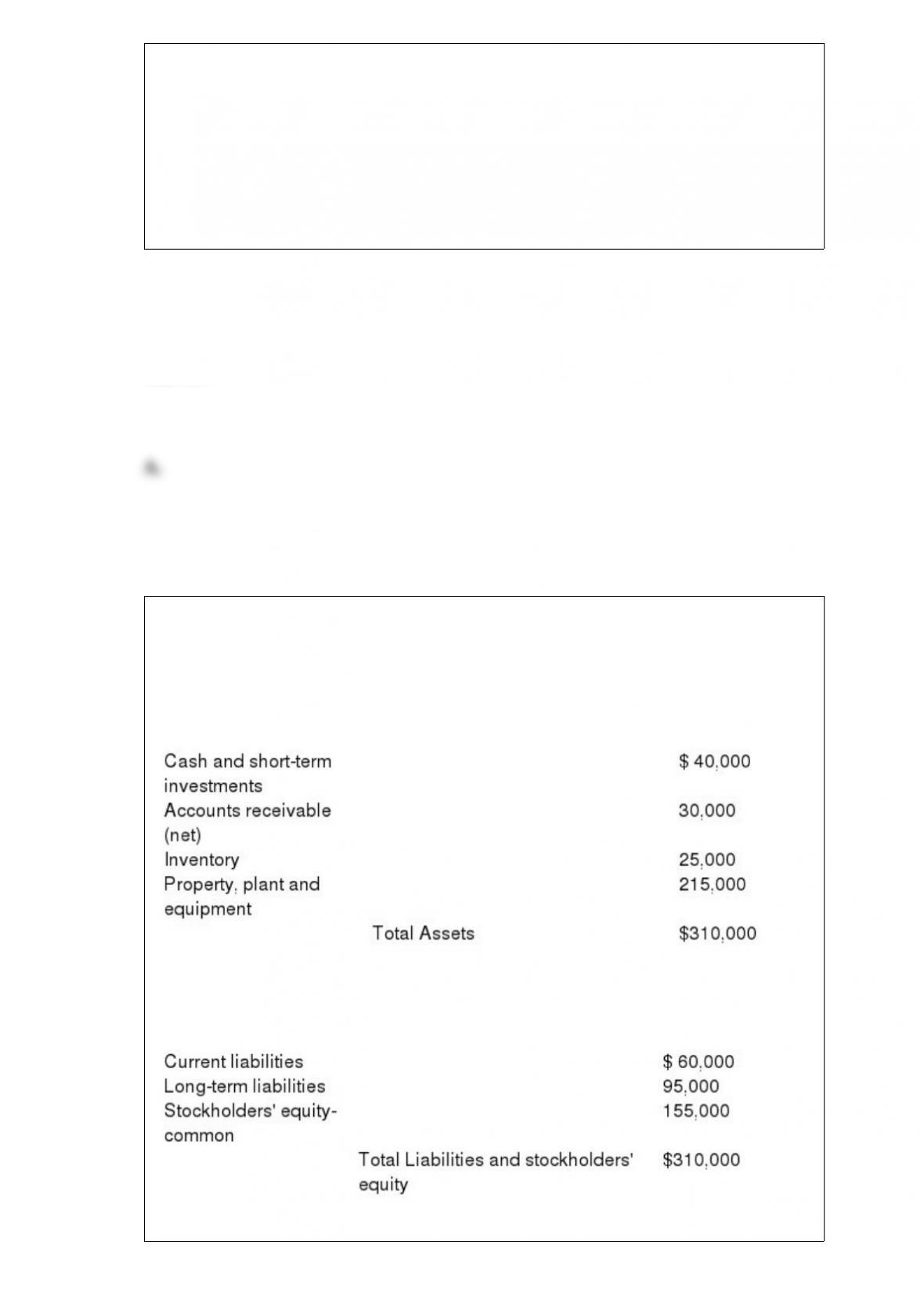
The following information pertains to Brock Company. Assume that all balance sheet
amounts represent both average and ending balance figures. Assume that all sales were
on credit.
Assets
Liabilities and Stockholders’ Equity
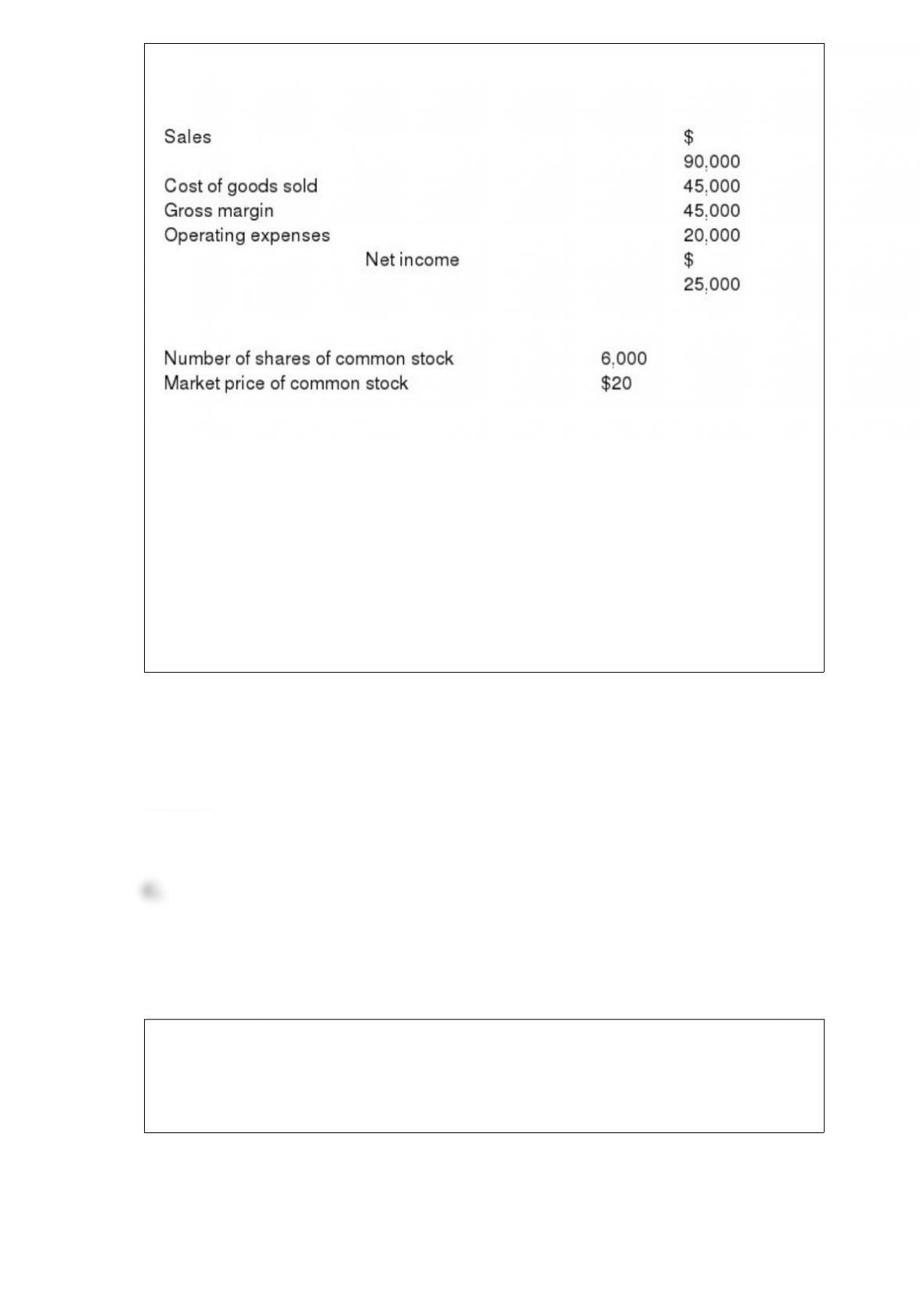
Income Statement
What is the current ratio for this company?
A. 1.42
B. 0.78
C.1.58
D. 0.67
Answer:
Use the following information to answer the following questions.
The Boxwood Company sells blankets for $60 each. The following was taken from the
inventory records during May. The company had no beginning inventory on May 1.
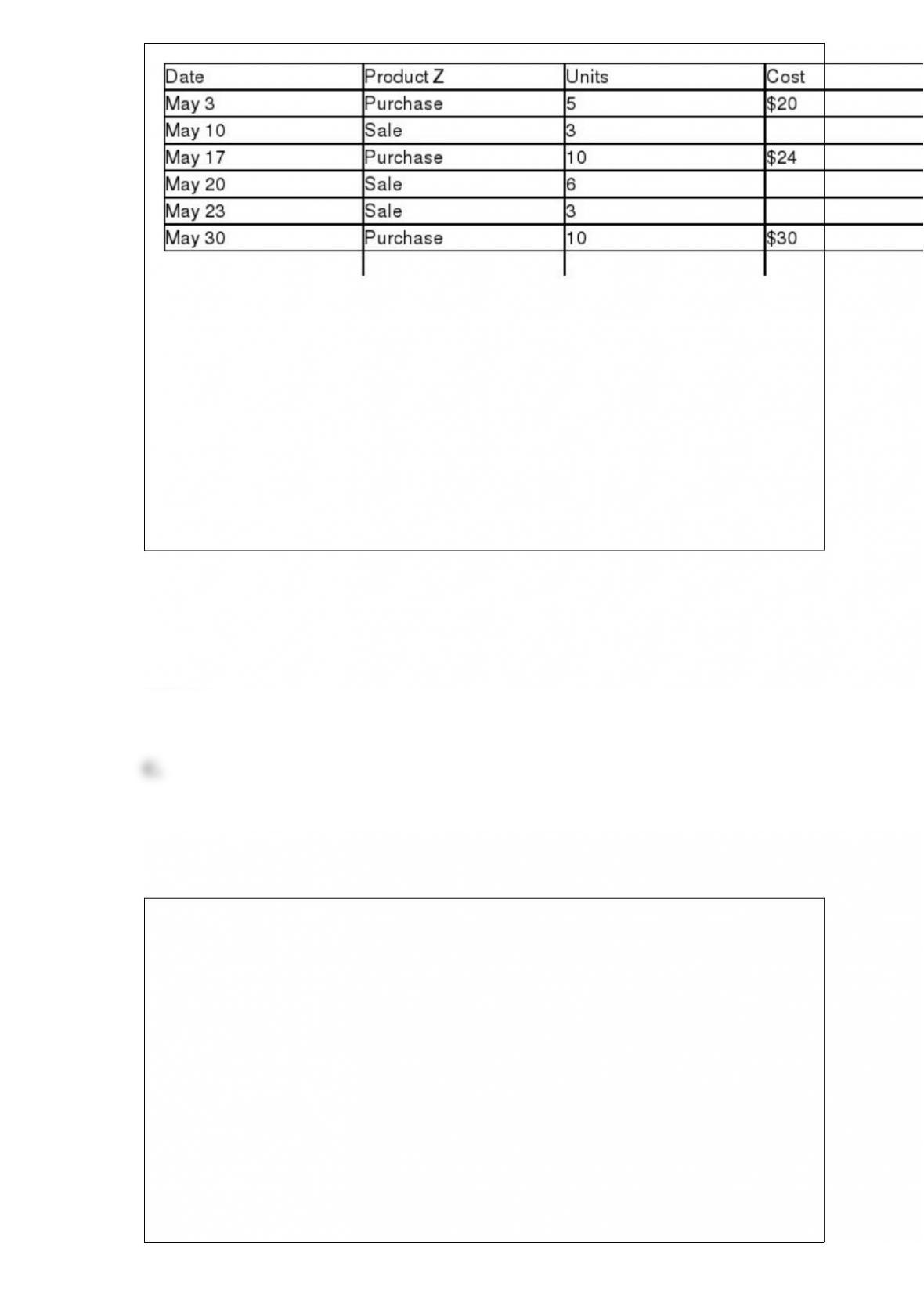
Assuming that the company uses the perpetual inventory system, determine the cost of
merchandise sold for the sale of May 20 using the FIFO inventory cost method.
A.$120
B.$180
C.$136
D.$144
Answer:
Materials used by Square Yard Products Inc. in producing Division 3’s product are
currently purchased from outside suppliers at a cost of $5 per unit. However, the same
materials are available from Division 6. Division 6 has unused capacity and can
produce the materials needed by Division 3 at a variable cost of $3 per unit. A transfer
price of $3.20 per unit is established, and 40,000 units of material are transferred, with
no reduction in Division 6’s current sales.
How much would Division 6’s income from operations increase?
A.$8,000
B.$15,000
C.$80,000
D.$150,000
Answer:
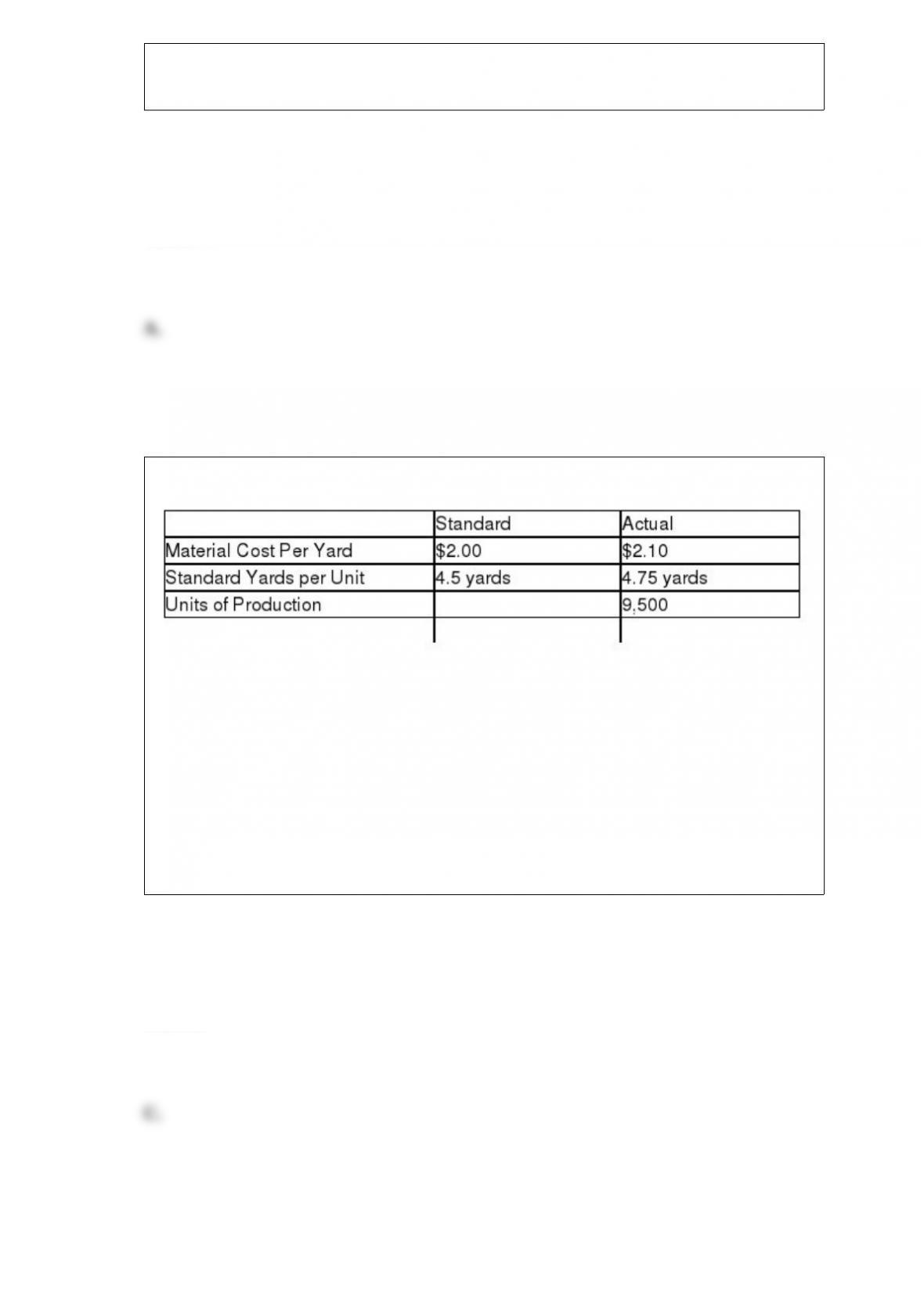
Calculate the Direct Materials Price variance using the above information:
A.$1,795.50 Favorable
B.$378.00 Favorable
C.$4,512.50 Unfavorable
D.$378.00 Unfavorable
Answer:

If there is no written agreement as to the way income will be divided among partners
A.they will share income and losses equally
B.they will share income and losses according to their capital balances
C.they will share income and losses according to the time devoted to the business.
D.there really is no partnership agreement
Answer:
A bank statement
A.is a credit reference letter written by the company’s bank.
B.lets a company know the financial position of the bank as of a certain date.
C.is a bill from the bank for services rendered.
D.shows the activity that increased or decreased the company’s account balance.
Answer:
The revenue recognition concept

A.is not in conflict with the cash method of accounting
B.determines when revenue is credited to a revenue account
C.states that revenue is not recorded until the cash is received
D.controls all revenue reporting for the cash basis of accounting
Answer:
If budgeted beginning inventory is $8,300, budgeted ending inventory is $9,400, and
budgeted cost of goods sold is $10,260, budgeted purchases should be:
A.$1,100
B.$9,300
C.$11,360
D.$11,250
Answer:
Journalize the entries to record the following selected transactions of Oliver Co.:
(a) Purchased $100,000 of Kruse Co. 8% bonds at par value plus accrued interest of
$2,000.
(b) Received first semiannual interest payment.
(c) Sold the bonds at 97 plus accrued interest of $1,500.
Answer:
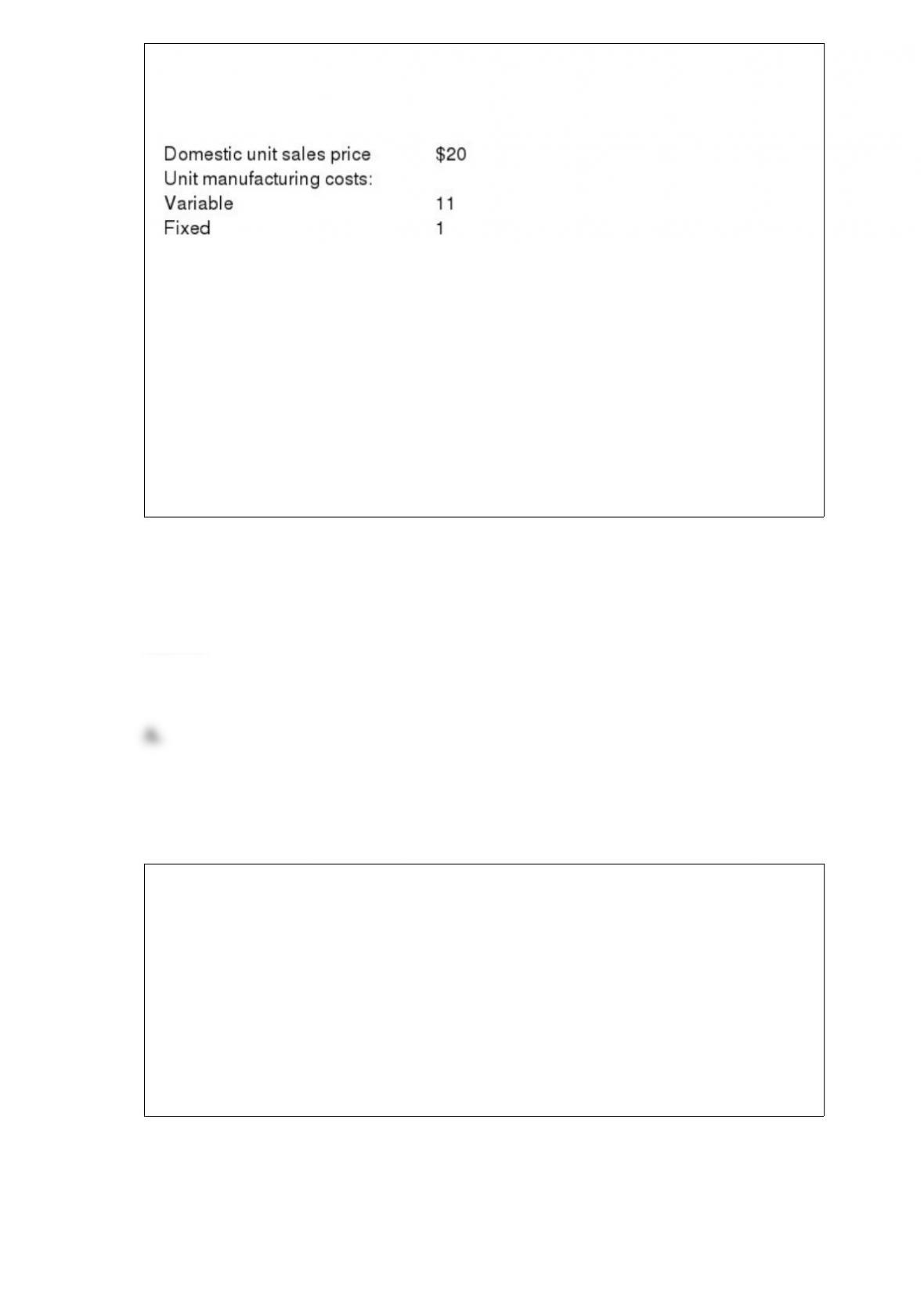
A business received an offer from an exporter for 10,000 units of product at $17.50 per
unit. The acceptance of the offer will not affect normal production or domestic sales
prices. The following data is available:
What is the amount of gain or loss from acceptance of the offer?
A.$65,000 gain
B.$50,000 loss
C.$30,000 loss
D.$20,000 loss
Answer:
Which of the following costs incurred by a paper manufacturer would be included in
the group of costs referred to as conversion costs?
A.Advertising costs
B.Raw lumber (direct materials)
C.Machine operator’s wages (direct labor)
D.Sales salaries
Answer: