Level return on investments (ROI) over the life of a long-term project is more likely
when ROI is computed using
A. historical costs and net book values.
B. historical costs and gross book values.
C. current costs and net book values.
D. current costs and gross book values.
Answer:
In a production-cost report using process costing, transferred-in costs are most similar
to
A. material added at the beginning of the process.
B. conversion costs added during the process.
C. costs transferred-out to the next process.
D. costs included in beginning inventory.
Answer:
Economic value added (EVA) adjustments are made to both the after-tax income and
the capital employed.
Answer:
Which of the following statements about the theory of constraints is (are) true?
(A) The theory of constraints focuses on determining the optimal product mix when one
or more resources restrict the attainment of a goal or objective.
(B) The theory of constraints focuses on maximizing the rate of throughput contribution
while minimizing investment and other operating costs.
A. Only A.
B. Only B.
C. Neither A nor B is true.
D. Both A and B are true.
Answer:
In the standard regression equation of y = a + bx, the letter y is best described as the
A. independent variable.
B. dependent variable.
C. slope of the equation.
D. intercept of the equation.
Answer:
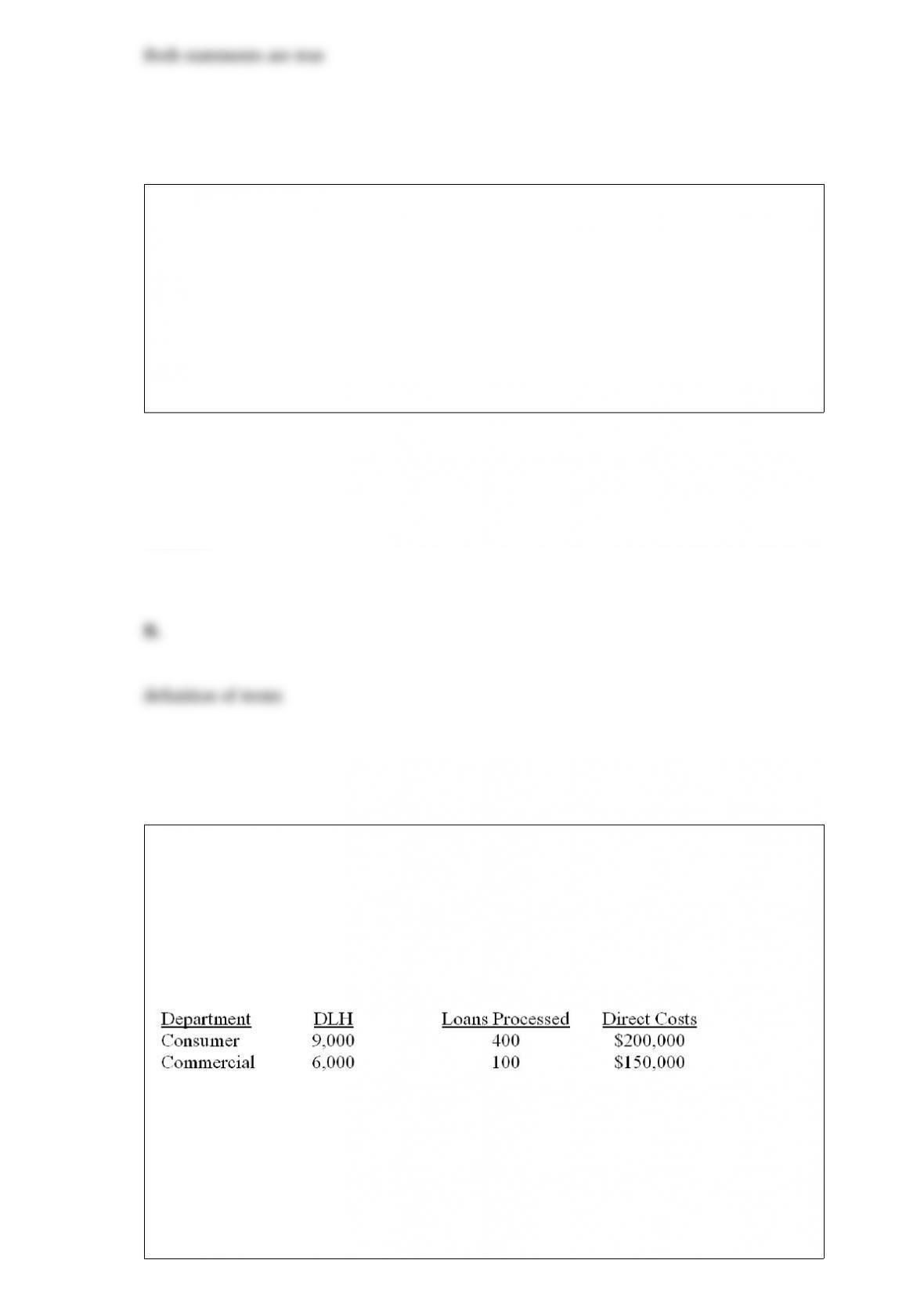
The Muskego National Bank is considering either a bankwide overhead rate or
department overhead rates to allocate $250,000 of indirect costs. The bankwide rate
could be based on either direct labor hours (DLH) or the number of loans processed.
The departmental rates would be based on direct labor hours for Consumer Loans and a
dual rate based on direct labor hours and the number of loans processed for Commercial
Loans. The following information was gathered for the upcoming period:
If Muskego uses a bankwide rate based on the number of loans processed, what would
be the total costs for the Consumer Department?
A. $50,000
B. $150,000
C. $200,000
D. $400,000
Answer:
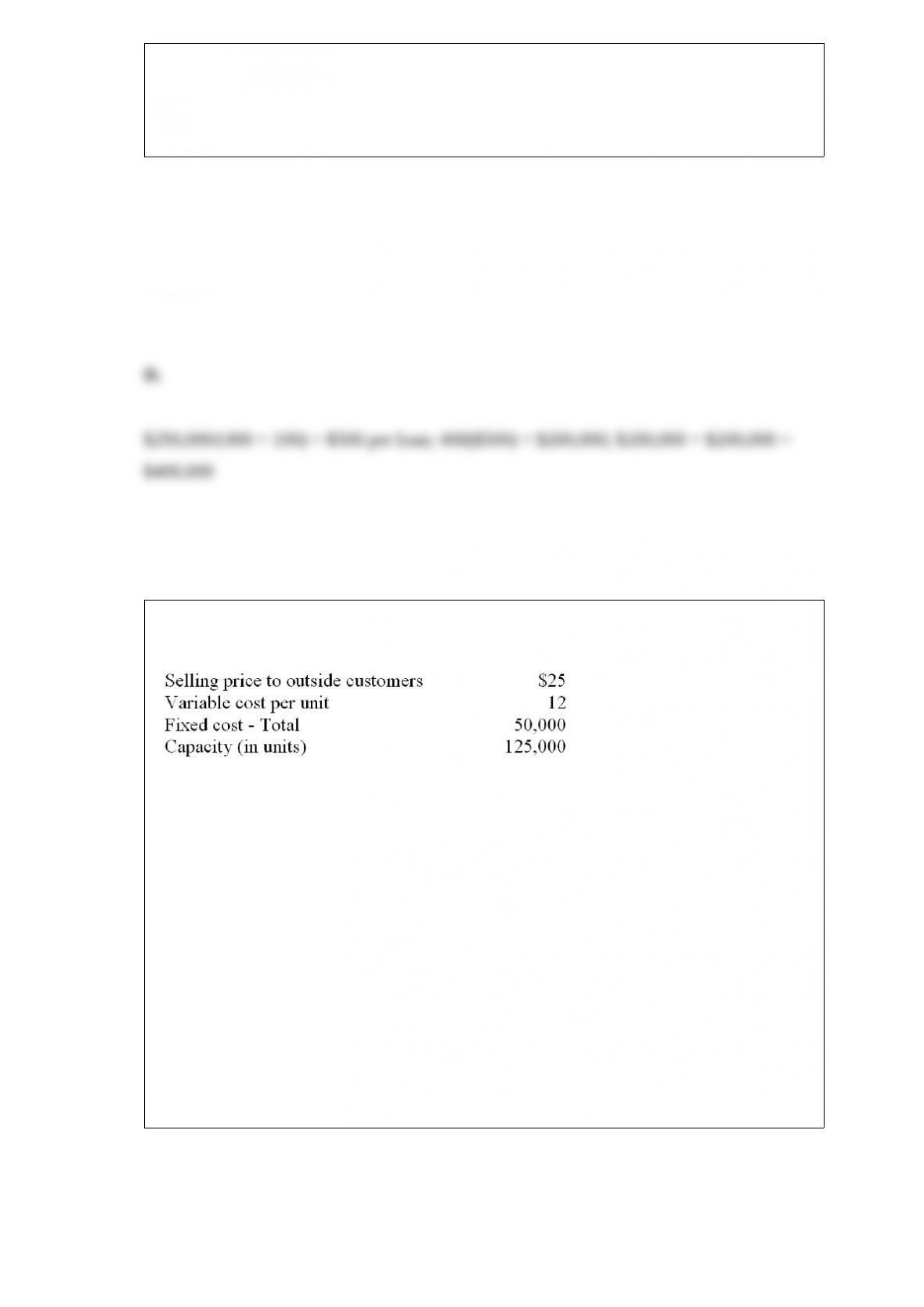
Given the following data for Division X:
Division Y would like to purchase 15,000 units each period from Division X. Division
X has ample excess capacity to handle all of Division Y’s needs. Division Y now
purchases from an outside supplier at a price of $20. If Division X refuses to accept an
$18 price internally, the company, as a whole, will be worse off by
A. $30,000.
B. $75,000.
C. $90,000.
D. $120,000.
E. $195,000.
Answer:
If a company multiplies its predetermined overhead rate by the actual activity level of
its allocation base, it is using
A. standard costing.
B. normal costing.
C. actual costing.
D. budget costing.
E. ideal costing.
Answer:
Stills Company expects the following results:
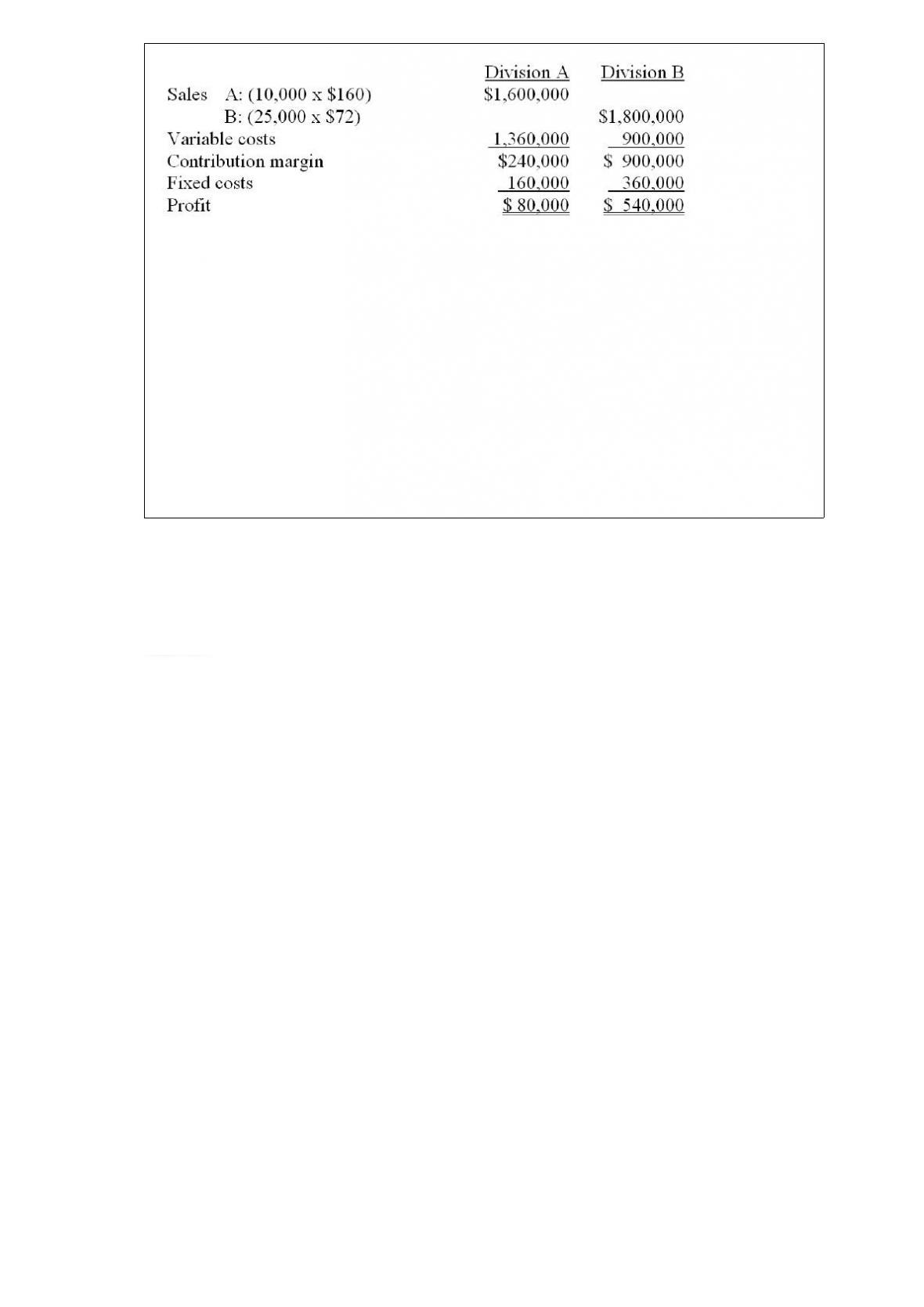
Included in Division A’s costs are 10,000 units of a subcomponent purchased from an
outside supplier for $45. The managers have recently initiated negotiations for Division
B to supply the components to Division A. Division B has a total capacity of 40,000
units.
Required:
a) Prepare a new segment reporting statement for Stills, assuming an internal transfer at
the maximum transfer price.
b) Prepare a new segment reporting statement for Stills, assuming an internal transfer at
the minimum transfer price.
Answer:
The loan department of a financial corporation makes loans to businesses. The costs of
processing these loans are often several thousand dollars. All loans are initially
evaluated using the same financial analysis software, but some require outside services
such as appraisals and legal services. Which is the most appropriate costing system for
the loan department?
A. job-order costing
B. process costing
C. operation costing
D. batch costing
Answer:
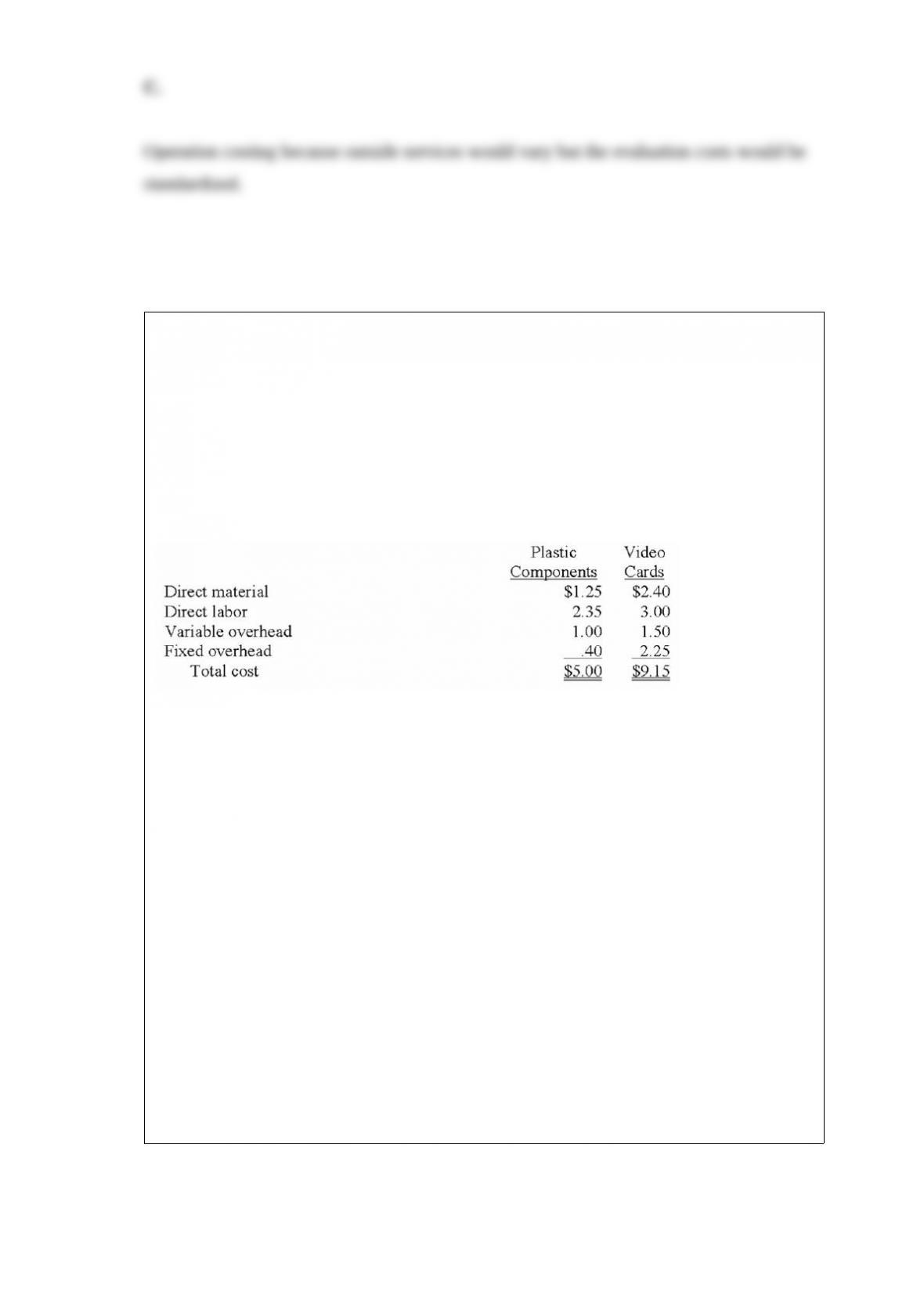
Parkside Inc. has several divisions that operate as decentralized profit centers.
Parkside’s Entertainment Division manufactures video arcade equipment using the
products of two of Parkside’s other divisions. The Plastics Division manufactures
plastic components, one type that is made exclusively for the Entertainment Division,
while other less complex components are sold to outside markets. The products of the
Video Cards Division are sold in a competitive market; however, one video card model
is also used by the Entertainment Division. The actual costs per unit used by the
Entertainment Division are presented in the next column. (CMA adapted)
The Plastics Division sells its commercial products at full cost plus a 25% markup and
believes the proprietary plastic component made for the Entertainment Division would
sell for $6.25 per unit on the open market. The market price of the video card used by
the Entertainment Division is $10.98 per unit.
Assume that the Entertainment Division is able to purchase a large quantity of video
cards from an outside source at $8.70 per unit. The Video Cards Division, having excess
capacity, agrees to lower its transfer price to $8.70 per unit. This action would
A. optimize the profit goals of the Entertainment Division while subverting the profit
goals of Parkside Inc.
B. allow evaluation of both divisions on the same basis.
C. subvert the profit goals of the Video Cards Division while optimizing the profit goals
of the Entertainment Division.
D. optimize the overall profit goals of Parkside Inc.
Answer:
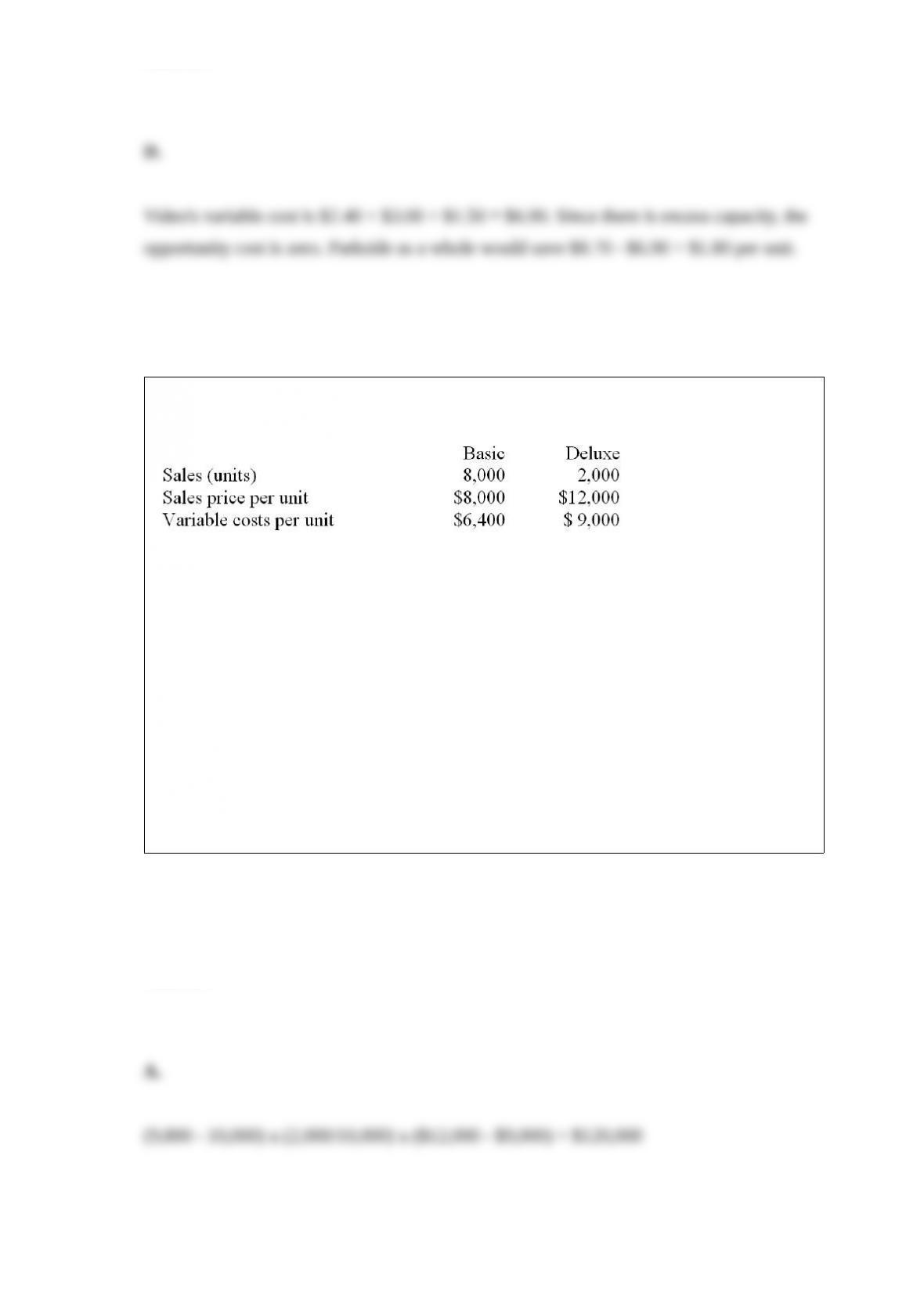
A machine distributor sells two models, basic and deluxe. The following information
relates to its master budget.
Actual sales were 7,000 basic models and 2,800 deluxe models. The actual sales prices
were the same as the budgeted sales prices for both models.
What is the sales quantity variance for the deluxe model?
A. $120,000
B. $256,000
C. $1,344,000
D. $1,600,000
Answer:
An error was made by ROC Company in computing the percentage-of-completion of
the current year’s ending Work-in-Process Inventory. The error resulted in the
assignment of a lower percentage of completion to each component of the inventory
than actually was the case. There was no beginning Work-in-Process Inventory. What is
the effect of this error on (1) cost assigned to cost of goods completed for the period
and (2) the computation of costs per equivalent unit?
1 2
A. Understated Understated
B. Understated Overstated
C. Overstated Understated
D. Overstated Overstated
Answer:
Which of the following balanced scorecard perspectives focuses on employee
development?
A. Financial
B. Customer
C. Internal Business Process
D. Learning and growth

Answer:
The fixed factory overhead application rate is a function of a predetermined activity
level. If standard hours allowed for good output equal this predetermined activity level
for a given period, the volume variance will be (CPA adapted)
A. Zero.
B. Favorable.
C. Unfavorable.
D. Either favorable or unfavorable, depending on the budgeted overhead.
Answer:
A company is highly centralized. Division X, which is operating at capacity, produces a
component that it currently sells in a perfectly competitive market for $13 per unit. At
the current level of production, the fixed cost of producing this component is $4 per
unit and the variable cost is $7 per unit. Division Y would like to purchase this
component from Division X. The price that Division X should charge Division Y per
unit for this component is
A. $7.
B. $11.
C. $13.
D. $15.
Answer:
The theory of constraints focuses on maximizing throughput contribution margin while
minimizing all of the following except
A. selling expenses per unit sold.
B. production bottlenecks.
C. investment in buildings.
D. investment in inventories.
Answer:
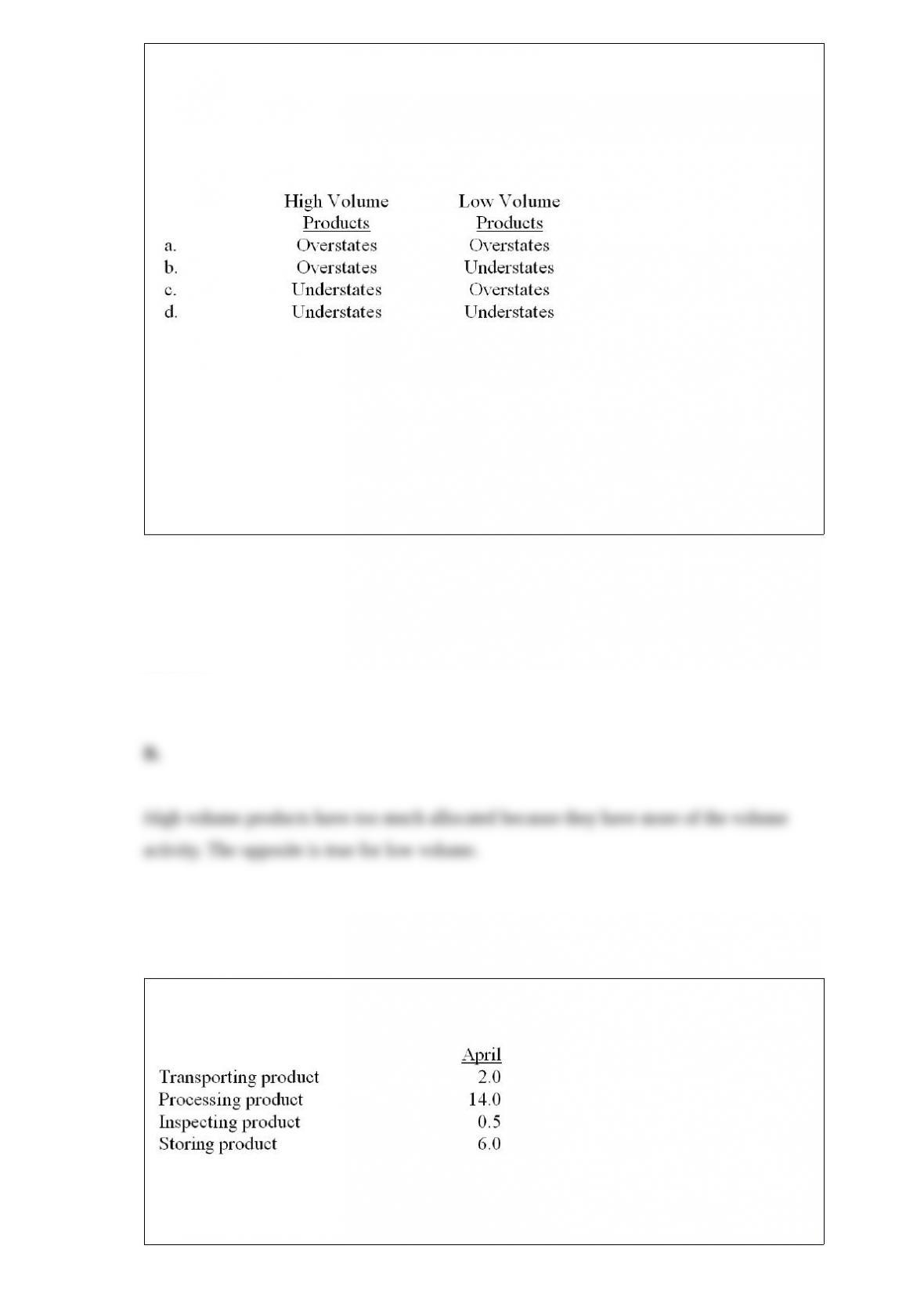
Volume-based costing allocates indirect product costs based on the volume of output,
using such allocation bases as direct labor hours, machine hours, or the amount of direct
material used in the production process. Activity-based costing (ABC) has consistently
shown that Volume-based costing ___________ the cost of high volume products and
______________ the cost of low volume products.
A. a
B. b
C. c
D. d
Answer:
The ABC Manufacturing Company collected the following information (in days):
What is the manufacturing cycle efficiency?
A. 87.5%
B. 63.6%
C. 62.2%
D. 42.9%
Answer:
Service department costs are
A. generally treated as period costs rather than product costs.
B. reported as selling and administrative expenses on the income statement.
C. eventually applied by the user departments to the units produced.
D. seldom found in manufacturing organizations.
Answer:
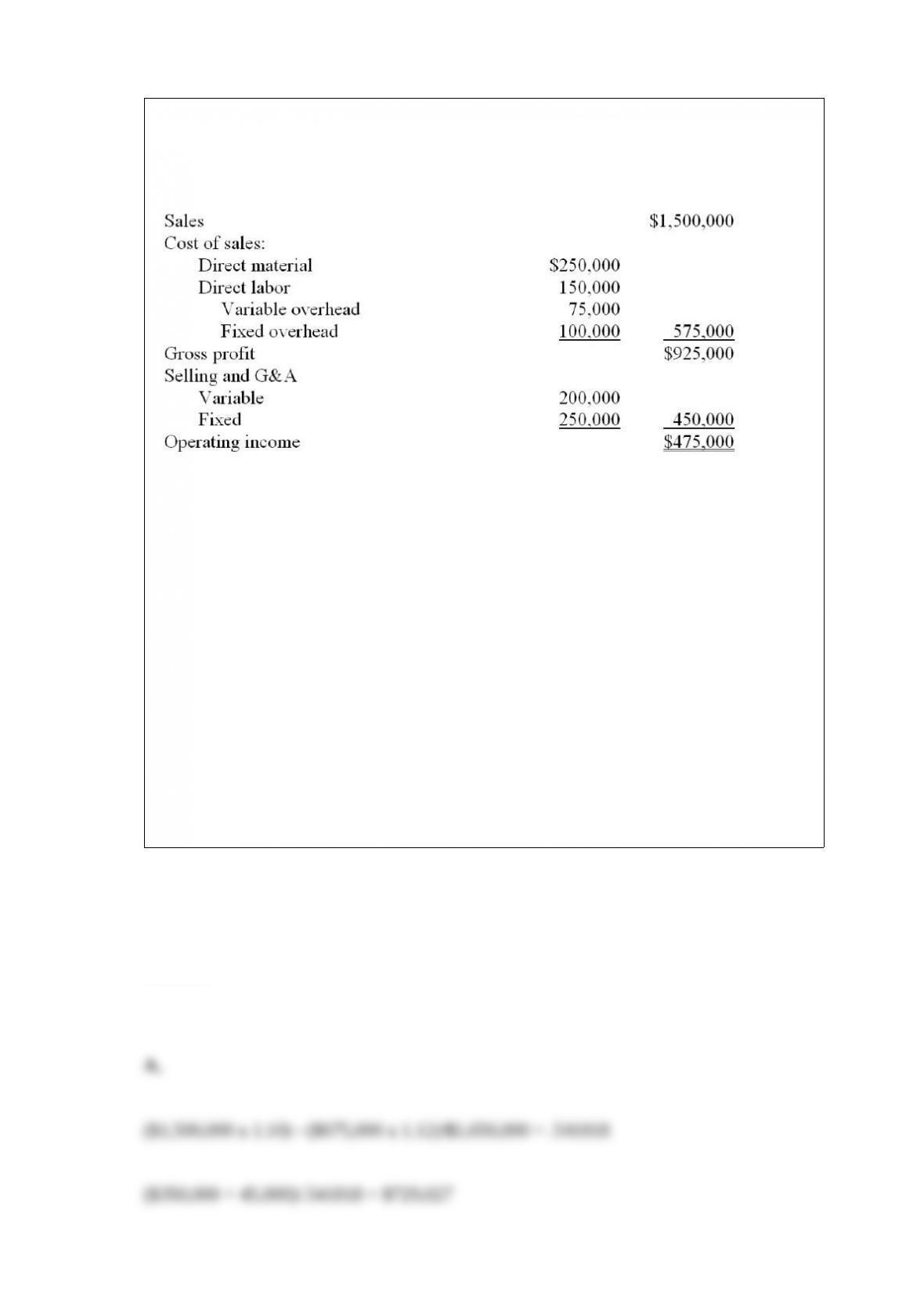
Barnes Corporation manufactures skateboards and is in the process of preparing next
year’s budget. The pro forma income statement for the current year is presented below.
For the coming year, the management of Barnes Corporation anticipates a 10 percent
increase in sales, a 12 percent increase in variable costs, and a $45,000 increase in fixed
expenses.
The break-even point for next year would be
A. $729,027.
B. $862,103.
C. $214,018.
D. $474,000.
E. $700,000.
Answer:
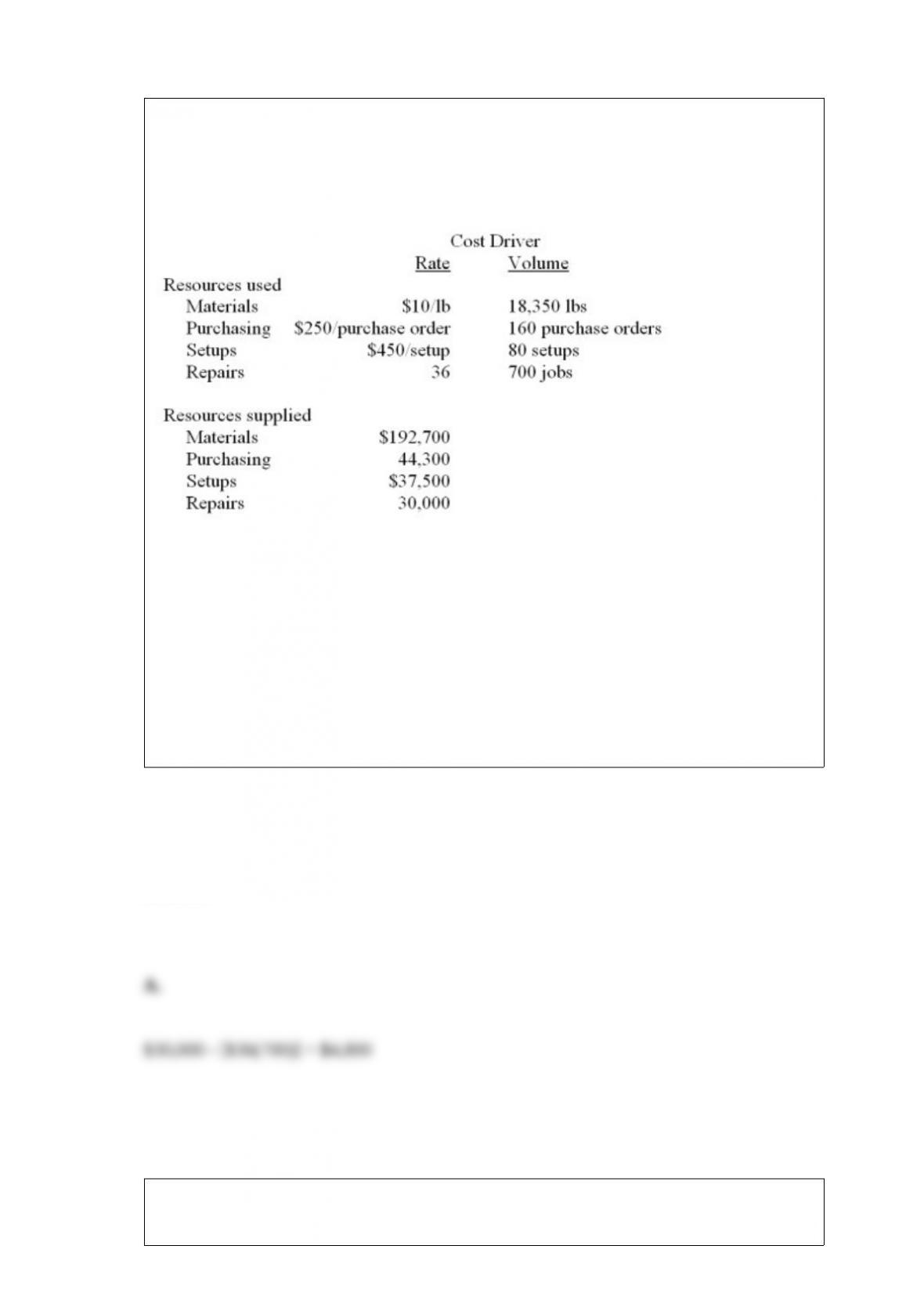
Sullivan Inc. reports the following information about resources. At the beginning of
the year, Sullivan estimated it would spend $180,000 for materials, $42,000 for
purchasing, $35,000 for setups and $36,000 for repairs.
Compute unused resource capacity for repairs for Sullivan.
A. $4,800
B. $10,800
C. $6,000
D. $3,600
Answer:
If a manager wants to assess performance relative to the industry, it is best to use
A. partial productivity measures
B. production volume variances
C. sales price variances
D. total factor productivity
Answer:
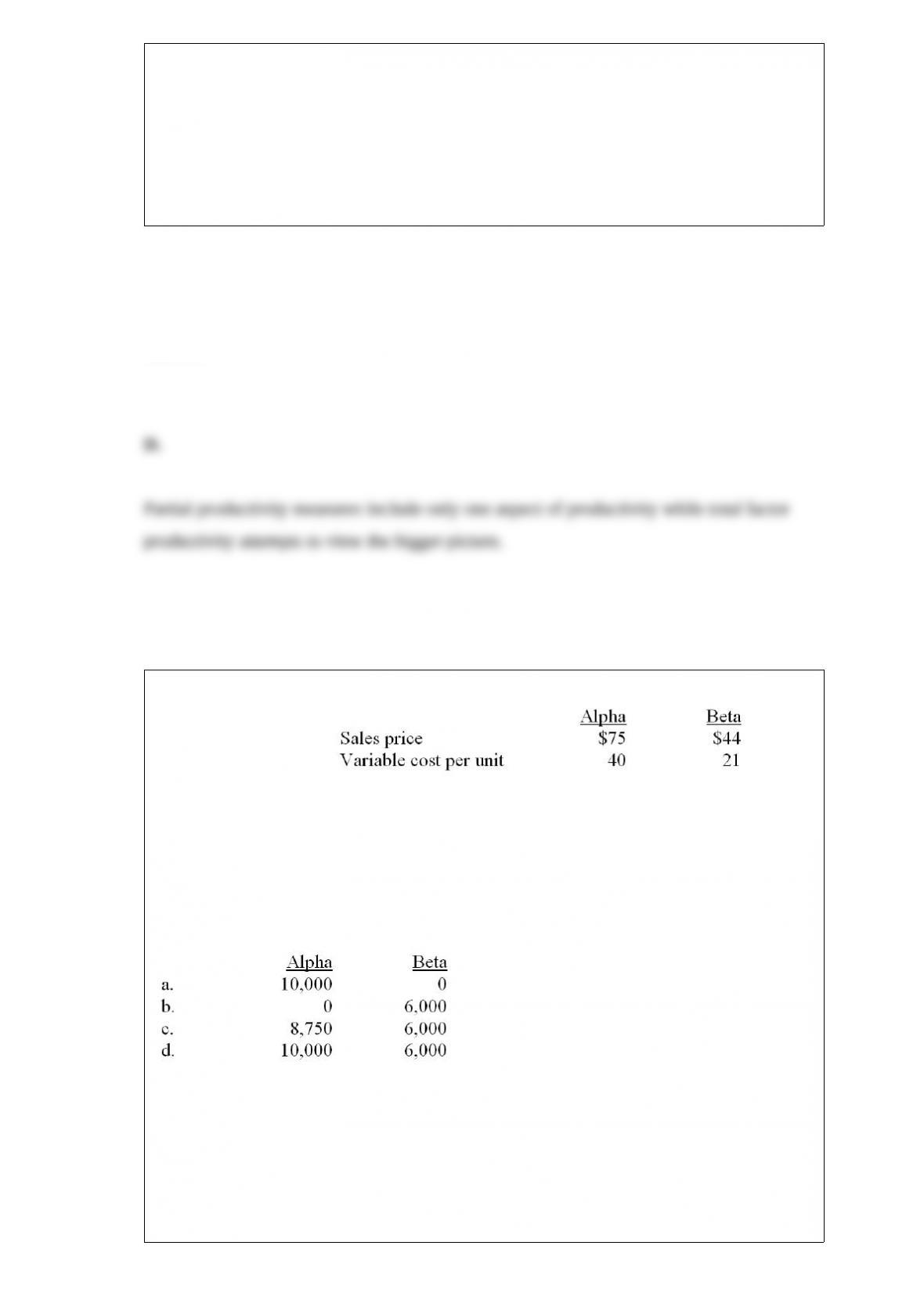
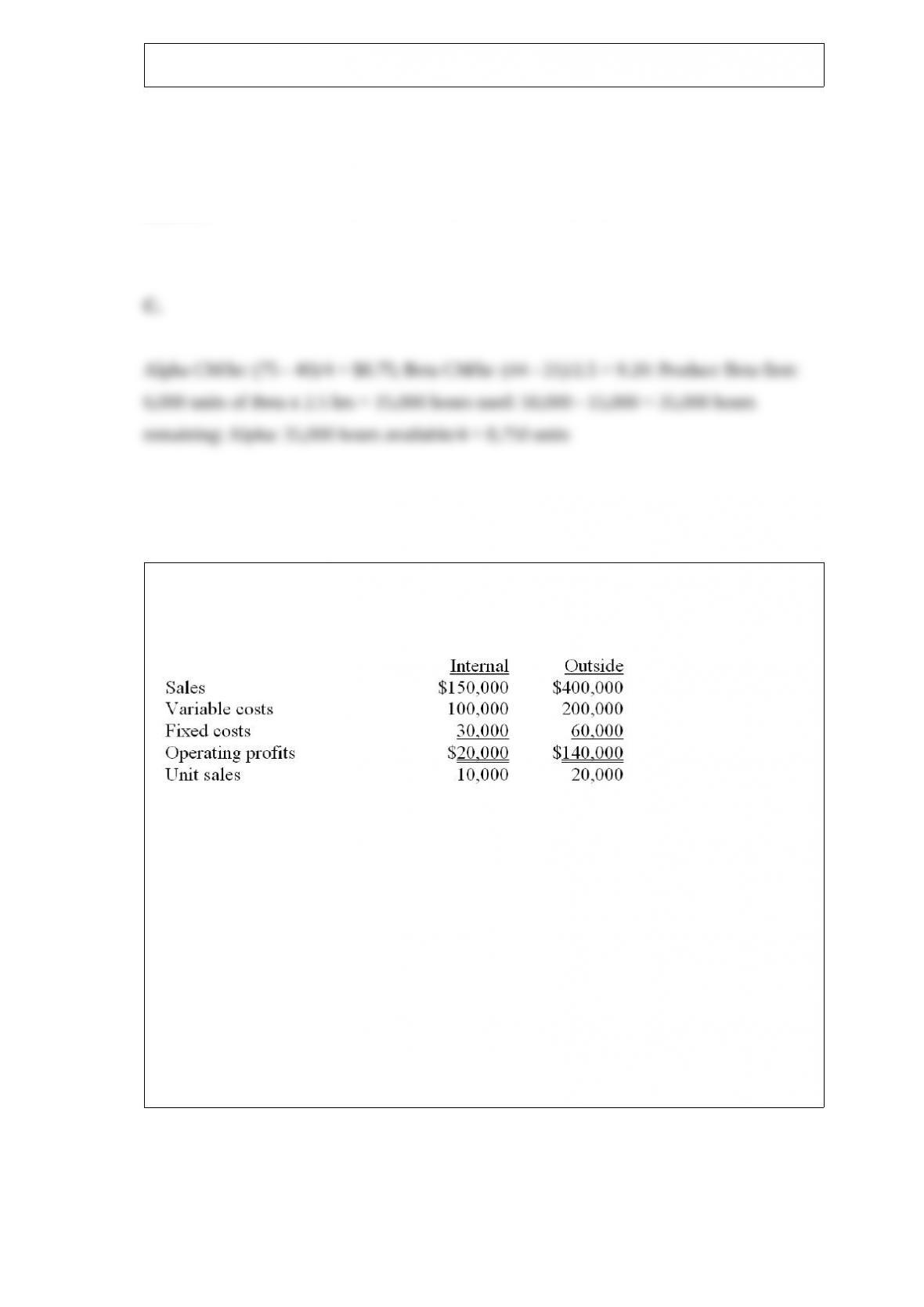
The Clapton Company manufactures two products: Alpha and Beta. The costs and
revenues are as follows:
Total demand for Alpha is 10,000 units and for Beta is 6,000 units. Machine hours is a
scarce resource. During the year, 50,000 machine hours are available. Alpha requires 4
machine hours per unit, while Beta requires 2.5 machine hours per unit.
How many units of Alpha and Beta should Clapton produce?
A. a
B. b
C. c
D. d
Answer:
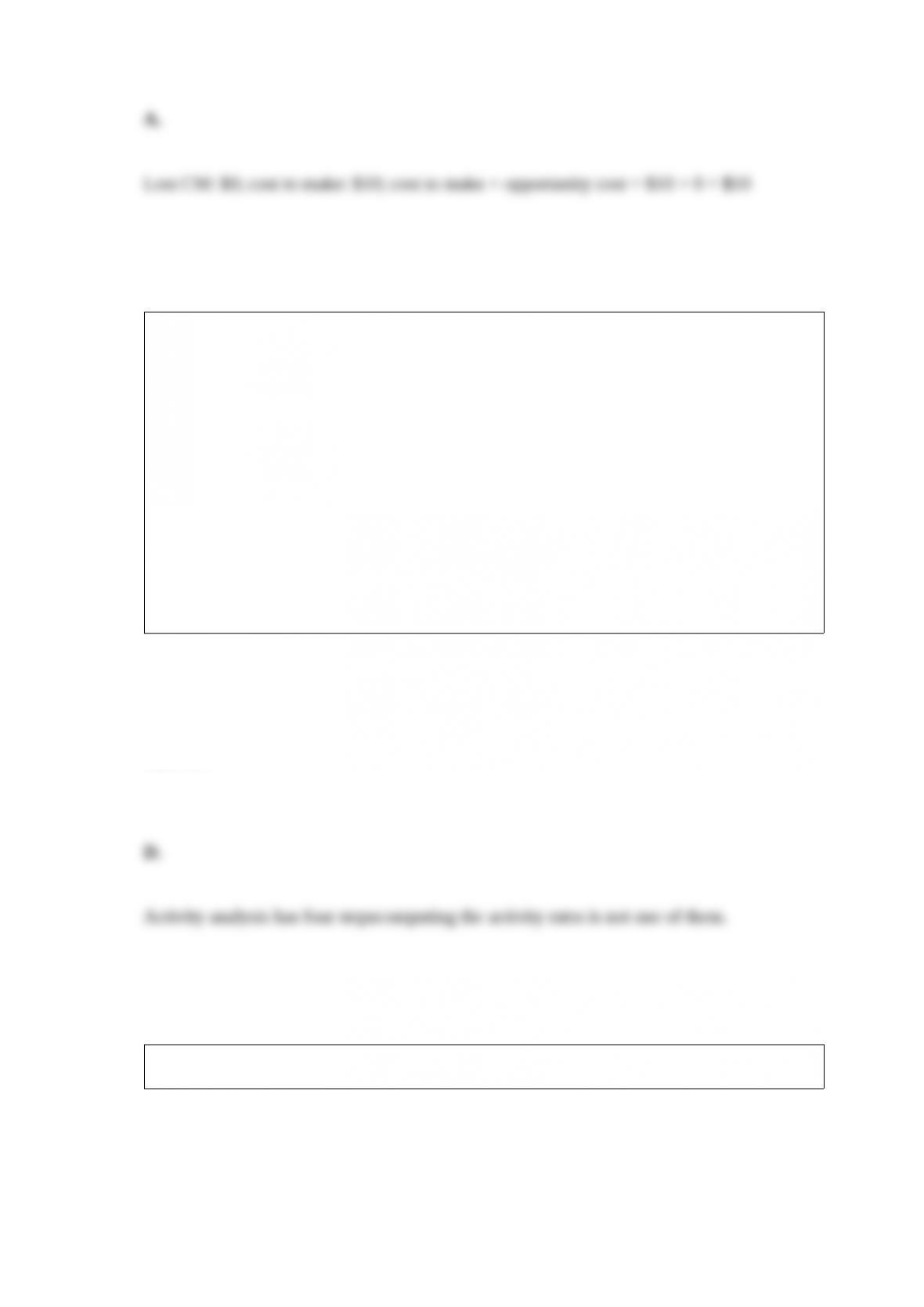
The Axle Division of Becker Company produces axles for off-road sport vehicles.
One-third of Axle’s output is sold to an internal division of Becker; the remainder is
sold to outside customers. Axle’s estimated operating profit for the year is:
The internal division has an opportunity to purchase 10,000 axles of the same quality
from an outside supplier on a continuing basis. The Axle Division cannot sell any
additional products to outside customers. What is the minimum selling price that Axle
should accept from the internal division?
A. $10.00
B. $13.00
C. $15.00
D. $50.00
Answer:
Activity analysis is an important approach to operations control and the successful
implementation of an activity-based costing (ABC) system. Which of the procedures is
not part of activity analysis?
A. Chart, from start to finish, the activities used to complete the product or service.
B. Classify all activities as either value-added or nonvalue-added activities.
C. Identify the process objectives as defined by what the customer desires from the
process.
D. Compute the predetermined rate per activity by dividing the total cost pool by the
total cost drivers.
Answer:
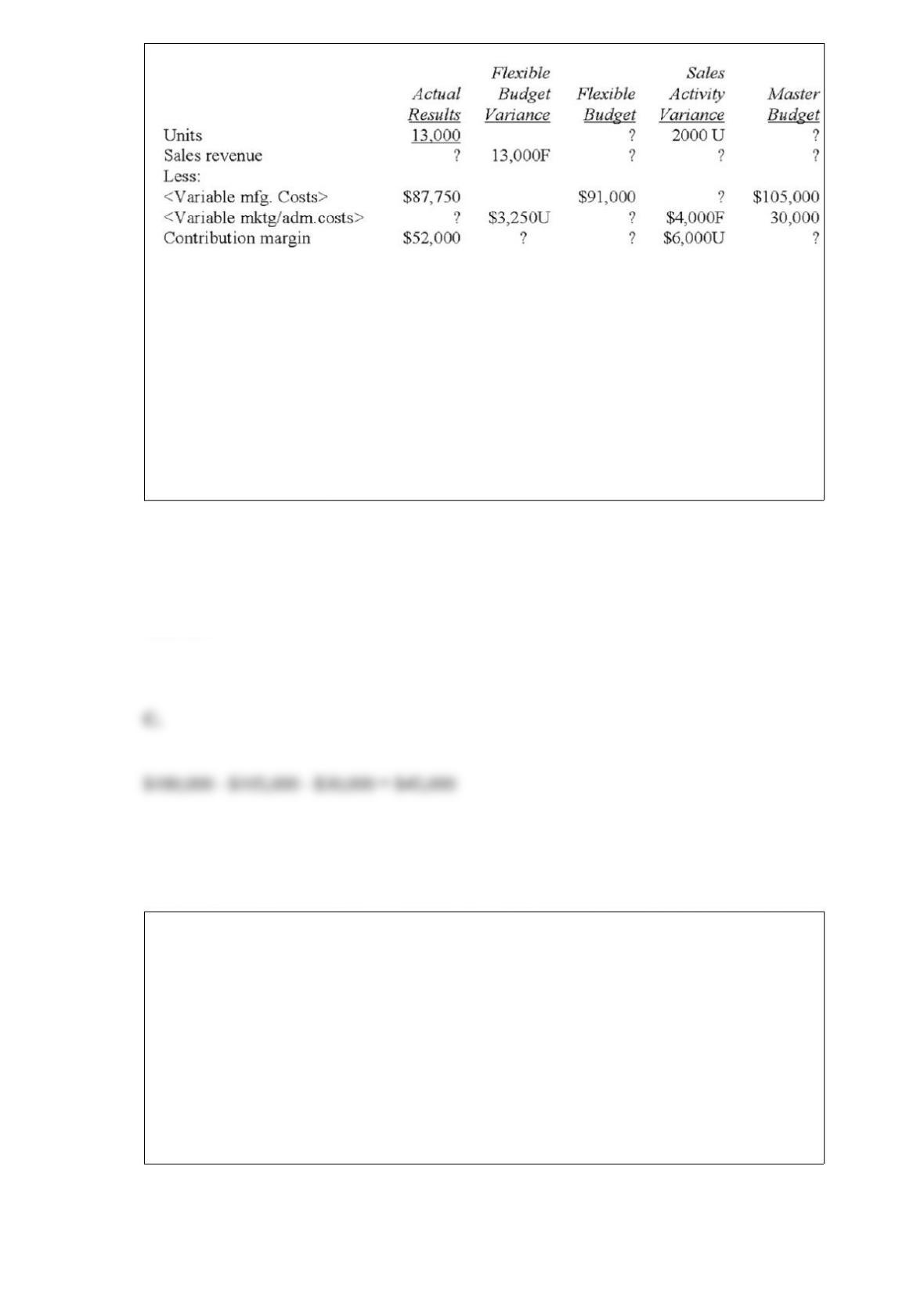
What is the master budget contribution margin?
A. $52,000.
B. $47,500.
C. $45,000.
D. $39,000.
Answer:
Which of the following nonfinancial measures would not be used to evaluate a middle
manager’s performance?
A. Frequency of meeting customer delivery requirements.
B. Amount of unwanted employee turnover.
C. Success in dealing with suppliers.
D. Fulfilling responsibilities to company shareholders.
Answer:
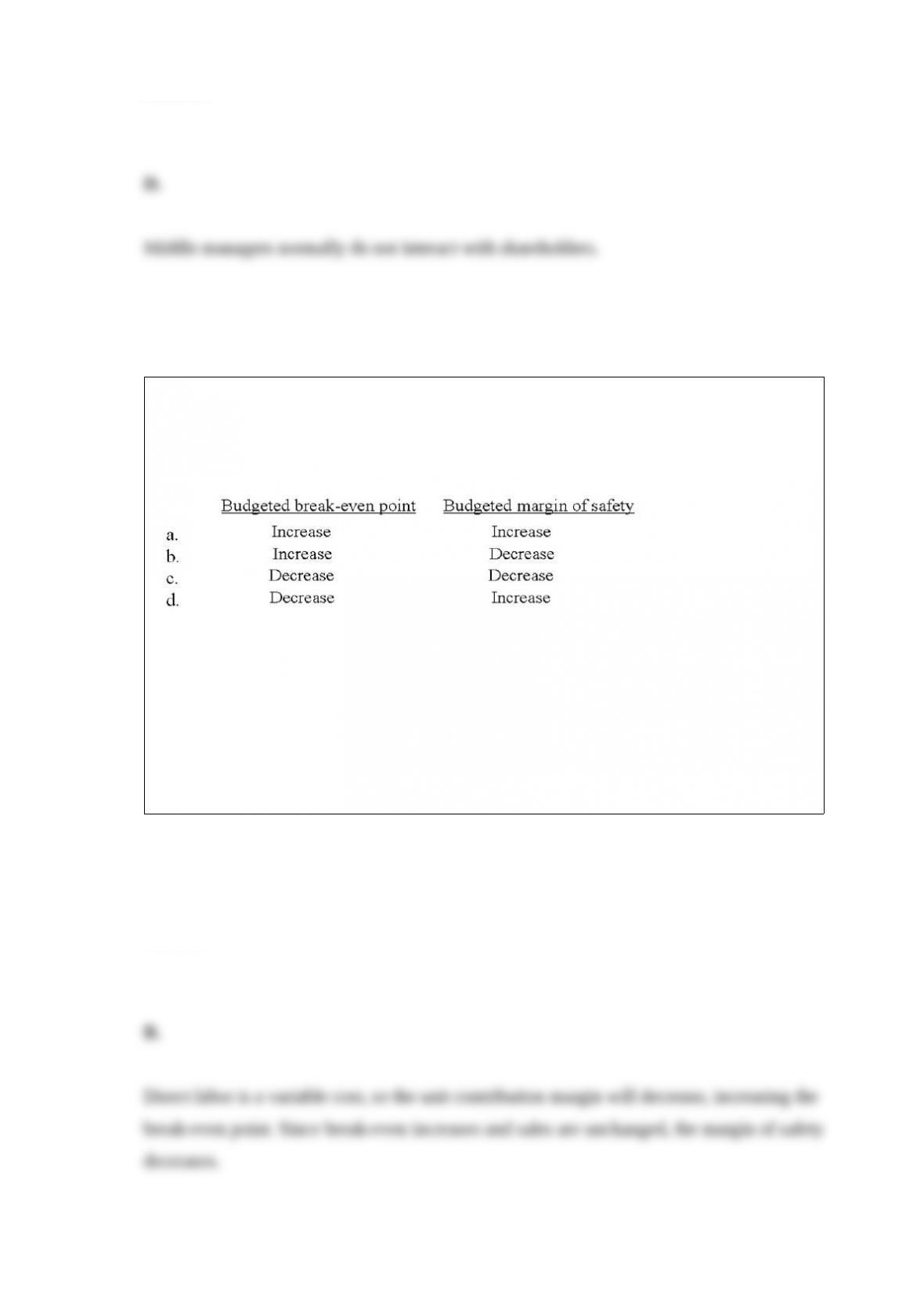
On January 1, 2006, Lake Co. increased its direct labor wage rates. All other budgeted
costs and revenues were unchanged. How did this increase affect Lake’s budgeted
break-even point and budgeted margin of safety? (CPA adapted)
A. a
B. b
C. c
D. d
Answer:
Scottso Corporation applies overhead using a normal costing approach based upon
machine-hours. Budgeted factory overhead was $266,400, budgeted machine-hours
were 18,500. Actual factory overhead was $287,920, actual machine-hours were
19,050. How much is the over- or underapplied overhead?
A. $21,520 underapplied
B. $13,600 underapplied
C. $7,920 overapplied
D. $0
Answer:
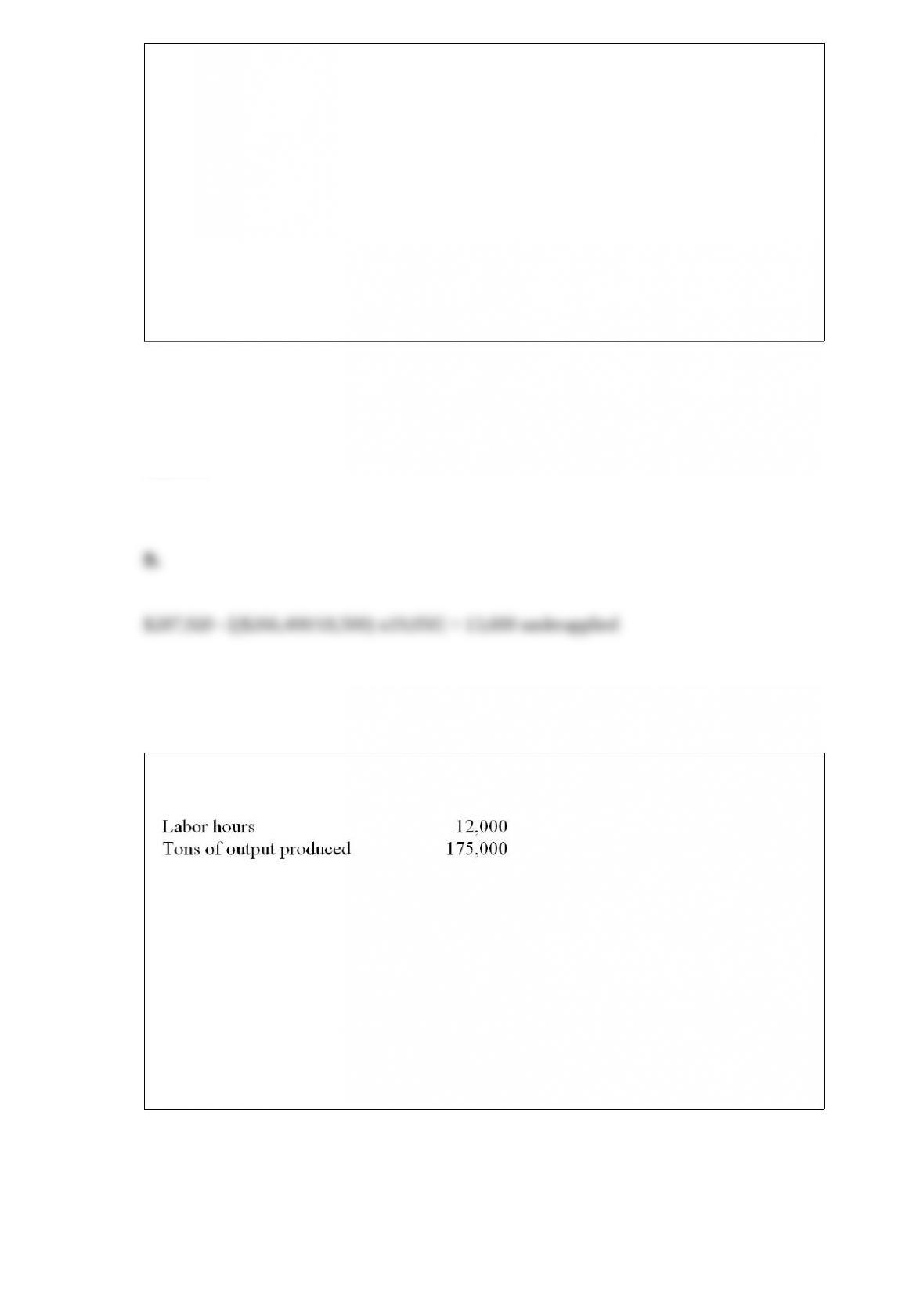
The Thunder Mining Co has the following information for last year
The partial productivity for labor is
A. 1.000
B. 0.069
C. 14.58
D. 12.00
Answer: