
An accountant is required to comply with the provisions of Statements on Standards for
Accounting and Review Services when
I. Typing client-prepared financial statements, without modification, as an
accommodation to a client.
II. Preparing standard monthly journal entries for depreciation and expiration of prepaid
expenses.
A. I only.
B. II only.
C. Both I and II.
D. Neither I nor II.
Tracing is used primarily to test which of the following assertions about classes of
transactions?
A. Occurrence.
B. Completeness.
C. Cutoff.
D. Classification.
Information and communication includes all of the following except:

A. Identifying and recording all valid transactions.
B. Determining the time period in which transactions occurred.
C. Communicating price changes to customers.
D. Properly presenting transactions and related disclosures in the financial statements.
Which is not an attribute of an external auditor?
A. Independence.
B. Auditee advocacy.
C. Objectivity.
D. Concern for the public interest.
While conducting an audit, Larson Associates, CPAs, failed to detect material
misstatements included in its client’s financial statements. Larson’s unqualified opinion
was included with the financial statements in a registration statement and prospectus for
a public offering of securities made by the client. Larson knew that its opinion and the
financial statements would be used for this purpose. Which of the following statements
is correct with regard to a suit against Larson and the client by a purchaser of the
securities under Section 11 of the Securities Act of 1933?
A. The purchaser must prove that Larson was negligent in conducting the audit.
B. The purchaser must prove that Larson knew of the material misstatements.

C. Larson will not be liable if it had reasonable grounds, based on work performed, to
believe the financial statements were accurate.
D. Larson will be liable unless the purchaser did not rely on the financial statements.
In performing a search for unrecorded retirements of fixed assets, an auditor most likely
would
A. inspect the property ledger and the insurance and tax records and then tour the
entity’s facilities.
B. tour the entity’s facilities and then inspect the property records and the insurance and
tax records.
C. analyze the repair and maintenance account and then tour the entity’s facilities.
D. tour the entity’s facilities and then analyze the repair and maintenance account.
When obtaining an understanding of the entity and its environment, the auditor should
obtain an understanding of internal controls primarily to
A. Identify areas of relatively high risk of misstatement and plan the audit accordingly.
B. Provide suggestions for improvement to the company.
C. Serve as a basis for setting audit risk and materiality.
D. Decide whether to perform an audit for the company.

If an auditor dates the auditor’s report on financial statements for the year ended
December 31, 2013, as of February 10, 2014, except for Note J, as to which the date is
March 3, 2014, the auditor is acknowledging responsibility to actively search for and
ensure proper handling by management of
A. all subsequent events occurring through March 3, 2014.
B. all subsequent events occurring through February 10, 2014.
C. all subsequent events occurring through February 10, 2014 and the specific
subsequent event referred to in Note J through March 3, 2014.
D. only the specific subsequent event referred to in Note J as of March 3, 2014.
A large retail enterprise has established a policy that requires that the paymaster deliver
all unclaimed payroll checks to the Internal Auditing Department at the end of each
payroll distribution day. This policy was most likely adopted in order to
A. assure that employees who were absent on a payroll distribution day are not paid for
that day.
B. prevent the paymaster from cashing checks that are unclaimed for several weeks.
C. prevent a bona fide employee’s check from being claimed by another employee.
D. detect any fictitious employee who may have been placed on the payroll.

The auditor’s best course of action with respect to “other financial information”
included in an annual report containing the auditor’s report is to
A. indicate in the auditor’s report that the “other financial information” is unaudited.
B. consider whether the “other financial information” is accurate by performing a
limited review.
C. obtain written representations from management as to the material accuracy of the
“other financial information.”
D. read and consider the manner of presentation of the “other financial information.”
Management documentation should include all of the following except:
A. Documentation regarding the auditor’s evaluation of internal controls.
B. Documentation regarding management’s testing and evaluation of the controls.
C. Documentation regarding the safeguarding of assets.
D. Documentation on the controls designed in all five components of internal control.
Audit documents that record the procedures used by the auditor to gather evidence
should be
A. Considered the primary support for the financial statements being examined.

B. Viewed as the connecting link between the accounting records and the financial
statements.
C. Designed in an orderly fashion to facilitate the review of audit work by the senior,
manager, and partner on the engagement.
D. Retained until the audited entity ceases to be a client.
The auditor’s program for the examination of long-term debt should include steps that
require the
A. verification of the existence of the bond holders.
B. examination of any bond agreement.
C. inspection of the accounts payable subsidiary ledger.
D. investigation of credits to the bond interest income account.
Audit evidence concerning proper segregation of duties ordinarily is best obtained by
A. Preparation of a flowchart of duties performed by available personnel.
B. Inquiring whether control activities operated consistently throughout the period.
C. Reviewing job descriptions prepared by the Personnel Department.
D. Direct personal observation of the employees who apply the control activities.

Auditors are most likely to use the most rigorous audit procedures to examine
A. Routine transactions.
B. Management assertions that are deemed to be of low risk.
C. Only the rights and obligations assertion.
D. Management assertions that are deemed to be of high risk.
In your own words, describe how the Institute of Internal Auditors (IIA) defines internal
auditing?
To provide for the greatest degree of independence in performing internal audit
activities, the internal audit function most likely should report to the

A. Vice-President – Finance.
B. Corporate controller.
C. Audit committee of the board of directors.
D. Corporate stockholders.
For which of the following matters should an auditor obtain written management
representations?
A. Management’s cost-benefit justifications for not correcting internal control
weaknesses.
B. Management’s knowledge of future plans that may affect the price of the entity’s
stock.
C. Management’s compliance with contractual agreements that may affect the financial
statements.
D. Management’s acknowledgment of its responsibility for employees’ violations of
laws.
In an IT payroll system environment, an auditor would be least likely to use test data to
test controls related to
A. missing employee numbers.
B. proper approval of overtime by supervisors.

C. time sheets with invalid job numbers.
D. agreement of hours per clock cards with hours on time sheets.
Which of the following procedures would an auditor most likely perform in searching
for unrecorded liabilities?
A. Trace a sample of accounts payable entries recorded just before year-end to the
unmatched receiving report file.
B. Compare a sample of purchase orders issued just after year-end with the year-end
accounts payable trial balance.
C. Vouch a sample of cash disbursements recorded just after year-end to receiving
reports and vendor invoices.
D. Scan the cash disbursements entries recorded just before year-end for indications of
unusual transactions.
Which of the following is not a primary objective of internal control as established by
COSO?
A. Efficiency and effectiveness of operations.
B. Effective purchasing systems.
C. Compliance with laws and regulations.
D. Reliable financial reporting.

An attestation report should state that the use of the report is restricted to specified
parties under all of the following circumstances except when:
A. The criteria used to evaluate the subject matter are available only to specified parties.
B. The report is an attest engagement to apply agreed-upon procedures.
C. A written assertion on the subject matter of the report has not been provided by the
responsible party.
D. All of the listed scenarios are circumstances that would dictate that the use of the
report is restricted to specific parties.
Which of the following is not a characteristic of a batch processed computer system?
A. The collection of like transactions which are sorted and processed sequentially
against a master file.
B. Keypunching of transactions, followed by machine processing.
C. The production of numerous printouts.
D. The posting of a transaction, as it occurs, to several files, without intermediate
printouts.

Monetary-unit sampling is said to eliminate the need to stratify the sample because
A. sample items are selected in proportion to their dollar amount.
B. the risk of incorrect acceptance is inversely related to sample size.
C. tolerable misstatement is considered when determining sample size.
D. the upper limit on misstatements can be computed based on statistical principles.
Which of the following is required for a firm to designate itself as a “Member of the
American Institute of Certified Public Accountants” on its letterhead?
A. At least one of the partners must be a member.
B. The partners whose names appear in the firm name must be members.
C. All partners must be members.
D. The firm must be a dues-paying member.
An auditor would most likely be concerned with internal control policies and
procedures that provide reasonable assurance about the
A. Efficiency of management’s decision-making process.
B. Appropriate prices that the entity should charge for its products.
C. Methods of assigning production tasks to employees.
D. Entity’s ability to accurately process and summarize financial data.
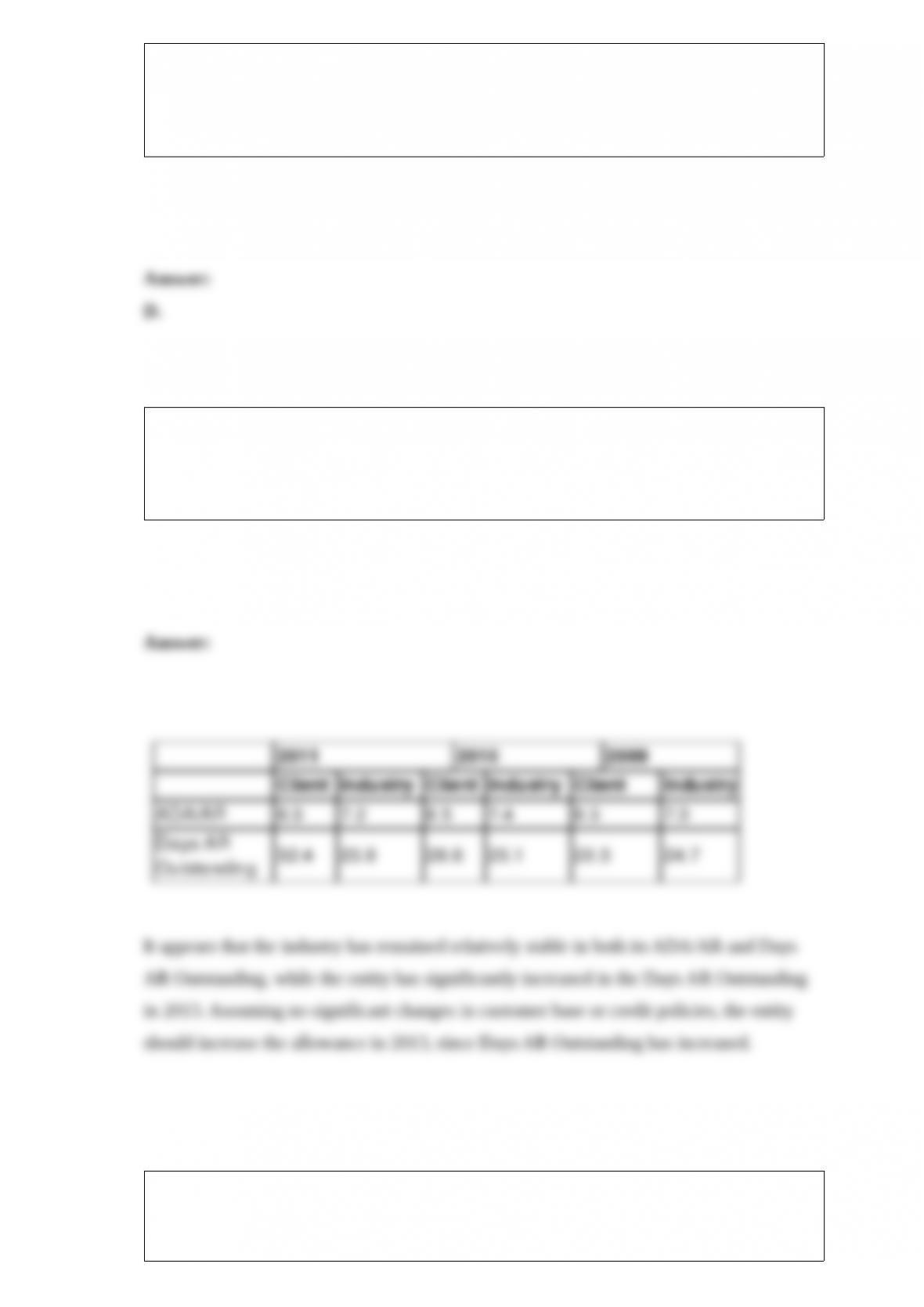
You are auditing the allowance for doubtful accounts (ADA) and perform the analytical
procedures shown below. Assume that no significant changes have occurred during the
year in either the entity’s credit policies or customer base. What concerns, if any, about
adjusting the ADA should the auditor have based on the information shown below?
During the year under audit, a company has completed a private placement of a
substantial amount of bonds. Which of the following is the most important step in the
auditor’s program for the audit of bonds payable?

A. Confirming the interest rate with the bond trustee.
B. Tracing the cash received from the issue to the accounting records.
C. Examining the bond agreement for a sinking fund provision.
D. Recomputing the annual interest cost and the effective yield.
Auditors are most likely to gather audit evidence solely using substantive procedures
A. If transactions are recurring.
B. For nonrecurring, unusual transactions.
C. If control risk is very low.
D. If the entity has a well-designed automated system.
“There have been no communications from regulatory agencies concerning
noncompliance with or deficiencies in, financial reporting practices that could have a
material effect on the financial statements.” The foregoing passage is most likely from a
A. report on internal control.
B. special report.
C. management representation letter.
D. letter for underwriters.

Tests designed to detect credit sales made after the end of the year that have been
recorded in the current year provide assurance about management’s assertion of
A. classification.
B. cutoff.
C. occurrence.
D. authorization and accuracy.
When outside firms of non-accountants specializing in physical inventory counts are
used to count, list, price, and subsequently compute the total dollar amount of inventory
on hand at the date of the physical count, the auditor will ordinarily
A. consider the report of the outside inventory firm to be an acceptable alternative
procedure to the observation of physical inventories.
B. make or observe some physical counts of the inventory, recompute certain inventory
calculations, and test certain inventory transactions.
C. increase the extent of work on the physical count of inventory.
D. consider the reduced audit effort with respect to the physical count of inventory as a
scope limitation.

The accounts payable department receives the purchase order form to accomplish all of
the following except to:
A. compare invoice price to purchase order price.
B. ensure that the purchase had been properly authorized.
C. ensure that the goods had been received by the party requesting the goods.
D. compare quantity ordered to quantity purchased.
Reasonable assurance is provided in
A. an audit engagement.
B. a compilation engagement.
C. a review engagement.
D. none of the items listed.