Purchased $400,000 of ABC Co. 5% bonds at 100 plus accrued interest of $4,500. Sold
$250,000 of bonds at 97. The journal entry for the purchase would include:
A.a credit to Interest Receivable for $4,500
B.a credit to Interest Revenue for $4,500
C.a debit to Interest Receivable for $4,500
D.a debit to Interest Revenue for $4,500
Answer:
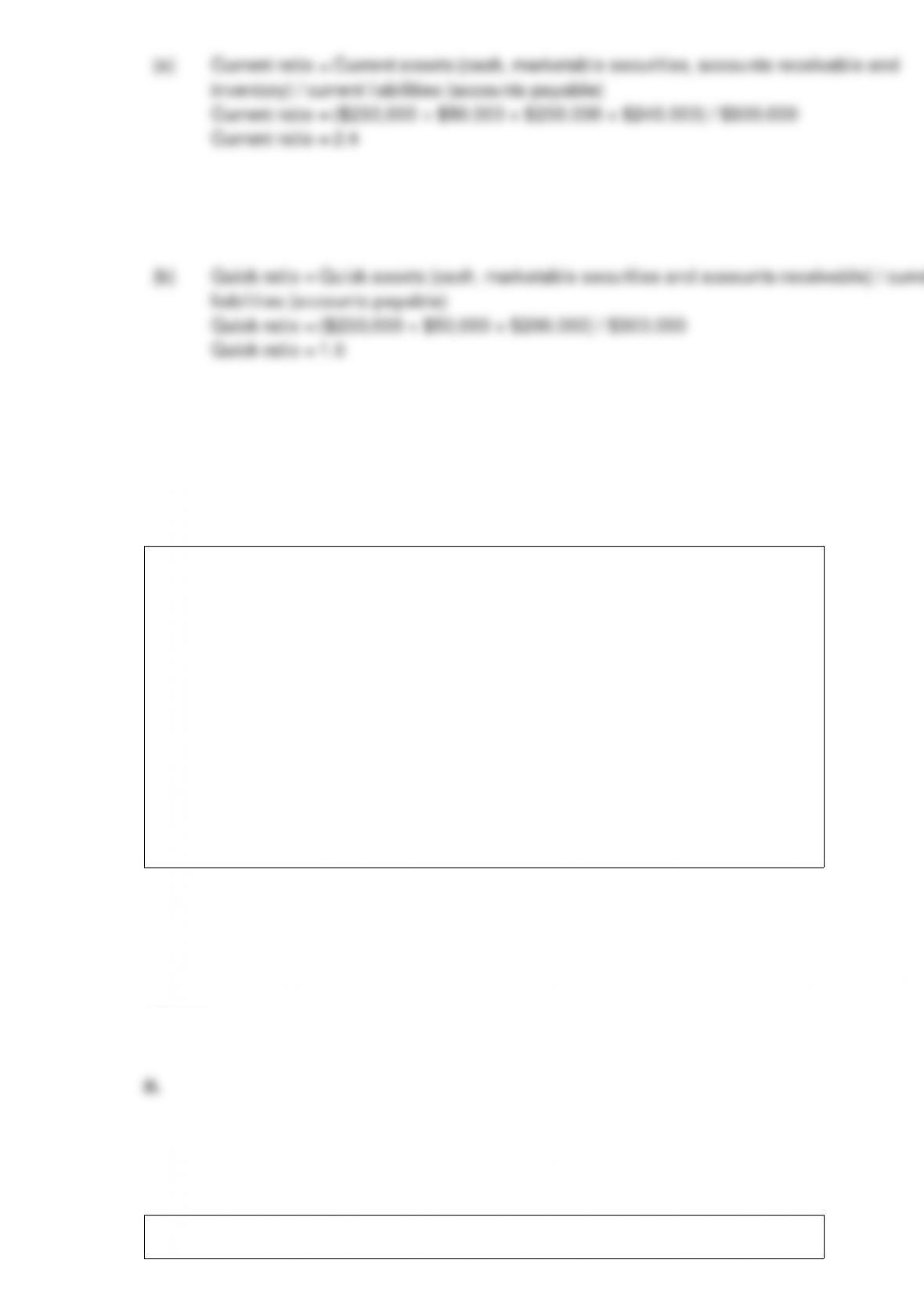
The following items are reported on a company’s balance sheet:
Determine the (a) current ratio, and (b) quick ratio. Round your answer to one decimal
place.
Answer:
The cost of merchandise sold during the year was $45,000. Merchandise inventories
were $13,500 and $10,500 at the beginning and end of the year, respectively. Accounts
payable were $7,000 and $5,000 at the beginning and end of the year, respectively.
Using the direct method of reporting cash flows from operating activities, cash
payments for merchandise total
A.$46,000
B.$44,000
C.$50,000
D.$40,000
Answer:
A business is considering a cash outlay of $250,000 for the purchase of land, which it

could lease for $35,000 per year. If alternative investments are available which yield an
18% return, the opportunity cost of the purchase of the land is:
A.$35,000
B.$45,000
C.$10,000
D.$6,300
Answer:
Cameron Manufacturing Co.’s static budget at 5,000 units of production includes
$40,000 for direct labor and $5,000 for variable electric power. Total fixed costs are
$20,000. At 8,000 units of production, a flexible budget would show:
A.variable costs of $64,000 and $25,000 of fixed costs
B.variable costs of $64,000 and $20,000 of fixed costs
C.variable costs of $72,000 and $20,000 of fixed costs
D.variable and fixed costs totaling $104,000
Answer:
If a two-column (all-purpose) general journal, a purchases journal, and a cash payments
journal are used, indicate the journal in which each of the following transactions should
be recorded:
(a) Payment of rent.
(b) Purchase of supplies on account.
(c) Purchase of computer on account.
(d) Purchase of supplies for cash.
(e) Advance payment of a one-year fire insurance policy on the office.
(f) Adjustment to record accrued salaries at the end of the period.
(g) Adjustment to record depreciation at the end of the month.
(h) Payment of an account payable.
Answer:

After net income is entered on the work sheet, the Balance Sheet debit and credit
columns must
A.be the same amount as the total amount of the Income Statement debit and credit
columns
B.equal each other
C.be the same amount as the total amount in the Adjusted Trial Balance debit and credit
columns
D.not be equal to each other and need not be the same total amounts as any other pair of
columns on the work sheet
Answer:
The Income Statement will include the following accounts
A.Revenues less Expenses (ordered largest to smallest amount) with Miscellaneous
Expense listed last
B.Revenues less Expenses (ordered smallest to largest amounts) with Miscellaneous
Expense listed last
C.Revenues less Expenses (ordered in alphabetical order)
D.Revenues less Expenses (order is not important)
Answer:

A bank reconciliation should be prepared
A.whenever the bank refuses to lend the company money.
B.to explain any difference between the company’s balance per books with the balance
per bank.
C.by the company’s bank.
D.by the person who is authorized to sign checks.
Answer:
Emma Co. sold Isabella Co. merchandise on account FOB shipping point,, 2/10, net 30,
for $15,000. Emma Co.prepaid the $750 shipping charge. Using the perpetual inventory
method, which of the following entries will Isabella Co. make to record payment of the
merchandise if Isabella Co.pays within the discount period?
A.Accounts Payable-Emma Co., debit $15,000; Freight In, credit $750; Cash, credit
$14,250
B.Accounts Payable-Emma Co., debit $15,750; Merchandise Inventory, credit $300;
Cash, credit $15,450
C.Accounts Payable-Emma Co., debit $15,000; Freight In, debit $750; Cash, credit
$15,750
D.Accounts Payable-Emma Co., debit $15,750; Merchandise Inventory, debit
$300;Cash, credit $16,050
Answer:

What is the purpose of the adjusted trial balance?
A.to verify that all of the adjusting entries have been posted
B.to verify that the net income (loss) is correctly reported
C.to verify that no adjusting journal entry has been omitted.
D.to verify that the debits and credits balance
Answer:
The recording of the jobs completed would include a debit to:
A.Factory Overhead
B.Finished Goods
C.Work in Process
D.Cost of Goods Sold
Answer:

When a job is completed in a service organization, the job costs are transferred to the
A.work in process account.
B.cost of services account.
C.finished goods account.
D.cost of goods sold account.
Answer:
The notification accompanying a check that indicates the specific invoice being paid is
called a
A.remittance advice
B.voucher
C.debit memo
D.credit memo
Answer:
All of the following are disadvantages of fair value use except:
A.fair values may not be readily obtainable.
B.fair values may cause more fluctuations as change occurs from period to period.
C.comparability between companies may be impacted by different fair value
measurement.
D.fair values can only be used on balance sheet accounts.
Answer:
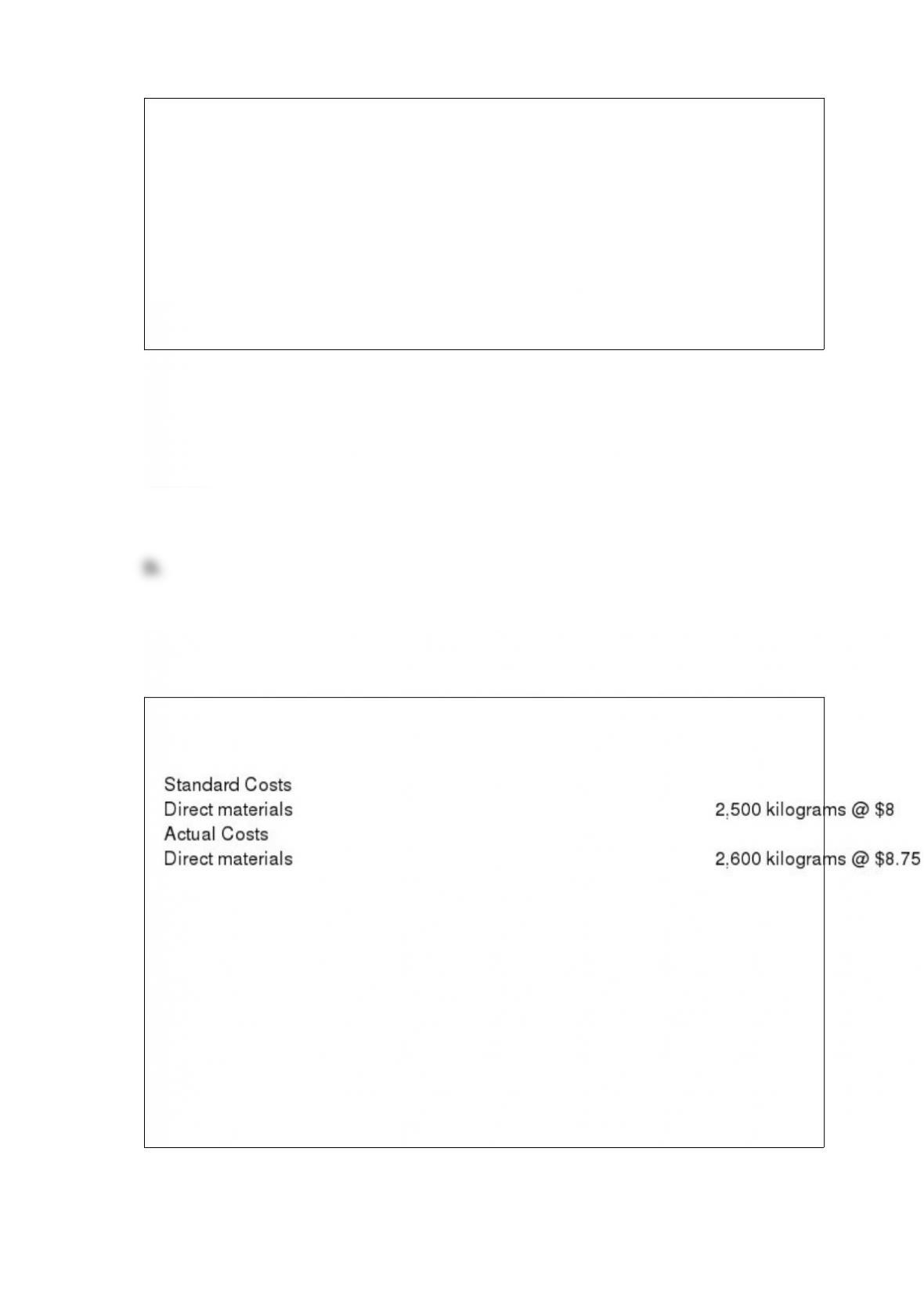
The standard costs and actual costs for direct materials for the manufacture of 2,500
actual units of product are as follows:
The amount of the direct materials quantity variance is:
A.$875 favorable
B.$800 unfavorable
C.$800 favorable
D.$875 unfavorable

Answer:
Every controlling account must have its own
A.revenue ledger
B.general ledger
C.subsidiary ledger
D.journal
Answer:
Franco and Elisa share income equally. During the current year the partnership net
income was $40,000. Franco made withdrawals of $12,000 and Elisa made withdrawals
of $17,000. At the beginning of the year, the capital account balances were: Franco
capital, $42,000; Elisa capital, $58,000. Elisa’s capital account balance at the end of the
year is
A.$81,000
B.$50,000
C.$61,000
D.$95,000
Answer:
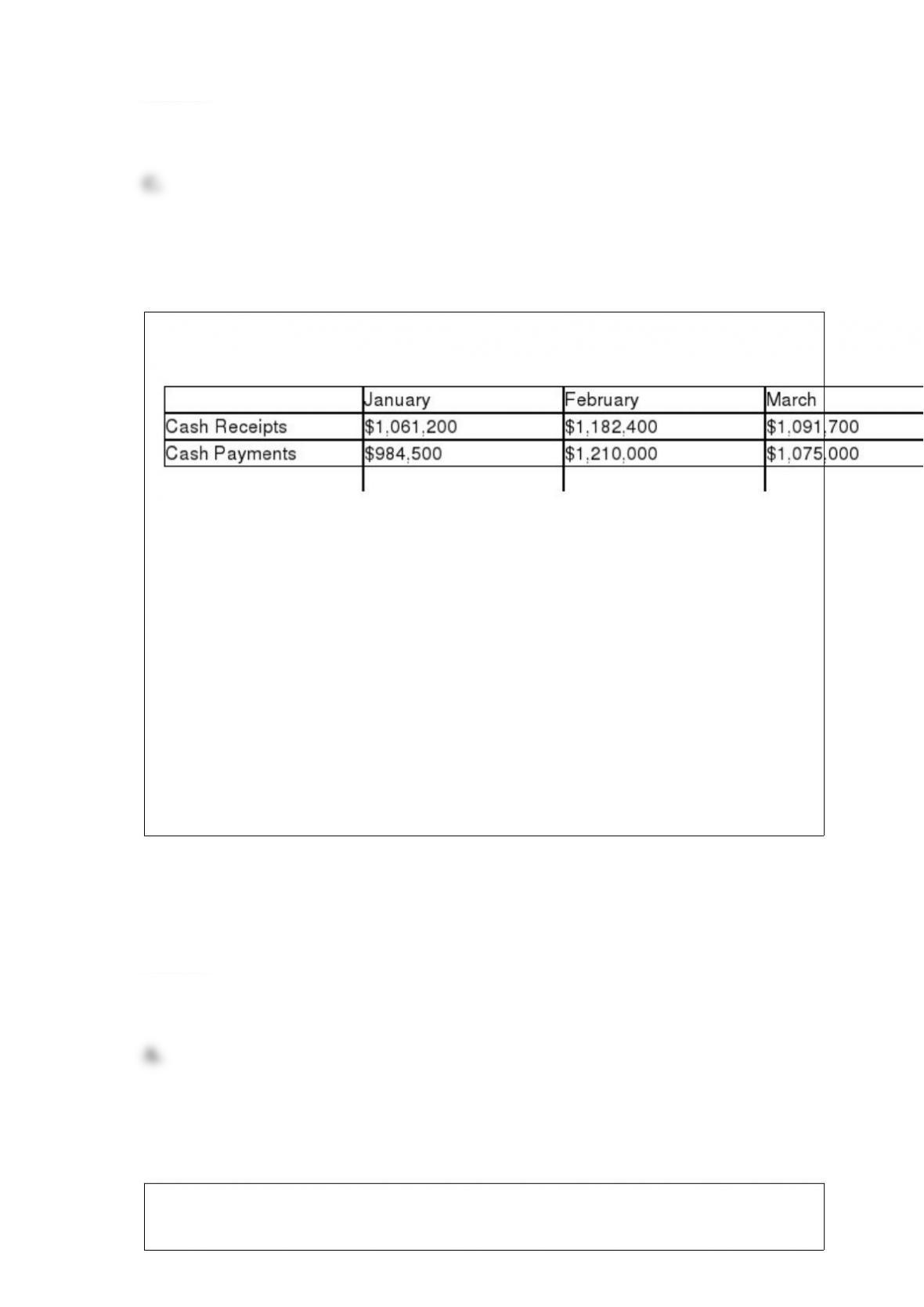
A company is preparing its their Cash Budget. The following data has been provided for
cash receipts and payments.
The company’s cash balance at January 1st is $290,000. This company desires a
minimum cash balance of $340,000.
What is the amount of excess cash or deficiency of cash (after considering the
minimum cash balance required) for January?
A.$26,700 excess
B.$136,700 deficiency
C.$356,700 excess
D.$60,000 excess
Answer:
Which of the following measures a company’s ability to pay its current liabilities?

A.earnings per share
B.inventory turnover
C.current ratio
D.number of times interest charges earned
Answer:
Ruben Company purchased $100,000 of Evans Company bonds at 100 plus $1,500 in
accrued interest. The bond interest rate is 8% and interest is paid semi-annually. The
journal entry to record the purchase would be:
A.Debit: Investment in Bonds $101,500; Credit: Cash $101,500
B.Debit: Investment in Bonds $100,000; Credit: Interest Revenue $1,500 and Cash
$98,500
C.Debit: Investment in Bonds $100,000 and Interest Receivable $1,500; Credit: Cash
$101,500
D.Investment in Bonds $100,000; Credit: Cash $100,000
Answer:

Costs other than direct materials cost and direct labor cost incurred in the
manufacturing process are classified as:
A.factory overhead cost
B.miscellaneous expense
C.product costs
D.period cost
Answer:
On the statement of cash flows, the cash flows from financing activities section would
include all of the following except
A.receipts from the sale of bonds payable
B.payments for dividends
C.payments for purchase of treasury stock
D.payments of interest on bonds payable
Answer:

When preparing the cash budget, all the following should be considered except:
A.Cash receipts from customers.
B.Depreciation expense.
C.Cash payments to suppliers.
D.Cash payments for equipment.
Answer:
Which of the following items that appeared on the bank reconciliation did not require
an adjusting entry?
A.bank service charges
B.deposits in transit
C.NSF checks
D.A check for $630, recorded in the check register for $360.
Answer:
Which of the following would appear as a prior-period adjustment?
A.loss resulting from the sale of fixed assets
B.difference between the actual and estimated uncollectible accounts receivable
C.error in the computation of depreciation expense in the preceding year
D.loss from the restructuring of assets
Answer:
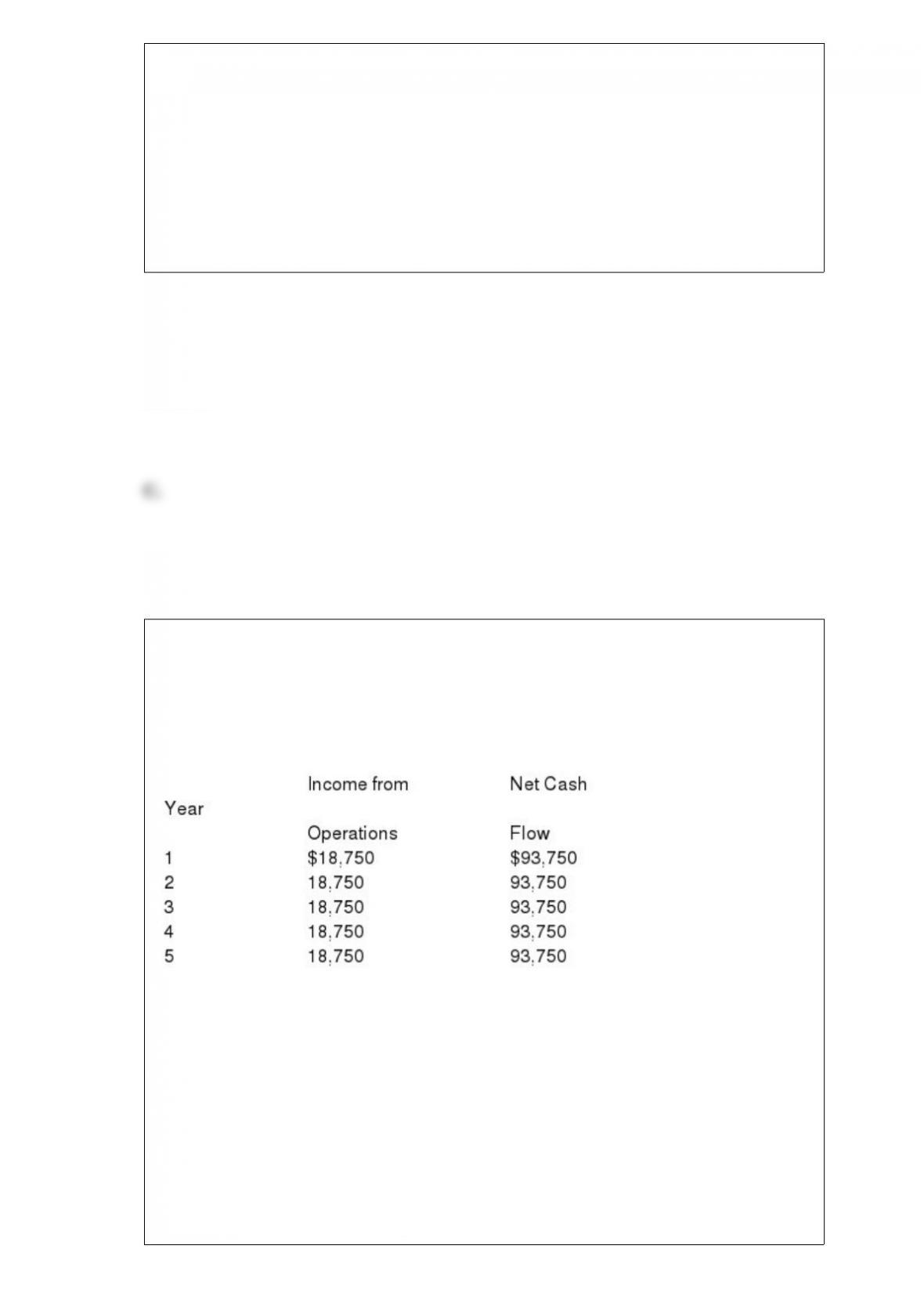
The management of Wyoming Corporation is considering the purchase of a new
machine costing $375,000. The company’s desired rate of return is 6%. The present
value factor for an annuity of $1 at interest of 6% for 5 years is 4.212. In addition to the
foregoing information, use the following data in determining the acceptability in this
situation:
The present value index for this investment is:
A.1.00
B..95
C.1.25
D.1.05

Answer:
For January, sales revenue is $700,000; sales commissions are 5% of sales; the sales
manager’s salary is $96,000; advertising expenses are $90,000; shipping expenses total
2% of sales; and miscellaneous selling expenses are $2,100 plus 1/2 of 1% of sales.
Total selling expenses for the month of January are:
A.$157,100
B.$240,600
C.$183,750
D.$182,100
Answer:
Amir Designs purchased a one-year liability insurance policy on March 1st of this year
for $7,200 and recorded it as a prepaid expense. Which of the following amounts would
be recorded for insurance expense during the adjusting process at the end of Amir’s first
month of operations on March 31st?
A.$7,200
B.$720

C.$600
D.$6,600
Answer:
What additional information is needed to find the rate of return on investment if income
from operations is known?
A.Invested assets
B.Residual income
C.Direct expenses
D.Sales
Answer:
Below is a table for the present value of $1 at compound interest.
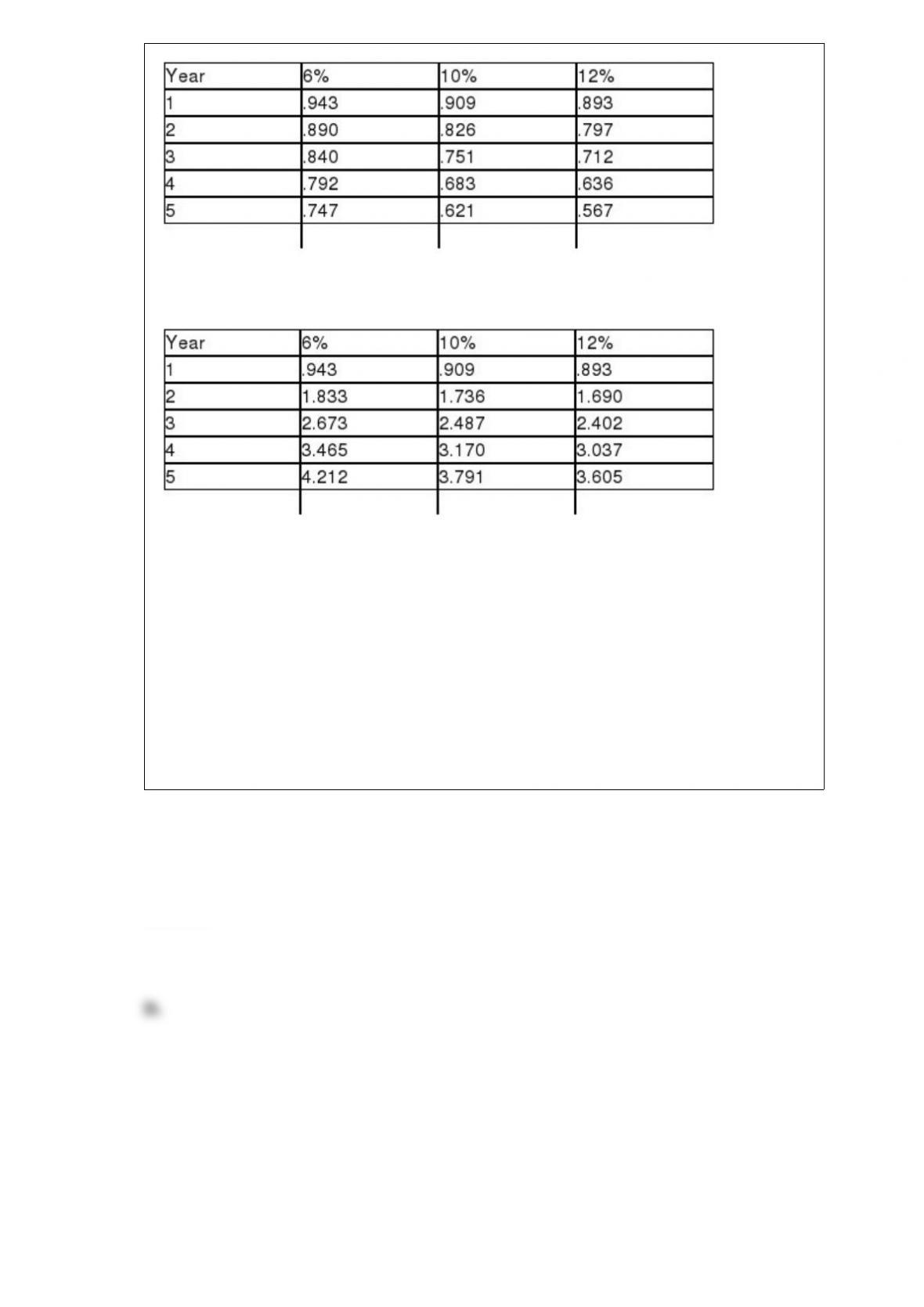
Below is a table for the present value of an annuity of $1 at compound interest.
Using the tables above, what would be the present value of $8,000 (rounded to the
nearest dollar) to be received one year from today, assuming an earnings rate of 12%?
A.$7,544
B.$7,120
C.$7,272
D.$7,144
Answer: