As the total volume of activity changes:
A. the total of variable costs changes.
B. the total of fixed costs changes.
C. variable costs per unit change.
D. fixed costs per unit stay the same.
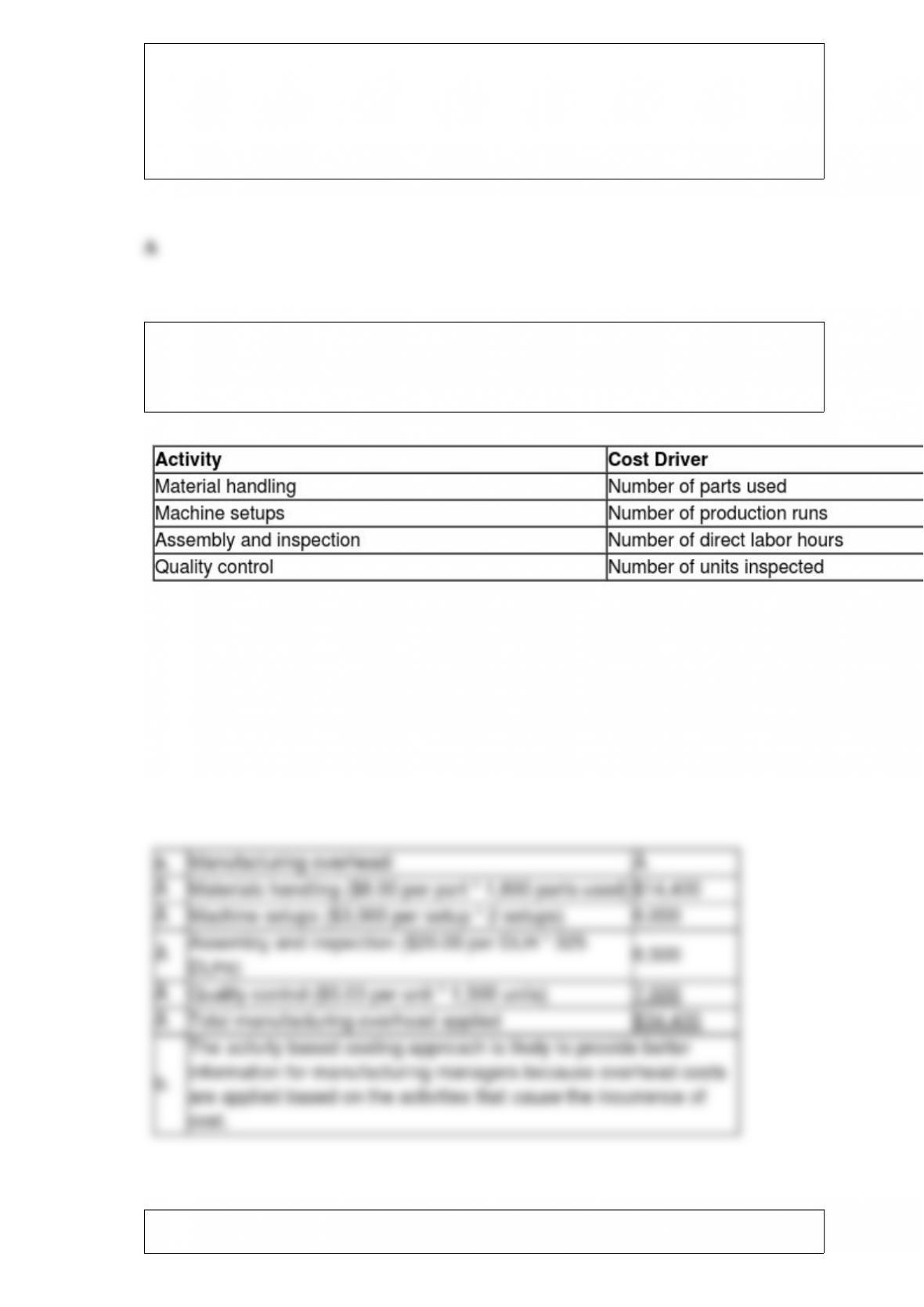
Envision Company uses activity-based costing (ABC) for allocating manufacturing
overhead costs to jobs and it has established the following cost drivers and rates:
During July, Job #2005 produced 1,500 units and required the following activity: 1,800
parts, 2 production runs, and 325 direct labor hours.
(a.) Calculate the amount of manufacturing overhead applied to Job #2005.
(b.) Explain the advantage of using the ABC approach.
In comparison to the stockholders’ equity section of a corporation’s balance sheet,

owners’ equity of a proprietorship or partnership:
A. normally does not make a distinction between invested capital and retained earnings.
B. normally uses “Capital” accounts for each individual owner, rather than a “Retained
Earnings” account for all of the stockholders.
C. normally uses a “Drawings” account for each individual owner, rather than a
“Dividends” account for all of the stockholders.
D. all of the above.
When a depreciable asset is sold:
A. a gain arises if the sales proceeds exceed the net book value.
B. a loss arises if the sales proceeds exceed the net book value.
C. any cash received results in a gain.
D. depreciation expense is adjusted so there is no gain or loss.
On July 1, 2016, $8 million face amount of 6%, 10-year bonds were issued. The bonds
pay interest on an annual basis on June 30 each year. The market interest rates were
slightly lower than 6% when the bonds were sold.
Required:
(a.) How much interest will be paid annually on these bonds?
(b.) Were the bonds issued at a premium or discount? Explain.
(c.) Will the annual interest expense on these bonds be more than, equal to, or less than
the amount of interest paid each year? Explain your answer.
(a.) Annual interest payment = $8 million * 6% = $480,000
(b.) The bonds were issued at a premium because market interest rates were less than
the stated rate when the bonds were issued. The lower the discount rate (i.e., the market
interest rate), the higher the present value of cash flows for interest payments and
principal (i.e., the higher the bond’s selling price).
The balance of the Estimated Warranty Liability account was $12,000 on January 1,
2016, and $13,600 on December 31, 2016. Based on an analysis of warranty claims
during the past several years, this year’s warranty provision was established at 3% of
sales, and sales during the year were $800,000.
Required:
(a.) What amount of warranty expense will appear on the income statement for the year
ended December 31, 2016?
(b.) What were the actual costs of servicing products under warranty during the year?
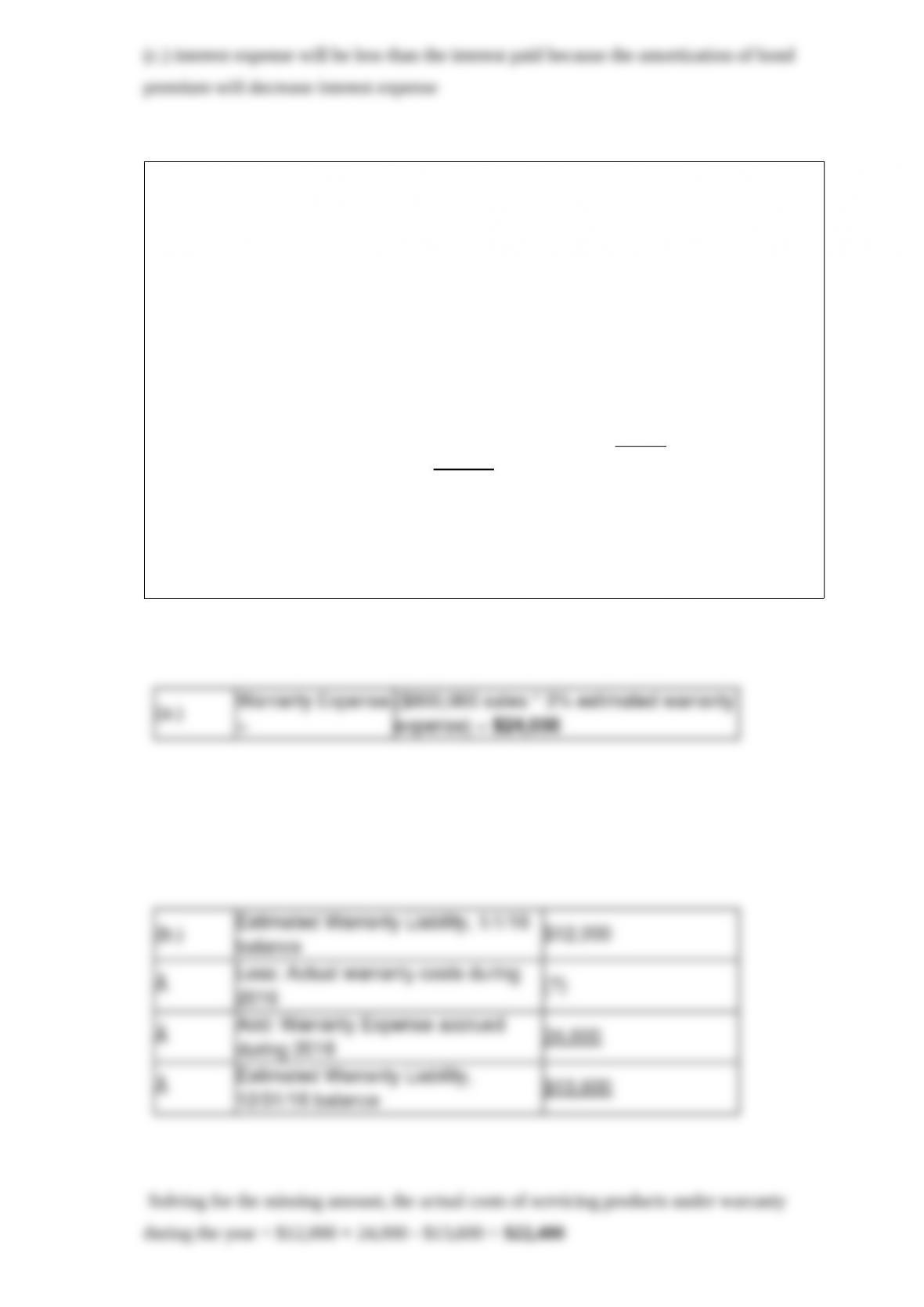
(a.) Warranty Expense = ($800,000 sales * 3% estimated warranty expense) = $24,000
(b.) Estimated Warranty Liability, 1/1/16 balance $12,000 Less: Actual warranty costs
during 2016 (?) Add: Warranty Expense accrued during 2016 24,000 Estimated
Warranty Liability, 12/31/16 balance $13,600
Solving for the missing amount, the actual costs of servicing products under warranty
during the year = $12,000 + 24,000 – $13,600 = $22,400
(a.) Warranty Expense = ($800,000 sales * 3% estimated warranty expense) = $24,000
(b.) Estimated Warranty Liability, 1/1/16 balance $12,000
Less: Actual warranty costs during 2016 (?
Sometimes when management decisions are reached, the investment project with the
highest NPV or IRR is not selected. This occurs because:
A. a lower IRR is a less risky investment.
B. the highest NPV is not necessarily the highest IRR.
C. qualitative factors override quantitative analysis techniques.
D. sometimes management makes the wrong decision.
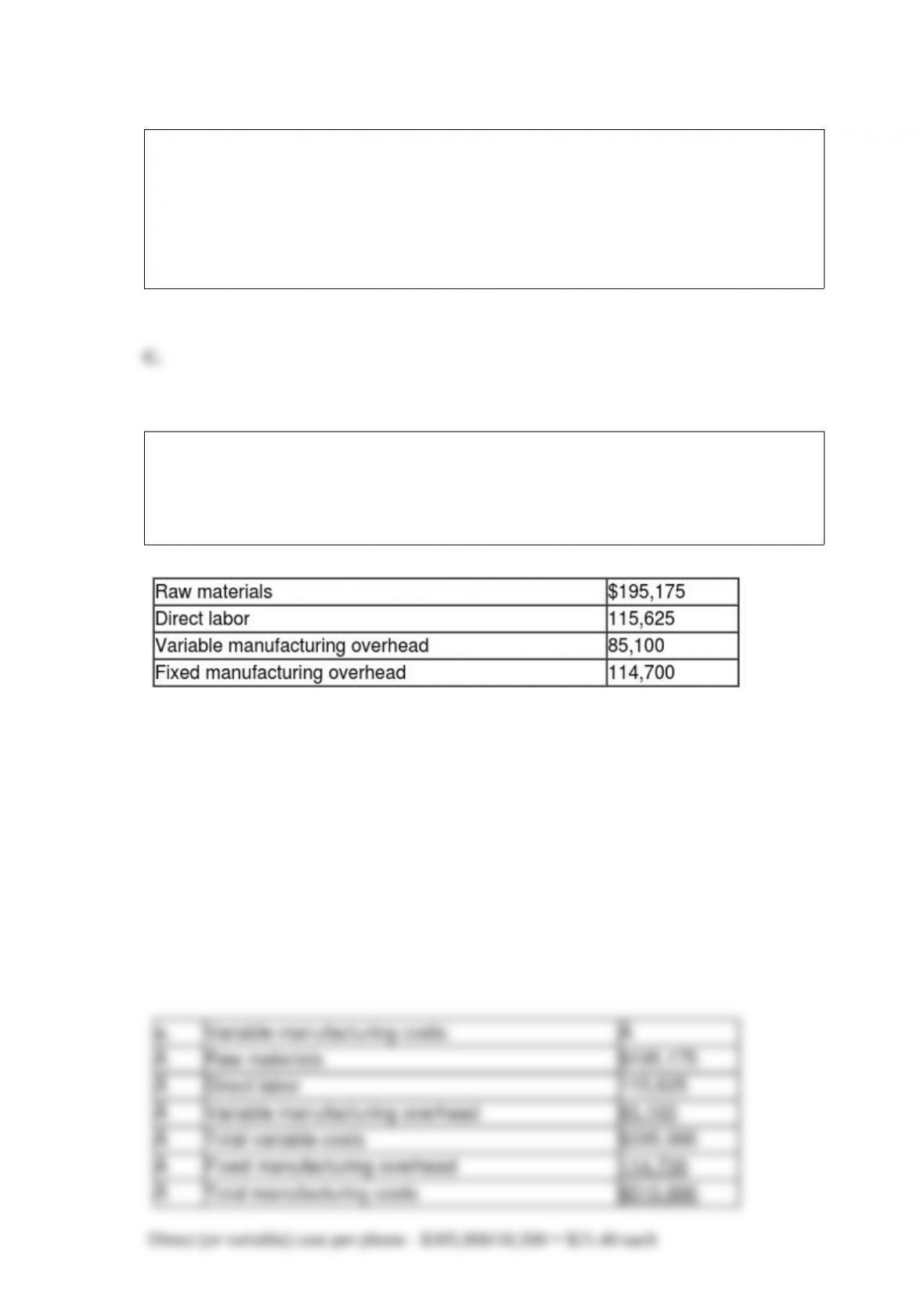
Great Bay Co. manufactures cordless telephones. During 2016, total costs associated
with manufacturing 18,500 of the AB-2000 model (introduced this year) were as
follows:
(a.) Calculate the cost per phone under both direct (or variable) costing and absorption
costing.
(b.) If 2,800 of these phones were in finished goods inventory at the end of 2016, by how
much and in what direction (higher or lower) would 2016 operating income be different
under direct (or variable) costing than under absorption costing?
(c.) Express the phone cost in a cost formula. What does this formula suggest the total cost
of making an additional 1,600 phones would be?
Interest on a Note Payable is most appropriately accrued:
A. when the note is signed.
B. as of the end of each accounting period during which the note is a liability.
C. when principal payments on the note are made.
D. when the interest is paid.
Which of the following activities is not included in the organization’s value chain?
A. marketing.
B. finance.
C. customer service.
D. research and development.
Return on equity:
A. will be the same as return on investment.
B. relates dividends and turnover.
C. relates dividends and stockholders’ equity.
D. relates net income and stockholders’ equity.

A management that wanted to increase the financial leverage of its firm would:
A. raise additional capital by selling common stock.
B. use excess cash to purchase preferred stock for the treasury.
C. raise additional capital by selling fixed interest rate long-term bonds.
D. try to increase its ROI by increasing asset turnover.
Once the standard cost for a unit of product is determined:
A. standards may remain unchanged for many years.
B. standards may be reviewed and revised on an annual basis.
C. standards may be reviewed and revised every 2-3 years.
D. all of the above.
In an inflationary economic environment, the selling price set for a firm’s products will:
A. not be affected by the cost flow assumption used.
B. be higher if LIFO is used than if FIFO is used.
C. be higher if FIFO is used than if LIFO is used.
D. be derived from the weighted average cost of inventory.
Which of the following is(are) true regarding cost flow assumptions?
A. Manufacturing firms are required to use FIFO.
B. Service firms are required to use LIFO.
C. If a firm uses FIFO for tax purposes, then FIFO must be used for financial reporting
purposes.
D. If a firm uses LIFO for tax purposes, then LIFO must be used for financial reporting
purposes.
E. All of the above.

In considering whether to accept a special order at a price less than the normal selling
price of the product and where the additional sales will make use of present idle
capacity, which of the following costs will not be relevant?
A. direct labor.
B. direct materials.
C. variable manufacturing overhead.
D. fixed manufacturing overhead that cannot be avoided.
What percentage of the contribution margin is profit on units sold in excess of the
break-even point?
A. It’s 50% to the contribution margin ratio.
B. It’s equal to the variable cost ratio.
C. It’s equal of the gross profit ratio.
D. It’s 100%.
If the net variance of a business using standard costing is significant relevant to total
production cost, the net variance should be:
A. assigned to cost of goods sold.
B. allocated between WIP and FG inventories and cost of goods sold.
C. carried forward to the next accounting period.
D. none of the above.
Which of the following accounting methods accomplishes much of the matching of
revenues and expenses?
A. Match accounting.
B. Cash accounting.
C. Accrual accounting.
D. Full disclosure accounting.

A credit entry will:
A. increase an asset account.
B. increase a liability account.
C. decrease paid-in capital.
D. increase an expense account.
When analyzing end of period production cost variances, which of the following
product cost components will not need “flexing”?
A. direct material.
B. direct labor.
C. variable manufacturing overhead.
D. fixed manufacturing overhead.
Cost accounting is a subset of which of the following?
A. Internal auditing.
B. Public auditing.
C. Cost analysis.
D. Managerial accounting.
Asset turnover calculations:
A. are made by dividing the average asset balance during the year by the sales for the
year.
B. are made by dividing sales for the year by the asset balance at the end of the year.
C. communicate information about how promptly the entity pays its bills.
D. should be evaluated by observing the turnover trend over a period of time.

The reason for recording a prepaid expense as a current asset is:
A. that the prepaid item will be returned for a cash refund.
B. that the prepaid item has not yet become an expense.
C. that the expense has been incurred but not yet paid.
D. to avoid recognizing an expense so net income will be higher for the current
accounting period.
An organization’s system of internal control is designed primarily to:
A. ensure that no employees steal the organization’s property.
B. increase efficiency by letting one employee handle all aspects of a transaction from
beginning to end.
C. ensure that the organization’s balance sheet will always balance.
D. provide an operating framework for all employees as they work to achieve the
organization’s goals.
When comparing entity financial ratios with industry ratios:
A. it should be assumed that the data result from the consistent application of
alternative accounting methods.
B. relative values at a point in time may not be significant.
C. the trend of entity ratios should be compared to the current year’s industry ratio.
D. entity ratios should not be compared with industry ratios.
In the T-account cost flow diagram of balance sheet inventory accounts and the income
statement cost of goods sold account:
A. raw materials purchases are debited to work in process.
B. direct labor costs are credited to work in process.
C. cost of goods manufactured is debited to finished goods inventory.
D. cost of goods sold is debited to finished goods inventory.

Which of the following items would be reported on the Statement of Cost of Goods
Manufactured?
A. cost of goods sold.
B. beginning finished goods inventory.
C. ending work in process inventory.
D. contribution margin.
Which of the following is not a transaction to be recorded in the accounting records of
an entity?
A. Investment of cash by the owners.
B. Sale of product to customers.
C. Receipt of a plaque recognizing the firm’s encouragement of employee participation
in the United Way fund drive.
D. Receipt of services from a “quick-print” shop in exchange for the promise to provide
advertising design services of equivalent value.
The dividend payout ratio describes:
A. the proportion of earnings paid as dividends.
B. the relationship of dividends per share to market price per share.
C. the percentage change in dividends this year compared to last year.
D. dividends as a percentage of the price/earnings ratio.
A current ratio of 6.0 is usually an indication that the firm:
A. has a low degree of liquidity.
B. has a reasonable degree of liquidity.
C. has not made the most productive use of its assets.
D. has made the most productive use of its assets.

Matching revenues and expenses refers to:
A. having revenues equal expenses.
B. recording revenues when cash is received.
C. accurately reflecting the results of operations for a fiscal period.
D. recording revenues when a product is sold or a service is rendered.
The present value ratio of a proposed investment will be:
A. less than 1.0 if the net present value is positive.
B. negative if the proposed investment meets the cost of capital target.
C. less than 1.0 if the net present value is negative.
D. greater than 1.0 if the cost of capital exceeds the internal rate of return.
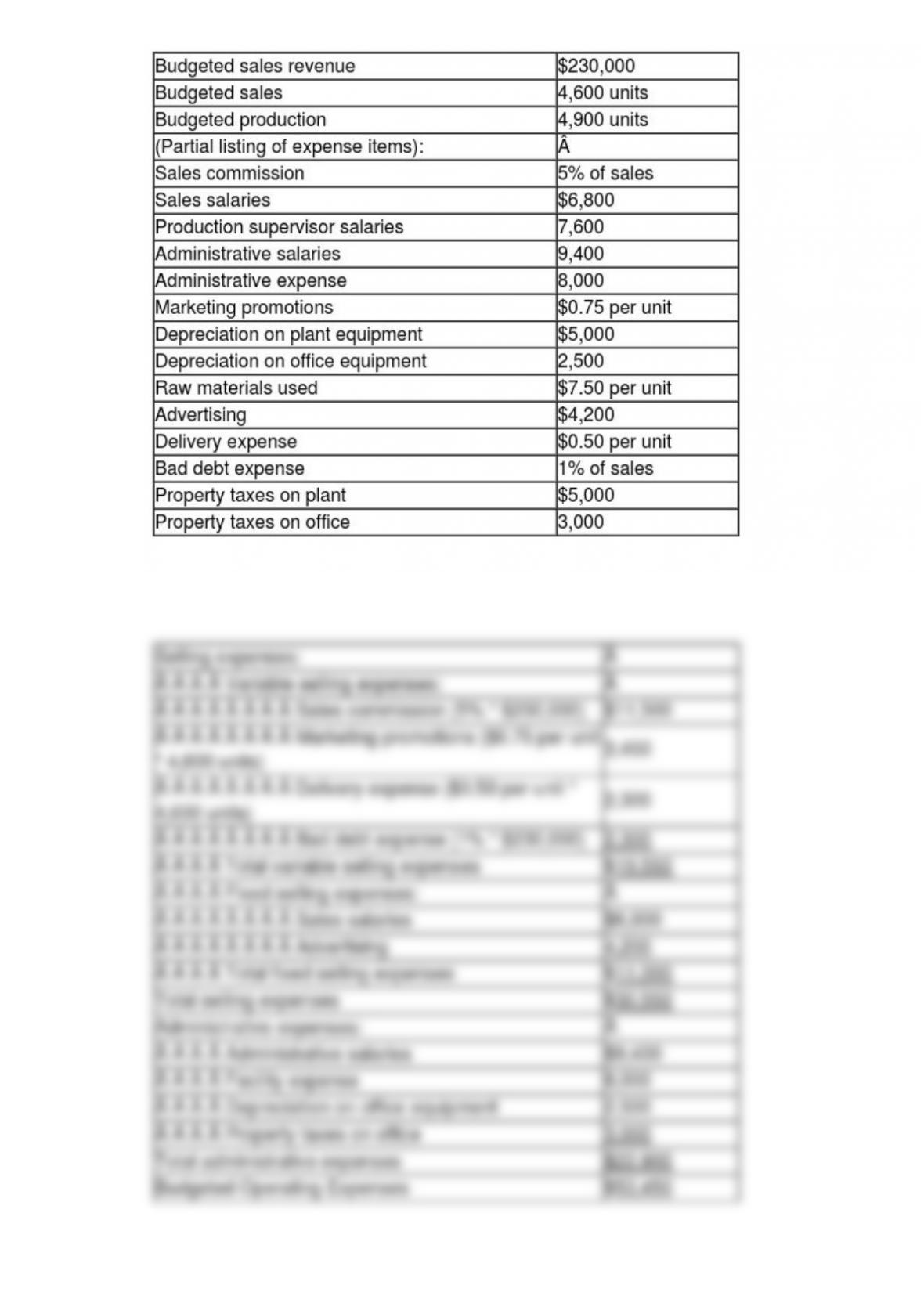
Danzi, Inc., has budgeted sales for the month of July and estimated cost behavior
patterns for a number of its expenses listed below. From this information prepare an
operating expense budget for the month of July.
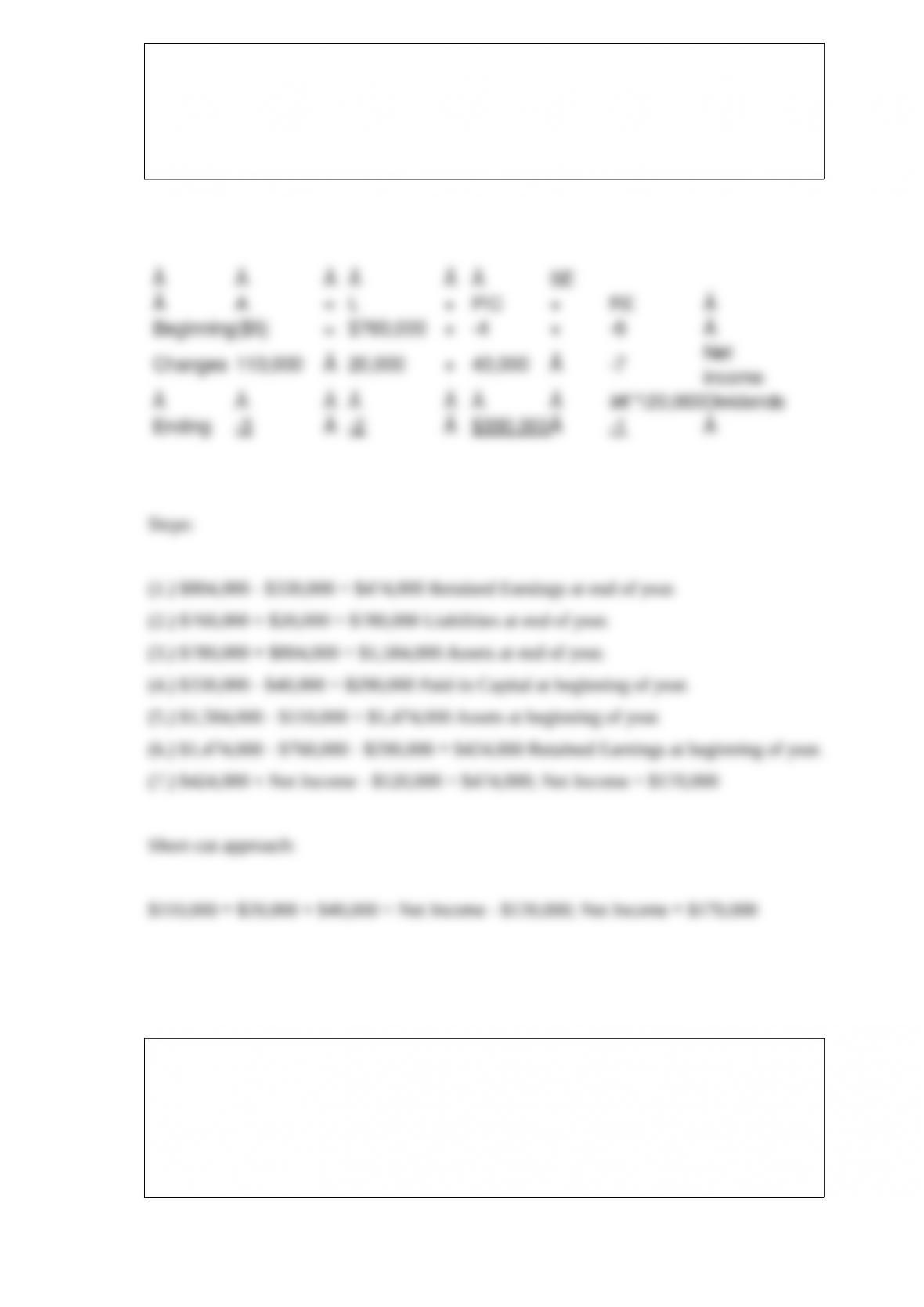
At the beginning of the current fiscal year, the balance sheet of Arches Co.showed
liabilities of $760,000. During the year liabilities increased by $20,000, assets increased
by $110,000, and paid-in capital increased by $40,000 to $330,000. Dividends declared
and paid during the year were $120,000. At the end of the year, stockholders’ equity
totaled $804,000. Calculate net income or loss for the year.
a. If the beginning balance of the Inventory account and the cost of items purchased or
made during the period are correct, but an error resulted in understating the firm’s
ending inventory balance by $12,000, how would the firm’s cost of goods sold be
affected?
b. If management wanted to overstate net income, would ending inventory be
understated or overstated? Explain your answer.
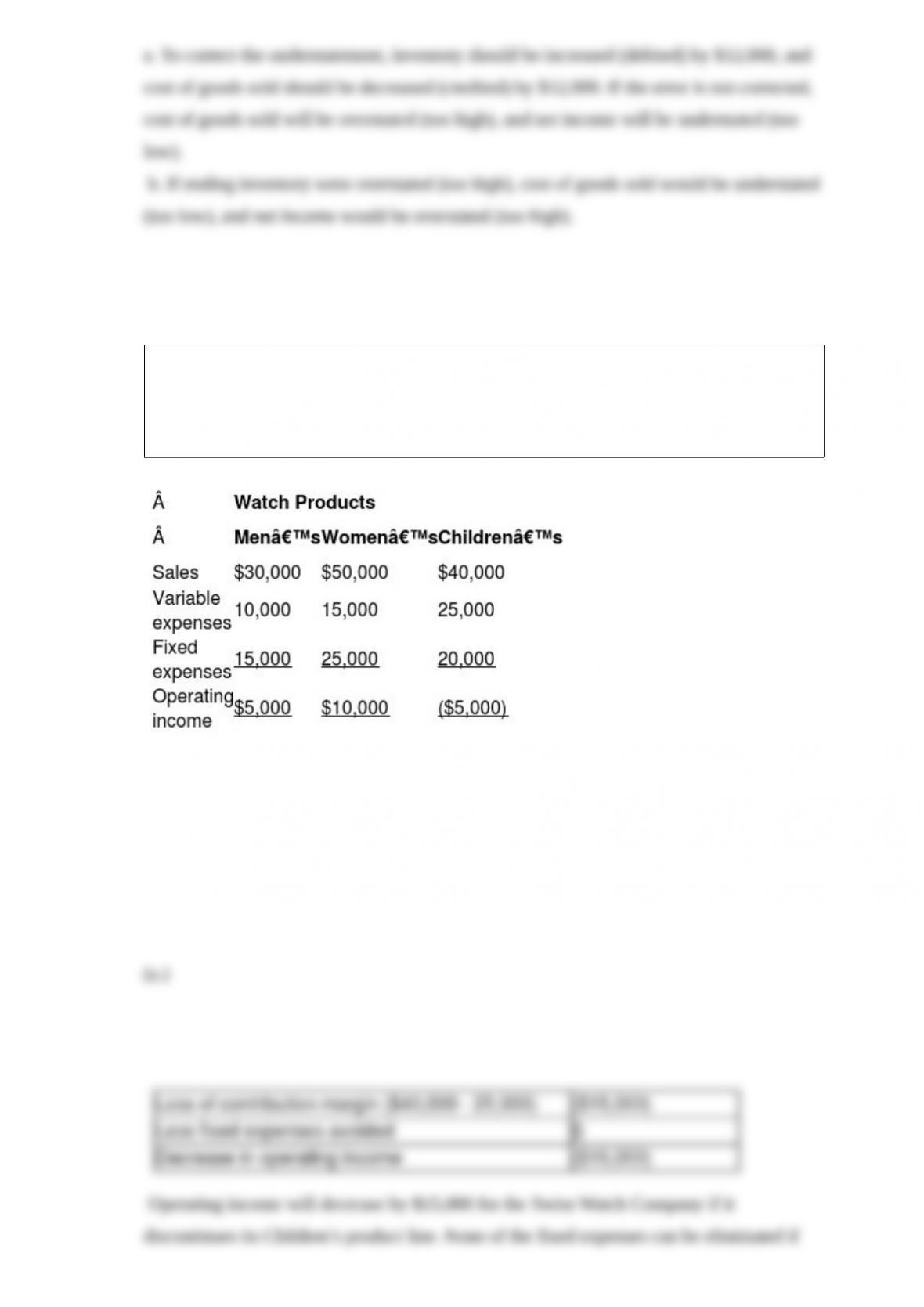
The following product line information is for the Swiss Watch Company. The company
is considering dropping its Children’s product line due to poor operating income
performance. Fixed expenses are allocated to each product line based on sales revenue.
(a.) Calculate the effect on the Swiss Company’s operating income if the Children’s watch
product line is discontinued. Comment on your analysis.
(b.) Assume that Swiss Company discontinues its Children’s product line. Calculate the
total operating income for the Swiss Company.
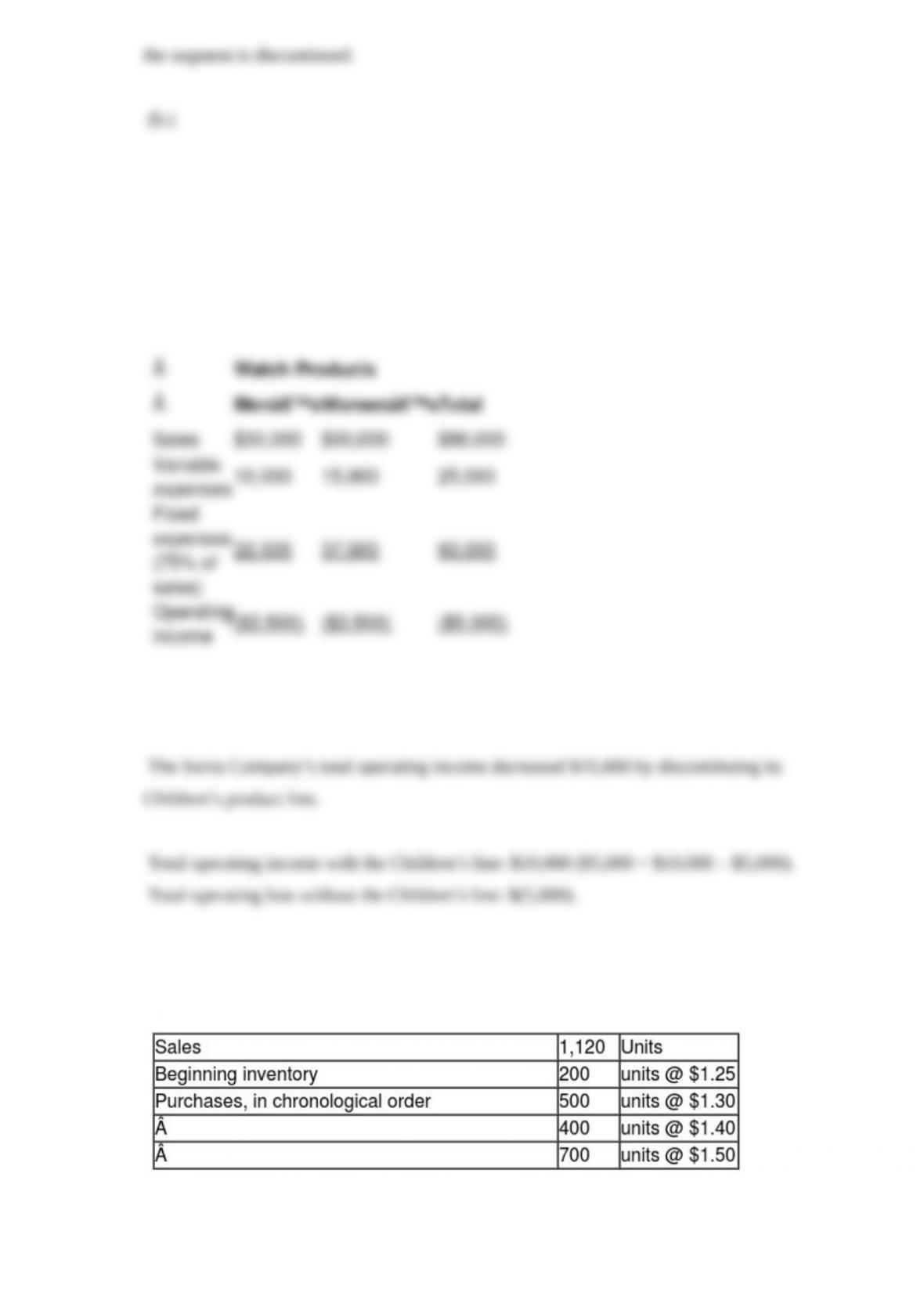
Calculate cost of goods sold and ending inventory under the following cost flow
assumptions:
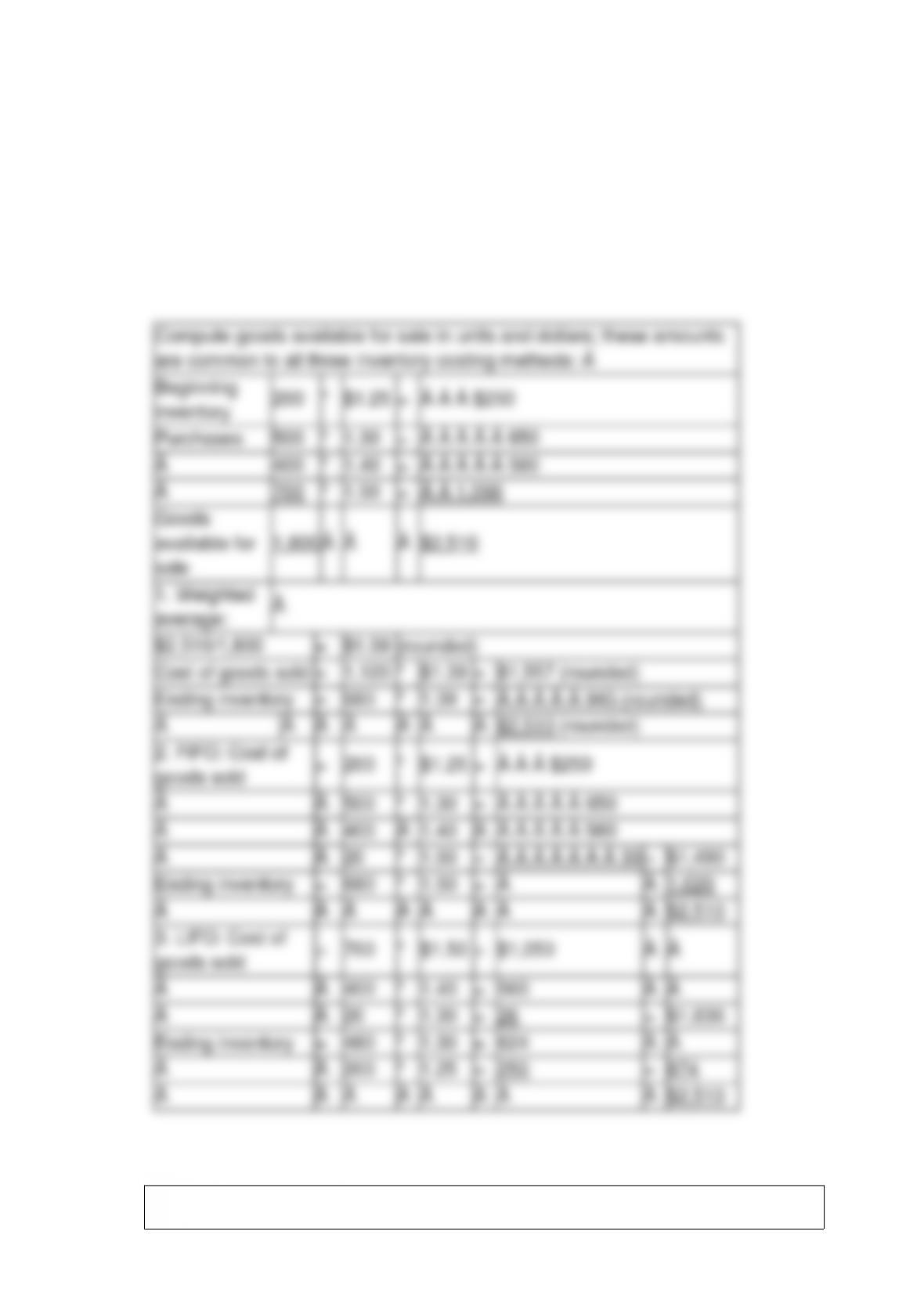
(1.) Weighted average
(2.) FIFO
(3.) LIFO
Firm V has a current ratio of 1.9 and current assets of $136,800.
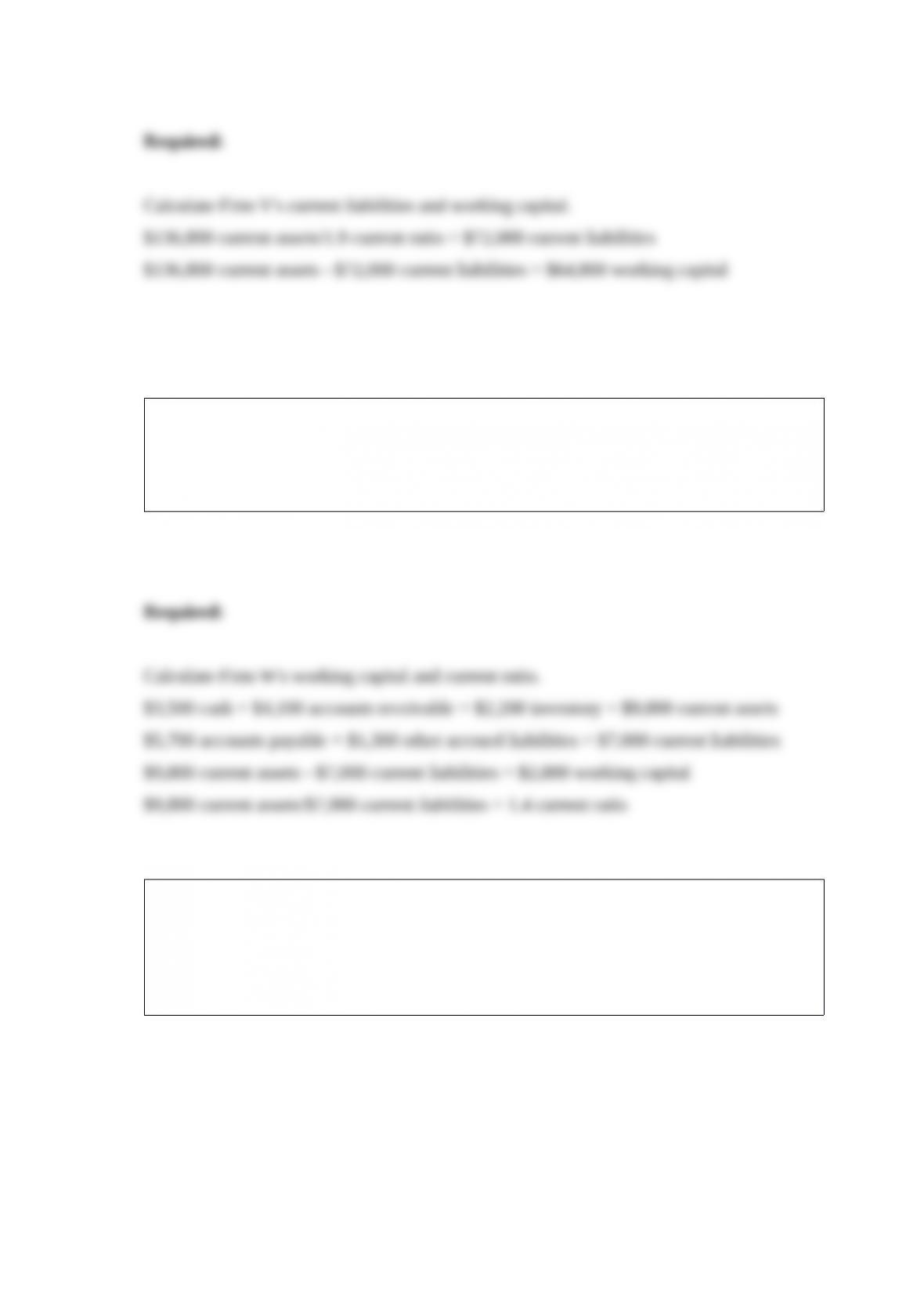
Firm W has accounts receivable of $4,100, cash of $3,500, property, plant, and
equipment of $30,200, merchandise inventory of $2,200, accounts payable of $5,700,
other accrued liabilities of $1,300, common stock of $10,000, and retained earnings of
$23,000.
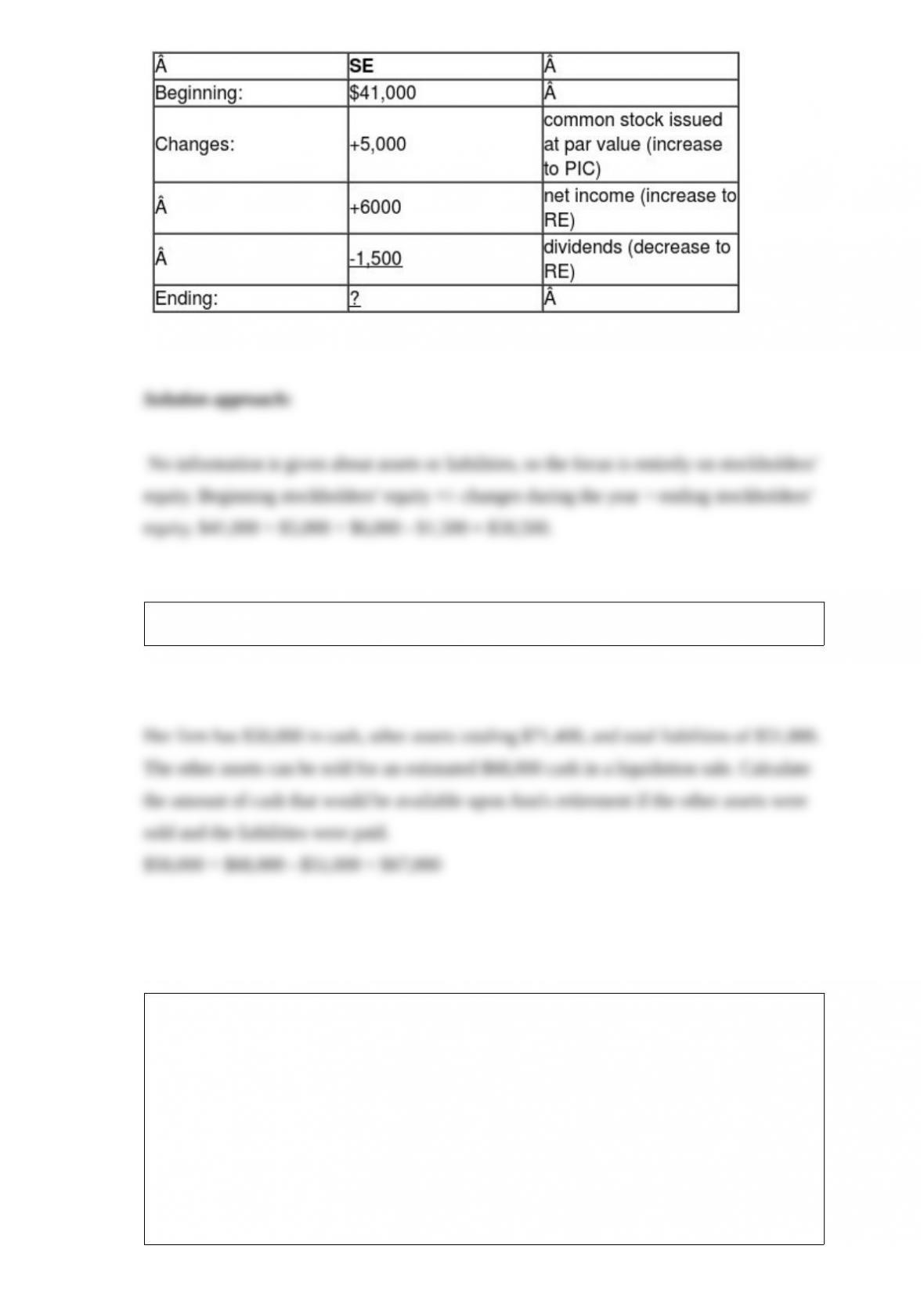
Stockholders’ equity totaled $41,000 at the beginning of the year. During the year, net
income was $6,000, dividends of $1,500 were declared and paid, and $5,000 of
common stock was issued at par value.
Required:
Calculate total stockholders’ equity at the end of the year.
Ann Kimber is thinking about going out of business and retiring.
Using the column headings provided below, show the effect, if any, of the transaction
on each financial statement category by indicating whether it is an addition (+) or
subtraction (-) and by showing the amount in the appropriate column. For the treasury
stock column, show the effects, if any, of the transaction on total stockholders’ equity.
Do not show items that affect net income in the retained earnings column. You should
assume that the transactions occurred in the chronological sequence as indicated.
(1.) Issued 2,400 shares of $60 par value preferred stock in exchange for land and an
existing building that had appraised values of $70,000 and $100,000, respectively.
(2.) Issued 15,000 shares of $10 par value common stock for $24 per share.
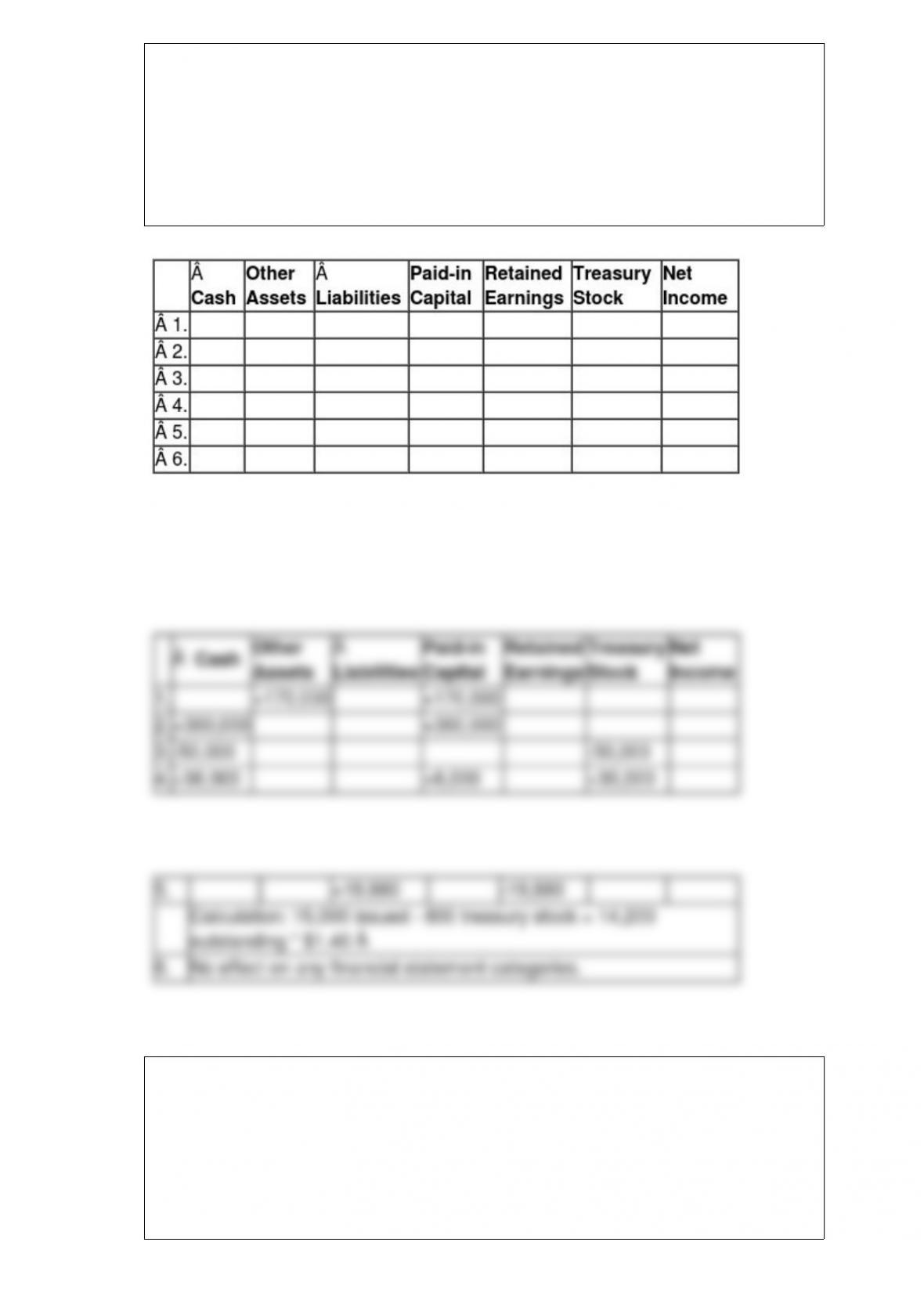
(3.) Purchased 2,000 shares of common stock for the treasury at $25 per share.
(4.) Sold 1,200 shares of the treasury stock purchased in transaction #3 for $30 per
share.
(5.) Declared a cash dividend of $1.40 per share on the common stock outstanding, to
be paid early next year.
(6.) Split the common stock 2-for-1.
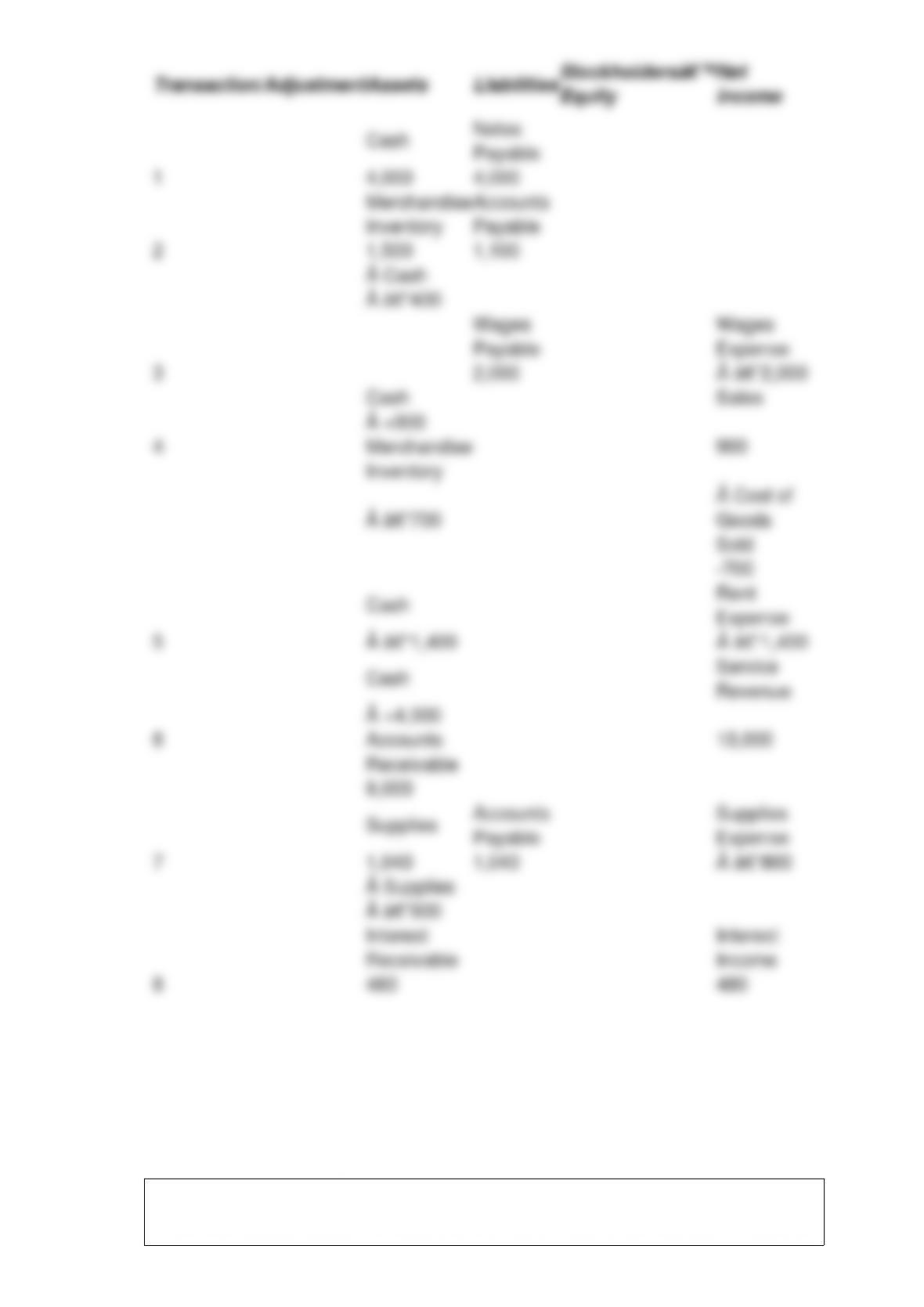
Using the column headings provided below, show the effect, if any, of the transaction
entry or adjusting entry on the appropriate balance sheet category or on the income
statement by entering the account name, amount, and indicating whether it is an
addition (+) or subtraction (-).
Column headings reflect the expanded balance sheet equation; items that affect net
income should not be shown as affecting stockholders’ equity.
(1.) During the month, the board of directors declared a cash dividend of $2,400,
payable next month.
(2.) Employees were paid $3,800 in wages for their work during the first three weeks
of the month.
(3.) Employee wages of $1,200 for the last week of the month have not been recorded.
(4.) Merchandise that cost $1,800 was sold for $2,700. Of this amount, $2,000 was
received in cash and the balance is expected to be received within 30 days.
(5.) A contract was signed with a local radio station for a $200 advertisement; the ad
was aired during this month but will not be paid for until next month.
(6.) Store equipment was purchased at a cash price of $600. The original list price of
the equipment was $800, but a discount was received.
(7.) Received $360 of interest income for the current month.
(8.) Accrued $620 of interest expense at the end of the month.
Marshall, Inc., produces three products but weekly demand for the three products
exceed the available amount of machine time. Following is information about each
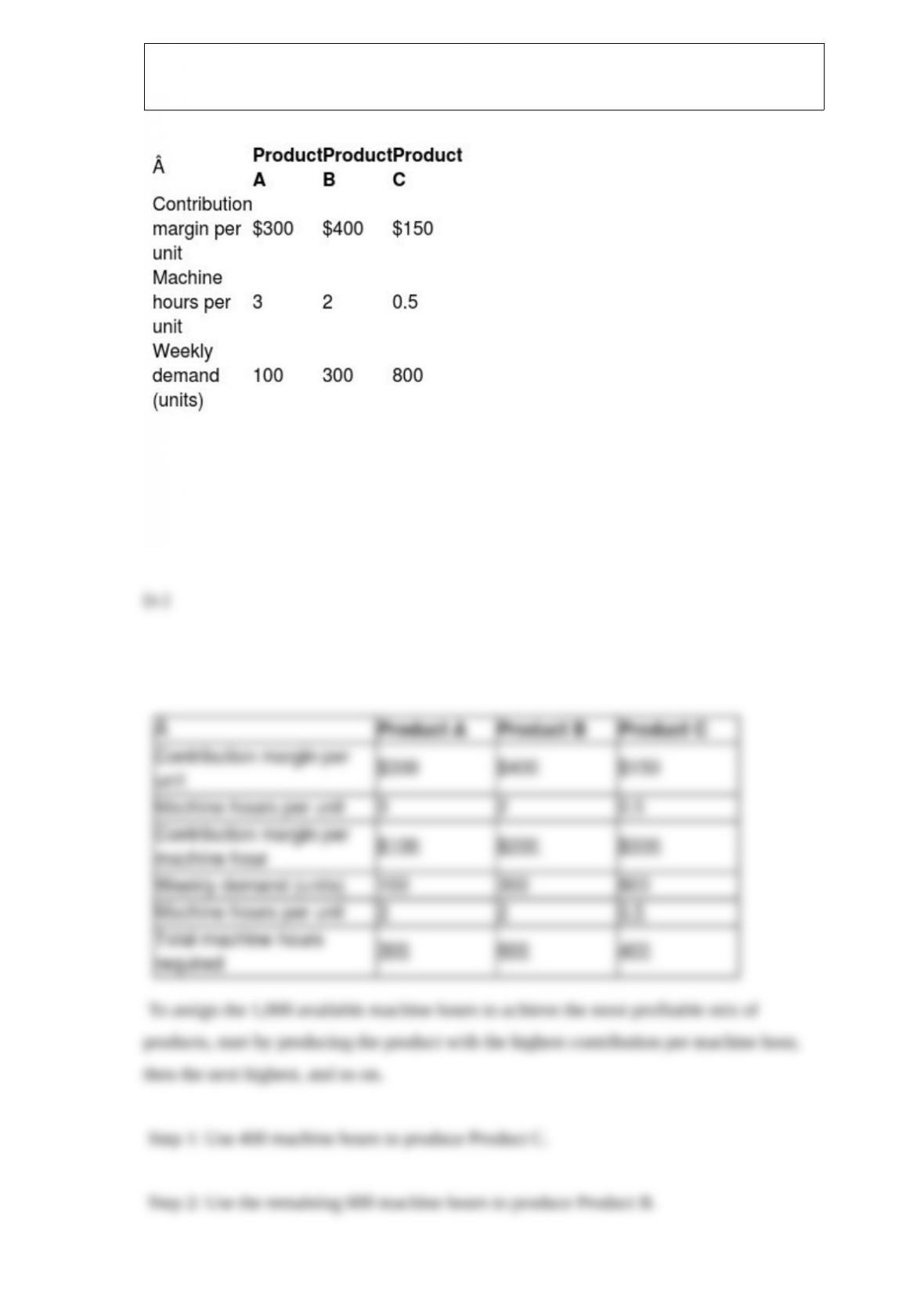
product:
(a.) Determine how many units each of Product A, Product B, and Product C that
Marshall, Inc., should produce each week assuming 1,000 hours of available machine time.
On April 15, 2017, Melissa purchased $60,000 of Verbecke Co.’s 12%, 20-year bonds at
face amount, with interest being paid on December 31 each year. Verbecke Co. has paid
interest due on the bonds regularly. On April 15, 2021, market interest rates had risen to
14% and Melissa is considering selling the bonds.
Required:
Using the present value tables in Chapter 6 of the textbook, calculate the market value
of Melissa’s bonds on April 15, 2021.
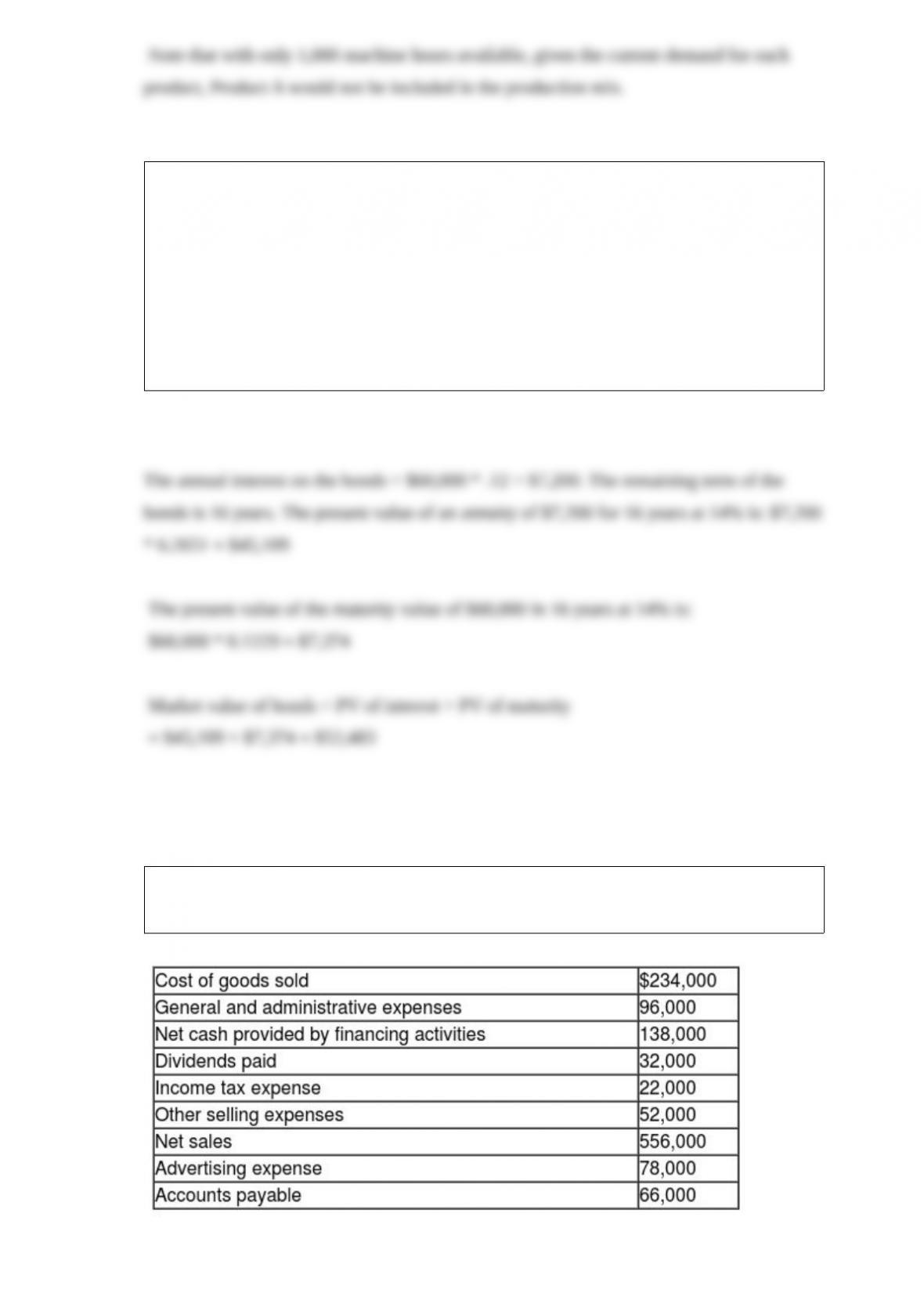
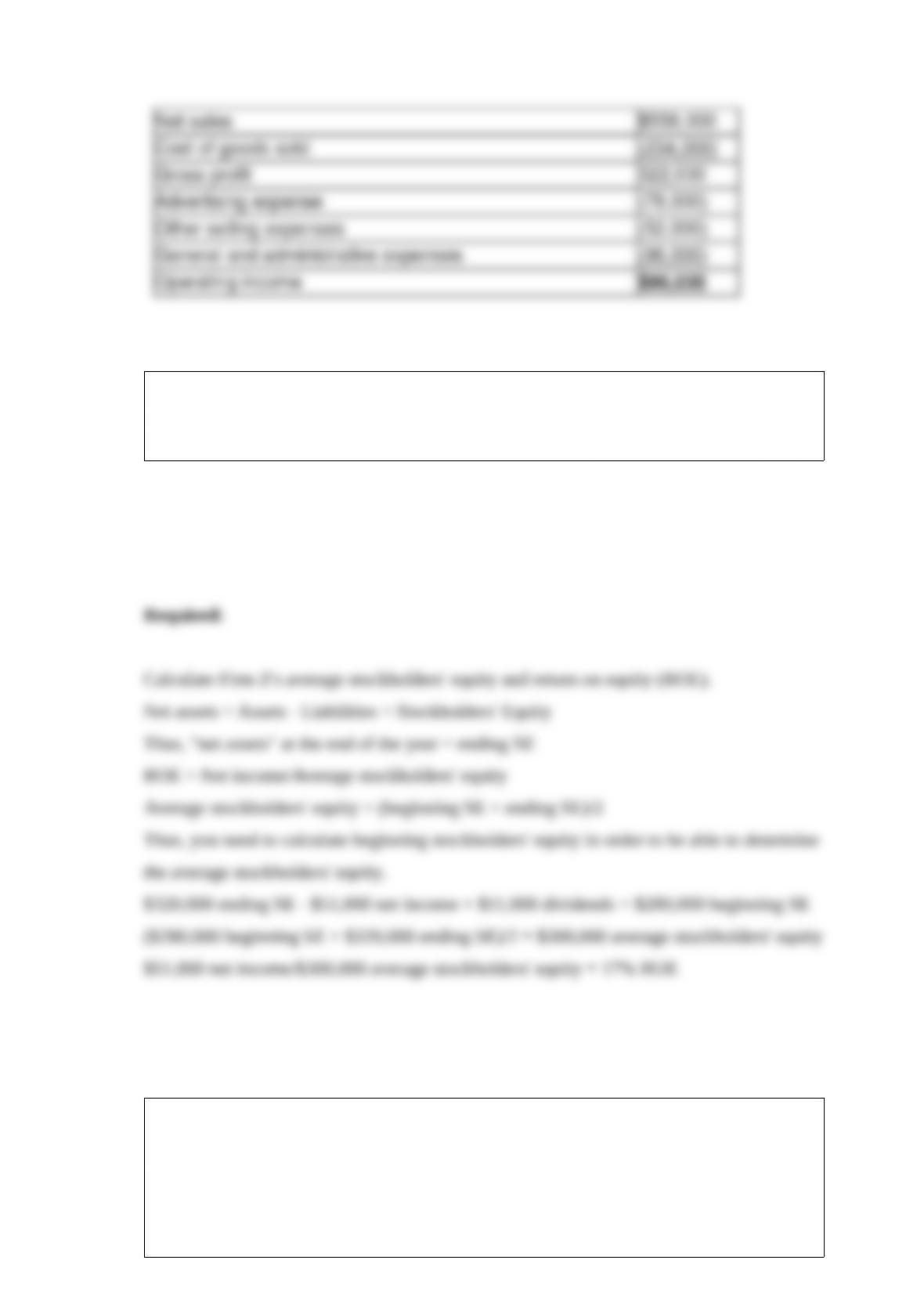
Use the appropriate information from the data provided below to calculate operating
income for the year ended December 31, 2017.
Firm Z had net assets at the end of the year of $320,000.The only transactions affecting
stockholders’ equity during the year were net income of $51,000 and dividends of
$11,000.
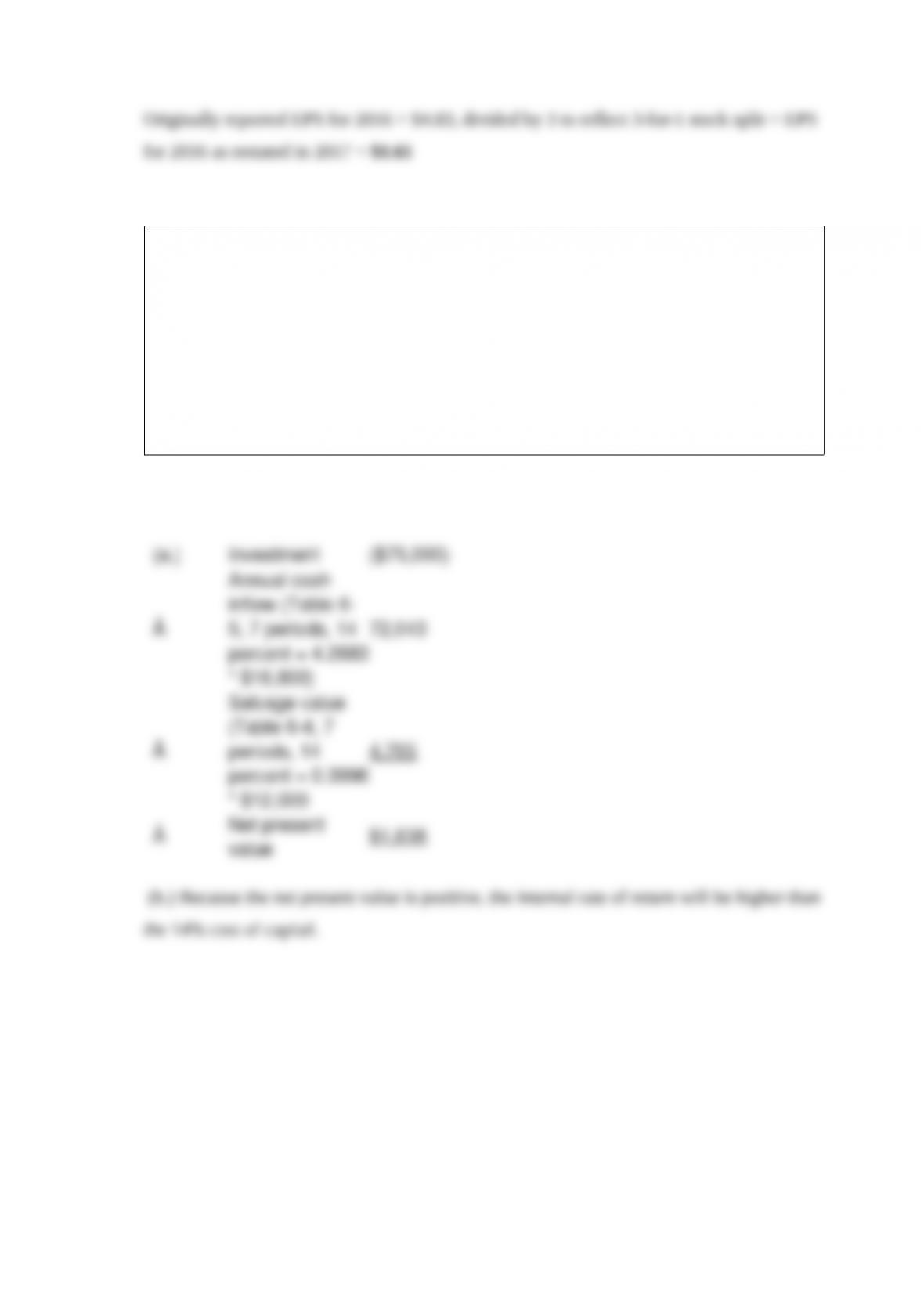
For the year ended December 31, 2016, Flagpole, Inc., reported earnings per share of
$4.83. During 2017, the company had a 3-for-1 stock split.
Required:
Calculate the 2016 earnings per share that will be reported in Flagpole, Inc.’s 2017
annual report for comparative purposes.
Delta, Inc. is considering the investment of $75,000 in a new machine. The machine
will generate cash flow of $16,800 per year for each year of its seven-year life and will
have a salvage value of $12,000 at the end of its life. Delta Inc.’s cost of capital is 14%
percent.
(a.) Calculate the net present value of the proposed investment. Ignore income taxes,
and round all answers to the nearest $1.
(b.) What will the internal rate of return on this investment be relative to the cost of
capital? Explain your answer.