Cost behavior refers to:
A. costs that are both good and bad.
B. costs that increase at a quicker rate than others.
C. costs that decrease at a quicker rate than others.
D. costs that are variable or fixed.
E. none of the above.
Volunteer, Inc. is in the process of liquidating and going out of business. The firm has
$69,820 in cash, inventory totaling $214,000, accounts receivable of $144,000, plant
and equipment with a $384,000 book value, and total liabilities of $614,000. It is
estimated that the inventory can be disposed of in a liquidation sale for 75% of its cost,
all but 15% of the accounts receivable can be collected, and plant and equipment can be
sold for $420,000.
(a.) Calculate the amount of cash that would be available to the stockholders if the
accounts receivable are collected, the other assets are sold as described, and the
liabilities are paid in full.
(b.) Describe how the difference between book value and liquidation value would be
treated on the final income statement for Volunteer, Inc. with respect to the following
assets: inventory, accounts receivable, and plant and equipment. What income statement
accounts would be affected when these assets are sold or collected as described above?
Which of the following inventory accounting systems has been made much more
feasible as a result of computer systems developments?
A. Periodic.
B. Physical.
C. Perpetual.
D. Just-in-time.
Noncurrent, intangible assets such as leasehold improvements, patents, and copyrights
are all subject to:
A. depreciation.
B. amortization.
C. depletion.
D. consolidation.
A firm’s independent auditors have the responsibility to:
A. assess the firm’s accounting policies.
B. ascertain the firm’s profit potential.
C. uncover all fraudulent activities.
D. assess management’s discussion and analysis.
Prepaid expenses classified as current assets represent:
A. current year expenses that have been accrued.
B. current year cash payments that will be matched against revenues of the next year or
for several future years.
C. cash that has been segregated to pay for future expenses.
D. expenses of the current year that have been paid in advance.
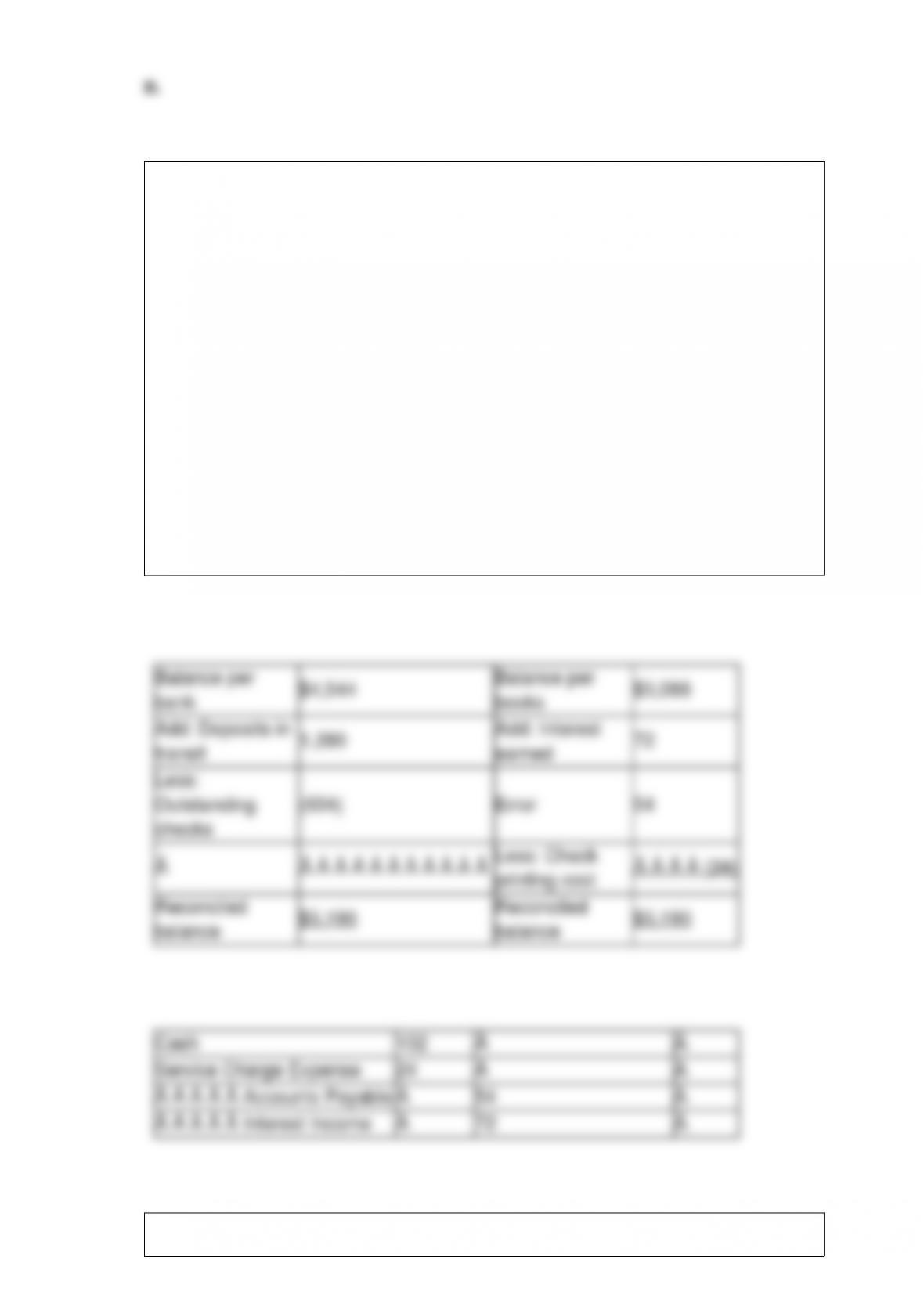
Prepare a bank reconciliation for Grace, Inc., as of January 31, from the following
information:
a.) The January 31 cash balance in the general ledger is $5,088.
(b.) The January 31 balance shown on the bank statement is $4,544.
(c.) Checks issued but not returned with the bank statement were No. 435 for $452 and
No. 448 for $182.
(d.) A deposit made on January 31 for $1,280 was included in the general ledger
balance but not in the bank statement balance.
(e.) Interest credited to the account during January but not recorded on the company’s
books amounted to $72.
(f.) A bank charge of $24 for printing new checks was made to the account during
January. Although the company was expecting a charge, the amount was not Known
until the bank statement arrived.
(g.) In the process of reviewing canceled checks, it was determined that a check issued
to a supplier in payment of an account payable of $139 was recorded as a $193 cash
disbursement.
Lessee, Inc., acquired the use of a machine by agreeing to pay the manufacturer of the
machine $20,000 per year for 5 years. At the time the lease was signed, the interest rate
for a 5-year loan was 8%.
Required:
(a.) Use the appropriate factor from Table 6-5 to calculate the amount that Lessee, Inc.
could have paid at the beginning of the lease to buy the machine outright.
(b.) What causes the difference between the amount you calculated in part (a.) and the
total of $100,000 ($20,000 per year for 5 years) that Lessee, Inc. will pay under the
terms of the lease?
(c.) What is the appropriate amount of cost to be reported in Lessee, Inc’s balance sheet
(at the time the lease was signed) with respect to this asset?
An example of a cost likely to have a mixed behavior pattern is:
A. sales force commission.
B. raw material cost.
C. depreciation of production equipment.
D. electricity cost for the manufacturing plant.
XYZ Company produces three products: A, B, and C. Product A has a contribution
margin of $20 and requires 1 hour of machine time. Product B has a contribution
margin of $30 and requires 2 hours of machine time. Product C has a contribution
margin of $36 and requires 1.5 hours of machine time. If machine hours are considered
scarce, in what product mix order should XYZ Company schedule the production of
Products A, B, and C for the available machine hours?
A. first A, then B, then C.
B. first C, then A, then B.
C. first C, then B, then A.
D. first B, then C, then A.
After the results of a present value analysis has been obtained for a capital investment
opportunity, overriding _______________ should also be considered before a final
decision is made.
A. interest rates
B. relevant costs
C. payback calculations
D. qualitative factors
The effect of an adjustment is:
A. to correct an entry that was not in balance.
B. to increase the accuracy of the financial statements.
C. to record transactions not previously recorded.
D. to close the books.
Standard costs are comprised of two elements:
A. the quantity of input and the cost per unit of input.
B. the quality of input and the cost per unit of input.
C. the quantity of input and the cost per unit of output.
D. the quality of input and the cost per unit of output.
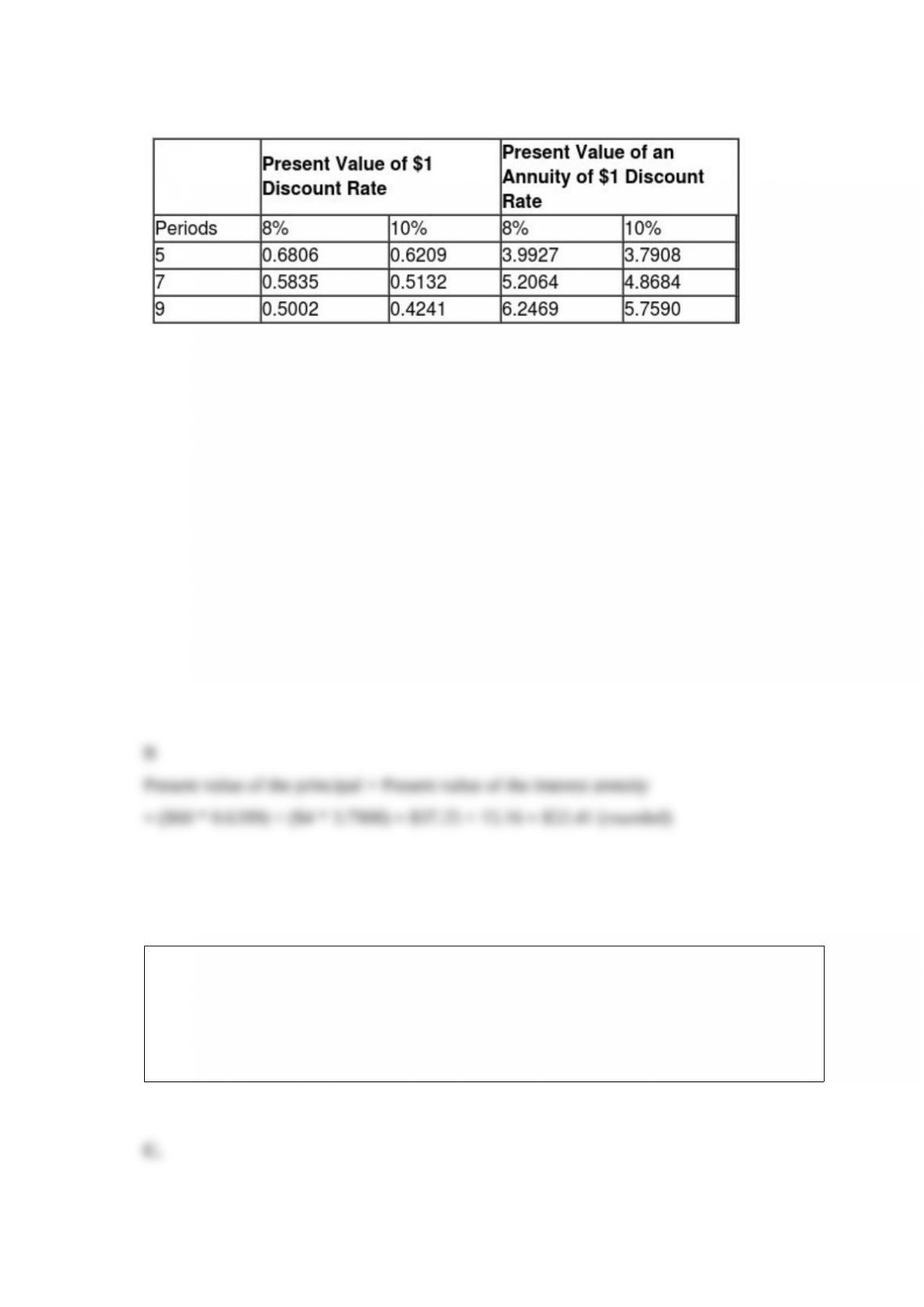
A particular common stock has an annual cash dividend of $4 per share and is predicted to
have a market value of $60 per share 5 years from now. Assuming a discount rate of 10%,
a fair market price for the stock today is:
A particular common stock has an annual cash dividend of $4 per share and is predicted to
have a market value of $60 per share 5 years from now. Assuming a discount rate of 10%,
a fair market price for the stock today is:
A. $40.00
B. $52.41
C. $75.16
D. $112.42
The sequence of activities that add value to the organization are:
A. the value processes.
B. the chain of production events.
C. the value chain.
D. the strategic cost initiatives.

The term “cost” means:
A. the price paid for a raw material.
B. the wage paid to a worker.
C. the price charged by an entity for its services.
D. all of the above.
Factors that usually affect retained earnings directly include:
A. net income or loss, and dividends.
B. restructuring charges and losses from discontinued operations.
C. stock dividends and gains or losses from the sale of treasury stock.
D. net income or loss, and the issuance of stock at an amount in excess of par value.
Which of the following are examples of physical measures of activity that are
sometimes disclosed in corporate annual reports?
A. Sales in units.
B. Number of employees.
C. Gross profit per square foot of selling space.
D. None of the above are examples of physical measures of activity that are sometimes
reported in corporate annual reports.
E. A, B, and C above are all examples of physical measures of activity that are
sometimes reported in corporate annual reports.
Leasehold is an example of which of the following types of assets?
A. Current asset.
B. Property, plant and equipment.
C. Goodwill.
D. Intangible asset.

The development of the operating budget is complete when:
A. the sales forecast for next year is complete.
B. the budgeted cash flow statement is complete.
C. the budgeted income statement is complete.
D. the budgeted balance sheet is complete.
A debit entry will:
A. decrease an asset account.
B. increase a liability account.
C. increase paid-in capital.
D. increase an expense account.
Which of the following is not included in a corporation’s annual report?
A. The reporting firm’s financial statements for the fiscal year.
B. The report of the external auditor’s examination of the financial statements.
C. Notes to the financial statements and key financial data for at least the past five
years.
D. A detailed Management’s Discussion and Analysis section.
E. All of the above are included in a corporation’s annual report.
Firms that issue registered securities are required to file, with the SEC on an annual
basis, which of the following?
A. An annual report.
B. A form 10-K.
C. A set of financial statements.
D. All of the above.

The return on investment measure of performance:
A. is relevant only to business enterprises.
B. is used by individuals to compare investment performance.
C. is calculated using sales as the amount of return.
D. is calculated using total assets at the beginning of the period as the amount of
investment.
A materials purchases budget must be completed immediately after the preparation of
the:
A. direct labor budget.
B. operating expense budget.
C. cash budget.
D. production budget.
In the statement of cash flows, depreciation and amortization expense is added back to
net income because:
A. these expenses do not affect cash, but were subtracted in the determination of net
income.
B. these expenses affect investing activities, not operating activities.
C. the cash disbursements for these accrued expenses will be made in a future period.
D. these expenses are recognized for accounting purposes, but they do not represent
economic costs.
If the net present value of a proposed investment is positive:
A. the investment not will be made.
B. the cost of capital is higher than the internal rate of return.
C. the cost of capital is positive.
D. the cost of capital is less than the expected rate of return.
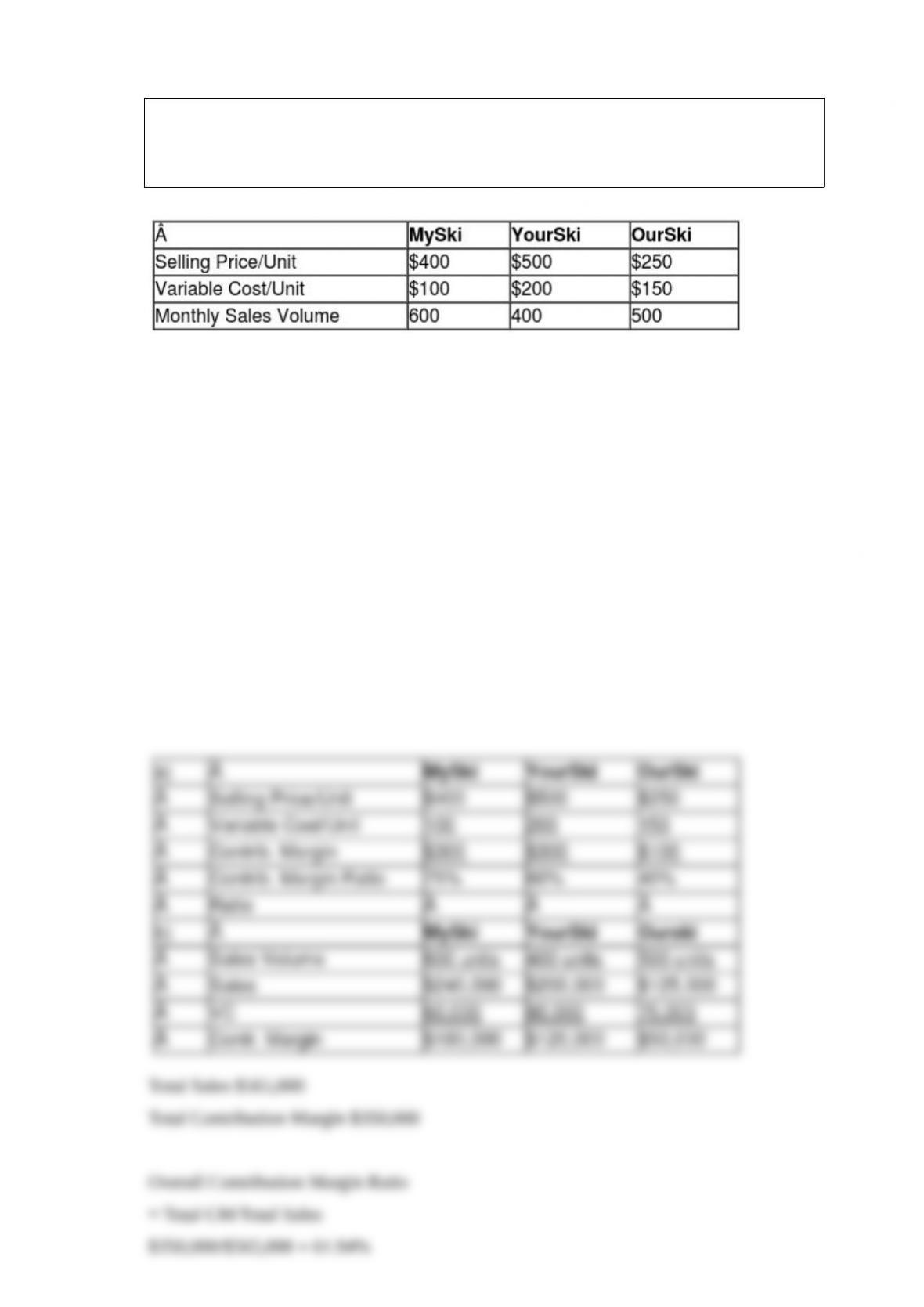
Obed Corp. makes three models of high performance cross country ski machines.
Current operating data are summarized below:
Fixed expenses per month total $185,820
(a) Calculate the contribution margin ratio for each product.
(b) Calculate the firm’s overall contribution margin ratio.
(c) Calculate the firm’s break-even point in sales dollar.
(d) Calculate the firm’s operating income.
(e) Management is considering the elimination of the OurSki model due to low sales
volume. As a result, total fixed expenses can be reduced by $60,000 per month. Assuming
that this change would not affect the other models, would you recommend the elimination
of the OurSki model?
The capital budgeting analytical technique that calculates the rate of return on the
investment based on the impact of the investment on the financial statements is known
as the:
A. internal rate of return.
B. accounting rate of return.
C. payback period.
D. net present value.
The accountant at Abco, Inc. made an adjusting entry at the end of February to accrue
interest on a note receivable from a customer. The effect of this entry is to:
A. decrease ROI for February.
B. increase ROI for February.
C. decrease working capital at February 28.
D. decrease the acid-test ratio at February 28.
Which of the following is not usually a right or attribute of preferred stock?
A. Having a claim to dividends in excess of the annual dividend requirement if
dividends on common stock exceed dividends on preferred stock.
B. Having a priority claim to dividends relative to the common stock’s claim to
dividends.
C. Having a priority claim in liquidation relative to the common stock’s claim in
liquidation.
D. Having a claim to dividends that is cumulative over time if the annual dividend
requirement is not satisfied.
A newspaper ad submitted and published this week, with the agreement to get paid for
it next week would, in the newspaper’s records:
A. increase assets and increase revenues.
B. increase assets and decrease liabilities.
C. increase assets and increase expenses.
D. have no effect on total assets.