A leveraged buyout refers to:
A. one firm issues stock to take over another firm.
B. one firm trades its stock for the stock of another firm.
C. a firm goes heavily into debt in order to obtain the funds to purchase the shares of
the public stockholders and thus take the firm private.
D. one firm pays cash for the shares of a takeover firm’s shares.
Which of the following is not a category of financial statement ratios?
A. Financial leverage.
B. Liquidity.
C. Profitability.
D. Prospectus.
Company A has fixed expenses of $100,000 and variable expenses of $50 per unit.
Company B has fixed expenses of $200,000 and variable expenses of $25 per unit. The
volume of unit sales necessary to produce exactly the same operating income for
Company A and Company B is:
A. 2,500.
B. 4,000.
C. 5,000.
D. 7,500.
______________ can be measured as the income that could have been earned on an
asset, based on the potential rate of return that is lost or sacrificed when one alternative
use of the asset is chosen over another:
A. Target cost
B. Sunk cost
C. Opportunity cost
D. Allocated cost
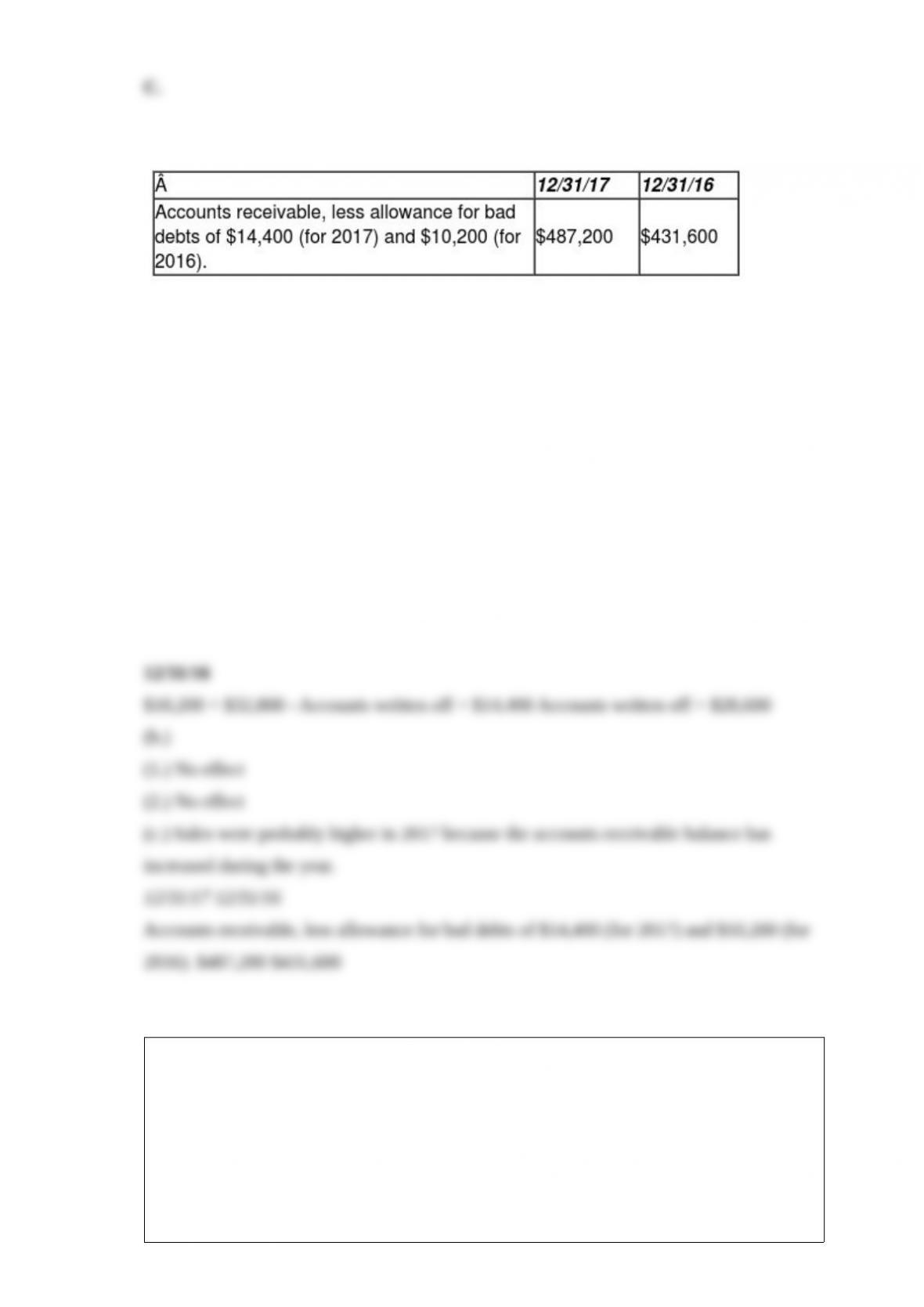
(a.) If bad debts expense for 2017 totaled $32,800, what was the amount of accounts
receivable written off during the year?
(b.) The December 31, 2017, Allowance account balance includes $6,800 for a past due
account that is not likely to be collected. This account has not been written off. If it had
been written off, what would have been the effect of the write off on:
(1.) The current ratio at December 31, 2017?
(2.) Net income and ROE for the year ended December 31, 2017?
(c.) What do you suppose was the level of The Sweet Cafe’s sales in 2017, compared to
2016? Explain your answer.
When an appropriately established and effective standard cost system is used to value
inventory:
A. cumulative variances are deferred.
B. a significant unfavorable net variance may be reported as an expense of the current
period.
C. a significant favorable net variance may be reported as an expense of the current
period.
D. the explanatory notes to the financial statements will explain the disposition of the

net variance.
An example of a direct cost in the production of a computer is:
A. depreciation of production equipment.
B. production labor costs.
C. salary of the vice president of production.
D. material warehouse costs.
The part of the variable overhead budget variance due to the difference between actual
hours required and standard hours allowed for the work done is called the:
A. variable overhead spending variance.
B. variable overhead budget variance.
C. variable overhead efficiency variance.
D. variable overhead volume variance.
Management’s Discussion and Analysis (MD&A):
A. is designed to enhance public disclosure of information about the corporation.
B. is a part of the annual report that should be read by current and potential investors.
C. often includes disclosures concerning non-GAAP financial measures and key
performance indicators that are used to assess the company’s financial and operating
results.
D. None of the above.
E. Items A, B and C are correct.
If the net of all variances is immaterial relative to the total production costs incurred
during the period, the net variance is:
A. treated as an adjustment to cost of goods sold.
B. ignored.
C. treated as an adjustment to work in process, finished goods, and cost of goods sold.
D. treated as an adjustment to manufacturing overhead.
An organization’s value chain refers to:
A. the process of using cost information to manage the activities of the organization.
B. the sequence of functions and related activities that add value for the customer.
C. the process of collecting and recording valuable information in the accounting
information system.
D. None of the above.
_____________ is a cost management technique in which the firm determines the
required cost for a product or service in order to earn a desired profit when the
marketplace establishes the product’s selling price.
A. Relevant costing
B. Product costing
C. Differential costing
D. Target costing
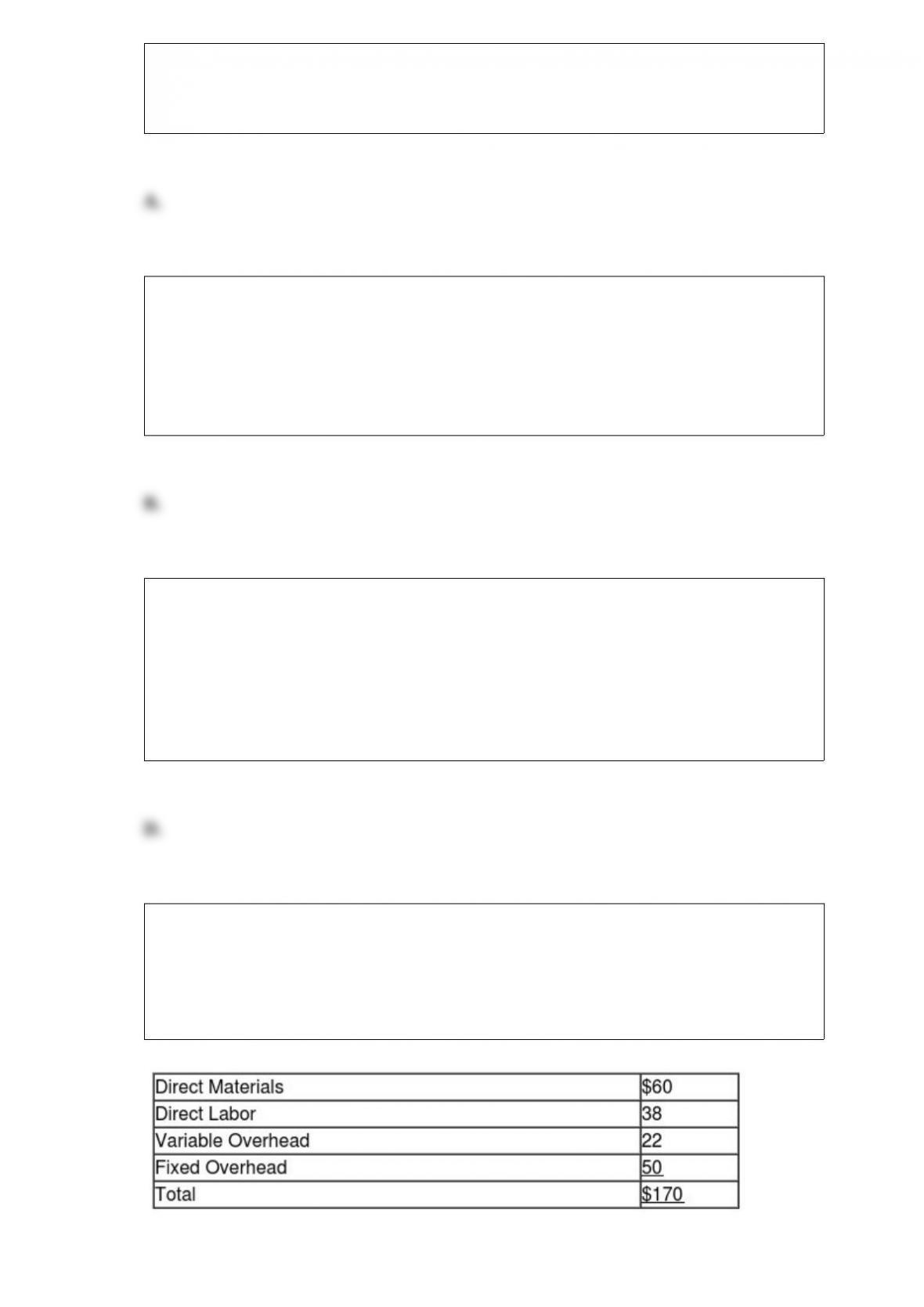
The following production costs are provided for AudioPro Co., a manufacturer of high
quality headphones.
Manufacturing Costs:
It has been determined that the headphones could be purchased from Integrated Labs at a
cost of $135 plus $8 shipping costs. Considering the offer from Integrated Labs, show
whether AudioPro should make or buy the product.
(a.) Assume 40% of fixed overhead allocated to making headphones relates to a
production manager who would not be retained if the headphones were not produced by
AudioPro.
(b.) How would your analysis change if AudioPro could use capacity resources for
alternative activities that would produce a contribution of $35 per unit?
(c.) What is your understanding of the term outsourcing? Briefly explain.
The cost of a single unit of production in excess of the break-even point in units is:
A. its fixed cost and variable cost.
B. its fixed cost only.
C. its variable cost only.
D. none of the above.

The price/earnings ratio:
A. is a measure of the relative expensiveness of a firm’s common stock.
B. does not usually change by more than 1.0 (e.g. 8.2 to 9.2) during the year.
C. can be used to determine the cash dividend to be received during the year.
D. is calculated by dividing the earnings multiple by net income.
A. is a measure of the relative expensiveness of a firm’s common stock.
B. does not usually change by more than 1.0 (e.g. 8.2 to 9.2) during the year.
The term “relevant range” refers to:
A. the range of activity where costs will fluctuate.
B. the range of activity where fixed costs change as activity changes.
C. the range of activity where total variable cost remains constant as activity changes.
D. the range of activity where cost relationships are valid.
In the statement of cash flows, an increase in the accounts receivable balance from the
beginning of the period to the end of the period would:
A. be added to net income because this represents earned revenues that have not been
collected.
B. be subtracted from net income because this represents earned revenue provided by
operating earnings.
C. be added to net income because this means that revenues were less than cash
collected.
D. be subtracted from net income because this means that revenues were more than
cash collected.
What is the “key” to the entire operating budget?
A. the forecast of operating activity.
B. the budgeted income statement.
C. the budgeted balance sheet.
D. the production/purchases budget.

The objectives of financial reporting for nonbusiness enterprises:
A. are exactly the same as those for business enterprises.
B. focus on providing information for resource providers, rather than investors.
C. have more of an internal utilization rather than external reporting focus.
D. do not give consideration to the cost of providing information.
Which of the following is not sometimes associated with bonds?
A. Debenture.
B. Callable.
C. Cumulative.
D. Convertible.
Which of the following costs are included in the “for cost accounting purposes”
classification?
A. Variable cost and fixed cost.
B. Direct cost and indirect cost.
C. Product cost and period cost.
D. Committed cost and discretionary cost.
Moped, Inc. purchased machinery at a cost of $44,000 on January 1, 2017. The
expected useful life is 5 years and the asset is expected to have salvage value of $4,000.
Moped depreciates its assets using the double-declining balance method.
What is the accumulated depreciation for this asset on December 31, 2018?
A. $8,800
B. $10,560
C. $17,600
D. $28,160
Which of the following best describes cost accounting?
A. cost accounting serves the needs of both financial and managerial accounting.
B. managerial accounting is a subset of cost accounting.
C. financial accounting is a subset of cost accounting.
D. cost accounting is an alternative to both financial and managerial accounting.
Product Z sells for $18 per unit as is, but if enhanced it can be sold for $24 per unit. The
enhancement process will cost $50,000 for 10,000 units. If the 10,000 units of Product
Z are sold as is without further processing, the company:
A. will incur an incremental profit of $10,000.
B. will incur an opportunity cost of $10,000.
C. will incur an incremental profit of $1 per unit.
D. will incur an incremental loss of $6 per unit. Incremental revenue = ($24 – $18) *
10,000 units = $60,000. Incremental cost = $50,000; $60,000 – $50,000 = $10,000
increase in overall profit if product Z is processed further. If company does not process
further, they will lose the opportunity of making an additional $10,000.
Which of the following accounting concepts/principles is most significant in the
development of a capitalization policy?
A. Matching of revenue and expense.
B. Materiality.
C. Original Cost.
D. Consistency.
Which of the following is not a limitation of financial statements?
A. It is possible that two firms operating in the same industry may follow different
accounting methods for the exact same transaction.

B. Full disclosure requires that the financial statements and notes include all necessary
information to prevent a reasonably astute user of the financial statements from being
misled.
C. Financial statements are not adjusted to show the impact of inflation.
D. Financial statements do not reflect opportunity cost, which is an economic concept
relating to income forgone because an opportunity to earn income was not pursued.
If a firm’s debt ratio was 25%, its debt/equity ratio would be:
A. 25%.
B. 50%.
C. 33.33%.
D. 75%. Debt ratio = liability/(liabilities + equity) = 25/100 = a debt ratio of 25% so,
debt/equity ratio is calculated by liabilities/equity = 25/75 = 33.33%
A higher P/E ratio means that:
A. the stock is more reasonably priced.
B. the stock is relatively expensive.
C. investors are wary of the stock.
D. earnings are expected to decrease.
Consolidated financial statements report financial position, results of operations, and
cash flows for:
A. a parent corporation and its subsidiaries.
B. a parent corporation alone.
C. two corporations that are owned by the same individual.
D. a parent corporation and its 100% owned subsidiaries only.
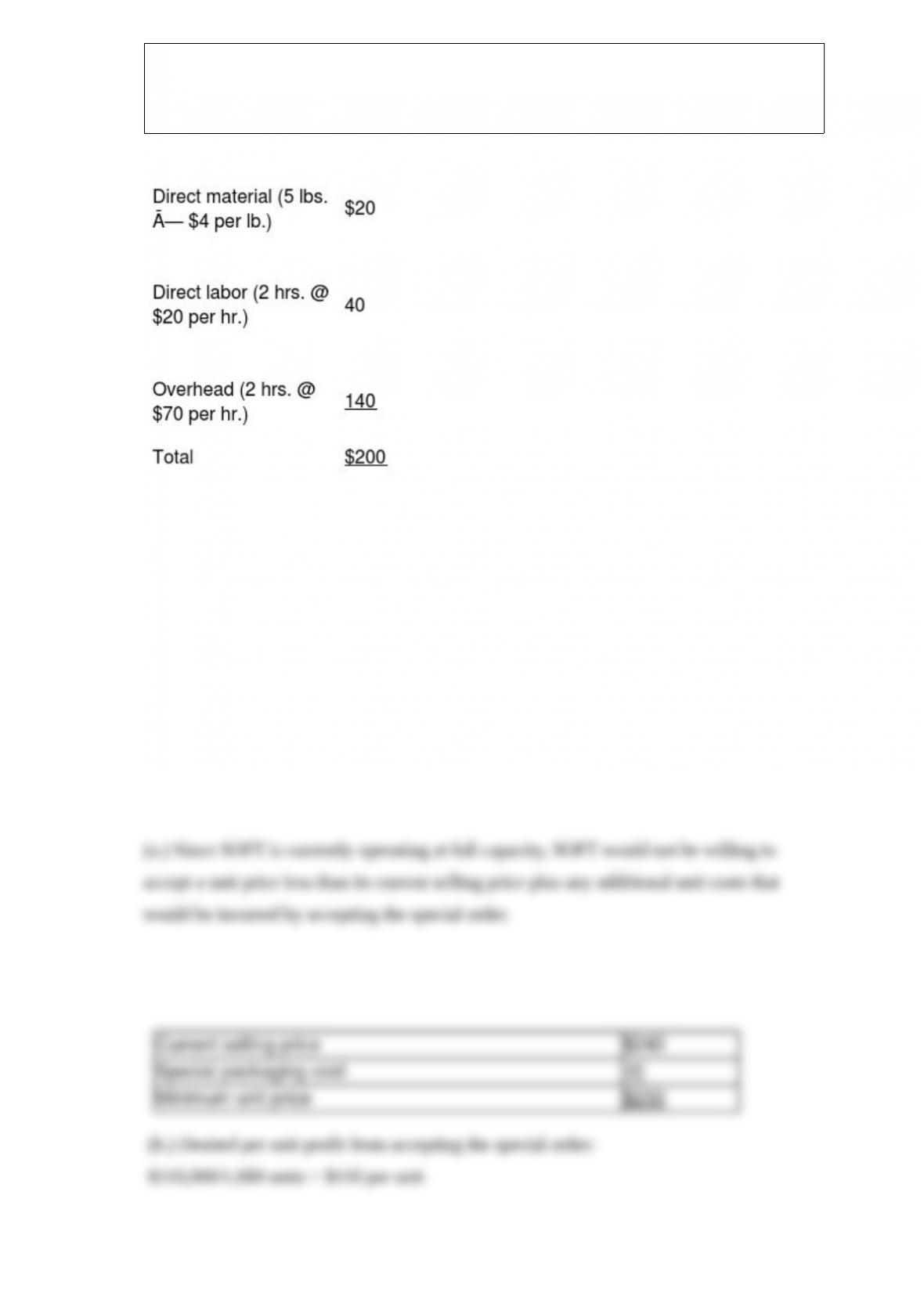
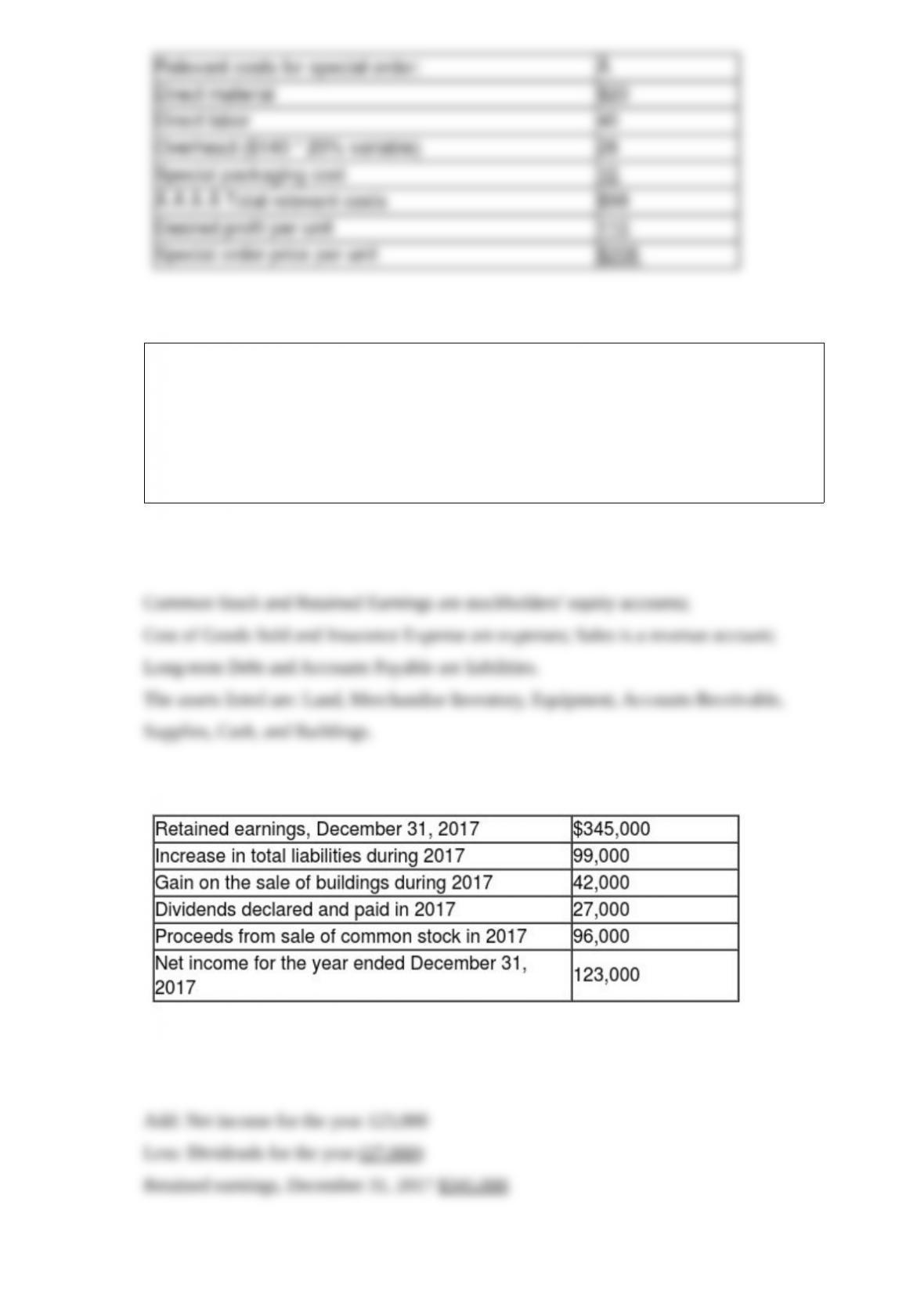
SOFT Micro Co., sells part #1973 for $240 per unit and the standard cost of producing
each unit of part #1973 is determined as follows:
SOFT received a special order for 1,000 units of part #1973. The only additional cost to
SOFT is a special packaging requirement that would cost $10 per unit.
(a.) If SOFT were currently able to sell all of its production of part #1973, what would be
the minimum sales price that SOFT should consider for this special order?
(b.) Assume that SOFT has enough idle capacity to produce 1,000 units of part #1973 and
that overhead is 20% variable. If SOFT wants to increase its operating profit by $110,000,
what price per unit would SOFT charge for the special order?
Listed here are a number of accounts: Merchandise Inventory, Land, Common Stock,
Accounts Payable, Insurance Expense, Equipment, Cash, Cost of Goods Sold,
Buildings, Retained Earnings, Supplies, Long-term Debt, Sales, Accounts Receivable.
Required:
Which of the accounts listed above are not assets? How would you categorize each of
these nonasset accounts?
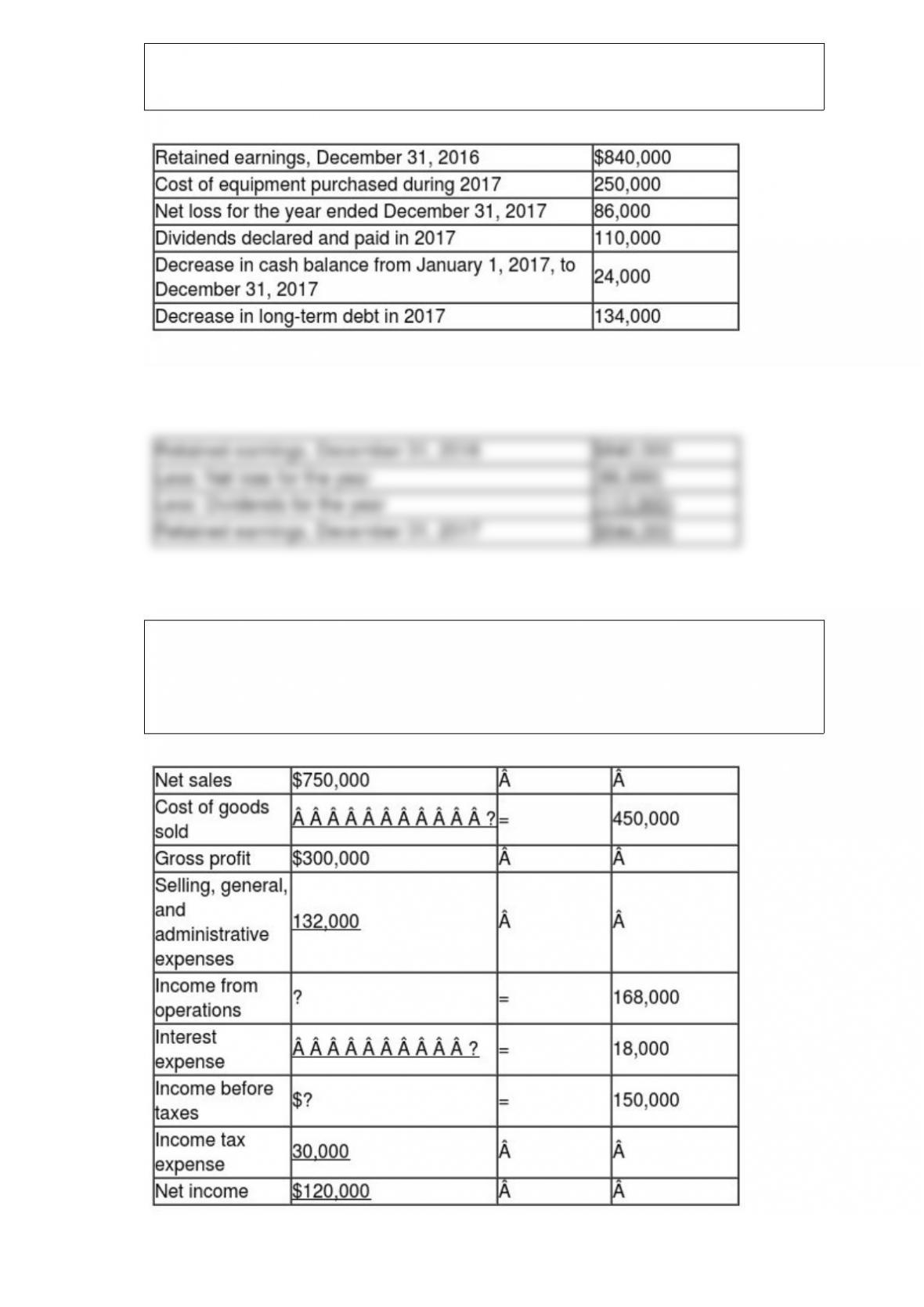
From the data given below, calculate the Retained Earnings balance as of December 31,
2017.
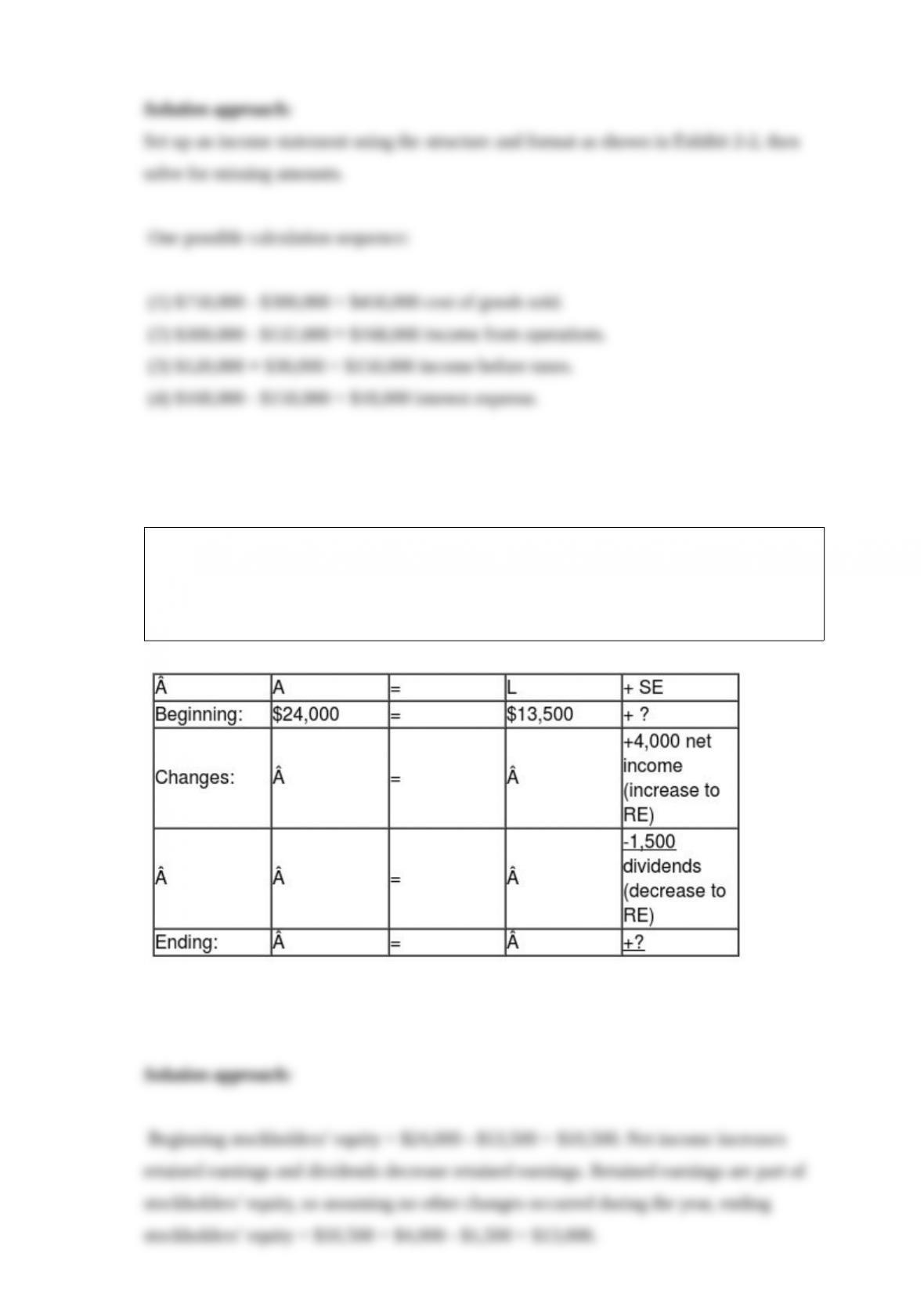
During the year, net sales were $750,000; gross profit was $300,000; net income was
$120,000; income tax expense was $30,000; and selling, general, and administrative
expenses were $132,000.
Required:
Total assets were $24,000 and total liabilities were $13,500 at the beginning of the year.
Net income for the year was $4,000, and dividends of $1,500 were declared and paid
during the year.
Required:
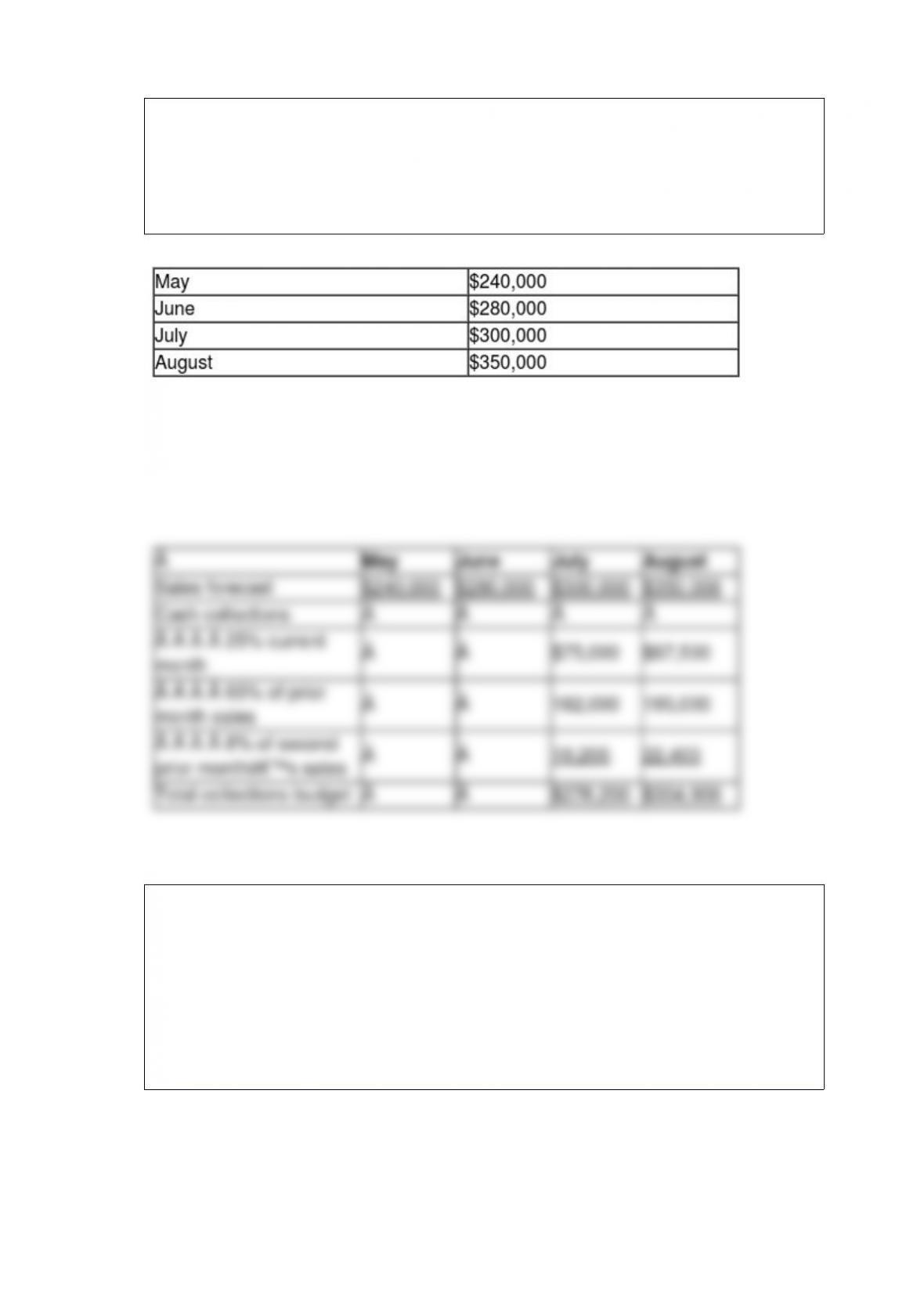
Sunset Center’s sales are all made on account. The firm’s collection experience has been
that 25 percent of a month’s sales are collected in the month of sale, 65 percent are
collected in the month following the sale, and 8 percent are collected in the second
month following the sale. The sales forecast for the months of May through August is:
Calculate the cash collections that would be included in the cash budgets for July and
August.
For the payroll period ended on October 19, 2016, gross pay was $22,300, net pay was
$17,000, FICA tax withholdings were $1,500, income tax withholdings were $3,000,
and medical insurance contributions were $800.
Required:
Use the horizontal model (or write the journal entry) to show the effects of the payroll
accrual on October 19, 2016.
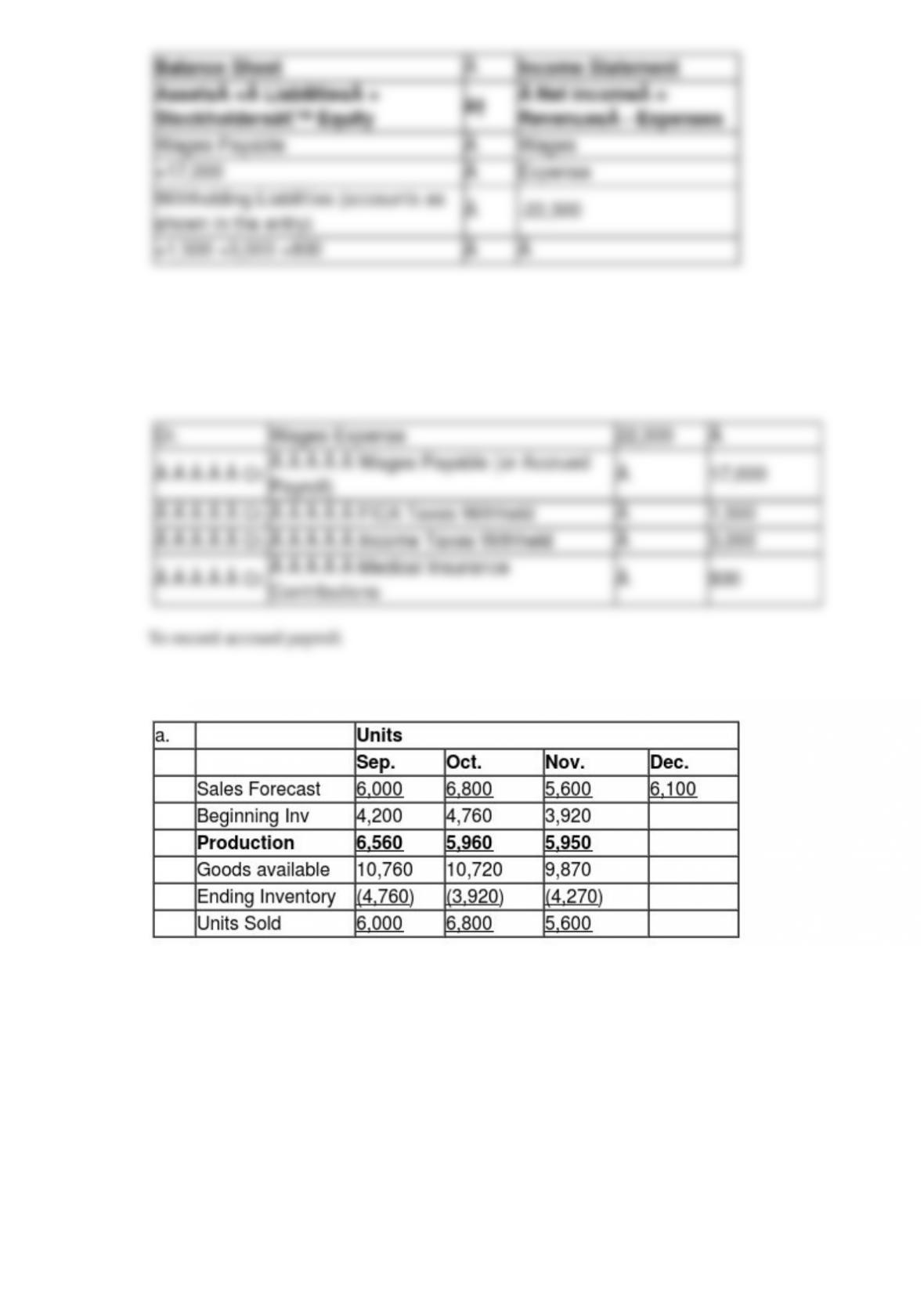
Mario’s Record Shop, a retail store, has an average gross profit ratio of 30 percent. The
sales forecast for the next four months follows:
Steps:
(1) Units sold based on sales forecast.
(2) Ending inventory = 70% of the next month’s forecast.
(3) Goods available for sale = units sold (based on sales forecast) + ending inventory.
(4) Beginning inventory = ending inventory from the prior month = 70% of the current
month’s sales forecast. September is given.
(5) Production = Goods available – Beginning inventory.
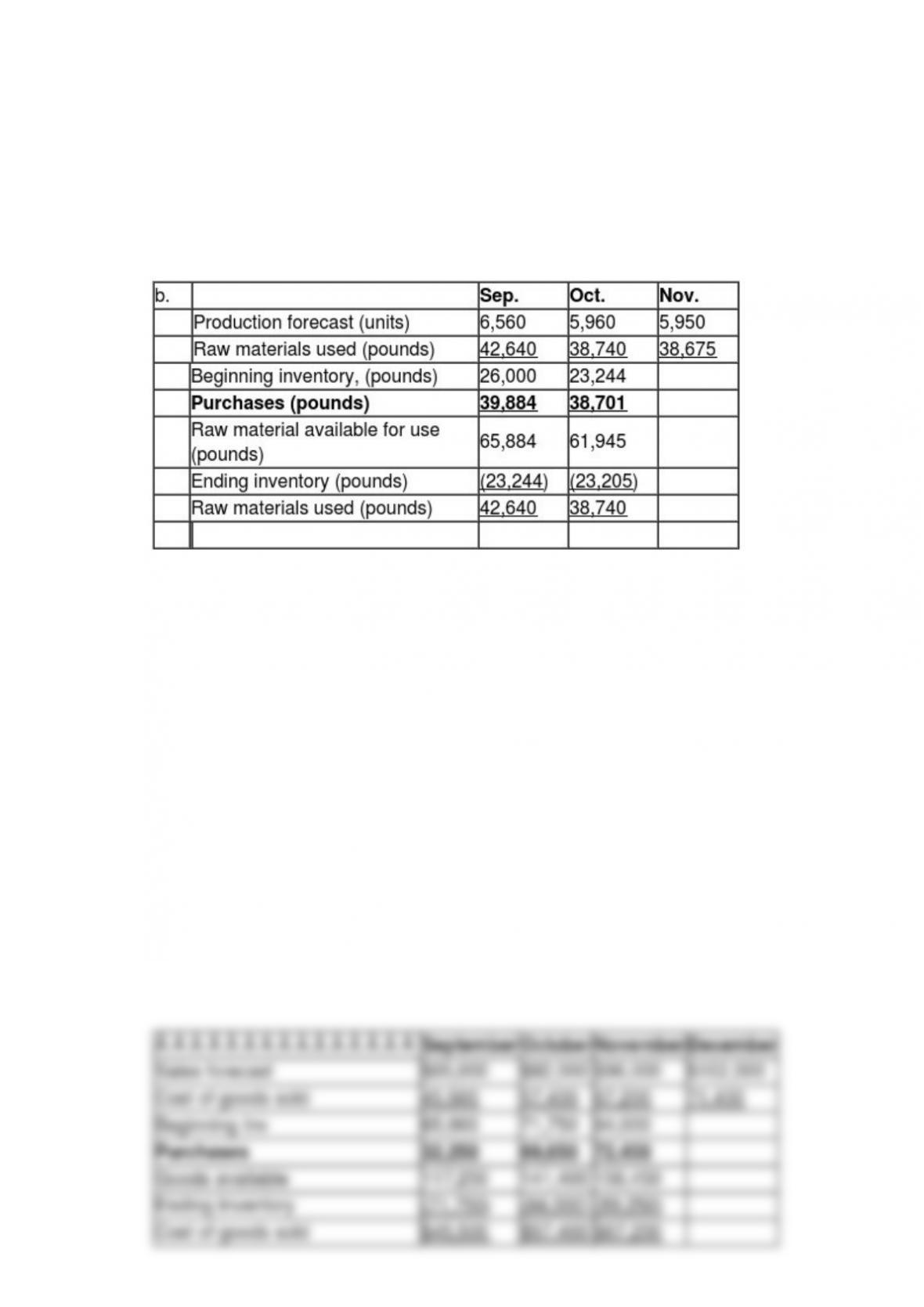
Steps:
(1) Raw materials used in production = production forecast × 6.5 pounds per unit
produced.
(2) Ending inventory = 60% of the next month’s estimated raw materials usage.
(3) Raw materials available for use = raw materials used (based on production forecast) +
ending inventory.
(4) Beginning inventory = ending inventory from the prior month = 60% of the current
month’s raw material usage (pounds). September is given.
(5) Purchases (pounds) = raw materials available for use – beginning inventory
XYZ, Inc., processes soy beans into Product A and Product B and the company’s
productivity and cost standards follow:
• From every bushel of beans processed, 6 pounds of Product A and 4 pounds of
Product B should be produced.
• Standard direct labor and variable overhead total $0.85 per bushel of beans processed.
• Standard fixed overhead (the predetermined fixed overhead application rate) is $0.70
per bushel processed.
Calculate the standard absorption cost per pound for Product A and Product B produced
from the processing of 24,000 bushels of beans if the average cost per bushel is $3.75.
Joe’s Garage, Inc., purchased a used vehicle lift, brake tester, and wheel aligning
equipment for a lump-sum price of $16,000 from a bankrupt competitor. Appraised
values were as follows: vehicle lift, $20,000; brake tester, $4,000; and wheel aligner,
$6,000.
Required:
What cost should be recorded for the wheel aligner?
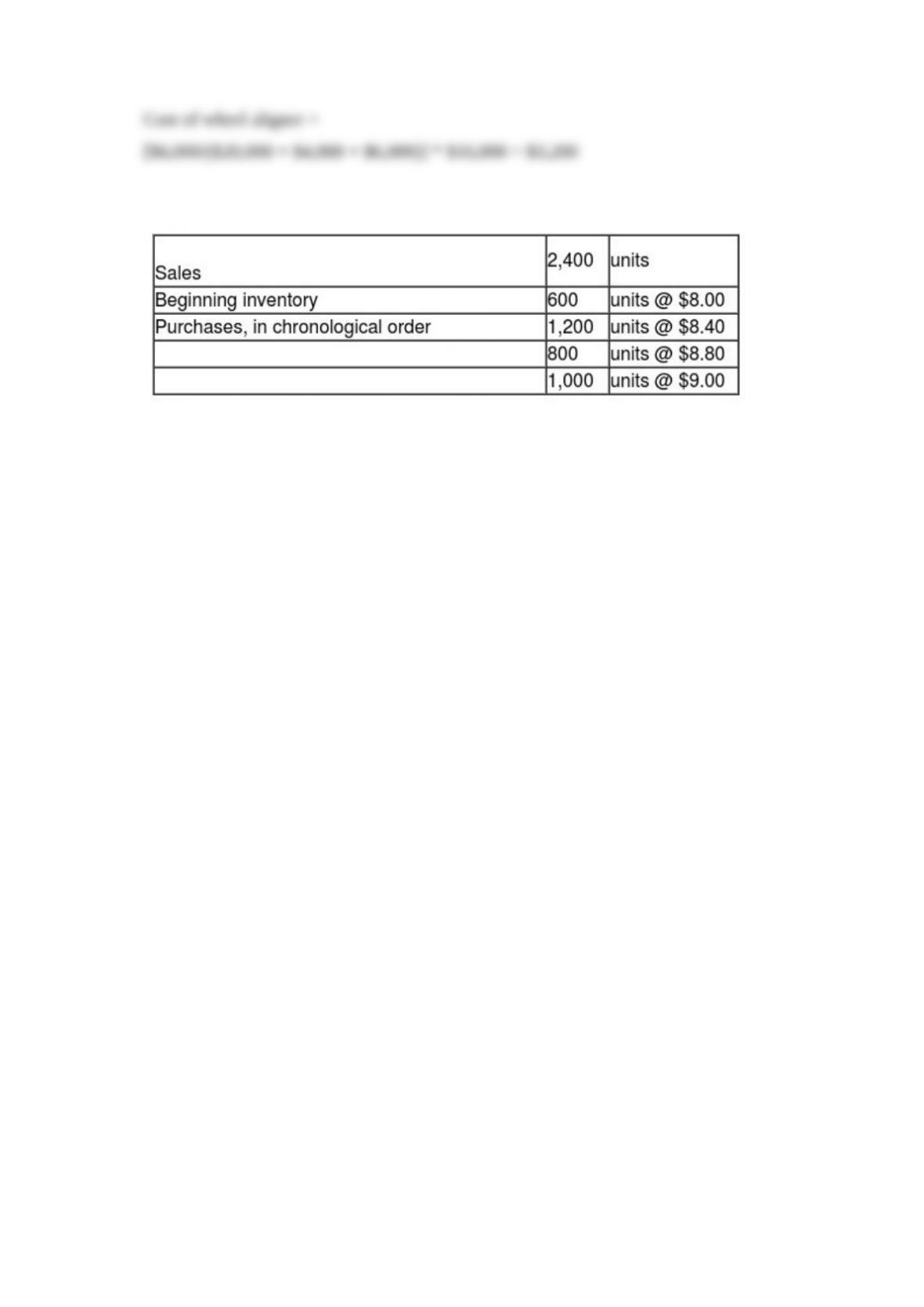
The following are data available for Blue Grass for the month of June:
(a.) Calculate cost of goods sold and ending inventory under the following cost flow
assumptions:
(1.) Weighted-average
(2.) FIFO
(3.) LIFO
(b.) Assume net income using the weighted average cost flow assumption was $12,800.
Calculate net income under FIFO and LIFO.
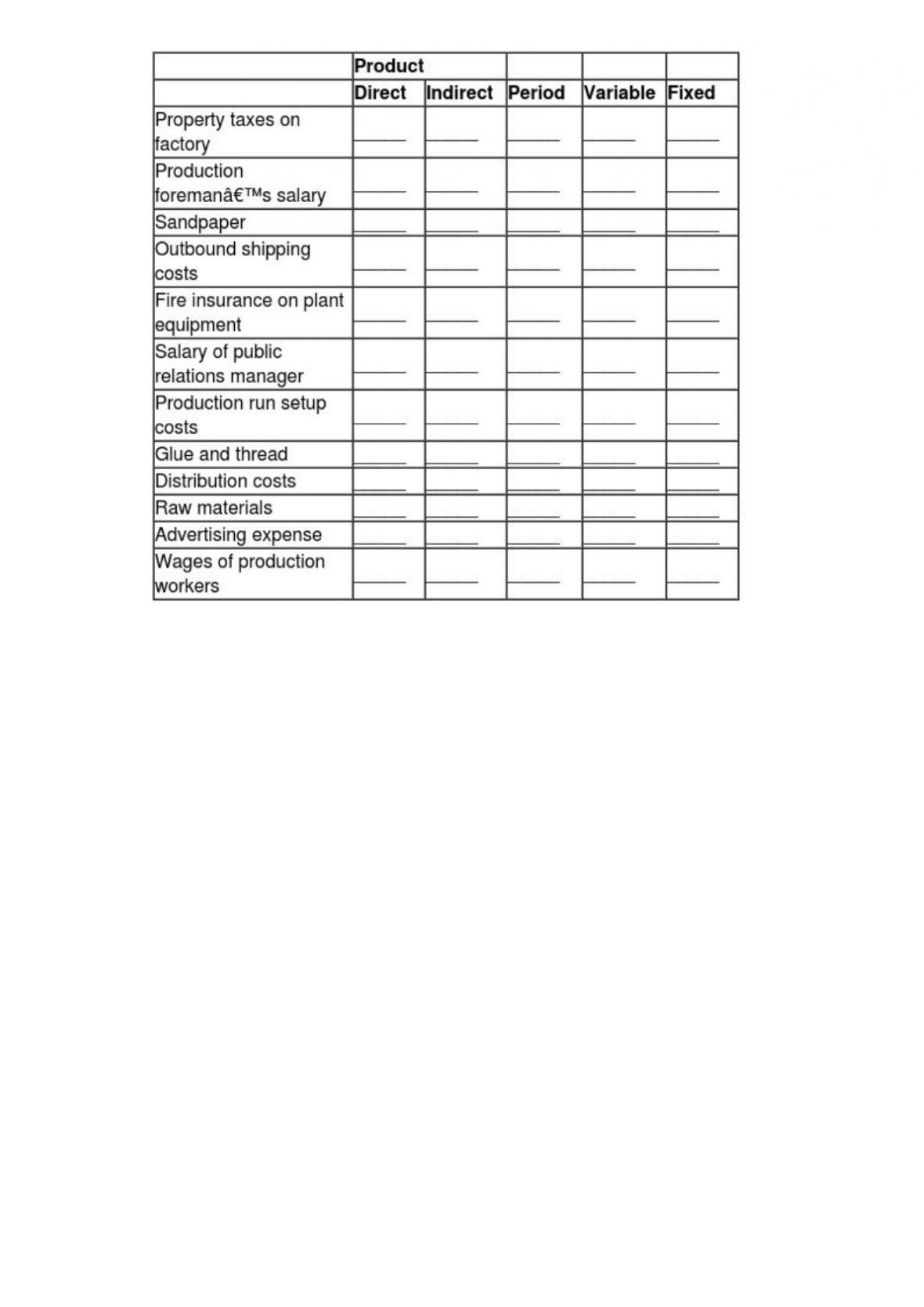
For each of the following costs, check the columns that most likely apply.
Peachtree’s Siding and Window Co. is a custom home improvement company. All sales
are made on account: 30 percent of a month’s sales are collected in the month of sale,
60 percent are collected in the month following the sale, and 8 percent are collected in
the second month following the sale. Cash on hand on October 1 is estimated to be
$32,000.
Merchandise purchases and operating expenses are paid as follows:
Peachtree’s Siding and Window Co.’s budgeted income statement for each of the next
three months is as follows:
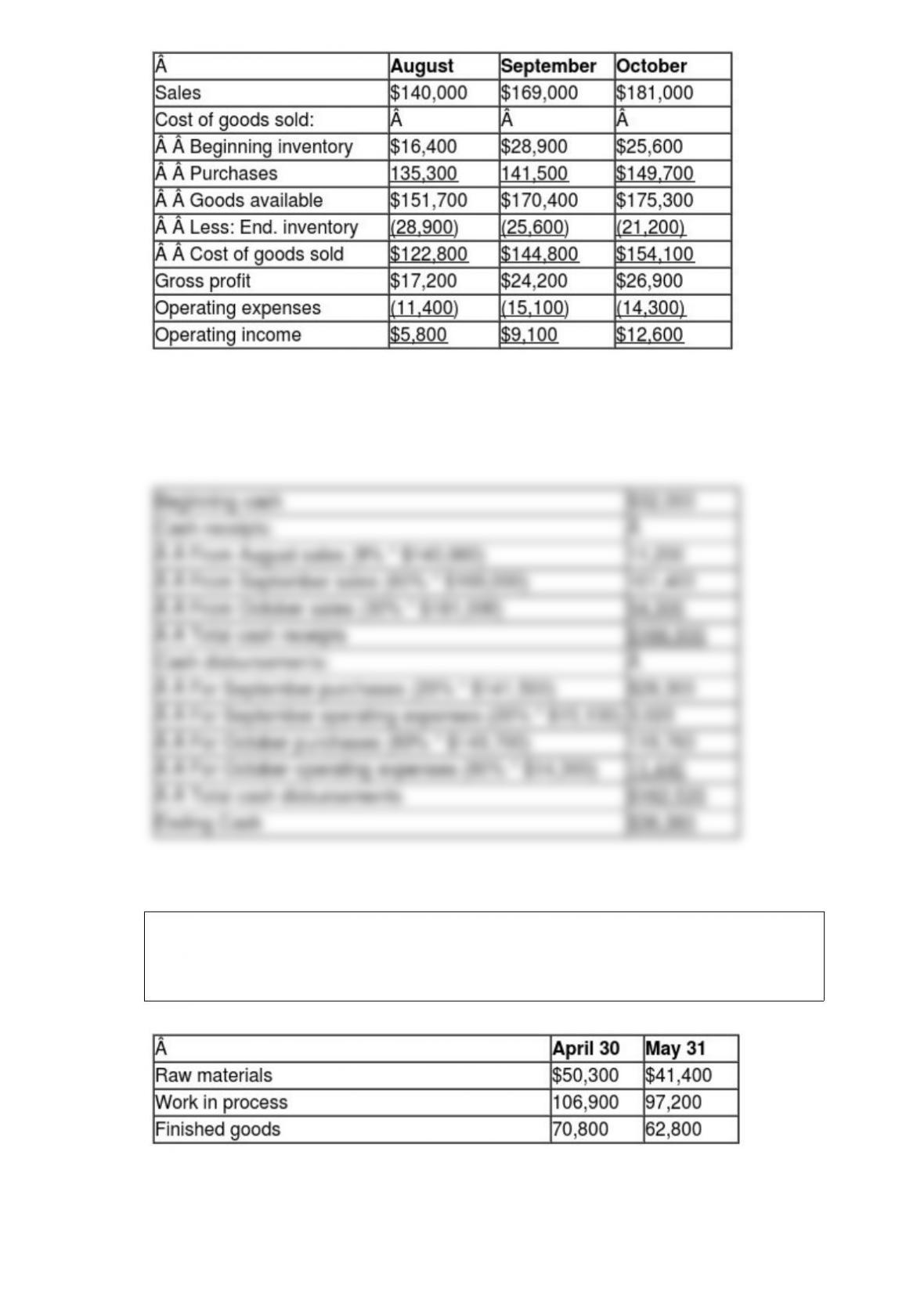
Prepare a cash budget for the month of October.
The following are beginning and ending inventories of ABC Company for the month of
May:
Raw materials purchased during the month of May totaled $185,900. Direct labor costs
incurred totaled $468,300 for the month. Actual and applied manufacturing overhead costs
for May totaled $282,600 and $288,400, respectively. Over/underapplied overhead is
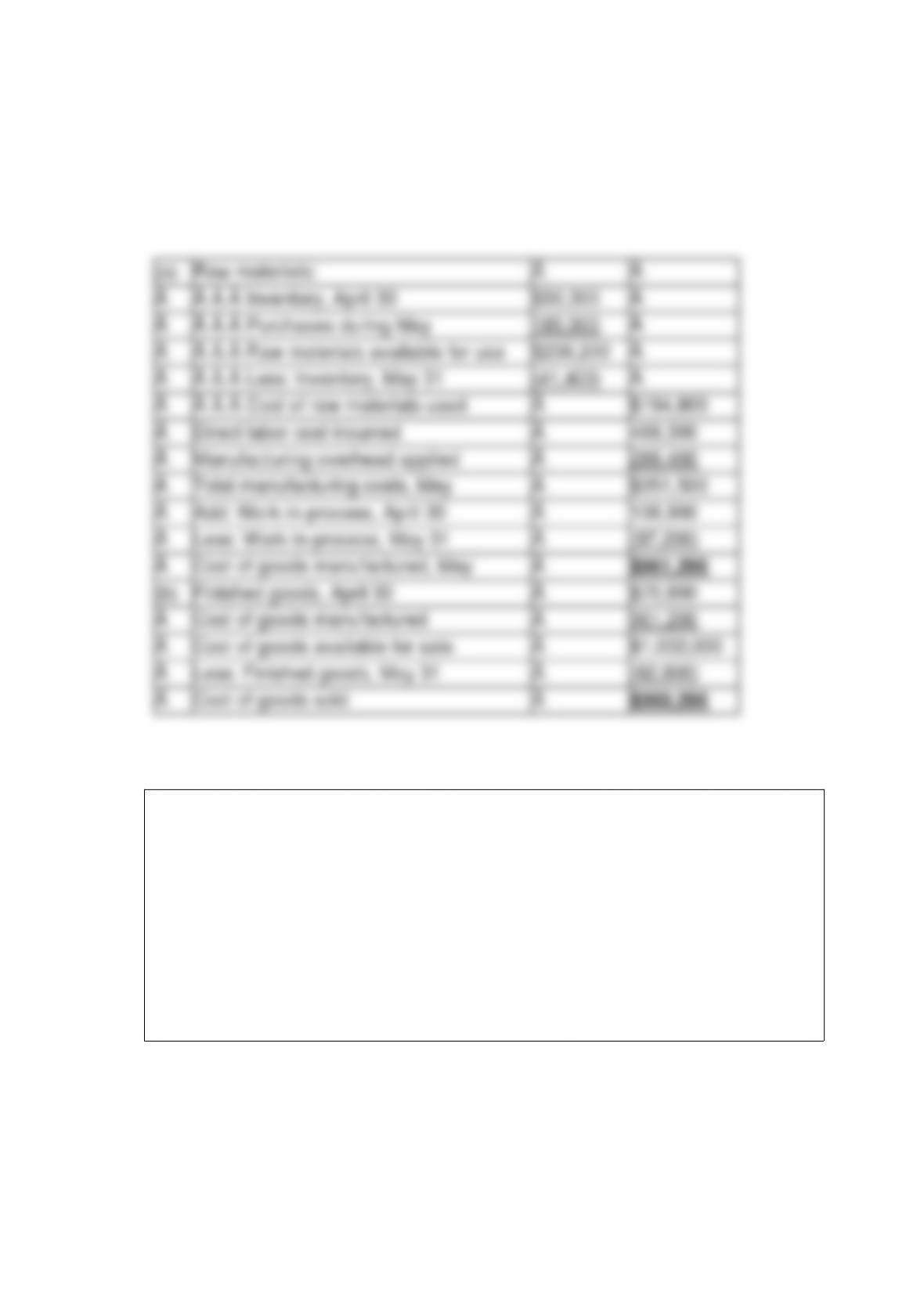
written off to cost of goods sold at the end of the year in December.
(a) Calculate the cost of goods manufactured for May.
(b) Calculate the cost of goods sold for May.
The Allowance for Bad Debts account had a balance of $20,400 at the beginning of the
year and $24,500 at the end of the year. During the year (including the year-end
adjustment), bad debts expense of $33,600 was recognized.
Required:
Calculate the total amount of past-due accounts receivable that were written off as
uncollectible during the year. (Hint: Make a T-account for the Allowance for Bad Debts
account, plug in the amounts that you know, and solve for the missing amount.)
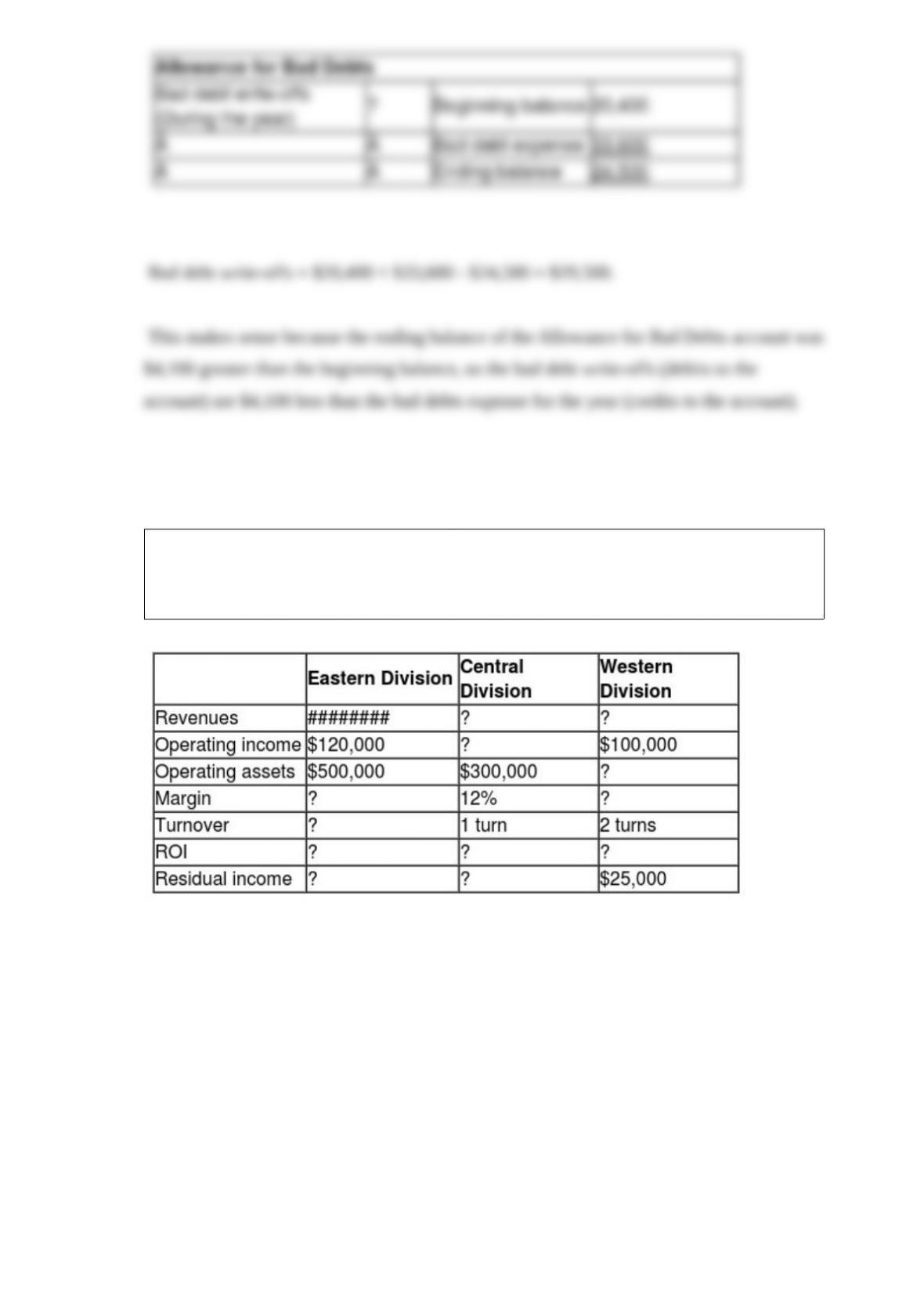
Selected information about American Industries is presented below. American has three
operating divisions and requires a 12% return on all investments:
Calculate the missing amounts for each division.