
The return on investment measure of performance:
A. is never as important a measure of management effectiveness as the amount of net
income.
B. relates dividends paid to the entity’s assets.
C. is calculated using net income as the amount of return.
D. is calculated by dividing average assets for a period by the amount of net income for
the period.
Which of the following is a true statement regarding the internal rate of return in capital
budgeting?
A. it provides the same basic information as the net present value method.
B. it calculates the net present value of future cash flows.
C. it calculates the proposal’s rate of return.
D. it doesn’t consider the time value of money.
On January 31, an entity’s balance sheet showed net assets of $3,075 and liabilities of
$675. Stockholders’ equity on January 31 was:
A. $2,400
B. $3,075
C. $3,750
D. $675
The entry to record depreciation expense:
A. increases a contra asset and decreases net income.
B. decreases a contra asset and decreases net income.
C. decreases working capital and decreases net income.
D. decreases an asset and increases a contra asset.

The amortization of bond discount:
A. increases the cash paid to bondholders for interest.
B. results in bond interest expense being greater than the interest paid to bondholders.
C. results in bond interest expense being less than the interest paid to bondholders.
D. reduces the carrying value of bonds payable on the balance sheet.
Interest on a Note Payable is most appropriately accrued:
A. when the note is signed.
B. as of the end of each accounting period during which the note is a liability.
C. when principal payments on the note are made.
D. when the interest is paid.
If an organization purchases $2,100 of supplies on account, with terms of 2/15, n50:
A. $1,950 must be paid within 15 days of the invoice date.
B. $2,094 must be paid within 50 days of the invoice date.
C. $2,058 can be paid within 15 days of the invoice date, or $2,100 must be paid within
50 days of the invoice date.
D. $2,058 can be paid within 15 days of the invoice date, or $2,142 must be paid within
50 days of the invoice date. $2,100 * 98% = $2,058
If fixed costs were increased by $9,000 and the contribution margin ratio remained at
30 percent, then sales must increase by _________ in order to cover the additional fixed
expenses.
A. $27,000
B. $30,000
C. $33,000
D. $54,000

The scattergram allows cost-volume relationships to be visually scanned for outlier
observations that should be:
A. included in the calculation of the cost formula of a mixed cost.
B. ignored in the calculation of the cost formula of a mixed cost.
C. included in the calculation of the fixed cost component of the mixed cost.
D. included in the calculation of the variable rate component of the mixed cost.
A magazine publisher has an account called “Unearned Subscription Revenue.” The
transaction that causes the balance of this account to decrease is:
A. cash is received from new subscribers.
B. magazines are printed for the publisher.
C. magazines are mailed to subscribers.
D. subscriptions are sold to new subscribers.
Which of the following items would not be reported on the statement of cost of goods
manufactured?
A. beginning work in process inventory.
B. purchases of raw materials.
C. total manufacturing costs.
D. contribution margin.
Which of the following is not a term that describes part of the accounting for noncurrent
assets?
A. Accumulation.
B. Depletion.
C. Amortization.
D. Depreciation.

An entity’s current ratio will be influenced by:
A. the inventory cost flow assumption used.
B. writing off an overdue account receivable against the allowance for uncollectible
accounts.
C. the depreciation method used.
D. issuance of a stock dividend.
Which of the following will cause income determined with absorption costing to be
higher than income determined with direct costing?
A. units produced equal units sold.
B. units produced are greater than units sold.
C. units produced are less than units sold.
D. income determined with absorption costing will always equal income determined
with direct costing.
The market value of a bond is the sum of the present value of future interest payments
and the present value of the amount to be repaid at maturity, discounted at:
A. the market rate.
B. the coupon rate.
C. the dividend rate.
D. the prime rate.
Over the years, the Securities and Exchange Commission (SEC) has delegated its
statutory authority to establish accounting principles for publicly traded companies in
the United States to each of the following organizations except the:
A. Committee on Accounting Procedures of the American Institute of Accountants.
B. Accounting Principles Board (APB).
C. Financial Accounting Standards Board (FASB).
D. None of the above organizations were ever delegated authority by the SEC to
establish accounting principles in the U.S.
E. Each of the organizations listed in A, B, and C were at one time or another delegated

authority by the SEC to establish accounting principles in the U.S.
When comparing entity financial ratios with industry ratios:
A. it should be assumed that the data result from the consistent application of
alternative accounting methods.
B. relative values at a point in time may not be significant.
C. the trend of entity ratios should be compared to the current year’s industry ratio.
D. entity ratios should not be compared with industry ratios.
Which of the following statements does not describe a characteristic of management
accounting?
A. Management accounting must conform to GAAP.
B. Approximate amounts rather than accurate amounts or refined estimates are often
used in management accounting.
C. Management accounting places a great deal of emphasis on the future.
D. Management accounting is more concerned with units of the organization rather than
with the organization as a whole.
Balance sheet disclosures for preferred stock include all of the following except:
A. The number of shares issued.
B. The number of shares outstanding.
C. The liquidating or redemption value.
D. The credit or market value.
E. The number of shares authorized.
Revenues are:
A. cash receipts.

B. increases in net assets from selling a product.
C. increases in net assets from occasional sales of equipment.
D. increases in net assets from selling common stock.
To which function of management is CVP analysis most applicable?
A. Planning.
B. Organizing.
C. Directing.
D. Controlling.
Managerial accounting can best be described as:
A. the preparation and distribution of the financial statements.
B. the preparation and distribution of the corporate tax return.
C. the preparation and use of accounting information within the organization.
D. meeting the requirements of generally accepted accounting principles.
On January 1, 2017, the balance in Great Lakes Co.’s Allowance for Bad Debts account
was $15,600. During the year, a total of $10,500 of delinquent accounts receivable were
written off as bad debts. The balance in the Allowance for Bad Debts account at
December 31, 2017, was $21,900.
(a.) What was the total amount of bad debts expense recognized during the year?
b.) As a result of a comprehensive analysis, it is determined that the December 31,
2017, balance of Allowance for Bad Debts should be $18,900. Show, in general journal
format the adjustment required.
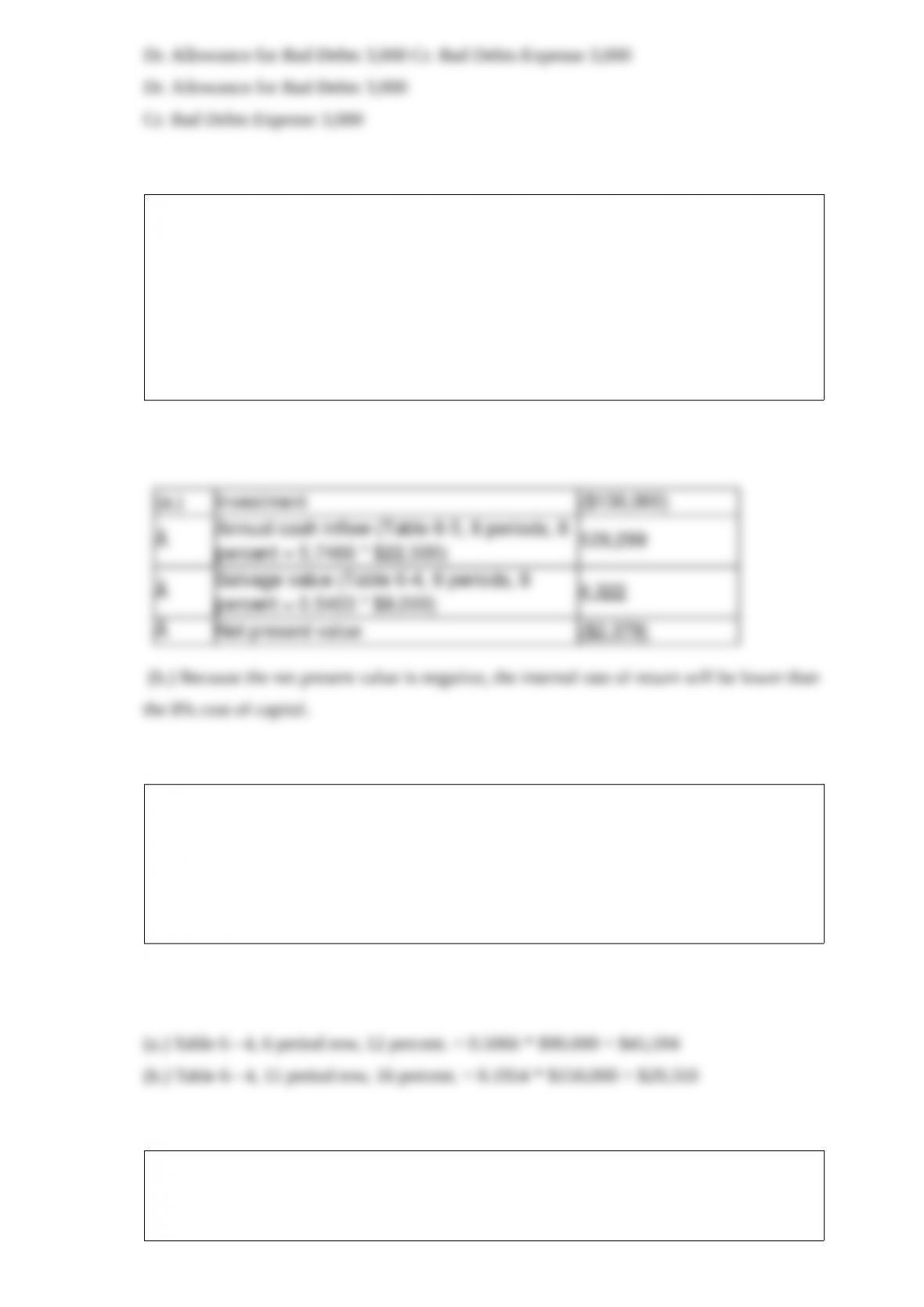
Griffin Co. is considering the investment of $136,000 in a new machine. The machine
will generate cash flow of $22,500 per year for each year of its eight-year life and will
have a salvage value of $8,000 at the end of its life. Griffin Co.’s cost of capital is 8
percent.
(a.) Calculate the net present value of the proposed investment. Ignore income taxes,
and round all answers to the nearest $1.
(b.) What will the internal rate of return on this investment be relative to the cost of
capital? Explain your answer.
Use the appropriate factors from Table 6 – 4 or Table 6 – 5 to answer the following
questions.
(a.) What is the present value of $90,000 to be received in six years using a discount
rate of 12%?
(b.) How much should be invested today at a return on investment of 16% compounded
annually to have $150,000 in eleven years?
If there is a loss on the disposal of a depreciable asset:
A. no cash was received in the disposal transaction.
B. the net book value of the asset was negative.

C. in retrospect, the life over which the asset was depreciated was too short.
D. in retrospect, the depreciation expense recognized over the asset’s life was too low.
Operating income using the contribution margin format income statement is calculated
as:
A. revenue – variable expenses = contribution margin – fixed expenses.
B. revenue – variable expenses = gross profit – fixed expenses.
C. revenue – cost of goods sold = contribution margin – fixed expenses.
D. revenue – cost of goods sold = contribution margin – operating expenses.
The term, “realization,” in revenue recognition refers to which of the following?
A. The entity has completed, or substantially completed, the activities it must perform
to be entitled to the revenue benefits.
B. The product or service has been exchanged for cash, claims to cash, or an asset that
is readily convertible to a known amount of cash or claims to cash.
C. The entity has received an irrevocable order for goods or services.
D. Cash has been received with an irrevocable order for goods or services.
E. None of the above.
Management’s Discussion and Analysis (MD&A):
A. is designed to enhance public disclosure of information about the corporation.
B. is a part of the annual report that should be read by current and potential investors.
C. often includes disclosures concerning non-GAAP financial measures and key
performance indicators that are used to assess the company’s financial and operating
results.
D. None of the above.
E. Items A, B and C are correct.
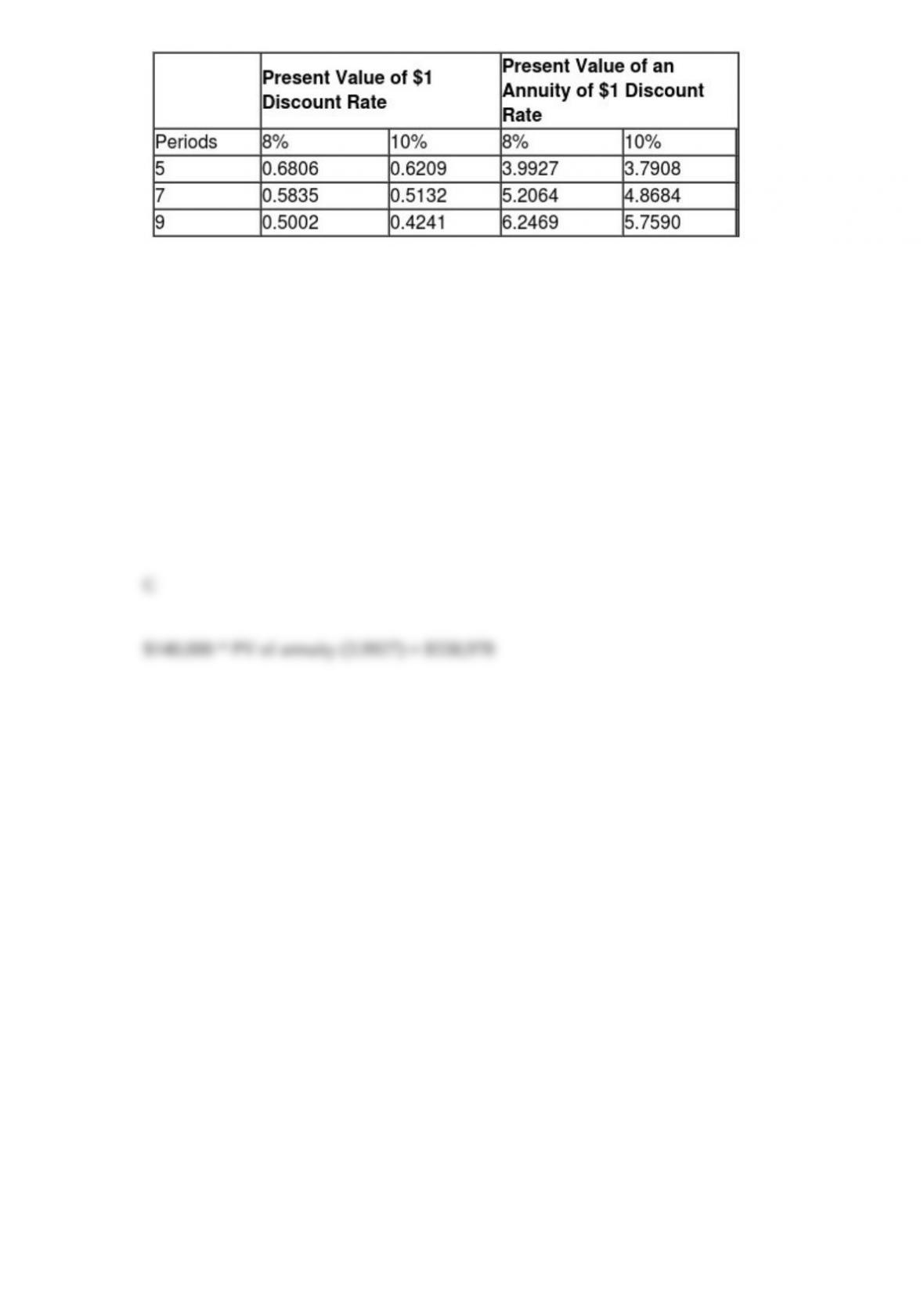
Psyche Company wants to acquire Trim Company. Trim’s ROI has been above average for
its industry; net income has averaged $140,000 a year more than the industry average.
These “excess” earnings are expected to continue at this amount for 5 years. Assuming a
discount rate of 8%, how much goodwill will arise from Psyches’ purchase of Trim?
A. $81,672
B. $176,314
C. $558,978
D. $700,000