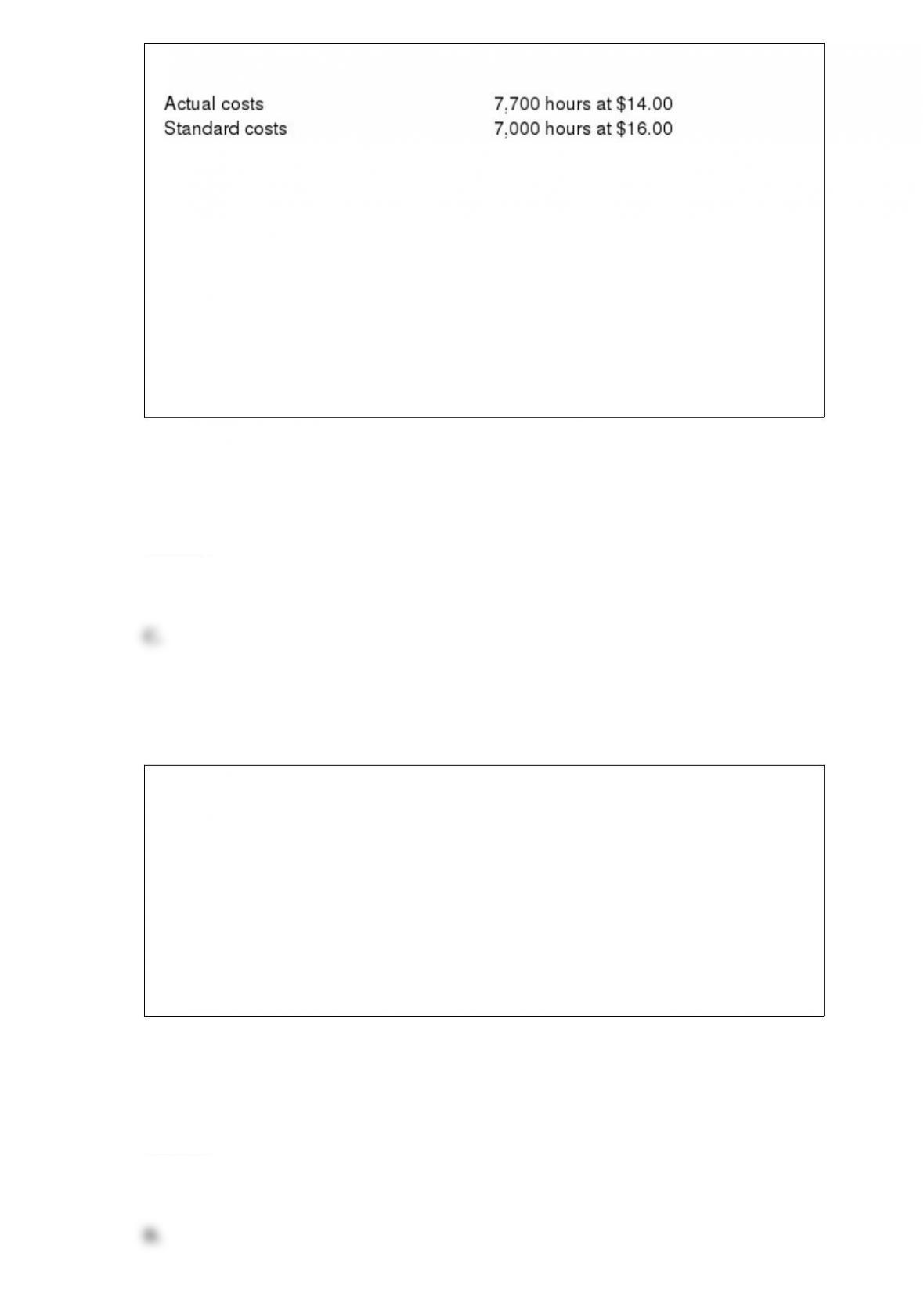
The following data relate to direct labor costs for February:
What is the direct labor rate variance?
A.$14,000 favorable
B.$14,000 unfavorable
C.$15,400 favorable
D.$15,400 unfavorable
Answer:
Which of the following activity bases would be the most appropriate for gasoline costs
of a delivery service, such as United Postal Service?
A.Number of trucks employed
B.Number of miles driven
C.Number of trucks in service
D.Number of packages delivered
Answer:

Woodpecker Co. has $296,000 in accounts receivable on January 1. Budgeted sales for
January are $860,000. Woodpecker Co. expects to sell 20% of its merchandise for cash.
Of the remaining 80% of sales on account, 75% are expected to be collected in the
month of sale and the remainder the following month. The January cash collections
from sales are:
A.$812,000
B.$688,000
C.$468,000
D.$984,000
Answer:
All of the following qualitative considerations may impact upon capital investment
analysis except:
A.time value of money
B.employee morale
C.the impact on product quality
D.manufacturing flexibility
Answer:

Mocha Company manufactures a single product by a continuous process, involving
three production departments. The records indicate that direct materials, direct labor,
and applied factory overhead for Department 2 were $100,000, $125,000, and
$150,000, respectively. The records further indicate that direct materials, direct labor,
and applied factory overhead for Department 3 were $50,000, $60,000, and $70,000,
respectively. In addition, work in process at the beginning of the period for Department
3 totaled $75,000, and work in process at the end of the period totaled $60,000. The
journal entry to record the flow of costs into Department 3 during the period for direct
materials is:
A.Work in Process–Department 3100,000
Materials100,000
B.Work in Process–Department 3125,000
Materials125,000
C.Work in Process–Department 350,000
Materials50,000
D.Work in Process–Department 370,000
Materials70,000
Answer:
Discuss the (1) focus and (2) financial statement emphasis of (a) the percent of sales
and (b) the analysis of receivables methods of estimating bad debts.

Answer:
What term is used to describe the process of monitoring operating results and
comparing actual results with the expected results?
A.Improving
B.Controlling
C.Directing
D.Planning
Answer:
A practical approach which is frequently used by managers when setting normal
long-run prices is the:
A.cost-plus approach
B.economic theory approach

C.price graph approach
D.price skimming
Answer:
A company with 100,000 authorized shares of $4 par common stock issued 40,000
shares at $8. Subsequently, the company declared a 4% stock dividend on a date when
the market price was $12 a share. What is the amount transferred from the Retained
Earnings account to Paid-in Capital accounts as a result of the stock dividend?
A.$12,800
B.$19,200
C.$32,000
D.$48,800
Answer:
By converting dollars to be received in the future into current dollars, the present value
methods take into consideration that money:

A.has an international rate of exchange
B.is the language of business
C.is the measure of assets, liabilities, and stockholders’ equity on financial statements
D.has a time value
Answer:
The method of analyzing capital investment proposals that divides the estimated
average annual income by the average investment is:
A.cash payback method
B.net present value method
C.internal rate of return method
D.average rate of return method
Answer:
Heedy Company is trying to decide how many units of merchandise to order each
month. The company policy is to have 20% of the next month’s sales in inventory at the

end of each month. Projected sales for August, September, and October are 30,000
units, 20,000 units, and 40,000 units, respectively. How many units must be purchased
in September?
A.24,000
B.18,000
C.28,000
D.22,000
Answer:
Department W had 2,400 units, one-third completed at the beginning of the period,
16,000 units were transferred to Department X from Department W during the period,
and 1,800 units were one-half completed at the end of the period. Assume the
completion ratios apply to direct materials and conversion costs.
What are the total gross number of units to be assigned cost on the cost of production
report for Department W?
A.12,000 units
B.13,600 units
C.18,500 units
D.17,800 units
Answer:

Which of the following items would affect the cost of merchandise inventory acquired
during the period?
A.quantity discounts
B.cash discounts
C.freight-in
D.all of these costs
Answer:
A company has 10,000 shares of $10 par common stock outstanding. Prepare entries to
record the following:
(a) Purchased 1,000 shares of treasury stock at $12. The treasury stock is accounted for
by the cost method.
(b) Sold 500 shares of treasury stock at $15.
(c) Purchased equipment for $75,000, paying $25,000 in cash and issuing 4,000 shares
of common stock for the remaining.
(d) Sold 500 shares of treasury stock at $11.
Answer:
All of the following are examples of activity bases except:
A.salaries of supervisors
B.quality inspections of products
C.number of machine setups

D.raw materials storage
Answer:
Using a perpetual inventory system, the entry to record the return of merchandise
purchased on account includes a
A.debit to Cost of Merchandise Sold
B.credit to Accounts Payable
C.credit to Merchandise Inventory
D.credit to Sales
Answer:
The journal entry a company uses to record the payment of a discounted note is
A.debit Notes Payable and Interest Expense; credit Cash
B.debit Notes Payable; credit Cash
C.debit Cash; credit Notes Payable

D.debit Accounts Payable; credit Cash
Answer:
Next year’s sales forecast shows that 20,000 units of Product A and 22,000 units of
Product B are going to be sold for prices of $10 and $12 per unit, respectively. The
desired ending inventory of Product A is 20% higher than its beginning inventory of
2,000 units. The beginning inventory of Product B is 2,500 units. The desired ending
inventory of B is 3,000 units.
Budgeted purchases of Product B for the year would be:
A.24,500 units
B.22,500 units
C.26,500 units
D.23,200 units
Answer:
Expenses follow the same debit and credit rules as
A.Revenues
B.Drawing Account
C.Capital Account
D.Liabilities
Answer:
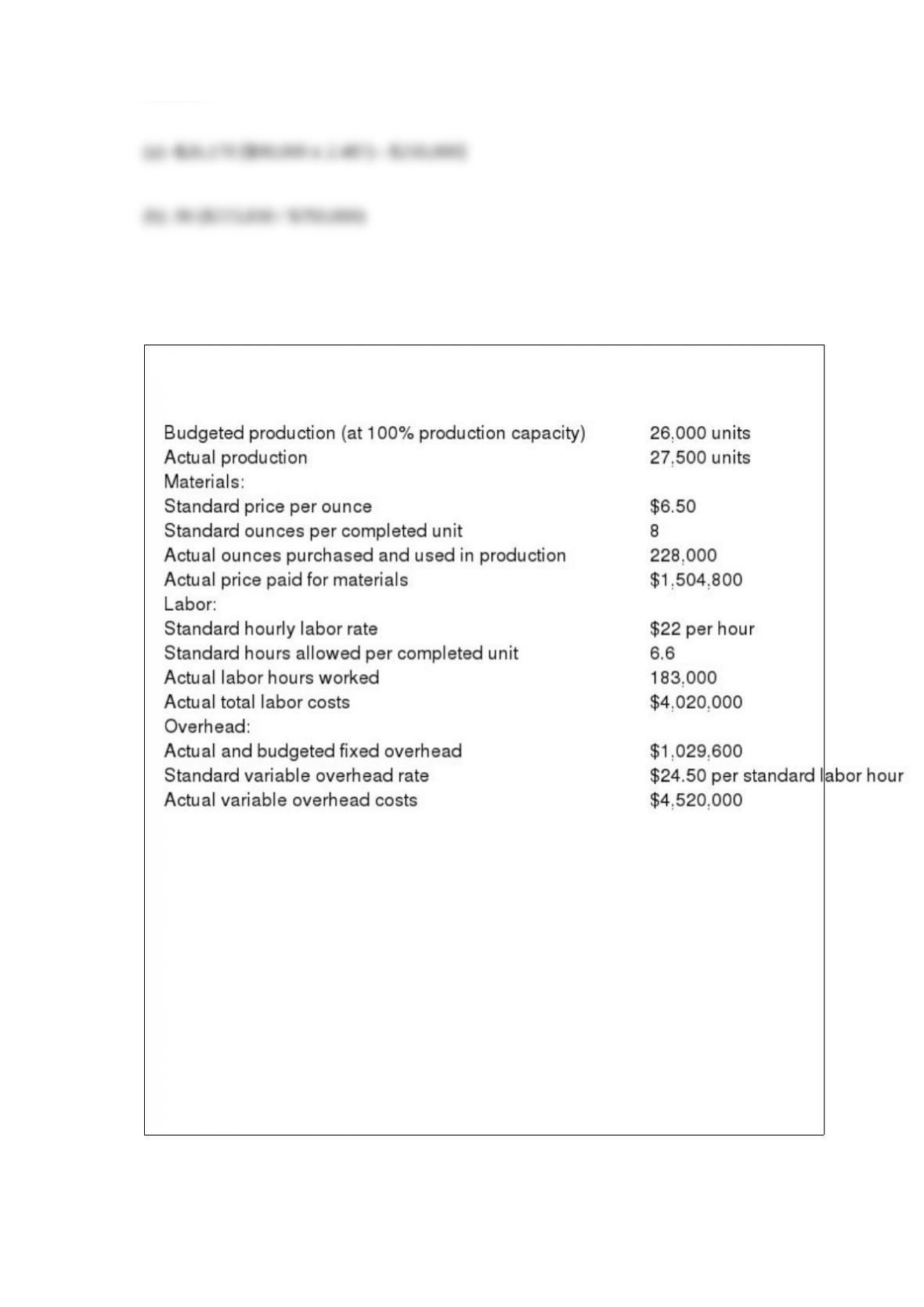
A project has estimated annual cash flows of $90,000 for three years and is estimated to
cost $250,000. Assume a minimum acceptable rate of return of 10%. Using the
following tables determine the (a) net present value of the project and (b) the present
value index, rounded to two decimal places.
Below is a table for the present value of $1 at compound interest.
Below is a table for the present value of an annuity of $1 at compound interest.
Answer:
The following data is given for the Zoyza Company:
Overhead is applied on standard labor hours.
The factory overhead controllable variance is:
A.$73,250F
B.$73,250U
C.$59,400F
D.$59,400U

Answer:
The journal entry a company records for the issuance of bonds when the contract rate is
less than the market rate would be
A.debit Bonds Payable, credit Cash
B.debit Cash and Discount on Bonds Payable, credit Bonds Payable
C.debit Cash, credit Premium on Bonds Payable and Bonds Payable
D.debit Cash, credit Bonds Payable
Answer:
Holly and Luke formed a partnership, investing $240,000 and $80,000, respectively.
Determine their participation in the year’s net income of $380,000 under each of the
following independent assumptions:
(a) No agreement concerning division of net income;
(b) Divided in the ratio of original capital investment;
(c) Interest at the rate of 15% allowed on original investments and the remainder
divided in the ratio of 2:3;
(d) Salary allowances of $50,000 and $70,000, respectively, and the balance divided
equally;
(e) Allowance of interest at the rate of 15% on original investments, salary allowances
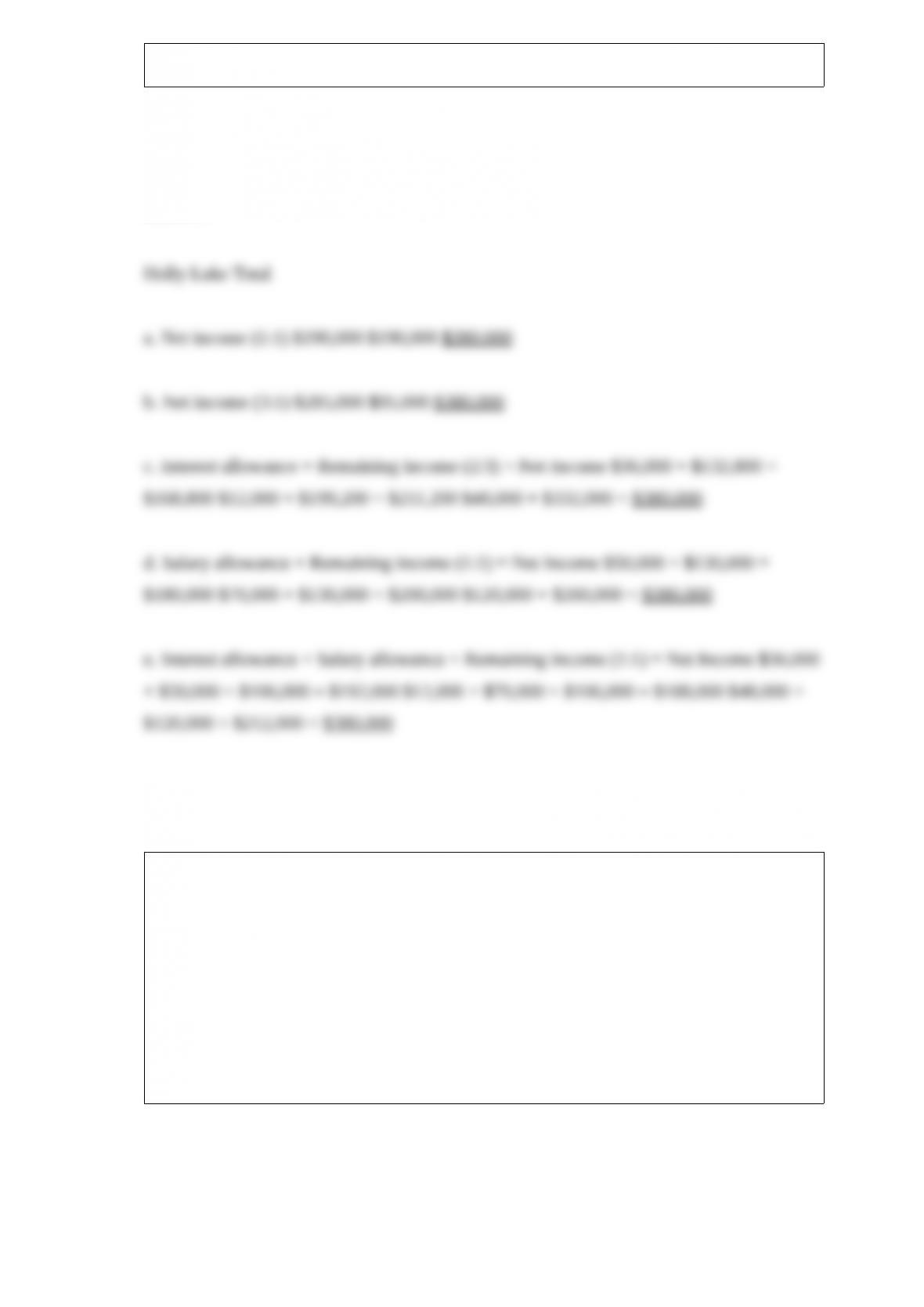
of $50,000 and $70,000, respectively, and the remainder divided equally.
Answer:
If title to merchandise purchases passes to the buyer when the goods are shipped from
the seller, the terms are
A.n/30
B.FOB shipping point
C.FOB destination
D.consigned
Answer:

In a cost-volume-profit chart, the
A.total cost line begins at zero.
B.slope of the total cost line is dependent on the fixed cost per unit.
C.total cost line begins at the total fixed cost value on the vertical axis.
D.total cost line normally ends at the highest sales value.
Answer:
Zeke Company sells 25,000 units at $21 per unit. Variable costs are $10 per unit, and
fixed costs are $75,000. The contribution margin ratio and the unit contribution margin
are:
A.47% and $11 per unit
B.53% and $7 per unit
C.47% and $8 per unit
D.52% and $11 per unit
Answer:
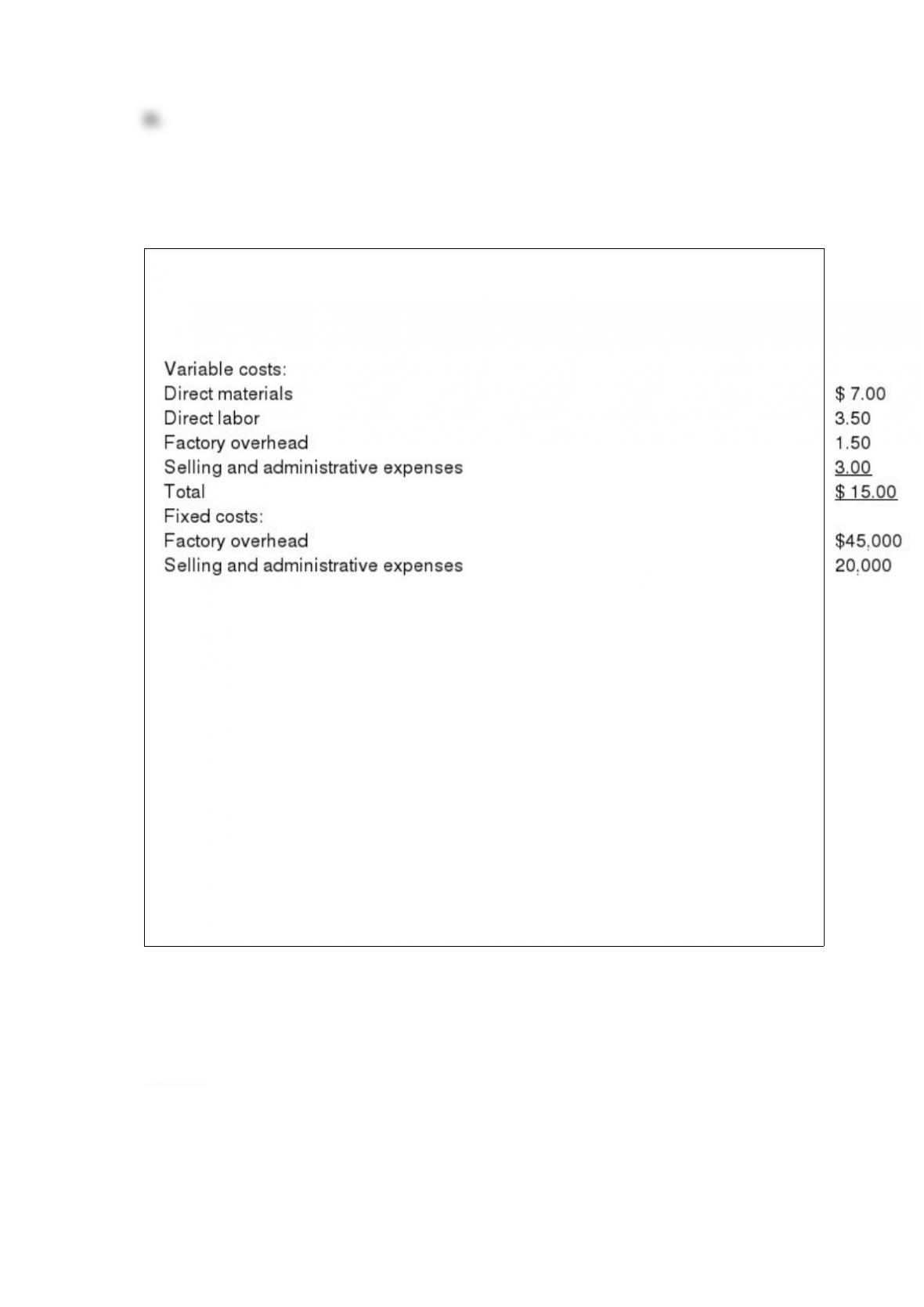
Moon Company uses the variable cost concept of applying the cost-plus approach to
product pricing. The costs and expenses of producing and selling 75,000 units of
Product T are as follows:
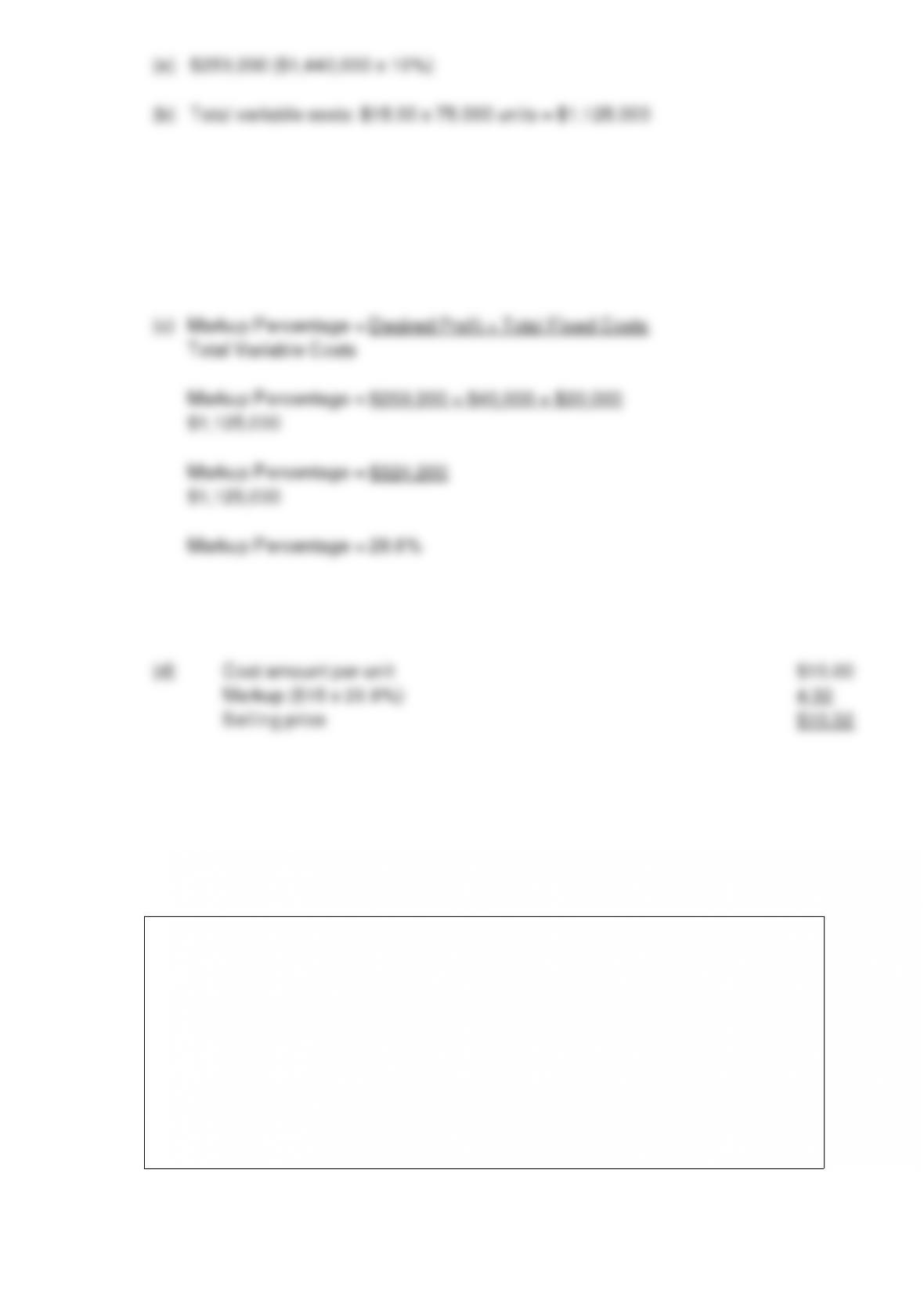
Moon desires a profit equal to a 18% rate of return on invested assets of $1,440,000.
(a) Determine the amount of desired profit from the production and sale of Product T.
(b) Determine the total variable costs for the production and sale of 75,000 units of
Product T.
(c) Determine the markup percentage for Product T.
(d) Determine the unit selling price of Product T.
Round your markup percentage to one decimal place and other intermediate
calculations and final answer to two decimal places.
Answer:
Which of the following below generally is the most useful in analyzing companies of
different sizes
A.comparative statements
B.common-sized financial statements
C.price-level accounting
D.audit report

Answer:
A business is operating at 70% of capacity and is currently purchasing a part used in its
manufacturing operations for $24 per unit. The unit cost for the business to make the
part is $36, including fixed costs, and $28, not including fixed costs. If 15,000 units of
the part are normally purchased during the year but could be manufactured using
unused capacity, what would be the amount of differential cost increase or decrease
from making the part rather than purchasing it?
A.$60,000 cost decrease
B.$180,000 cost increase
C.$60,000 cost increase
D.$180,000 cost decrease
Answer:
Mocha Company manufactures a single product by a continuous process, involving
three production departments. The records indicate that direct materials, direct labor,
and applied factory overhead for Department 1 were $100,000, $125,000, and
$150,000, respectively. The records further indicate that direct materials, direct labor,
and applied factory overhead for Department 2 were $50,000, $60,000, and $70,000,
respectively. Department 2 has transferred-in costs of $390,000 for the current period.
In addition, work in process at the beginning of the period for Department 2 totaled
$75,000, and work in process at the end of the period totaled $90,000. The journal entry
to record the flow of costs into Department 3 during the period is:

A.Work in Process–Department 3375,000
Work in Process–Department 2375,000
B.Work in Process–Department 3570,000
Work in Process–Department 2570,000
C.Work in Process–Department 3490,000
Work in Process–Department 2490,000
D.Work in Process–Department 3555,000
Work in Process–Department 2555,000
Answer:
The unit of measure concept:
A.is only used in the financial statements of manufacturing companies.
B.is not important when applying the cost concept.
C.requires that different units be used for assets and liabilities.
D.requires that economic data be reported in yen in Japan or dollars in the U.S.
Answer: