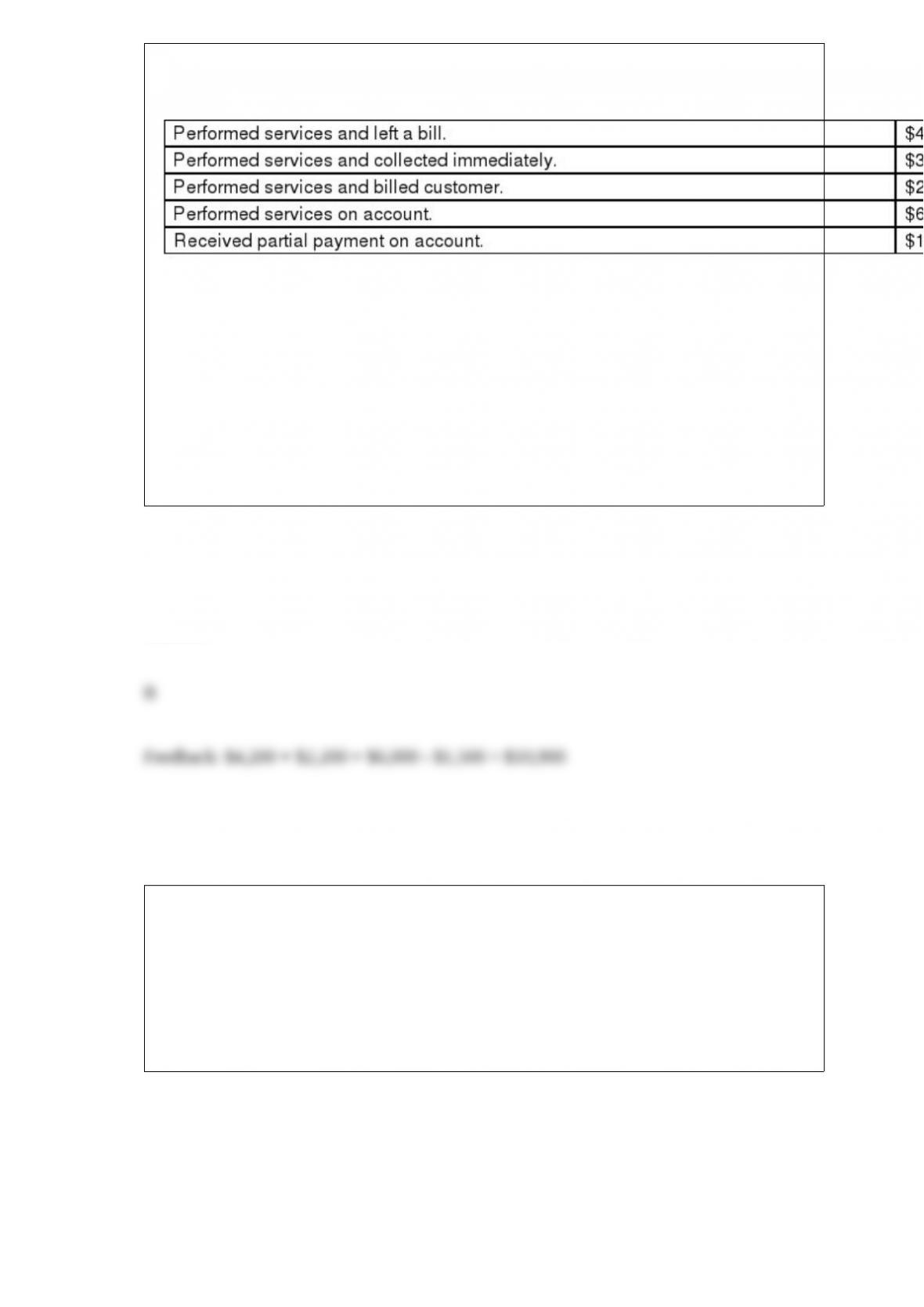
What would be the account balance in Accounts Receivable after the following
transactions, assuming a zero beginning balance?
A. $17,400
B. $10,900
C. $14,400
D. $ 4,500
E. $ 2,000
Answer:
On August 31, 2013, Victory Corporation’s common stock is priced at $30 per share
before any stock dividend or split, and the stockholders’ equity section of its balance
sheet appears as follows. Assume that the company declares and immediately
distributes a 35% stock dividend.
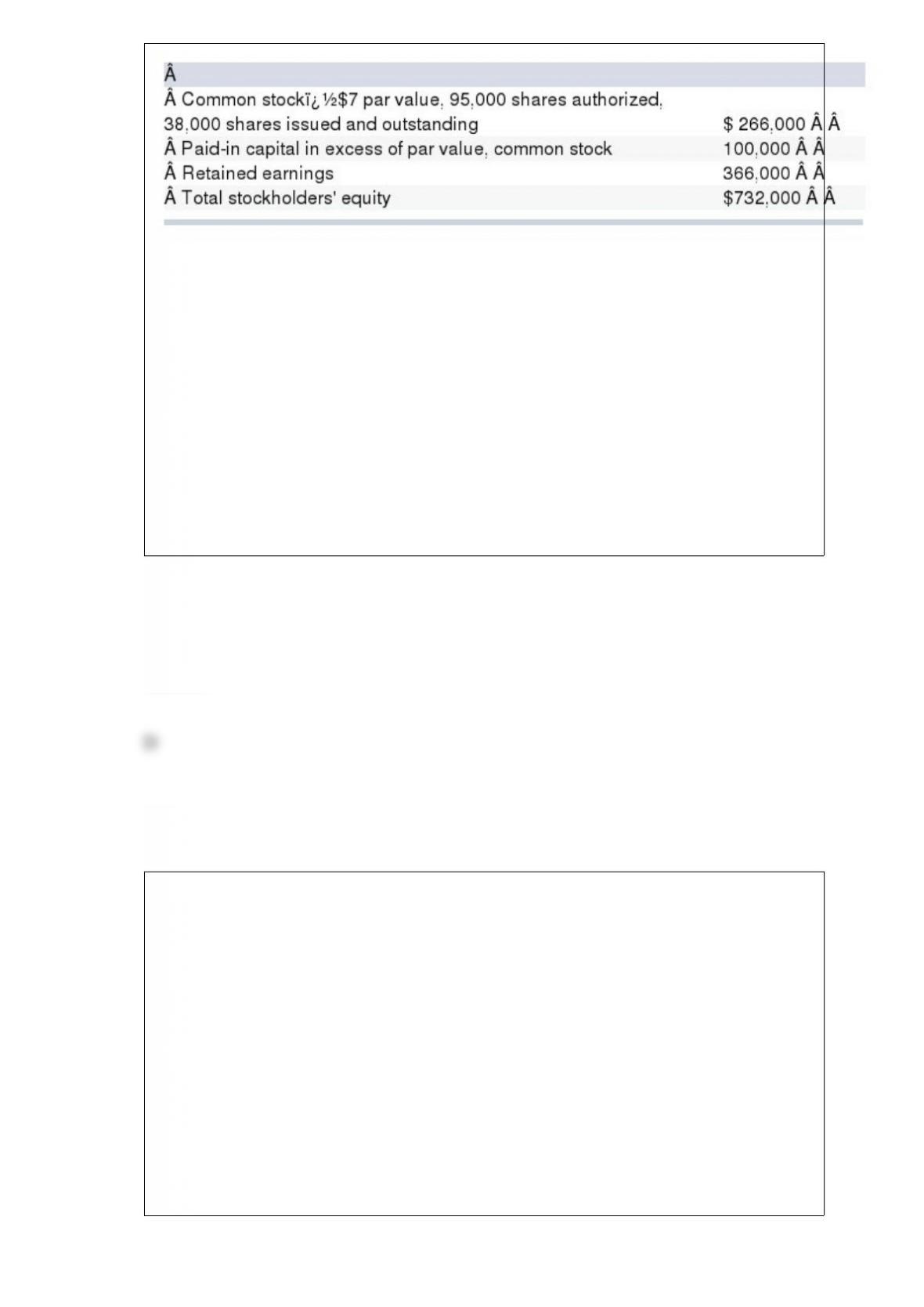
What is the total amount in the Paid-In Capital account immediately after the stock
dividend?
A. $193,100
B. $195,000
C. $366,000
D. $100,000
E. $231,000
Answer:
An accounts receivable ledger is:
A. A subsidiary ledger that contains an account for each credit customer.
B. A list of the balances of selected accounts in the accounts receivable ledger that is
added to show the total amount of the significant accounts receivable outstanding.
C. A book of original entry that is designed and used for recording only a specified type
of transaction.
D. The ledger that contains the financial statement accounts of a business.
E. A subsidiary ledger that contains a separate account for each creditor (supplier) to the
company.

Answer:
Beginning assets were $700,000, beginning equity was $225,000, revenue for the year
was $523,000, common stock issued during the year totaled $320,000, expenses for the
year were $392,000, ending equity is $751,000, and ending assets are $963,000.
What are the ending liabilities for the year?
A. $738,000
B. $998,000
C. $212,000
D. $203,000
E. $475,000
Answer:
The net cash flow of a particular investment project:
A. Does not take income taxes into consideration.
B. Equals the total of the inflows of the project.
C. Equals the total of the outflows of the project.
D. Does not include depreciation.

E. Is equal to operating income each period.
Answer:
A company has two departments, Aa and Bb, that incur delivery expenses. An analysis
of the total delivery expense of $9,000 indicates that Dept. Aa had a direct expense of
$1,000 for deliveries. None of the $9,000 is a direct expense to Dept. Bb. The analysis
also indicates that 60% of regular delivery requests originate in Dept. Aa and 40% in
Dept. Bb. The delivery expenses that should be charged to Dept. Aa and Dept. Bb,
respectively, are:
Aa Bb
A. $4,500 $4,500
B. $5,800 $3,200
C. $5,500 $3,500
D. $5,500 $4,500
E. $5,400 $3,600
Answer:
A company had total assets of $1,760,000, total cash flows of $1,320,000, and cash
flows from operations of $205,000. The cash flow on total assets ratio is equal to:
A. 1.33%
B. 8.58%
C. 11.65%
D. 15.5%
E. 75%
Answer:
Costs that are incurred as part of the manufacturing process but are not clearly
associated with specific units of product or batches of production, including all
manufacturing costs other than direct material and direct labor costs, are called:
A. Administrative expenses
B. Nonmanufacturing costs
C. Sunk costs
D. Factory overhead
E. Preproduction costs

Answer:
The credit purchase of a delivery truck for $4,700 was posted to Delivery Trucks as a
$4,700 debit and to Accounts Payable as a $4,700 debit. What effect would this error
have on the trial balance?
A. The total of the Debit column of the trial balance will exceed the total of the Credit
column by $4,700.
B. The total of the Credit column of the trial balance will exceed the total of the Debit
column by $4,700.
C. The total of the Debit column of the trial balance will exceed the total of the Credit
column by $9,400.
D. The total of the Credit column of the trial balance will exceed the total of the Debit
column by $9,400.
E. The total of the Debit column of the trial balance will equal the total of the Credit
column.
Answer:
Expenses that are not easily associated with a specific department, and which are
incurred for the benefit of more than one department, are:
A. Fixed expenses
B. Indirect expenses
C. Direct expenses
D. Uncontrollable expenses
E. Variable expenses
Answer:
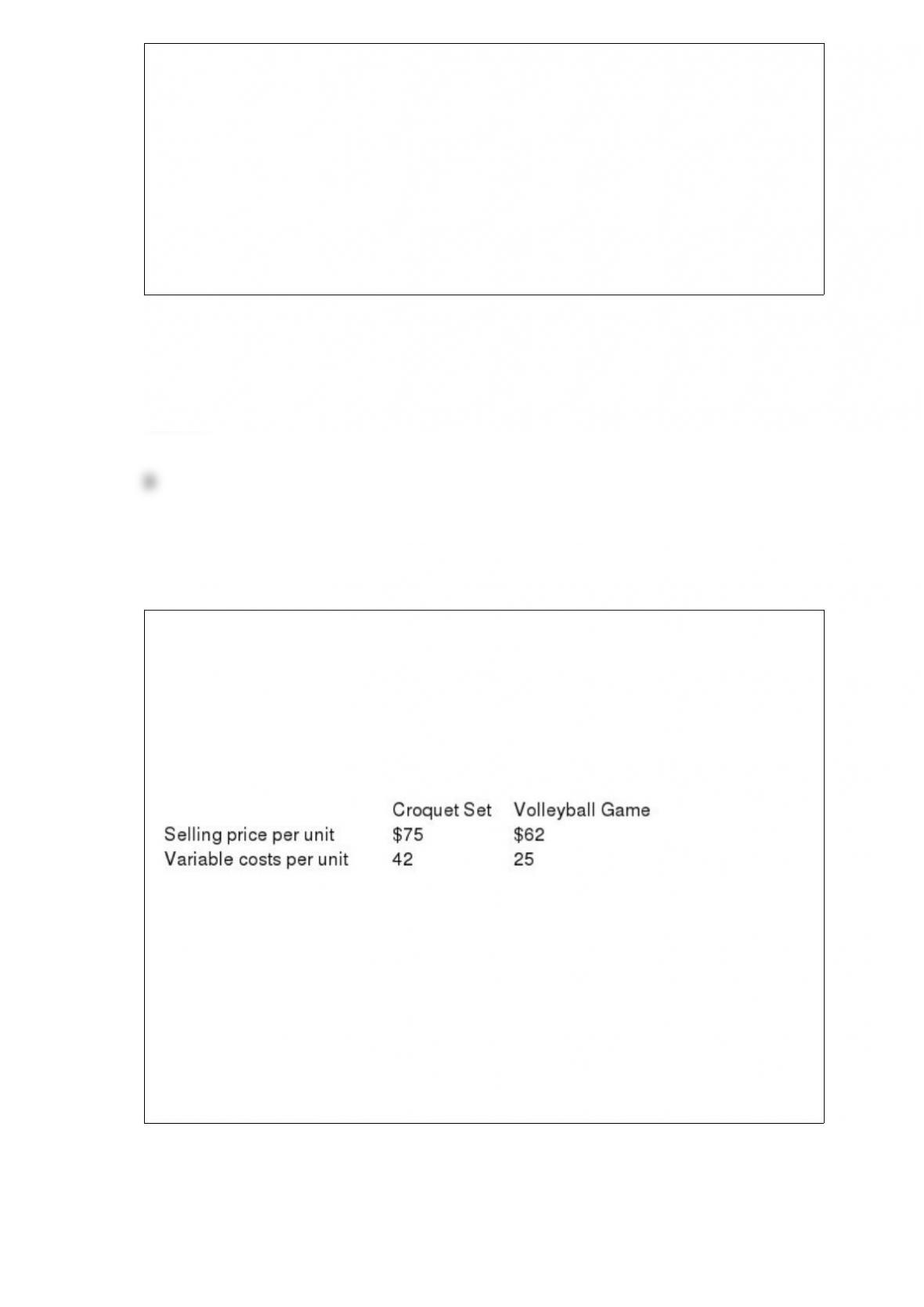
Bandy Corporation owns a machine that manufactures lawn games. Production time for
the croquet set is 10 units per hour and for the volley ball game is 8 units per hour. The
machines capacity is 1,500 hours per year. Both products are sold to a single customer
who has agreed to buy all of the companys output up to a maximum of 4,000 croquet
sets and 10,000 volleyball games. Selling prices and variable costs per unit are shown
below. Based on this information, what is Bandy Corporations most profitable sales
mix?
A. 15,000 croquet sets.
B. 12,000 volleyball games.
C. 4,000 croquet sets and 10,000 volleyball games.
D. 4,000 croquet sets and 8,800 volleyball games.
E. 2,500 croquet sets and 10,000 volleyball games.
Answer:
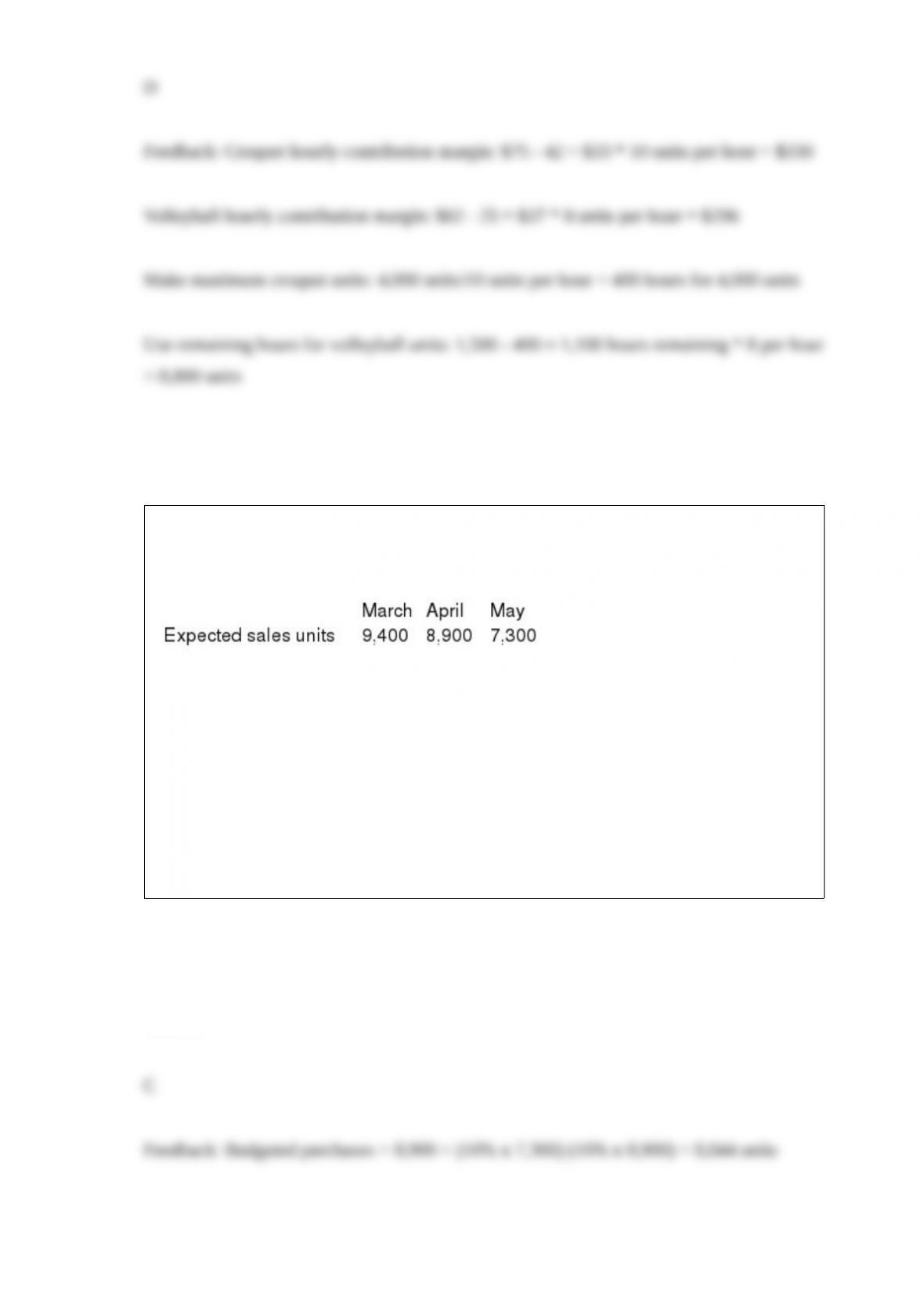
Kabuki Companys policy is to have 16% of the next months sales as desired ending
inventory. Estimated sales are shown in the following table. Given this data, what are
Kabukis estimated purchases for April?
A. 8,584
B. 9,176
C. 8,644
D. 9,256
E. 9,000
Answer:
Reference: 21_04
A company has established 5 pounds of Material M at $2 per pound as the standard for
the material in its Product A. The company has just produced 1,000 units of this
product, using 5,200 pounds of Material M that cost $9,880.
The direct materials price variance is:
A. $520 unfavorable
B. $400 unfavorable
C. $120 favorable
D. $520 favorable
E. $400 favorable
Answer:
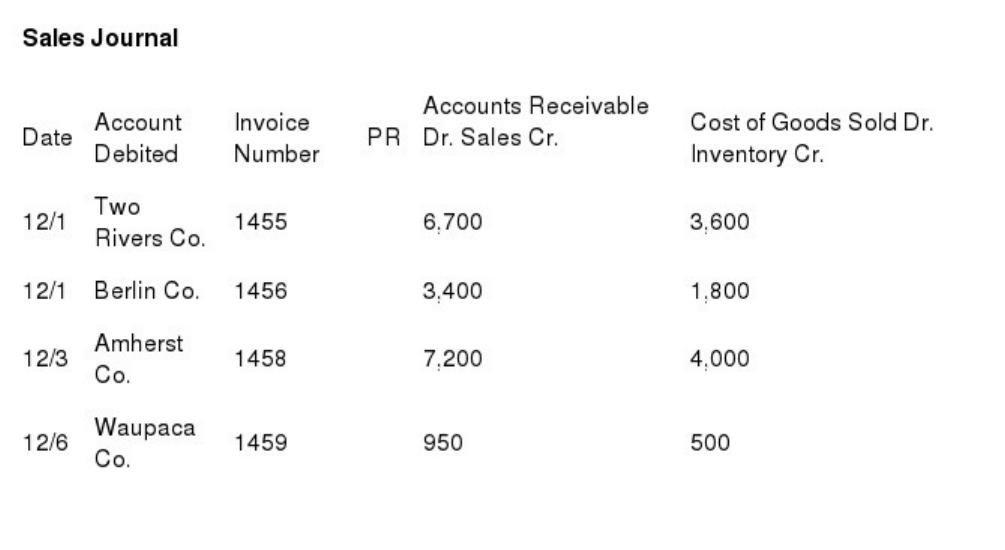
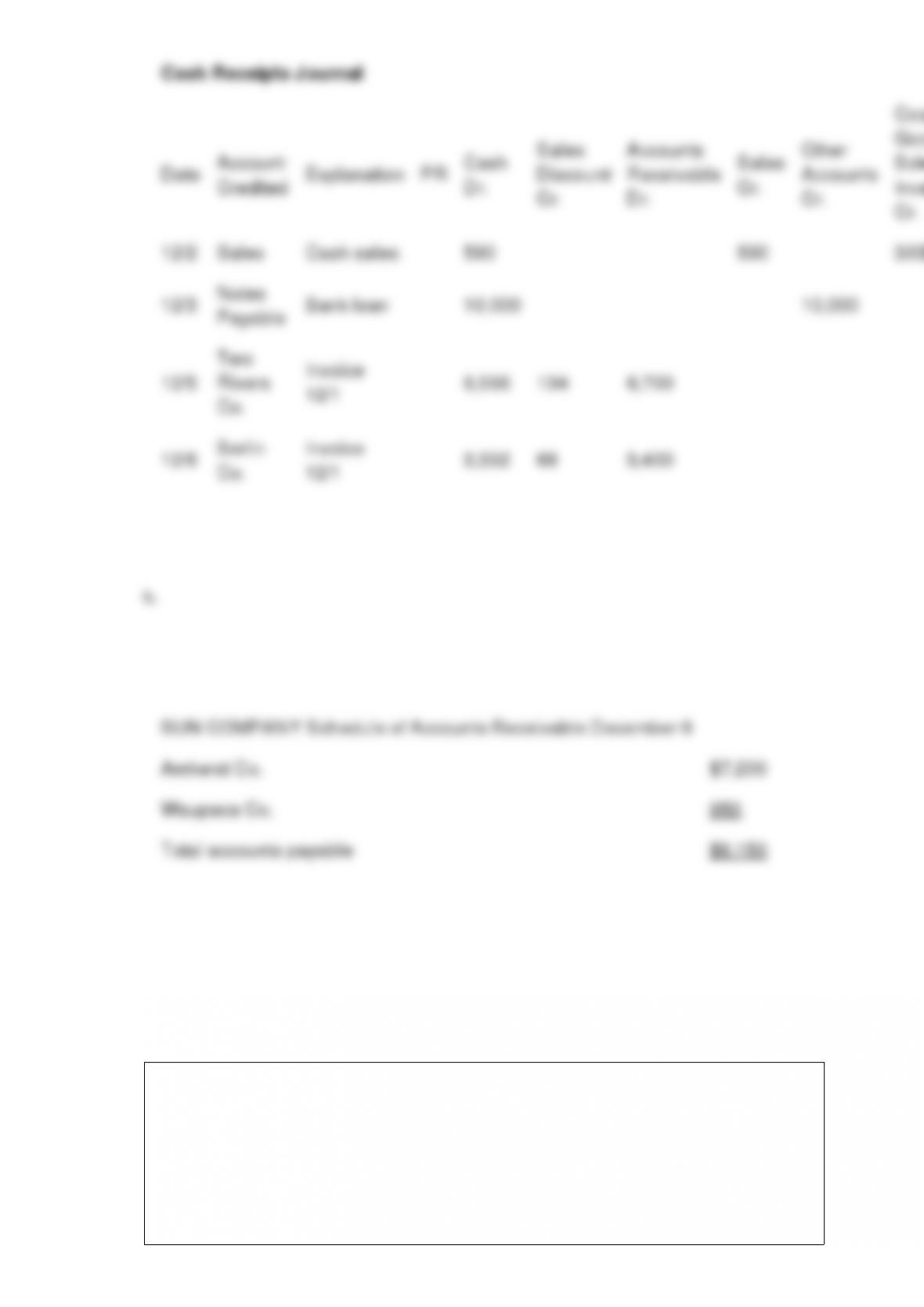
The Sun Company completed the following sales and cash receipts transactions during
the first week of December. The Sun Company uses the perpetual inventory system.
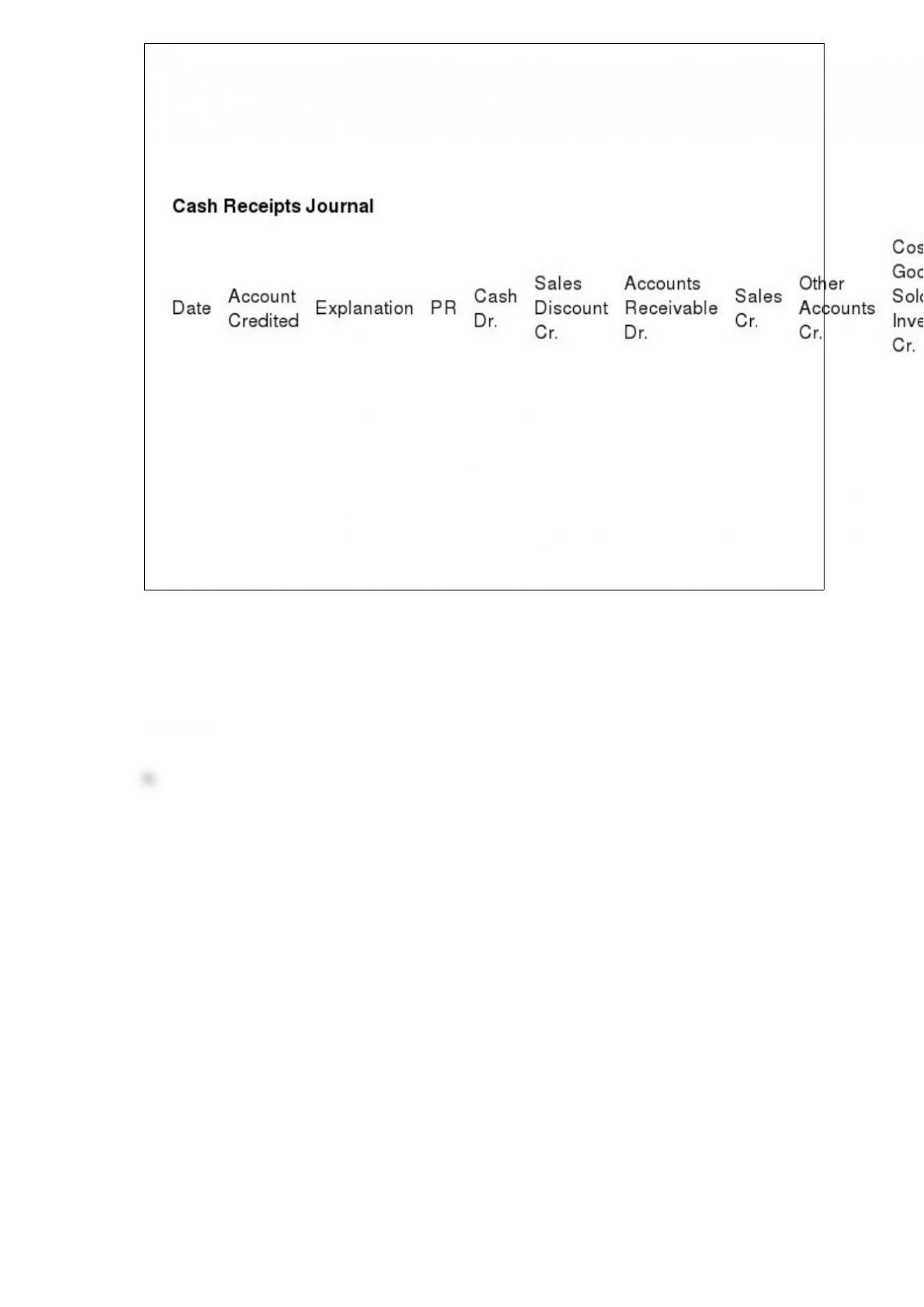
a. Use the sales journal and the cash receipts journal to record these transactions.
b. Prepare a schedule of accounts receivable. There were no account receivables at
December 1.
Answer:
Toys “R” Us had cost of goods sold of $9,421 million, ending inventory of $2,089
million, and average inventory of $1,965 million. Its days’ sales in inventory equals:
A. 0.21
B. 4.51

C. 4.79
D. 76.1 days
E. 80.9 days
Answer:
Consolidated financial statements:
A. Show the results of operations, cash flows, and the financial position of all entities
under a parent’s control.
B. Show the results of operations, cash flows, and the financial position of the parent
only.
C. Show the results of operations, cash flows, and the financial position of the
subsidiary only.
D. Include the investments account on the balance sheet.
E. Do not include a balance sheet.
Answer:
The accounting rate of return is calculated as:
A. The after-tax income divided by the total investment.
B. The after-tax income divided by the average investment.
C. The cash flows divided by the average investment.
D. The cash flows divided by the total investment.
E. The average investment divided by the after-tax income.
Answer:
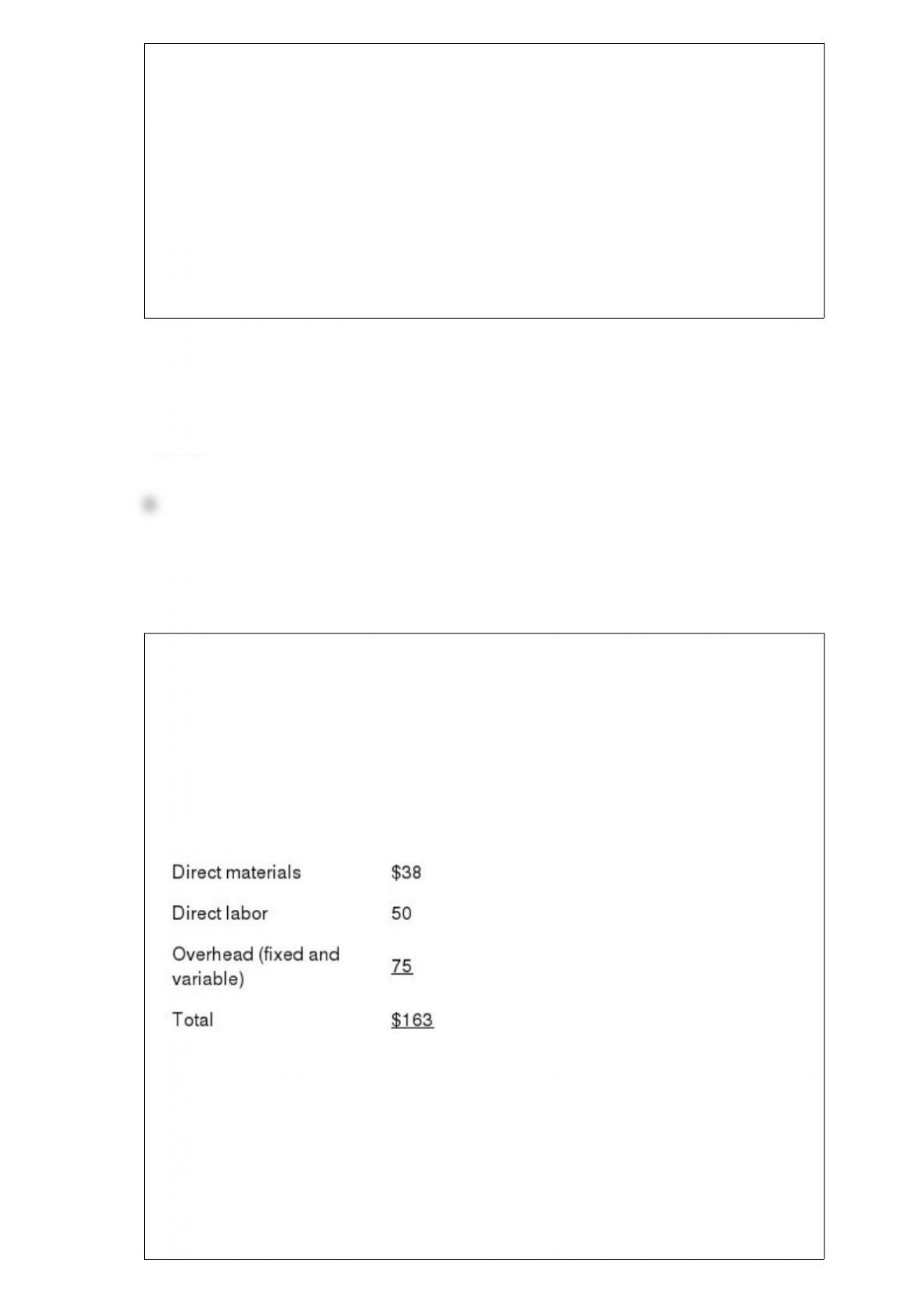
Derby Inc. manufactures a product which contains a small part. The company has
always purchased this motor from a supplier for $125 each. Derby recently upgraded its
own manufacturing capabilities and now has enough excess capacity (including trained
workers) to begin manufacturing the motor instead of buying it. The company prepared
the following per unit cost projections of making the motor, assuming that
overhead is allocated to the part at the normal predetermined overhead rate of 150% of
direct labor cost.
The required volume of output to produce the motors will not require any incremental
fixed overhead. Incremental variable overhead cost is $21 per motor. What is the effect
on income if Derby decides to make the motors?
A. Income will decrease by $16 per unit.
B. Income will increase by $16 per unit.
C. Income will increase by $23 per unit.
D. Income will decrease by $23 per unit.
E. Income will increase by $39 per unit.
Answer:
The cost of labor that is not clearly associated with specific units or batches of product
is called:
A. Unspecified labor
B. Direct labor
C. Indirect labor
D. Basic labor
E. Joint labor
Answer:
A manufacturing company uses a job order cost accounting system. Overhead is applied
using pounds of direct materials used as an allocation base. Total costs for a particular
job were $5,720. Of this amount $2,600 was direct labor and $1,040 was direct
material. The company pays $26 per hour of direct labor and $2 per pound of direct
materials. What is this companys overhead rate?
A. $2 per pound of direct material used.
B. $1,040 per pound of direct material used.
C. $520 per pound of direct material used.
D. $4 per pound of direct material used.
E. $2,080 per pound of direct material used.
Answer:
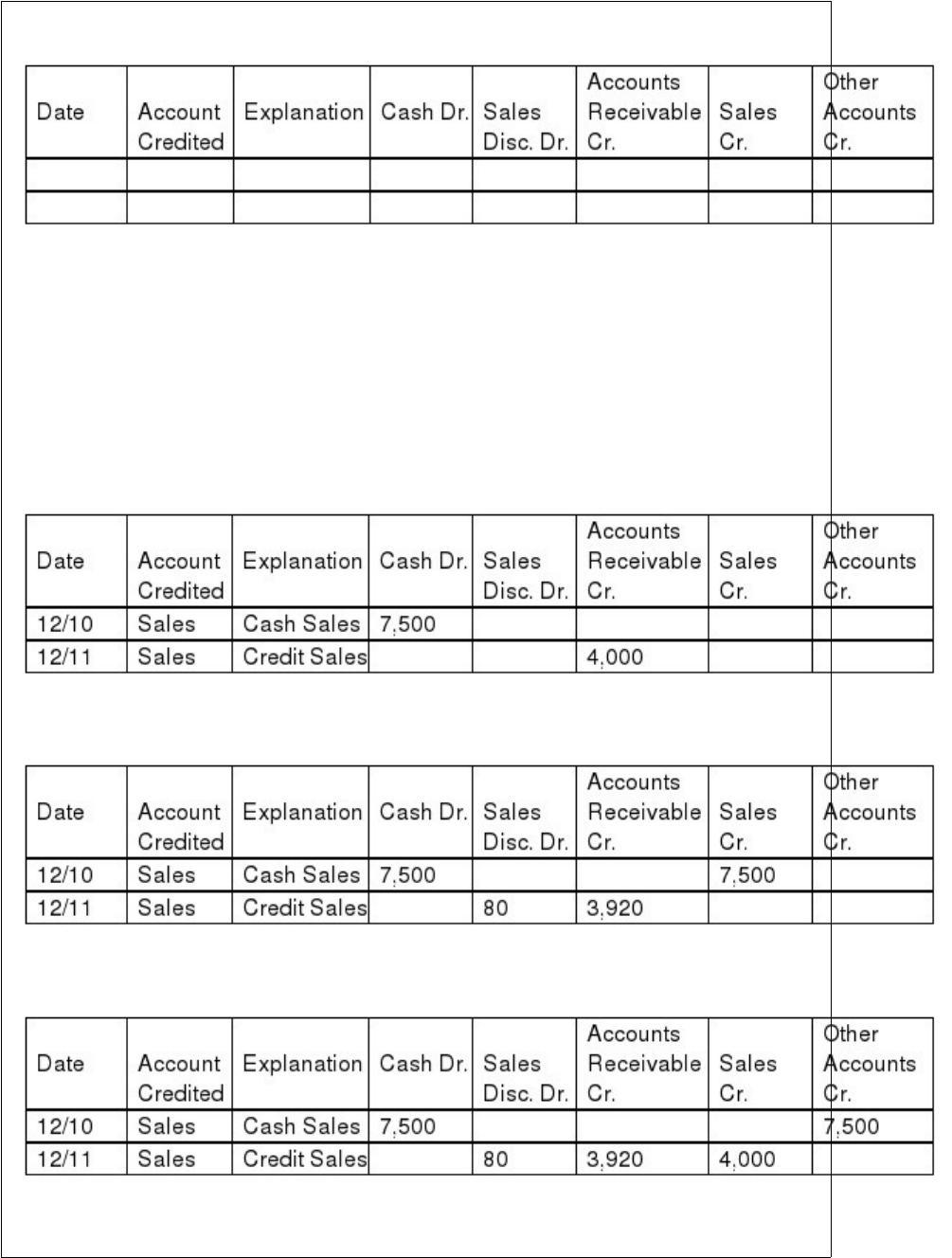
A company uses a cash receipts journal (periodic system) as shown below:
How would the following transactions be recorded in this cash receipts journal?
12/10 Sold merchandise to Cat Company for $7,500 cash (cost is $4,250)
12/11 Sold merchandise on credit to Dog, Inc, Invoice No. 852, for $4,000 (cost is
$2,200) Terms are 2/10, n/30.
A.
B.
C.
D.
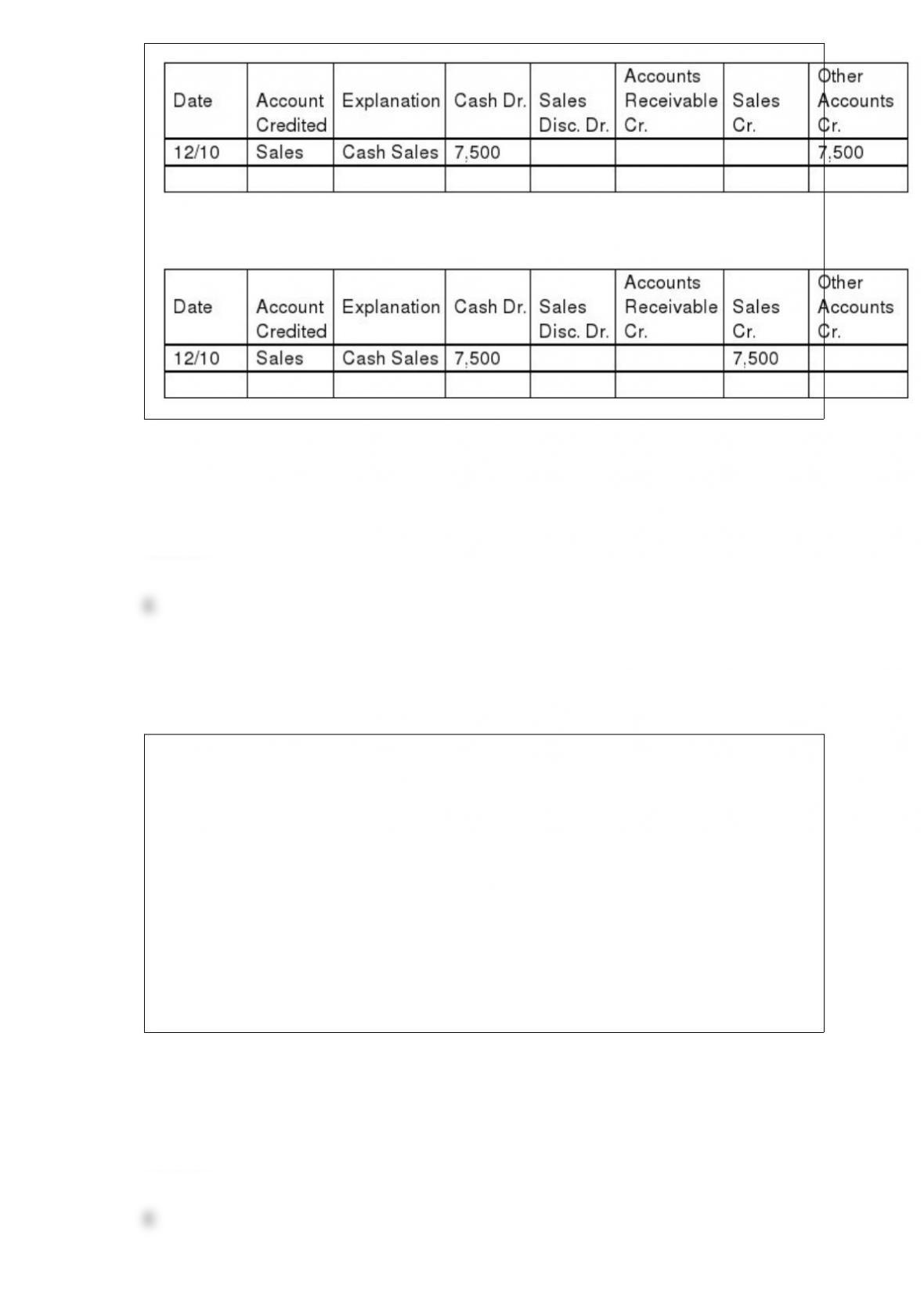
E.
Answer:
An analytical technique used by management to focus on the most significant variances
and give less attention to the areas where performance is satisfactory is known as:
A. Controllable management.
B. Management by variance.
C. Performance management.
D. Management by objectives.
E. Management by exception.
Answer:
Force and Zabala are partners. Force’s capital balance in the partnership is $98,000 and
Zabala ‘s capital balance is $53,000. Force and Zabala have agreed to share equally in
income or loss. Force and Zabala agree to accept Burns with a 25% interest. Burns will
invest $56,000 in the partnership. Which of the following statements is correct?
A. Forces capital balance after the admission of Burns is $50,875.
B. Burns capital after admission is $51,750.
C. Zabalas capital after the admission of Burns is $98,000.
D. Burns capital after admission is $56,000.
E. Forces capital balance after the admission of Burns is $53,000.
Answer:
An accounting procedure that (1) estimates and reports bad debts expense from credit
sales during the period of the sales and (2) reports accounts receivable at the amount of
cash to be collected is the:
A. Allowance method of accounting for bad debts.
B. Aging of notes receivable.

C. Adjustment method for uncollectible debts.
D. Direct write-off method of accounting for bad debts.
E. Cash basis method of accounting for bad debts.
Answer:
The Asian segment of a multinational company had a segment return on assets of 60%.
If the revenues and operating income of this segment were $17,000 million and $14,586
million, respectively, what is the segment’s average total assets amount?
A. $24,310 million
B. $28,333 million
C. $52,643 million
D. $10,200 million
E. $8,751 million
Answer:
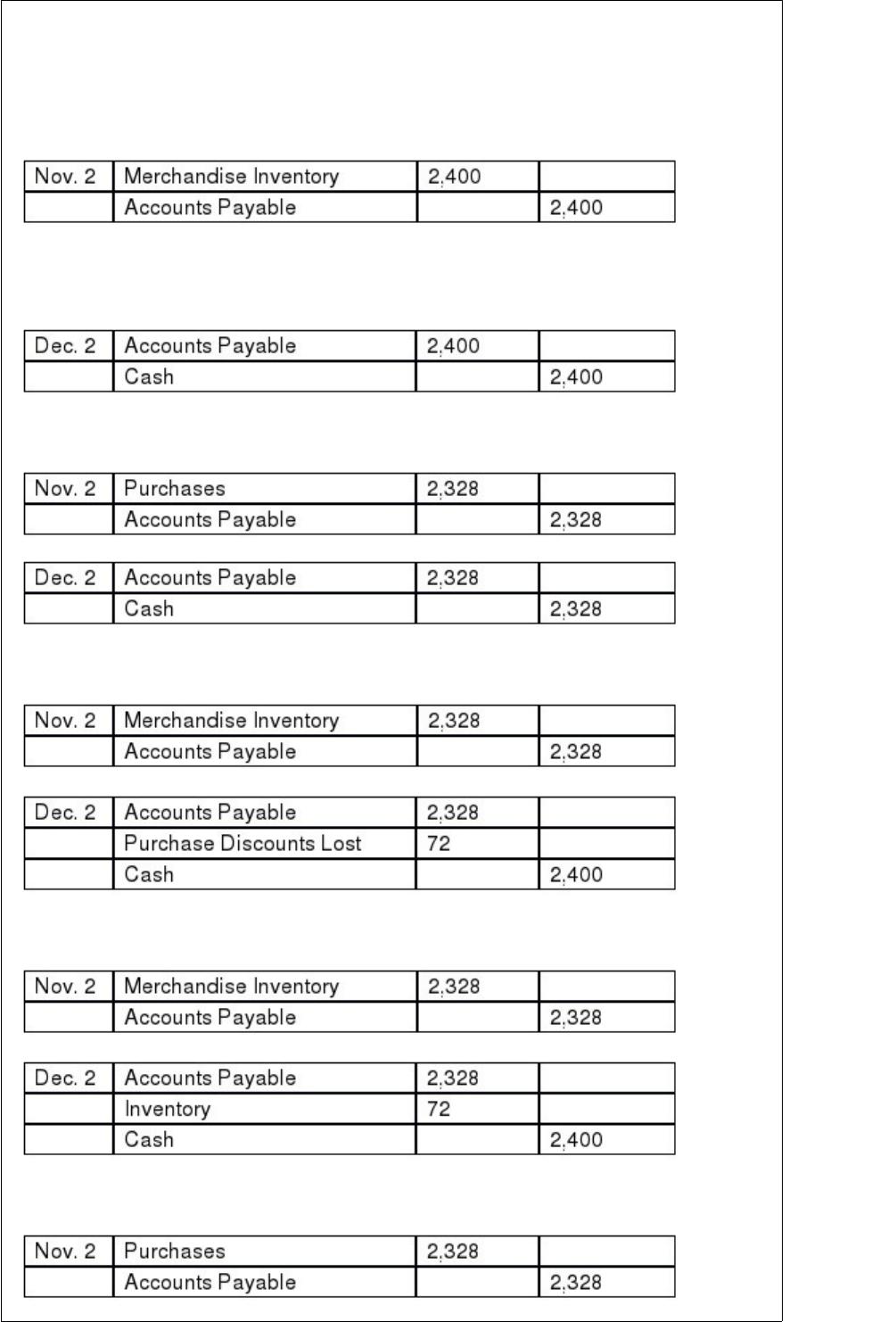
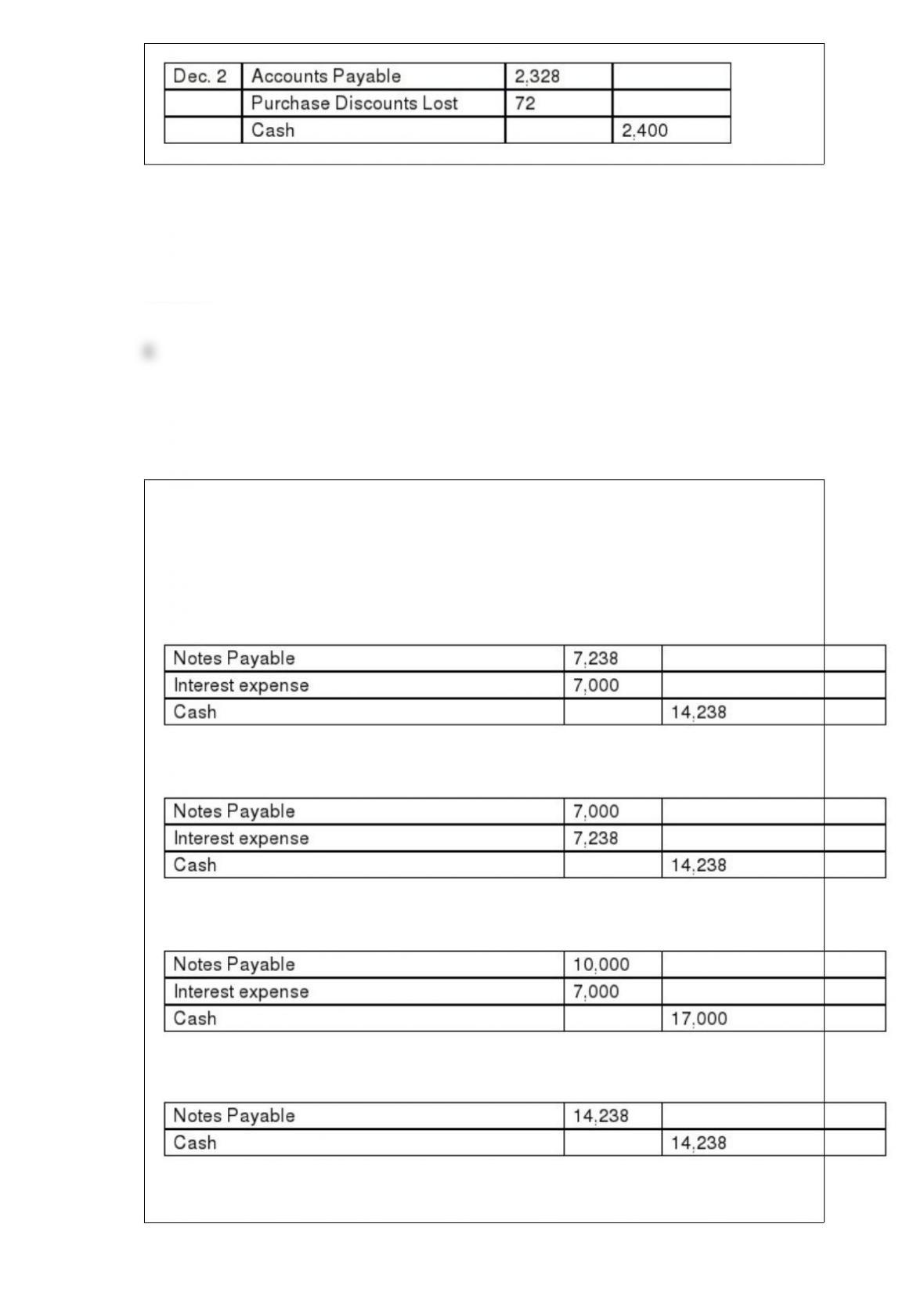
A company purchases merchandise on November 2 at a $2,400 invoice price (terms
3/10, n/30) and then pays all amounts owed on December 2. Using periodic inventory
and net purchases methods, what are the proper entries to record these two transactions?
A.
nventoryDiscounts Lostecord these two transactions.thod, what are the proper entries to
record the pury purchases
B.
C.
D.
E.
Answer:
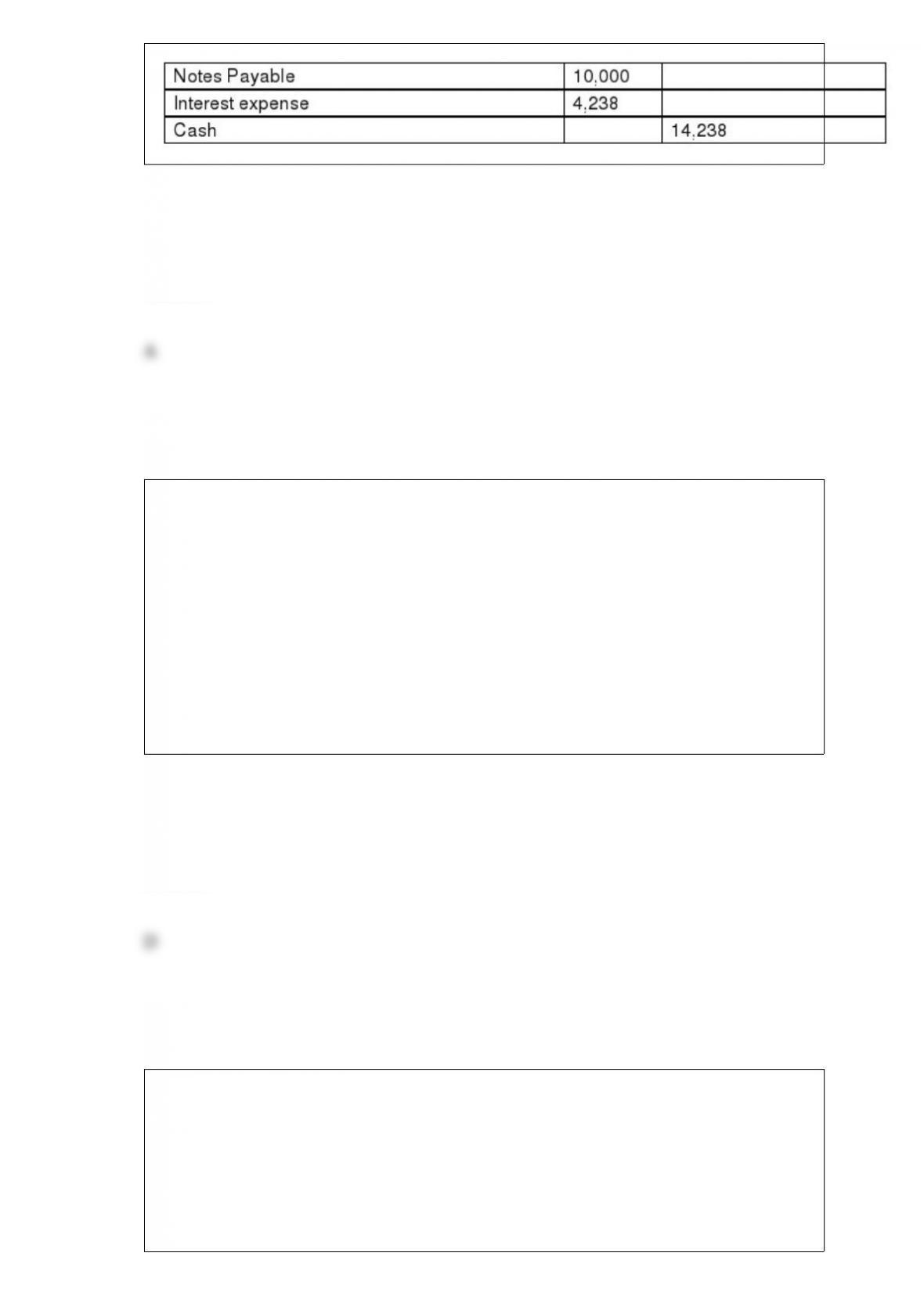
On January 1, 2013, Merrill Company borrowed $100,000 on a 10-year, 7%
installment note payable. The terms of the note require Merrill to pay 10 equal
payments of $14,238 each December 31 for 10 years. The required general journal
entry to record the first payment on the note on December 31, 2013 is:
A.
B.
C.
D.
E.
Answer:
The currency in which a company presents its financial statements is known as the:
A. Multinational currency
B. Price-level-adjusted currency
C. Specific currency
D. Reporting currency
E. Historical cost currency
Answer:
Merchandise inventory includes:
A. All goods owned by a company and held for sale.
B. All goods in transit.
C. All goods on consignment.
D. Only damaged goods.
E. Only items that are on the shelf.
Answer:
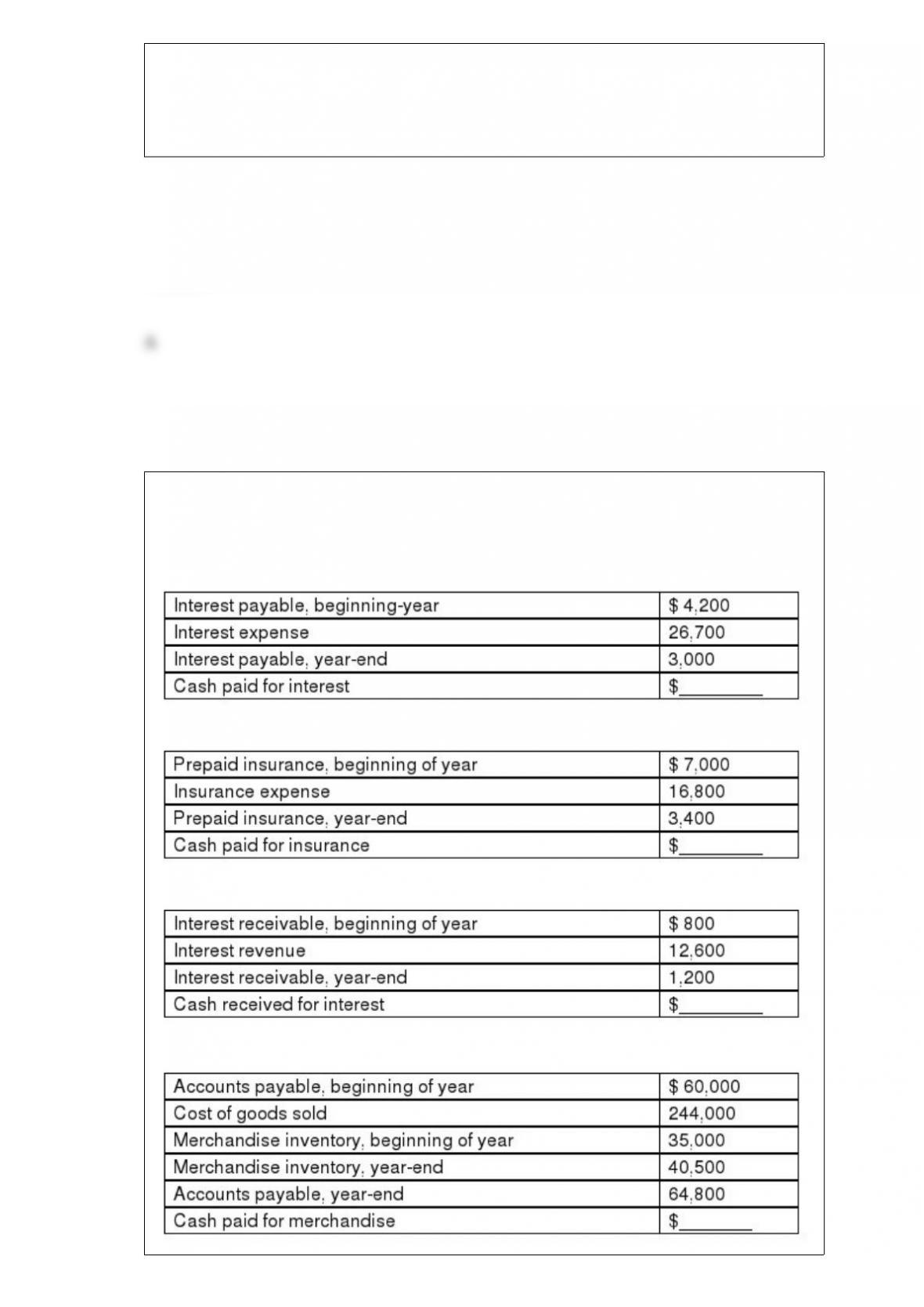
For each of the following independent cases, use the information provided to calculate
the missing cash inflow or cash outflow:
(a.)
(b.)
(c.)
(d.)
Answer:

Labor costs that are clearly associated with specific units or batches of product because
the labor is used to convert raw materials into finished products called are:
A. Sunk labor
B. Direct labor
C. Indirect labor
D. Finished labor
E. Supervisory labor
Answer:
The accounting principle that requires an accounting information system to report
useful, understandable, timely, and pertinent information for effective decision-making
is the:
A. Control principle
B. Compatibility principle
C. Relevance principle
D. Flexibility principle
E. Cost-benefit principle
Answer:
A company had inventory on November 1 of 5 units at a cost of $20 each. On
November 2, they purchased 10 units at $22 each. On November 6, they purchased 6
units at $25 each. On November 8, 8 units were sold for $55 each. Using the FIFO
perpetual inventory method, what was the value of the inventory on November 8 after
the sale?
A. $304
B. $296
C. $288
D. $280
E. $276
Answer:
The reporting of investing and financing activities is _________________ under the
direct and indirect methods of preparing the statement of cash flows.
Answer:
The ______________________ method of assigning costs to inventory and cost of
goods sold requires that the cost of goods available for sale be divided by the units of
inventory available when each sale takes place.
Answer:
Reference: 16_05
Refer to the following incomplete table of cost information:
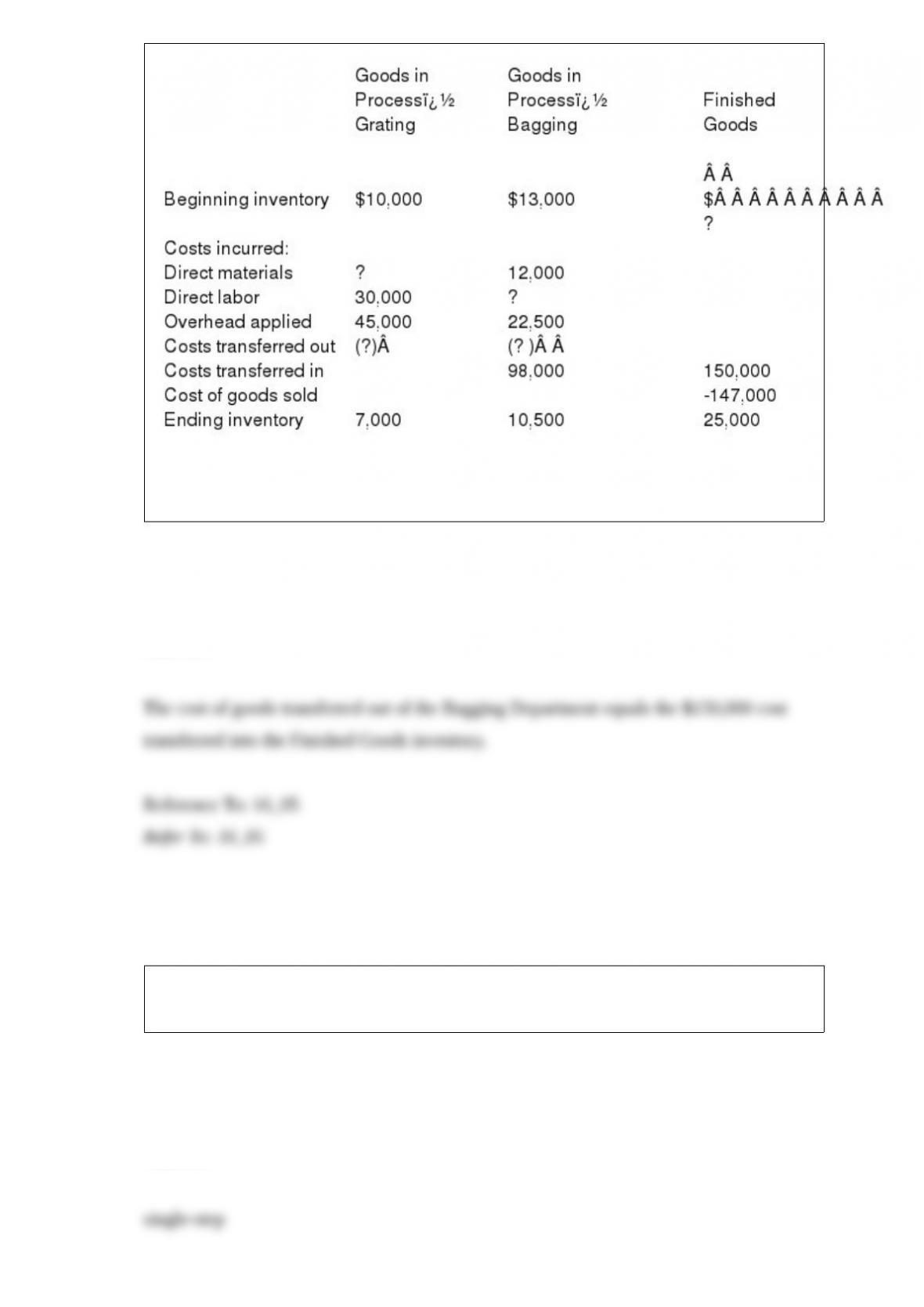
What was the cost of the goods transferred out of the Bagging Department and into the
finished goods inventory?
Answer:
A ______________________ income statement includes cost of goods sold as another
expense and shows only one subtotal for total expenses.
Answer:
A company purchases a machine for $84,000. The machine has an expected life of 12
years and no salvage value. The company anticipates a yearly net income of $41,000
after taxes of 32% to be received uniformly throughout each year. What is the
accounting rate of return?
Answer:
What are the types of adjusting entries used for prepaid expenses, depreciation, and
unearned revenues?
Answer:
A company charged the following amounts of overhead to jobs during the current year:
$12,000 to jobs still in process, $42,000 to jobs completed but not sold, and $66,000 to
jobs finished and sold. At year-end, the company’s Factory Overhead account has a
credit balance of $9,000, which is not a material amount. What entry (if any) should the
company make at year-end related to this overhead balance?
Answer:
What is the segment return on assets ratio? What is it used for?
Answer:
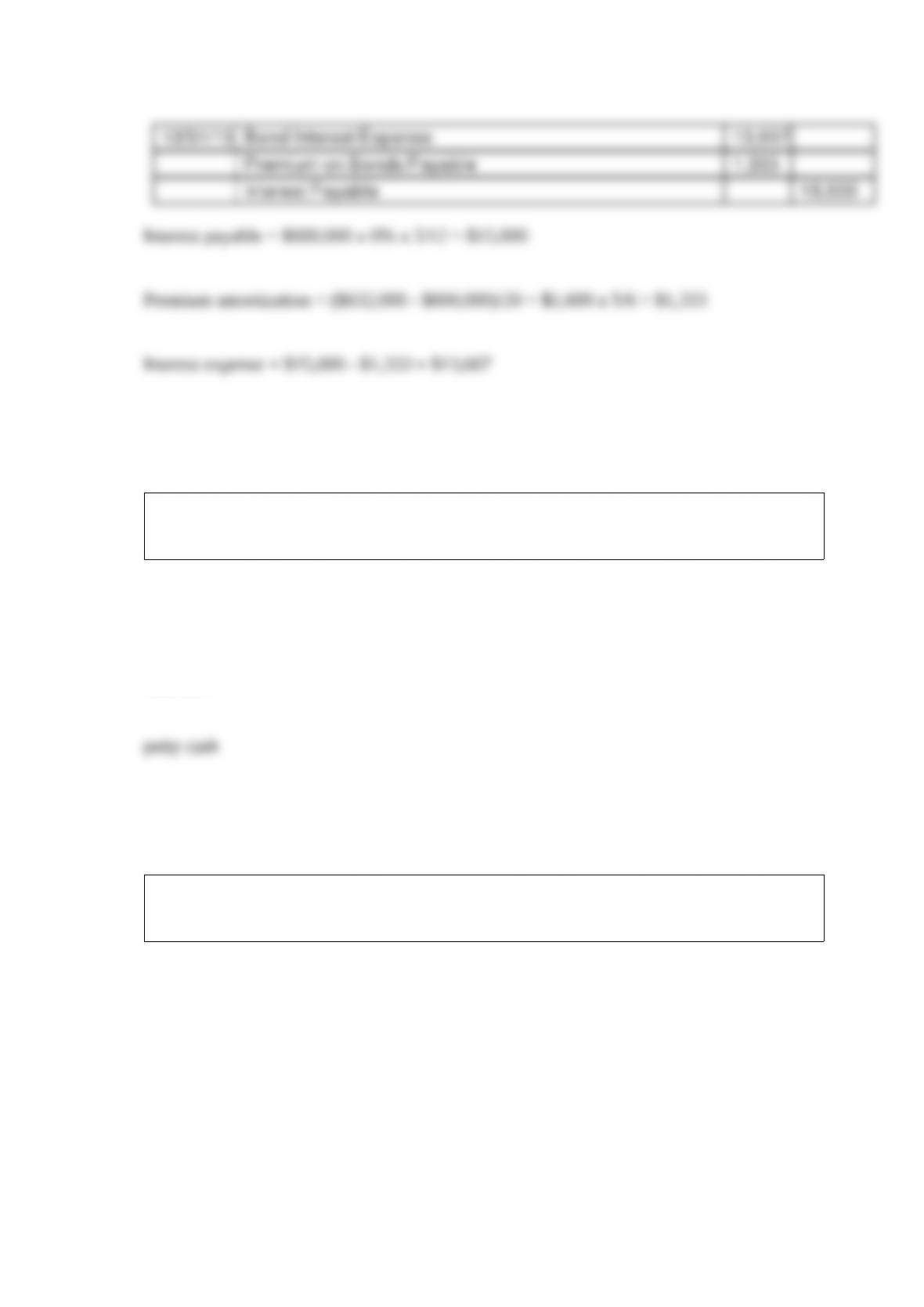
On August 1, 2013, a company issues bonds with a par value of $600,000. The bonds
mature in 10 years and pay 6% annual interest, payable each February 1 and August 1.
The bonds sold at $632,000. The company uses the straight-line method of amortizing
bond premiums and discounts. The company’s year-end is December 31. Prepare the
general journal entry to record the interest accrued at December 31,
Answer:
A _____________________________ fund is used for the control of small amounts of
cash disbursements.
Answer:
Maia’s Bike Shop uses the perpetual inventory system and had the following
transactions during the month of May:
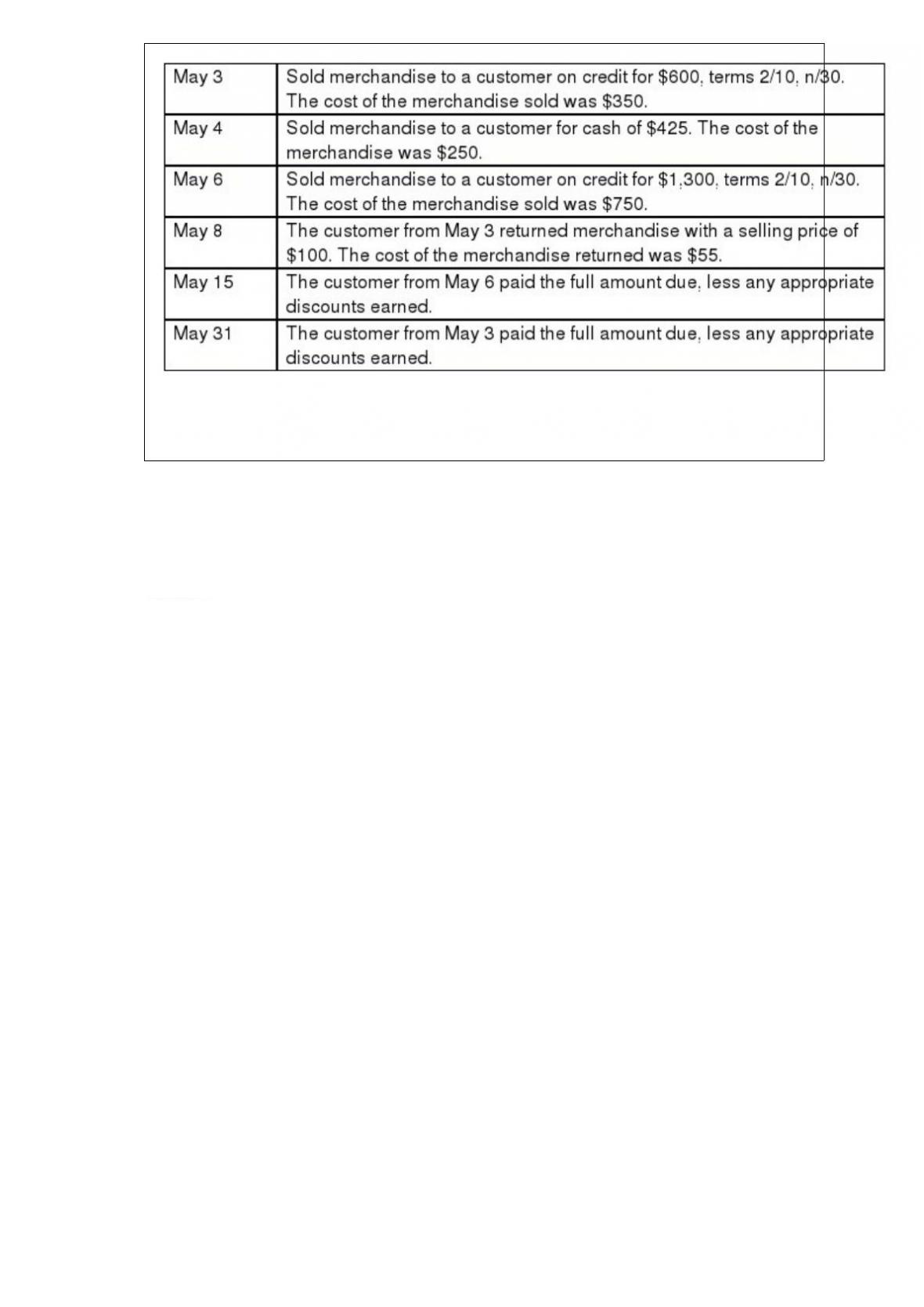
Prepare the required journal entries that Maia’s Bike Shop must make to record these
transactions.
Answer:
The total amount of cash and other assets the corporation receives from its
stockholders in exchange for common stock is called __________________________.
Answer:
Using __________________ ledgers removes unnecessary details from the general
ledger.
Answer:
Identify and discuss the key differences between common and preferred stock.
Answer:
If a company discovers a mistake in 2013 that was made in 2012, the company records
the adjustment in the year ________.
Answer:

When a job is finished, its job cost sheet is completed and moved from the jobs in
process file to the ____________________ file.
Answer: