
Which of the following is(are) a category for securities?
A. Trading.
B. Held-to-maturity.
C. Available-for-sale.
D. All of the above.
As the total volume of activity changes:
A. the total of variable costs changes.
B. the total of fixed costs changes.
C. variable costs per unit change.
D. fixed costs per unit stay the same.
An activity-based costing system involves identifying the activity that causes the
incurrence of a cost; this activity is known as a:
A. cost driver.
B. cost applier.
C. direct cost.
D. cost object.
Activity-based costing minimizes the risk of cost distortion when applying overhead by:
A. using a single cost driver rate.
B. using multiple cost driver rates.
C. using actual activity cost rates.
D. using absorption cost rates.
In an advertiser’s records, a newspaper ad submitted and published this week with the

agreement to pay for it next week would:
A. decrease assets and decrease expenses.
B. increase liabilities and increase expenses.
C. decrease assets and increase revenue.
D. increase assets and decrease liabilities.
Retained earnings represents:
A. cash that is available for dividends.
B. the total net income of the firm since its beginning.
C. cumulative net income of the firm since its beginning that has not been distributed to
its stockholders in the form of dividends.
D. net income plus gains (or minus losses) on treasury stock transactions.
A budgeting process that involves justifying resource requirements based on an analysis
and prioritization of organizational objectives is called:
A. continuous budgeting.
B. zero-based budgeting.
C. discretionary budgeting.
D. single-period budgeting.
The return on investment measure of performance:
A. is relevant only to business enterprises.
B. is used by individuals to compare investment performance.
C. is calculated using sales as the amount of return.
D. is calculated using total assets at the beginning of the period as the amount of
investment.

The cash budget is especially important to a firm when:
A. there is not a lot of confidence in the sales forecast.
B. it has a relatively large amount of operating cash.
C. the P/E ratio has been trending downwards.
D. it may have to negotiate a short-term bank loan.
How is performance evaluated for a profit center?
A. Actual costs incurred compared to budgeted costs.
B. Actual segment margin compared to budgeted segment margin.
C. Comparison of actual and budgeted return on investment (ROI) based on segment
margin and assets controlled by the segment.
D. None of the above.
ABC Company’s sales are $100,000, fixed costs are $50,000, and variable costs are
$30,000. ABC Company’s contribution margin and operating income are __________
and __________ respectively.
A. $50,000; $20,000
B. $20,000; $70,000
C. $70,000; $50,000
D. $70,000; $20,000
In consolidated financial statements:
A. the parent’s and subsidiary’s financial statements are reported on a separate basis.
B. the parent’s and subsidiary’s financial statements are reported on a combined basis.
C. financial statements are reported on an industry-wide basis.
D. none of the above.

Which of the following is true regarding notes receivables?
A. A notes receivable is always a long-term asset.
B. A notes receivable is always a current asset.
C. A note is a more formal document than an account receivable.
D. A note is a less formal document than an account receivable.
Which of the following is typically not important when calculating the net present value
of a project?
A. timing of cash flows from the project.
B. income tax effect of cash flows from the project.
C. method of financing the project.
D. amount of cash flows from the project.
Which of the following is(are) a true statement(s) pertaining to bonds?
A. Bonds can be sold at a discount, par, or payable.
B. Bonds can be sold at a discount, par, or premium.
C. The SEC sets the market price of a bond.
D. The issuing firm sets the price of a bond.
The production budget uses all of the following except:
A. the sales forecast.
B. the inventory policy.
C. the cash receipts budget.
D. the beginning inventory quantity.

The decision for solving production mix problems involving multiple products and
scarce production resources should focus on:
A. gross profit of each product.
B. sales price of each product.
C. contribution margin per unit of scarce resource.
D. contribution margin of each product.
A materials purchases budget must be completed immediately after the preparation of
the:
A. direct labor budget.
B. operating expense budget.
C. cash budget.
D. production budget.
ABC Company’s sales are $100,000, fixed costs are $50,000, and variable costs are
$30,000. ABC Company’s contribution margin ratio is:
A. 20%.
B. 30%.
C. 50%.
D. 70%.
Braco has 80,000 shares of $100 par value common stock outstanding, and 20,000
shares in the treasury. The number of additional shares that would be issued in a 5%
stock dividend is:
A. 1,000
B. 2,000
C. 4,000
D. 5,000

An Accounts Payable normally results from which of the following transactions?
A. Purchasing accounts for cash.
B. Purchasing property, plant and equipment on credit.
C. Purchasing goods and services from suppliers on credit.
D. All of the above.
Which of the following is a universally accepted measure of profitability?
A. Return on investment.
B. Return on retained earnings.
C. Return on liabilities.
D. All of these.
ABU Co. has several products, each with a different contribution margin ratio. If the
same number of units were sold in July as in June, but the sales mix changed:
A. operating income would be the same in June and July.
B. fixed expenses in July would be in a different relevant range than in June.
C. the company’s overall contribution margin ratio would be the same in June and July.
D. total contribution margin in July would be different from that in June.
A debit entry will:
A. decrease an asset account.
B. increase a liability account.
C. increase paid-in capital.
D. increase an expense account.

______________ can be measured as the income that could have been earned on an
asset, based on the potential rate of return that is lost or sacrificed when one alternative
use of the asset is chosen over another:
A. Target cost
B. Sunk cost
C. Opportunity cost
D. Allocated cost
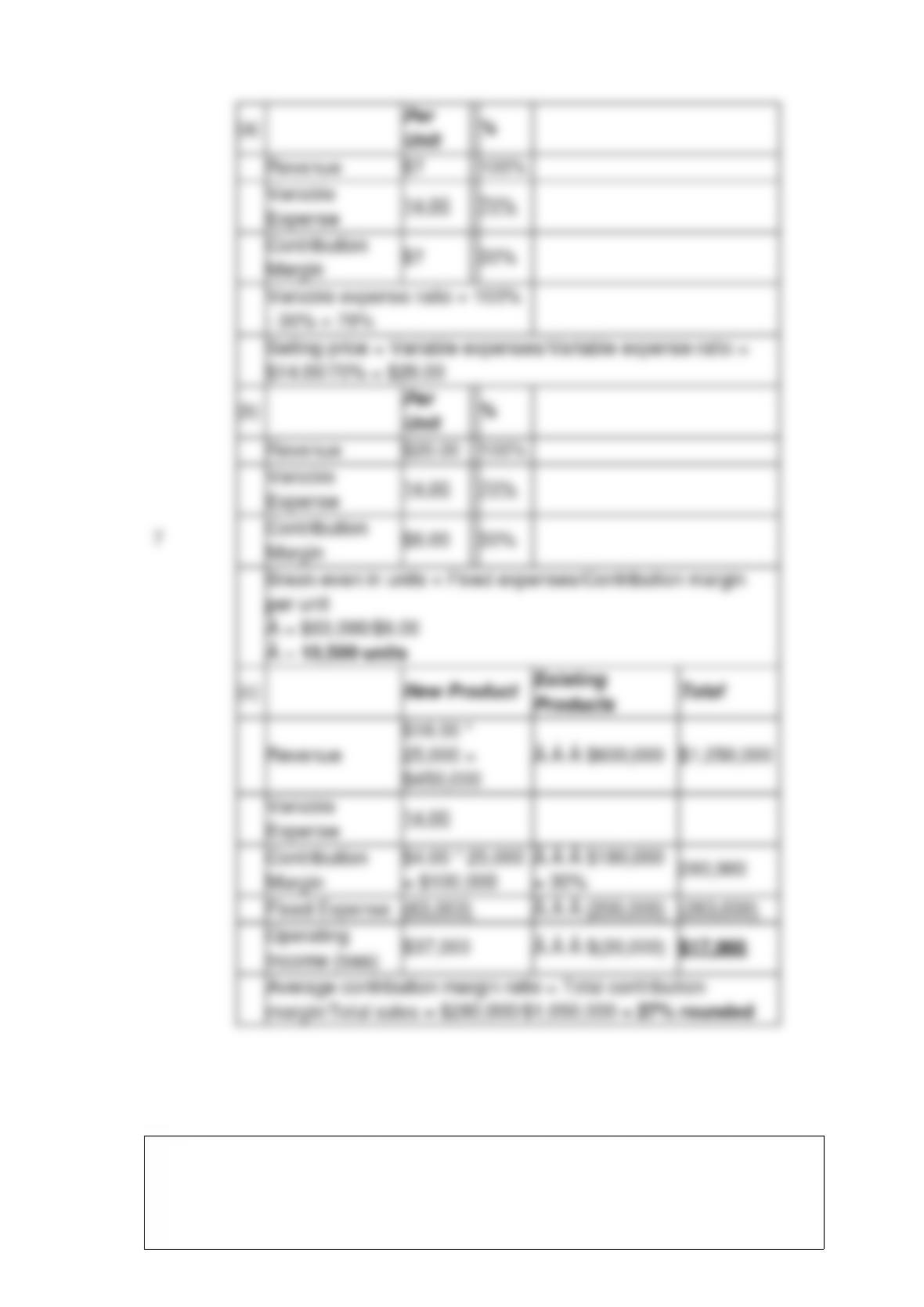
Pineapple Corp. has annual revenues of $600,000, fixed expenses of $200,000, and an
average contribution margin ratio of 30%.
(a) Management is considering adding a new product to the company’s product line.
The new item will have $14.00 of variable costs per unit. Calculate the selling price that
will be required for this product to maintain the 30% average contribution margin ratio
on current sales
(b) If the new product adds an additional $63,000 to Pineapple’s fixed expenses, how
many units of the new product must be sold at the price calculated in part (a) in order to
break even on the new product?
(c) If 25,000 units of the new product could be sold at a price of $18.00 per unit, and
the company’s other business did not change, calculate Pineapple’s total operating
income and average contribution margin ratio.
Accounts receivable are reported at:
A. net realizable value.
B. historical cost.
C. weighted average cost.

D. market value.
Which of the following is not a principal form of business organization?
A. Partnership.
B. Sole proprietorship.
C. Limited unregistered business.
D. Corporation.
E. None of the above.
A credit entry will:
A. always decrease the account balance.
B. always increase the account balance.
C. increase the balance of a revenue account.
D. increase the balance of an expense account.
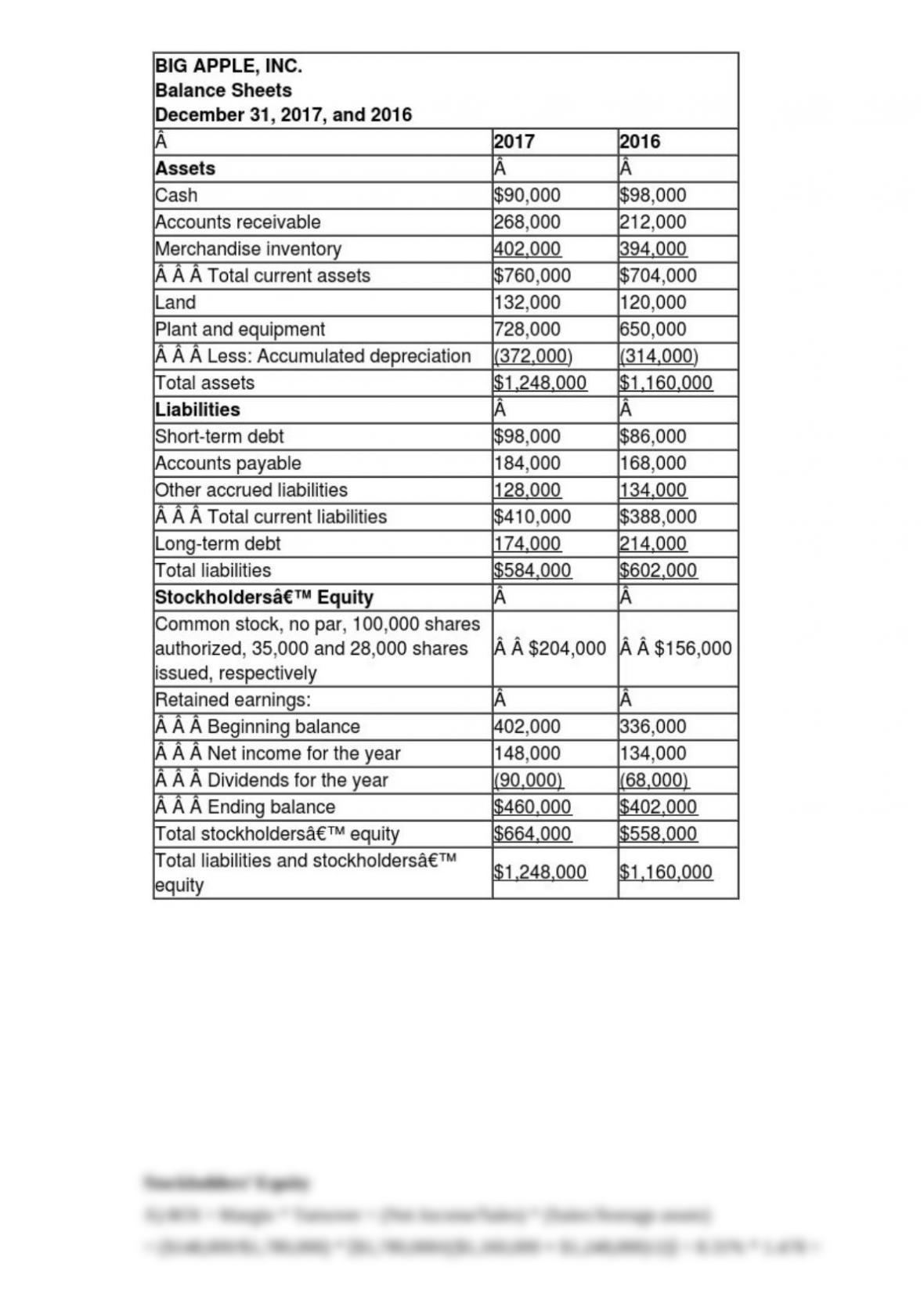
Presented below are the comparative balance sheets of Big Apple, Inc., at December 31,
2017, and 2016. Sales for the year ended December 31, 2017, totaled $1,780,000.
Required:
A) Calculate ROI for 2017.
B) Calculate ROE for 2017.
C) Calculate working capital at December 31, 2017.
D) Calculate the current ratio at December 31, 2017.
E) Calculate the acid-test ratio at December 31, 2017.

Which of the following is not usually considered a measure of an entity’s liquidity?
A. Current ratio.
B. Acid-test ratio.
C. Cash ratio.
D. Working capital.
A budget that is prepared for several periods in the future, then revised several times
prior to the budget period is called a:
The relevant range concept refers to:
A. a firm’s range of profitability.
B. a firm’s range of sales.
C. a firm’s range of rates of return.
D. a firm’s range of activity.