A cost driver is a variable that causes costs.
Answer:
The production mix variance measures the impact of substituting one material for
another material during the production process.
Answer:
Customer satisfaction is an example of a non-financial performance measure.
Answer:
The single-stage cost allocation system uses a plant wide rate because the cost pool is
the entire plant.
Answer:
The cost in the ending Finished Goods inventory account consists of the direct
materials, direct labor, and manufacturing overhead of all jobs still in process at the end
of the period.
Answer:
One of the important guidelines of benchmarking is to not benchmark everything at the
best-in-the-business level; no organization can be the best at everything.
Answer:

Fixed compensation is generally not linked to measured performance; i.e., it is
independent of measured performance.
Answer:
The break-even point in sales dollars is fixed costs divided by the contribution margin
ratio.
Answer:
Before-tax operating profits are equal to the after-tax operating profits divided by (1 –
tax rate).
Answer:
If the average selling price is $.60 per unit, the average variable cost is $.36 per unit,
and the total fixed costs are $1,500, then sales of 15,000 units will result in operating
profits of $3,600.
Answer:
If an organization’s fixed costs are $2,400, tax rate is 40%, and contribution margin is
$5,200, then its after-tax operating profits are $1,680.
Answer:
In setting standards, allowances usually include normal inefficiencies (e.g., defects in
the direct material, inexperienced workers, and coffee breaks).
Answer:
In general, the optimal transfer price for a division is the sum of its outlay costs and the
opportunity cost of not transferring its goods to another division.
Answer:
Underapplied overhead occurs when the actual overhead costs incurred during a period
are greater than the overhead costs applied during the period.
Answer:
Fixed costs are always classified as sunk costs in differential cost analysis.
Answer:
Quality can be defined as the degree to which a product or service performs as it was
designed to.
Answer:
The direct labor efficiency variance can be the result of poor supervision or poor
scheduling by divisional managers.
Answer:
In general, performance measuresfinancial and nonfinancialshould relate to what
managers at different levels control.
Answer:
In general, traditional product costing methods allocate less cost to low-volume
products and more costs to high-volume products than activity-based costing (ABC).
Answer:
Regression analysis can be used to estimate the strength of the relationship between a
cost and potential allocation bases for that cost.
Answer:
The death spiral concept refers to the process of continually decreasing selling prices to
meet foreign competition.
Answer:
Improving the efficiency of the manufacturing cycle involves decreasing the time spent
processing a good.
Answer:
When overhead is applied based on the volume of output, high-volume products tend
to ‘subsidize” low-volume products.
Answer:
Fixed costs per unit change inversely with changes in the volume of activity.
Answer:
Treating research and development costs as an expense rather than a long-term asset
may reduce a manager’s inclination to participate in research and development
activities.
Answer:
Because outliers are extreme data points, they can be included in the regression
analysis and not significantly affect the results.
Answer:
It is not possible for a manager to accept an unacceptable project when his/her
performance is evaluated using ROI.
Answer:
The terms “master budget” and “flexible budget” mean the same thing and can be used
interchangeably.
Answer:
An increase in an industry’s volume and a decrease in a company’s market share
implies that the company’s sales price variance is unfavorable.
Answer:
One advantage of using after-tax income as a performance measure of divisional
results is it’s a financial accounting measure that is also used to compute the
organizational income.
Answer:
If the budgeted activity level is greater than the actual activity level, then the total
budgeted costs of the master budget will be greater than the total budgeted costs of the
flexible budget.
Answer:
Peak load pricing is the practice of setting prices lowest when the quantity demanded
for the product approaches the physical capacity to produce it.
Answer:

The variable production cost variances are computed using the units produced instead
of the units sold.
Answer:
Which of the following statements regarding first-in, first-out (FIFO) process costing
is/are true?
(A) First-in, first-out (FIFO) process costing transfers out the costs in beginning
inventory before transferring out the costs associated with units started and completed.
(B) First-in, first-out process costing requires one additional step in assigning costs to
the units transferred out and the ending Work-in-Process Inventory.
A. A only.
B. B only.
C. Both A and B.
D. Neither A nor B.
Answer:
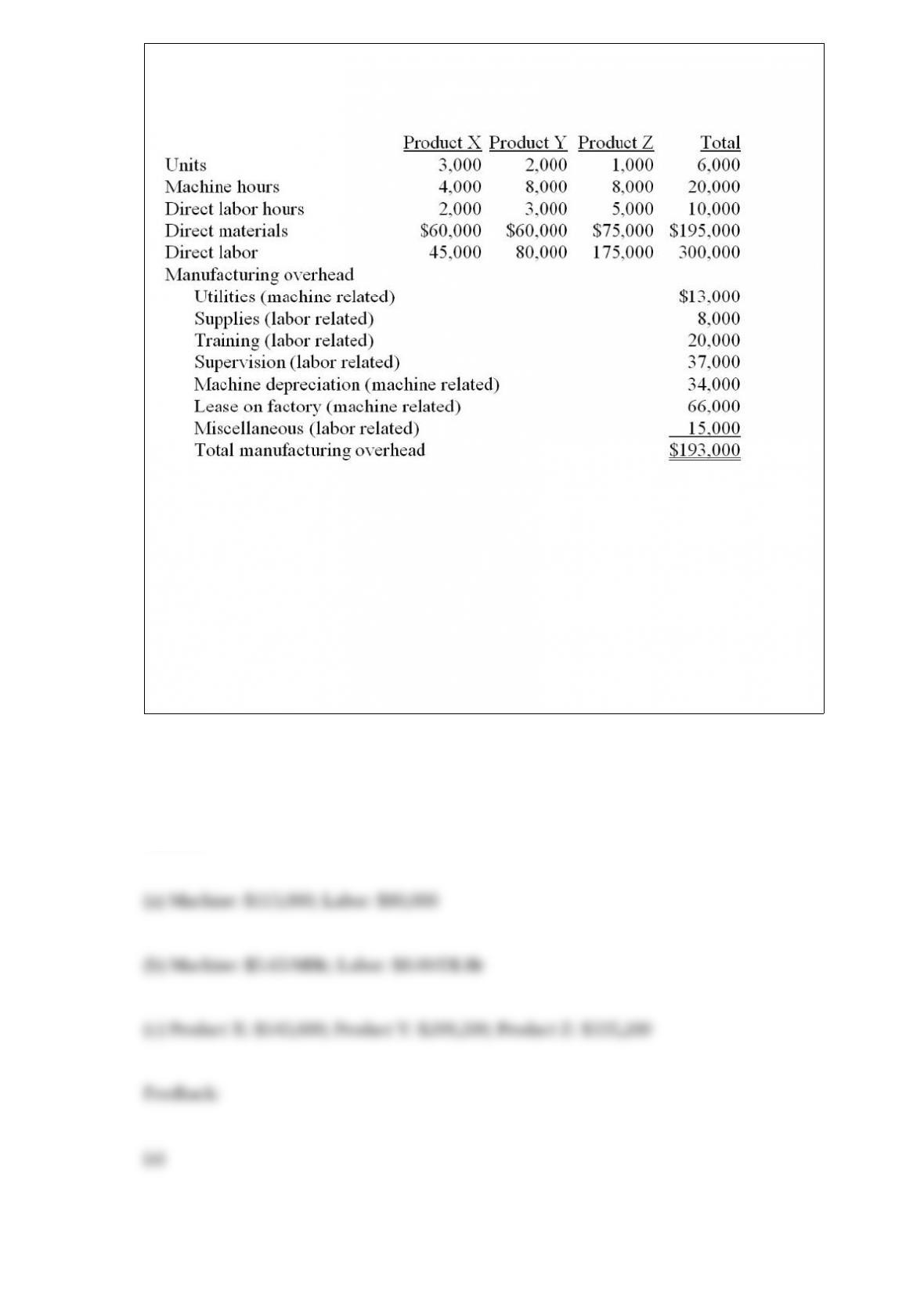
Acme Industries uses a two-stage allocation method to assign costs to its products. The
following information has been provided for the month:
Required:
(a) Allocate the manufacturing overhead to two cost pools: machine-related and
labor-related
(b) Compute the predetermined overhead rate for the two pools, using machine hours
and direct labor hours as the bases.
(c) Compute the total costs of production for each of the three products.
Answer:
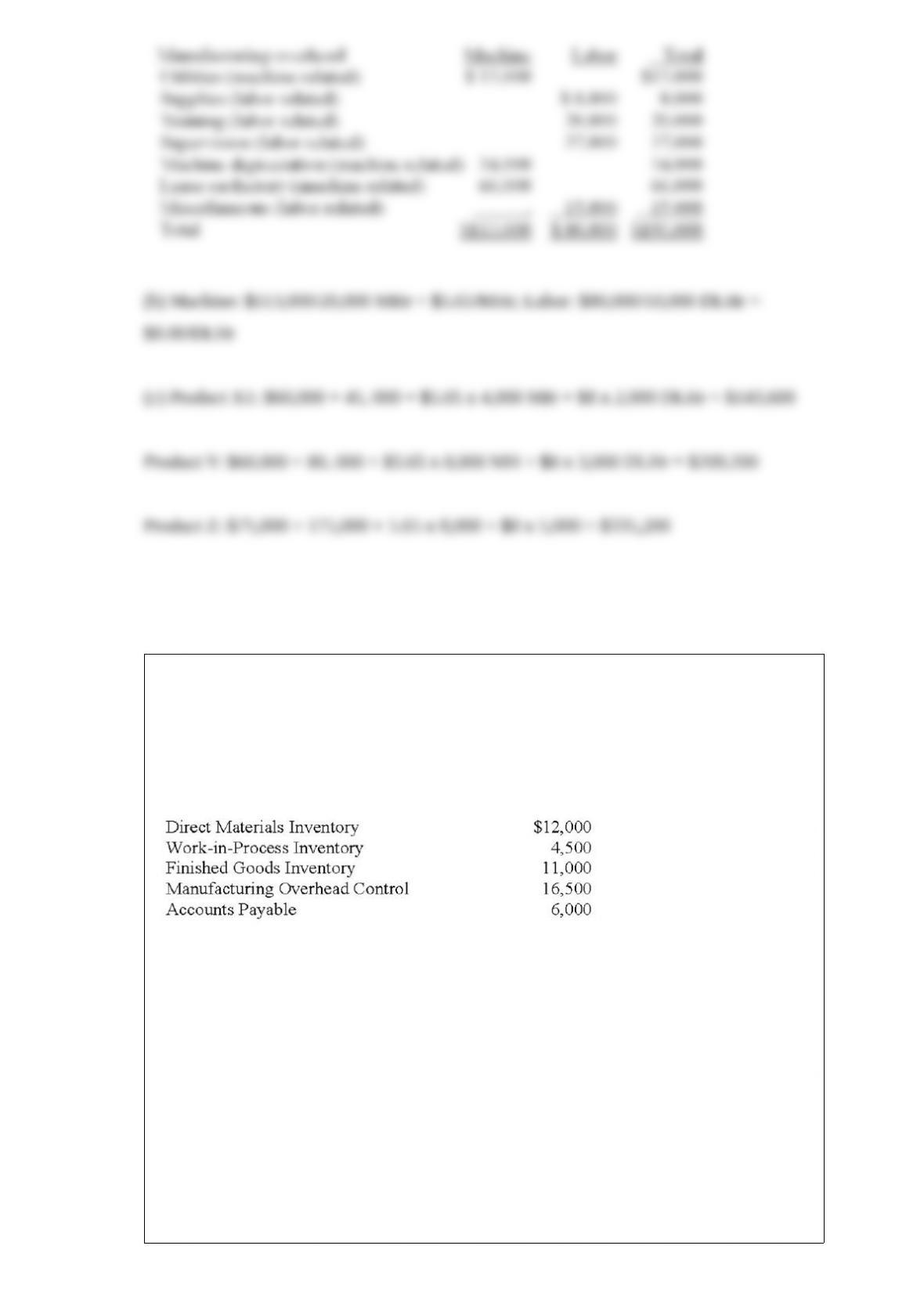
The Update Company does not maintain backup documents for its computer files. In
June, some of the current data were lost, and you have been asked to help reconstruct
the data. The following beginning balances on June 1 are known:
Reviewing old documents and interviewing selected employees have generated the
following additional information:
The production superintendent’s job cost sheets indicated that materials of $2,600 were
included in the June 30 Work-in-Process Inventory. Also, 300 direct labor hours had
been paid at $6.00 per hour for the jobs in process on June 30.
The Accounts Payable account is only for direct material purchases. The clerk
remembers clearly that the balance in the Accounts Payable on June 30 was $8,000. An
analysis of canceled checks indicated payments of $40,000 were made to suppliers
during June.
Payroll records indicate that 5,200 direct labor hours were recorded for June. It was
verified that there were no variations in pay rates among employees during June.
Records at the warehouse indicate that the Finished Goods Inventory totaled $16,000 on
June 30.
Another record kept manually indicates that the Cost of Goods Sold in June totaled
$84,000.
The predetermined overhead rate was based on an estimated 60,000 direct labor hours
for the year and an estimated $180,000 in manufacturing overhead costs.
What is the Cost of Goods Manufactured for June?
A. $89,000
B. $84,000
C. $94,000
D. $99,000
Answer:
Scottso Enterprises has identified the following overhead costs and cost drivers for the
coming year:
Budgeted direct labor cost was $200,000 and budgeted direct material cost was
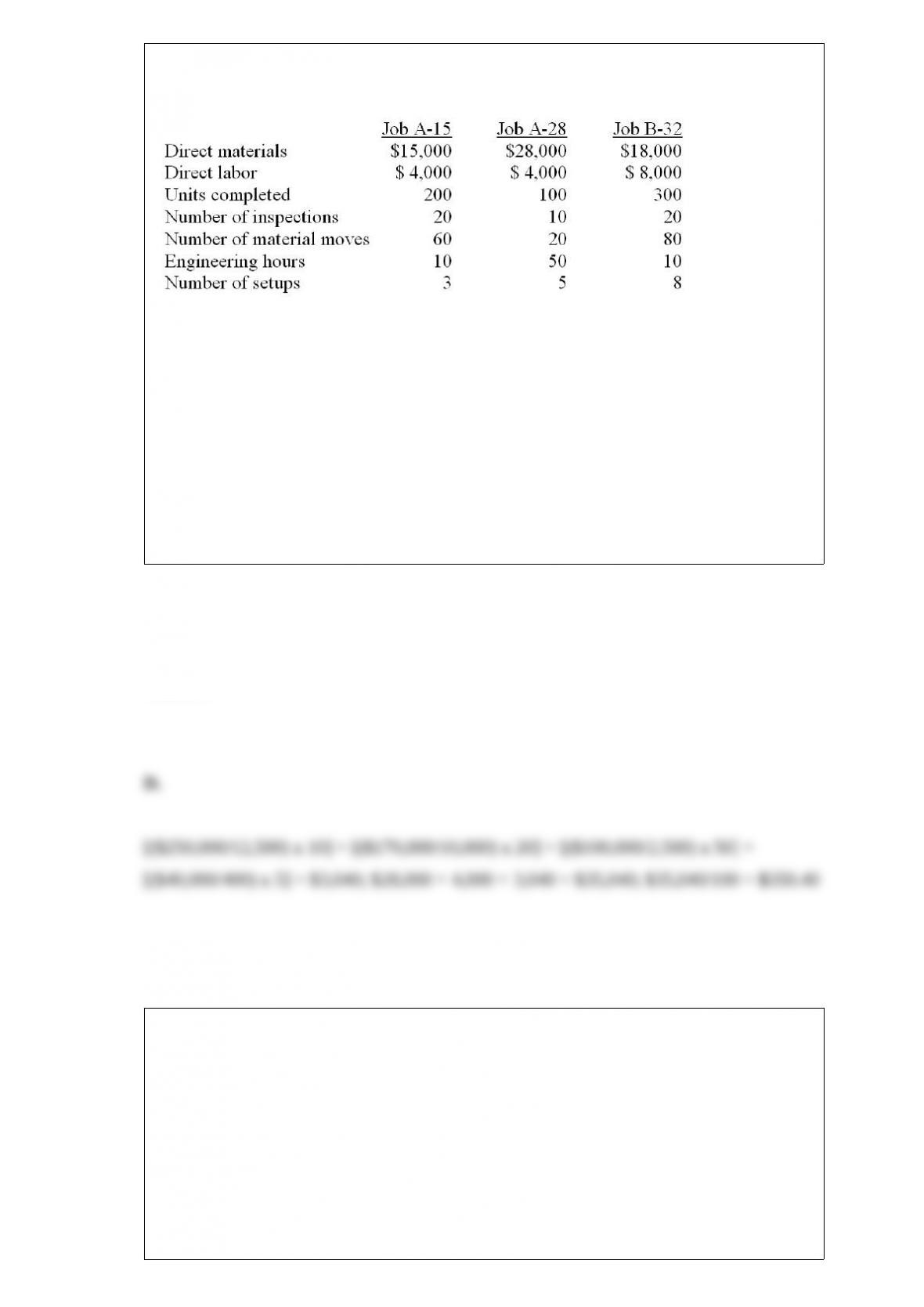
$800,000. The following information was collected on three jobs that were completed
during the month:
If the company uses activity-based costing (ABC), what is the cost of each unit of Job
A-28?
A. $320.00
B. $30.40
C. $187.40
D. $350.40
Answer:
Which of the following statements is (are) true regarding cost behaviors?
(A) In general, accounting records accumulate cost information according to its
behavior.
(B) Cost behaviors are the most important consideration in managerial decision
making.
A. only A is true.
B. only B is true.
C. Both A and B are true.
D. Neither A nor B is true.
Answer:
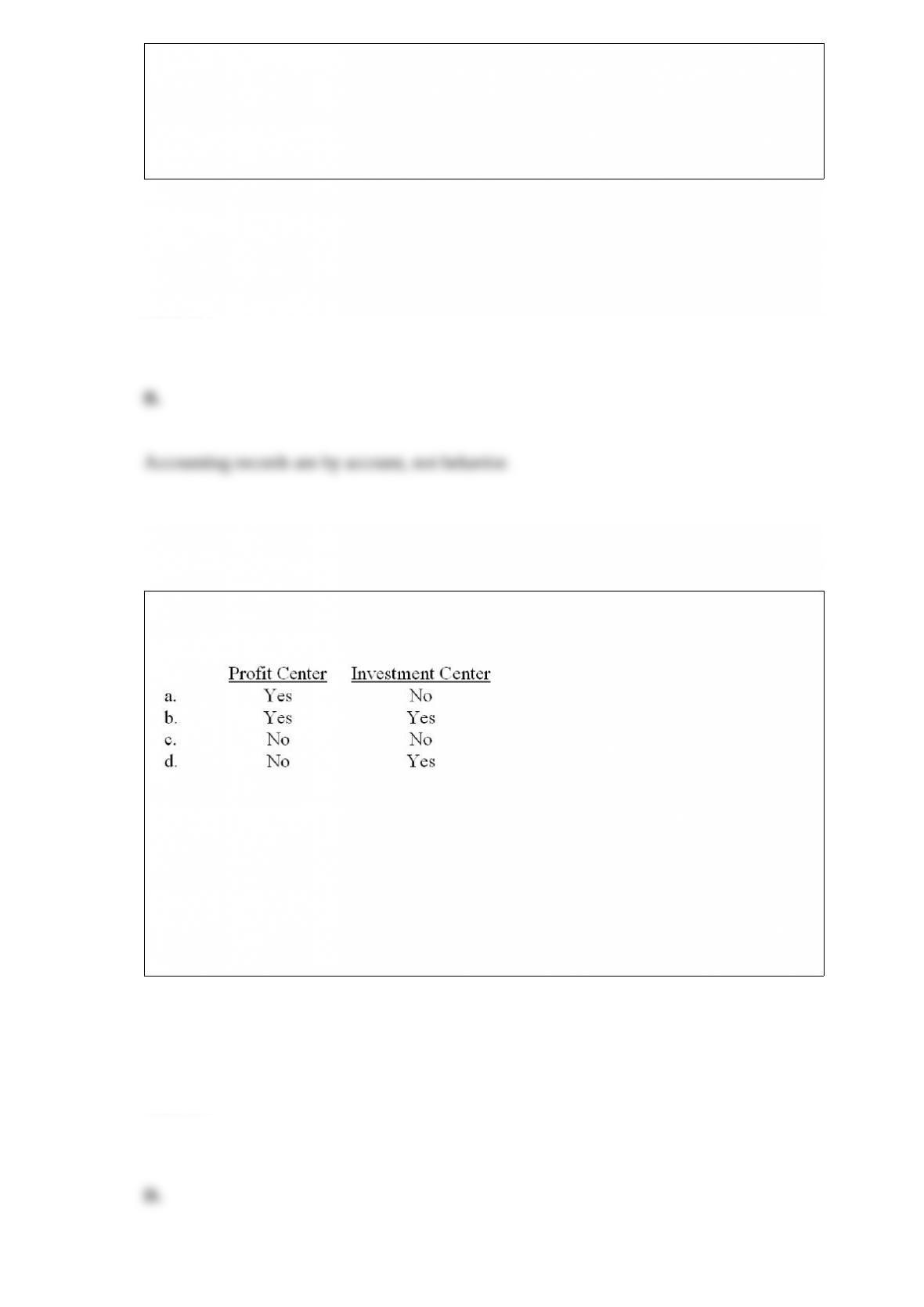
Assets invested in a responsibility center are included in a performance report of
A. a
B. b
C. c
D. d
Answer:
If a division is evaluated using return on investment (ROI) without regard to how
assets are financed, the denominator in the ROI calculation will be
A. current assets.
B. working capital.
C. total assets available.
D. total assets employed.
E. based on historical costs.
Answer:
A product cost is deducted from revenue when
A. the finished goods are sold.
B. the expenditure is incurred.
C. the production process takes place.
D. the production process is completed.
E. the finished goods are transferred to the Finished Goods Inventory.

Answer:
Manufacturing overhead applied on the basis of direct labor hours was $120,000, while
actual manufacturing overhead incurred was $124,000 for the month of April. Which of
the following is always true given the statement above?
A. Overhead was overapplied by $4,000.
B. Overhead was underapplied by $4,000.
C. Actual direct labor hours exceeded budgeted direct labor hours.
D. Actual direct labor hours were less than budgeted direct labor hours.
Answer:
In the standard regression equation of y = a + bx, the letter b is best described as the
A. independent variable.
B. dependent variable.
C. slope of the equation.
D. intercept of the equation.
Answer:
Which of the following costs would continue to be incurred even if a segment is
eliminated?
A. Direct fixed expenses
B. Variable cost of goods sold
C. Common fixed costs
D. Variable selling and administrative expenses
Answer:
The QRT Company collected the following information (in days):
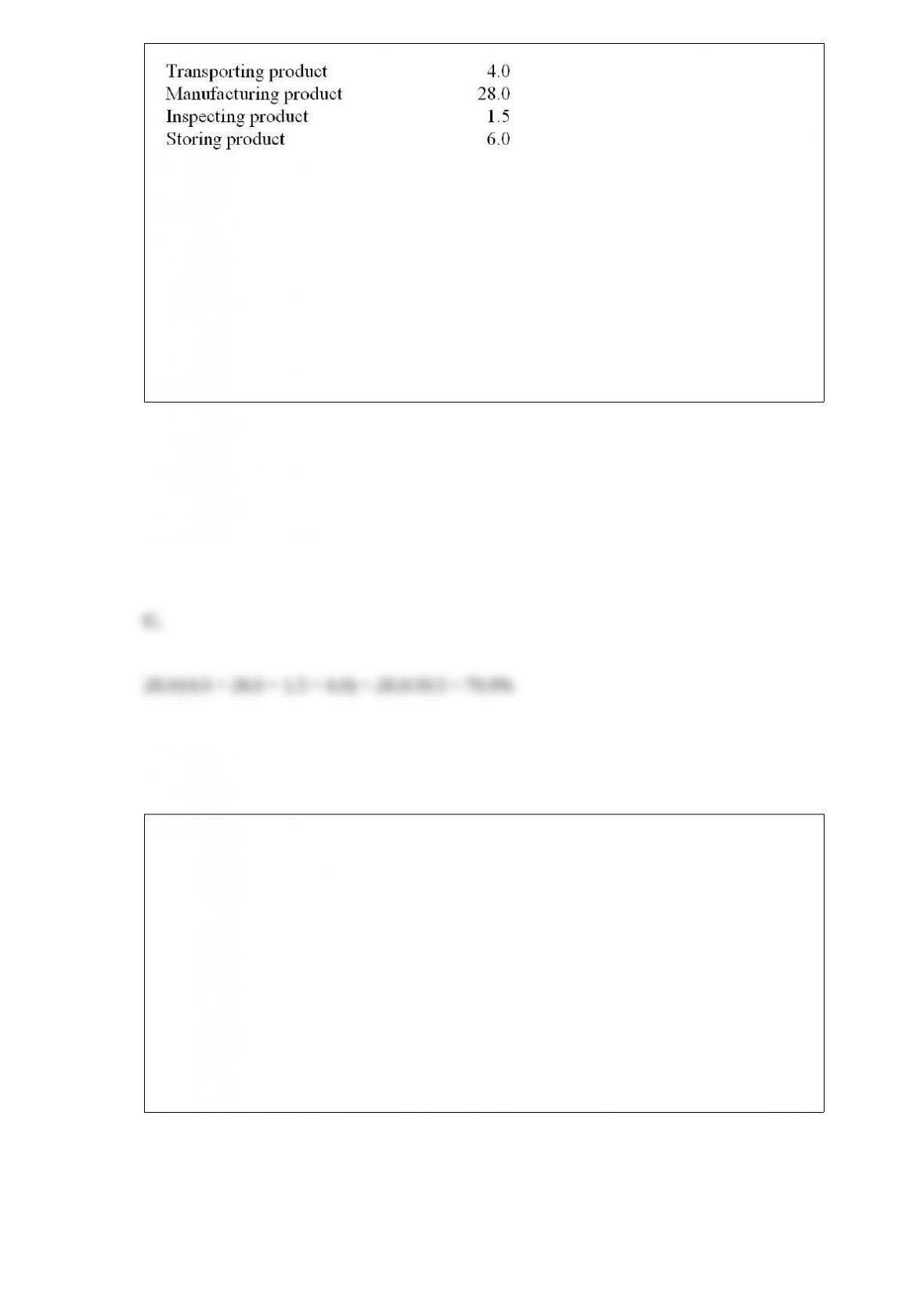
What is the manufacturing cycle efficiency?
A. 87.5%
B. 82.4%
C. 70.9%
D. 17.6%
Answer:
The least complex segment or area of responsibility for which costs are allocated is
a(n) (CMA adapted)
A. profit center.
B. investment center.
C. contribution center.
D. cost center.
E. hybrid center.
Answer:
Which of the following is not a key financial manager in an organization?
A. Chief financial officer
B. Treasurer
C. External auditor
D. Controller
E. Cost accountant
Answer:
Which of the following is not an example of a prevention cost?
A. Training employees to improve quality
B. Designing products to reduce production problems
C. Correcting product defects before they are sold
D. Inspecting the production process as it occurs
Answer:
An operating unit of an organization is called a revenue center if it is responsible
A. only for costs.
B. only for revenues.
C. for costs and revenues.
D. for investments in assets.
Answer:
In the balanced scorecard, the customer perspective addresses which of the following
questions?
A. “To achieve our mission, how will we sustain our ability to change and improve?”
B. “To succeed financially, how should we appear to our shareholders?”
C. “To satisfy our shareholders and customers, in what business process must we
excel?”
D. “To achieve our mission, how should we appear to our customers?”
Answer:
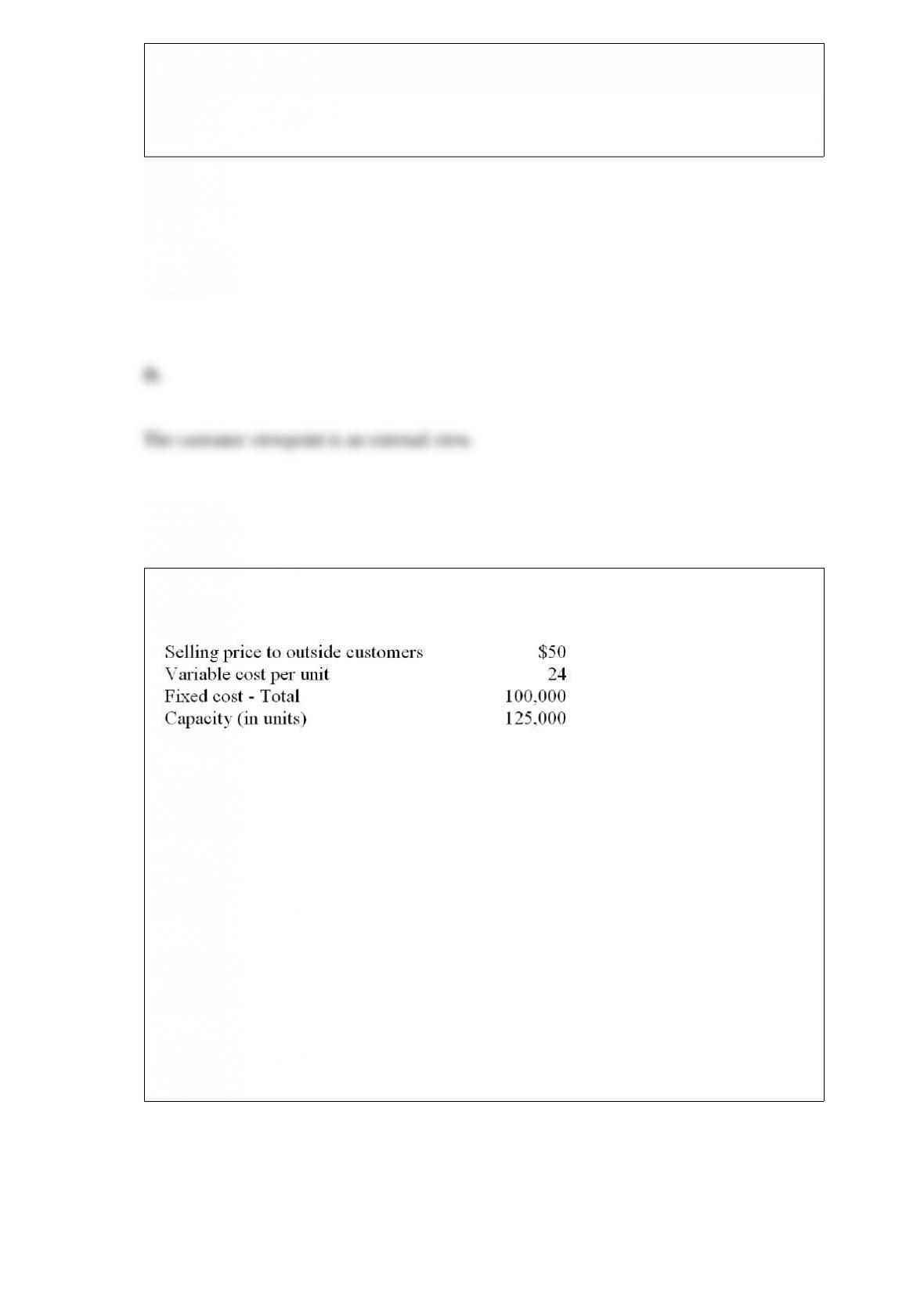
Given the following data for Division M:
Division T would like to purchase 15,000 units each period from Division M. Division
M has ample excess capacity to handle all of Division T’s needs. Division T now
purchases from an outside supplier at a price of $40. If Division M refuses to accept an
$18 price internally, the company, as a whole, will be worse off by
A. $60,000.
B. $150,000.
C. $180,000.
D. $240,000.
E. $290,000.
Answer:
Scranton produces a cleaning solvent. Production of 200,000 gallons was started in
February, 170,000 gallons were completed. Material costs were $138,220 for the month
while conversion costs were $116,380. There was no beginning work-in-process; the
ending work-in-process was 60% complete.
(a) What is the total cost of the product that was completed and transferred to finished
goods?
(b) What is the value of the ending work-in-process?
Answer:
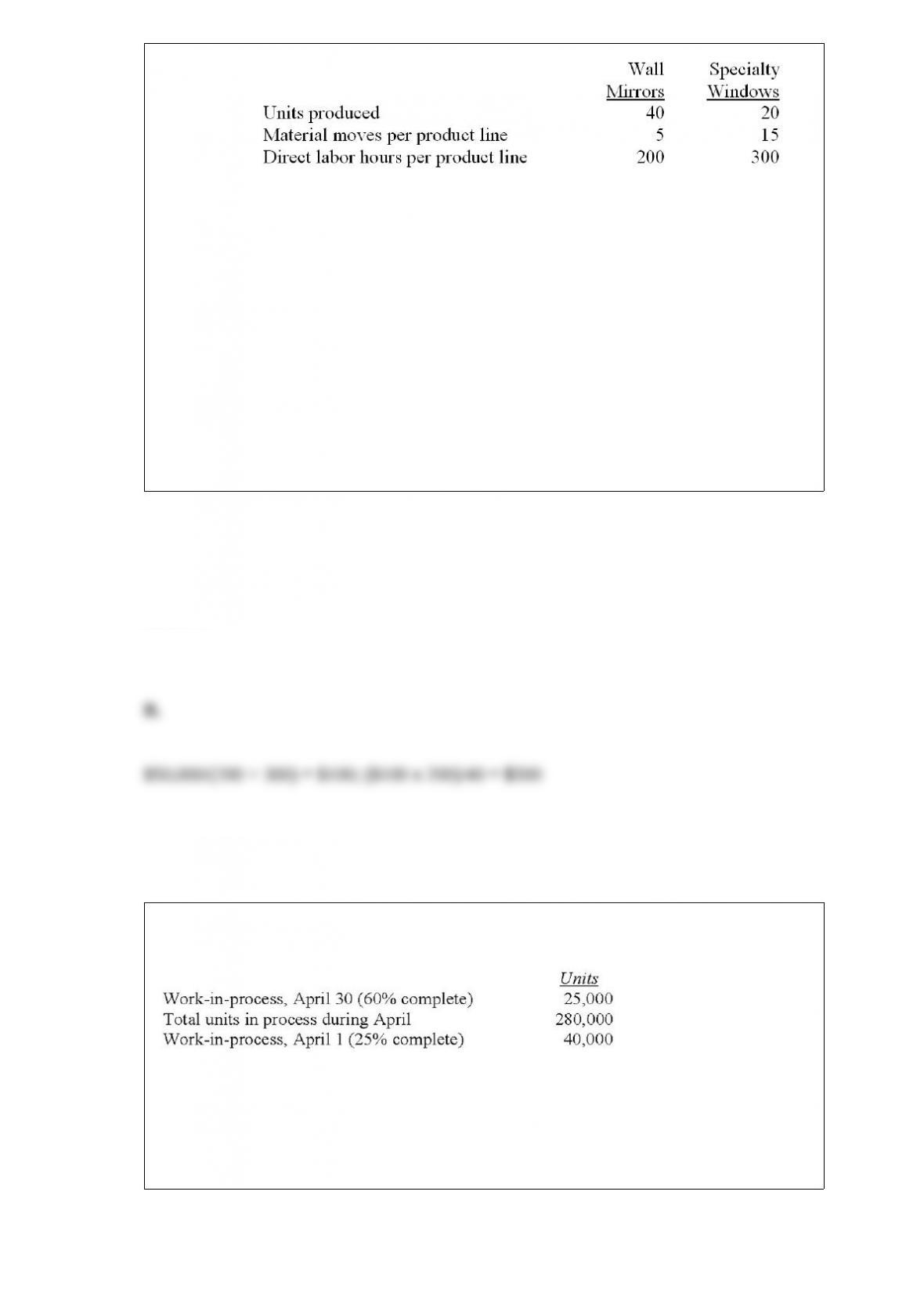
Zela Company is preparing its annual profit plan. As part of its analysis of the
profitability of individual products, the controller estimates the amount of overhead that
should be allocated to the individual product lines from the information provided below.
(CMA based)
Budgeted material handling costs: $50,000
Under a traditional costing system that allocates overhead on the basis of direct labor
hours, the materials handling costs allocated to one unit of wall mirrors would be
A. $1,000
B. $500
C. $2,000
D. $5,000
Answer:
Sussex Corporation’s production cycle starts in the Mixing Department. The following
information is available for April:
Materials are added at the beginning of the process in the Mixing Department. What are
the equivalent units of production for the month of April, assuming Sussex uses the
weighted average method?
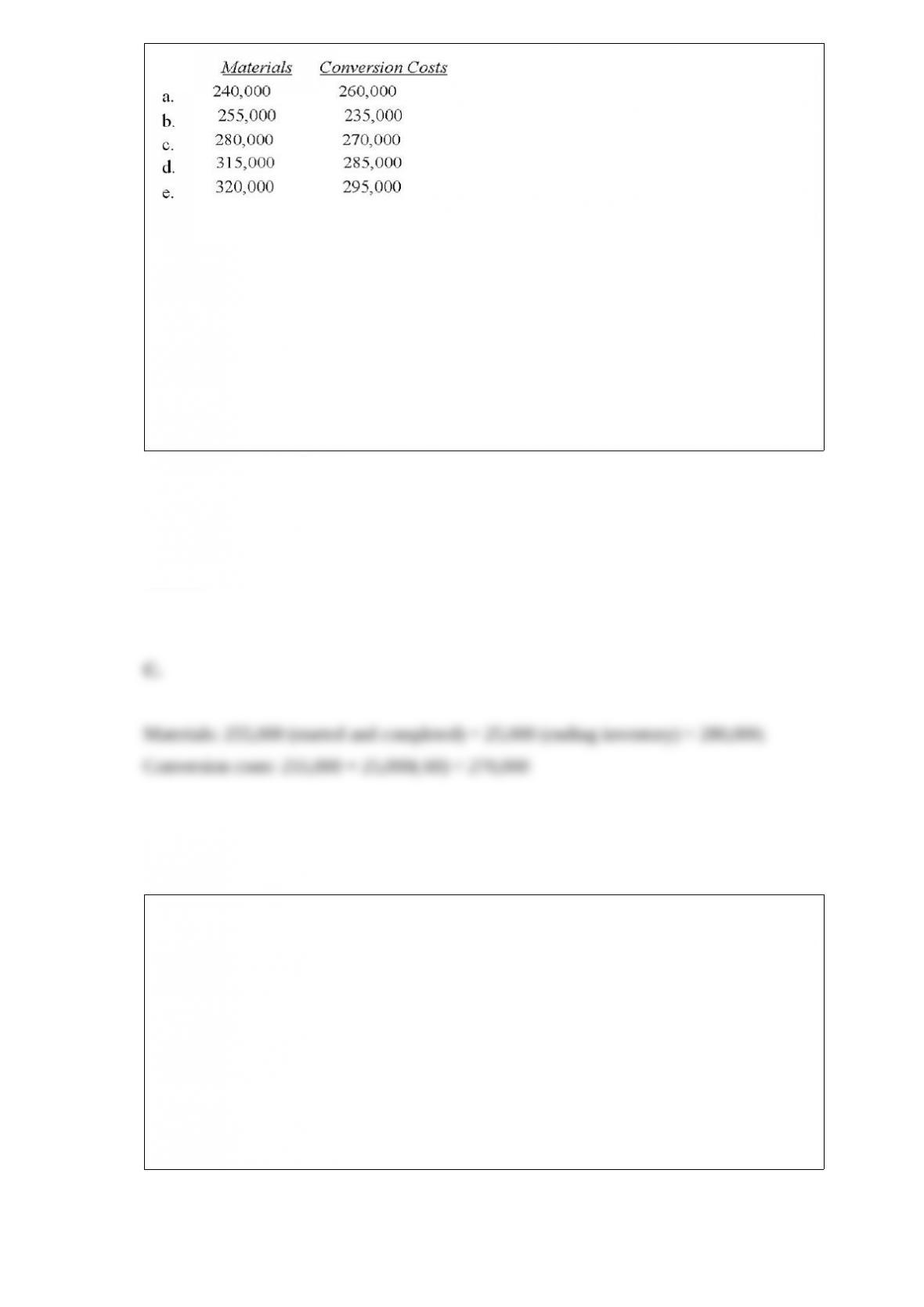
A. a
B. b
C. c
D. d
E. e
Answer:
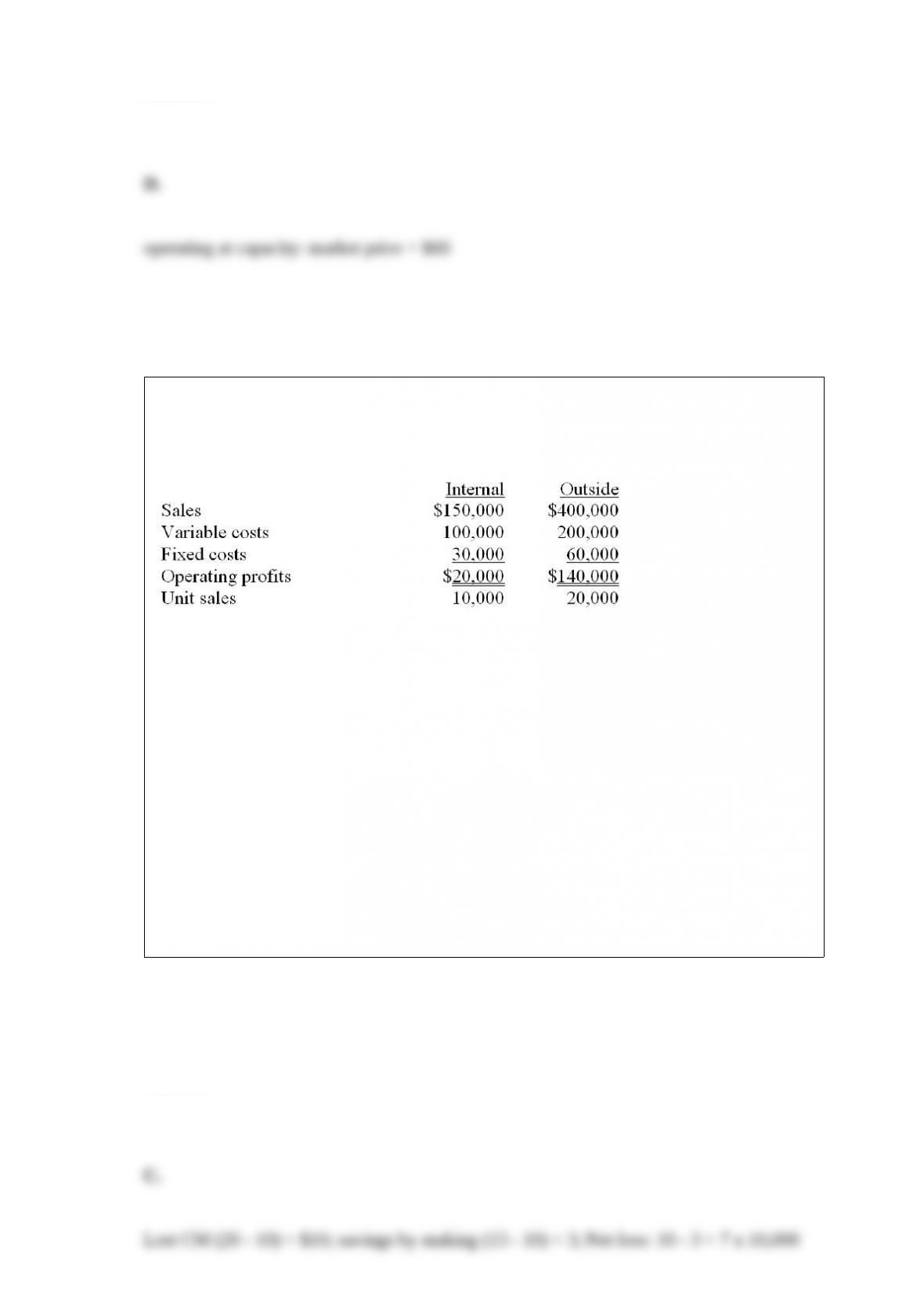
A division can sell externally for $60 per unit. Its variable manufacturing costs are $35
per unit, and its variable marketing costs are $12 per unit. What is the optimal transfer
price for transferring internally, assuming the division is operating at capacity?
A. $12
B. $35
C. $47
D. $60
Answer:
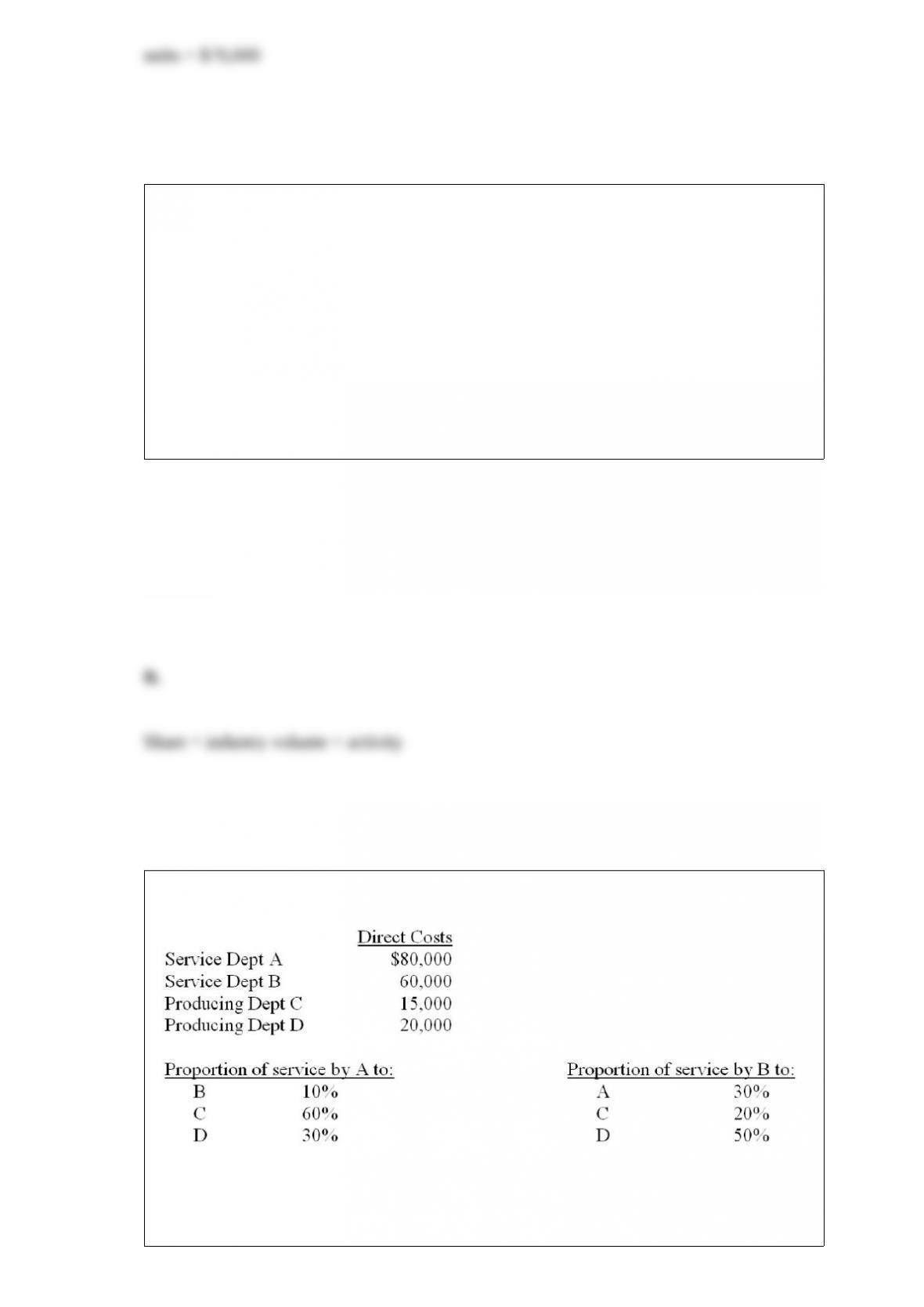
The Axle Division of Becker Company produces axles for off-road sport vehicles.
One-third of Axle’s 30,000 unit output is sold to an internal division of Becker; the
remainder is sold to outside customers. Axles’ estimated operating profit for the year is:
The internal division has an opportunity to purchase 10,000 axles of the same quality
from an outside supplier on a continuing basis. The purchase price would be $13.00. If
the Axle Division is now operating at full capacity and can sell all its units to outside
customers at the present selling price, what is the differential cost to Becker of requiring
that the axles be made internally and sold to the internal division?
A. $25,000
B. $50,000
C. $70,000
D. $100,000
Answer:
The sales activity variance is equal to the sum of the market share variance and the
A. selling price variance.
B. industry volume variance.
C. sales quantity variance.
D. sales mix variance.
E. contribution margin variance.
Answer:
The following information relates to Ray Corporation for the past accounting period.
Using the simultaneous solution method, department A’s cost allocated to department C
is
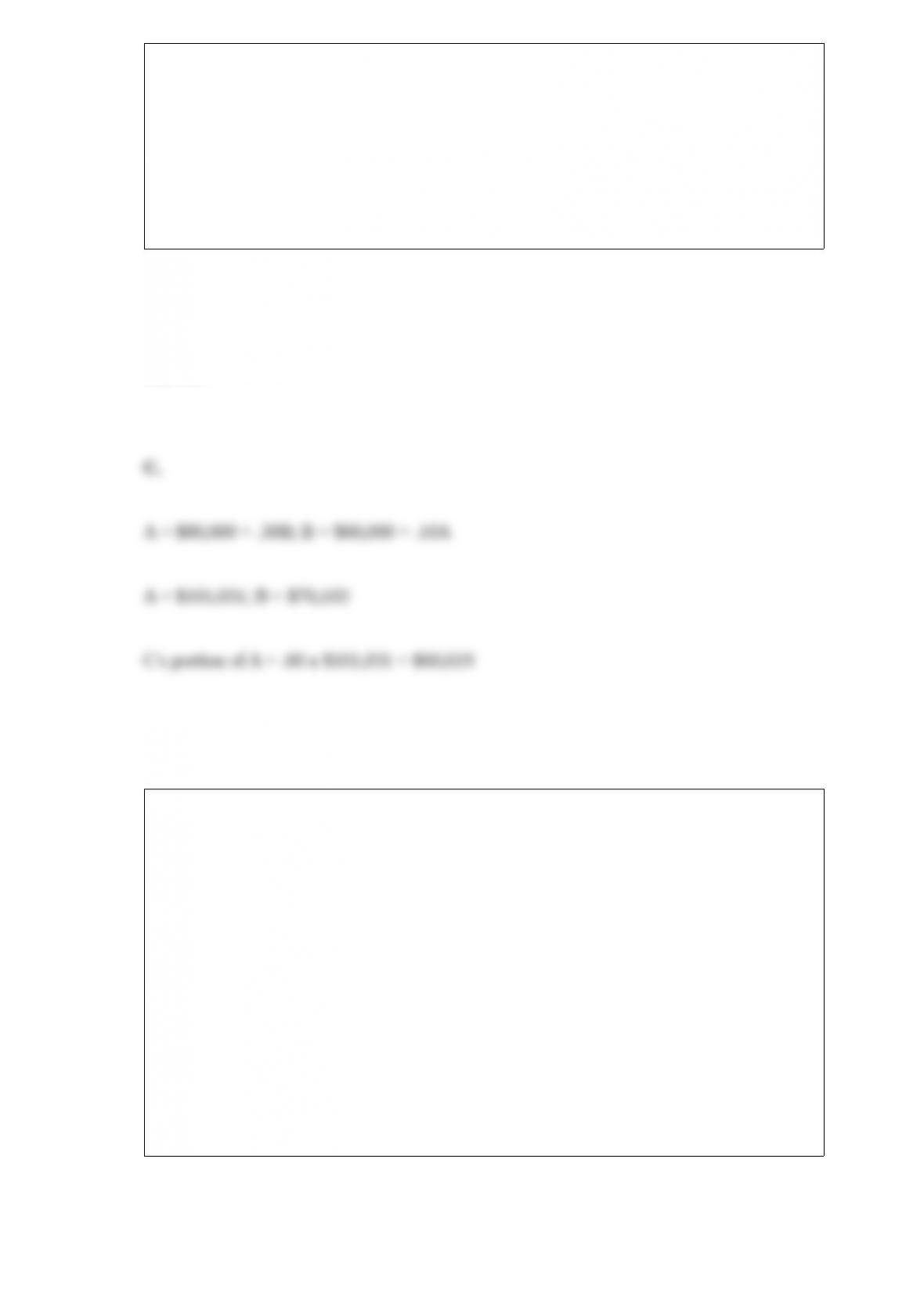
A. $48,000
B. $58,800
C. $60,619
D. $98,000
Answer:
The Lemaire Company manufactures wiring tools. The company is currently producing
well below its full capacity. The Boisvert Company has approached Lemaire with an
offer to buy 10,000 tools at $1.75 each. Lemaire sells its tools wholesale for $1.85 each;
the average cost per unit is $1.83, of which $0.27 is fixed costs. If Lemaire were to
accept Boisvert’s offer, what would be the increase in Lemaire’s operating profits?
A. $800
B. $1,000
C. $1,900
D. $2,900
E. Lemaire’s operating profits will not increase as a result of accepting the special order.

Answer:
A company is considering the use of a single-stage cost allocation process. Under what
conditions would this choice be justified?
A. The company has many service departments but only one production department.
B. The company produces a few products with similar characteristics in a few
departments.
C. The company has no service departments but many production departments.
D. The company produces a wide selection of differing products.
Answer:
Which of the following would NOT be a batch-related activity?
A. Setting up a machine for a new production run
B. Performing 100% inspection
C. Purchasing materials
D. Processing a customer order
Answer:
One division of the RST Enterprise Company has depreciable assets costing
$4,000,000. The cash flows from these assets for the past three years have been:
The current (i.e., replacement) costs of these assets were expected to increase 25% each
year. RST used the straight-line depreciation method; the estimated useful life is
10-years with no salvage value. For return on investment (ROI) calculations, RST uses
end-of-year balances.
What is the ROI using current costs and net book value?
A. a
B. b
C. c
D. d
Answer:
Cash disbursements would not include payments for
A. dividends.
B. income taxes.
C. accounts receivable.
D. capital budget expenditures.
E. marketing and administrative expenses.
Answer:
Which of the following costs is not related to a batch-related activity?
A. Material handling
B. Machine setups
C. Shipping costs
D. Compliance costs
Answer:
When a manufacturing company has a highly automated manufacturing plant
producing many different products, what is probably the most appropriate basis of
applying overhead costs to work-in-process?
A. Direct labor hours.
B. Direct labor dollars.
C. Machine hours.
D. Cost of materials used.
Answer:
An objective performance measure is one where
A. different people will agree as to the appropriateness of a measure.
B. different people will agree as to the method to calculate the measure.
C. different managers will calculate a measure differently.
D. different managers will view the facts and come to different conclusion.
Answer:
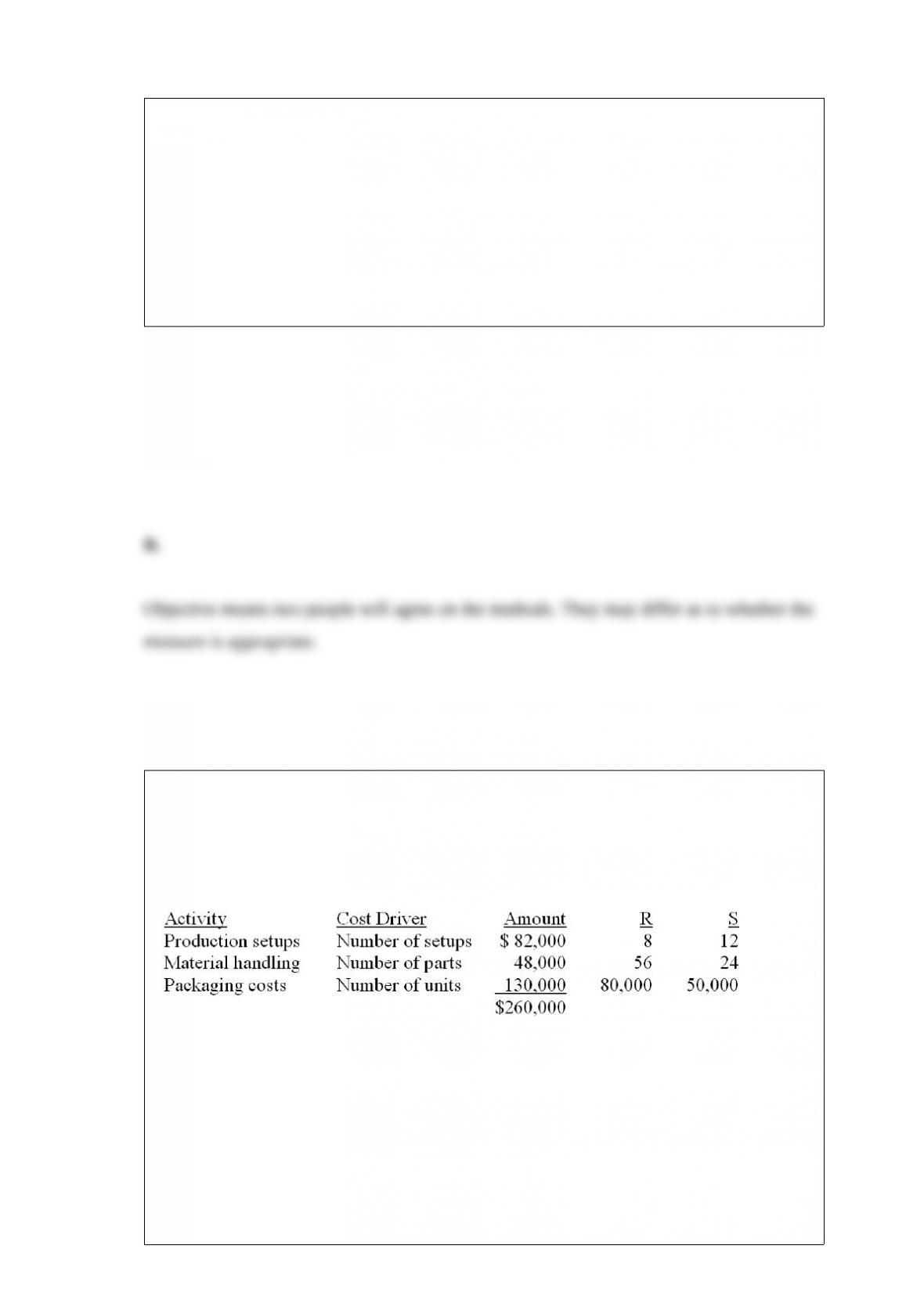
RS Company manufactures and distributes two products, R and S. Overhead costs are
currently allocated using the number of units produced as the allocation base. The
controller has recommended changing to an activity-based costing (ABC) system. She
has collected the following information:
What is the total overhead allocated to Product R using the current system?
A. $113,600
B. $130,000
C. $146,400
D. $160,000
Answer:
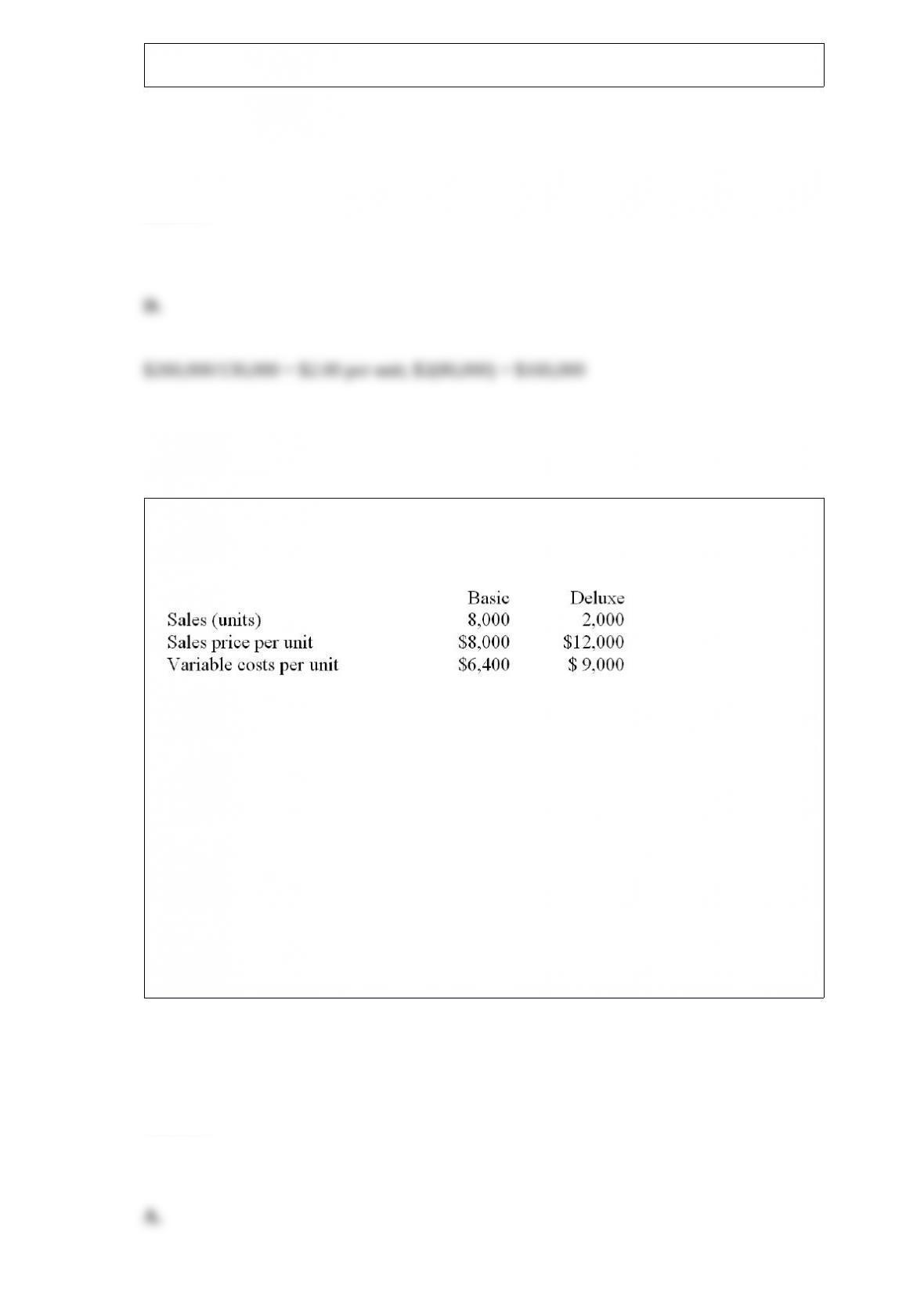
A machine distributor sells two models, basic and deluxe. The following information
relates to its master budget.
Actual sales were 7,000 basic models and 2,800 deluxe models. The actual sales prices
were the same as the budgeted sales prices for both models.
Is the sales mix variance for the deluxe model favorable or unfavorable?
A. favorable.
B. unfavorable.
Answer:
Compare financial accounting and cost accounting using the following concepts: users
of the information; important criteria; who establishes or defines the system; and how to
determine an accounting treatment.
Answer:
Answer:
Arrow Industries employs a standard cost system in which direct materials inventory is
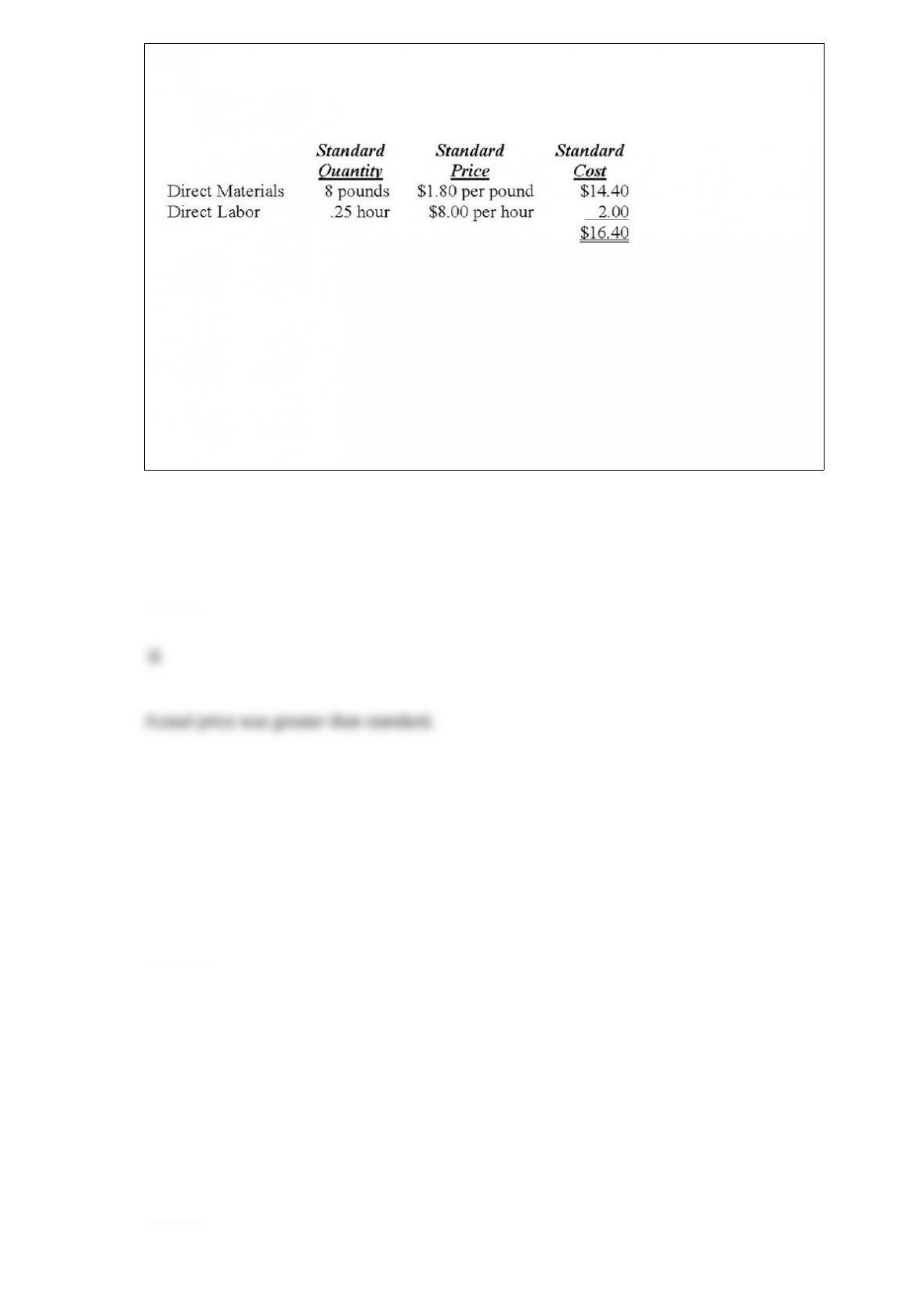
carried at standard cost. Arrow has established the following standards for the prime
costs of one unit of product.
During November, Arrow purchased 160,000 pounds of direct materials at a total cost
of $304,000. The total factory wages for November were $42,000, 90% of which were
for direct labor. Arrow manufactured 19,000 units of product during November using
142,500 pounds of direct materials and 5,000 direct labor hours.
Is the direct materials price variance favorable or unfavorable?A. favorable
B. unfavorable
Answer:
Answer:
Answer:
Explain how standards and budgets are different.
Answer:
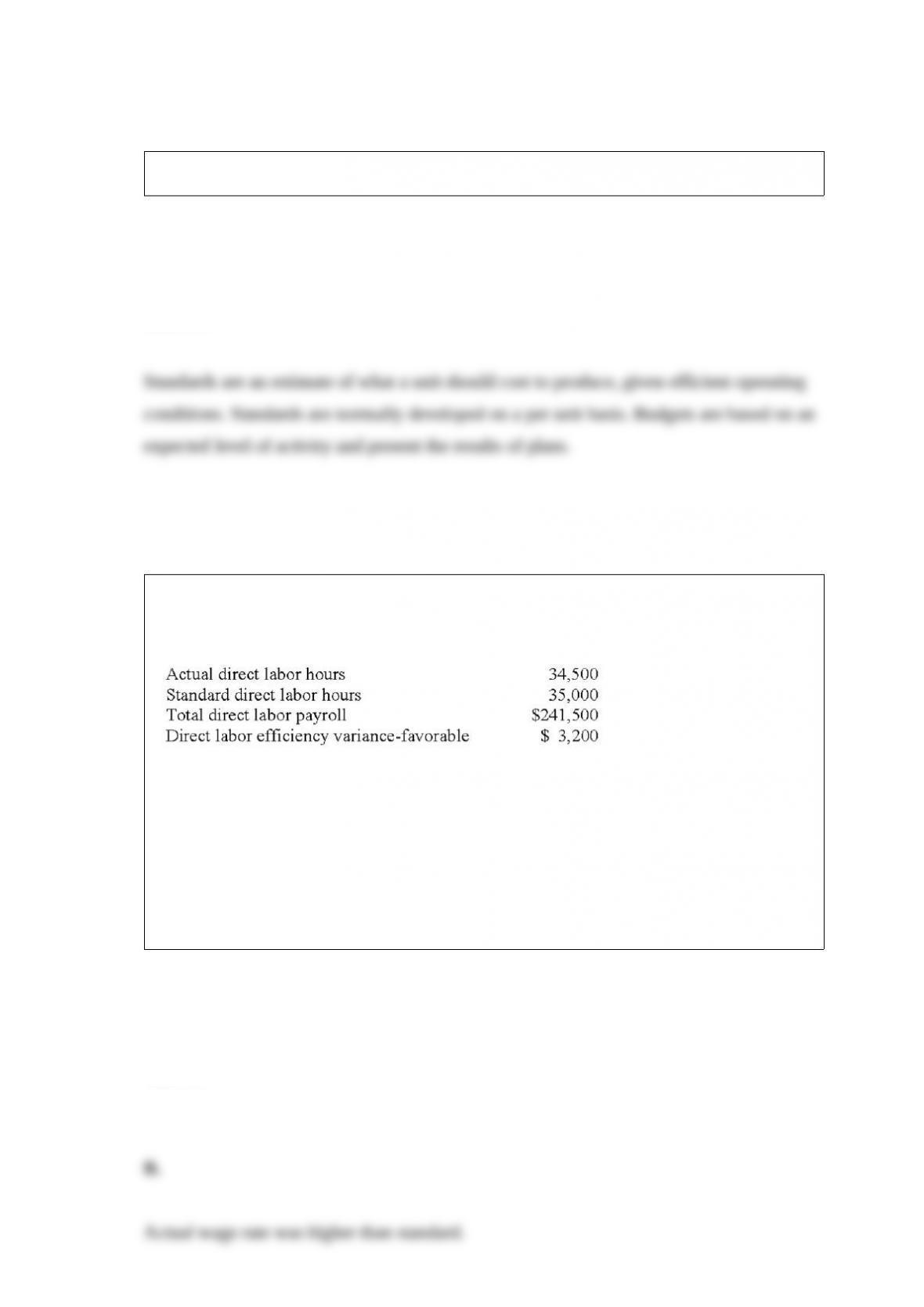
Information on Barber Company’s direct labor costs for the month of January is as
follows:
Is the direct labor price (rate) variance favorable or unfavorable?
A. favorable
B. unfavorable
Answer:
Describe the three main elements of a management control system.
Answer:
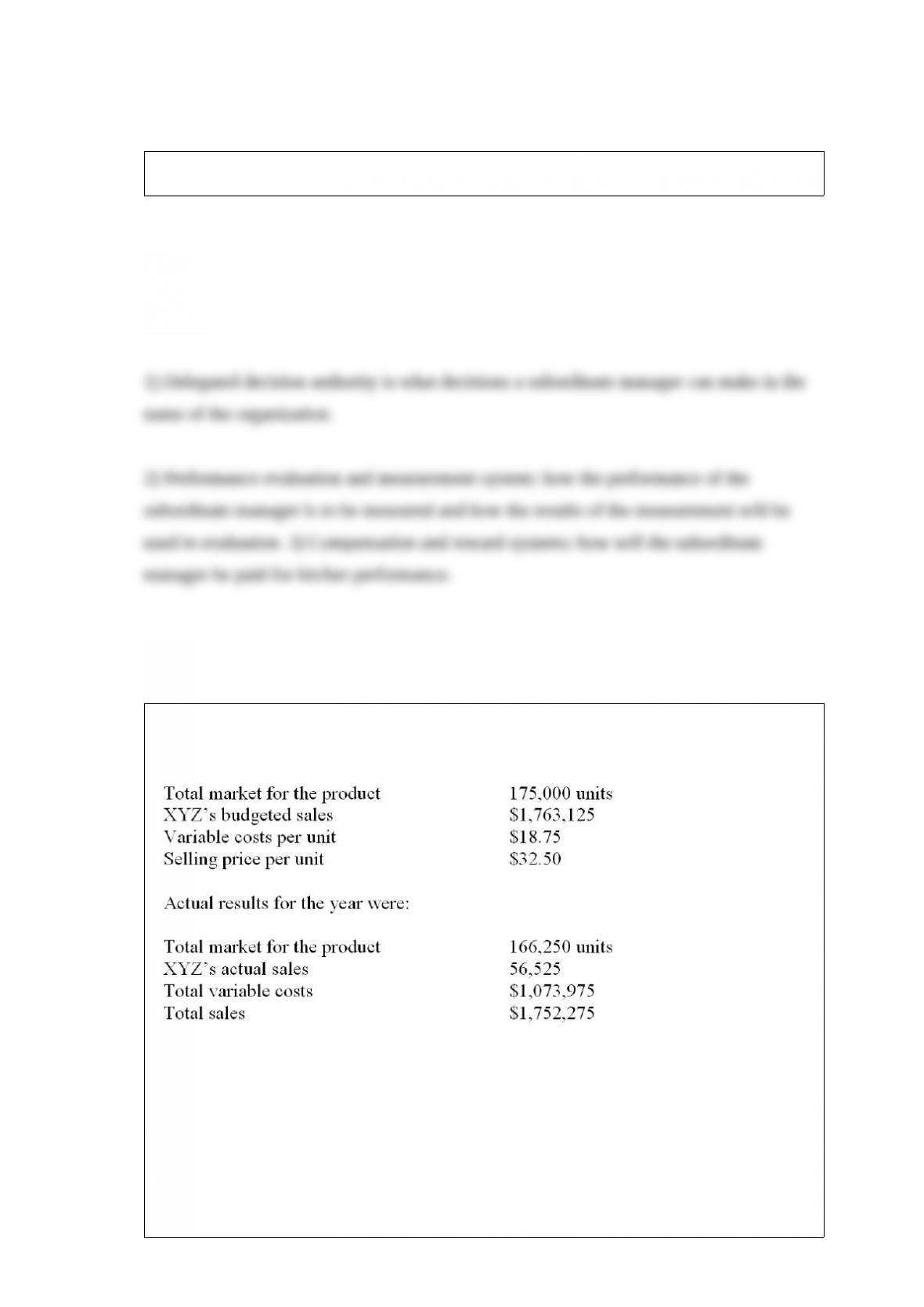
The XYZ Company had the following expectations for the year:
Is the market share variance favorable or unfavorable?
A. favorable.
B. unfavorable.
Answer:
Describe the difference between a company’s mission statement and its business-level
strategy.
Answer:
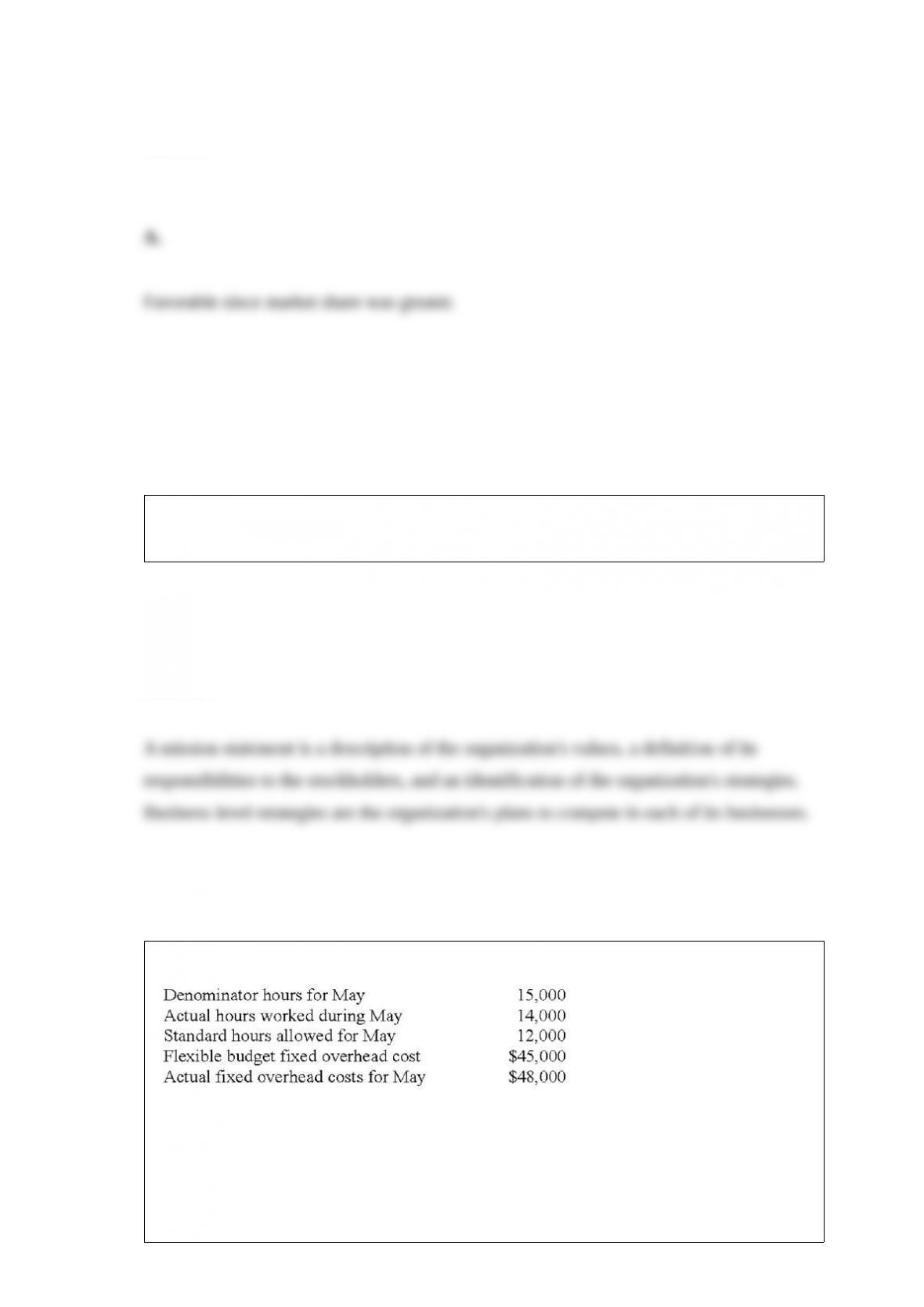
Is the production volume variance favorable or unfavorable?
A. favorable
B. unfavorable
Answer:
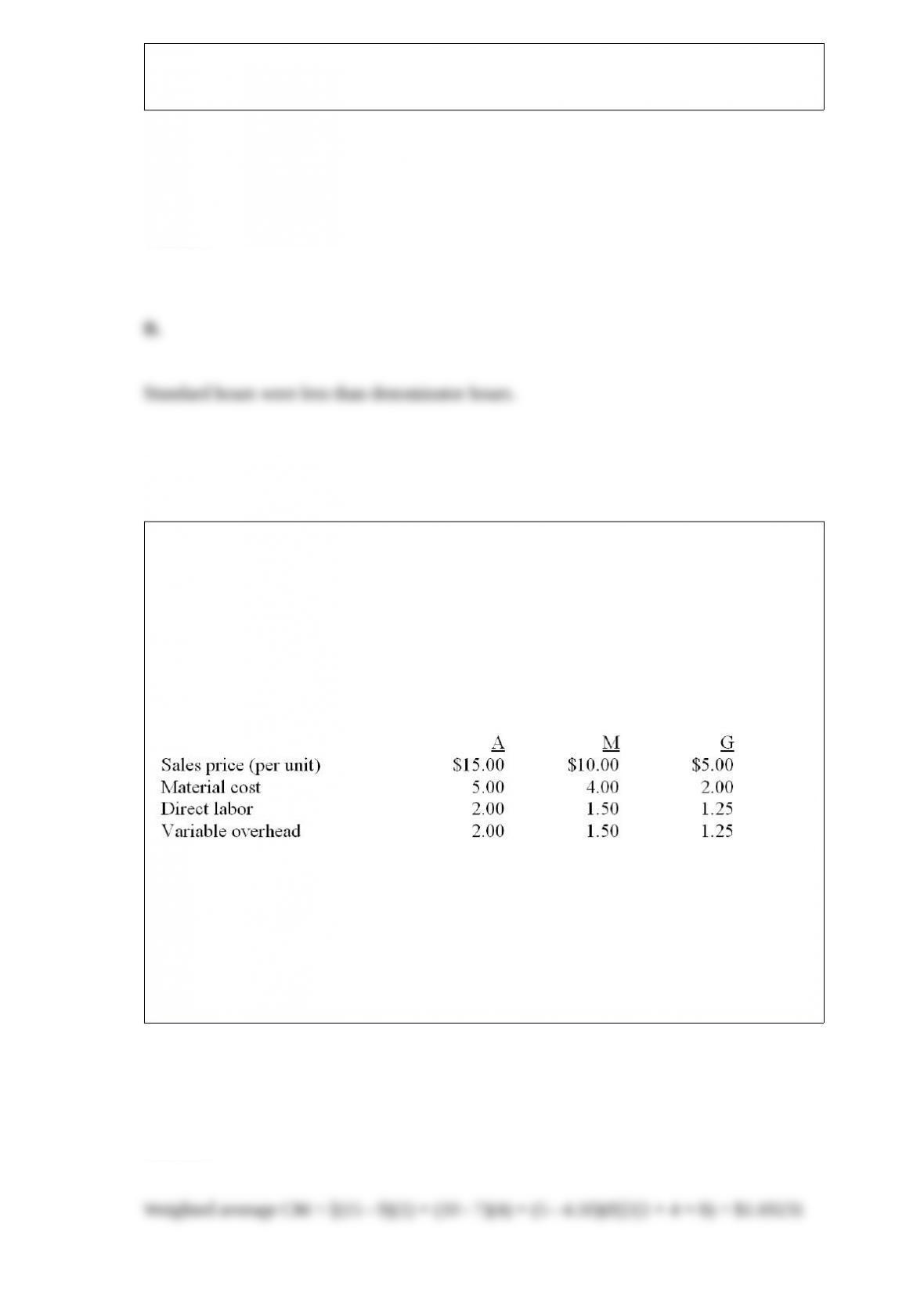
The president of AMG Enterprises is considering expanding sales by producing three
different versions of their product. Each will be targeted by the marketing department to
different income levels and hence will be produced from three different qualities of
materials. After reviewing the sales forecasts, the sales department feels that for every
item of A sold, 4 of M can be sold and 8 of G can be sold.
The following information has been assembled by the sales department and the
production department.
The fixed costs associated with the manufacture of these three products are $75,000 per
year.
Required:
Determine the number of units of each product that would be sold at the break-even
point.
Answer:
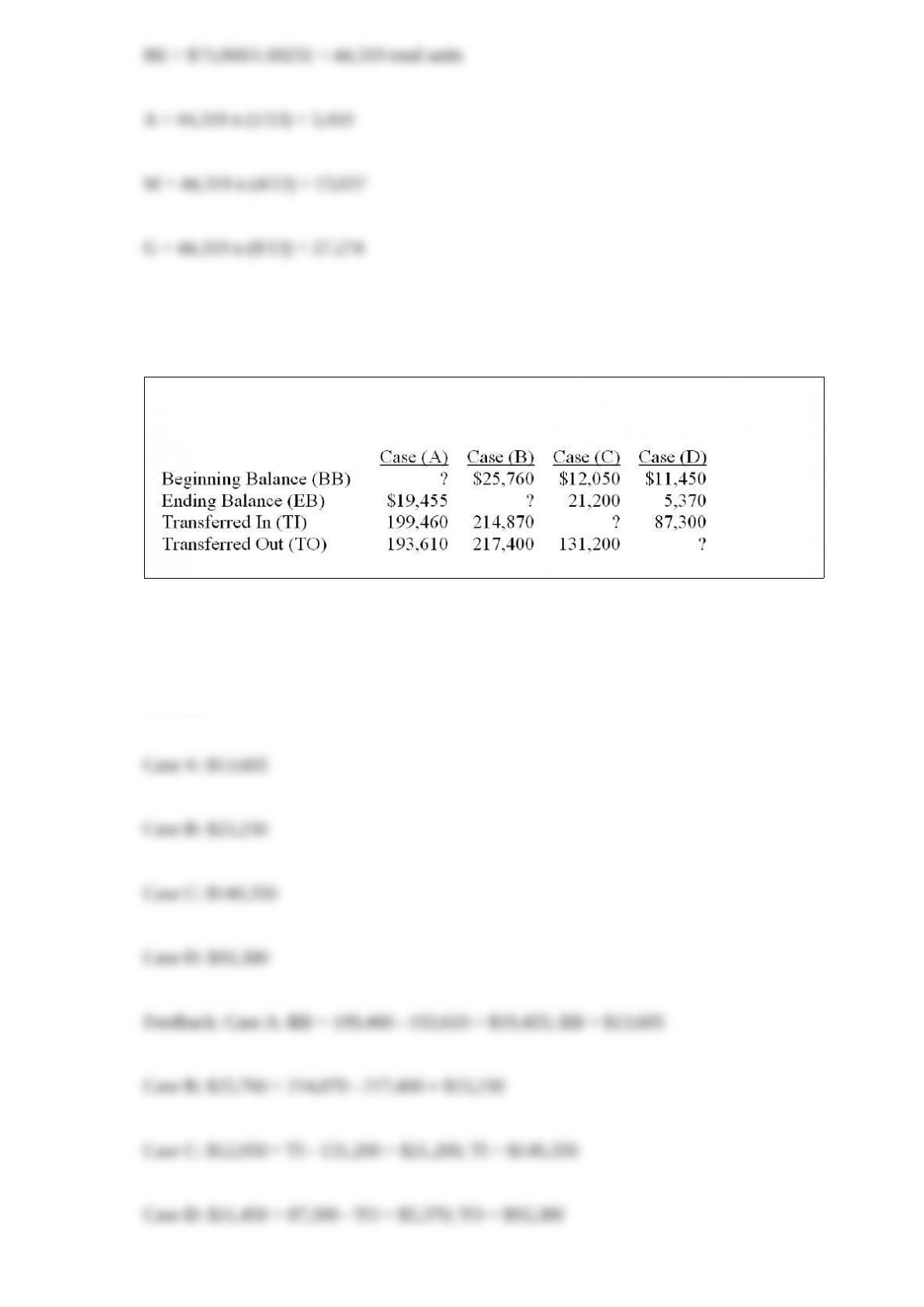
Determine the missing values from the table below:
Answer:
Explain the difference between actual activity, theoretical capacity, practical capacity,
and normal activity.
Answer:
Explain the difference between operating budgets, financial budgets, and flexible
budgets.
Answer:
Explain two reasons for preparing a variance analysis.
Answer: