The sales volume variance is the difference between sales revenue on the static budget
and sales revenue on the flexible budget.
Taylor Company is considering whether or not to replace a drill press that is several
years old. The current market value of the old equipment is an opportunity cost of
replacing the drill press.
Once indirect costs are pooled, they must remain pooled for all allocations.
Services performed by service departments for the benefit of an operating department
are called interdepartmental services.
If a company shifts its cost structure by decreasing fixed costs and increasing variable
costs, it will lower both the level of risk and its potential for profits.

In order to perform cost-volume-profit analysis, a company must be able to identify its
variable and fixed costs.
Under the indirect method losses are added and gains are subtracted when computing
net cash flow from operating activities.
Generally, the unadjusted rate of return should be calculated based on the average
investment rather than the amount of the original investment in a depreciable asset such
as equipment.
The accounts receivable turnover ratio can be used to asses a firm’s solvency.

Contribution margin cannot be calculated for a service-type business, and
cost-volume-profit analysis is not applicable for a company that provides services rather
than selling goods.
Within the relevant range, the fixed cost per unit can be expected to decrease with
increases in volume.
In preparing the statement of cash flows by the indirect method, a decrease in a current
liability is deducted from net income.
The term “quality” refers to the degree to which products or services exceed customer
expectations.
Multiple regression analysis should be performed when a single independent variable
influences multiple dependent variables.
The biggest challenge in computing the total cost per unit of a product is determining
the amount of overhead cost that should be assigned to each unit.
Actual overhead costs are charged (debited) to the work in process account as they
occur.
If the net present value for a capital investment is equal to zero, the internal rate of
return for the investment is equal to the required rate of return.
The two factors that determine the costs of manufacturing inputs (materials, labor, and
overhead) are price and quantity.
A potential negative effect of using a just in time inventory system is the immediate
impact of labor strikes on the transportation system such as railroad.
Financial ratio analysis is a form of horizontal analysis in that comparisons are made
between different accounts in the same set of financial statements.
Falls Company has a contribution margin of $32 per unit and fixed costs of $500,000,
and it desires to earn a profit of $100,000. What is the sales volume in units required to
achieve this desired profit?
A. 3,125 units
B. 18,750 units

C. 15,625 units
D. 12,500 units
Assuming a company’s inventory increased during the period, which of the following
misclassifications may increase net income?
A. Recording administrative salaries as a product cost
B. Recording depreciation on production equipment as an expense
C. Expensing raw material costs instead of including them in inventory
D. Recording depreciation on production equipment as an expense and Expensing raw
material costs instead of including them in inventory
Washington Company made the following estimates for the 2014 accounting period:
Overhead costs: $250,000
Direct labor hours: 50,000
If 7,000 hours of labor are actually used in February, how much overhead cost would be
allocated to work in process during the month? Assume Overhead to be allocated on the
basis of direct labor hours.
A. $7,000
B. $35,714

C. $35,000
D. $20,833
Why do accountants normally calculate cost per unit as an average?
A. Determining the exact cost of a product is virtually impossible.
B. Some manufacturing-related costs cannot be accurately traced to specific units of
product.
C. Even when producing multiple units of the same product, normal variations occur in
the amount of materials and labor used.
D. All of these are justifications for computing average unit costs.
Select the correct statement from the following, assuming Carmichael Company had a
favorable direct materials price variance of $3,000 and an unfavorable direct materials
usage variance of $2,000.
A. The total direct materials variance is $1,000 unfavorable.
B. The total direct materials variance is $5,000 favorable.
C. The total direct materials variance is $5,000 unfavorable.
D. The total direct materials variance is $1,000 favorable.
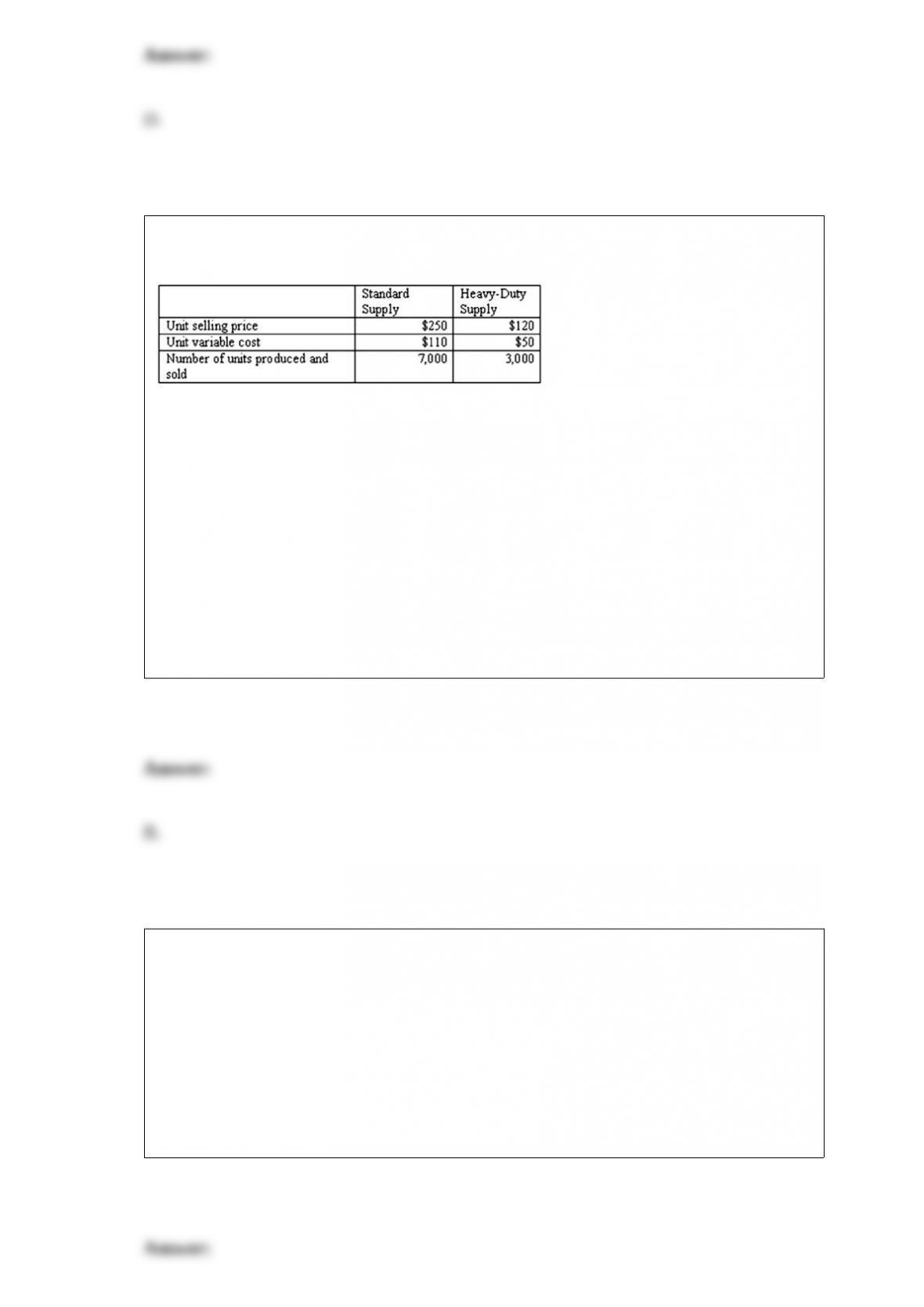
Zed Company sells two kinds of mainframe computer power supplies. The company
projected the following cost information for the two products:
Assume that total fixed costs are $428,400. How many units of the standard supply unit
would be included in the total number of units required to break-even with the projected
sales mix (round your answer to the nearest whole unit)?
A. 3,600 units
B. 2,520 units
C. 1,080 units
D. 2,040 units
Cost information for services or products produced by a company is needed for:
A. contract negotiations.
B. financial reporting.
C. managerial accounting.
D. All of these.

A credit to the work in process account represents the:
A. cost of goods manufactured.
B. cost of goods available for sale.
C. cost of overhead applied.
D. cost of goods sold.
Benson Corporation is considering an investment in equipment that would cost $50,000
and provide annual cash inflows of $14,000. The company’s required rate of return is
12%; the internal rate of return for the investment is 10.5%. Should the company make
this investment?
A. No, since the internal rate of return is more than the company’s required rate of
return.
B. Yes, since the internal rate of return is less than the company’s required rate of return.
C. No, since the internal rate of return is less than the company’s required rate of return.
D. The answer cannot be determined.

Mendez Company is considering a capital project that costs $16,000. The project will
deliver the following cash flows:
Using the incremental approach, the payback period for the investment is:
A. 5 years.
B. 2 years.
C. 2.4 years.
D. 1.66 years.
Ting Company started the accounting period with the following beginning balances:
raw materials, $21,000; work in process, $45,000; finished goods, $10,000
During the accounting period, the company purchased $30,000 of raw materials and
ended the period with $8,000 in raw material inventory. Direct labor costs for the period
were $60,000 and $63,000 of manufacturing overhead costs was allocated to work in
process. There was no over or underapplied overhead. Ending work in process was
$41,000 and ending finished goods inventory was $17,500. Goods were sold during the
period for $162,500. The amount of cost of goods manufactured (i.e., amount
transferred from work in process to finished goods) would be:
A. $117,500.
B. $170,000.
C. $221,000.
D. $166,000.

The sales volume variance is
A. The difference between the static budget (based on actual volume) and the flexible
budget (based on planned volume).
B. The difference between the static budget (based on planned volume) and the flexible
budget (based on actual volume).
C. The difference between the static budget (based on planned volume) and actual
revenue or cost.
D. The difference between the flexible budget (based on actual volume) and actual or
revenue or cost.
The entry to record the completion of a job in a job costing system would cause:
A. An increase to the cost of goods manufactured account.
B. An increase in net income.
C. An increase to the cost of goods sold account.
D. A decrease to the work in process inventory account.
Herald Company paid $2,800 cash for production supplies. The recognition of this
event will:
A. not impact total assets.
B. increase expenses.
C. decrease equity.
D. None of these.
Static and flexible budgets are similar in that:
A. They both are based on the same per unit variable amounts and the same fixed costs.
B. They both concentrate solely on costs.
C. They both are prepared for multiple activity levels.
D. None of these answers is correct.
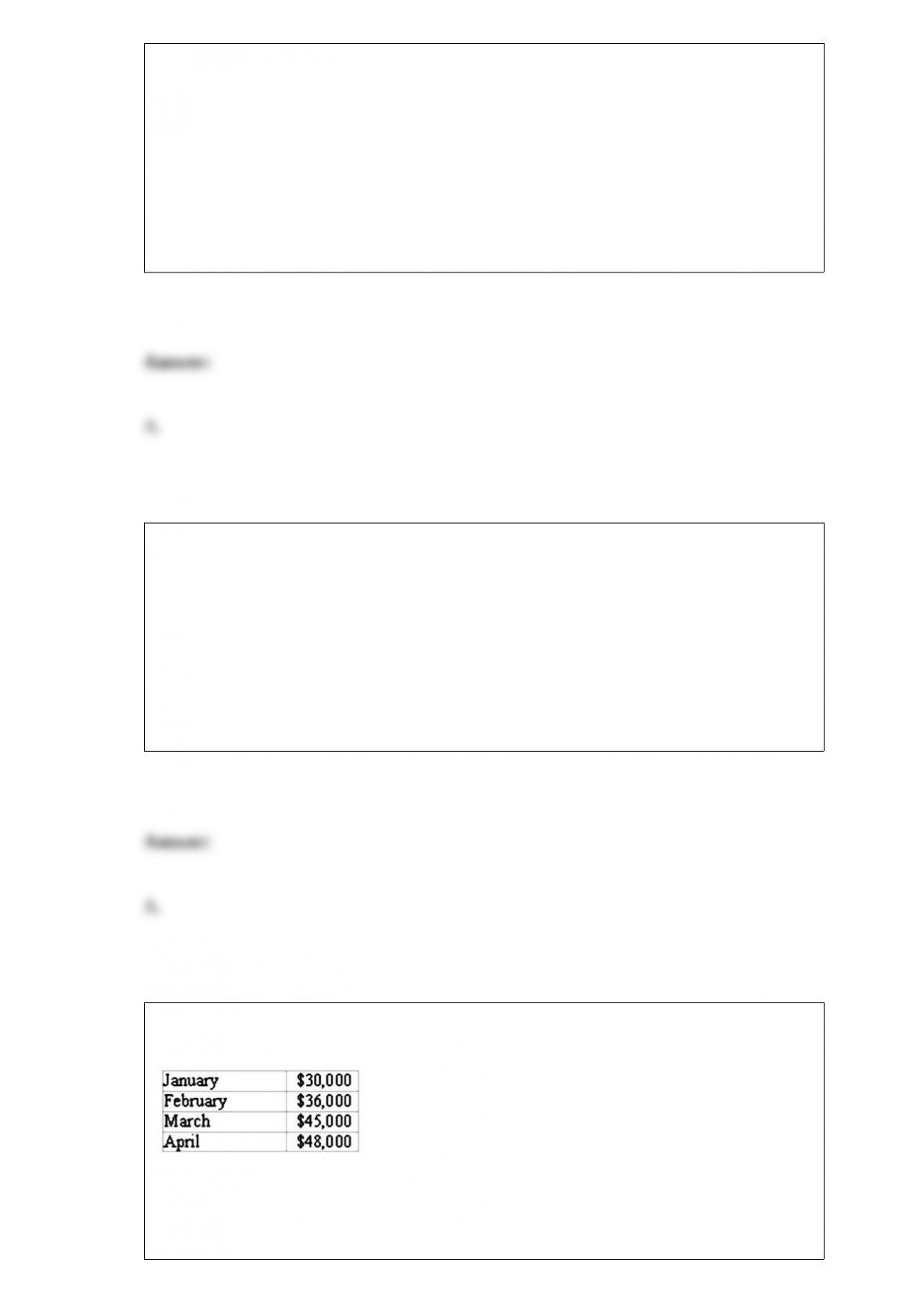
Markham Company has completed its sales budget for the first quarter of 2014.
Projected credit sales for the first four months of the year are shown below:
The company’s past records show collection of credit sales as follows: 40% in the
month of sale and the balance in the following month. The total cash collection from
receivables in March is expected to be:

A. $18,000.
B. $45,000.
C. $41,400.
D. $39,600.
Which of the following does not represent an advantage of the unadjusted rate of return
over the payback method for evaluating capital projects?
A. The unadjusted rate of return method considers the investment’s profitability.
B. The unadjusted rate of return method considers the time value of money.
C. The unadjusted rate of return is a percentage that can be compared to a stated hurdle
rate.
D. None of these represents an advantage.
A difference between the static budget based on planned volume and a flexible budget
prepared at actual volume is called a:
A. Flexible budget variance.
B. Static budget variance.
C. Production activity variance.
D. Volume variance.
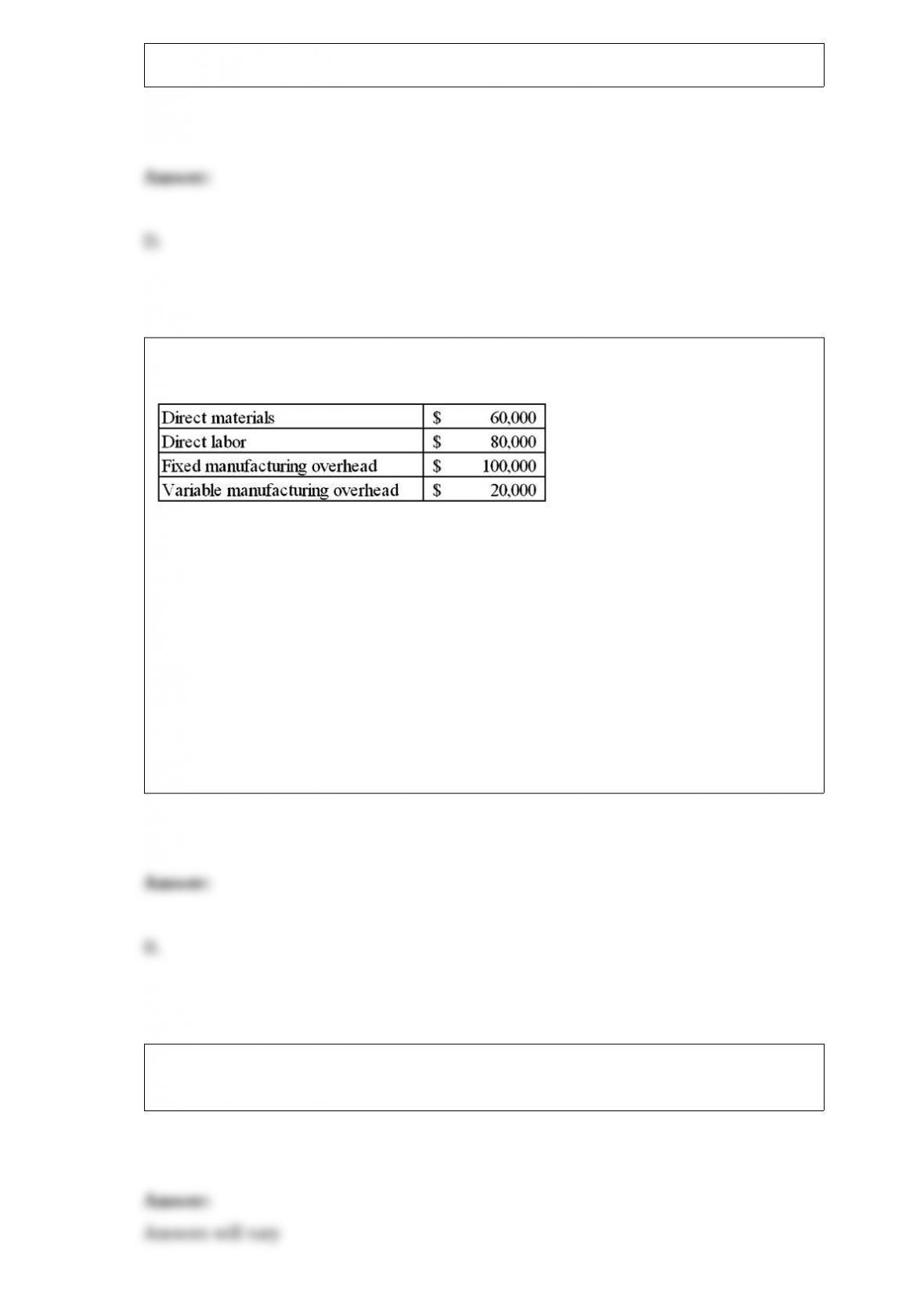
The accounting records for Eisner Manufacturing Company disclosed the following
cost information for 2014:
Assume the company produced 10,000 units of inventory, sold 6,000 of these units in
2014 for $192,000, and that there was no beginning inventory. The cost per unit under
variable and absorption costing would be, respectively:
A. $5.00 and $11.00.
B. $16.00 and $26.00.
C. $14.00 and $10.00.
D. $19.00 and $30.00.
Describe the differences between the liquidity ratios, solvency ratios and profitability
ratios. Identify examples of each type of ratio as well.
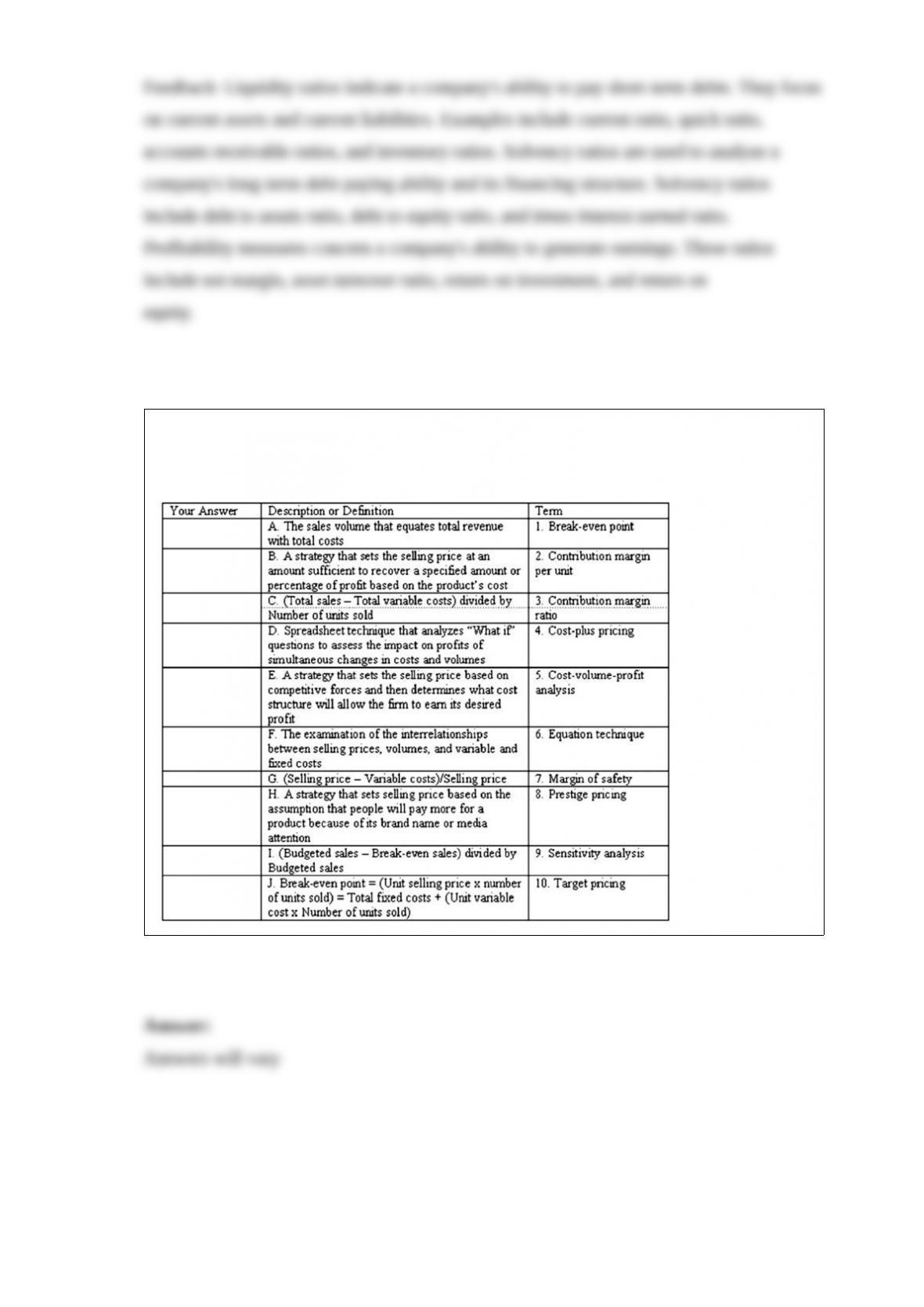
Select the term from the list provided that best describes each of the following
descriptions or definitions.
How does total variable cost respond when volume increases?
Indicate whether each of the following statements about financial statement analysis is
true or false.
Having too little inventory can hurt a company’s profitability because of lost sales.
Having too much inventory can hurt a company’s profitability because of excess costs.
Generally, a lower inventory turnover indicates that merchandise is being handled more
efficiently.
Average days to sell inventory is the number of times, on average, that inventory is
replaced during the year.
Values for the inventory turnover ratio vary widely among different industries.
Vanguard Company makes three products, M, N, and P, which come from a joint
process. The joint costs for each batch of the products are: $80,000 for direct materials,
$40,000 for direct labor, and $30,000 for indirect costs (overhead). Each batch produces
10,000 pounds of product M with a market value of $6 per pound; 5,000 pounds of N
with a market value of $12 per pound; and 9,000 pounds of P with a market value of
$10 per pound.
Required:
1) Determine the total amount of joint cost allocated to each of the products, assuming
that the allocation is based on the weight of products produced.
2) Determine the total amount of joint cost allocated to each of the products, assuming
that the allocation is based on the market value of the products.
Management accountants have a responsibility to be objective. What does this ethical
standard require of management accountants?
Anton Valve Company produces a mechanical valve used in water systems. Three years
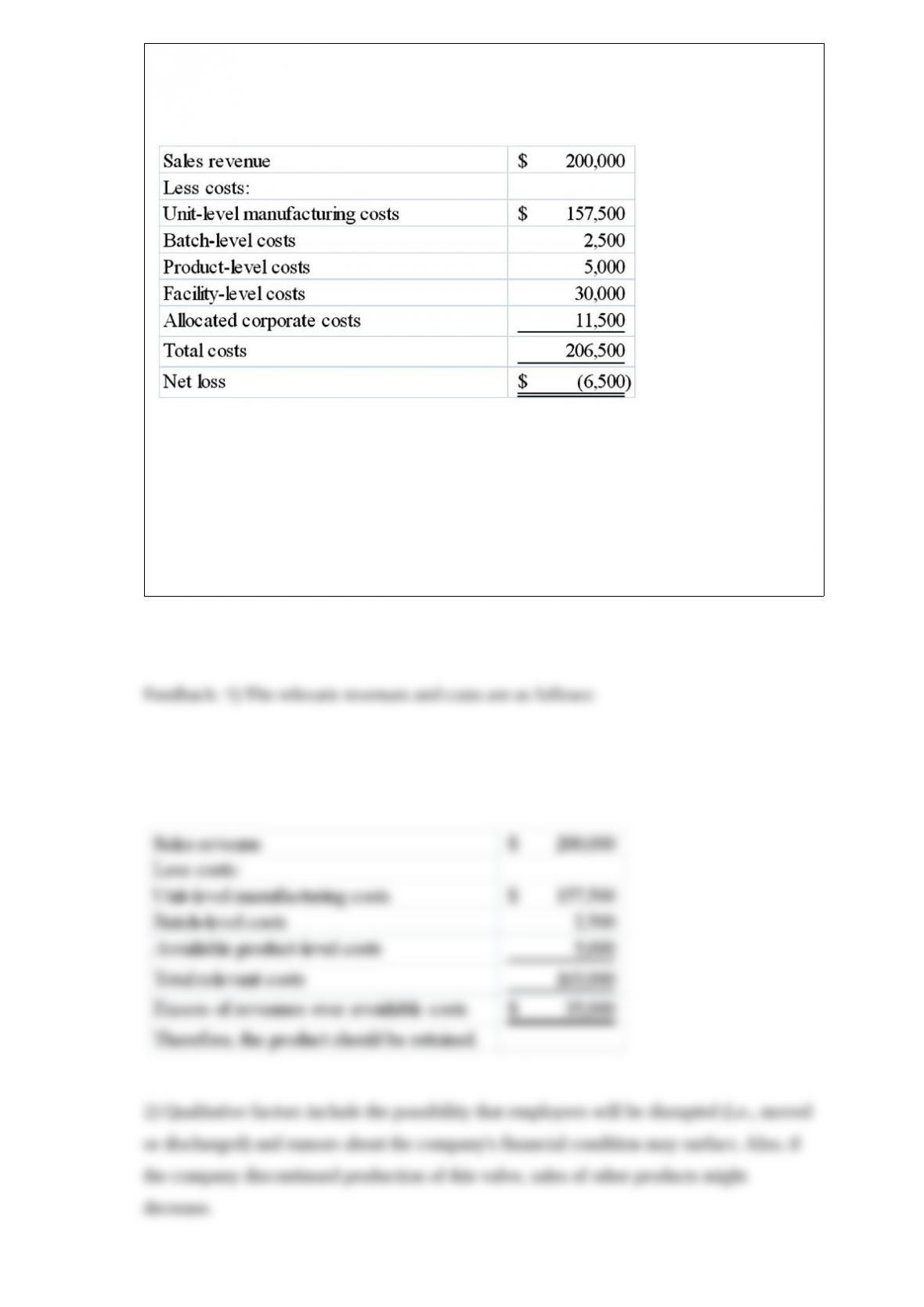
ago the company introduced an electronic version of the valve. Sales of the mechanical
model have steadily declined, and the company will report a loss on the product this
year as follows:
If production of the mechanical valve is discontinued, product-level costs will be
eliminated but facility level and corporate costs would not be affected.Required:
1) Prepare a quantitative analysis that indicates whether the valve should be
discontinued.
2) What qualitative factors should be considered in this decision?