A company uses $100,000 in cash to pay off $100,000 in notes payable. This would
result in a:
A) $100,000 debit to Notes Payable and a $100,000 credit to Cash.
B) $100,000 credit to Cash and a $100,000 credit to Notes Payable.
C) $100,000 debit to Cash and a $100,000 credit to Notes Payable.
D) $100,000 debit to Cash and a $100,000 debit to Notes Payable.
A company borrows $2 million from its bank. It then uses this money to buy equipment.
How do these two transactions affect the company ‘s accounting equation?
A) Assets and liabilities both increase by $2 million.
B) Assets increase by $2 million and liabilities decrease by $2 million.
C) Assets increase by $4 million, liabilities increase by $2 million, and stockholders ‘
equity increases by $2 million.
D) Assets remain unchanged and liabilities increase by $2 million.
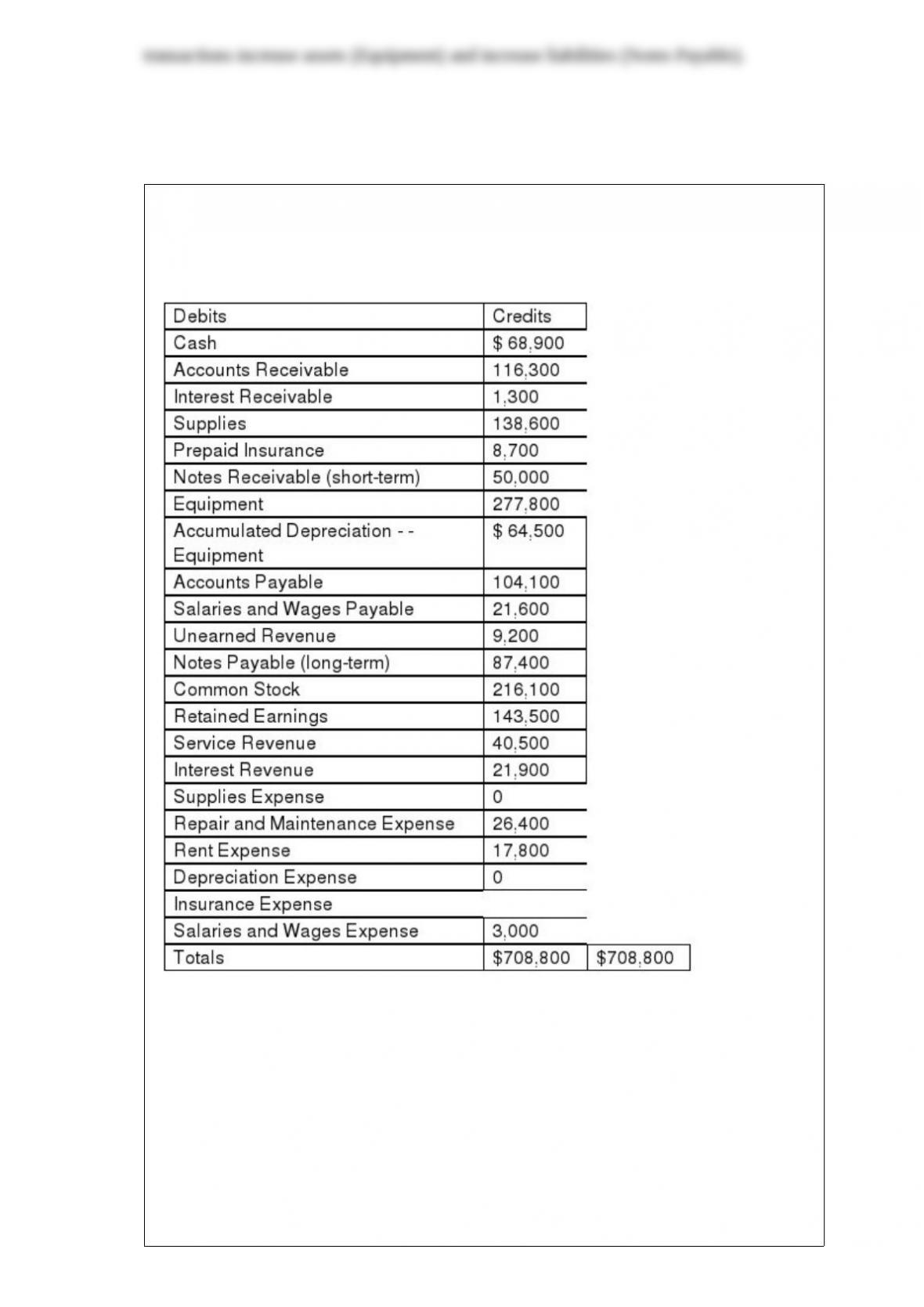
Garvey Company’s unadjusted trial balance includes the following account balances as
of December 31, 2015:
The following data are available to determine adjusting entries:
A) Insurance purchased at the beginning of July for $8,700 provided coverage for
twelve months (July 2015 through June 2016). The insurance coverage for July through
December totaling $4,250 has now been used.
B) The company estimates $8,150 in depreciation each year.
C) A count showed $85,700 of supplies on hand at the end of the year.
D) An additional $260 of interest has been earned but has not yet been uncollected on
the outstanding notes receivable.
E) Services in the amount of $5,600 were performed for customers who had previously
paid in advance.
F) Services in the amount of $2,000 were performed; these services have not yet been
billed or recorded.
Required:
Part a. Prepare the adjusting entries that are required at the end of the period.
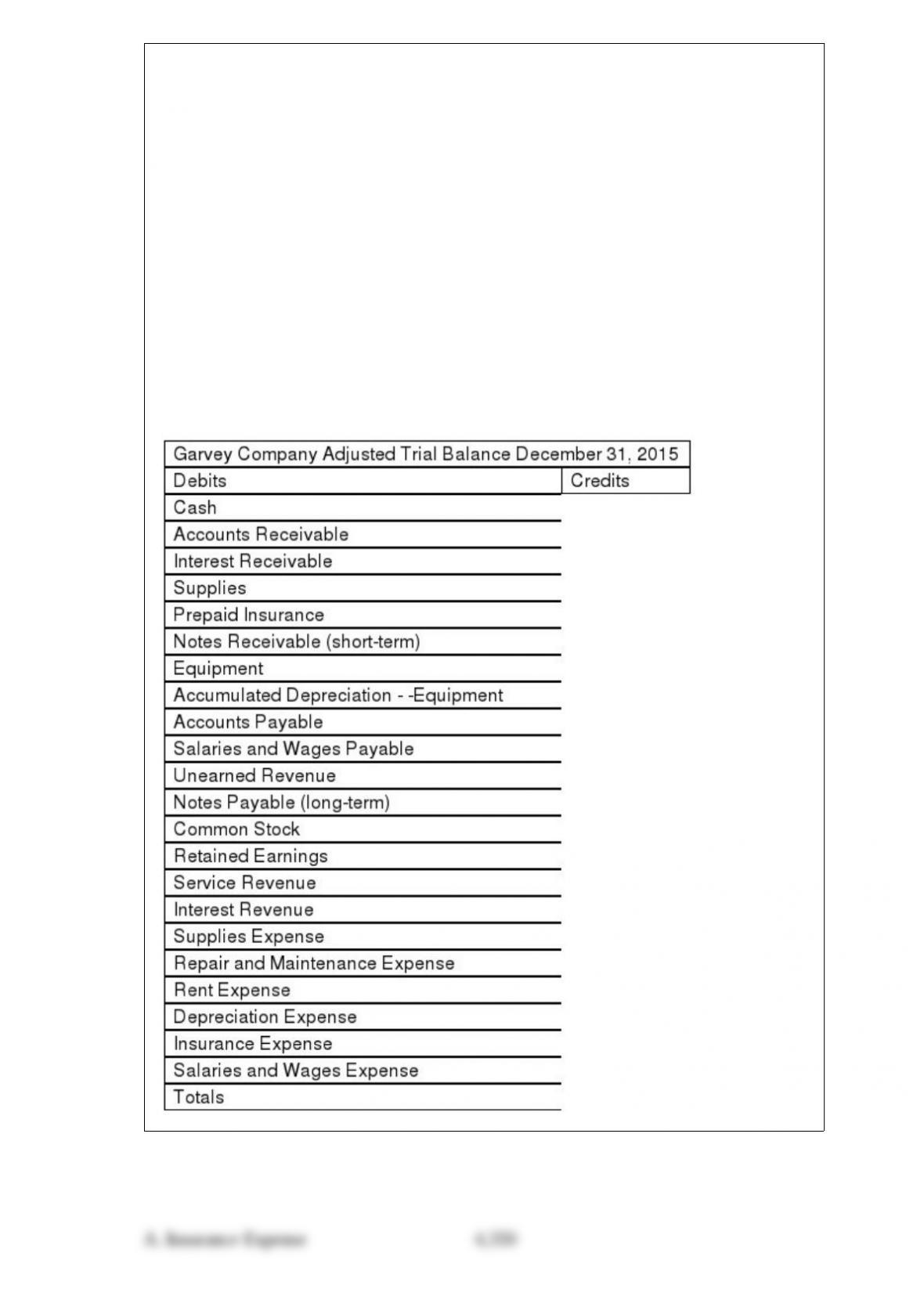
Part b. Prepare an adjusted trial balance by completing the related columns in the table
below.
Current liabilities could include all of the following except:
A) an accounts payable due in 30 days.
B) a notes payable due in 9 months.
C) a bank loan due in 18 months.
D) any part of long-term debt due during the current period.
On July 1, 2016, Empire Inc. lends $8,000 to a customer and receives a 9% note due in
two years. Interest is due in full on July 1, 2018, the due date of the note. What is the
amount of Interest Revenue that will be reported on Empire’s income statement for the
year ended December 31, 2016?
A) $1,440
B) $720
C) $420
D) $360
If an analyst wants to examine a company’s current ability to generate income, which of
the following would best be considered?
A) Liquidity
B) Market share
C) Profitability
D) Solvency
The following transactions occurred during July:
1> Received $800 cash for services performed during July.
2> Received $5,000 cash from the issuance of common stock to owners.
3> Received $400 from a customer as payment for services performed during June.
4> Billed $3,500 to customers for services performed on account in July.
5> Borrowed $2,500 from the bank and signed a promissory note.
6> Received $1,000 from a customer for services to be performed during August.
Use the information above to answer the following question. What is the amount of
revenue that will be reported on the income statement for the month ended July 31?
A) $5,300.
B) $5,700.
C) $4,300.
D) $7,200.
A company reported that its bonds with a face value of $50,000 and a carrying value of
$53,000 are retired for $56,000 cash. The amount to be reported under cash flows from
financing activities is:
A) ($53,000).
B) ($3,000).
C) ($56,000)
D) $0; this is an operating activity.
Which of the following would be classified as an operating activity on the statement of
cash flows using the direct method?
A) Cash dividends paid
B) Cash received from selling equipment
C) Cash paid to retire bonds payable at maturity
D) Cash received from accounts receivable collections
Which of the following statements about cash flows from financing activities is correct?
A) When a company borrows from lenders, a cash outflow from financing activities has
occurred.
B) When a company receives cash dividends, a cash inflow from financing activities
has occurred.
C) When a company repurchases its own stock, a cash outflow for financing activities
has occurred.
D) When a company pays cash dividends, a cash inflow from financing activities has
occurred.
Which of the following statements about liabilities is not correct?
A) Liabilities are amounts owed by a business.
B) Liability accounts have a normal credit balances.
C) Financing activities may affect the amount of liabilities.
D) Examples of liabilities include Notes Payable, Common Stock, and Income Tax
Payable.
If a company receives payment when it provides a service:
A) more than one journal entry is always needed.
B) cash will be credited.
C) a revenue account will be increased with a debit.
D) stockholders’ equity will increase.
Which of the following is not a reason why it is especially important for companies to
have internal controls over cash?
A) Most businesses accept remote sources of payment on account.
B) The volume of cash transactions is enormous.
C) Cash is portable.
D) There is a high risk of theft of cash.
The classified balance sheet for a company reported current assets of $1,623,850, total
liabilities of $799,540, Common Stock of $1,000,000, and Retained Earnings of
$130,260. The current ratio was 2.5.
Use the information above to answer the following question. What is the total amount
of noncurrent assets?
A) $493,590.
B) $824,310.
C) $649,540.
D) $305,950.