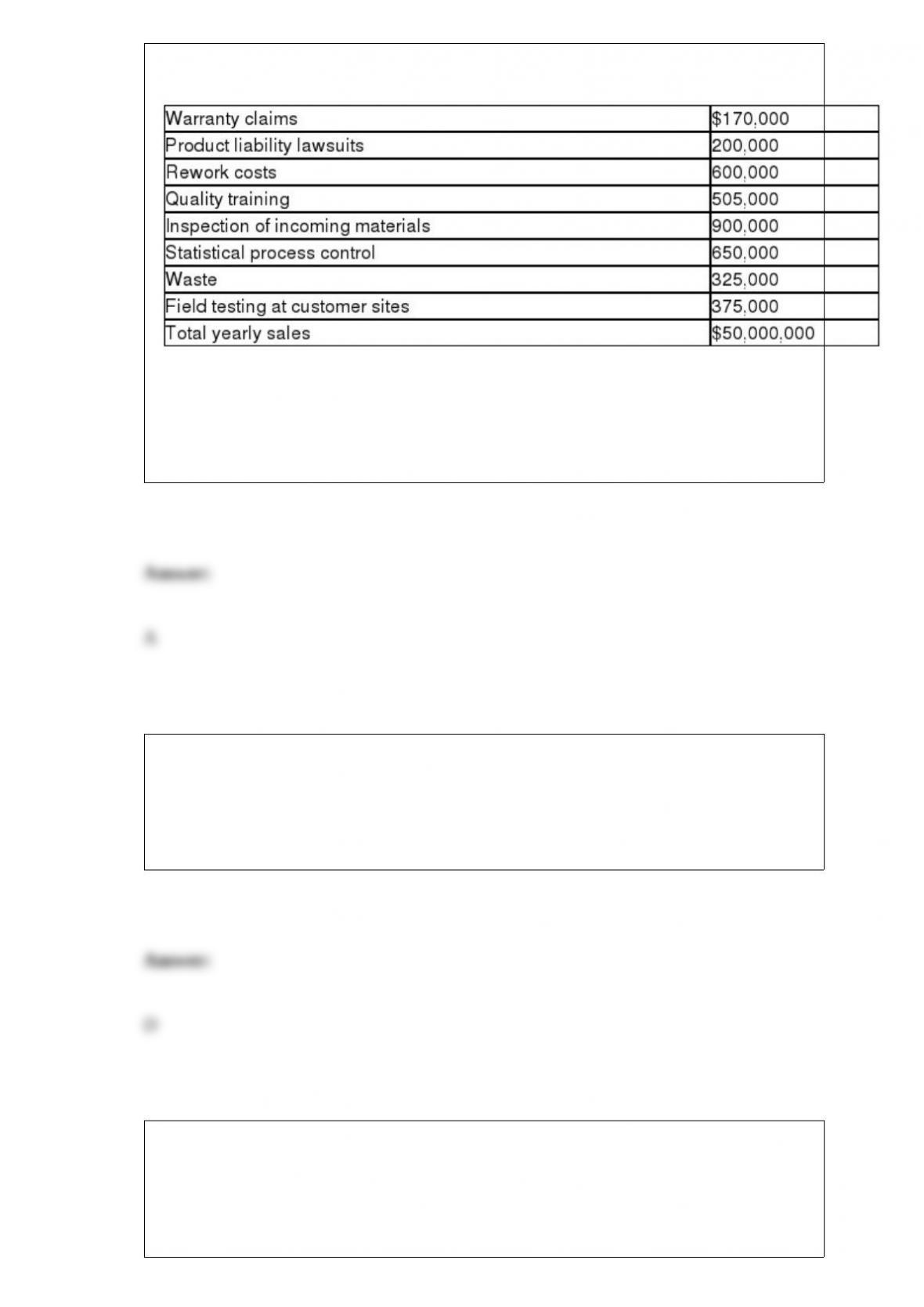
Three Dog Bite Company:
Refer to Three Dog Bite Company. What are the total appraisal costs?
A.$ 375,000
B.$1,550,000
C.$1,275,000
D.$2,025,000
Traditional cost allocation methods include which of the following?
A.plantwide allocation, only.
B.department allocation, only.
C.activity-based costing.
D.plantwide and department allocation.
Which of the following is not a component of a comprehensive master budget?
A.budgeted income statement,
B.budgeted balance sheet.
C.budgeted retained earnings statement.
D.budgeted statement of cash flows.

The question “How much information is enough?” for managerial purposes should be
answered on
A.a cost/benefit basis.
B.a cost, but not benefit, basis.
C.a benefit, but not cost, basis.
D.neither costs nor benefits, but some other criteria.
Which statement is true concerning job costing?
A.Firms collect costs for each unit produced.
B.Firms accumulate costs in a department or production process during the accounting
period.
C.Firms spread costs evenly over the units produced during the period.
D.The equation for determining average unit cost is Total Manufacturing Cost Incurred
during the Period divided by Total Units Produced during the period.
Barker Agricultural Industries studied the production and sale of 8,000 cases of roma
tomatoes that sold retail for $25 per case. Barker owns the tomato farm and a salsa
manufacturing facility. Last year, Barker harvested tomatoes to produce 8,000 cases of
salsa using these tomatoes. The company produced the 8,000 cases and sold them to a
large chain of restaurants in the region for $75 per case, who in turn sold them to their
individual restaurants. These restaurants then sold them to customers in their condiment
gift shops. Using the following information below, compute the profitability of each
segment of the value chain-farm, salsa manufacturing, restaurant chain, and individual
restaurant.
Farm
Farm Assets (beginning of year) $210,000
Farm Assets (end of year) $190,000
10 percent weighted-average cost-of-capital
Depreciable asset life 5 years (Use to compute economic depreciation or decline in the
economic value of the farm assets)
Operating costs excluding depreciation $160,000
Salsa Operations
Market value of assets (Beginning of Year) $1,550,000
Market value of assets (End of Year) $1,450,000
10 percent weighted-average cost-of-capital
Operating costs excluding depreciation $142,000
Additional cost of spices, peppers and onions $6.00 per case
Restaurant Chain
Revenues per case of salsa: $115
Operating costs per case of salsa, including economic depreciation: $20
Cost-of-capital per case of salsa: $5
Individual Restaurant ( on average)
Revenues per case of salsa: $145
Operating costs per case of salsa, including economic depreciation: $15
Cost-of-capital per case of salsa: $5
Required: Prepare a value chain analysis using this information and explain how
Barker’s management could use this data. Include options that they might generate from
this analysis.
A manufacturing division of a company would most likely be evaluated as a(n)
A.cost center.
B.investment center.
C.revenue center.
D.asset center.
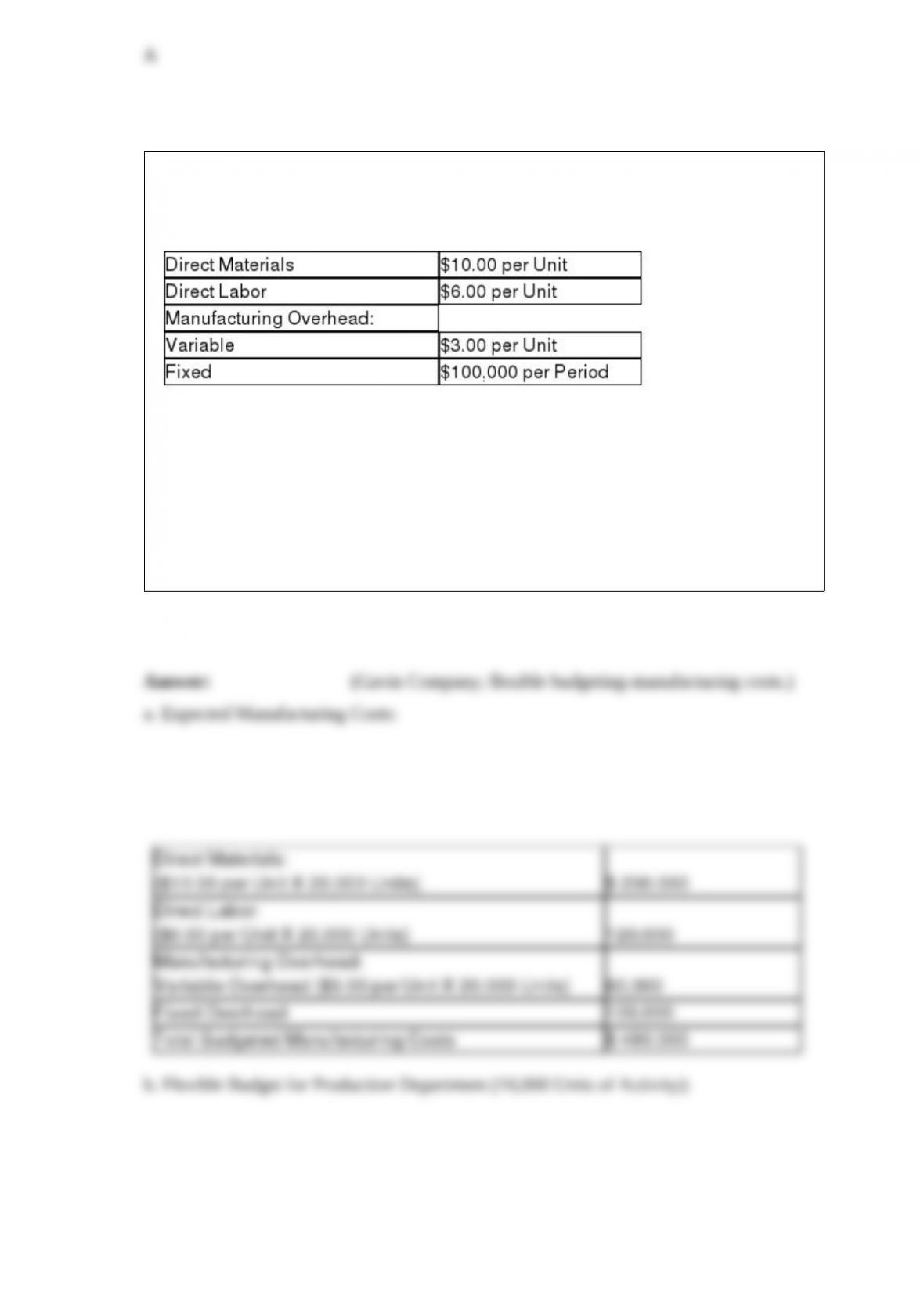
Flexible budgeting-manufacturing costs. As a result of studying past cost behavior
and adjusting for expected price increases in the future, Gavin Company estimates that
its manufacturing costs will be as follows:
Required:
Gavin uses these estimates for planning and control purposes.
a. Gavin expects to produce 20,000 units during the next period. Prepare a schedule of
the expected manufacturing costs.
b. Suppose that Gavin produces only 16,000 units during the next period. Prepare a
flexible budget of manufacturing costs for the 16,000-unit level of activity.
c. Suppose that Gavin produces 25,000 units during the next period. Prepare a flexible
budget of manufacturing costs for the 25,000-unit level of activity.
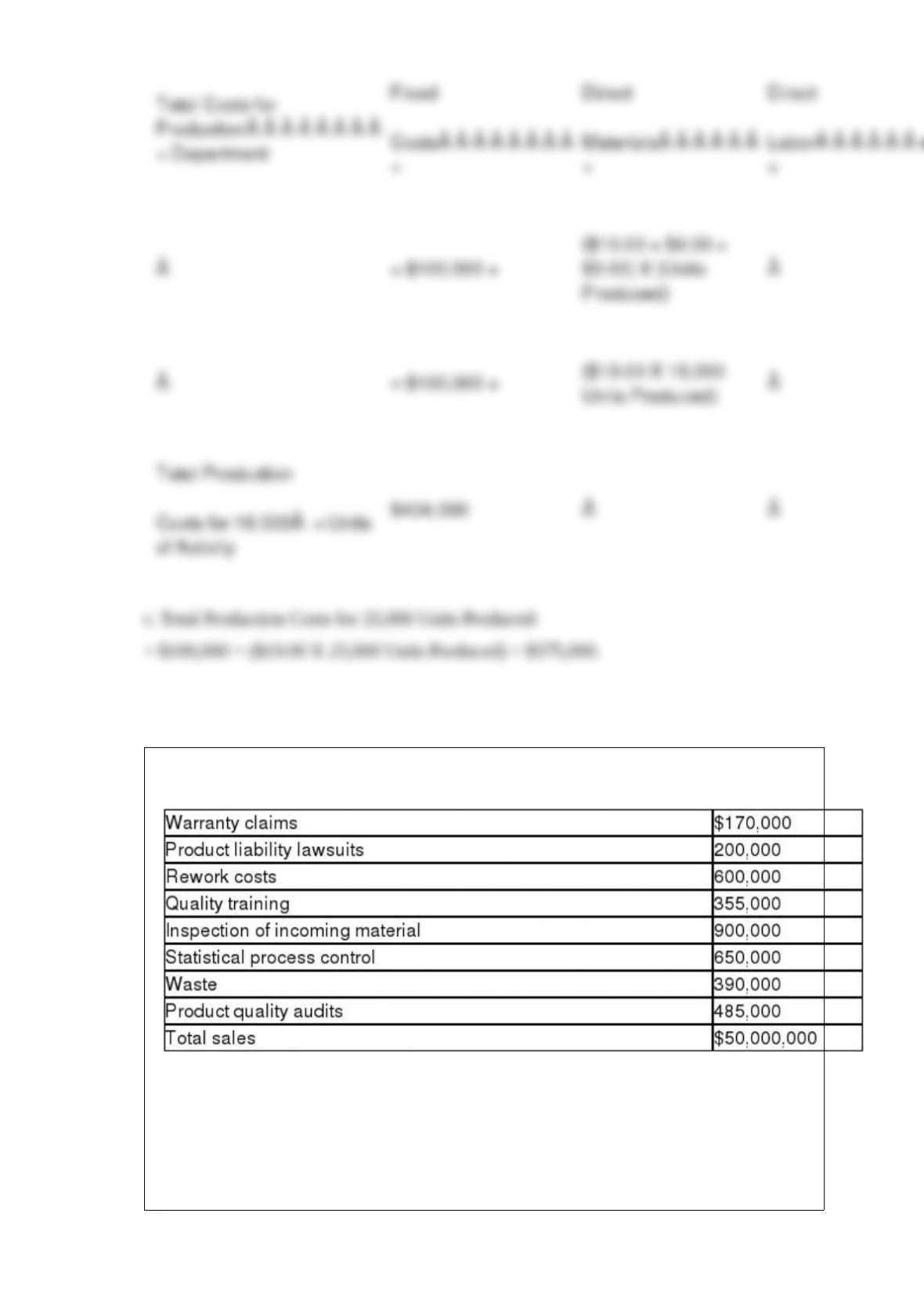
The following information was received from Sheltie Manufacturing.
REQUIRED:
a. Compute the total prevention costs.
b. Compute the total appraisal costs.
c. Compute the total internal failure costs.
d. Compute the total external failure costs.
e. Define each of the above costs.
Which of the following statements best defines the contribution margin ratio?
A.Total contribution margin divided by total sales.

B.Unit contribution margin divided by unit sales price.
C.Total contribution margin divided by total sales and unit contribution margin divided
by unit sales price.
D.None of the answers is correct.
The agency theory of motivation deals with relationships between supervisors and
workers where the principals assign responsibility to the workers and the workers work
on behalf of the supervisors. Supervisors and workers, respectively, are called
A.principals and agents.
B.agents and employees.
C.masters and slaves.
D.lords and serfs.
Applying the techniques of activity-based costing typically results in identifying which
of the following?
A.less accurate cost-allocation bases (cost drivers).
B.as accurate cost-allocation bases (cost drivers).
C.more accurate cost-allocation bases (cost drivers).
D.None of the answers is correct.

Which of these is a cost that results from the joint use of a facility or a service by
several products, departments, or processes?
A.direct cost.
B.indirect cost.
C.marginal cost.
D.variable cost.
To simplify the analysis of cost behavior, decision makers usually assume that costs are
either
A.short-run or long-run.
B.fixed or variable.
C.controllable or noncontrollable.
D.direct or indirect.
According to the agency view, the objective of a good incentive compensation system is
to do which of the following?
A.maximize principal wealth.
B.maximize agent wealth.
C.strike a fair balance between principal and agency wealth.
D.minimize agency costs.