
You are a public accountant retained by the manager of a cooperative retirement village
to do “write-up work.” You are expected to prepare unaudited financial statements with
each page marked “unaudited” and accompanied by a disclaimer of opinion stating no
audit was made. In performing the work, you discover that there are no invoices to
support $25,000 of the manager’s claimed disbursements. The manager informs you that
all the disbursements are proper. What should you do?
A) Submit the expected statements but omit $25,000 of unsupported disbursements
B) Include the unsupported disbursements in the statements since you are not expected
to make an audit
C) Obtain, from the manager, a written statement that you informed him of the missing
invoices and include his assurance that the disbursements are proper
D) Obtain further information about the $25,000 unsupported items and withdraw if the
situation is not satisfactorily resolved
Which of the following controls helps to prevent error with set up of access rights, and
also helps to prevent unauthorized changes to the access rights?
A) independent comparison to check that they have been set up properly
B) access rights forms that are signed by the user’s manager
C) tracking all accesses in an access log by user identification code
D) using audit software to provide a list of who has accessed sensitive data

Before performing a review of an entity’s financial statements, an accountant should
A) complete a series of inquiries concerning the entity’s procedures for recording,
classifying, and summarizing transactions.
B) apply analytical procedures to provide limited assurance that no material
modifications should be made to the financial statements.
C) obtain a sufficient level of knowledge of the accounting principles and practices of
the industry in which the entity operates.
D) inquire whether management has omitted substantially all of the disclosures required
by generally accepted accounting principles.
CAS 200 explains that as part of general qualifications and conduct the auditor should
exercise due care in the performance of all aspects of auditing. Which of the following
is an illustration of due care?
A) having an objective state of mind and independence from the client
B) completing formal education and having practical experience in the conduct of
auditing
C) issue a standard audit report using the CICA Handbook specified wording
D) considering the completeness of the working papers

The auditor has evaluated the effectiveness of the client’s procedures to count inventory,
and has provided constructive suggestions for improvement. However, the client has not
implemented the suggestions, so the auditor has concluded that the inventory
instructions do not provide adequate controls. This means that the auditor
A) must send a management letter informing management of the impact of these
weaknesses.
B) must spend more time ensuring that the physical count is accurate.
C) should use attribute sampling to select a smaller sampling for testing the physical
inventory.
D) increase the level of price and compilation tests to ensure better quality inventory
pricing data.
Dussault & Montgomery, the auditors of Greenwich Corp., relied on Groves & Padden,
another PA firm, to audit the Quebec subsidiaries of Greenwich. The responsibility for
the opinion to issue on the financial statements is the responsibility of
A) Greenwich Corp.
B) Dussault & Montgomery.
C) Groves & Padden.
D) Dussault & Montgomery and Groves & Padden.

As part of the audit of dividends, the auditor would verify whether the payment was
made to the shareholders who owned the stock at the dividend record date. Which of the
following audit tests assists with this objective?
A) examine the minutes of board of directors’ meetings for the amount of the dividend
per share and the dividend date
B) review the permanent audit working paper file to determine if there are restrictions
on the payment of dividends
C) recomputed the amount of dividends declared by multiplying the dividend amount
per share by the number of shares outstanding
D) select a sample of recorded dividend payments and trace the payee’s name on the
cancelled cheque to the dividend records
When considering each material type (or class) of transactions during the audit, which
general transaction-related audit objectives are assessed during the audit?
A) those transaction-related audit objectives where there is the highest risk of error
B) all five transaction-related audit objectives
C) those transaction-related audit objectives where there are poor internal controls
D) primarily completeness, occurrence and accuracy, since this is where most errors
occur

You, PA, have been assigned as in charge auditor of a long-time audit client of your
firm, Mikla Tool Inc. (MTI). MTI is owned by George Mikla, an experienced
machinist. George established the business over 20 years ago, and it has grown into a
$10 million a year business, with an excellent reputation for high quality machined
parts. MTI has regular clients in the automobile parts sector and in the health care
sector. The company has recently begun producing parts for environmentally friendly
products, such as recycling containers. This is due to the business’ versatility in dealing
with a variety of metals as well as plastics using both manually controlled and machine
controlled (computerized) equipment. The following description is based upon your
review of prior files, and planning discussions with personnel at MTI.
Equipment suppliers have helped MTI develop efficient operations, by providing
sample programs for standard operations and by providing training to employees. One
of the suppliers unfortunately sent sample programs that had been infected by a virus.
George’s daughter, Tiffany, had to cleanse the servers and each of the machines using
her copy of the anti-virus software. When contacted, the supplier did not know that the
software was infected, and apologized profusely!
The company’s four CAD/CAM terminals and printers are connected to the company’s
central local area network. The local area network is maintained by Toni Lee, the owner
of a computer shop conveniently located three blocks away. All computer equipment,
software and supplies are now purchased from Mr. Lee, who is responsible for attaching
and maintaining equipment, upgrading software, and maintaining user profiles on the
network. To reduce the amount of Mr. Lee’s work as network administrator, he has set
up passwords by function.
There is one user identification code (userid) and password for accounting (shared by
Tiffany, George and the accounting clerk, Isabel). The plant supervisors share another
userid that is used for production control and to initiate the timekeeping system every
morning. A separate userid and password allowing for only enquiry into the job costing
system has also been set up, and can be used by all employees.
A standard routine has been set up to back up the accounting systems. Either Tiffany or
the accounting clerk inserts one of seven tape cartridges into the system at the end of
the day (they are labelled with the day of the week), so that the company has a full set
of accounting
backups for the week. Tiffany keeps these in her office. These are particularly
important, since during the last office move, two years ago, the original software for the
accounting system was misplaced.
The network has two central servers, eleven user stations, and five printers. The user
stations are set up as follows: four CAD/CAM, two time keeping, two production
planning and control, two accounting and one for George.
A good working relationship is extremely important for satisfying some of the
company’s larger customers. MTI has paid for computer equipment for each of the
supervisors, so that they have fully functioning computers at home. If a rush job
requires weekend work, then these senior personnel can work at home to get the
necessary quoting or design work completed. Since the ‘at home’ systems are identical
to the office systems Mr. Lee simply copied across the MTI systems to the home

computers. Files can be easily taken home and then brought back to the office using
thumb drives. It is understood that when times are slower, a day off can be taken to
compensate for this weekend work.
It is almost ten years ago that Tiffany arranged for the implementation of the network,
and the purchase of the standard integrated accounting packages (general ledger, order
entry/accounts receivable, purchases/payable and payroll), and for the purchase of the
job costing and time keeping systems. A variety of reports are printed daily, weekly, or
monthly from the job costing system which are used for monitoring employee hours,
the status of the jobs, the costs accumulated for particular jobs, and the work in progress
inventory.
The weekly report of hours from the job costing system is approved by the production
supervisors, and is used as an input source for hours worked into the payroll system.
The accounting clerk enters the hours into the accounting system, so that weekly
payroll cheques and reports can be produced. The accounting clerk handles most data
entry.
Tiffany is really pleased with their accounting clerk, Isabel, who has been with the
company for three years. She insists that fate had a hand in getting Isabel working for
MTI. Isabel had been ‘pounding the pavement,’ having recently immigrated, and had no
Canadian business experience. Her accounting skills were rudimentary, but she quickly
learned the accounting software, and has reorganized the filing systems. Tiffany
considers her as indispensable. When Isabel goes on holiday, many things just don’t get
done! Tiffany can do the payroll in a pinch, but accounts payable and cash
disbursements are always done by Isabel. If she’s away, suppliers are simply told to
wait, or Tiffany issues a manual cheque for recording later. Isabel is very good at
clearing queries from suppliers, and ensuring that new suppliers are set up properly. The
purchasing supervisor and his staff rely on Isabel, for she checks the account allocation
of purchases and makes any necessary corrections.
Tiffany or George are signing officers, although Tiffany realizes that she checks
supporting materials more thoroughly than George, who usually just queries Isabel
verbally about larger purchases.
In the past, MTI’s audit has been entirely substantive. However, your partner has
decided that with MTI’s growth, it is time for the company to consider adding additional
internal controls. Accordingly, he has asked you to draft a management letter, to be
addressed to George and Tiffany.
Required:
A) Prepare a draft management letter, clearly identifying the weaknesses (W), impact or
implications of the weaknesses (I), and recommendations for improvement (R).
[The following is a theory question that does not require examples from the case,
although examples could be used.]
B) Explain how the control environment and general IT (information technology)
controls are related. Describe the impact of the control environment and of general IT
controls upon different types of application controls and upon the audit process.




The auditor has completed analyzing the results of tests of details of the accounts
receivable ending balance. Errors totaling $25,000 were found. These exceptions are
A) indications that the credit limit is being incorrectly applied.
B) probably cut-off errors that can be explained.
C) an indication of potential errors in the ending balance.
D) financial statement misstatements.
The control test which requires the auditor to “compare recorded transactions in the
acquisitions journal with the vendor’s invoice, receiving report, and other supporting
documentation” satisfies the objective of
A) occurrence.
B) classification.
C) completeness.
D) accuracy.
Auditing standards regarding the detection of illegal acts clearly state that the auditor
provides

A) no assurance that they will be detected.
B) the same reasonable assurance provided for other items.
C) assurance that they will be detected, if material.
D) assurance that they will be detected, if highly material.
Farah is currently auditing Software Synx, a public company. After a long day of work,
Farah goes for a drink with her friend John who mentions that he owns shares of
Software Synx. Farah indicates that John should hold on to his shares as they will go up
next week when the financial statements are released and show an increase of 12% for
revenues. Which element of quality control is compromised by Farah?
A) General ethical requirements
B) Independence
C) General human resource policies
D) Engagement performance
The file for recording each payroll transaction for each employee and maintaining total
employee wages paid for the year to date is the
A) payroll master file.

B) payroll transaction file.
C) payroll journal.
D) job time ticket.
It is normal practice to verify all capital stock transactions
A) that are in excess of a material amount.
B) if there aren’t very many during the year.
C) regardless of the controls in existence, because of their materiality and permanence
in the records.
D) only when the client is small.
A PA firm is conducting the audit of a company that has operations in both Canada and
Finland. There is a conflict between ISAs (International Statements on Auditing) and
CASs (Canadian Auditing Standards) for the foreign operations that will be
consolidated with the Canadian operations. Which reporting standards should the PA
firm follow?
A) reporting standards of Finland
B) international reporting standards

C) Canadian reporting standards
D) the best of Canadian or international
How is lack of understanding of a client’s knowledge and industry linked to the
auditor’s business risk?
A) sales and collection processes need to be carefully documented so that the auditor
can assess the value of accounts receivable
B) failure to fully understand the nature of the client’s transactions could result in
litigation should the client fail
C) the auditor may not be adequately trained to understand the nature of the client’s
business, conducting a poor quality audit
D) there may not be sufficient expertise assigned to the audit engagement, resulting in a
lack of understanding of complex issues
If the auditor sets a low dollar amount as materiality,
A) more evidence is required than for a high amount.
B) less evidence is required than for a high amount.
C) the same amount of evidence is required as for a high dollar amount.

D) it has no effect on the amount of evidence required.
Which of the following rights is in the CBCA (Canada Business Corporations Act) and
is necessary for the completion of the audit? The right to
A) obtain copies of all documentation needed to conduct the audit.
B) advise management regarding how it should set up its records.
C) publish information when management engages in fraud.
D) have access to the necessary records, information and explanations.
A bank sues an auditor after having lost a significant amount of money from a loan
granted to a client based on the financial statements that contained a material error. The
source of the legal liability is
A) known third party liability.
B) client liability.
C) liability under provincial securities law.
D) criminal liability.

An auditor who uses statistical sampling for attributes in testing internal controls should
increase the assessed level of control risk when the
A) sample rate of exceptions is less than the expected rate of exception used in planning
the sample.
B) tolerable exception rate less the allowance for sampling risk exceeds the sample rate
of deviation.
C) sample rate of exceptions plus the allowance for sampling risk exceeds the tolerable
exception rate.
D) sample rate of exceptions plus the allowance for sampling risk equals the tolerable
exception rate.
FiddleWare Limited uses purchased packaged application software to handle the
processing of its transactions. An important control that management should implement
with respect to information systems is the
A) use of a formal systems development methodology.
B) evaluation of potential new systems against organizational objectives.
C) use of appropriate checkpoints and milestones during development.
D) tracking of routine program maintenance changes.

Which of the following procedures might be useful in discovering a contingent liability
for a lawsuit that management is intentionally neglecting to disclose?
A) Inquiries (orally and in writing) of management
B) Analyze legal expense and review invoices and statements from outside legal
counsel
C) Review current and previous years’ Canada Revenue Agency correspondence
D) Obtain a letter of representation from management that it is not aware of any
undisclosed contingent liabilities
What is the primary difference between internal and external auditors? The
A) methodology used to conduct financial statement audits.
B) level of competence required.
C) parties to whom the auditor is responsible.
D) level of objectivity required.

A document identifying the description, supplier, quantity, and related information for
goods and services the company intends to purchase is the
A) purchases catalogue.
B) purchase requisition.
C) receiving report.
D) purchase order.
Which of the following is an important purpose of an organizational code of ethics and
the associated processes to ensure adherence?
A) make sure that there are no fraudulent or illegal transactions at the company
B) train employees in acceptable conduct at the organization
C) keep unethical employees from acting out unacceptable behaviour
D) provide a powerful signal of acceptable organizational conduct
CPAB’s purpose is to
A) develop auditing standards.

B) provide training and continuing education to auditors.
C) clarify and communicate the role of the auditor to the public.
D) improve the public’s confidence in independent auditing.
Your client is a large financial institution in Canada. Canadian regulators require that
such financial statements have an audit report that provides an opinion on the
consistency of accounting policies. How do these events affect the independent auditors
report? The auditor would
A) add an Other Matter paragraph titled Report on Other Legal and Regulatory
Requirements.
B) add an Emphasis of Matter paragraph titled Report on Other Legal and Regulatory
Requirements.
C) use a standard unqualified auditor’s report.
D) state in the opinion paragraph that the financial statements were prepared in
accordance with the legislation for financial institutions.
The auditor’s report of the Samcorp Company indicates that the auditor is unable to
form an opinion on whether the financial statements of the company are fairly presented
due to scope restrictions and unavailable and incomplete records. The auditor’s report is

A) unqualified.
B) qualified.
C) adverse.
D) disclaimer of opinion.
Which of the following internal control tests would assist in satisfying the occurrence
transaction-related audit objective for payroll?
A) Examine payroll records for evidence of approval
B) Prove the payroll bank reconciliation
C) Review chart of accounts
D) Account for a sequence of payroll cheques
Recalculation of an approximate interest expense using the basis of average interests
rates and overall monthly notes payable could detect what type of possible
misstatement?
A) Misstatement of interest expense or accrued interest, or omission of a note payable
B) Omission or misstatement of a note payable
C) Misclassification of a note payable as long term rather than current
D) Misclassification of notes payable, interest expense or accrued interest
A) Describe the differences between positive and negative confirmations. Which type is
more reliable?
B) Discuss the advantages and disadvantages of using negative accounts receivable
confirmations rather than positive confirmations.
C) Discuss the circumstances in which it is acceptable to use negative confirmation
requests.
D) The auditor’s decision regarding the type of accounts receivable confirmation to use
involves a continuum, starting with using no confirmations in some circumstances, to
using only negatives, to using both positives and negatives, to using only positives.
Discuss the primary factors affecting this decision.
A risk of material misstatement in accounts receivable associated with the rights and
obligations balance-related audit objective is that “consignment goods are recorded as
revenue, overstating both revenue and accounts receivable. Which of the following tests
of detail of balances would respond to this risk?
A) include confirmation of terms of sale with accounts receivable confirmations
B) check cash received after the year end and trace to accounts receivable master file
C) read the notes to the financial statements and compare to audited financial
information
D) compare accounts receivable balances by customer last year end to this year
Joan talked to the owners of Fancy Clothing Limited before investing. She obtained a

copy of their financial statements and saw that profits were low, even considering the
fact that the owners did not take any money for themselves in the current year.
However, she decided to invest in the company because she believed her superior
knowledge of the clothing industry would turn the business around, resulting in enough
profits for all owners. Unfortunately, this did not occur and the company went bankrupt.
Joan is suing the auditors because she relied upon the financial statements during her
investment decision. What is the auditor’s best defence?
A) absence of misstatement
B) contributory negligence
C) non-negligent performance
D) duty of care
Each of the following situations involves a possible violation of the independence
requirements of the provincial institutes’ Rules of Professional Conduct. For each
situation, (1) decide whether the Rules have been violated, and (2) briefly explain how
the situation violates (or does not violate) the Rules.
A) Mike Lednicky, public accountant, is a partner in the Oshawa office of Arthur &
Thompson, public accountants. Mike’s brother is employed as an inventory warehouse
supervisor (an audit-sensitive position) by Sweeny Appliances, a publicly-held
company in Manitoba. Sweeny Appliances is one of Arthur & Thompson’s audit clients.
Neither Mike nor the Oshawa office of Arthur & Thompson is involved in the audit of
Sweeny Appliances.
Violation? Yes No
Explanation:
B) The accounting firm of Finke & Hersley, public accountants, provides bookkeeping
and tax services for Hendershot Corporation. Finke & Hersley also performs the annual
audit of Hendershot Corporation.
Violation? Yes No
Explanation:
C) Brent Shaw, public accountant, is the auditor of Cafe Eccel. A couple of weeks ago,
Cafe Eccel’s management expressed an intention to commence litigation against Brent,
alleging he was negligent in last year’s audit. Brent believes there is a strong possibility
that management will proceed with the litigation. However, Cafe Eccel has not fired
Brent as its auditor, and he is now working on the current year’s audit of Cafe Eccel.
Violation? Yes No
Explanation:
D) Melissa Barry, public accountant, is the auditor of Audio Video Inc. Audio Video has
not paid Melissa’s audit fee for the past two years. Melissa is working on the current
year’s audit of Audio Video.
Violation? Yes No
Explanation:

There are four major sources of auditor’s legal liability. Briefly summarize the four
sources.
Big Box Distribution Company has an in-house information systems department of 50
people. The company generally does its own programming, although some software
was acquired as a software package.
In addition, a software package was purchased for customer relationship management,
which will be modified by the programming staff.
Procedures for implementing programs vary by department. All major changes are
approved by the Management Information Systems steering committee. The committee
is also given a list of the maintenance changes that are planned in the coming year.
Some departments request that the data processing department handle testing, while
other users are rather picky and want to do their own testing.
Requirements are generally prepared in writing, although small maintenance changes
may be handled verbally.
Required:
Assess inherent risk associated with program changes at Big Box.
Discuss three audit procedures commonly used to search for contingent liabilities.
What are inventory price tests and inventory compilation tests? Provide an example of
each.
Frederic is an account manager at a large Canadian bank. Frederic has to decide if the
bank will make a loan to Frost Corp, a snow removal company. Further, Frederic has to
decide how much they will lend to Frost and at what rate.
Assuming that Frederic makes the loan, what factors will he use to decide the rate of
interest? What factors are impacted by auditing and how?
Pet Shop Ltd. is a large retail outlet with ten full time employees in addition to the
owner. You dropped by on your way home one day to organize the audit planning
process for the coming year, and noticed brand new terminals at the cashier’s desk. One
of the employees was having fun zapping inventory items. The owner teased him about
the new laser scanning devices and told him to get to work to see which items needed to
be ordered. It turns out that Pet Shop Ltd. has implemented a new point of sale
computer system that is integrated with inventory. The last time you were there to buy
dog food (about three months ago) there were old computer terminals that were no
longer functional and recorded sales transactions manually in the sales journal.
Required:
List the three sections of the audit. For each section, explain how these new computer
systems might affect the audit process.
There are 14 steps to audit sampling, divided into four sections: plan the sample, select
the sample, perform the audit procedures, and evaluate the results. Discuss each of the
steps that comprise the “plan the sample” section for attribute sampling.
Identify the characteristics that working papers should have. For each characteristic,
briefly explain why it is important.
Always Quick Manufacturing Limited is a small business that manufactures metal and
plastic components for a variety of industries. The bulk of the business is in the
computing industry, although the occasional contract is for the automotive industry.
Jose, the owner, would like to expand the business so that he can bid on larger
contracts. This requires an investment of about $500,000 to finance capital assets and
about $300,000 for a working capital loan. Jose has financed the business himself to
this point, and has been given some alternatives by the bank.
The alternatives pertain to which assets are used as guarantees, and whether Jose also
guarantees the loans personally (as he has substantial personal assets). The bank also
stated that if Jose personally guarantees the loan, the company will only require a
review engagement, whereas if the loan is only secured by corporate assets, then an
audit of the company will be required.
Jose understands the differences among the guarantees, but is not sure about the
difference between a review and audit engagement. Presently, the company financial
statements are prepared using a compilation engagement.
Required:
Explain to Jose the difference between a review and audit engagement in the context of
his present compilation engagement.
Identify three analytical procedures commonly performed for notes payable.
You have recently been hired as an audit trainee with an internal audit department. Your
first assignment will be to select the sample for a test of new capital assets acquired
over the last two years. Your review of the internal audit files indicates that the last time
this work was done the sample to be tested was selected on a judgmental nonstatistical
basis.
However, based on your university/college audit course, you believe the work offers
good potential for the use of statistical sampling techniques. You know that you will
have to be able to explain and justify your opinion to the internal audit manager.
Required:
Both statistical sampling as well as nonstatistical or judgmental sampling have
advantages and disadvantages. Briefly state two advantages and two disadvantages of
statistical sampling and one advantage and one disadvantage of nonstatistical sampling.
Julia is in the process of auditing the legal liability section of the financial statements.
The controller indicated that he did not want her to contact their external lawyers and he
is refusing to grant her access to the detail of the legal expense for the year and any
legal invoices.
What should Julia do in this situation? Indicate the steps, in the proper order, that
should be taken.
Discuss the purpose of a management letter.
There are five conditions that must be met before an auditor can issue a standard
unqualified report. Discuss each of these five conditions.
You are conducting the audit of Files R Us Inc. (FRI), a family-owned business that
manufactures a variety of different types of wooden and metal file cabinets. In business
for over twenty years, FRI has a reputation for providing high quality products on time
or even ahead of schedule. FRI does not sell to the public, but only to fine furniture
stores and to a variety of office supply chains.
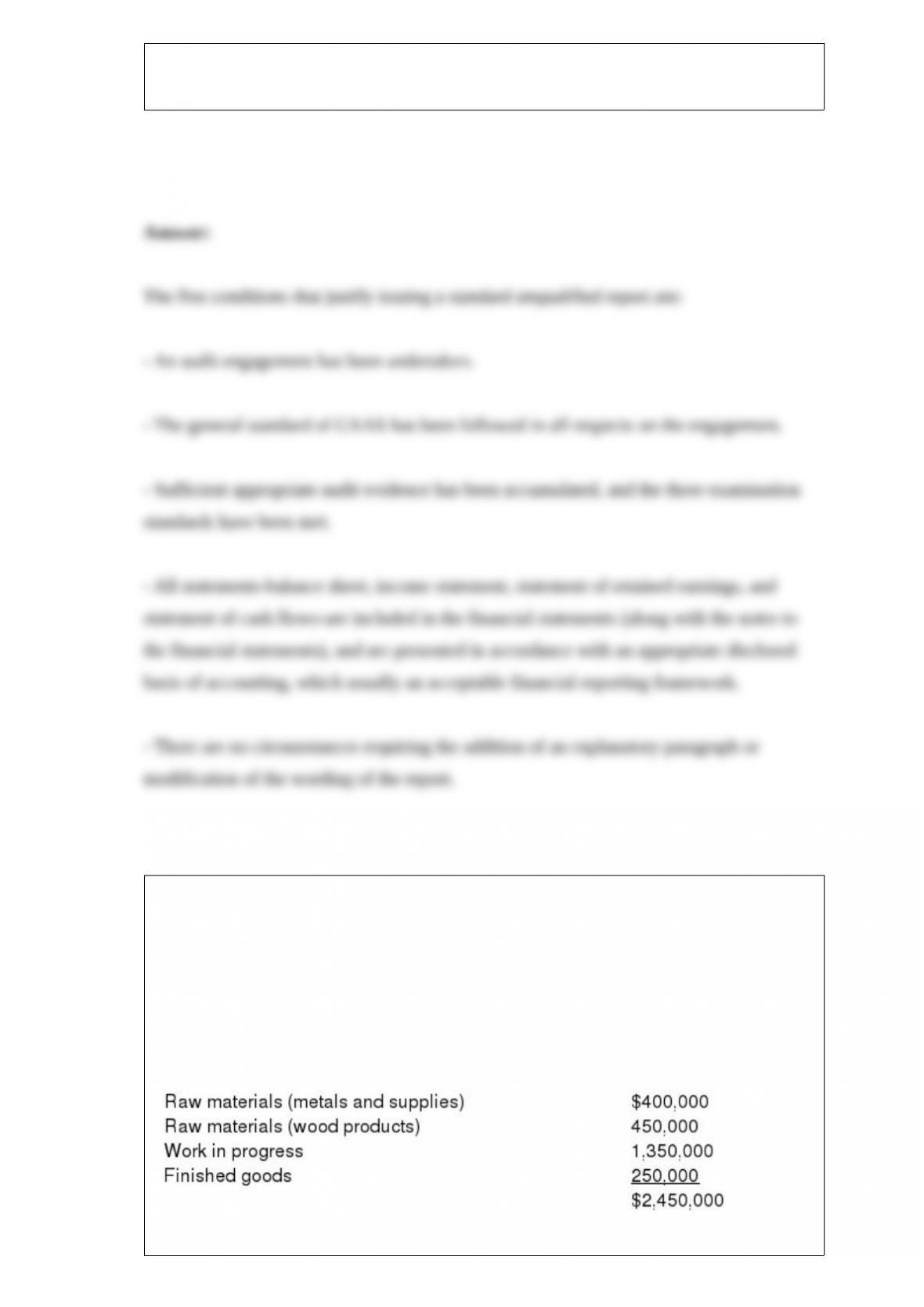
As of the current year end, the company has a total of $6.3 million in assets. Inventory
information is as follows:
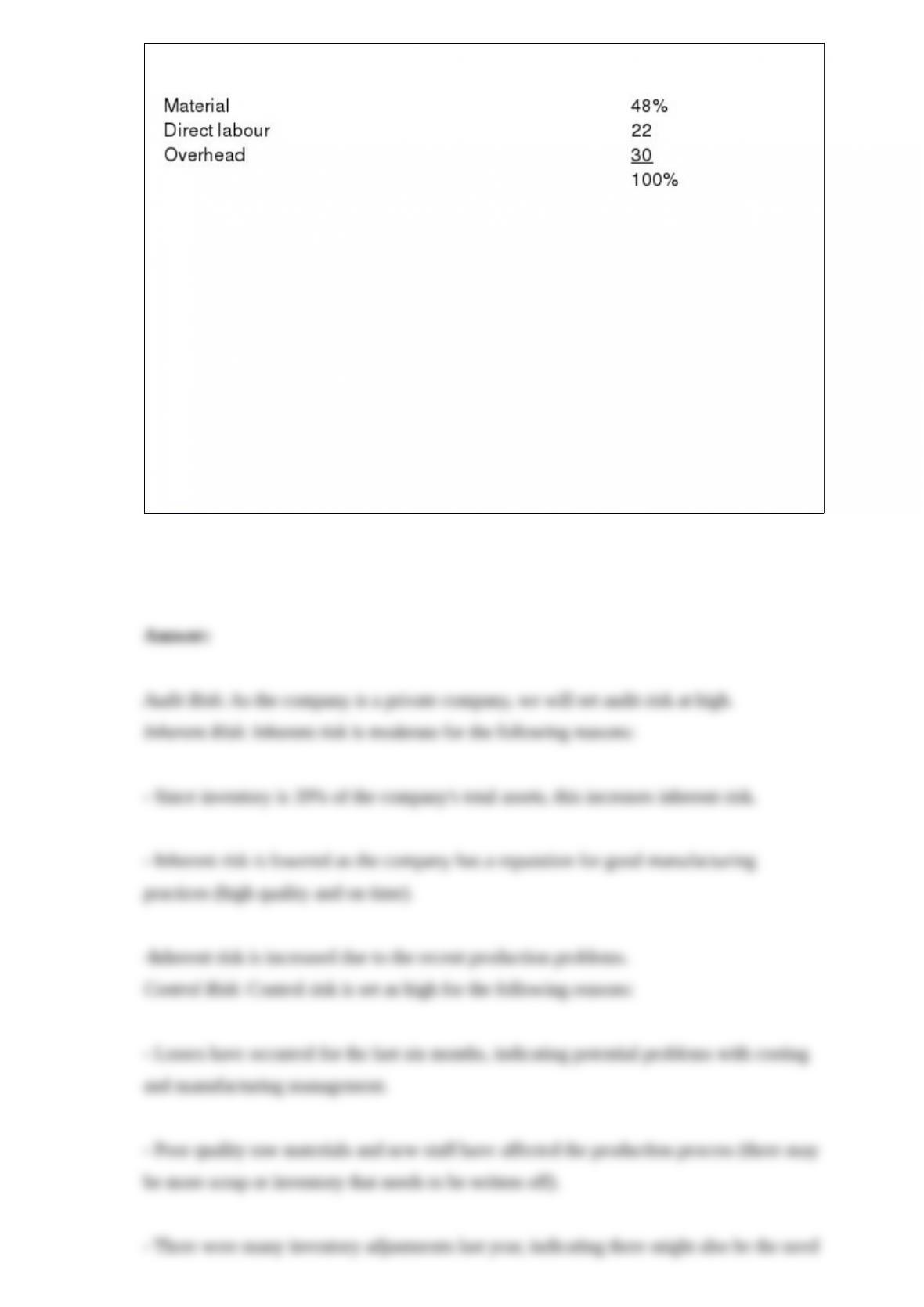
Finished goods consists of:
File cabinet production is intensely competitive, primarily due to imports from Asia and
Mexico. To help manage costs, FRI uses a job-order, standard cost system. Standard
costs are assessed quarterly. Each job is costed and compared to standard. Inventory is
counted only at the end of the year. There is no perpetual inventory system.
Due to problems with raw material quality and new staff, losses have been incurred in
the last six months of the year. Your review of last year’s audit file indicated that there
were numerous inventory adjustments required last year.
Required:
Using the audit risk model, assess the risks associated with the audit of inventory.
Identify and define the seven methods of audit evidence collection. Which two types of
evidence are the most expensive? Which three types of evidence are the least
expensive? Which type of evidence would be most persuasive when testing the
existence objective for long-term assets?