
Select the correct statement.
A. Four purposes often claimed for budgeting involve planning, coordination,
performance measurement, and reporting.
B. In a participative budgeting system, budget information flows in one direction only,
from bottom to top.
C. The three major categories of the master budget are operating budgets, capital
budgets, and pro forma financial statements.
D. The accounting department normally coordinates the development of the sales
forecast.
Asset replacement decisions involve:
A. choices between continuing using existing materials or replacing them with less
expensive materials.
B. choices between closing down or continuing to operate a segment of a business.
C. choices between continuing operating existing equipment or replacing it with new
equipment.
D. None of these.
The cost of capital is called all of the following except:
A. cutoff rate.
B. discount rate.
C. hurdle rate.
D. All of these are terms for the cost of capital.
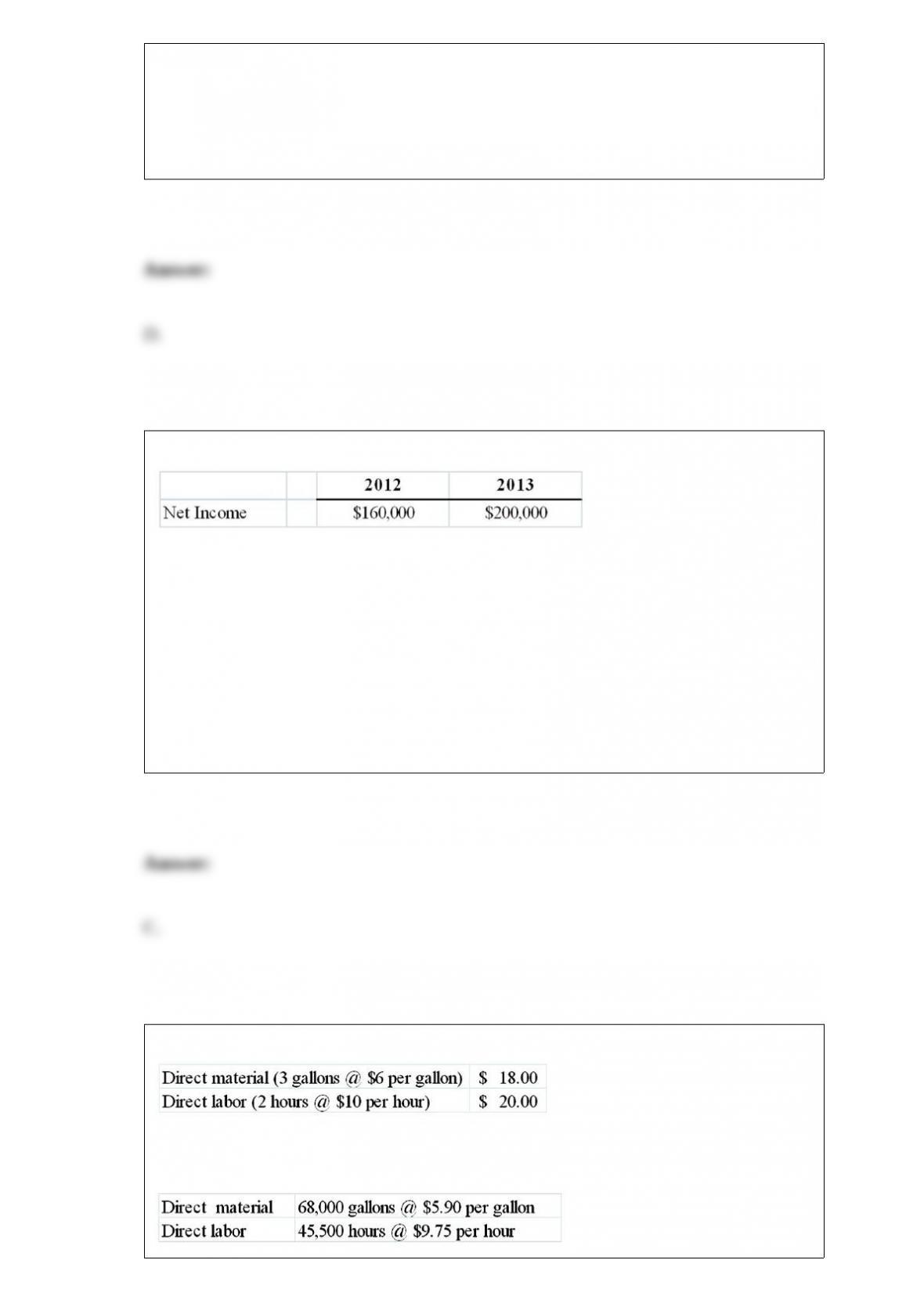
For the last two years BRC Company had net income as follows:
What was the percentage change in income from 2012 to 2013?
A. 20% increase
B. 20% decrease
C. 25% increase
D. 25% decrease
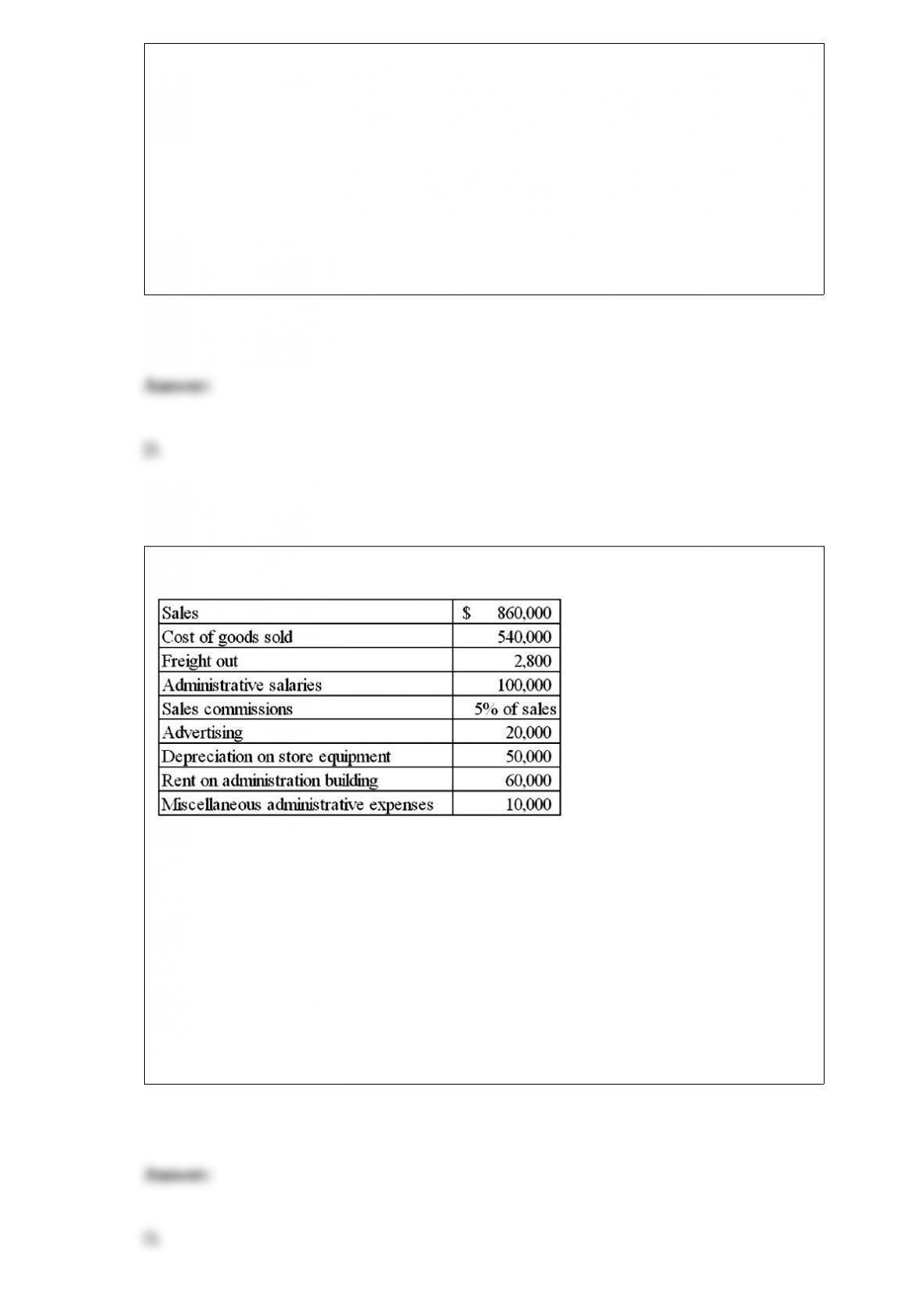
The Russell Company provides the following standard cost data per unit of product:
During the period, the company produced and sold 22,000 units incurring the following
costs:

The direct labor price variance was:
A. $11,000 unfavorable.
B. $11,000 favorable.
C. $11,375 unfavorable.
D. $11,375 favorable.
Select the incorrect statement regarding the relationship between type of user and type
of information.
A. Middle managers need more nonfinancial, or operational data than do senior
executives.
B. Assembly line supervisors need more immediate feedback on performance than do
senior executives.
C. Senior executives need less aggregated information than do lower-level managers.
D. Senior executives use general economic information as well as financial information.
Select the incorrect statement regarding the recognition of depreciation on
manufacturing equipment.
A. Recognizing depreciation on manufacturing equipment is an asset exchange event.
B. Depreciation on manufacturing equipment is an indirect product cost.

C. Recognizing depreciation on manufacturing equipment decreases the equipment’s
book value and increases the manufacturing overhead account.
D. If the equipment was used to work on a job, the amount of depreciation must be
entered on the appropriate job cost sheet.
A cost that contains both fixed and variable elements is referred to as a:
A. mixed cost.
B. hybrid cost.
C. relevant cost.
D. nonvariable cost.
Managerial accounting systems consider economic and non-financial data as well as
financial statement data.

When evaluating alternatives, what type of costs should be considered?
A. Relevant costs
B. Sunk costs
C. Prevention costs
D. Fixed costs
All of the following are internal failure costs except:
A. inventory inspection costs.
B. rework costs.
C. downtime costs.
D. scrap costs.
Hazel Company allocates overhead on the basis of direct labor hours. It allocates
overhead costs of $8,000 to two different jobs as follows:
Job 1: (10 hours) = $4,000; Job 2: (10 hours) = $4,000
The production process for Job 2 was then automated. Now Job 2 requires only two
hours of direct labor but four hours of mechanical processing. As a result, total
overhead increases to $12,000. Select the incorrect statement from the following.
A. While the actual processing of Job 1 was not affected by automation, it received an
increase of $6,000 in its overhead allocation.
B. The use of machine hours as the allocation base would significantly improve the
overhead cost allocations.
C. Automation and the costing system used by the company causes the cost of Job 1 to
be significantly overstated.
D. The increased overhead costs associated with automation should be allocated to both
jobs.
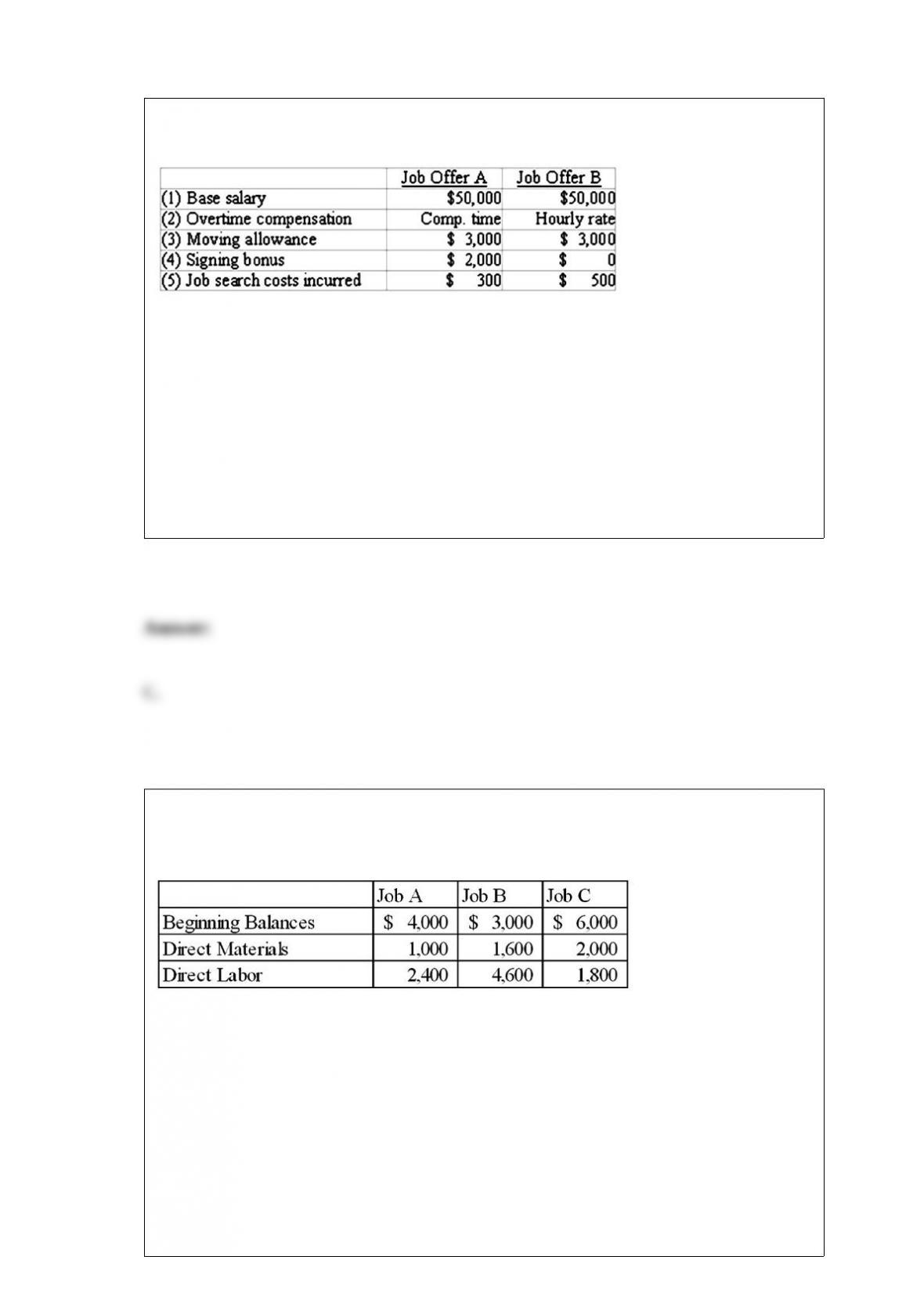
The following budget information is available for the Arch Company for January 2014:
All operating expenses are paid in cash in the month incurred. Compute total budgeted
selling and administrative expenses (excluding interest) amount for January 2014.
A. $262,500
B. $283,000
C. $240,000
D. $285,800
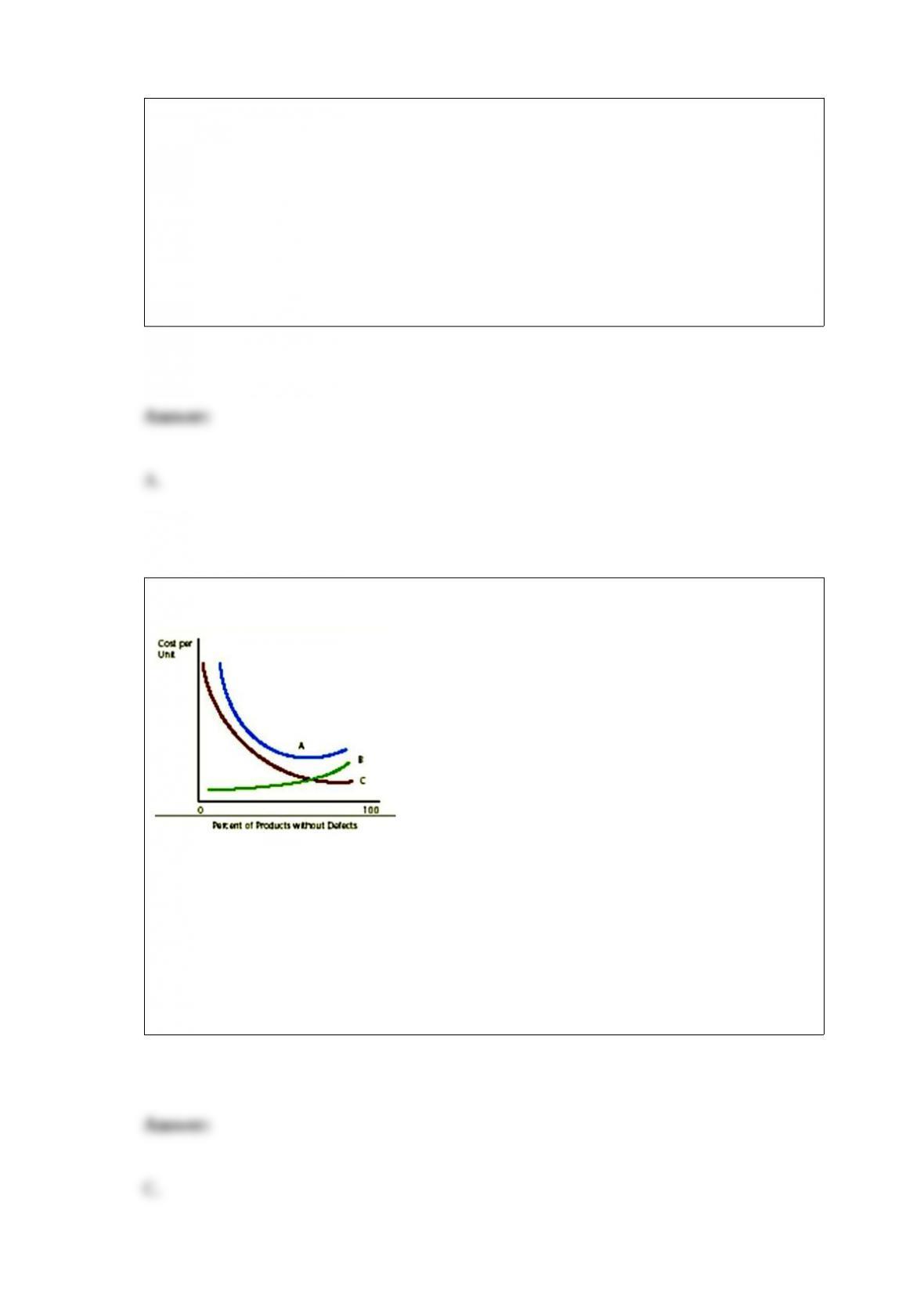
Ann is trying to decide which one of two job offers she will accept. Several items are
presented below:
Select the items that are irrelevant to Ann’s decision.
A. (1), (2), (3), (4), (5)
B. (2), (3), (4)
C. (1), (3), (5)
D. (2), (4)
Needham Company uses a job order cost system. During the month of September, the
company worked on three jobs. The job order cost sheets for the three jobs contained
the following information at the end of September:
The company applies overhead at 120% of direct labor cost.
During September Job B was completed, and it was sold in October. At the end of
September the total cost in work in process was:
A. $36,960.
B. $22,240.
C. $26,400.

D. None of these.
Rose Corporation sells backpacks. Variable costs for this product are $30 per unit, and
the sales price per unit is $50 per unit. Total fixed costs amount to $100,000. How many
backpacks does Rose need to sell to achieve a desired profit of $60,000?
A. 2,000 units
B. 5,000 units
C. 5,333 units
D. 8,000 units
Cash inflows generated by capital investments include all of the following except:
A. incremental revenues.
B. cost savings.
C. reduction in the amount of required working capital.
D. increase in operating expenses.

The following information is provided for Southall Company:
What is this company’s contribution margin?
A. $30,000
B. $17,500
C. $45,000
D. $67,500
Which of the following statements is true for a company that uses variable costing?
A. The manufacturing cost per unit decreases when the volume of production increases.
B. Net income is not affected by fluctuations in production.
C. Fixed manufacturing overhead is treated like a product cost.
D. Fixed manufacturing overhead costs incurred in the current period may be
recognized as expense in a later period.
Payment of cash for production workers’ wages is:
A. An asset exchange transaction.
B. An asset source transaction.
C. An asset use transaction.
D. A claims exchange transaction.
The objective of using the following graph is to:
A. minimize quality.
B. maximize profit.
C. minimize total quality costs.
D. maximize total quality costs.
The number of activity cost centers used by a company should:
A. equal the number of activities required to produce the product.
B. equal the number of departments it has.
C. equal the number of products it has.
D. be determined on a cost-benefit basis.
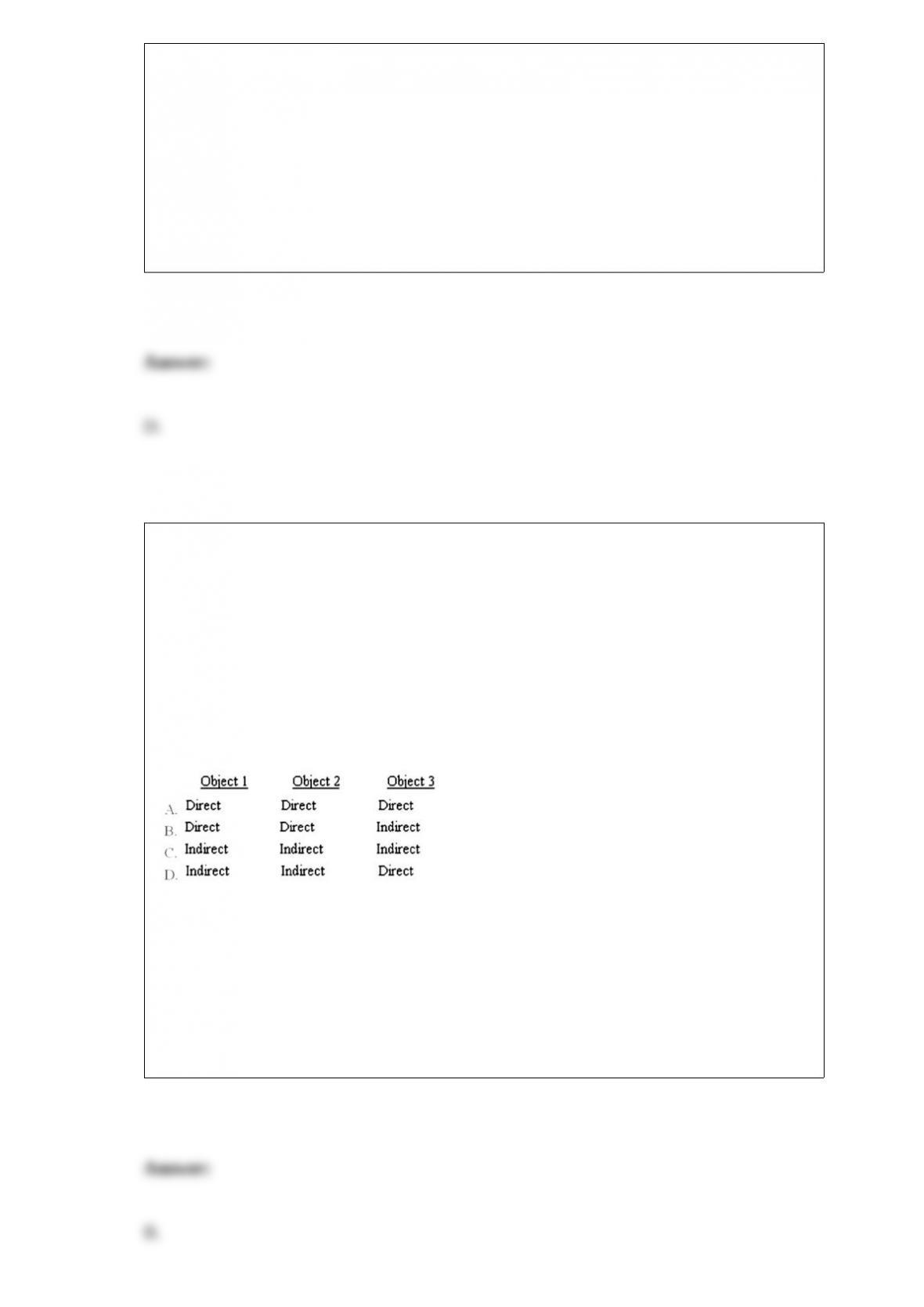
Cobalt Company management has identified the following cost objects:
Cost Object 1: The cost of operating the finishing department
Cost Object 2: The cost of operating the factory
Cost Object 3: The cost of a particular product made in June
With respect to these cost objectives, how would rent paid by the finishing department
for storage space be classified?
A. Option A
B. Option B
C. Option C
D. Option D
Can a company have a negative cash flow from operations for the year on the statement
of cash flows but still have a net income on the income statement? Explain.
Brown Company engaged in the following transactions during May 2014. Indicate
whether each is an asset source (AS), asset use (AU), or asset exchange (AE)
transaction.
Purchased raw materials for cash, $42,000
Used raw materials to begin jobs, $28,400
Paid wages of production employees, $18,000
Applied overhead at rate of $1.25 per direct labor dollar
Completed job that had cost $32,000
Sold goods for $44,000 cash
The goods referred to in the transaction above had cost $29,500 to complete
Indicate whether each of the following statements is true or false.
Short-term plans are more specific and detailed than long-term plans.
Short-term planning focuses on the operations of a business for the next two to three
years.
A decision to lease equipment would be part of a company’s capital budgeting process.
The master budget focuses on long-term objectives and goals.
The master budget normally covers a period of one quarter.
What is the basic premise behind activity-based costing systems (ABC)? What is an
activity? Describe how ABC systems work.
How can the use of a predetermined overhead rate prevent timing problems in
determining the costs of products?