
1) terry corporation had 400,000 shares of common stock outstanding at december 31,
2012. in addition, it had 90,000 stock options outstanding, which had been granted to
certain executives, and which gave them the right to purchase shares of terry’s stock at
an option price of $37 per share. the average market price of terry’s common stock for
2012 was $50. what is the number of shares that should be used in computing diluted
earnings per share for the year ended december 31, 2012?
a.400,000
b.431,622
c.466,600
d.423,400
2) on june 30, 2013, cey, inc. exchanged 4,000 shares of seely corp. $30 par value
common stock for a patent owned by gore co. the seely stock was acquired in 2013 at a
cost of $110,000. at the exchange date, seely common stock had a fair value of $46 per
share, and the patent had a net carrying value of $220,000 on gore’s books. cey should
record the patent at
a.$110,000
b.$120,000
c.$184,000
d.$220,000
3) which of the following is not a required supplemental disclosure for the balance
sheet?
a.contingencies
b.financial forecasts
c.accounting policies
d.contractual situations
4) a general description of the depreciation methods applicable to major classes of
depreci-able assets
a.is not a current practice in financial reporting
b.is not essential to a fair presentation of financial position
c.is needed in financial reporting when company policy differs from income tax policy
d.should be included in corporate financial statements or notes thereto
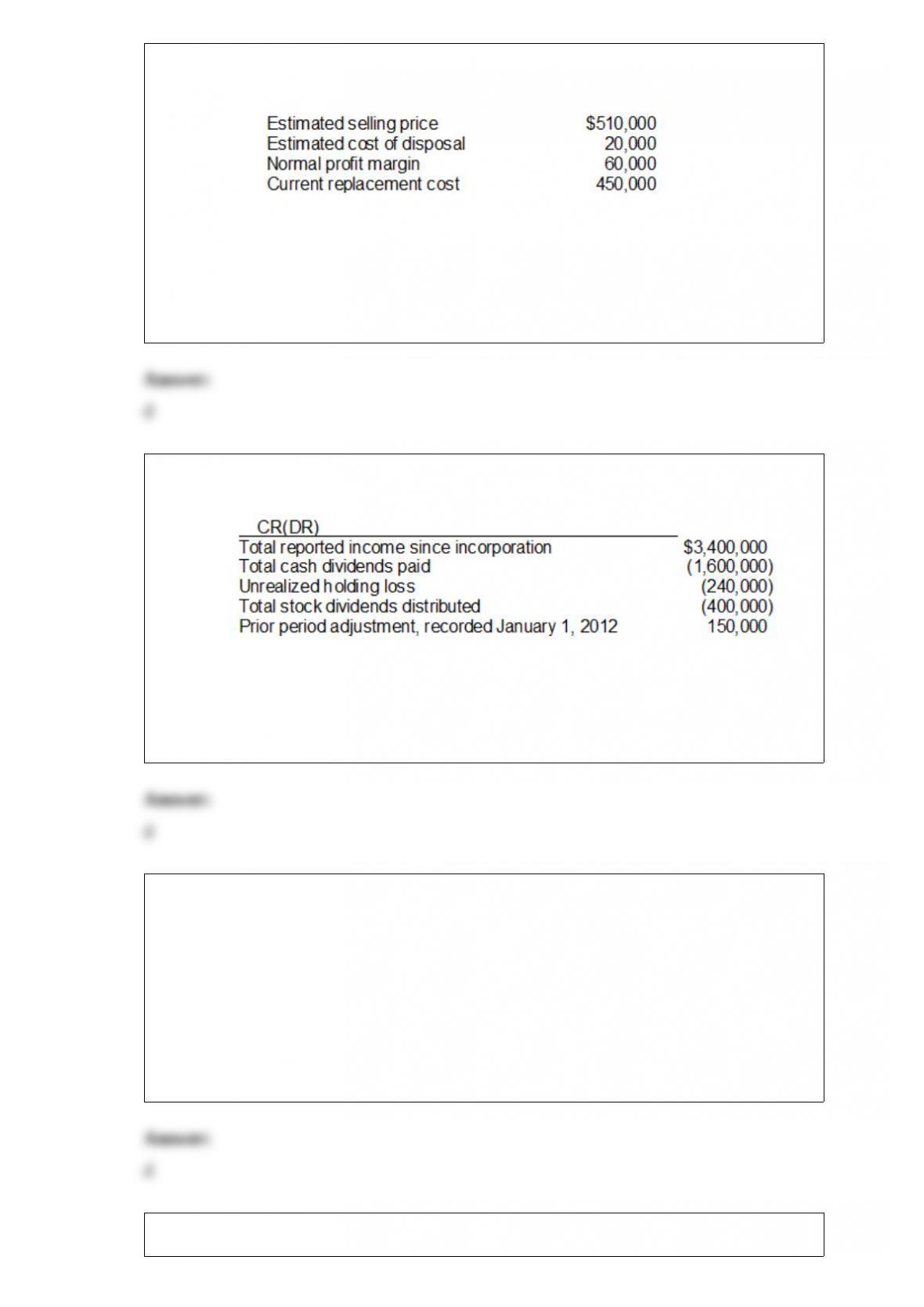
5) ryan distribution co. has determined its december 31, 2012 inventory on a fifo basis
at $500,000. information pertaining to that inventory follows:
ryan records losses that result from applying the lower-of-cost-or-market rule. at
december 31, 2012, the loss that ryan should recognize is
a.$0
b.$10,000
c.$40,000
d.$50,000
6) the following information was extracted from the accounts of essex corporation at
december 31, 2012:
what should be the balance of retained earnings at december 31, 2012?
a.$1,310,000
b.$1,400,000
c.$1,160,000
d.$1,550,000
7) dean company becomes aware of a lawsuit after the date of the financial statements,
but before they are issued. a loss and related liability should be reported in the financial
statements if the amount can be reasonably estimated, an unfavorable outcome is highly
probable, and
a.the dean company admits guilt
b.the court will decide the case within one year
c.the damages appear to be material
d.the cause for action occurred during the accounting period covered by the financial
statements
8) barber company will receive $800,000 in 7 years. if the appropriate interest rate is

10%, the present value of the $800,000 receipt is
a.$408,000
b.$410,528
c.$1,208,000
d.$1,558,976
9) why would a company sell receivables to another company?
a.to improve the quality of its credit granting process
b.to limit its legal liability
c.to accelerate access to amounts collected
d.to comply with customer agreements
10) during the lifetime of an entity accountants produce financial statements at artificial
points in time in accordance with the concept of
relevance periodicity
a. no no
b. yes no
c. no yes
d. yes yes
11) an inventory method which is designed to approximate inventory valuation at the
lower of cost or market is
a.last-in, first-out
b.first-in, first-out
c.conventional retail method
d.specific identification
12) fasb technical bulletins
a.are similar to fasb interpretations in that they establish enforceable standards under
the
b.are issued monthly by the fasb to deal with current topics
c.are not expected to have a significant impact on financial reporting in general and
provide guidance when it does not conflict with any broad fundamental accounting

principle
d.were recently discontinued by the fasb because they dealt with specialized topics
having little impact on financial reporting in general
13) capitalized costs incurred while developing computer software to be sold should be
amortized using the:
a.lower of the straight-line method or the percent-of-revenue method
b.higher of the percent-of-revenue method or the percent-of-completion method
c.lower of the percent-of-revenue method or the percent-of-completion method
d.higher of the straight-line method or the percent-of-revenue method
14) how should research and development costs be accounted for, according to a
financial accounting standards board statement?
a.must be capitalized when incurred and then amortized over their estimated useful
lives
b.must be expensed in the period incurred
c.may be either capitalized or expensed when incurred, depending upon the materiality
of the amounts involved
d.must be expensed in the period incurred unless it can be clearly demonstrated that the
expenditure will have alternative future uses or unless contractually reimbursable