All other things being equal, the higher the return on equity ratio, the better the
financial performance of the company.
Answer:
Which of the following isTRUE of a company’s quarterly report?
A. Contains the same detail as is found in the annual report.
B. Is an audited report.
C. Does not include any discussion of financial results.
D. Has the benefit of being released on a timelier basis.
Answer:
The par value of stock indicates what the stock is worth.
Answer:
Which of the following statements regarding loan terminology isTRUE?
A. Loan covenants are the collateral provided by a borrower to a lender as security on a
loan.
B. A secured loan means that the borrower has a pre-approved line of credit backing the
debt.
C. Lenders can revise loan terms if a borrower violates a loan covenant.
D. All companies are able to establish lines of credit which will allow them to borrow
money as needed, up to a prearranged limit.
Answer:
Company A uses the FIFO inventory method and Company B uses the LIFO method. If
prices are rising and there are no other significant differences between the companies,
which of the following isTRUE?
A. Company A will report a higher current ratio and lower earnings per share than
Company B.
B. Company A will report a higher current ratio and higher earnings per share than
Company B.
C. Company A will report a lower current ratio and higher earnings per share than
Company B.
D. Company A will report a lower current ratio and lower earnings per shares than
Company B.
Answer:
The International Accounting Standards Board (IASB) is the international counterpart
to the FASB in the United States.
Answer:
Which of the following isTRUE?
A. Accounts receivable decline as companies sell on credit.
B. Accounts receivable increase as companies receive payment.
C. Receivables turnover refers to how fast receivables are collected.
D. Days to Collect will increase as the receivables turnover increases.
Answer:
The gross pay for all employees is credited to Wages Payable.
Answer:
Which of the following statements is notTRUE?
A. The legal capital of a corporation represents an amount that cannot be returned to the
owners while the corporation still exists.
B. Investors in a corporation are called stockholders.
C. The right to receive a dividend is one of the basic rights of preferred stockholders.
D. Compared with preferred stock, common stock usually has a favorable preference in
terms of dividends.
Answer:
The assignment of costs to cost of goods sold and to inventory using the weighted
average method usually yields different results depending on whether a perpetual or a
periodic system is used.
Answer:
On December 31, 2014, you count 300 tie clips in inventory. During the next quarter,
you carefully record the effect of each purchase and sale transaction on inventory. You
buy 128 tie clips during the next quarter. On March 31, 2015, you count 288 tie clips in
inventory. Which of the following is notTRUE?
A. Ending inventory on March 31, 2015 should be 288 tie clips.
B. Your company uses the perpetual inventory method.
C. Your company’s records would show that 140 tie clips were sold during the quarter.
D. The amount of shrinkage cannot be determined with this type of inventory system.
Answer:
Which of the following statements isTRUE when the straight-line method is used to
compute depreciation?
A. The carrying value of an asset is a constant amount during the asset’s useful life.
B. Accumulated depreciation is a constant amount during the asset’s estimated useful
life.
C. Depreciation is a constant amount each year.
D. The book value of an asset is an increasing amount during the asset’s useful life.
Answer:
Long-lived assets found on a company’s balance sheet may include some which have no
physical substance.
Answer:
The higher the accounts receivable turnover, the slower accounts receivable are being
collected.
Answer:
A company has a current ratio of 2.0 and a quick ratio of 1.4. If the company then
collects an accounts receivable, which of the following is aTRUE statement?
A. The current ratio will not change and the quick ratio will increase.
B. The current ratio will increase and the quick ratio will increase.
C. The current ratio and the quick ratio will not change.
D. The current ratio will increase and the quick ratio will decrease.
Answer:
If the market rate exceeds the stated interest rate, a bond will sell at a premium.
Answer:
Company A has a debt-to-assets ratio of 0.73 while Company B has a debt-to-assets
ratio of 0.45. Which of the following isTRUE?
A. Stockholders own a smaller proportion of Company A than Company B.
B. Company A must make less profit than Company B.
C. Creditors own a smaller proportion of Company A than Company B.
D. Company A must have less assets than Company B.
Answer:
Which of the following statements isTRUE regarding the companies’ ability to control
their expenses?
A. The asset turnover indicates that B.Darin is doing a better job at controlling expenses
than is S. Dee.
B. B. Darin uses a greater % of each sales dollar to cover expenses than does S. Dee
Company.
C. The debt-to-assets ratio shows that S. Dee controls expenses better than B. Darin.
D. The net profit margin ratio indicates that B. Darin Company is controlling expenses
better than S. Dee Company.
Answer:
The current ratio can be used to evaluate a company’s ability to pay liabilities in the
short term, and in general, a lower ratio means better ability to pay.
Answer:
Which of the following statements isTRUE?
A. Stock splits and stock dividends both reduce the market price of a share, but only
stock splits reduce the par value of a share.
B. Stock splits and stock dividends both reduce the market price of a share and the par
value of a share.
C. Stock splits and stock dividends both reduce the market price of a share, but only
stock dividends reduce the par value of a share.
D. Stock splits and stock dividends both reduce the market price of a share and reduce
retained earnings.
Answer:
Which of the following is aTRUE statement about the nature of equipment?
A. While equipment is an asset, its use (depreciation) is an expense.
B. While equipment is an asset, its use (depreciation) is a liability.
C. While equipment is an asset, its use (depreciation) affects contributed capital.
D. Equipment and its use (depreciation) are both liabilities.
Answer:
Horizontal analysis is the comparison of a company’s financial information to a base
amount.
Answer:
A company purchased a computer system on January 2, 2013 for $1,600,000. The
company used the straight-line depreciation method with an estimated useful life of 6
years and a residual value of $130,000. The company prepares financial statements at
December 31.
Use the information above to answer the following question. Assume the company
decides to sell the computer system on July 1, 2015 for $1,000,000. Which of the
following is notTRUE concerning the journal entry(ies) required on July 1?
A. The depreciation expense must be recorded for 6 months, January 1 to July 1.
B. The Computer System asset account must be credited for $1,600,000 to record the
sale.
C. The amount of the debit to accumulated depreciation at the date of sale is $612,500.
D. The loss on the sale is $12,500.
Answer:
Investing activities include receiving cash from selling land and any resulting gain or
loss on the sale.
Answer:
When preparing the operating activities section of the statement of cash flows using the
indirect method, an increase in income taxes payable is added to net income.
Answer:
The higher the times interest earned ratio, the greater the risk of nonpayment of interest.
Answer:
A company has a debt to assets ratio of .45 and a return on equity ratio of 10%. If the
company then issues common stock, which of the following is aTRUE statement?
A. The debt to assets ratio will decrease and the return on equity ratio will decrease.
B. The debt to assets ratio will increase and the return on equity ratio will increase.
C. The debt to assets ratio will not change and the return on equity ratio will not
change.
D. The debt to assets ratio will decrease and the return on equity ratio will increase.
Answer:
Cash equivalents are short-term, highly liquid investments purchased within one year of
maturity.
Answer:
Which of the following statements regarding the recording of interest on notes
receivable isTRUE?

A. Interest on notes receivable is recorded as revenue only when the cash is received.
B. When a company receives an interest payment on a note, the entire payment is
debited to interest receivable.
C. Interest on notes receivable is recognized when it is earned which is not necessarily
when the interest is received in cash.
D. Interest earned but not yet received must be recorded in an adjusting entry which
includes a debit to interest revenue.
Answer:
Which of the following is notTRUE if excessive quantities of inventory are purchased?
A. Storage and interest costs may increase.
B. Goods might have to be sold at large discounts.
C. There is a greater probability that goods will become damaged or obsolete.
D. The inventory turnover ratio is likely to increase.
Answer:
Which of the following statements is notTRUE?
A. The statement of cash flows can be used to assess the likelihood of a company
paying dividends.
B. Net cash flow is the best measure of profitability since it doesn’t rely on estimates.
C. A company can have positive net income but at the same time have negative cash
flow.
D. The statement of cash flows is the only financial statement that reports business
activities.
Answer:
Which of the following statements concerning financial reporting isTRUE?
A. The FASB requires all financial decision makers to adhere to a code of professional
conduct.
B. The Sarbanes-Oxley Act does not require businesses to maintain an audited system
of internal control.
C. A fundamental characteristic of useful financial information is that it fully depicts the
economic substance of business activities.
D. There is no attempt to eliminate the difference in accounting rules in the U.S. and
elsewhere as this would prevent investors from comparing financial statements of
companies from different countries.
Answer:
During the current year, a company issues $200,000 in long-term bonds and buys
$200,000 in inventory for cash. Which of the following statements isTRUE regarding
the company’s year-end ratios?
A. The quick ratio will stay the same and the times interest earned ratio will fall.
B. The quick ratio will rise and the times interest earned ratio will rise.
C. The quick ratio will rise but the times interest earned ratio will fall.
D. The quick ratio will rise and the times interest earned ratio will stay the same.
Answer:

State laws often restrict dividends to the amount of retained earnings.
Answer:
Suppose a company generally records revenues and expenses before receiving or
making cash payments. Which of the following statements is notTRUE?
A. If sales are falling, net losses could occur even though the company reports a net
cash inflow from operating activities.
B. If sales are rising, net profits could occur even though the company reports a net
cash outflow from operating activities.
C. Net income and cash flows will always agree because even though revenues and
expenses can be recorded in different time periods than their related cash flows the
differences will cancel out and the results will be the same.
D. When the indirect method is used, net cash flow from operating activities includes
adjustments for non-cash expenses such as depreciation which would cause net cash
from operating activities to be different from net income.
Answer:
The opportunity to commit fraud exists if there are weak internal controls.
Answer:
An asset turnover ratio of 0.4 means that $4 in net income is generated for every $10 in
assets.
Answer:
Which of the following statements concerning the multiple-step income statement is
false?
A. The multiple-step income statement provides a subtotal of Income before Income
Tax Expense.
B. Income from Operations is the amount of revenues minus expenses from the
company’s main business activities.
C. Any revenue and/or expense from activities other than the company’s main business
are peripheral results and are included in Income from Operations.
D. Income before Income Tax Expense and Income from Operations are different if
there are any peripheral revenues and expenses.
Answer:
A company started the current year with assets of $700,000, liabilities of $350,000 and
contributed capital of $200,000. During the current year, assets increased by $400,000,
liabilities decreased by $50,000 and contributed capital increased by $275,000. There
was no payment of dividends to owners during the year.
What was the amount of net income for the year?
A. $225,000
B. $275,000
C. $175,000
D. $450,000
Answer:
The Grass is Greener Company borrows money from a bank. Part of the loan agreement
requires Grass is Greener to maintain stockholders’ equity of at least 40% of assets or
otherwise to pay a higher interest rate. This requirement is referred to as a:
A. loan covenant.
B. credit rating.
C. bond rating.
D. call feature.
Answer:
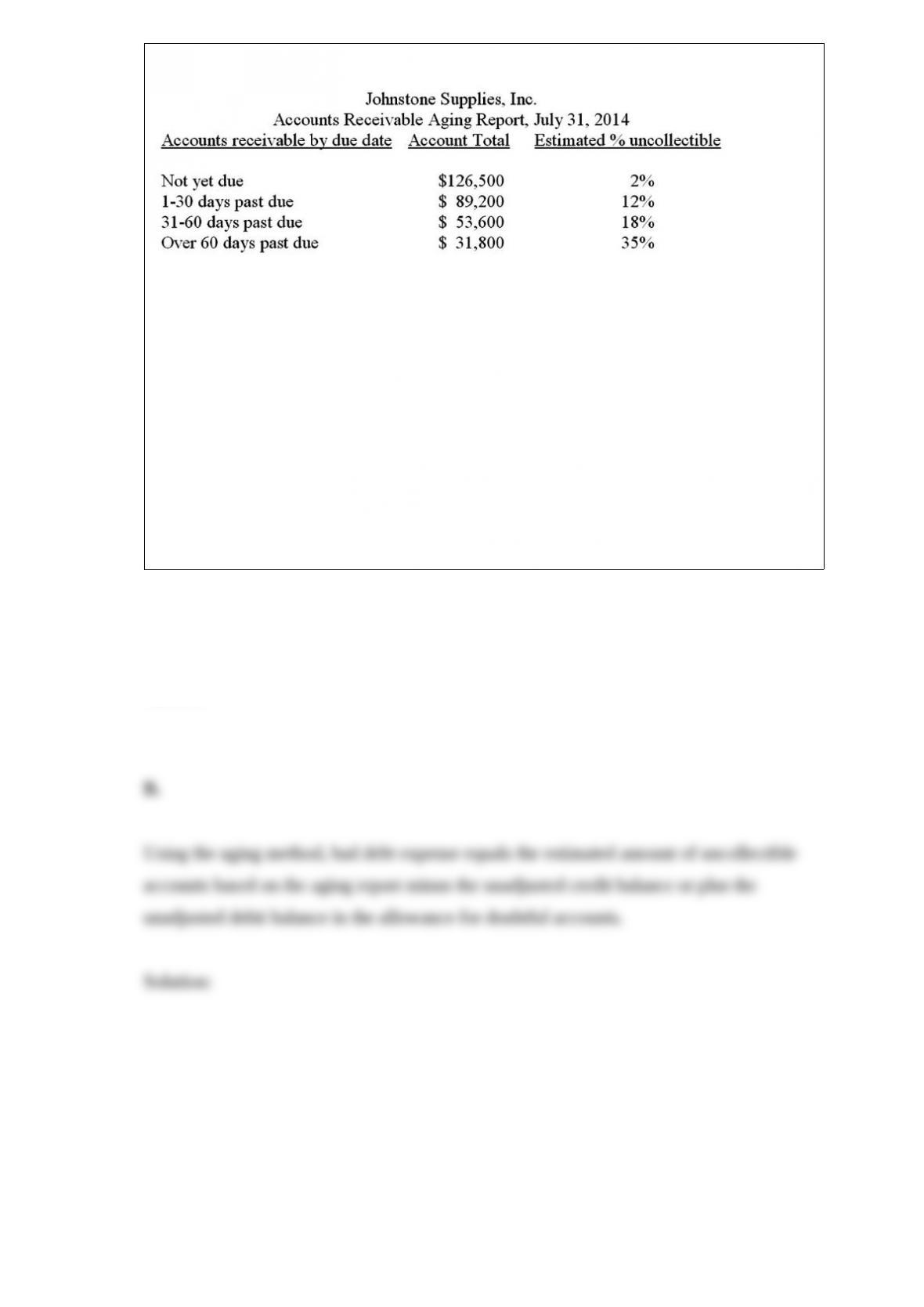
Use the information above to answer the following question. The unadjusted balance of
the allowance for doubtful accounts of Johnstone Supplies, Inc., is a credit balance in
the amount of $28,947 on July 31, 2014. Based on the accounts receivable aging report,
bad debt expense will be:
A. $34,012.
B. $5,065.
C. $62,959.
D. $50,434.
Answer:
BetterBuy sells a computer from inventory for $599 on credit. BetterBuy originally
bought the computer from IBM for $395 and uses the perpetual inventory system. How
is the sale recorded in BetterBuy’s journal entries?
A. Debit Cash for $599, credit Sales for $599; debit Cost of goods sold for $395 and
credit Inventory for $395.
B. Debit Accounts Receivable for $599, credit Inventory for $395, and credit gross
profit for $204.
C. Debit Accounts Receivable for $599, credit Sales for $599; debit Cost of Goods Sold
for $395 and credit Inventory for $395.
D. Debit Inventory for $395, debit Cost of Goods Sold for $204, and credit Accounts
Receivable for $599.
Answer:
IBM is planning to issue $1,000 bonds with a stated interest rate of 7% and a maturity
date of July 15, 2022. If interest rates rise in the economy so that similar financial
investments pay 9%, IBM will:
A. not be able to issue the bonds because no one will buy them.
B. receive a higher issue price to compensate buyers for the lower stated interest rate.
C. have to accept a lower issue price to attract buyers.
D. have to reprint the bond certificates to change the stated interest rate to 9%.
Answer:
When estimated useful life of an asset is revised:
A. depreciation will continue at the current rate.
B. depreciation expense reported in previous years would be changed retroactively.

C. the depreciation expense in subsequent years will be changed but previous
calculations will not be changed.
D. generally accepted accounting principles have been violated.
Answer:
During March, the Long Life Consulting Company provides $23,000 in consulting
services of which $12,000 is immediately paid for and $11,000 is on account.
A. Cash increases $12,000, revenue increases $11,000, and accounts receivable
increases $23,000.
B. Cash increases $12,000, Accounts Receivable increases $11,000, and revenues
increase $23,000.
C. Accounts Receivable increases $11,000, liabilities decrease $12,000, and
stockholders’ equity increases $1,000.
D. Revenues increase $12,000, liabilities decrease $12,000, and stockholders’ equity is
unchanged.
Answer:

The MegaBuck movie studio’s name has become famous for adventure movies. Another
studio once offered to buy the name for $20 million, but MegaBuck turned down the
offer. The MegaBuck balance sheet will show:
A. Other Assets, valued at $20 million.
B. Other Assets, valued conservatively at $10 million.
C. Accounts Receivable, valued at $20 million.
D. The company’s name will not be shown as an asset on the balance sheet.
Answer:
Because interest rates have fallen, a company retires bonds which had been issued at
their face value of $200,000. The company bought the bonds back at 97. This
retirement would be recorded with a:
A. debit of $200,000 to Bonds Payable, a credit of $6,000 to Gain on Bond Retirement,
and a credit of $194,000 to Cash.
B. debit of $194,000 to Bonds Payable, a debit to Gain on Bond Retirement of $6,000,
and a credit of $200,000 to Cash.
C. debit of $200,000 to Bonds Payable, a credit of $6,000 to Interest Expense, and a
credit of $194,000 to Cash.
D. debit of $194,000 to Bonds Payable and a credit of $194,000 to Cash.
Answer:
Which of the following would be included in cash flows from operating activities?
A. Cash proceeds from sales.
B. Cash received from an issuance of bonds.
C. Dividends paid to stockholders.
D. Cash used for purchases of equipment.
Answer:

In applying the lower of cost or market method to inventory, market is defined as
A. historical cost.
B. current replacement cost.
C. current sales price.
D. weighted-average cost.
Answer:
When the effective-interest method of amortization is used, what happens to the amount
of discount or premium amortized as a bond moves toward maturity?
A. The amount of discount or premium amortized each period decreases.
B. The amount of discount or premium amortized each period increases for bonds sold
at a discount but decreases for bonds sold at a premium.
C. The amount of discount or premium amortized each period increases.
D. The amount of discount or premium amortized each period decreases for bonds sold
a discount but increases for bonds sold at a premium.
Answer:
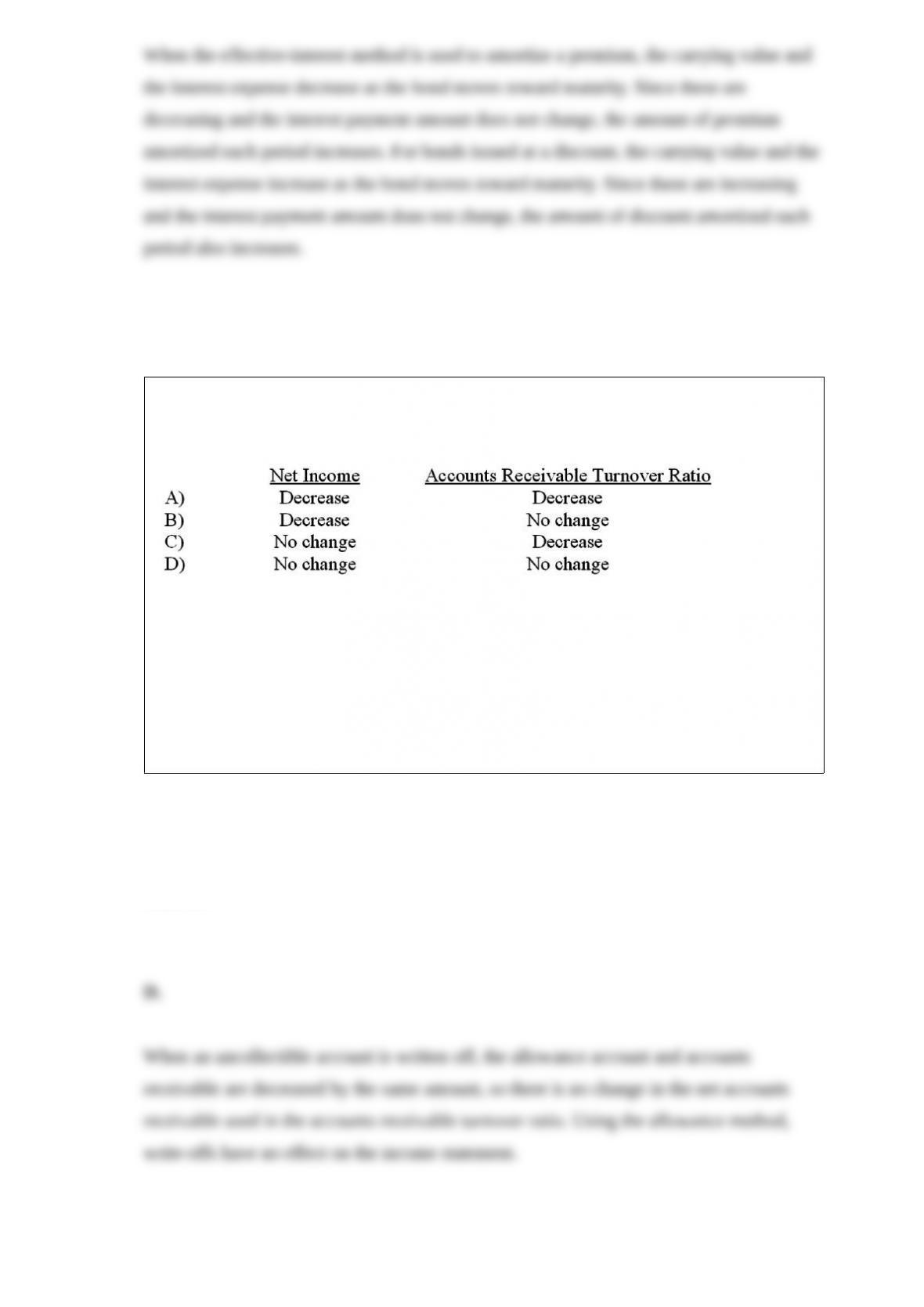
Using the allowance method, how would net income and the accounts receivable
turnover ratio be affected when a customer’s account balance, which is known to be
uncollectible, is written off?
A. Option A
B. Option B
C. Option C
D. Option D
Answer:
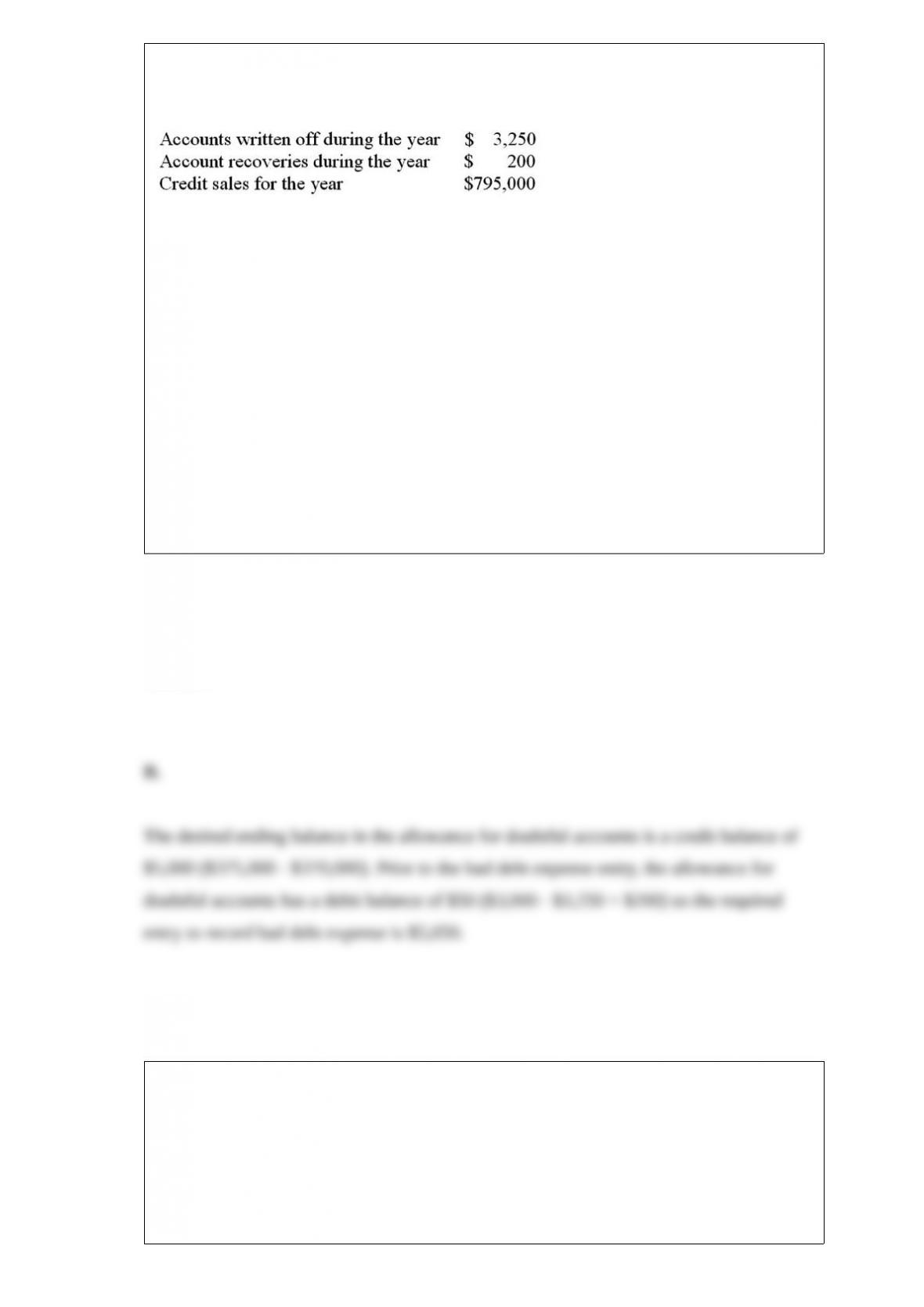
A company started the year with $430,000 of accounts receivable and a credit balance
in the allowance for doubtful accounts of $3,000. During the year the following events
were recorded:
At the end of the year the company has $375,000 of accounts receivable and has
determined, using the aging method, that the net realizable value of the accounts
receivable is $370,000.
Use the information above to answer the following question. What is the amount of Bad
Debt Expense for 2015?
A. $2,000
B. $5,050
C. $5,000
D. $4,950
Answer:
On October 1, you borrow $200,000 in order to build a new facility. The loan is for 10
years, at 7% interest, and semiannual interest payments are due each April and October.
The journal entry to record the issuance of the promissory note should:
A. debit Notes Payable for $200,000, debit Interest Expense for $14,000, credit Cash
for $200,000, and credit Interest Payable for $14,000.

B. debit Accrued Interest for $14,000 and credit Cash for $14,000.
C. debit Cash for $200,000 and credit Notes Payable for $200,000.
D. debit Cash for $200,000, debit Interest Expense for $14,000, credit Notes Payable
for $200,000, and credit Interest Payable $14,000.
Answer:
Klatu Company uses the allowance method to account for uncollectible accounts. On
May 1, Klatu wrote off a $3,500 accounts receivable as uncollectible because the
customer had filed bankruptcy. On May 29, Klatu unexpectedly received the $3,500
from the customer.
Use the information above to answer the following question. The journal entry to record
the write-off on May 1 would include which of the following?
A. Debit to Bad Debt Expense and credit to Allowance for Doubtful Accounts
B. Debit to Accounts Receivable and credit to Allowance for Doubtful Accounts
C. Debit to Allowance for Doubtful Accounts and credit to Bad Debt Expense
D. Debit to Allowance for Doubtful Accounts and credit to Accounts Receivable
Answer:
A company issued 600 shares of $50 par value stock for $45,000. The total amount of
contributed capital is:
A. $30,000.
B. $15,000.
C. $45,000.
D. $50.
Answer:
Which of the following actions would be considered unethical?
A. The CEO puts a favorable ‘spin” on the year’s operating results in the Letter to the
Stockholders in the annual report.
B. A company presents three years’ results on the income statement to highlight a
positive trend in earnings.
C. The external auditors present their findings to management before the annual report
is published.
D. A company anticipates customers’ needs by shipping them product before they order
it, and records the related sales.
Answer:
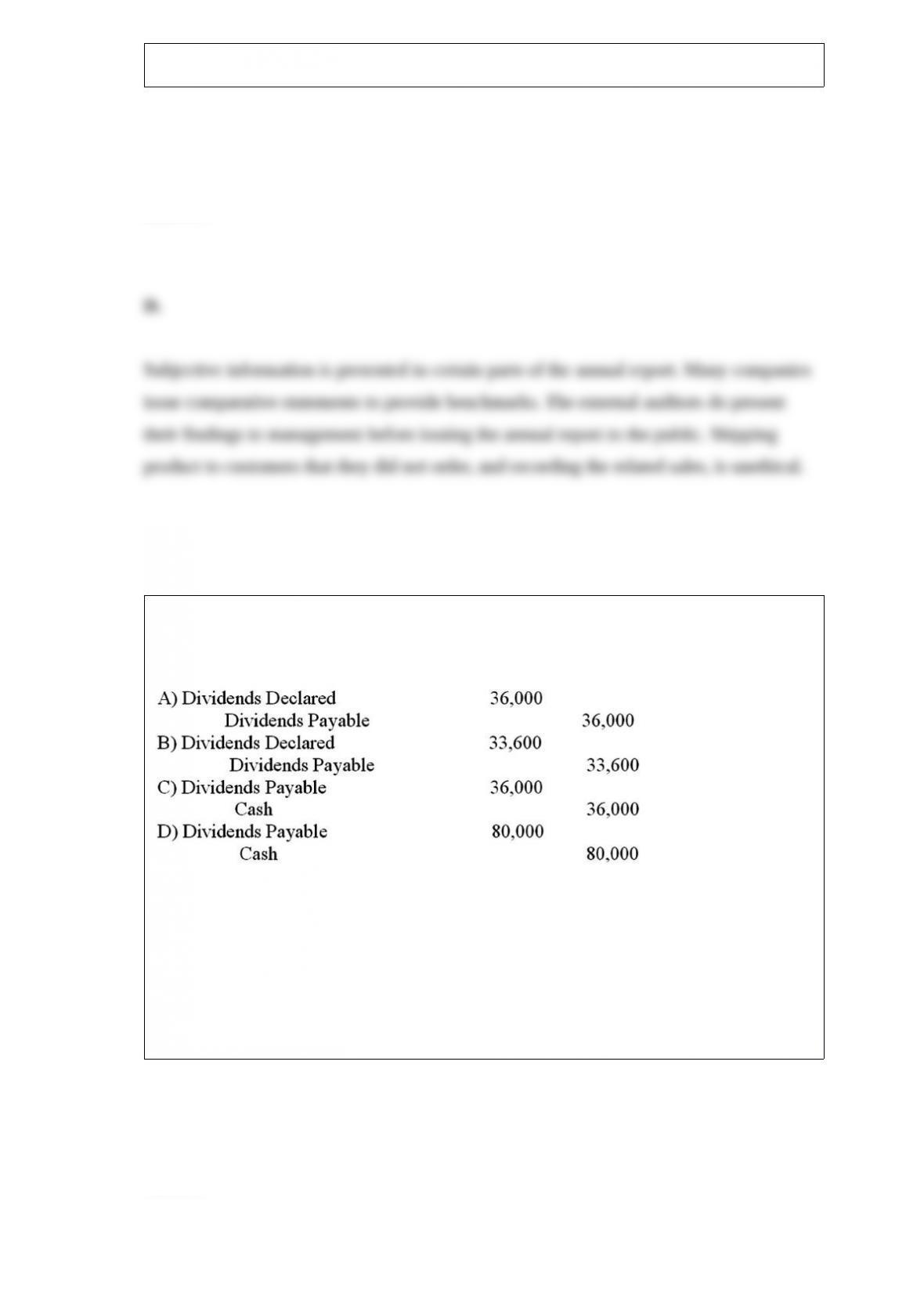
A company declared a $0.80 per share cash dividend. The company has 100,000 shares
authorized, 45,000 shares issued, and 42,000 shares of common stock outstanding.
What is the journal entry to record the dividend declaration?
A. Option A
B. Option B
C. Option C
D. Option D
Answer:

A company purchases a $300,000 building, paying $200,000 in cash and signing a
$100,000 promissory note. What will be reported on the statement of cash flows as a
result of this transaction?
A. A $300,000 cash outflow from investing activities.
B. A $200,000 cash outflow from investing activities and a $100,000 cash inflow from
financing activities.
C. A $200,000 cash outflow from investing activities and a $100,000 noncash
transaction.
D. A $300,000 cash outflow from investing activities and a $100,000 cash inflow from
financing activities.
Answer:
Which of the following would not appear as a possible asset on the balance sheet?
A. Accounts receivable
B. Supplies
C. Retained earnings
D. Cash
Answer:
Which of the following would be reported as a cash outflow from investing activities?
A. Donating an old piece of equipment to charity.
B. Repaying the principal of a bond.
C. Buying another company’s bonds with cash.
D. Paying for an investment asset by issuing company stock.
Answer:
When the indirect method is used, if accounts receivable increases during the
accounting period, the change in accounts receivable is:
A. added to the change in the cash account.
B. subtracted from net income.
C. added to net income.
D. subtracted from the change in the cash account.
Answer:
Merchandise shipped FOB shipping point on the last day of the year should be included
in:
A. the inventory balance of the seller.
B. the inventory balance of the buyer.
C. neither the inventory balance of the buyer or the seller.
D. both the inventory balance of the buyer and the seller.
Answer:
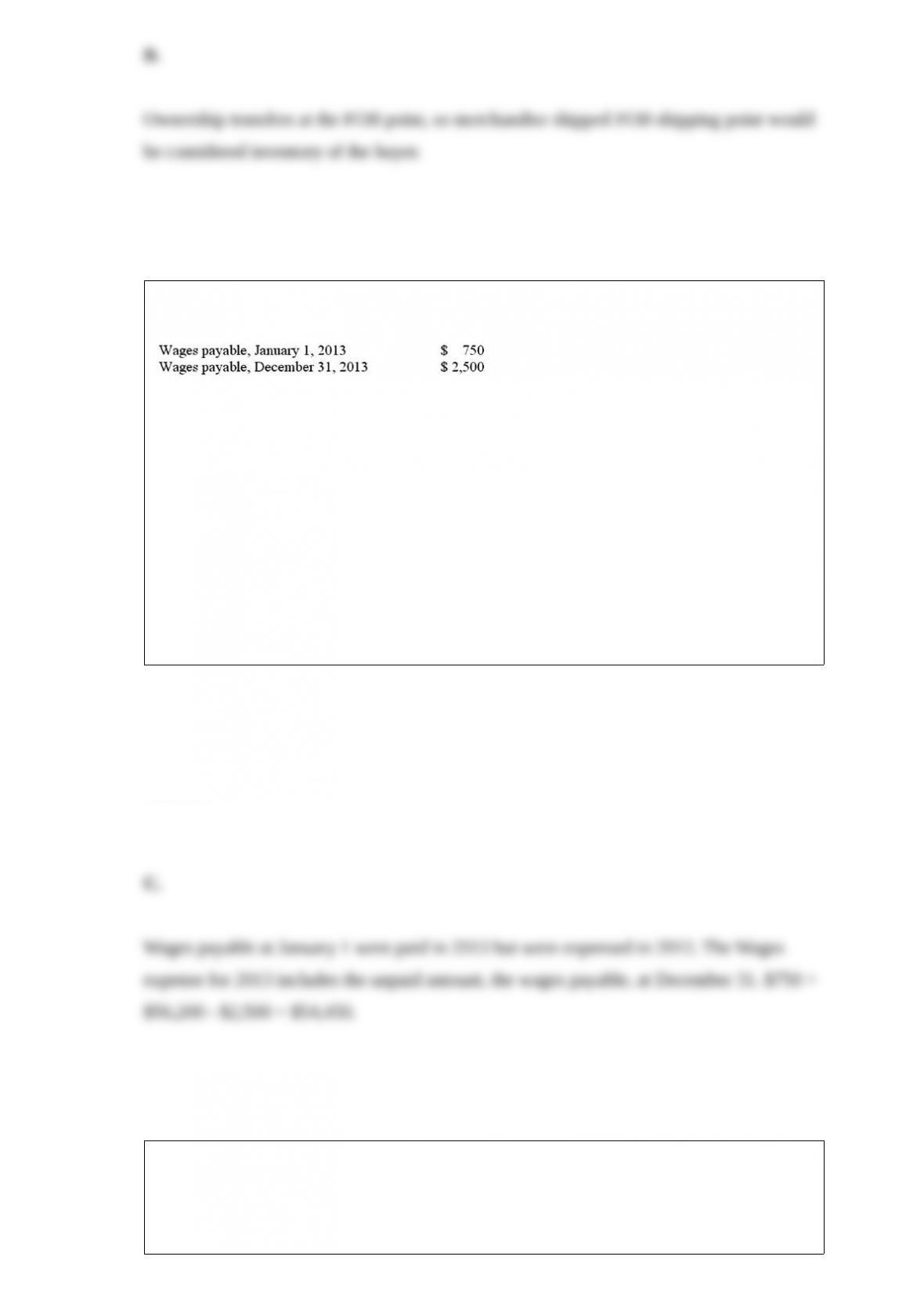
A company reported the following amounts of wages payable at the beginning and the
end of the year 2013:
The income statement for 2013 reported Wages Expense of $56,200.
How much cash was paid for wages during 2013?
A. $52,950
B. $56,200
C. $54,450
D. $53,700
Answer:
Which of the following ratios is used to evaluate solvency?
A. Earnings per share.
B. Fixed asset turnover.
C. Debt-to-assets.
D. Quick ratio.
Answer:
Merchandise was sold on credit for $3,000, terms 1/10, n/30. How should the seller
record the cash collection?
A. Debit Cash, $3,000, and credit Accounts Receivable, $3,000, if collected within the
discount period.
B. Debit Cash, $3,000, credit Accounts Receivable, $2,970, and credit Sales Discounts,
$30, if collected within the discount period.
C. Debit Cash, $3,000, credit Accounts Receivable, $2,970, and credit Sales Discounts,
$30, if collected after the discount period.
D. Debit Cash, $3,000, and credit Accounts Receivable, $3,000, if collected after the
discount period.
Answer:
At the end of last year, the company’s assets totaled $860,000 and its liabilities totaled
$740,000. During the current year, the company’s total assets increased by $58,000 and
its total liabilities increased by $24,000. At the end of the current year, stockholders’
equity was
A. $154,000.
B. $120,000.
C. $34,000.
D. $178,000.
Answer:
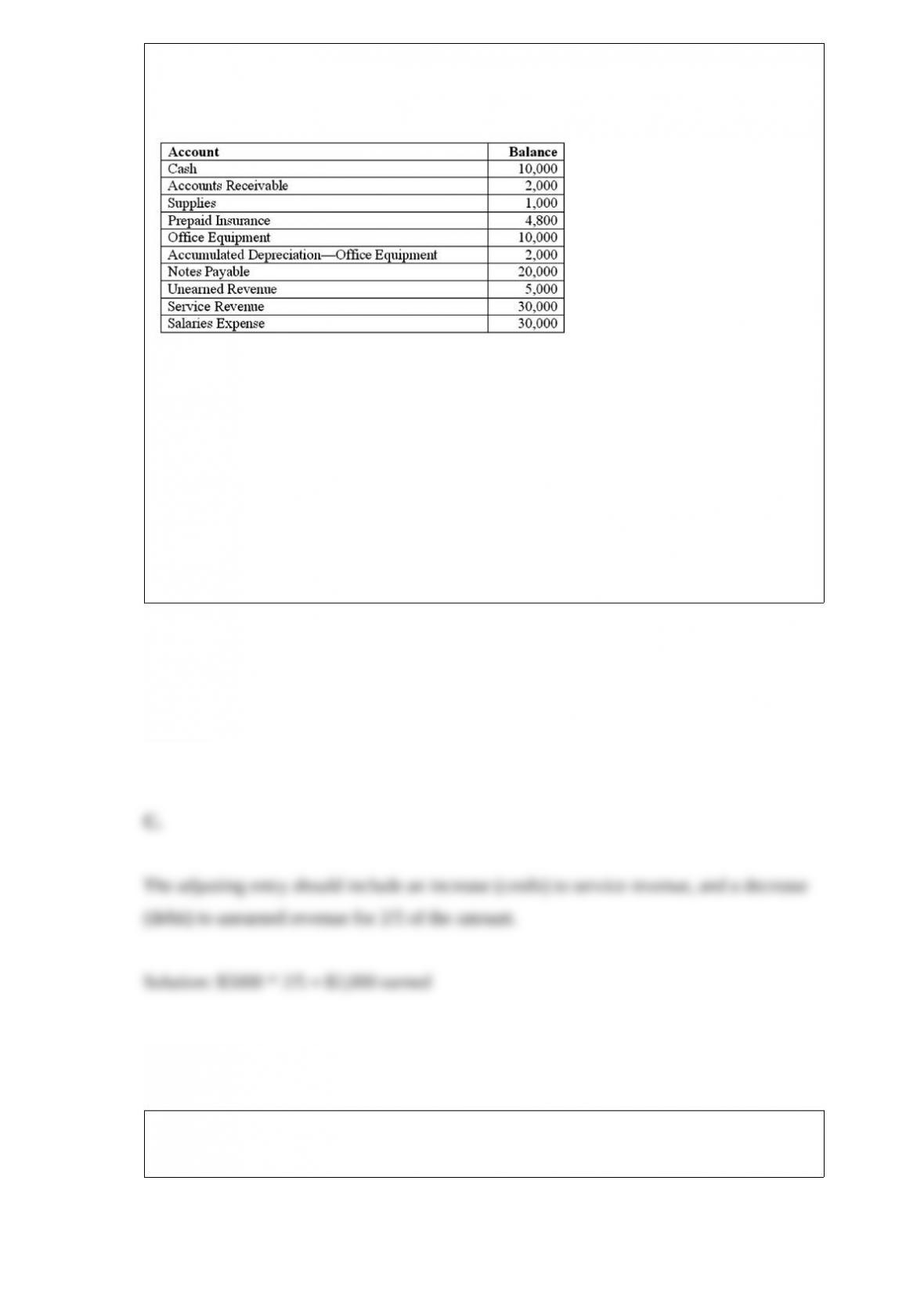
Presented below are selected accounts from the unadjusted trial balance of Sneetch Star
Makers Inc., a talent agency, at 12/31/13 (debit and credit labels have been omitted;
assume all balances are normal).
Three-fifths (60%) of the amount recorded as unearned revenue remains unearned as of
12/31/13. The adjusting entry would include
A. a credit to service revenue for $3,000.
B. a credit to unearned revenue for $3,000.
C. a credit to service revenue for $2,000.
D. a credit to unearned revenue for $2,000.
Answer:
Furniture with a $3,000 sticker price is purchased for $2,500 on account. Which of the
following entries would properly record this purchase?
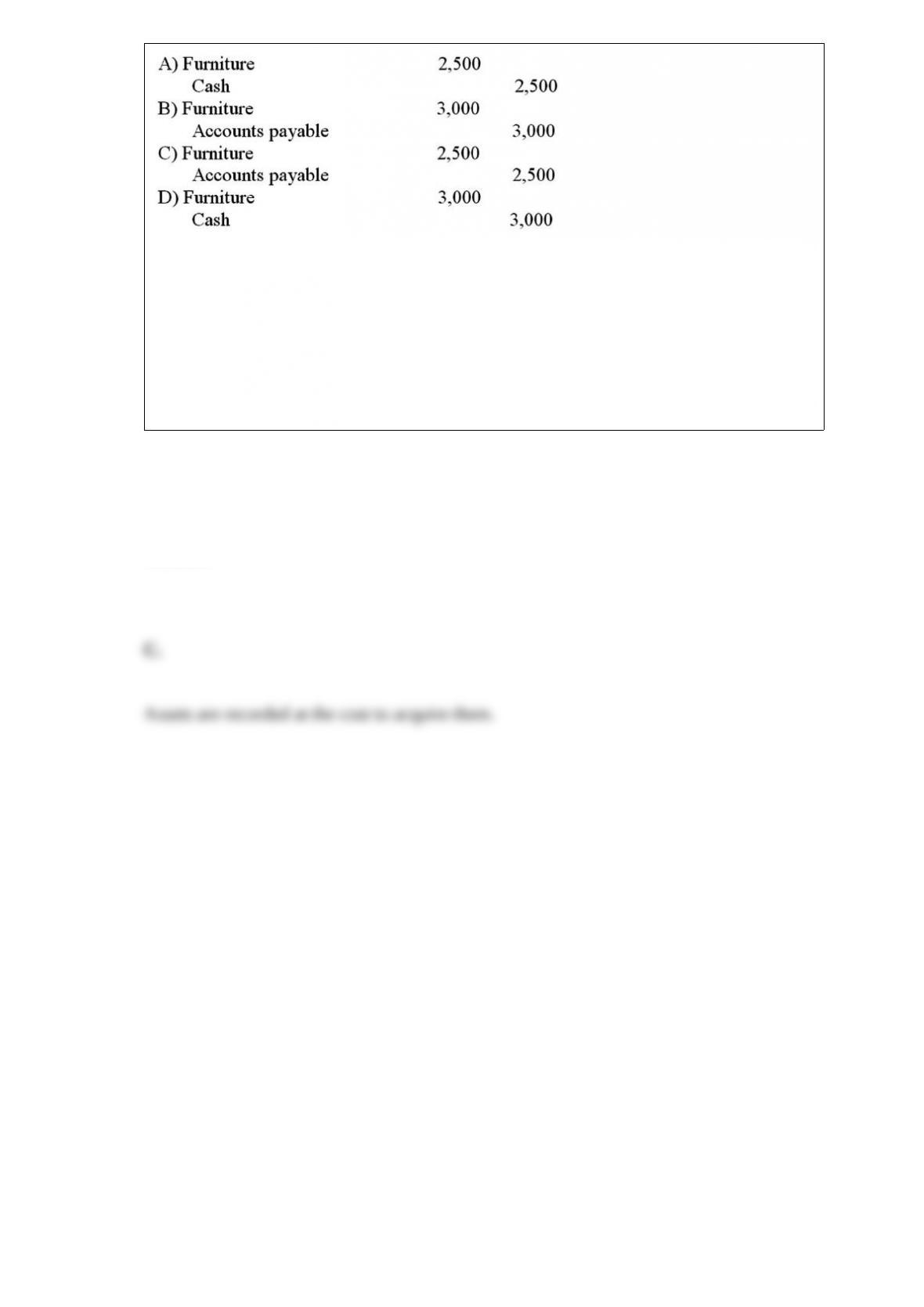
A. Option A
B. Option B
C. Option C
D. Option D
Answer: