
1) noncash investing and financing activities are disclosed either in a separate schedule
or in a separate note to the financial statements.
2) one of the disclosure requirements for a change in accounting principle is to show the
cumulative effect of the change on retained earnings as of the beginning of the earliest
period presented.
3) ifrs allows reversal of impairment losses when there has been a change in economic
conditions or in the expected use of the asset. under u.s gaap, impairment losses cannot
be reversed for assets to be held and used.
4) taxable amounts increase taxable income in future years.
5) a general journal chronologically lists transactions and other events, expressed in
terms of debits and credits to accounts.
6) companies must make correcting entries for noncounterbalancing errors, even if they
have closed the prior years books.
7) verifiability and predictive value are two ingredients of faithful representation.

8) companies recognize a gain or loss when stockholders exercise convertible preferred
stock.
9) if a stock dividend occurs after year-end, but before issuing the financial statements,
a company must restate the weighted-average number of shares outstanding for the
year.
10) the expectations gap is caused by what the public thinks accountants should do and
what accountants think they can do.
11) a reclassification adjustment is necessary when a company reports realized
gains/losses as part of net income but also shows unrealized gains/losses as part of other
comprehensive income.
12) use of a multiple-step income statement will result in the company reporting a
higher net income than if they used a single-step income statement.
13) ifrs permits some capitalization of internally generated intangible assets, if it is
probable there will be a future benefit and the amount can be readily measured.
14) current liabilities are usually recorded and reported in financial statements at their
full maturity value.
15) lifo liquidation often distorts net income, but usually leads to substantial tax
savings.
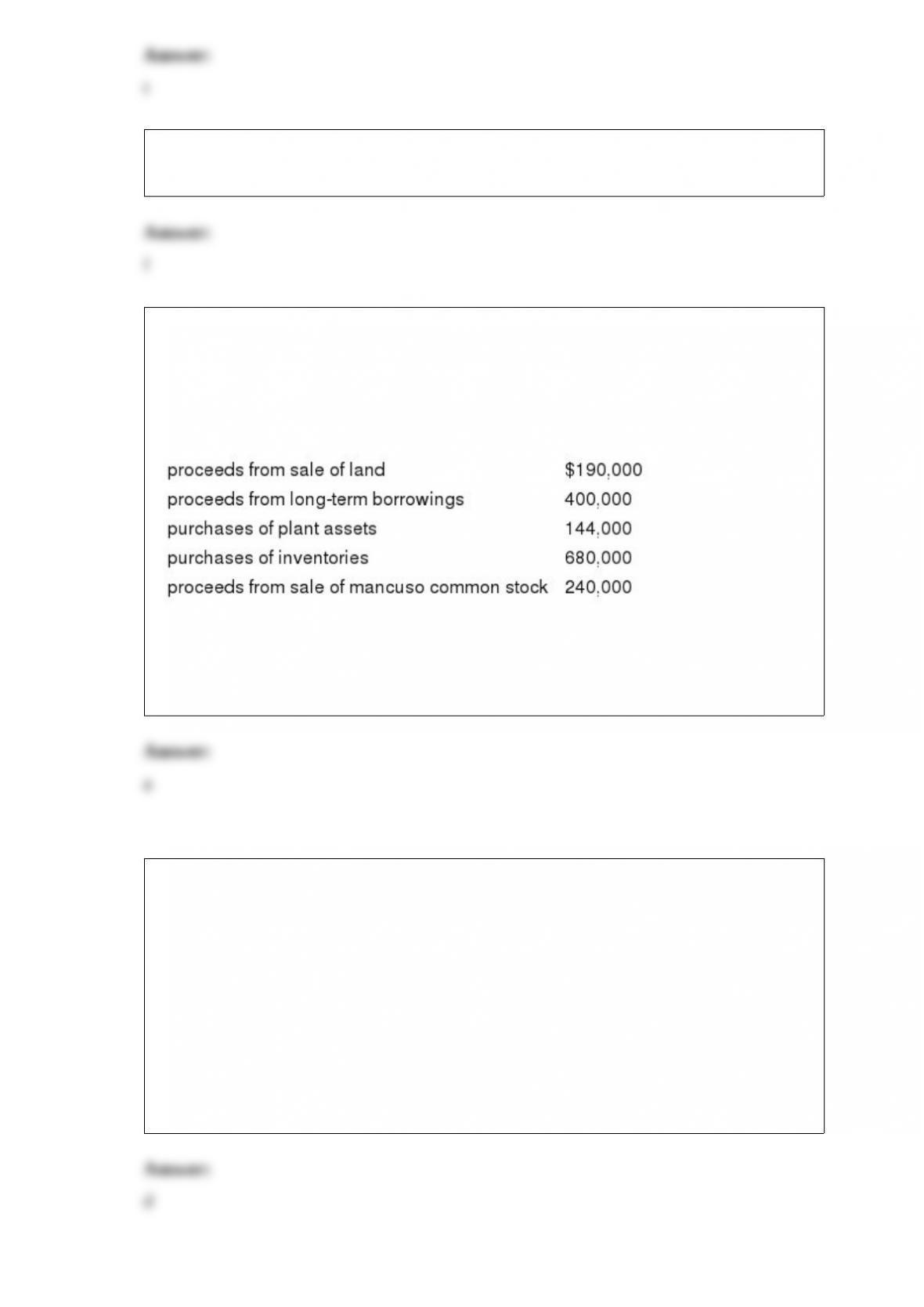
16) the following information on selected cash transactions for 2013 has been provided
by mancuso company:
what is the cash provided (used) by investing activities for the year ended december 31,
2013, as a result of the above information?
a.$46,000
b.$256,000
c.$190,000
d.$830,000
17) robertson inc. bought a machine on january 1, 2002 for $400,000. the machine had
an expected life of 20 years and was expected to have a salvage value of $40,000. on
july 1, 2012, the company reviewed the potential of the machine and determined that its
undiscounted future net cash flows totaled $200,000 and its discounted future net cash
flows totaled $140,000. if no active market exists for the machine and the company
does not plan to dispose of it, what should robertson record as an impairment loss on
july 1, 2012?
a.$ 0
b.$11,000
c.$20,000
d.$71,000

18) the deferred tax expense is the
a.increase in balance of deferred tax asset minus the increase in balance of deferred tax
liability
b.increase in balance of deferred tax liability minus the increase in balance of deferred
tax asset
c.increase in balance of deferred tax asset plus the increase in balance of deferred tax
liability
d.decrease in balance of deferred tax asset minus the increase in balance of deferred tax
liability
19) which of the following is a general limitation of “general purpose financial
statements”?
a.general purpose financial statements may not be the most informative for a specific
enterprise
b.general purpose financial statements are comparable
c.general purpose financial statements are assumed to present fairly the company’s
financial operations
d.none of the above
20) which of the following is a real (permanent) account?
a.goodwill
b.sales
c.accounts receivable
d.both goodwill and accounts receivable
21) similar to u.s. practice, ifrs requires that companies present current and noncurrent
liabilities on the face of the balance sheet with current liabilities
a.generally presented in order of magnitude
b.presented in alphabetic order
c.presented in order of liquidity
d.presented in the order in which they were incurred
22) which accounting assumption or principle is being violated if a company reports its
corporate headquarter building at its fair value on the balance sheet?
a.going concern
b.monetary unit
c.historical cost
d.full disclosure
23) income taxes are allocated to
a.extraordinary items
b.discontinued operations
c.prior period adjustments
d.all of these
24) earnings per share data are required on the face of which of the following financial
statements?
a.statement of retained earnings
b.statement of stockholders’ equity
c.income statement
d.balance sheet
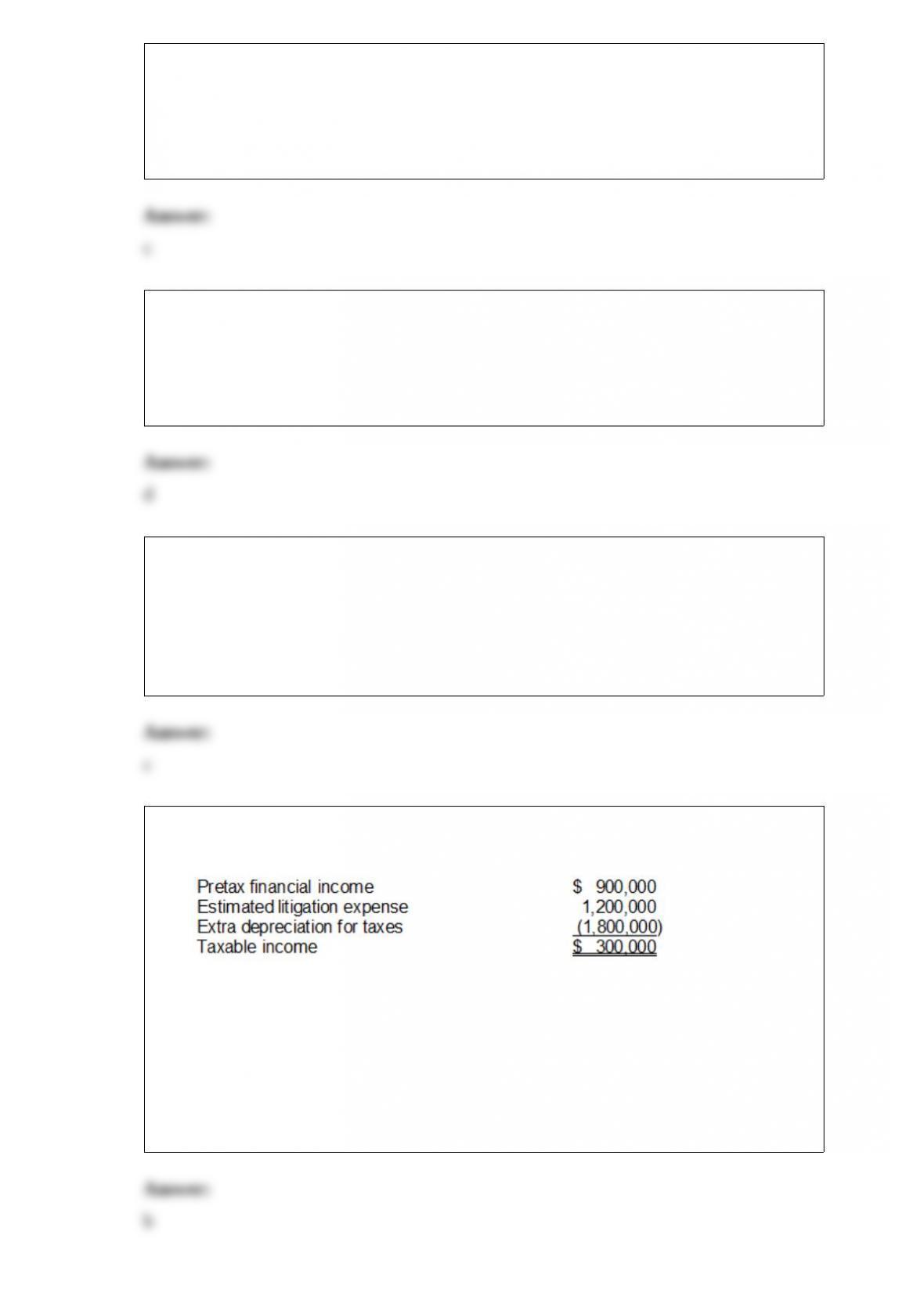
25) hopkins co. at the end of 2012, its first year of operations, prepared a reconciliation
between pretax financial income and taxable income as follows:
the estimated litigation expense of $1,200,000 will be deductible in 2013 when it is
expected to be paid. use of the depreciable assets will result in taxable amounts of
$600,000 in each of the next three years. the income tax rate is 30% for all years.
income tax payable is
a.$0
b.$90,000
c.$180,000
d.$270,000
26) reed co. wishes to enter receipts and payments in such a manner that adjustments at
the end of the period will not require reversing entries at the beginning of the next
period. record the following transactions in the desired manner and give the adjusting
entry on december 31, 2012. (two entries for each part.)
1>.an insurance policy for two years was acquired on april 1, 2012 for $12,000.
2>.rent of $15,000 for six months for a portion of the building was received on
november 1, 2012.
27) there are four types of temporary differences. for each type: (1) indicate the cause of
the difference, (2) give an example, and (3) indicate whether it will create a taxable or
deductible amount in the future.
28) briefly discuss how accounting convergence efforts addressing liabilities is related
to the iasb/fasb conceptual framework project.
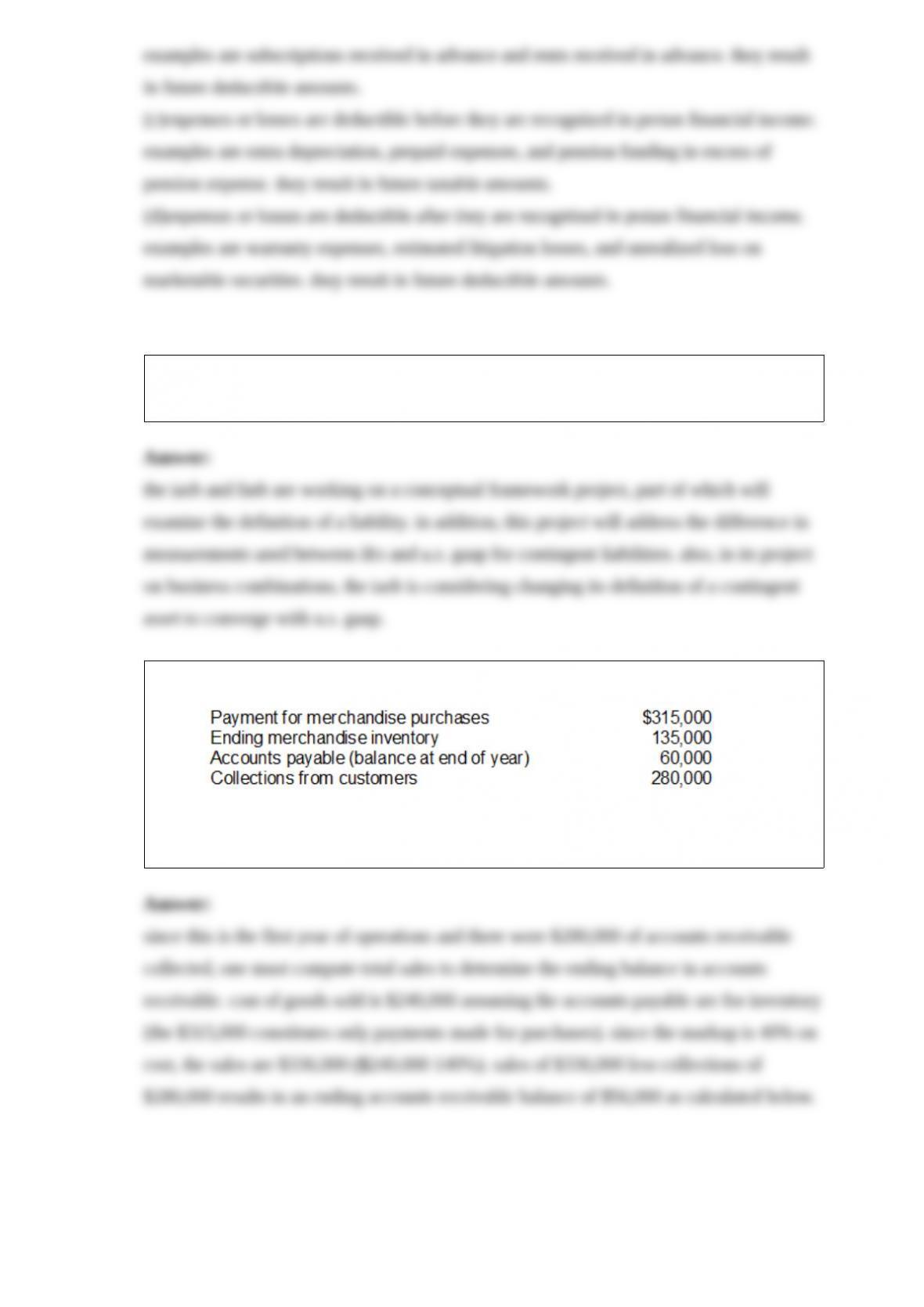
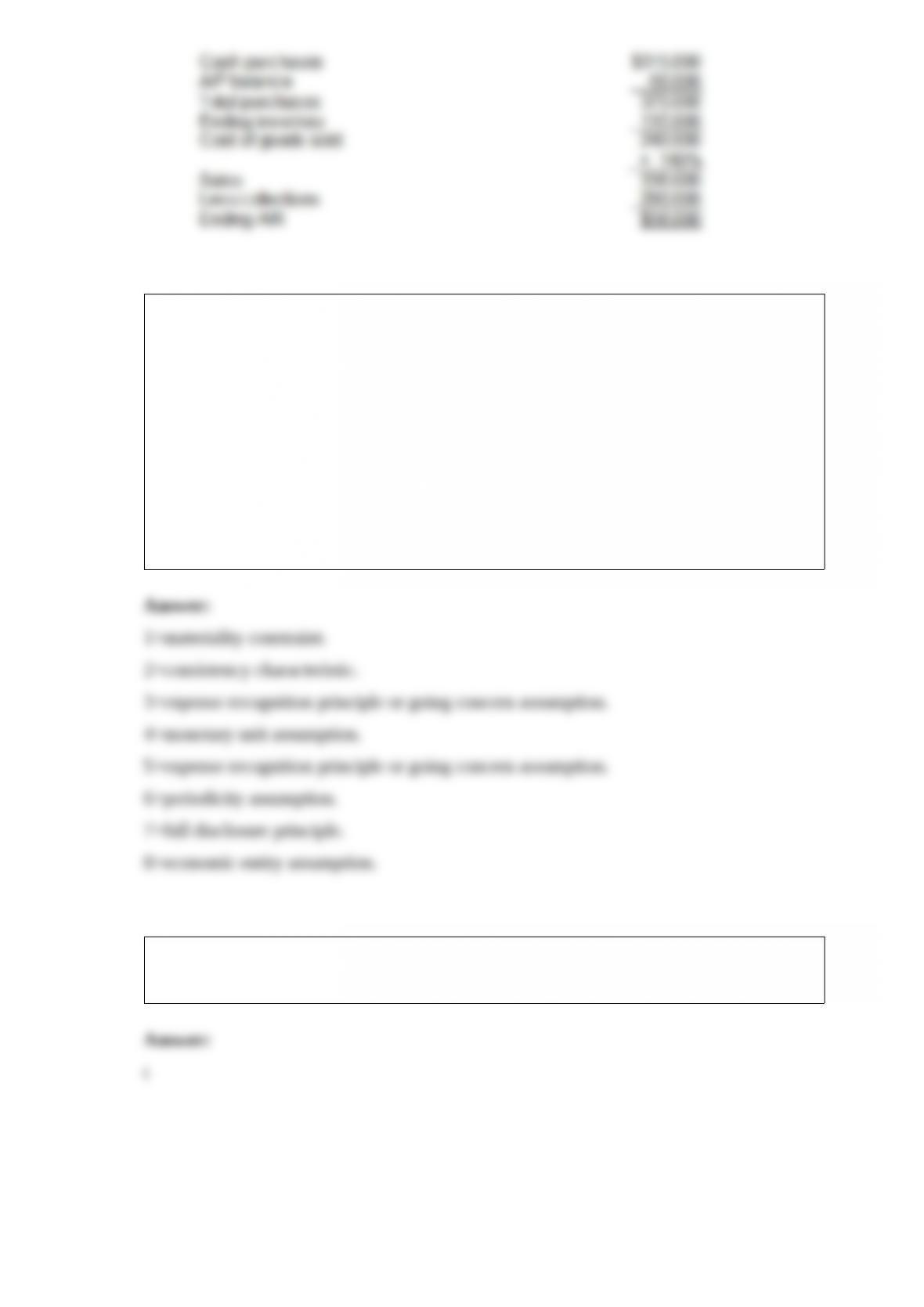
29) the following information is available for renn corporation’s first year of operations:
the balance in accounts payable relates only to merchandise purchases. all merchandise
items were marked to sell at 40% above cost. what should be the ending balance in
accounts receivable, assuming all accounts are deemed collectible?
30) accounting conceptsidentification.
state the accounting assumption, principle, information characteristic, or constraint that
is most applicable in the following cases.
1>all payments less than $25 are expensed as incurred. (do not use conservatism.)
2>the company employs the same inventory valuation method from period to period.
3>a patent is capitalized and amortized over the periods benefited.
4>assuming that dollars today will buy as much as ten years ago.
5>rent paid in advance is recorded as prepaid rent.
6>financial statements are prepared each year.
7>all significant post-balance sheet events are reported.
8>personal transactions of the proprietor are distinguished from business transactions.
31) the components of other comprehensive income can be reported in a statement of
stockholders equity.
32)
33) presented below are changes in the account balances of wenn company during the
year, except for retained earnings.
increase increase
(decrease)(decrease)
cash$29,000accounts payable$34,000
accounts receivable (net)(13,000)bonds payable(20,000)
inventory52,000common stock62,000
plant assets (net)47,000paid-in capital16,000
the only entries in retained earnings were for net income and a dividend declaration of
$12,000.
compute the net income for the current year.