The Statement of Cash Flows indicates the cash inflows and outflows from
A. investing, financing, and borrowing activities.
B. operating, investing, and sending activities.
C. merchandising, financing, and investing activities.
D. operating, investing, and financing activities.
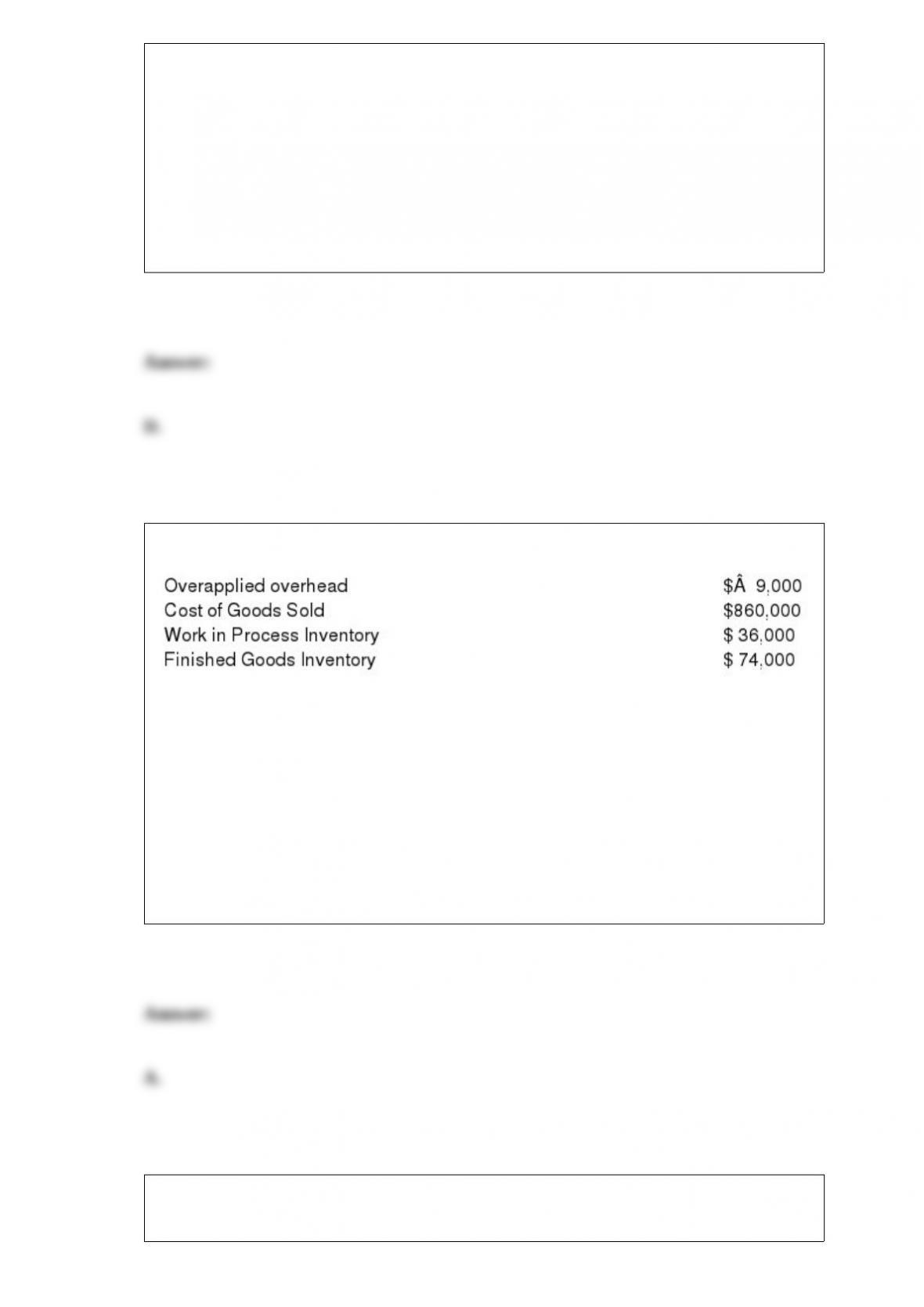
At the end of the last fiscal year, Drury Company had the following account balances:
If the most common treatment of assigning overapplied overhead were used, the final
balance in Cost of Goods Sold is:
A. $851,000.
B. $852,021.
C. $867,979.
D. $869,000.
Industrial Solutions Company

Industrial Solutions Company manufactures a cleaning solvent. The company employs
both skilled and unskilled workers. To produce one 55-gallon drum of solvent requires
Materials A and B as well as skilled labor and unskilled labor. The standard and actual
material and labor information is presented below:
Standard:
Material A: 30.25 gallons @ $1.25 per gallon
Material B: 24.75 gallons @ $2.00 per gallon
Skilled Labor: 4 hours @ $12 per hour
Unskilled Labor: 2 hours @ $ 7 per hour
Actual:
Material A: 10,716 gallons purchased and used @ $1.50 per gallon
Material B: 17,484 gallons purchased and used @ $1.90 per gallon
Skilled labor hours: 1,950 @ $11.90 per hour
Unskilled labor hours: 1,300 @ $7.15 per hour
During the current month Industrial Solutions Company manufactured 500 55-gallon
drums.
Round all answers to the nearest whole dollar.
Refer to Industrial Solutions Company. What is the total material yield variance?
A. $1,111 U
B. $1,111 F
C. $2,670 U
D. $2,670 F
Efficient Electronics Corporation produces two types of electronic data organizers:
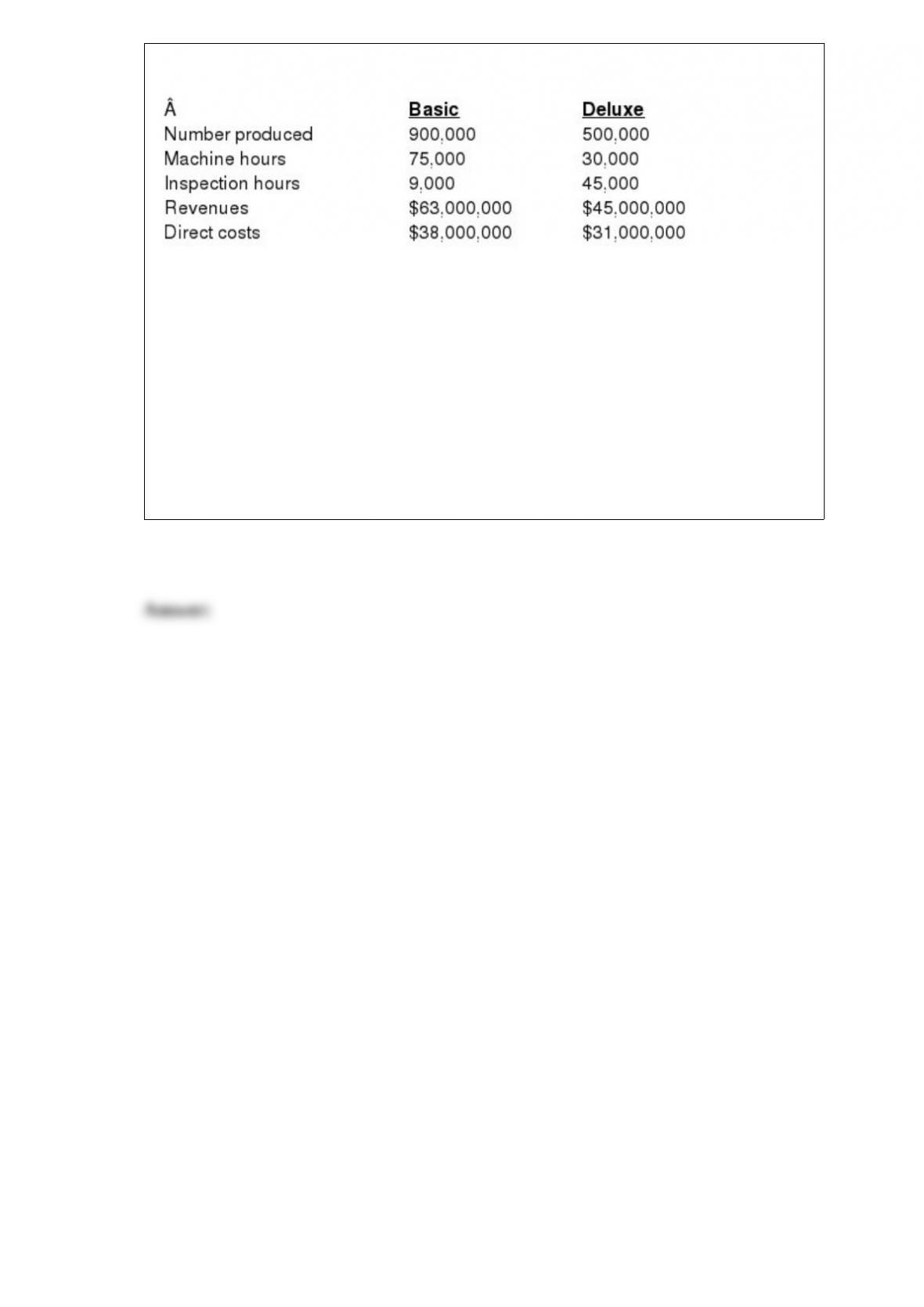
basic and deluxe. The following information about the production process is available:
Total factory overhead is $10,000,000. Of this overhead, $4,000,000 is related to
utilities and the remainder is related to quality control.
a. Determine the total overhead cost assigned to each type of data organizer using
machine hours as the allocation base. Calculate the gross profit per unit for each
product. b. Determine the total overhead cost assigned to each type of data organizer if
overhead is assigned using allocation bases appropriate to the overhead costs. Calculate
the gross profit per unit of each product.
c. Explain why the unit cost for each model is different between the two methods of
allocation.

The costing system that classifies costs by both functional group and behavior is
A. process costing.
B. job order costing.
C. variable costing.
D. absorption costing.
There is a positive relationship between value-added (VA) activities and manufacturing
cycle efficiency (MCE).
The “Rule of One” underlies the premise that all costs are
A. variable.
B. fixed.
C. unit-based.
D. short-term.

The variance least significant for purposes of controlling costs is the
A. material quantity variance.
B. variable overhead efficiency variance.
C. fixed overhead spending variance.
D. fixed overhead volume variance.
Which of the following responsibility centers may be evaluated on the basis of residual
income?
A. investment center
B. revenue center
C. profit center
D. cost center
Glassman Company
Glassman Company produces two products: A and B. The company has three overhead
functions that are required for both products.
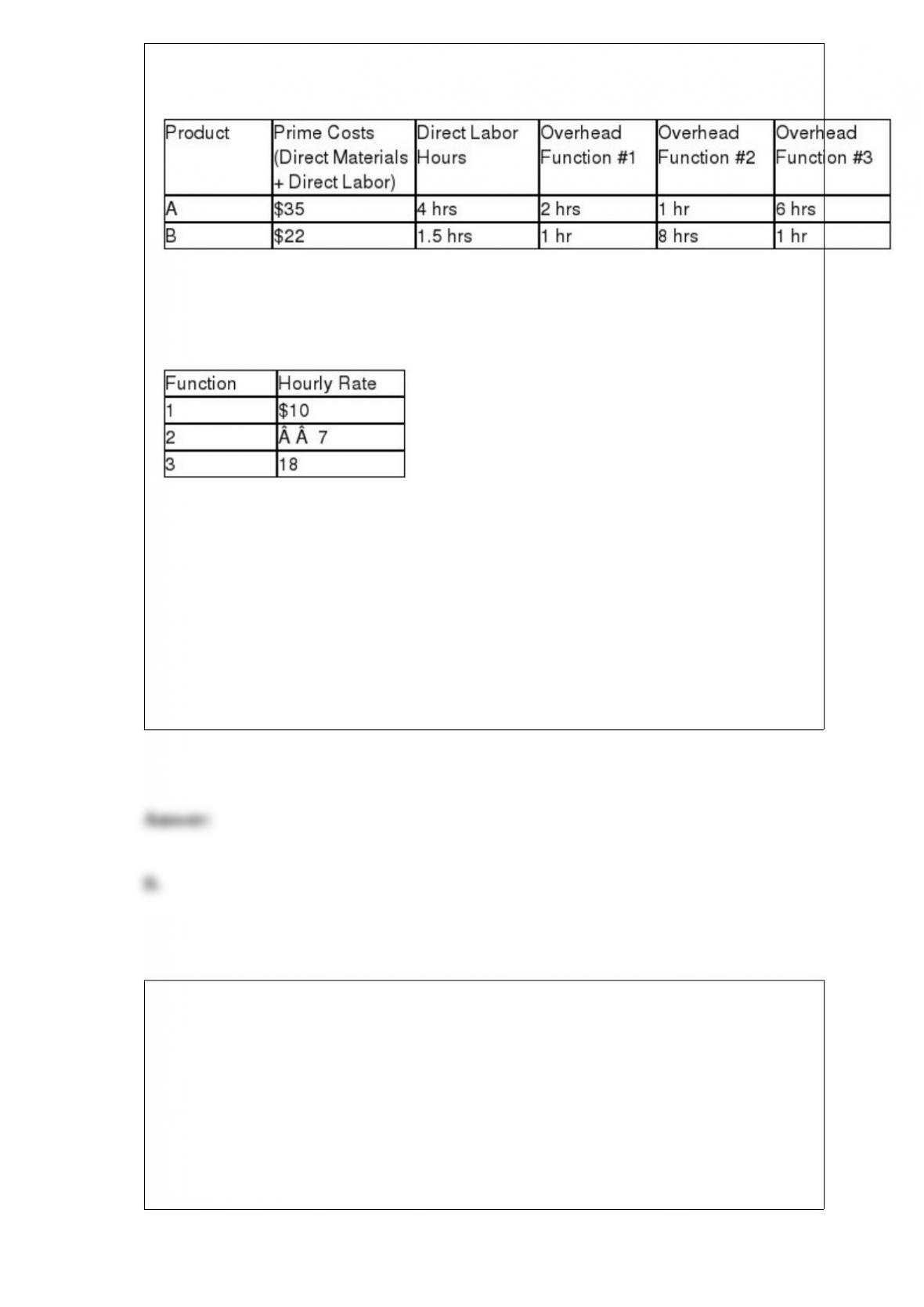
Below is production information for Products A and B:
The company produces 800 units of Product A and 8,000 units of Product B each
period.
The overhead functions have the following hourly costs:
Refer to Glassman Company If total overhead is assigned to A and B on the basis of
units produced, Product B will have an overhead cost per unit of
A. $84.00.
B. $88.64.
C. $110.64.
D. None of the responses are correct.
An unfavorable fixed overhead volume variance is most often caused by
A. actual fixed overhead incurred exceeding budgeted fixed overhead.
B. an over-application of fixed overhead to production.
C. an increase in the level of the finished inventory.
D. normal capacity exceeding actual production levels.

Minimizing period-by-period increases in unit variable costs and total fixed costs
defines efforts of cost
A. control.
B. avoidance.
C. containment.
D. reduction.
Which of the following would be considered a discrete loss in a production process?
A. adding the correct ingredients to make a bottle of ketchup
B. putting the appropriate components together for a stereo
C. adding the wrong components when assembling a stereo
D. putting the appropriate pieces for a bike in the box
Industrial Solutions Company
Industrial Solutions Company produces three products from the same process that has
joint processing costs of $4,100. Products R, S, and T are produced in the following
quantities: 250 gallons, 400 gallons, and 750 gallons. Industrial Solutions Company
also incurred advertising costs of $60,000. The ad was used to run sales for all three
products. The three products occupy floor space in the following ratio: 5:4:9. (Round all
answers to the nearest dollar.)
Refer to Industrial Solutions Company. Assume that Industrial Solutions chooses to
allocate its advertising cost among the three products. What amount of advertising cost
is allocated to Product S using the floor space ratio?
A. $911
B. $14,244
C. $13,333
D. $30,000
Commodore Company
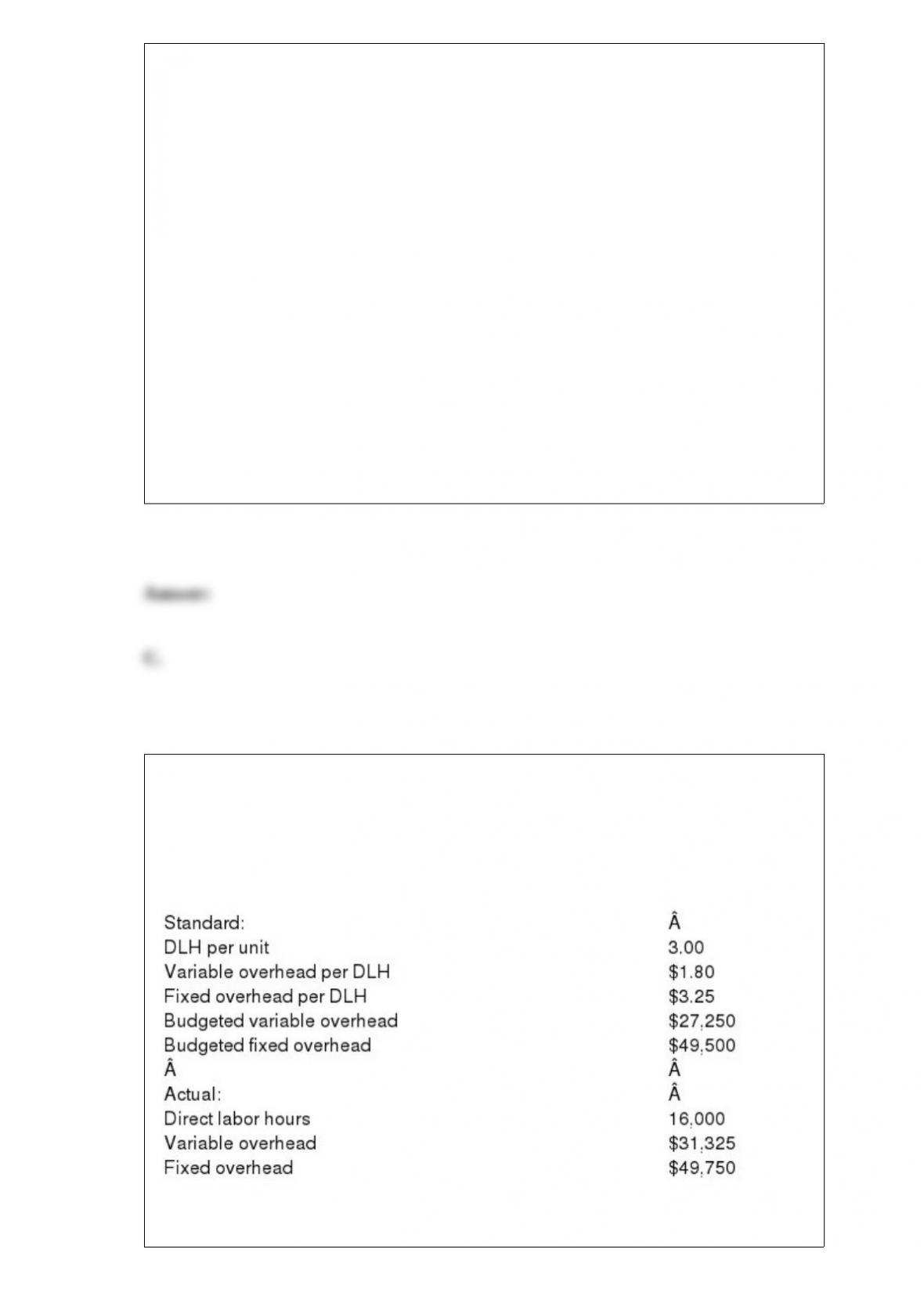
Commodore Company uses a standard cost system for its production process and
applies overhead based on direct labor hours. The following information is available for
September when Commodore produced 5,000 units:
Refer to Commodore Company. Using the three-variance approach, what is the
spending variance?
A. $2,525 U
B. $2,775 U
C. $4,375 U
D. $4,375 F
Lincoln Corporation
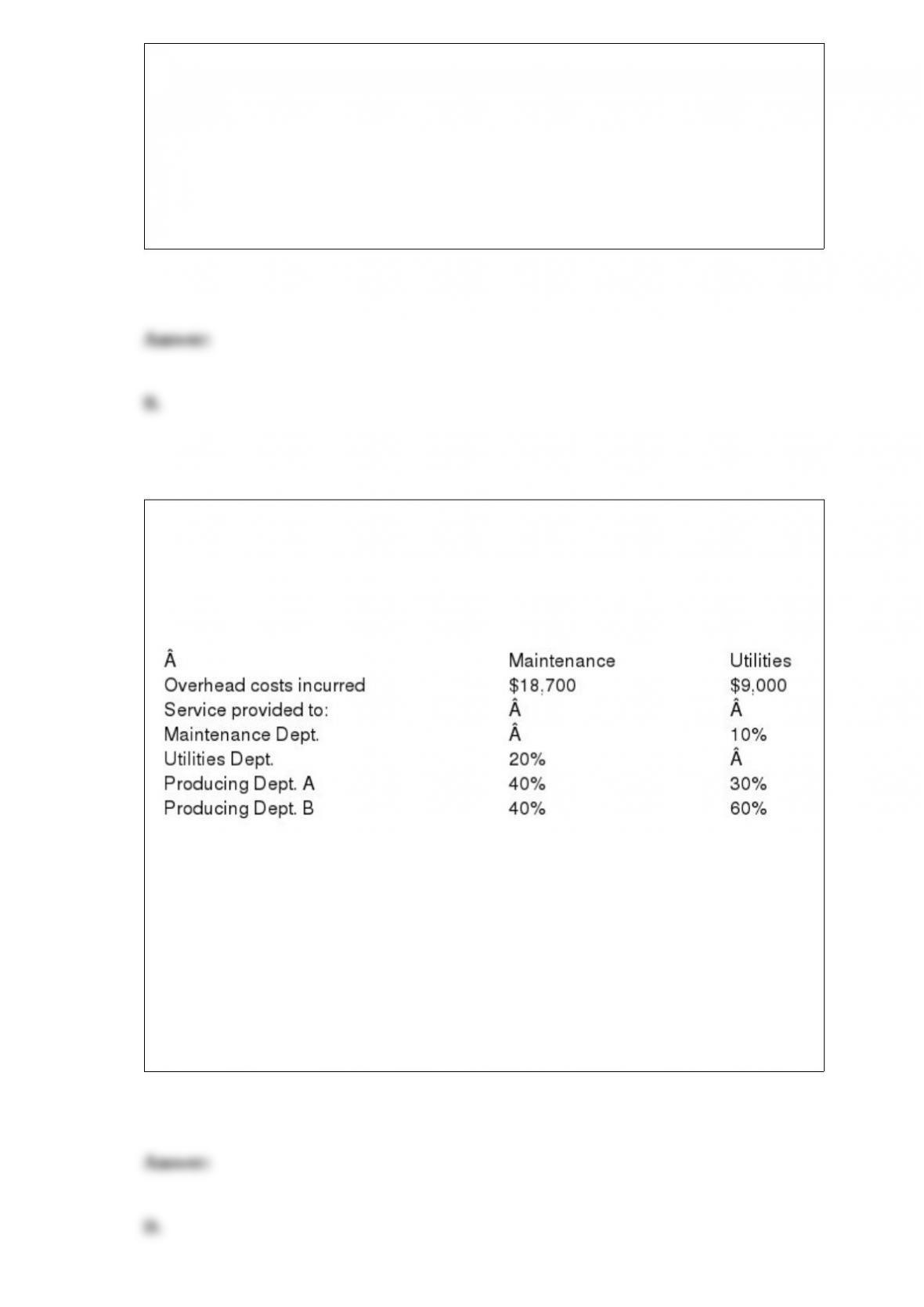
Lincoln Corporation distributes its service department overhead costs directly to
producing departments without allocation to the other service departments. Information
for January is presented here.
Refer to Lincoln Corporation. The amount of Utilities Department costs distributed to
Dept. B for January should be (rounded to the nearest dollar)
A. $3,600.
B. $4,500.
C. $5,400.
D. $6,000.