
The budgetary unit of an organization which is led by a manager who has both the
authority over and responsibility for the unit’s performance is known as a:
A.control center
B.budgetary area
C.responsibility center
D.managerial department
Answer:
In the manufacture of 10,000 units of a product, direct materials cost incurred was
$145,800, direct labor cost incurred was $82,000, and applied factory overhead was
$45,500. What is the total conversion cost?
A.$127,500
B.$145,800
C.$272,200
D.$273,300
Answer:
A company purchases a one-year insurance policy on June 1 for $2,760. The adjusting
entry on December 31 is
A.debit Insurance Expense, $1,380 and credit Prepaid Insurance, $1,380.
B.debit Insurance Expense, $1,150 and credit Prepaid Insurance, $1,150.
C.debit Insurance Expense, $1,610, and credit Prepaid Insurance, $1,610.
D.debit Prepaid Insurance, $1,380, and credit Cash, $1,380.
Answer:
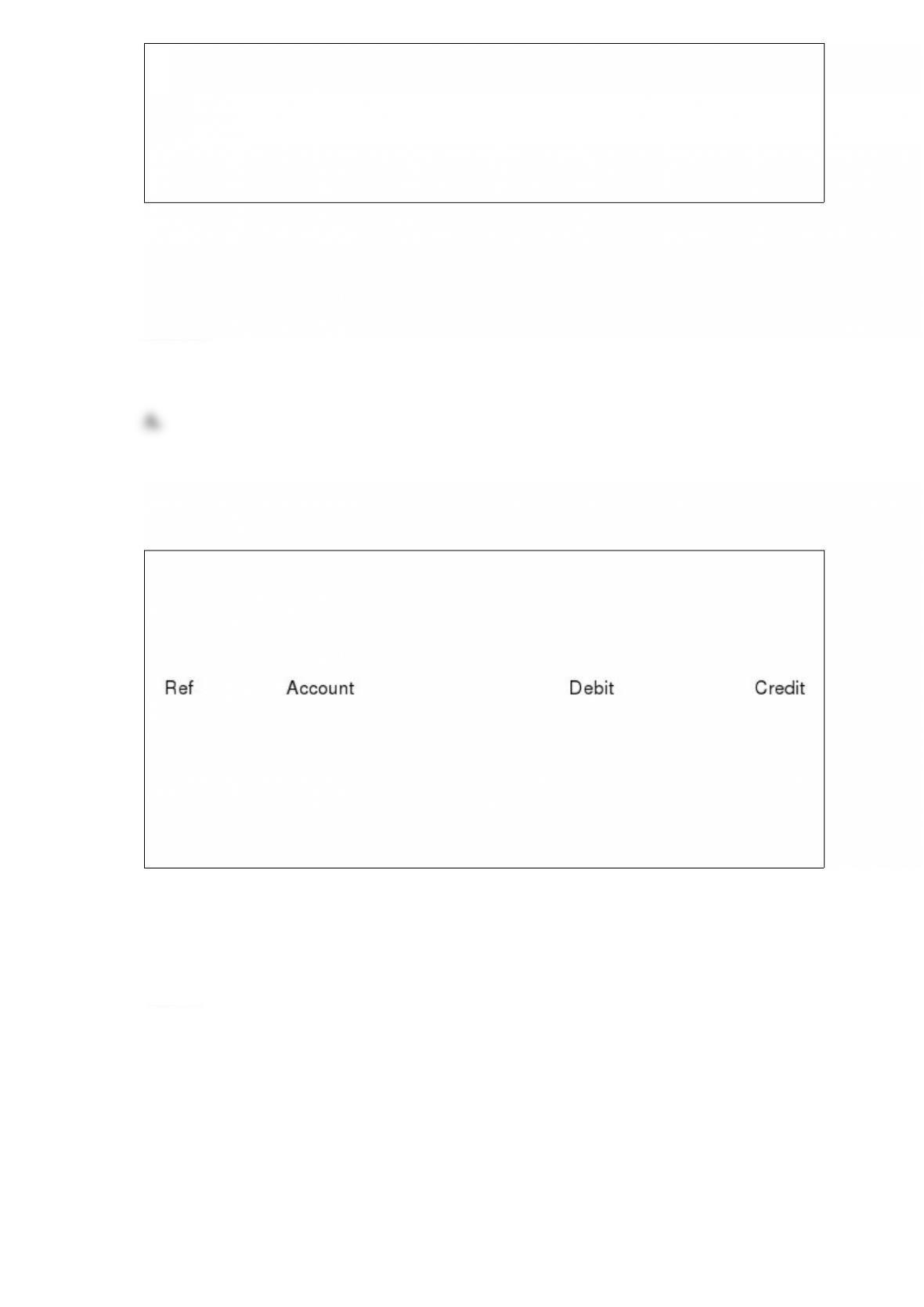
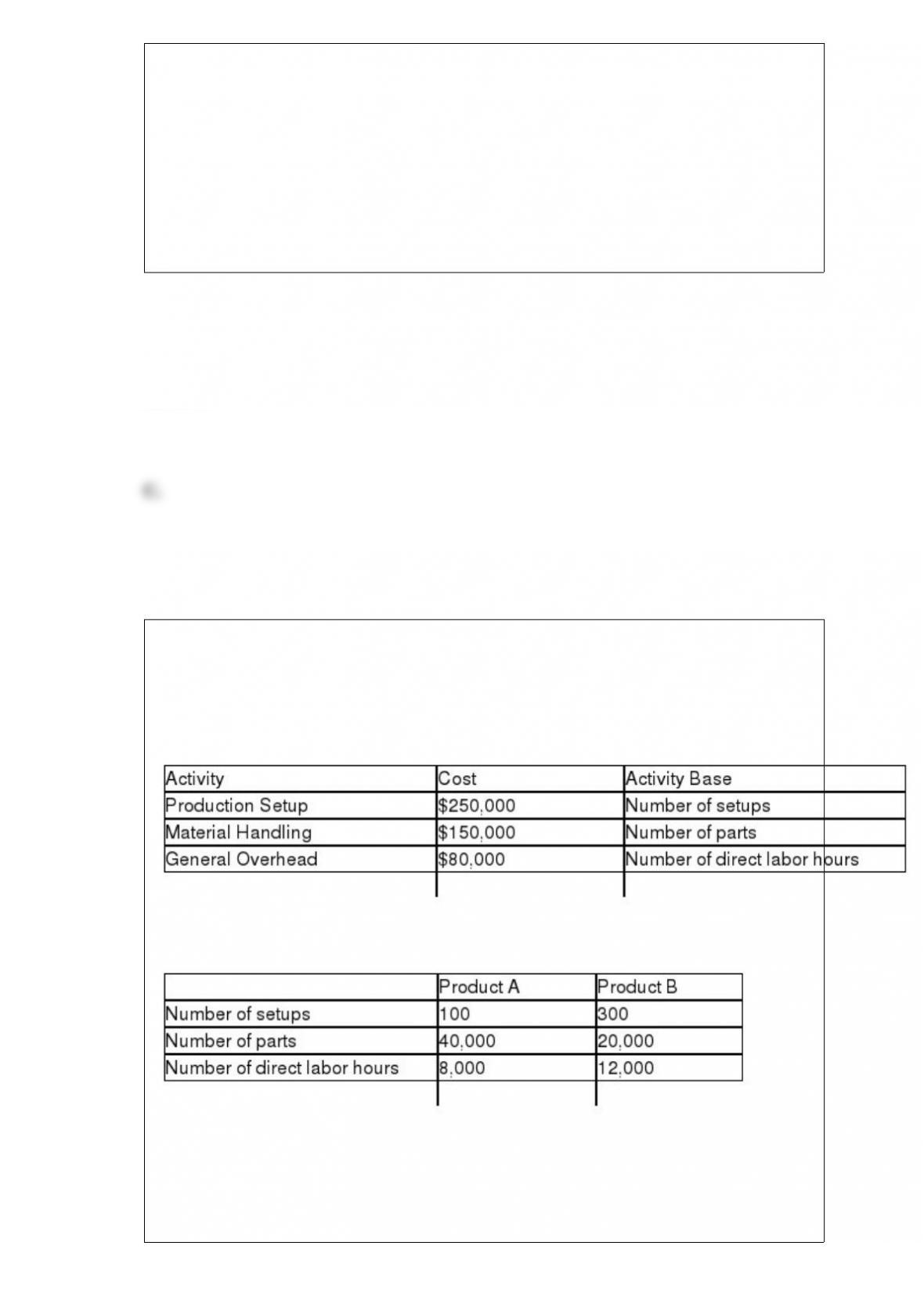
Miramar Industries manufactures two products, A and B. The manufacturing operation
involves three overhead activities – production setup, material handling, and general
factory activities. Miramar uses activity-based costing to allocate overhead to products.
An activity analysis of the overhead revealed the following estimated costs and activity
bases for these activities:
Each product’s total activity in each of the three areas are as follows:
What is the activity rate for General Overhead?
A.$4.00 per direct labor hour
B.$60.00 per direct labor hour
C.$6.67 per direct labor hour
D.$10.00 per direct labor hour
Answer:
A business issued a 120-day, 6% note for $10,000 to a creditor on account. The
company uses a 360-day year for interest calculations. Journalize the entries to record
(a) the issuance of the note and (b) the payment of the note at maturity, including
interest.
Answer:
When merchandise is returned under the perpetual inventory system, the buyer would
credit
A.Merchandise Inventory
B.Purchases Returns and Allowances
C.Accounts Payable
D.Accounts Receivable
Answer:
Expected useful life is
A.calculated when the asset is sold.
B.estimated at the time that the asset is placed in service.
C.determined each year that the depreciation calculation is made.
D.none of the answers are correct.

Answer:
Nuthatch Corporation began its operations on September 1 of the current year.
Budgeted sales for the first three months of business are $260,000, $375,000, and
$400,000, respectively, for September, October, and November. The company expects
to sell 30% of its merchandise for cash. Of sales on account, 80% are expected to be
collected in the month of the sale and 20% in the month following the sale.
The cash collections in November from accounts receivable are:
A.$280,000
B.$316,400
C.$295,200
D.$276,500
Answer:
Jacki Lopez started JVL Consulting on January 1, 2014. The following are the account
balances at the end of the first month of business, before adjusting entries were
recorded:
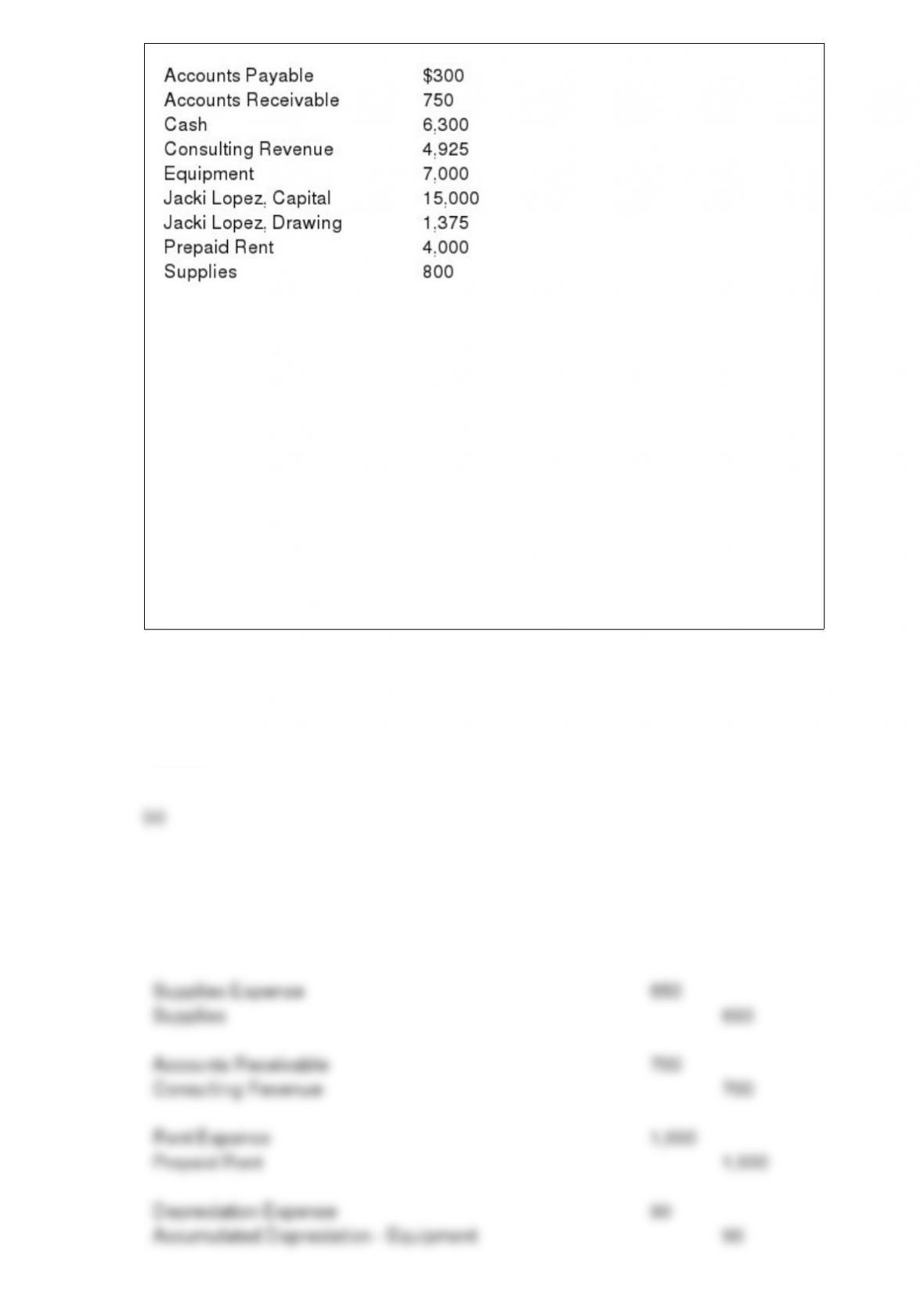
Adjustment data:
Supplies on hand at the end of the month: $150
Unbilled Consulting Revenue: $700
Rent expense for the month: $1,000
Depreciation on equipment: $90
(a) Prepare the required adjusting entries, adding accounts as needed.
(b) Prepare an Adjusted Trial Balance for JVL Consulting as of January 31, 2014.
Answer:
An aging of a company’s accounts receivable indicates that the estimate of uncollectible
accounts totals $6,400. If Allowance for Doubtful Accounts has a $1,300 debit balance,
the adjustment to record the bad debt expense for the period will require a
A.debit to Bad Debt Expense for $7,700.
B.debit to Bad Debt Expense for $6,400.
C.debit to Bad Debt expense for $5,100
D.credit to Allowance for Doubtful Accounts for $1,300.

Answer:
When using a revenue journal:
A.both a “Fees Earned” and an “Accounts Receivable” column are included.
B.both cash sales and sales on account are posted to the journal.
C.revenues are normally recorded when the company sends customer invoices.
D.postings to customer accounts are done at month end.
Answer:
Land, originally purchased for $30,000, is sold for $62,000 in cash. What is the effect
of the sale on the accounting equation?
A.assets increase $62,000; owner’s equity increases $62,000
B.assets increase $32,000; owner’s equity increases $32,000
C.assets increase $62,000; liabilities decrease $30,000; owner’s equity increases
$32,000
D.assets increase $30,000; no change for liabilities; owner’s equity increases $62,000
Answer:
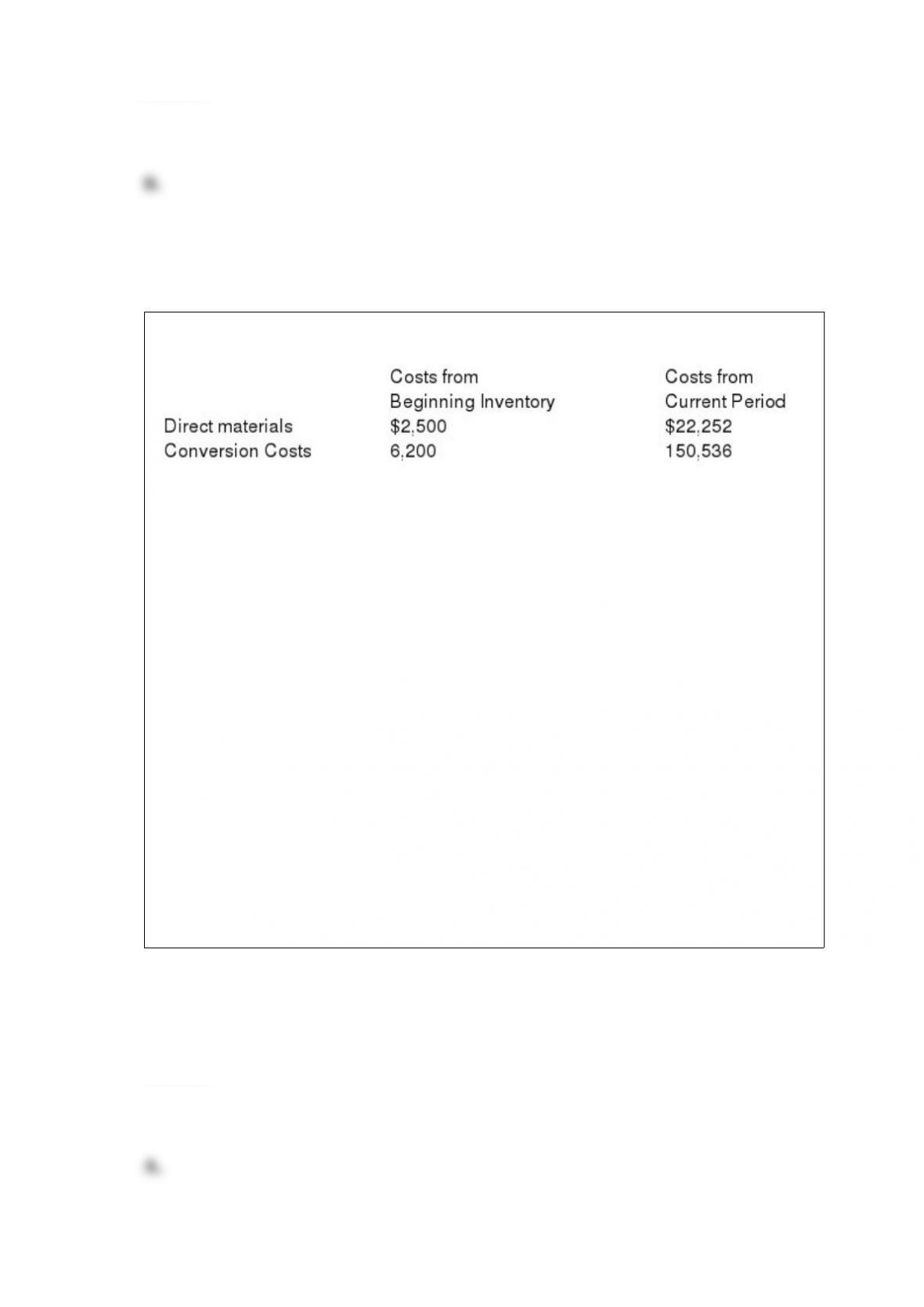
Carmelita Inc., has the following information available:
At the beginning of the period, there were 500 units in process that were 60 percent
complete as to conversion costs and 100 percent complete as to direct materials costs.
During the period 4,500 units were started and completed. Ending inventory contained
340 units that were 30 percent complete as to conversion costs and 100 percent
complete as to materials costs. (Assume that the company uses the FIFO process cost
method. Round cost per unit figures to two cents, i.e. $2.22 when calculating total
costs.)
The total costs that will be transferred into Finished Goods for units started and
completed were
A.$161,775
B.$156,960
C.$162,855
D.$161,505
Answer:

In a profit center, the manager has responsibility and authority for making decisions that
affect:
A.liabilities
B.assets
C.investments
D.costs
Answer:
Alpha and Beta are partners who share income in the ratio of 1:2 and have capital
balances of $40,000 and $70,000 at the time they decide to terminate the partnership.
After all noncash assets are sold and all liabilities are paid, there is a cash balance of
$50,000. What amount of loss on realization should be allocated to Alpha?
A.$60,000
B.$20,000
C.$30,000
D.$50,000
Answer:
Significant changes in stockholders’ equity are reported in
A.income statement
B.retained earnings statement
C.statement of stockholders’ equity
D.statement of cash flows
Answer:
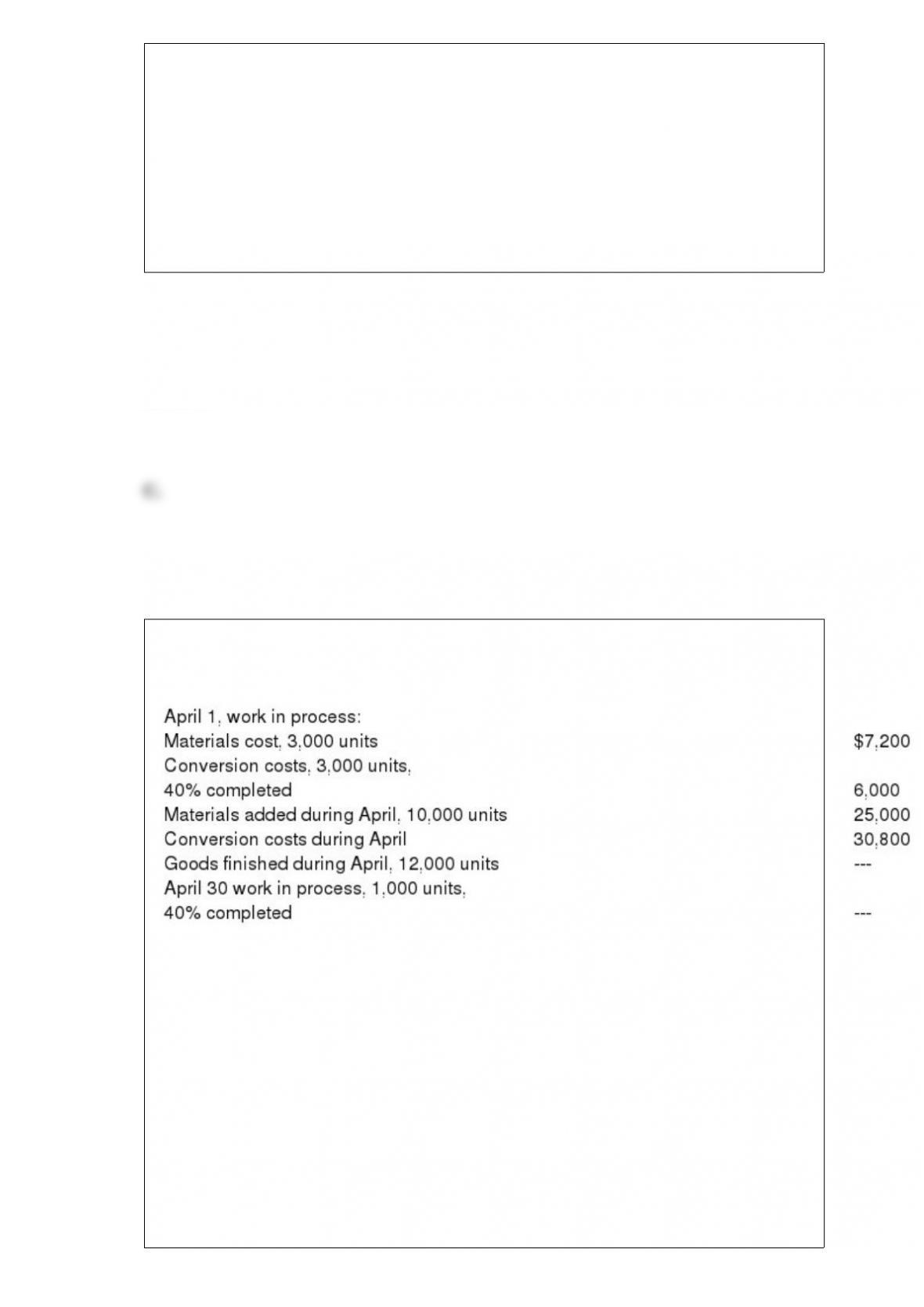
The debits to Work in Process–Assembly Department for April, together with data
concerning production, are as follows:
All direct materials are placed in process at the beginning of the process and the first-in,
first-out method is used to cost inventories. The conversion cost per equivalent unit for
April is:
A.$2.48
B.$2.75
C.$2.50
D.$5.25
Answer:
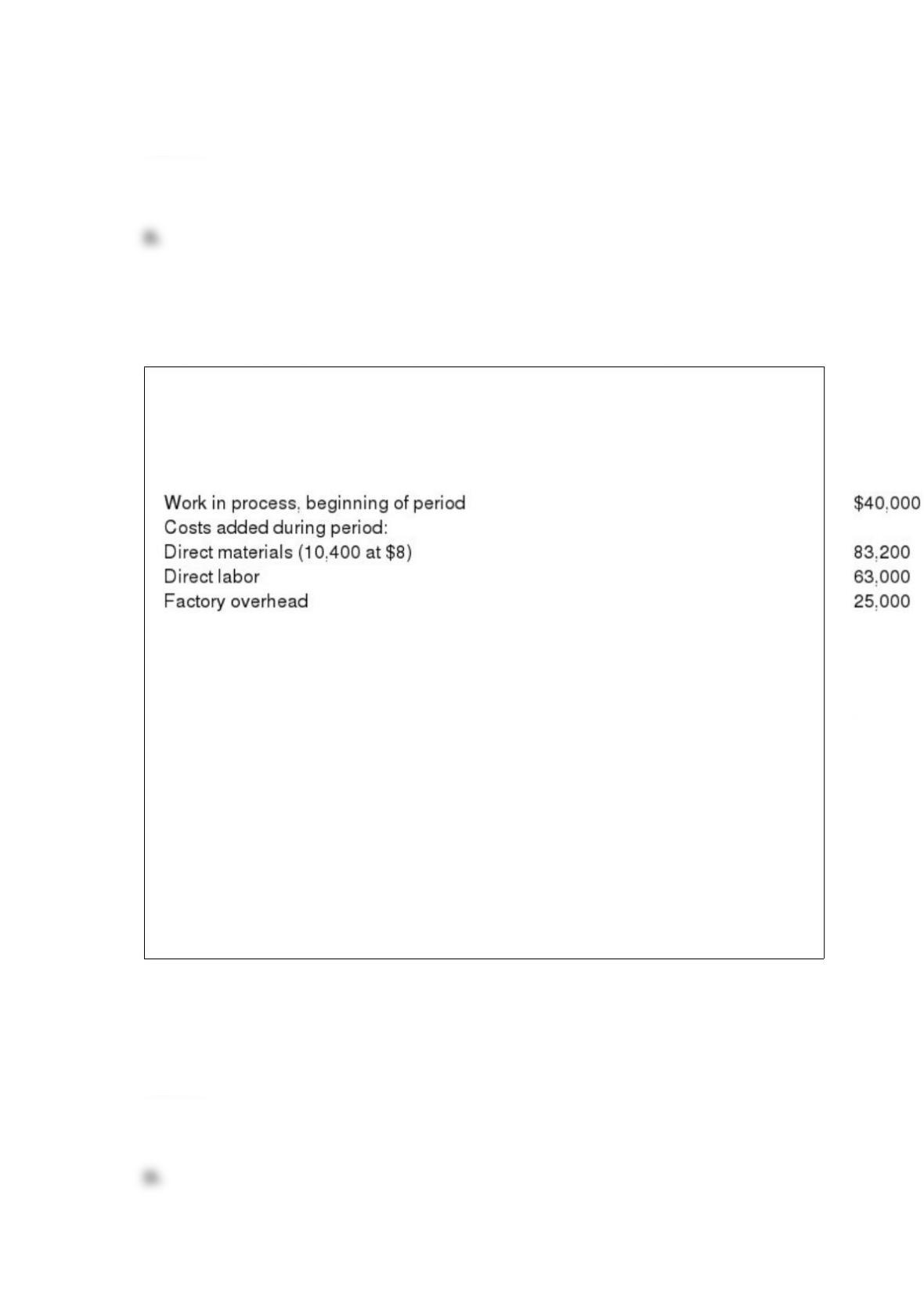
Department G had 3,600 units, 25% completed at the beginning of the period, 11,000
units were completed during the period, 3,000 units were one-fifth completed at the end
of the period, and the following manufacturing costs were debited to the departmental
work in process account during the period:
Assuming that all direct materials are placed in process at the beginning of production
and that the first-in, first-out method of inventory costing is used, what is the total cost
of the departmental work in process inventory at the end of the period (round unit cost
calculations to four decimal places)?
A.$16,163
B.$21,432
C.$35,670
D.$28,935
Answer:

Under the equity method, the receipt of cash dividends on an investment in common
stock of Vallerio Corporation is accounted for as a debit to Cash and a credit to
A.Investment in Vallerio
B.Retained Earnings
C.Dividend Revenue
D.Dividend Receivables
Answer:
Which of the following will increase owner’s equity?
A.Expenses > revenues
B.the owner draws money for personal use
C.Revenues > expenses
D.Cash is received from customers on account.
Answer:
A current liability is a debt that is reasonably expected to be paid
A.between 6 months and 18 months.
B.out of currently recognized revenues.
C.within one year.
D.out of cash currently on hand.
Answer:
Miramar Industries manufactures two products, A and B. The manufacturing operation
involves three overhead activities – production setup, material handling, and general
factory activities. Miramar uses activity-based costing to allocate overhead to products.
An activity analysis of the overhead revealed the following estimated costs and activity
bases for these activities:
Each product’s total activity in each of the three areas are as follows:
What is the activity rate for Production Setup?
A.$2,500 per setup

B.$833 per setup
C.$625 per setup
D.$400 per setup
Answer:
Mandy Corporation sells a single product. Budgeted sales for the year are anticipated to
be 640,000 units, estimated beginning inventory is 98,000 units, and desired ending
inventory is 80,000 units. The quantities of direct materials expected to be used for each
unit of finished product are given below.
Material A .50 lb. per unit X $ .60 per pound
Material B 1.00 lb. per unit X $1.70 per pound
Material C 1.20 lb. per unit X $1.00 per pound
The dollar amount of direct material B used in production during the year is:
A.$1,057,400
B.$1,193,400
C.$1,026,800
D.$1,224,000
Answer:

Knowing how costs behave is useful to management for all the following reasons
except for
A.predicting customer demand.
B.predicting profits as sales and production volumes change.
C.estimating costs.
D.changing an existing product production.
Answer:
Cost behavior refers to the manner in which:
A.a cost changes as the related activity changes
B.a cost is allocated to products
C.a cost is used in setting selling prices
D.a cost is estimated
Answer:

If fixed costs are $450,000, the unit selling price is $75, and the unit variable costs are
$50, what are the old and new break-even sales (units) if the unit selling price increases
by $10?
A.6,000 units and 5,294 units
B.18,000 units and 6,000 units
C.18,000 units and 12,858 units
D.9,000 units and 15,000 units
Answer:
Soledad and Winston are partners who share income in the ratio of 1:3 and have capital
balances of $100,000 and $140,000 at the time they decide to terminate the partnership.
After all noncash assets are sold and all liabilities are paid, there is a cash balance of
$130,000. What amount of loss on realization should be allocated to Winston?
A.$110,000
B.$97,500
C.$42,500
D.$82,500
Answer:

A debit balance in which of the following accounts would indicate a likely error?
A.Salaries Expense
B.Notes Payable
C.Edgar Martin, Drawing
D.Supplies
Answer:
Which of the following is not characteristic of a process cost system?
A.The system may use several work in process inventory accounts.
B.Manufacturing costs are grouped by department rather than by jobs.
C.The system accumulates costs per job.
D.The system emphasizes time periods rather than the time it takes to complete a job.
Answer:
Answer: